Recognition: 1 theorem link
· Lean TheoremProbing the chiral magnetic effect via transverse spherocity event classification in relativistic heavy-ion collisions
Pith reviewed 2026-05-10 18:42 UTC · model grok-4.3
The pith
Transverse spherocity classifies heavy-ion events to isolate the chiral magnetic effect by suppressing flow and resonance backgrounds.
A machine-rendered reading of the paper's core claim, the machinery that carries it, and where it could break.
Core claim
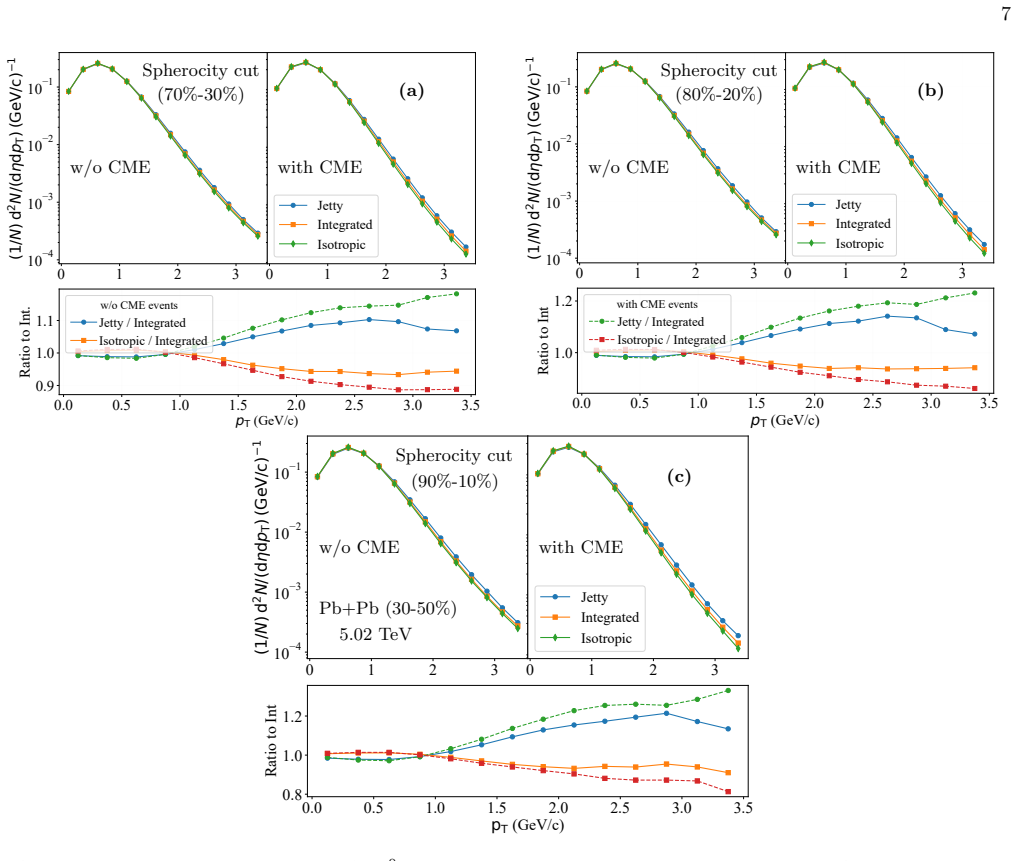
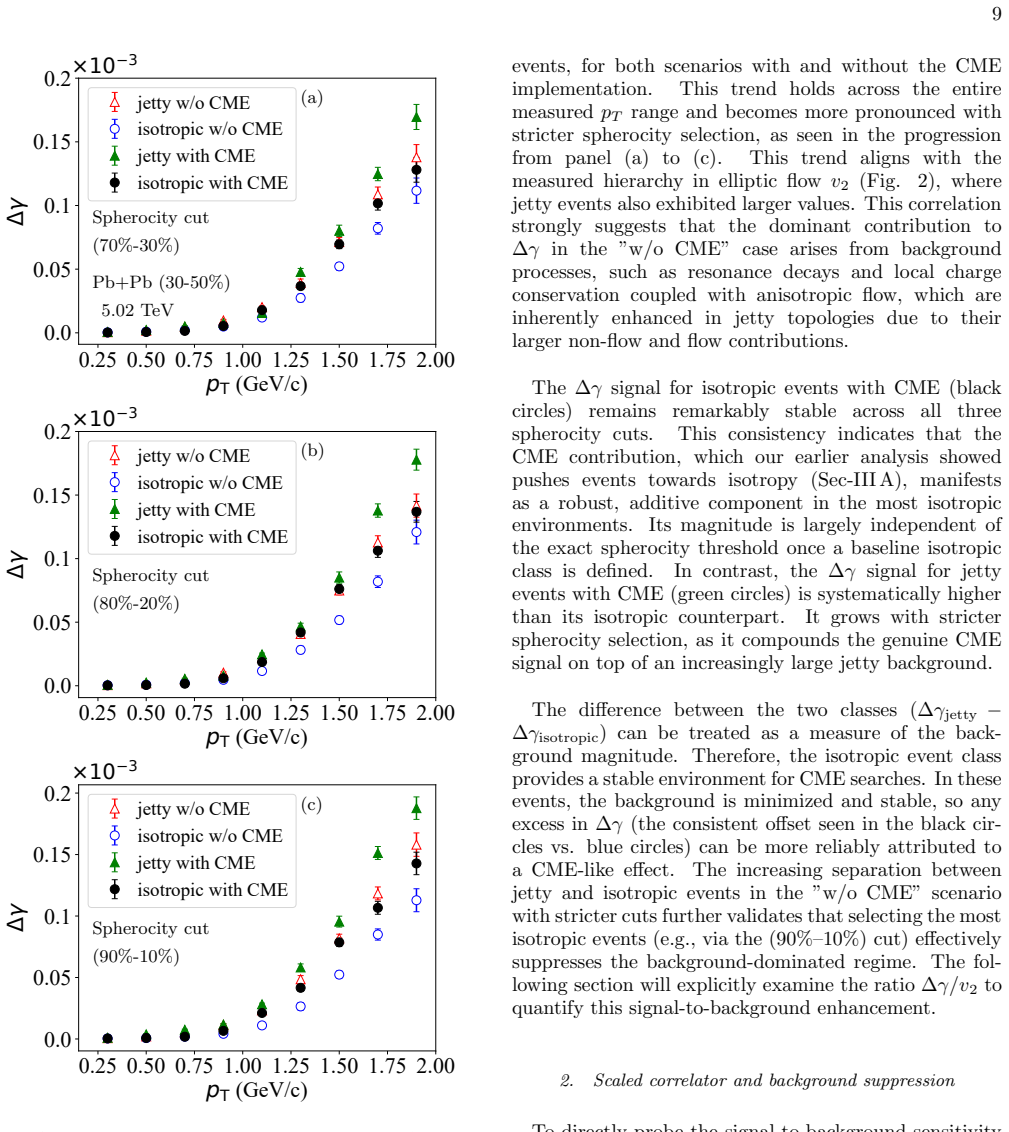
In AMPT-model simulations of Pb+Pb collisions at 5.02 TeV that include a realistic CME implementation, the presence of the chiral magnetic effect shifts the transverse-spherocity distribution toward more isotropic events. The charge-dependent azimuthal correlator Δγ remains higher in jetty events and is accompanied by larger flow-coupled backgrounds, yet the scaled ratio Δγ/v₂ becomes enhanced in the isotropic sample, demonstrating that spherocity-based selection suppresses both flow-driven and resonance-decay backgrounds without relying on the flow vector for classification.
What carries the argument
Transverse spherocity, a geometric observable that quantifies the azimuthal spread of transverse momentum and partitions events into jetty versus isotropic topologies.
If this is right
- Isotropic events selected by transverse spherocity exhibit an enhanced Δγ/v₂ ratio after elliptic-flow scaling.
- Jetty events retain larger values of the charge-dependent correlator and its flow-coupled background.
- Inclusion of the CME signal in the model moves the overall spherocity distribution toward isotropy.
- The method supplies a geometry-driven classification that complements flow-vector-based event-shape engineering.
Where Pith is reading between the lines
- The same spherocity cut could be applied directly to experimental data sets from the LHC or RHIC to test whether the background suppression observed in simulation survives detector effects and real-event fluctuations.
- If the isotropic sample continues to show a cleaner signal, the technique may be combined with other observables such as three-particle correlators to reduce systematic uncertainty in CME searches.
- The approach might also be adapted to study other phenomena whose signals are entangled with collective flow, such as local parity violation or initial-state fluctuations.
Load-bearing premise
The AMPT model with its chosen CME implementation reproduces the relevant physics of real collisions, and transverse spherocity stays independent of the flow and resonance backgrounds it is meant to suppress.
What would settle it
In real LHC data, the spherocity distribution either does or does not shift toward isotropy when a CME signal is expected, and the scaled Δγ/v₂ ratio either does or does not rise in the isotropic subsample after the same cuts applied in the simulation.
Figures




read the original abstract
We present the first study of the Chiral Magnetic Effect (CME) using transverse spherocity as an event-shape classifier in Pb+Pb collisions at $\sqrt{s_{NN}} = 5.02$ TeV, simulated with the A Multi-Phase Transport (AMPT) model with a realistic CME implementation. Transverse spherocity separates events into jetty and isotropic topologies based on the geometric distribution of transverse momentum. Unlike traditional event shape engineering methods, which use the flow vector as an event classifier that is itself contaminated by the very backgrounds it is intended to suppress, spherocity provides a cleaner, geometry-driven classification that avoids this circular limitation. CME inclusion shifts the spherocity distribution toward more isotropic events, confirming its sensitivity to CME-induced charge separation. The charge-dependent azimuthal correlator $\Delta\gamma$ and correlated background coupled with elliptic flow are consistently higher in jetty events. The scaled ratio $\Delta\gamma/v_2$ shows enhanced values for isotropic events, confirming effective background suppression after elliptic flow scaling. Our results demonstrate that isotropic event selection via transverse spherocity provides a cleaner and more reliable environment for CME searches by simultaneously suppressing flow-driven and resonance-decay backgrounds, making it a powerful complementary method to existing flow-vector-based methods.
Editorial analysis
A structured set of objections, weighed in public.
Referee Report
Summary. The manuscript reports the first study applying transverse spherocity as an event-shape classifier to probe the Chiral Magnetic Effect (CME) in AMPT simulations of Pb+Pb collisions at √s_NN = 5.02 TeV. It claims that spherocity offers a geometry-driven classification that avoids the circularity inherent in flow-vector methods, that CME inclusion shifts the spherocity distribution toward isotropic events, and that the scaled ratio Δγ/v₂ is enhanced in isotropic events, indicating simultaneous suppression of flow-driven and resonance-decay backgrounds.
Significance. If the reported independence of spherocity from the targeted backgrounds can be verified, the method would constitute a useful complementary tool to existing event-shape engineering approaches for CME searches. The controlled nature of the AMPT framework, which permits direct comparison with and without the CME signal, is a methodological strength that supports falsifiable tests of the classification scheme.
major comments (2)
- [Results (discussion of spherocity distribution shift and Δγ/v₂ enhancement)] The central claim that isotropic event selection via transverse spherocity provides a cleaner environment for CME searches (abstract and results) requires that spherocity remain uncorrelated with v₂ and resonance yields when the CME signal is disabled. The manuscript does not present an explicit test of this independence (e.g., spherocity–v₂ correlation plots or ratios in the no-CME case), leaving open the possibility that the observed shift toward isotropic events and the rise in Δγ/v₂ are driven by model-internal correlations between initial geometry, final-state flow, and the p_T-weighted azimuthal distribution used to define spherocity.
- [Model and Methods] The CME implementation in AMPT is described as 'realistic' but the manuscript provides insufficient detail on how the charge-separation signal is injected, how it couples to the background mechanisms, and what parameter choices govern its strength relative to the default AMPT settings. This information is load-bearing for interpreting whether the reported enhancement in the scaled ratio is robust or specific to the chosen implementation.
minor comments (2)
- [Abstract] The abstract phrasing 'the charge-dependent azimuthal correlator Δγ and correlated background coupled with elliptic flow are consistently higher in jetty events' is ambiguous; consider separating the statements about Δγ and the background term for clarity.
- [Figures] Figure captions should explicitly state whether each panel shows results with CME enabled or disabled, and should label the jetty versus isotropic selections consistently across all panels.
Simulated Author's Rebuttal
We thank the referee for the thorough review and valuable suggestions that have helped clarify and strengthen our manuscript. We address each major comment below and have made revisions where appropriate to improve transparency and support for our claims.
read point-by-point responses
-
Referee: [Results (discussion of spherocity distribution shift and Δγ/v₂ enhancement)] The central claim that isotropic event selection via transverse spherocity provides a cleaner environment for CME searches (abstract and results) requires that spherocity remain uncorrelated with v₂ and resonance yields when the CME signal is disabled. The manuscript does not present an explicit test of this independence (e.g., spherocity–v₂ correlation plots or ratios in the no-CME case), leaving open the possibility that the observed shift toward isotropic events and the rise in Δγ/v₂ are driven by model-internal correlations between initial geometry, final-state flow, and the p_T-weighted azimuthal distribution used to define spherocity.
Authors: We agree that an explicit verification of spherocity's independence from v₂ and resonance yields in the no-CME case is essential to substantiate the claim of a cleaner environment for CME searches. The original manuscript emphasized the differential effects with and without CME but did not include dedicated correlation analyses for the background-only scenario. In the revised manuscript we have added new panels to Figure 3 showing the spherocity–v₂ correlation and the spherocity dependence of resonance yields specifically for the no-CME AMPT runs. These plots exhibit only weak correlations, indicating that the observed shift toward isotropic events and the enhancement in Δγ/v₂ are not artifacts of model-internal geometry-flow couplings but arise from the CME-induced charge separation. revision: yes
-
Referee: [Model and Methods] The CME implementation in AMPT is described as 'realistic' but the manuscript provides insufficient detail on how the charge-separation signal is injected, how it couples to the background mechanisms, and what parameter choices govern its strength relative to the default AMPT settings. This information is load-bearing for interpreting whether the reported enhancement in the scaled ratio is robust or specific to the chosen implementation.
Authors: We acknowledge that the original description of the CME implementation was too brief. In the revised manuscript we have expanded the Model and Methods section with a new subsection that details: (i) the injection of charge separation by modifying the azimuthal distribution of partons during the string-melting stage of AMPT to produce a charge-dependent dipole moment; (ii) the subsequent propagation of this signal through partonic and hadronic rescattering, including its interplay with elliptic flow and resonance production; and (iii) the specific parameter values chosen for the charge-separation strength (relative to default AMPT settings) so that the resulting Δγ magnitude is consistent with theoretical expectations. These additions allow readers to assess the robustness of the reported enhancement in Δγ/v₂. revision: yes
Circularity Check
No significant circularity; model-based comparison remains self-contained
full rationale
The paper performs a simulation study inside the AMPT transport model, explicitly comparing runs with and without its CME implementation, then classifies events by transverse spherocity (a geometric observable computed from the final-state pT distribution) and reports shifts in Δγ/v2. No equation or claim reduces a derived quantity to a fitted parameter by construction, nor does any load-bearing premise rest on a self-citation whose content is unverified. The contrast with flow-vector methods is presented as an external methodological advantage rather than an internal redefinition. All reported trends are direct outputs of the same Monte Carlo events, making the derivation self-contained within the stated model assumptions.
Axiom & Free-Parameter Ledger
axioms (1)
- domain assumption The AMPT transport model with the chosen CME implementation faithfully reproduces the relevant charge-separation and background processes in Pb+Pb collisions at 5.02 TeV.
Reference graph
Works this paper leans on
-
[1]
In the context of CME searches, the second order flow coefficientv 2 (defined in Eq
Anisotropic Flow Anisotropic flow is a key manifestation of collective behavior in heavy-ion collisions, arising from the trans- formation of initial spatial anisotropy in the overlap zone into a momentum-space anisotropy in the final-state par- ticle distributions [79]. In the context of CME searches, the second order flow coefficientv 2 (defined in Eq. ...
-
[2]
These decays produce charge-dependent azimuthal cor- relations between decay products that mimic the charge separation
Resonance decays as a background in spherocity-selected events It has been observed that resonance decays associated with elliptic flow can mimic the CME signal [69, 80, 81]. These decays produce charge-dependent azimuthal cor- relations between decay products that mimic the charge separation. When a short-lived resonance decays, its daughter particles (o...
-
[3]
We analyze the model event record directly to iden- tify resonance decay vertices
and to studyK S andρdecays using the invariant mass method in CME analyses [19]. We analyze the model event record directly to iden- tify resonance decay vertices. For theK ∗0 andρ 0, we reconstruct their yields by calculating the invariant mass of all candidate charged daughter pairs (K ±π± for K ∗0 andπ +π− forρ 0) within each event. We identify true de...
-
[4]
3, as a function of transverse momentum pT for different transverse spherocity selections in Pb+Pb collisions at √sN N = 5.02 TeV (30-50% centrality)
Charge Correlators Figure 5 presents the charge-dependent correlator ∆γ, defined in Eq. 3, as a function of transverse momentum pT for different transverse spherocity selections in Pb+Pb collisions at √sN N = 5.02 TeV (30-50% centrality). The figure compares the behavior of ∆γacross differ- ent event topologies, e.g., isotropic and jetty events, for three...
-
[5]
Scaled correlator and background suppression To directly probe the signal-to-background sensitivity for the chiral magnetic effect, we examine the scaled correlator ∆γ/v 2. This ratio is a crucial experimental measurement since the dominant background processes, namely local charge conservation and resonance decays coupled with collective flow, are expect...
2025
- [6]
- [7]
- [8]
-
[9]
X. Anet al., The BEST framework for the search for the QCD critical point and the chiral magnetic effect, Nucl. Phys. A1017, 122343 (2022), arXiv:2108.13867 [nucl-th]
-
[10]
L. Adamczyket al.(STAR), Beam-energy dependence of charge separation along the magnetic field in Au+Au collisions at RHIC, Phys. Rev. Lett.113, 052302 (2014), arXiv:1404.1433 [nucl-ex]
- [11]
-
[12]
Shuryak, Strongly coupled quark-gluon plasma in heavy ion collisions, Rev
E. Shuryak, Strongly coupled quark-gluon plasma in heavy ion collisions, Rev. Mod. Phys.89, 035001 (2017), arXiv:1412.8393 [hep-ph]
-
[13]
Kharzeev, K
D. Kharzeev, K. Landsteiner, A. Schmitt, and H.-U. Yee, eds.,Strongly Interacting Matter in Magnetic Fields, Vol. 871 (Springer, 2013)
2013
- [14]
- [15]
-
[16]
K. Fukushima, D. E. Kharzeev, and H. J. Warringa, The Chiral Magnetic Effect, Phys. Rev. D78, 074033 (2008), arXiv:0808.3382 [hep-ph]
- [17]
- [18]
-
[19]
K. Fukushima, M. Ruggieri, and R. Gatto, Chiral mag- netic effect in the PNJL model, Phys. Rev. D81, 114031 (2010), arXiv:1003.0047 [hep-ph]
- [20]
-
[21]
P. Adhikariet al., Strongly interacting matter in extreme magnetic fields, Prog. Part. Nucl. Phys.146, 104199 (2026), arXiv:2412.18632 [nucl-th]
-
[22]
A. Bzdak and V. Skokov, Event-by-event fluctuations of magnetic and electric fields in heavy ion collisions, Phys. Lett. B710, 171 (2012), arXiv:1111.1949 [hep-ph]
-
[23]
Q.-Y. Shou, G.-L. Ma, and Y.-G. Ma, Charge separation with fluctuating domains in relativistic heavy-ion colli- sions, Phys. Rev. C90, 047901 (2014), arXiv:1405.2668 [nucl-th]
-
[24]
J. Zhao and F. Wang, Experimental searches for the chi- ral magnetic effect in heavy-ion collisions, Prog. Part. Nucl. Phys.107, 200 (2019), arXiv:1906.11413 [nucl-ex]
- [25]
- [26]
- [27]
-
[28]
M. Asakawa, A. Majumder, and B. Muller, Electric Charge Separation in Strong Transient Magnetic Fields, Phys. Rev. C81, 064912 (2010), arXiv:1003.2436 [hep- ph]
-
[29]
S. Schlichting and S. Pratt, Charge conservation at ener- gies available at the BNL Relativistic Heavy Ion Collider and contributions to local parity violation observables, Phys. Rev. C83, 014913 (2011), arXiv:1009.4283 [nucl- th]
- [30]
-
[31]
Kharzeev, Parity violation in hot QCD: Why it can happen, and how to look for it, Phys
D. Kharzeev, Parity violation in hot QCD: Why it can happen, and how to look for it, Phys. Lett. B633, 260 (2006), arXiv:hep-ph/0406125
- [32]
-
[33]
S. Grieninger, S. Morales-Tejera, and P. G. Romeu, Chi- ral magnetic effect enhancement at lower collision ener- gies, Phys. Rev. D112, 036003 (2025), arXiv:2503.10593 [hep-ph]
- [34]
- [35]
- [36]
-
[37]
M. Abdallahet al.(STAR), Search for the chiral mag- netic effect with isobar collisions at √sN N=200 GeV by the STAR Collaboration at the BNL Relativistic Heavy Ion Collider, Phys. Rev. C105, 014901 (2022), arXiv:2109.00131 [nucl-ex]
- [38]
-
[39]
B. Abelevet al.(ALICE), Charge separation rel- ative to the reaction plane in Pb-Pb collisions at√sN N = 2.76 TeV, Phys. Rev. Lett.110, 012301 (2013), arXiv:1207.0900 [nucl-ex]
-
[40]
Zhao, Search for the Chiral Magnetic Effect in Rela- tivistic Heavy-Ion Collisions, Int
J. Zhao, Search for the Chiral Magnetic Effect in Rela- tivistic Heavy-Ion Collisions, Int. J. Mod. Phys. A33, 13 1830010 (2018), arXiv:1805.02814 [nucl-ex]
-
[41]
Wang, Effects of Cluster Particle Correlations on Local Parity Violation Observables, Phys
F. Wang, Effects of Cluster Particle Correlations on Local Parity Violation Observables, Phys. Rev. C81, 064902 (2010), arXiv:0911.1482 [nucl-ex]
- [42]
- [43]
- [44]
-
[45]
L. Adamczyket al.(STAR), Observation of charge asym- metry dependence of pion elliptic flow and the possible chiral magnetic wave in heavy-ion collisions, Phys. Rev. Lett.114, 252302 (2015), arXiv:1504.02175 [nucl-ex]
-
[46]
L. Adamczyket al.(STAR), Measurement of charge mul- tiplicity asymmetry correlations in high-energy nucleus- nucleus collisions at √sN N = 200 GeV, Phys. Rev. C89, 044908 (2014), arXiv:1303.0901 [nucl-ex]
-
[47]
V. Khachatryanet al.(CMS), Observation of charge- dependent azimuthal correlations inp-Pb collisions and its implication for the search for the chiral mag- netic effect, Phys. Rev. Lett.118, 122301 (2017), arXiv:1610.00263 [nucl-ex]
-
[48]
J. Adamet al.(STAR), Charge-dependent pair correla- tions relative to a third particle inp+ Au andd+ Au collisions at RHIC, Phys. Lett. B798, 134975 (2019), arXiv:1906.03373 [nucl-ex]
- [49]
-
[50]
Y. Wang and H. Pei, Study of event and particle se- lection effects on elliptic flow background at the iso- bar experiments based on AMPT model, arXiv (2025), arXiv:2503.14815 [nucl-th]
-
[51]
W.-T. Deng, X.-G. Huang, G.-L. Ma, and G. Wang, Test the chiral magnetic effect with isobaric collisions, Phys. Rev. C94, 041901 (2016), arXiv:1607.04697 [nucl-th]
-
[52]
S. Acharyaet al.(ALICE), Constraining the magnitude of the Chiral Magnetic Effect with Event Shape Engi- neering in Pb-Pb collisions at √sNN = 2.76 TeV, Phys. Lett. B777, 151 (2018), arXiv:1709.04723 [nucl-ex]
- [53]
- [54]
-
[55]
J. Schukraft, A. Timmins, and S. A. Voloshin, Ultra- relativistic nuclear collisions: event shape engineering, Phys. Lett. B719, 394 (2013), arXiv:1208.4563 [nucl-ex]
- [56]
- [57]
- [58]
-
[59]
N. Mallick, R. Sahoo, S. Tripathy, and A. Ortiz, Study of Transverse Spherocity and Azimuthal Anisotropy in Pb-Pb collisions at √sNN = 5.02 TeV using A Multi- Phase Transport Model, J. Phys. G48, 045104 (2021), arXiv:2008.13616 [hep-ph]
-
[60]
Rathore, A
A. Rathore, A. Khuntia, and P. Palni, Novel approach to probe the underlying event activity through transverse spherocity and relative transverse multiplicity activity event classifier, Phys. Rev. D112, 116021 (2025)
2025
- [61]
-
[62]
V. Chekhovskyet al.(CMS), Measurement of event shapes in minimum-bias events from proton-proton col- lisions at s=13 TeV, Phys. Rev. D112, 112006 (2025), arXiv:2505.17850 [hep-ex]
- [63]
-
[64]
S. Acharyaet al.(ALICE), Charged-particle production as a function of multiplicity and transverse spherocity in pp collisions at √s= 5.02 and 13 TeV, Eur. Phys. J. C 79, 857 (2019), arXiv:1905.07208 [nucl-ex]
-
[65]
Tripathy, System size and event shape dependence of the mean transverse momentum fluctuations with AL- ICE at the LHC, J
T. Tripathy, System size and event shape dependence of the mean transverse momentum fluctuations with AL- ICE at the LHC, J. Subatomic Part. Cosmol.5, 100291 (2026)
2026
-
[66]
Prasad, N
S. Prasad, N. Mallick, S. Tripathy, D. Behera, and R. Sa- hoo, Event topology in heavy-ion collisions: The initial spatial anisotropy and final azimuthal anisotropy, J. Sub- atomic Part. Cosmol.4, 100110 (2025)
2025
- [67]
-
[68]
S. Tripathy, S. Prasad, and R. Sahoo, Event-shape depen- dence of symmetry plane correlations using the Gaussian estimator in Pb-Pb collisions at the LHC using a multi- phase transport model, Phys. Rev. D112, 114012 (2025), arXiv:2504.09275 [nucl-ex]
- [69]
- [70]
-
[71]
Voloshin and Y
S. Voloshin and Y. Zhang, Flow study in relativistic nu- clear collisions by fourier expansion of azimuthal parti- cle distributions, Zeitschrift f¨ ur Physik C Particles and Fields70, 665 (1996)
1996
-
[72]
Magdy, S
N. Magdy, S. Shi, J. Liao, N. Ajitanand, and R. A. Lacey, New correlator to detect and characterize the chiral mag- netic effect, Phys. Rev. C97, 061901 (2018)
2018
- [73]
- [74]
-
[75]
Y. Lin (STAR), Measurement of the charge separation along the magnetic field with Signed Balance Function in 200 GeV Au + Au collisions at STAR, Nucl. Phys. A 1005, 121828 (2021), arXiv:2002.11446 [nucl-ex]
-
[76]
L. Huang, C.-W. Ma, and G.-L. Ma, Investigating the quark flavor dependence of the chiral magnetic effect with a multiphase transport model, Phys. Rev. C97, 034909 (2018), arXiv:1711.00637 [nucl-th]
- [77]
- [78]
- [79]
-
[80]
Wang and M
X.-N. Wang and M. Gyulassy, HIJING: A Monte Carlo model for multiple jet production in p p, p A and A A collisions, Phys. Rev. D44, 3501 (1991)
1991
discussion (0)
Sign in with ORCID, Apple, or X to comment. Anyone can read and Pith papers without signing in.