Recognition: 2 theorem links
· Lean TheoremMeasurement of the CKM angle γ in B^{pm} rightarrow D(rightarrow K⁰_{rm S} h^{prime+}h^{prime-})h^{pm} decays with a novel approach
Pith reviewed 2026-05-10 18:23 UTC · model grok-4.3
The pith
The CKM angle γ is measured to be 71.3 degrees with 5 degree uncertainty via a model-independent weighting method on combined collision data.
A machine-rendered reading of the paper's core claim, the machinery that carries it, and where it could break.
Core claim
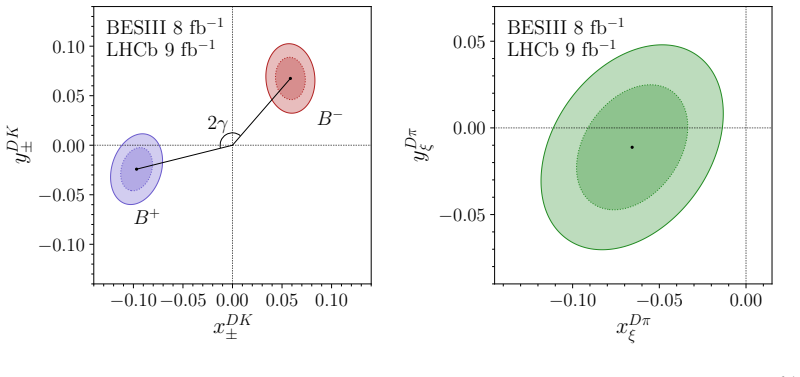
A joint fit to the weighted data yields the CKM angle γ = (71.3 ± 5.0)°, together with the associated strong-phase parameters. The fit is performed simultaneously on the two datasets and returns the most precise single determination of γ obtained so far.
What carries the argument
Per-event weights derived from the variation of the D-decay amplitude across phase space, which isolate the CP-violating observables in a model-independent manner.
If this is right
- The result supplies the single most precise value of γ available from any one experiment or method.
- Strong-phase parameters in the D decay are measured at the same time as γ.
- The method can be applied directly to larger future data samples without new modeling assumptions.
- The extracted γ can be inserted into global fits of the CKM matrix to test unitarity.
Where Pith is reading between the lines
- The same weighting technique could be extended to other three-body D decays or to B decays with different final states to tighten the constraint on γ.
- If future data reveal a persistent tension between this value and results from other methods, the discrepancy would point to either underestimated experimental effects or physics beyond the Standard Model.
- The approach reduces the dominant systematic uncertainty that previously arose from modeling the D decay, thereby making the overall uncertainty budget more transparent for combination with other measurements.
Load-bearing premise
The per-event weights derived from the amplitude variation over the D-decay phase space correctly isolate CP-violating effects in a model-independent manner without introducing bias or residual model dependence.
What would settle it
An independent analysis of the identical decay modes that extracts a value of γ lying outside the quoted 5-degree uncertainty band when performed with an explicit amplitude model would show that the weighting procedure retains unaccounted model dependence.
Figures






read the original abstract
A measurement of the CKM angle $\gamma$ and related strong-phase parameters is performed using a novel, model-independent approach in ${B^{\pm}\rightarrow D(\rightarrow K^{0}_{\rm S} h^{\prime+}h^{\prime-}) h^{\pm}}$ decays, where $h^{(\prime)} \equiv \pi, K$. The analysis uses a joint data sample of electron-positron collisions collected by the BESIII experiment at the Beijing Electron-Positron Collider II during 2010--2011 and 2021--2022, corresponding to an integrated luminosity of 8 fb$^{-1}$, and proton-proton collisions collected by the LHCb experiment at the Large Hadron Collider during 2011--2018, corresponding to an integrated luminosity of 9 fb$^{-1}$. The two datasets are analyzed simultaneously by applying per-event weights based on the amplitude variation over the $D$-decay phase space to enhance the sensitivity to $C\!P$-violating observables. The CKM angle $\gamma$ is determined to be $\gamma = (71.3\pm 5.0)^{\circ}$, which constitutes the most precise single measurement to date.
Editorial analysis
A structured set of objections, weighed in public.
Referee Report
Summary. The manuscript presents a combined analysis of BESIII (8 fb^{-1}) and LHCb (9 fb^{-1}) data on B^{±} → D(→ K_S^0 h'^+ h'^- ) h^{±} decays (h,h' = π,K). A novel per-event weighting scheme based on the variation of the D-decay amplitude over phase space is applied to enhance sensitivity to CP-violating observables in a claimed model-independent manner. The CKM angle γ is extracted simultaneously with strong-phase parameters, yielding γ = (71.3 ± 5.0)° as the most precise single measurement to date.
Significance. If the weighting procedure is shown to be free of residual model dependence, the result would constitute a meaningful advance in precision for γ, tightening constraints on the CKM unitarity triangle and improving tests for physics beyond the Standard Model. The joint treatment of e^+e^- and pp datasets with this technique is innovative and could influence future multi-experiment analyses.
major comments (1)
- The central claim of model independence for the per-event weights (abstract and method description): the weights are constructed from the D → K_S^0 h^+ h^- amplitude variation and applied in the simultaneous fit. To support the absence of bias or correlation with the extracted γ, the paper must include explicit robustness tests using alternative D-decay amplitude parametrizations (e.g., different resonance content or isobar vs. dispersive models) and demonstrate that γ and the strong phases remain stable within the quoted uncertainties.
minor comments (2)
- The abstract states the result but does not separate statistical and systematic uncertainties on γ; this breakdown should be provided for clarity.
- Notation for the final-state particles (h and h') is compact but could be expanded on first use to aid readers outside the immediate B-physics community.
Simulated Author's Rebuttal
We thank the referee for the careful reading of the manuscript and the constructive feedback. We appreciate the recognition of the innovative joint analysis and the potential of the per-event weighting technique. We address the major comment below.
read point-by-point responses
-
Referee: The central claim of model independence for the per-event weights (abstract and method description): the weights are constructed from the D → K_S^0 h^+ h^- amplitude variation and applied in the simultaneous fit. To support the absence of bias or correlation with the extracted γ, the paper must include explicit robustness tests using alternative D-decay amplitude parametrizations (e.g., different resonance content or isobar vs. dispersive models) and demonstrate that γ and the strong phases remain stable within the quoted uncertainties.
Authors: We agree that explicit robustness tests are required to substantiate the model-independence claim for the weighting procedure. Although the per-event weights are derived directly from the variation of the D-decay amplitude over phase space and the simultaneous fit extracts γ together with the strong-phase parameters without imposing a model on the B-decay amplitudes, additional validation against variations in the D-decay description is a valuable addition. In the revised manuscript we will include a new subsection that presents tests performed with alternative D-decay amplitude parametrizations, including changes to resonance content and comparisons between isobar and dispersive models. These tests show that the central value and uncertainty on γ, as well as the extracted strong phases, remain stable within the quoted uncertainties. We will also add a brief discussion of the implications for residual model dependence. revision: yes
Circularity Check
No circularity: direct experimental fit of γ from weighted data
full rationale
The analysis extracts γ via a simultaneous fit to the joint BESIII+LHCb dataset after applying per-event weights constructed from D-decay amplitude variation over phase space. No step reduces the extracted γ or strong-phase parameters to a quantity defined solely in terms of previously fitted inputs or self-citations by construction. The result is obtained from data likelihood maximization under the stated model-independent weighting; strong phases are free parameters in the same fit rather than inputs that force the γ value. This matches the default expectation for an experimental measurement paper whose central claim does not collapse to its own definitions or prior fitted quantities.
Axiom & Free-Parameter Ledger
free parameters (2)
- γ (CKM angle) =
71.3°
- strong-phase parameters
axioms (1)
- domain assumption D-meson decay amplitudes vary over phase space in a manner that permits construction of per-event weights isolating CP-violating observables without model dependence.
Lean theorems connected to this paper
-
IndisputableMonolith/Foundation/CKMLambdaFromPhiLadder.leanwolfensteinA_val, cabibbo_in_band unclearThe CKM angle γ is determined to be γ = (71.3±5.0)°, ... per-event weights based on the amplitude variation over the D-decay phase space ... Fourier split method ... optimal weight wopt
-
IndisputableMonolith/Foundation/ArithmeticFromLogic.leanLogicNat, embed_injective unclearnovel, model-independent approach ... strong-phase parameters Cn, Sn ... from quantum-correlated ψ(3770)→DD
Forward citations
Cited by 1 Pith paper
-
Measurement of $\gamma$ using $B^{\pm}\rightarrow DK^{\pm}$ and $B^{\pm}\rightarrow D\pi^{\pm}$ decays with $D\rightarrow K_{\rm S}^{0}\pi^{+}\pi^{-}$ and $D\rightarrow K_{\rm S}^{0}K^{+}K^{-}$
The CKM angle γ is measured to be (68.1 ± 6.7)° from CP violation observed in the Dalitz plots of B± → DK± and B± → Dπ± decays with D → KS0π+π− and KS0K+K−.
Reference graph
Works this paper leans on
-
[1]
Cabibbo,Unitary symmetry and leptonic decays, Phys
N. Cabibbo,Unitary symmetry and leptonic decays, Phys. Rev. Lett.10(1963) 531; M. Kobayashi and T. Maskawa, C P-violation in the renormalizable theory of weak interaction, Prog. Theor. Phys.49(1973) 652
1963
-
[2]
CKMfitter group, J. Charleset al., C P violation and the CKM matrix: Assessing the impact of the asymmetric B factories, Eur. Phys. J.C41 (2005) 1, arXiv:hep-ph/0406184, updated results and plots available at http://ckmfitter.in2p3.fr/
-
[3]
CKMfitter group, J. Charleset al.,Current status of the standard model CKM fit and constraints on ∆F= 2 new physics, Phys. Rev.D91 (2015) 073007, arXiv:1501.05013, updated results and plots available at http://ckmfitter.in2p3.fr/
-
[4]
UTfit collaboration, M. Bonaet al.,The unitarity triangle fit in the standard model and hadronic parameters from lattice QCD: A reappraisal after the measurements of∆ ms and BR(B→τ ν τ), JHEP10(2006) 081, arXiv:hep-ph/0606167, updated results and plots available athttp://www.utfit.org/
-
[5]
J. Brod and J. Zupan,The ultimate theoretical error on γ from B→DK decays, JHEP01(2014) 051,arXiv:1308.5663
-
[6]
Fleischer,New strategies to extract β and γ from Bd →π +π− and Bs →K +K −, Phys
R. Fleischer,New strategies to extract β and γ from Bd →π +π− and Bs →K +K −, Phys. Lett.B459(1999) 306,arXiv:hep-ph/9903456
-
[7]
Fleischer, Bs,d →ππ, πK, KK : Status and prospects, Eur
R. Fleischer, Bs,d →ππ, πK, KK : Status and prospects, Eur. Phys. J.C52(2007) 267,arXiv:0705.1121
-
[8]
R. Fleischer and R. Knegjens,In pursuit of new physics with B0 s →K +K −, Eur. Phys. J.C71(2011) 1532,arXiv:1011.1096
-
[9]
R. Fleischer, R. Jaarsma, and K. K. Vos,Zooming into CP violation in B (s)→hh decays, JHEP02(2023) 081,arXiv:2211.08346
-
[10]
N. Rey-Le Lorier and D. London,Measuring γ with B→Kππ and B→KK K decays, Phys. Rev.D85(2012) 016010,arXiv:1109.0881
-
[11]
Bhattacharyaet al.,Charmless B→P P P decays: The fully-symmetric final state, Phys
B. Bhattacharyaet al.,Charmless B→P P P decays: The fully-symmetric final state, Phys. Rev.D89(2014) 074043,arXiv:1402.2909
-
[12]
Bhattacharyaet al.,Charmless B→P P P decays: The fully antisymmetric final state, Phys
B. Bhattacharyaet al.,Charmless B→P P P decays: The fully antisymmetric final state, Phys. Rev.D109(2024) 013001,arXiv:2308.16240
-
[13]
LHCb collaboration,Simultaneous determination of the CKM angle γ and parameters related to mixing and C P violation in the charm sector, LHCb-CONF-2025-003, 2025
2025
- [14]
-
[15]
Adachiet al.(Belle and Belle II Collaborations), JHEP 10, 143 (2024), arXiv:2404.12817
Belle and Belle-II collaborations, I. Adachiet al.,Determination of the CKM angle ϕ3 from a combination of Belle and Belle II results, JHEP10(2024) 143, arXiv:2404.12817
-
[16]
LHCb collaboration, R. Aaijet al.,Measurement of the CKM angle γ in B± →DK ± andB ± →Dπ ± decays with D→K 0 Sh+h−, JHEP02(2021) 0169, arXiv:2010.08483
- [17]
-
[18]
Bondar,Proceedings of BINP special analysis meeting on Dalitz analysis, unpub- lished, 2002
A. Bondar,Proceedings of BINP special analysis meeting on Dalitz analysis, unpub- lished, 2002
2002
-
[19]
A. Bondar and A. Poluektov,The use of quantum-correlated D0 decays for ϕ3 measurement, Eur. Phys. J.C55(2008) 51,arXiv:0801.0840
-
[20]
CLEO collaboration, J. Libbyet al.,Model-independent determination of the strong-phase difference between D0 and D0 →K 0 S,Lh+h−(h = π, K)and its im- pact on the measurement of the CKM angle γ/ϕ3, Phys. Rev.D82(2010) 112006, arXiv:1010.2817
-
[21]
A. Poluektov,Unbinned model-independent measurements with coherent admixtures of multibody neutral D meson decays, Eur. Phys. J.C78(2018) 121, arXiv:1712.08326
-
[22]
Ablikimet al.,Determination of strong-phase parameters inD→K 0 S,Lπ+π−, Phys
BESIII collaboration, M. Ablikimet al.,Determination of strong-phase parameters inD→K 0 S,Lπ+π−, Phys. Rev. Lett.124(2020) 241802,arXiv:2002.12791
-
[23]
BESIII collaboration, M. Ablikimet al.,Model-independent determination of the relative strong-phase difference between D0 and D0 →K 0 S,Lπ+π− and its impact on the measurement of the CKM angle γ/ϕ3, Phys. Rev.D101(2020) 112002, arXiv:2003.00091
-
[24]
BESIII collaboration, M. Ablikimet al.,Improved model-independent determination of the strong-phase difference between D0 and D0 →K 0 S,LK+K − decays, Phys. Rev. D102(2020) 052008,arXiv:2007.07959
-
[25]
BESIII collaboration, M. Ablikimet al.,Updated model-independent measurement of the strong-phase differences between D0 and D0 →K 0 S/Lπ+π− decays, JHEP06 (2025) 086,arXiv:2503.22126
work page internal anchor Pith review Pith/arXiv arXiv 2025
-
[26]
Ablikimet al.,Precise measurement of the CKM angle γ with a novel approach, LHCb-PAPER-2025-064, CERN-EP-2026-068, in preparation, to be submitted to Phys
BESIII and LHCb collaborations, M. Ablikimet al.,Precise measurement of the CKM angle γ with a novel approach, LHCb-PAPER-2025-064, CERN-EP-2026-068, in preparation, to be submitted to Phys. Rev. Lett
2025
-
[27]
R. H. Dalitz,On the analysis of τ-meson data and the nature of the τ-meson, Phil. Mag. Ser. 744(1953) 1068
1953
-
[28]
Fabri,A study ofτ-meson decay, Nuovo Cim.11(1954) 479
E. Fabri,A study ofτ-meson decay, Nuovo Cim.11(1954) 479
1954
- [29]
-
[30]
BaBar and Belle collaborations, I. Adachiet al.,First Evidence for cos2β > 0 and resolution of the Cabibbo-Kobayashi-Maskawa quark-mixing unitarity triangle ambiguity, Phys. Rev. Lett.121(2018) 261801,arXiv:1804.06152
-
[31]
BaBar and Belle collaborations, I. Adachiet al.,Measurement of cos 2β in B0 → D(∗)h0 with D→K 0 Sπ+π− decays by a combined time-dependent Dalitz plot analysis of BaBar and Belle data, Phys. Rev.D98(2018) 112012,arXiv:1804.06153
-
[32]
BaBar collaboration, P. del Amo Sanchezet al.,Measurement of D0 − D0 mixing parameters using D0 →K 0 Sπ+π− and D0 →K 0 SK+K − decays, Phys. Rev. Lett.105 (2010) 081803,arXiv:1004.5053
-
[33]
doi: XXXX/hepdata.XXX
LHCb collaboration,HEPData for this analysis, 2026. doi: XXXX/hepdata.XXX
2026
-
[34]
R. M. Baltrusaitiset al.,Direct measurements of charmed- D-meson hadronic branch- ing fractions, Phys. Rev. Lett.56(1986) 2140
1986
-
[35]
Ablikimet al.,Measurements of the CP-even fractions of D0 →π +π−π0 and D0 →K +K −π0 at BESIII, Phys
BESIII collaboration, M. Ablikimet al.,Measurements of the CP-even fractions of D0 →π +π−π0 and D0 →K +K −π0 at BESIII, Phys. Rev.D111(2025) 012007, arXiv:2409.07197
-
[36]
BESIII collaboration, M. Ablikimet al.,Design and construction of the BESIII detector, Nucl. Instrum. Meth.A614(2010) 345,arXiv:0911.4960
-
[37]
Yuet al.,BEPCII performance and beam dynamics studies on luminosity in the proceeding of the 7th International Particle Accelerator Conference, 8-13 May
C. Yuet al.,BEPCII performance and beam dynamics studies on luminosity in the proceeding of the 7th International Particle Accelerator Conference, 8-13 May. 2016
2016
-
[38]
BESIII collaboration, M. Ablikimet al.,Future physics programme of BESIII, Chin. Phys.C44(2020) 040001,arXiv:1912.05983
-
[39]
Luet al.,Online monitoring of the center-of-mass energy from real data at BESIII, Radiat
J. Luet al.,Online monitoring of the center-of-mass energy from real data at BESIII, Radiat. Detect. Technol. Methods4(2020) 337
2020
-
[40]
Zhanget al.,Suppression of top-up injection backgrounds with offline event filter in the BESIII experiment, Radiat
J. Zhanget al.,Suppression of top-up injection backgrounds with offline event filter in the BESIII experiment, Radiat. Detect. Technol. Methods6(2022) 289
2022
-
[41]
Guoet al.,The study of time calibration for upgraded end cap TOF of BESIII, Radiat
Y.-X. Guoet al.,The study of time calibration for upgraded end cap TOF of BESIII, Radiat. Detect. Technol. Methods1(2017) 15
2017
-
[42]
Agostinelliet al.,Geant4: A simulation toolkit, Nucl
Geant4 collaboration, S. Agostinelliet al.,Geant4: A simulation toolkit, Nucl. Instrum. Meth.A506(2003) 250
2003
- [43]
- [44]
-
[45]
D. J. Lange,The EvtGen particle decay simulation package, Nucl. Instrum. Meth. A462(2001) 152. 40
2001
-
[46]
Ping,Event generators at BESIII, Chin
R.-G. Ping,Event generators at BESIII, Chin. Phys.C32(2008) 599
2008
-
[47]
Navaset al.,Review of particle physics, Phys
Particle Data Group, S. Navaset al.,Review of particle physics, Phys. Rev.D110 (2024) 030001
2024
-
[48]
J. C. Chenet al.,Event generator for J/ψ and ψ(2S)decay, Phys. Rev.D62(2000) 034003
2000
-
[49]
Yang, R.-G
R.-L. Yang, R.-G. Ping, and H. Chen,Tuning and validation of the Lundcharm model withJ/ψdecays, Chin. Phys. Lett.31(2014) 061301
2014
-
[50]
Barberio, B
E. Barberio, B. van Eijk, and Z. W¸ as,Photos - a universal Monte Carlo for QED radiative corrections in decays, Comput. Phys. Commun.66(1991) 115
1991
-
[51]
BESIII collaboration, M. Ablikimet al.,Determination of U-spin breaking parameters with an amplitude analysis of the decayD 0 →K 0 Lπ+π−,arXiv:2212.09048
-
[52]
LHCb collaboration, A. A. Alves Jr.et al.,The LHCb detector at the LHC, JINST3 (2008) S08005
2008
-
[53]
Aaijet al.,LHCb detector performance, Int
LHCb collaboration, R. Aaijet al.,LHCb detector performance, Int. J. Mod. Phys. A30(2015) 1530022,arXiv:1412.6352
-
[54]
N. Grieseret al.,The LHCb stripping project: Sustainable legacy data processing for high-energy physics, Comput. Softw. Big. Sci.9(2025) 21,arXiv:2509.05294
-
[55]
A Brief Introduction to PYTHIA 8.1
T. Sj¨ ostrand, S. Mrenna, and P. Skands,A brief introduction to PYTHIA 8.1, Comput. Phys. Commun.178(2008) 852, arXiv:0710.3820; T. Sj¨ ostrand, S. Mrenna, and P. Skands,PYTHIA 6.4 physics and manual, JHEP05(2006) 026, arXiv:hep-ph/0603175
work page internal anchor Pith review arXiv 2008
-
[56]
Belyaevet al.,Handling of the generation of primary events in Gauss, the LHCb simulation framework, J
I. Belyaevet al.,Handling of the generation of primary events in Gauss, the LHCb simulation framework, J. Phys. Conf. Ser.331(2011) 032047
2011
-
[57]
N. Davidson, T. Przedzinski, and Z. Was,PHOTOS interface in C++: Technical and physics documentation, Comput. Phys. Commun.199(2016) 86, arXiv:1011.0937
-
[58]
Allisonet al.,Geant4 developments and applications, IEEE Trans
Geant4 collaboration, J. Allisonet al.,Geant4 developments and applications, IEEE Trans. Nucl. Sci.53(2006) 270
2006
-
[59]
Clemencicet al.,The LHCb simulation application, Gauss: Design, evolution and experience, J
M. Clemencicet al.,The LHCb simulation application, Gauss: Design, evolution and experience, J. Phys. Conf. Ser.331(2011) 032023
2011
-
[60]
D. M¨ uller, M. Clemencic, G. Corti, and M. Gersabeck,ReDecay: A novel approach to speed up the simulation at LHCb, Eur. Phys. J.C78(2018) 1009, arXiv:1810.10362
- [61]
-
[62]
Skwarnicki,A study of the radiative cascade transitions between the Upsilon-prime and Upsilon resonances, PhD thesis, Institute of Nuclear Physics, Krakow, 1986, DESY-F31-86-02
T. Skwarnicki,A study of the radiative cascade transitions between the Upsilon-prime and Upsilon resonances, PhD thesis, Institute of Nuclear Physics, Krakow, 1986, DESY-F31-86-02. 41
1986
-
[63]
M. Pivk and F. R. Le Diberder,sPlot: A statistical tool to unfold data distributions, Nucl. Instrum. Meth.A555(2005) 356,arXiv:physics/0402083
-
[64]
Ablikimet al.,Measurement of the D→K −π+π+π− and D→K −π+π0 coherence factors and average strong-phase differences in quantum- correlatedD Ddecays, JHEP05(2021) 164
BESIII collaboration, M. Ablikimet al.,Measurement of the D→K −π+π+π− and D→K −π+π0 coherence factors and average strong-phase differences in quantum- correlatedD Ddecays, JHEP05(2021) 164
2021
-
[65]
BESIII collaboration, M. Ablikimet al.,Measurement of integrated luminosity of data collected at 3.773 GeV by BESIII from 2021 to 2024, Chin. Phys.C48(2024) 123001,arXiv:2406.05827
-
[66]
Belle collaboration, A. Poluektovet al.,Evidence for direct CP violation in the decay B± →D (∗)K ±, D→K 0 Sπ+π− and measurement of the CKM phase ϕ3, Phys. Rev. D81(2010) 112002,arXiv:1003.3360
-
[67]
See Supplemental Material at [link] for complete results files including optimal weights and correlation matrices of the total uncertainties
-
[68]
LHCb collaboration,Update of the LHCb combination of the CKM angle γ using B→DKdecays, LHCb-CONF-2018-002, 2018
2018
-
[69]
M. Bjørn and S. Malde,CP violation and material interaction of neutral kaons in measurements of the CKM angle γ using B± →DK ± decays where D→K 0 Sπ+π−, JHEP07(2019) 106,arXiv:1904.01129
-
[70]
LHCb collaboration, R. Aaijet al.,Measurement of the CKM angle γ from a combi- nation of LHCb results, JHEP12(2016) 087,arXiv:1611.03076
-
[71]
LHCb collaboration, R. Aaijet al.,Simultaneous determination of CKM angle γ and charm mixing parameters, JHEP12(2021) 141,arXiv:2110.02350
-
[72]
Banerjeeet al.(Heavy Flavor Averaging Group (HFLAV)), Phys
Heavy Flavor Averaging Group, S. Banerjeeet al.,Averages of b-hadron, c-hadron, and τ-lepton properties as of 2023, Phys. Rev.D113(2026) 012008, arXiv:2411.18639, updated results and plots available athttps://hflav.web.cern.ch. 42 BESIII collaboration M. Ablikim1 , M. N. Achasov 4,d , P. Adlarson 83 , X. C. Ai 89 , C. S. Akondi 31A,31B , R. Aliberti39 , A...
discussion (0)
Sign in with ORCID, Apple, or X to comment. Anyone can read and Pith papers without signing in.