Recognition: 2 theorem links
· Lean TheoremPion Parton Distribution Functions in the Light-Cone Quark Model and Experimental Constraints
Pith reviewed 2026-05-10 19:53 UTC · model grok-4.3
The pith
Light-cone quark model produces pion valence PDFs that match HERA data after DGLAP evolution.
A machine-rendered reading of the paper's core claim, the machinery that carries it, and where it could break.
Core claim
Within the light-cone quark model, valence quark PDFs of the pion are obtained from the quark-quark correlation function at a low initial scale. After DGLAP evolution these PDFs reproduce observed pion structure at higher scales. The model supplies the first NLO calculation of the F2 structure function, which matches ZEUS and H1 measurements across a wide range of energy scales, and it is further used to predict Drell-Yan cross sections and F2 at electron-ion collider kinematics.
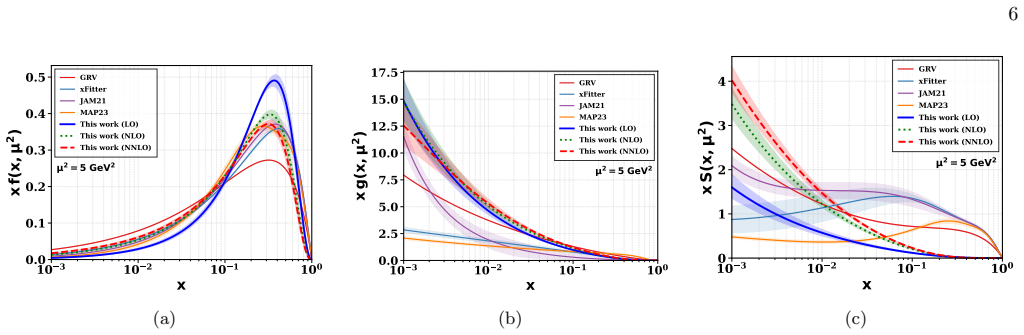
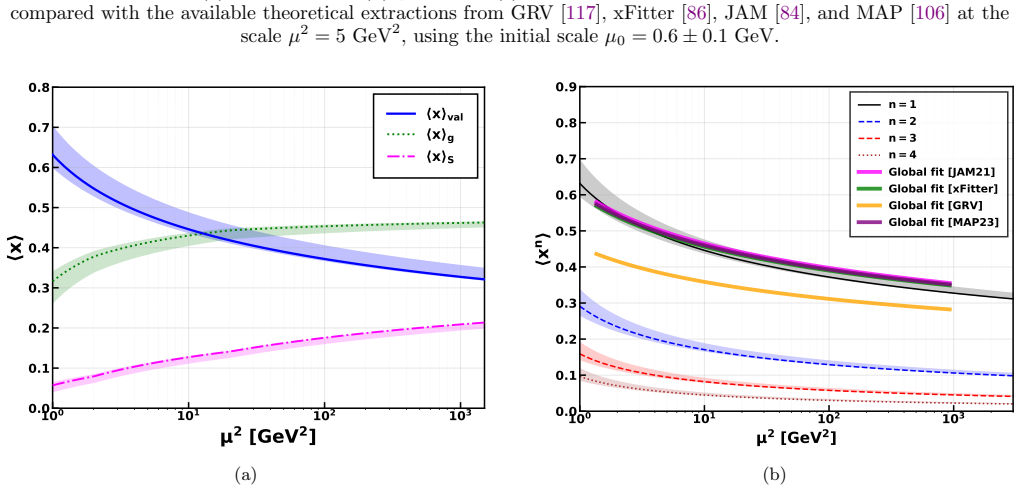
What carries the argument
The quark-quark correlation function solved inside the light-cone quark model to generate initial valence PDFs, followed by DGLAP evolution to experimental scales.
If this is right
- Evolved PDFs agree with available experimental and theoretical extractions of pion structure.
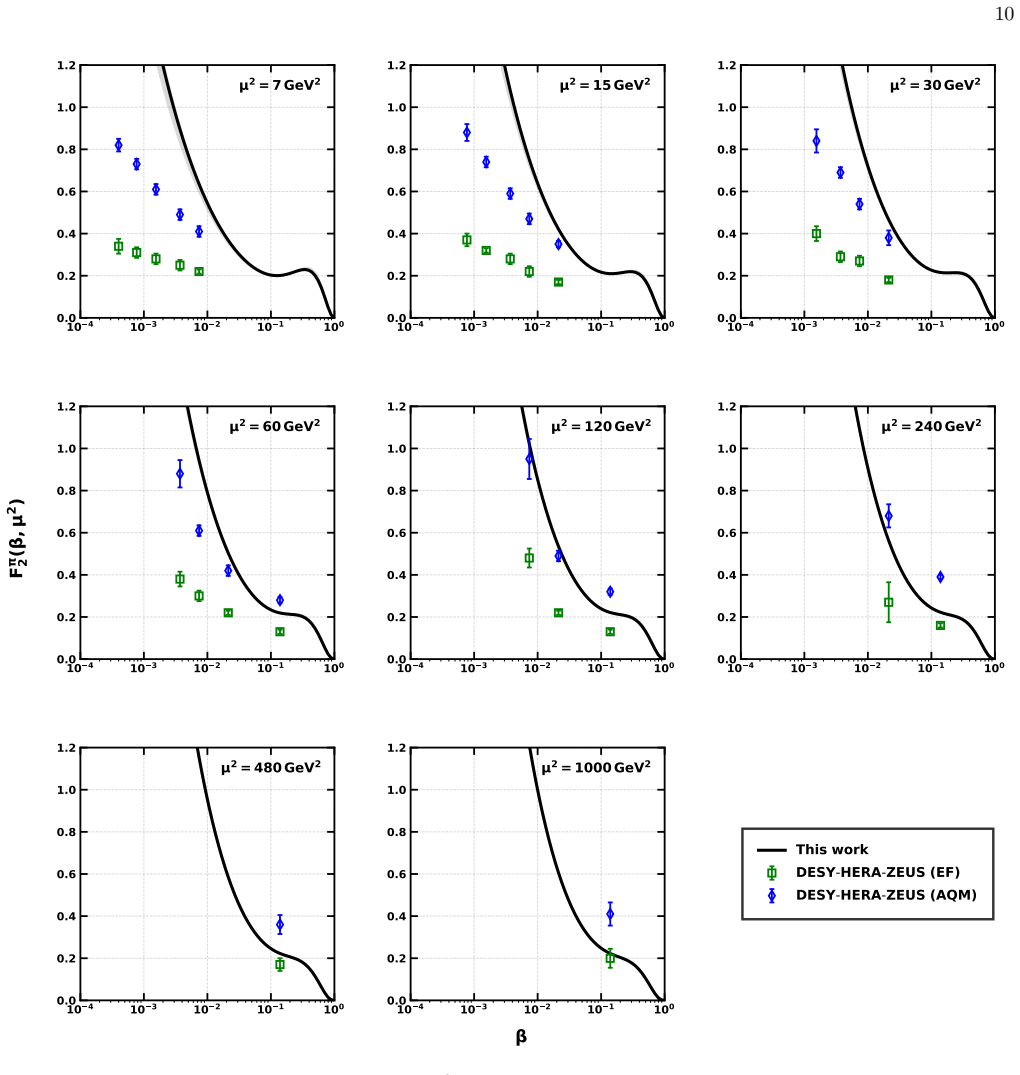
- The NLO F2 structure function matches ZEUS and H1 data over a broad range of energy scales.
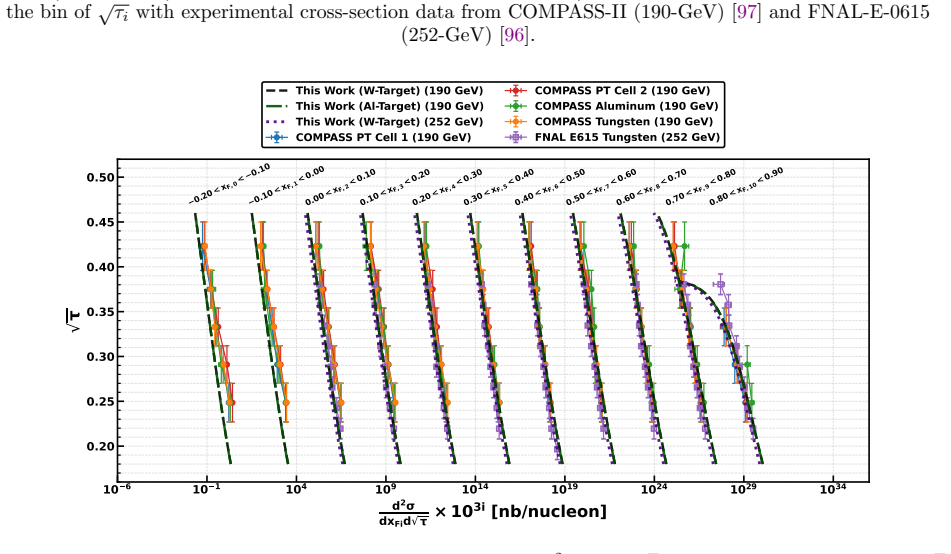
- Pion PDFs allow calculation of forward pion production cross sections in the Drell-Yan process.
- The evolved F2 can be studied at the kinematics expected at the upcoming electron-ion collider.
Where Pith is reading between the lines
- The agreement suggests valence quarks dominate the observables examined here, with sea-quark or higher-twist terms remaining small.
- The same initial-scale inputs could be applied to other light mesons to test whether the light-cone approach remains consistent.
- Success at EIC energies provides a baseline expectation for new meson-structure measurements without additional model tuning.
Load-bearing premise
The light-cone quark model supplies accurate initial valence quark PDFs at a low starting scale such that standard DGLAP evolution alone reproduces the pion structure observed at higher experimental scales.
What would settle it
A clear mismatch between the NLO F2 predictions and ZEUS or H1 data at moderate values of x and Q squared would show that the initial model PDFs plus DGLAP evolution are insufficient.
Figures




read the original abstract
In this work, we investigate the valence quark parton distribution functions (PDFs) of the pion within the light-cone quark model. The initial quark PDFs are calculated by solving the quark-quark correlation function for the pseudoscalar mesons. The initial quark PDFs have been evolved to higher energy scales through the Dokshitzer,Gribov,Lipatov,Altarelli,Parisi (DGLAP) evolution equations. We also find that our calculated evolved PDFs match experimental and available theoretical extraction data. For the first time, we have also predicted the $F_2$ structure function at next-to-leading (NLO) order accuracy. The calculated $F_2$ structure function has been compared with the available ZEUS and H1 experimental data at DESY-HERA over a wide range of energy scales. Additionally, we display the forward pion production cross-section for the Drell-Yan process caused by pions using the pion PDFs that were calculated and the target nucleon PDFs from the LHAPDF nucleus datasets. The evolved $F_2$ structure function of the pion have been studied at the upcoming electron-ion collider energy kinematics. Overall, it was observed that the quark PDFs of pions computed using the light-cone quark model consistent with the experimental results.
Editorial analysis
A structured set of objections, weighed in public.
Referee Report
Summary. The paper computes valence quark PDFs for the pion in the light-cone quark model by solving the quark-quark correlation function at a low initial scale. These PDFs are evolved to higher scales using NLO DGLAP equations and compared to experimental data from ZEUS, H1, and LHAPDF extractions. The work also predicts the pion F2 structure function at NLO, compares it to HERA data across energy scales, computes forward pion production cross sections in Drell-Yan processes using the evolved PDFs, and provides predictions for EIC kinematics.
Significance. If the agreement with data holds under scrutiny, the approach supplies a model-derived low-scale input for pion valence PDFs that can be tested via perturbative evolution, offering a bridge between light-cone quark models and high-energy data. The NLO F2 prediction and Drell-Yan application add practical value for upcoming experiments, though the overall impact depends on demonstrating that the results are robust rather than tuned.
major comments (3)
- Abstract: the statement that 'our calculated evolved PDFs match experimental and available theoretical extraction data' is presented without any quantitative measures of agreement (e.g., chi-squared per degree of freedom, residual plots, or error propagation from model parameters), which is load-bearing for the central claim of consistency with ZEUS, H1, and LHAPDF data.
- Abstract and implied results section: the initial PDFs are valence-only from the light-cone model; the manuscript does not specify the starting scale Q0^2, the treatment (or omission) of initial sea/gluon distributions, or the sensitivity of the evolved results to these choices, leaving open whether pure NLO DGLAP evolution from this input suffices or requires additional non-perturbative corrections to reproduce the observed pion structure.
- F2 structure function comparison: while NLO accuracy is claimed and data from ZEUS/H1 are referenced over a wide Q^2 range, the text provides no details on the kinematic cuts, higher-twist contributions, or how the model parameters (adjusted to meson properties) were chosen to achieve the reported match, undermining the assertion that the calculation constitutes a robust prediction.
minor comments (2)
- The abstract and conclusions could more clearly state the numerical value of the initial evolution scale and the specific light-cone model parameters used.
- Notation for the quark-quark correlation function and its relation to the PDFs should be defined explicitly in the main text for readers unfamiliar with the light-cone formalism.
Simulated Author's Rebuttal
We thank the referee for the thorough review and constructive suggestions. We address each major comment point by point below, indicating the revisions we will implement to improve clarity and rigor without altering the core results.
read point-by-point responses
-
Referee: Abstract: the statement that 'our calculated evolved PDFs match experimental and available theoretical extraction data' is presented without any quantitative measures of agreement (e.g., chi-squared per degree of freedom, residual plots, or error propagation from model parameters), which is load-bearing for the central claim of consistency with ZEUS, H1, and LHAPDF data.
Authors: We agree that the abstract claim would benefit from quantitative support. In the revised manuscript we will add chi-squared per degree of freedom values (computed from the existing PDF comparison figures) and a short discussion of parameter uncertainties in the results section, with a brief reference in the abstract. revision: yes
-
Referee: Abstract and implied results section: the initial PDFs are valence-only from the light-cone model; the manuscript does not specify the starting scale Q0^2, the treatment (or omission) of initial sea/gluon distributions, or the sensitivity of the evolved results to these choices, leaving open whether pure NLO DGLAP evolution from this input suffices or requires additional non-perturbative corrections to reproduce the observed pion structure.
Authors: The light-cone quark model yields valence-only distributions at a low initial scale fixed by meson properties; DGLAP evolution then generates sea and gluon components. We will revise the text to state the numerical value of Q0^2 explicitly, clarify the valence-only initial condition, and add a paragraph discussing the sensitivity of evolved results to this choice and the absence of initial sea/gluons, noting that this is the standard procedure for such model-based inputs. revision: yes
-
Referee: F2 structure function comparison: while NLO accuracy is claimed and data from ZEUS/H1 are referenced over a wide Q^2 range, the text provides no details on the kinematic cuts, higher-twist contributions, or how the model parameters (adjusted to meson properties) were chosen to achieve the reported match, undermining the assertion that the calculation constitutes a robust prediction.
Authors: We will expand the F2 section to specify the kinematic cuts applied to the ZEUS/H1 data (restricting to the perturbative regime), state that higher-twist terms are omitted because the calculation is performed at NLO in the perturbative framework, and confirm that model parameters are determined solely from meson masses and decay constants with no additional adjustment to F2 or PDF data. revision: yes
Circularity Check
No significant circularity in the PDF calculation and evolution chain
full rationale
The paper computes initial valence quark PDFs directly from the light-cone quark model's quark-quark correlation function for pseudoscalar mesons at a low starting scale. These are evolved using the standard NLO DGLAP equations (an external perturbative tool) and then compared to experimental extractions and ZEUS/H1 F2 data. The F2 structure function is obtained from the evolved PDFs via the standard convolution with parton-level coefficients. No step reduces by construction to its own inputs: model parameters derive from independent meson properties, the evolution is not fitted to the target data, and no self-citation chain or ansatz smuggling is required for the central comparison. The agreement with data is therefore a genuine test rather than a tautology.
Axiom & Free-Parameter Ledger
free parameters (1)
- light-cone quark model parameters
axioms (2)
- domain assumption Light-cone quark model gives reliable valence quark distributions for the pion at a low initial scale
- standard math DGLAP evolution equations accurately describe the scale dependence of pion PDFs
Lean theorems connected to this paper
-
IndisputableMonolith/Cost/FunctionalEquation.leanwashburn_uniqueness_aczel contradicts?
contradictsCONTRADICTS: the theorem conflicts with this paper passage, or marks a claim that would need revision before publication.
The initial quark PDFs are calculated by solving the quark-quark correlation function... evolved... through the DGLAP evolution equations... initial scale μ₀=0.6±0.1 GeV... fitted with modified FNAL-E-0615 data
-
IndisputableMonolith/Foundation/RealityFromDistinction.leanreality_from_one_distinction unclear?
unclearRelation between the paper passage and the cited Recognition theorem.
Brodsky-Huang-Lepage (BHL) prescription ϕ(x,k²_⊥)=A exp[−(k²_⊥+m²_q)/x + ... /8β² ...]
What do these tags mean?
- matches
- The paper's claim is directly supported by a theorem in the formal canon.
- supports
- The theorem supports part of the paper's argument, but the paper may add assumptions or extra steps.
- extends
- The paper goes beyond the formal theorem; the theorem is a base layer rather than the whole result.
- uses
- The paper appears to rely on the theorem as machinery.
- contradicts
- The paper's claim conflicts with a theorem or certificate in the canon.
- unclear
- Pith found a possible connection, but the passage is too broad, indirect, or ambiguous to say the theorem truly supports the claim.
Reference graph
Works this paper leans on
-
[1]
Now using the meson Fock-state of Eq
and determines the path of the quark field opera- tors, which has been taken as unity here. Now using the meson Fock-state of Eq. (14) and quark field operators, the overlap form of the unpolarized PDF f(x) is found to be, /uni00000013/uni00000011/uni00000013/uni00000013/uni00000011/uni00000015/uni00000013/uni00000011/uni00000017/uni00000013/uni00000011/u...
-
[2]
= 1, Z 1 0 dx ¯f(x, µ2
-
[3]
= 1, Z 1 0 dx x f(x, µ2
-
[4]
+ ¯f(x, µ2 0) = 1, Z 1 0 dx g(x, µ2
-
[5]
= 0, Z 1 0 dx S(x, µ2
-
[6]
(18) Here,gandSdenote gluons and sea quarks, respectively
= 0. (18) Here,gandSdenote gluons and sea quarks, respectively. However, in this work, we have not considered gluon and sea-quark contributions at the initial scale, therefore, the total momentum of the pion will be equally distributed between the quark and antiquark. The unpolarized quark PDF is found to be the result of the non-flip quark po- larization...
-
[7]
The first step is to calculate the initial scale of our PDFs by fit- ting with the available experimental results
to solve the DGLAP equations numerically. The first step is to calculate the initial scale of our PDFs by fit- ting with the available experimental results. To find the initial scale, we evolve our PDFs to 16 GeV2 and fit with modified FNAL-E-0615 data in Fig. 2 through next-to- next-to-leading order (NNLO) DGLAP evolutions. We have calculated the initial...
-
[8]
in Fig. 3. For the valence quark PDF, our NLO and NNLO results exhibit similar behavior at both low and highx, indicating the quality of our results. How- ever, atx∼1, our results for the valence quark PDFs are smoothly decreasing distributions rather than linear, slightly faster distributions as in the above predictions. A higher distribution is observed...
2002
-
[9]
Accardi et al., Eur
A. Accardi et al., Eur. Phys. J. A52, 268 (2016)
2016
-
[10]
Bacchetta, M
A. Bacchetta, M. Diehl, K. Goeke, A. Metz, P. J. Mul- ders, and M. Schlegel, JHEP02, 093 (2007)
2007
-
[11]
V. W. Hughes and J. Kuti, Ann. Rev. Nucl. Part. Sci. 33, 611 (1983)
1983
-
[12]
Brock et al
R. Brock et al. (CTEQ), Rev. Mod. Phys.67, 157 (1995)
1995
-
[13]
Gross et al., Eur
F. Gross et al., Eur. Phys. J. C83, 1125 (2023)
2023
-
[14]
F. E. Close and R. G. Roberts, Phys. Rev. Lett.60, 1471 (1988)
1988
-
[15]
E. D. Bloom et al., Phys. Rev. Lett.23, 930 (1969)
1969
-
[16]
Adcox et al
K. Adcox et al. (PHENIX), Nucl. Phys. A757, 184 (2005)
2005
-
[17]
W. J. Marciano and H. Pagels, Phys. Rept.36, 137 (1978)
1978
-
[18]
J. L. Abelleira Fernandez et al. (LHeC Study Group), J. Phys. G39, 075001 (2012)
2012
-
[19]
Y. V. Kovchegov and E. Levin,Quantum Chromo- dynamics at High Energy, vol. 33 (Oxford University Press, 2013)
2013
-
[20]
Diehl, Phys
M. Diehl, Phys. Rept.388, 41 (2003)
2003
-
[21]
J. C. Collins, D. E. Soper, and G. F. Sterman, Adv. Ser. Direct. High Energy Phys.5, 1 (1989)
1989
-
[22]
Ji, J.-p
X.-d. Ji, J.-p. Ma, and F. Yuan, Phys. Rev. D71, 034005 (2005)
2005
-
[23]
Gardi and L
E. Gardi and L. Magnea, JHEP03, 079 (2009)
2009
-
[24]
Ahrens, A
V. Ahrens, A. Ferroglia, M. Neubert, B. D. Pecjak, and L. L. Yang, JHEP09, 097 (2010)
2010
-
[25]
I. W. Stewart, F. J. Tackmann, and W. J. Waalewijn, Phys. Rev. D81, 094035 (2010)
2010
-
[26]
Izubuchi, X
T. Izubuchi, X. Ji, L. Jin, I. W. Stewart, and Y. Zhao, Phys. Rev. D98, 056004 (2018)
2018
-
[27]
Mineo, W
H. Mineo, W. Bentz, N. Ishii, A. W. Thomas, and K. Yazaki, Nucl. Phys. A735, 482 (2004)
2004
-
[28]
Nambu and G
Y. Nambu and G. Jona-Lasinio, Phys. Rev.122, 345 (1961)
1961
-
[29]
S. P. Klevansky, Rev. Mod. Phys.64, 649 (1992)
1992
-
[30]
Schlumpf, Phys
F. Schlumpf, Phys. Rev. D50, 6895 (1994)
1994
-
[31]
C. D. Roberts and S. M. Schmidt, Prog. Part. Nucl. Phys.45, S1 (2000)
2000
-
[32]
S. J. Brodsky and G. F. de Teramond, Phys. Rev. Lett. 96, 201601 (2006)
2006
-
[33]
Ruiz Arriola and W
E. Ruiz Arriola and W. Broniowski, Phys. Rev. D66, 094016 (2002)
2002
-
[34]
Meissner, A
S. Meissner, A. Metz, and M. Schlegel, JHEP08, 056 (2009)
2009
-
[35]
Lorce, B
C. Lorce, B. Pasquini, X. Xiong, and F. Yuan, Phys. Rev. D85, 114006 (2012)
2012
-
[36]
Puhan et al., (2025), 2504.14982
S. Puhan, S. Sharma, N. Kumar, and H. Dahiya (2025), 2504.14982
-
[37]
Sharma, S
S. Sharma, S. Jain, and H. Dahiya, Phys. Rev. D110, 074025 (2024)
2024
-
[38]
A. V. Belitsky and A. V. Radyushkin, Phys. Rept.418, 1 (2005)
2005
-
[39]
M. V. Polyakov and P. Schweitzer, Int. J. Mod. Phys. A33, 1830025 (2018)
2018
-
[40]
Boffi and B
S. Boffi and B. Pasquini, Riv. Nuovo Cim.30, 387 (2007)
2007
-
[41]
Guidal, M
M. Guidal, M. V. Polyakov, A. V. Radyushkin, and M. Vanderhaeghen, Phys. Rev. D72, 054013 (2005)
2005
-
[42]
Diehl, T
M. Diehl, T. Feldmann, R. Jakob, and P. Kroll, Eur. Phys. J. C39, 1 (2005)
2005
-
[43]
Guidal, H
M. Guidal, H. Moutarde, and M. Vanderhaeghen, Rept. Prog. Phys.76, 066202 (2013)
2013
- [44]
-
[45]
Avakian, A
H. Avakian, A. V. Efremov, P. Schweitzer, and F. Yuan, Phys. Rev. D81, 074035 (2010)
2010
-
[46]
Bacchetta, V
A. Bacchetta, V. Bertone, C. Bissolotti, G. Bozzi, M. Cerutti, F. Delcarro, M. Radici, L. Rossi, and A. Sig- nori (MAP (Multi-dimensional Analyses of Partonic dis- tributions)), JHEP08, 232 (2024)
2024
-
[47]
Angeles-Martinez et al., Acta Phys
R. Angeles-Martinez et al., Acta Phys. Polon. B46, 2501 (2015)
2015
-
[48]
Puhan, S
S. Puhan, S. Sharma, N. Kumar, and H. Dahiya, Phys. Rev. D113, 036030 (2026)
2026
-
[49]
Lorce, B
C. Lorce, B. Pasquini, and M. Vanderhaeghen, JHEP 05, 041 (2011)
2011
-
[50]
Puhan and H
S. Puhan and H. Dahiya, Phys. Rev. D111, 114039 (2025)
2025
-
[51]
G. A. Miller, Ann. Rev. Nucl. Part. Sci.60, 1 (2010)
2010
-
[52]
H. Davoudiasl, H. Liu, S. Mantry, and E. T. Neil (2025), 2512.15865
-
[53]
X.-H. Cao, F.-K. Guo, Q.-Z. Li, B.-W. Wu, and D.-L. Yao (2025), 2507.05375
-
[54]
D. E. Soper, Nucl. Phys. B Proc. Suppl.53, 69 (1997)
1997
-
[55]
H. L. Lai, J. Botts, J. Huston, J. G. Morfin, J. F. Owens, J.-w. Qiu, W. K. Tung, and H. Weerts, Phys. Rev. D 51, 4763 (1995)
1995
-
[56]
Pumplin, D
J. Pumplin, D. R. Stump, J. Huston, H. L. Lai, P. M. Nadolsky, and W. K. Tung, JHEP07, 012 (2002)
2002
-
[57]
A. D. Martin, W. J. Stirling, R. S. Thorne, and G. Watt, Eur. Phys. J. C63, 189 (2009)
2009
-
[58]
H.-L. Lai, M. Guzzi, J. Huston, Z. Li, P. M. Nadolsky, J. Pumplin, and C. P. Yuan, Phys. Rev. D82, 074024 (2010)
2010
-
[59]
Dulat, T.-J
S. Dulat, T.-J. Hou, J. Gao, M. Guzzi, J. Huston, P. Nadolsky, J. Pumplin, C. Schmidt, D. Stump, and C. P. Yuan, Phys. Rev. D93, 033006 (2016)
2016
-
[60]
Buckley, J
A. Buckley, J. Ferrando, S. Lloyd, K. Nordstr¨ om, B. Page, M. R¨ ufenacht, M. Sch¨ onherr, and G. Watt, Eur. Phys. J. C75, 132 (2015)
2015
-
[61]
F. D. Aaron et al. (H1, ZEUS), JHEP01, 109 (2010)
2010
-
[62]
Abramowicz et al
H. Abramowicz et al. (H1, ZEUS), Eur. Phys. J. C75, 580 (2015)
2015
-
[63]
de Florian, R
D. de Florian, R. Sassot, M. Stratmann, and W. Vogel- sang, Phys. Rev. D80, 034030 (2009)
2009
-
[64]
Altarelli and G
G. Altarelli and G. Parisi, Nucl. Phys. B126, 298 (1977)
1977
-
[65]
F. D. Aaron et al. (H1), Eur. Phys. J. C68, 381 (2010)
2010
-
[66]
Chekanov et al
S. Chekanov et al. (ZEUS), Nucl. Phys. B637, 3 (2002)
2002
-
[67]
S. D. Drell and T.-M. Yan, Phys. Rev. Lett.25, 316 (1970), [Erratum: Phys.Rev.Lett. 25, 902 (1970)]
1970
-
[68]
Aghasyan et al
M. Aghasyan et al. (COMPASS), Phys. Rev. Lett.119, 112002 (2017)
2017
-
[69]
C. Lorc´ e, A. Metz, B. Pasquini, and P. Schweitzer (2025), arXiv:2507.12664 [hep-ph]
-
[70]
V. John, G. S. Krishnaswami, and S. G. Rajeev, Phys. Lett. B487, 125 (2000)
2000
-
[71]
Aad et al
G. Aad et al. (ATLAS), JHEP07, 223 (2021)
2021
-
[72]
J. Lan, C. Mondal, S. Jia, X. Zhao, and J. P. Vary, Phys. Rev. D101, 034024 (2020)
2020
-
[73]
Choi and C.-R
H.-M. Choi and C.-R. Ji, Phys. Rev. D110, 014006 20 (2024)
2024
-
[74]
N. Kaur, N. Kumar, C. Mondal, and H. Dahiya, Nucl. Phys. B934, 80 (2018)
2018
-
[75]
Gutsche, V
T. Gutsche, V. E. Lyubovitskij, I. Schmidt, and A. Vega, J. Phys. G42, 095005 (2015)
2015
-
[76]
G. F. de Teramond, T. Liu, R. S. Sufian, H. G. Dosch, S. J. Brodsky, and A. Deur (HLFHS), Phys. Rev. Lett. 120, 182001 (2018)
2018
-
[77]
Shigetani, K
T. Shigetani, K. Suzuki, and H. Toki, Phys. Lett. B 308, 383 (1993)
1993
- [78]
-
[79]
Broniowski, E
W. Broniowski, E. Ruiz Arriola, and K. Golec-Biernat, Phys. Rev. D77, 034023 (2008)
2008
- [80]
discussion (0)
Sign in with ORCID, Apple, or X to comment. Anyone can read and Pith papers without signing in.