Recognition: no theorem link
Probing the Factorized Island Branch with the Capacity of Entanglement in JT Gravity
Pith reviewed 2026-05-10 19:32 UTC · model grok-4.3
The pith
Capacity of entanglement detects finite-n structure in the factorized island branch of JT gravity where entropy plateaus.
A machine-rendered reading of the paper's core claim, the machinery that carries it, and where it could break.
Core claim
In the late-time high-temperature regime of the factorized island branch, the entropy plateau remains unchanged at the first nontrivial order while the capacity acquires a definite correction. This shows that the factorized island saddle already carries finite-n information beyond the entropy, and that the capacity is a natural observable for exposing it. The physics of island saddles is not exhausted by the n=1 limit; the surrounding replica geometry contains additional, and observable, information about how the semiclassical saddle is assembled.
What carries the argument
The capacity of entanglement evaluated on the factorized island saddle within the replica manifold of JT gravity coupled to a large-c bath.
Load-bearing premise
The factorized island branch remains the dominant saddle and the large-c bath approximation continues to control the capacity calculation at the order where the correction appears.
What would settle it
An explicit higher-order calculation in the JT model showing either a correction to the entropy plateau at the same order or a capacity correction whose size or sign differs from the predicted value.
Figures


read the original abstract
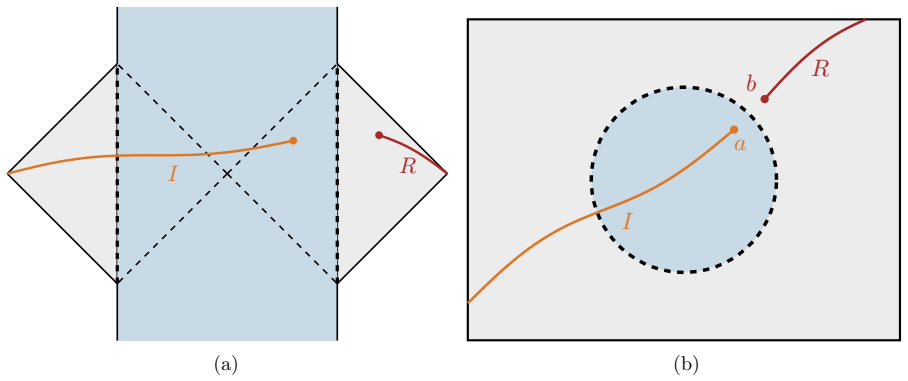
Black hole islands are usually diagnosed through the von Neumann entropy, but the full replica saddle contains more information than survives in the limit $n \to 1$. In this paper we show that the capacity of entanglement can detect that extra structure already within the controlled factorized island branch of JT gravity coupled to a large-$c$ bath. In the late-time high-temperature regime, the entropy plateau remains unchanged at the first nontrivial order, while the capacity acquires a definite correction. This provides a sharp semiclassical example in which nearby replica data are physically meaningful even when the entropy itself appears rigid. Our result shows that the factorized island saddle already carries finite-$n$ information beyond the entropy, and that the capacity is a natural observable for exposing it. More broadly, it highlights that the physics of island saddles is not exhausted by the $n=1$ limit: the surrounding replica geometry can contain additional, and observable, information about how the semiclassical saddle is assembled.
Editorial analysis
A structured set of objections, weighed in public.
Referee Report
Summary. The paper analyzes the capacity of entanglement in the factorized island branch of JT gravity coupled to a large-c bath. It claims that, in the late-time high-temperature regime, the von Neumann entropy plateau is unchanged at the first nontrivial order in the replica parameter, while the capacity acquires a definite correction arising from the surrounding replica geometry. This is presented as evidence that finite-n replica data remain physically meaningful even when the n=1 entropy appears rigid, and that the factorized island saddle encodes additional observable information beyond the entropy limit.
Significance. If the central result holds, the work supplies a controlled semiclassical example in which an observable sensitive to the second n-derivative distinguishes replica structure invisible to the entropy alone. This strengthens the case for treating island saddles as carrying finite-n information and identifies the capacity of entanglement as a natural diagnostic. The JT setting permits explicit saddle computations, adding a concrete data point to the literature on replica geometries and black-hole information.
major comments (1)
- [§4 (late-time high-T regime) and the expansion around the factorized saddle] The large-c bath approximation is invoked to control the on-shell action in the late-time high-T regime. Because the capacity extracts the second derivative with respect to n (C ~ n² d²S_n/dn² at n=1), any n-dependent correction that is subleading for the first derivative can become leading for the second. The manuscript must supply an explicit error estimate or bound demonstrating that 1/c or fluctuation terms remain negligible at the order kept for the reported capacity correction; without this, the claim that the correction is definite is not yet secured.
minor comments (2)
- [Introduction and §2] Notation for the replica parameter and the precise definition of the capacity (including the overall prefactor) should be stated once in a dedicated paragraph or equation to avoid ambiguity when comparing to the entropy.
- [Abstract and §4] The abstract states a 'definite correction' without quoting the explicit formula; adding the leading expression for the capacity shift in the main text or a summary equation would improve readability.
Simulated Author's Rebuttal
We thank the referee for their careful reading and constructive feedback on our manuscript. The concern regarding the need for an explicit error estimate on subleading 1/c and fluctuation terms in the capacity calculation is well-taken, as the second n-derivative can amplify such contributions. We address this point below and will revise the manuscript to incorporate a dedicated error analysis in §4.
read point-by-point responses
-
Referee: [§4 (late-time high-T regime) and the expansion around the factorized saddle] The large-c bath approximation is invoked to control the on-shell action in the late-time high-T regime. Because the capacity extracts the second derivative with respect to n (C ~ n² d²S_n/dn² at n=1), any n-dependent correction that is subleading for the first derivative can become leading for the second. The manuscript must supply an explicit error estimate or bound demonstrating that 1/c or fluctuation terms remain negligible at the order kept for the reported capacity correction; without this, the claim that the correction is definite is not yet secured.
Authors: We agree that a rigorous bound is required to confirm that the reported O(1) correction to the capacity remains uncontaminated by subleading terms. In the revised version we will add an explicit error estimate in §4. The factorized saddle is controlled by the large-c limit, where the on-shell action receives Gaussian fluctuation corrections suppressed by 1/c. Because the leading correction to the capacity arises from the explicit n-dependence of the replica geometry (which enters at order 1 in the large-c expansion), the fluctuation contributions to the second n-derivative remain O(1/c) and are therefore negligible at the order kept in our calculation. This bound will be derived by expanding the replica action to quadratic order in fluctuations and differentiating twice with respect to n before taking the large-c limit. revision: yes
Circularity Check
No circularity: capacity correction follows from direct evaluation of replica saddle
full rationale
The derivation computes the capacity as the second n-derivative of the on-shell replica action in the factorized island saddle of JT gravity plus large-c bath. The late-time high-T expansion is performed explicitly on the n-dependent geometry; the entropy (first derivative) remains flat at the kept order while the second derivative acquires a nonzero term. This is a standard replica-trick calculation with an external large-c control parameter, not a self-definition, fitted input renamed as prediction, or load-bearing self-citation. The result is independent of the target observable and does not reduce to its own inputs by construction.
Axiom & Free-Parameter Ledger
axioms (2)
- domain assumption JT gravity coupled to a large-c bath admits a controlled factorized island branch
- standard math The replica trick and n to 1 limit can be extended to the capacity observable
Reference graph
Works this paper leans on
-
[1]
Generalized gravitational entropy
A. Lewkowycz and J. Maldacena,Generalized gravitational entropy, JHEP08(2013) 090, arXiv:1304.4926
work page Pith review arXiv 2013
-
[2]
Quantum corrections to holographic entanglement entropy
T. Faulkner, A. Lewkowycz and J. Maldacena,Quantum corrections to holographic entan- glement entropy, JHEP11(2013) 074, arXiv:1307.2892
work page Pith review arXiv 2013
-
[3]
Quantum Extremal Surfaces: Holographic Entanglement Entropy beyond the Classical Regime
N. Engelhardt and A. C. Wall,Quantum Extremal Surfaces: Holographic Entanglement Entropy beyond the Classical Regime, JHEP01(2015) 073, arXiv:1408.3203
work page Pith review arXiv 2015
-
[4]
D. L. Jafferis, A. Lewkowycz, J. Maldacena and S. J. Suh,Relative entropy equals bulk relative entropy, JHEP06(2016) 004, arXiv:1512.06431
work page Pith review arXiv 2016
-
[5]
Dong, The Gravity Dual of Renyi Entropy, Nature Commun.7, 12472 (2016), arXiv:1601.06788 [hep-th]
X. Dong,The Gravity Dual of R´ enyi Entropy, Nat. Commun.7(2016) 12472, arXiv:1601.06788
-
[6]
A. Almheiri, N. Engelhardt, D. Marolf and H. Maxfield,The entropy of bulk quantum fields and the entanglement wedge of an evaporating black hole, JHEP12(2019) 063, arXiv:1905.08762
-
[7]
A. Almheiri, R. Mahajan, J. Maldacena and Y. Zhao,The Page curve of Hawking radiation from semiclassical geometry, JHEP03(2020) 149, arXiv:1908.10996
-
[8]
G. Penington,Entanglement wedge reconstruction and the information paradox, JHEP09 (2020) 002, arXiv:1905.08255
-
[9]
G. Penington, S. H. Shenker, D. Stanford and Z. Yang,Replica wormholes and the black hole interior, JHEP03(2022) 205, arXiv:1911.11977
-
[10]
The entropy of Hawking ra- diation,
A. Almheiri, T. Hartman, J. Maldacena, E. Shaghoulian and A. Tajdini,The entropy of Hawking radiation, Rev. Mod. Phys.93(2021) 035002, arXiv:2006.06872
-
[11]
A. Almheiri, R. Mahajan and J. Maldacena,Islands outside the horizon, arXiv:1910.11077
-
[12]
Y. Nakaguchi and T. Nishioka,A holographic proof of R´ enyi entropic inequalities, JHEP12 (2016) 129, arXiv:1606.08443
-
[13]
J. de Boer, J. J¨ arvel¨ a and E. Keski-Vakkuri,Aspects of capacity of entanglement, Phys. Rev. D99(2019) 066012, arXiv:1807.07357
-
[14]
K. Kawabata, T. Nishioka, Y. Okuyama and K. Watanabe,Probing Hawking radiation through capacity of entanglement, JHEP05(2021) 062, arXiv:2102.02425
-
[15]
K. Kawabata, T. Nishioka, Y. Okuyama and K. Watanabe,Replica wormholes and capacity of entanglement, JHEP10(2021) 227, arXiv:2105.08396
-
[16]
A. Almheiri, T. Hartman, J. Maldacena, E. Shaghoulian and A. Tajdini,Replica Wormholes and the Entropy of Hawking Radiation, JHEP05(2020) 013, arXiv:1911.12333
- [17]
- [18]
- [19]
-
[20]
R. Arias and D. Fondevila,Capacity of Entanglement and Replica Backreaction in RST Gravity, arXiv:2603.09763
-
[21]
Teitelboim,Gravitation and Hamiltonian Structure in Two Space-Time Dimensions, Phys
C. Teitelboim,Gravitation and Hamiltonian Structure in Two Space-Time Dimensions, Phys. Lett. B126(1983) 41
1983
-
[22]
Jackiw,Lower Dimensional Gravity, Nucl
R. Jackiw,Lower Dimensional Gravity, Nucl. Phys. B252(1985) 343
1985
-
[23]
Models of AdS_2 Backreaction and Holography
A. Almheiri and J. Polchinski,Models of AdS 2 backreaction and holography, JHEP11(2015) 014, arXiv:1402.6334
work page Pith review arXiv 2015
-
[24]
An Investigation of AdS$_2$ Backreaction and Holography
J. Engels¨ oy, T. G. Mertens and H. Verlinde,An investigation of AdS 2 backreaction and holography, JHEP07(2016) 139, arXiv:1606.03438
work page Pith review arXiv 2016
-
[25]
Conformal symmetry and its breaking in two dimensional Nearly Anti-de-Sitter space
J. Maldacena, D. Stanford and Z. Yang,Conformal symmetry and its breaking in two dimensional Nearly Anti-de-Sitter space, PTEP2016(2016) 12C104, arXiv:1606.01857
work page Pith review arXiv 2016
- [26]
- [27]
- [28]
discussion (0)
Sign in with ORCID, Apple, or X to comment. Anyone can read and Pith papers without signing in.