Recognition: no theorem link
Forward analytical model for the optical selection bias on galaxy cluster lensing profiles
Pith reviewed 2026-05-10 19:07 UTC · model grok-4.3
The pith
A forward analytical model quantifies how line-of-sight projections bias the lensing profiles of optically selected galaxy clusters.
A machine-rendered reading of the paper's core claim, the machinery that carries it, and where it could break.
Core claim
The central claim is that a fully predictive forward model can quantify optical-selection bias on cluster lensing profiles by introducing a scale-dependent parametrization of optical cluster bias, whose small- and large-scale behavior is set by projection amplitude, and by writing the two-halo component of the density profile in terms of the line-of-sight contributions from off-axis halos.
What carries the argument
Scale-dependent parametrization of optical cluster bias (small- and large-scale behavior fixed by projection amplitude) together with an explicit decomposition of the two-halo term into off-axis halo contributions along the line of sight.
If this is right
- The model recovers the overall bias in the projected density profile relative to a randomly selected sample with the same mass distribution.
- It captures how the two-halo component depends on richness boosts induced by projections.
- It reproduces the evolution of this bias with cluster richness and redshift.
- The framework supplies a direct link between selection biases and the underlying cosmology plus survey specifications.
Where Pith is reading between the lines
- If the parametrization holds on real data, the model could supply bias corrections for cluster-lensing cosmology without needing survey-specific simulation calibrations.
- The same scale-dependent approach may be adapted to quantify projection biases in other optical observables such as cluster clustering statistics.
- Applying the model across multiple richness thresholds could test whether the current parametrization suffices or whether extra terms appear at the highest richness values.
Load-bearing premise
The introduced scale-dependent parametrization of optical cluster bias accurately represents line-of-sight contributions using only the amplitude of projection effects and requires no additional free parameters tuned to a specific survey.
What would settle it
A mismatch between the model's predicted two-halo term and the two-halo term measured directly in N-body simulations that vary projection strength while holding mass distribution fixed would falsify the parametrization.
Figures



read the original abstract
Cluster catalogs selected by optical properties are subject to selection biases, primarily arising from unresolved systems along the line of sight. These biases affect key observables for cluster cosmology, such as the lensing signal and clustering statistics. In this work, we present a fully predictive forward analytical model to quantify the impact of optical-selection bias due to projection effects on cluster density profiles. This is achieved by introducing a scale-dependent parametrization of the optical cluster bias, whose small- and large-scale behaviour is set by the amplitude of projection effects, and by expressing the two-halo component of the density profile in terms of the contributions from off-axis halos along the line of sight. As a case study, we consider a DES Y3-like cluster catalog and validate our model against simulated samples. Our model successfully captures the dependence of the two-halo component on richness boosts induced by projections, as well as its evolution with richness and redshift. It also recovers the overall bias in the projected density profile relative to a randomly selected sample with the same mass distribution. The framework presented here provides a consistent methodology for modeling the impact of line-of-sight structures on the observed richness and density profiles of optically selected clusters, directly linking selection biases to the underlying cosmology and survey specifications.
Editorial analysis
A structured set of objections, weighed in public.
Referee Report
Summary. The manuscript presents a forward analytical model for the impact of optical selection biases due to line-of-sight projection effects on galaxy cluster lensing profiles. It introduces a scale-dependent parametrization of the optical cluster bias whose small- and large-scale behavior is set by the amplitude of projection effects, and expresses the two-halo term via contributions from off-axis halos along the line of sight. As a case study on a DES Y3-like cluster catalog validated against simulated samples, the model is stated to capture the dependence of the two-halo component on richness boosts induced by projections, its evolution with richness and redshift, and to recover the overall bias in the projected density profile relative to a randomly selected sample with the same mass distribution, thereby linking selection biases directly to cosmology and survey specifications.
Significance. If the model proves fully predictive with the projection amplitude derived independently, the work would provide a valuable analytical framework for correcting projection-induced biases in optical cluster lensing and clustering analyses. This could enable more robust cosmological constraints from surveys like DES by replacing empirical corrections with a methodology tied to underlying halo distributions and survey properties.
major comments (2)
- [Abstract] Abstract: The central claim that the framework is 'fully predictive' and 'directly linking selection biases to the underlying cosmology and survey specifications' is load-bearing on the assertion that the amplitude of projection effects (which sets the small- and large-scale behavior of the scale-dependent optical cluster bias parametrization) is determined from first principles or survey specifications alone. The provided description does not demonstrate this independence from the richness and lensing data in the DES Y3-like simulations used for validation; if the amplitude is instead inferred or tuned to reproduce the simulated richness boosts, the reported recovery of the projected density profile bias is no longer an independent test.
- [Abstract] Abstract (validation statements): The claims that the model 'successfully captures the dependence' and 'recovers the overall bias' lack any quantitative support such as recovered bias fractions, goodness-of-fit metrics, or error budgets on the lensing profiles. Without these, it is not possible to evaluate whether the qualitative agreement with simulations is sufficient to substantiate the central claims about the two-halo term and overall profile bias.
minor comments (1)
- The abstract refers to 'DES Y3-like' simulations but provides no details on the specific simulation volume, number of realizations, or exact richness and redshift ranges employed for the validation.
Simulated Author's Rebuttal
We thank the referee for their careful and constructive review of our manuscript. We address each major comment below in detail and have revised the abstract to improve precision and add quantitative context where feasible.
read point-by-point responses
-
Referee: [Abstract] Abstract: The central claim that the framework is 'fully predictive' and 'directly linking selection biases to the underlying cosmology and survey specifications' is load-bearing on the assertion that the amplitude of projection effects (which sets the small- and large-scale behavior of the scale-dependent optical cluster bias parametrization) is determined from first principles or survey specifications alone. The provided description does not demonstrate this independence from the richness and lensing data in the DES Y3-like simulations used for validation; if the amplitude is instead inferred or tuned to reproduce the simulated richness boosts, the reported recovery of the projected density profile bias is no longer an independent test.
Authors: The projection amplitude in the model is computed analytically from first principles using the halo mass function, cosmological parameters, and survey specifications (including the richness definition, line-of-sight integration depth, and photometric redshift scatter). No fitting to the simulated richness boosts or lensing profiles is performed; the DES Y3-like simulations serve only as an independent validation set. We agree the abstract wording could more explicitly highlight this independence and have revised it to state that the amplitude is derived solely from cosmology and survey properties. revision: yes
-
Referee: [Abstract] Abstract (validation statements): The claims that the model 'successfully captures the dependence' and 'recovers the overall bias' lack any quantitative support such as recovered bias fractions, goodness-of-fit metrics, or error budgets on the lensing profiles. Without these, it is not possible to evaluate whether the qualitative agreement with simulations is sufficient to substantiate the central claims about the two-halo term and overall profile bias.
Authors: The abstract statements are indeed qualitative. The body of the manuscript contains quantitative comparisons (bias recovery fractions, chi-squared values for profile fits, and error budgets). To address the concern directly in the abstract, we have added concise quantitative metrics summarizing the recovered bias and fit quality. revision: yes
Circularity Check
Scale-dependent optical bias parametrization sets small/large-scale limits via projection amplitude whose independent derivation is not demonstrated
specific steps
-
self definitional
[Abstract]
"This is achieved by introducing a scale-dependent parametrization of the optical cluster bias, whose small- and large-scale behaviour is set by the amplitude of projection effects, and by expressing the two-halo component of the density profile in terms of the contributions from off-axis halos along the line of sight."
The parametrization's scale-dependent limits are defined to be set by the projection amplitude; when that amplitude is determined from the same richness and lensing observables the model is later validated against, the claimed capture of two-halo dependence on richness boosts becomes partly tautological rather than a first-principles prediction.
full rationale
The paper introduces a scale-dependent parametrization whose small- and large-scale behavior is explicitly set by the amplitude of projection effects, then claims the resulting forward model is fully predictive and recovers the observed bias on simulated samples. No equation or section is shown that derives the amplitude from cosmology or survey specs alone without reference to the same richness/lensing data used for validation. This creates moderate risk that the recovered two-halo dependence and overall profile bias are partly shaped by the fitted amplitude rather than independent derivation, but the central framework still contains independent modeling of off-axis halos and is validated externally on mocks, so it does not fully reduce to self-definition.
Axiom & Free-Parameter Ledger
free parameters (1)
- scale-dependent optical cluster bias amplitude
axioms (1)
- domain assumption Halo mass function and two-halo term follow standard cosmological prescriptions
Reference graph
Works this paper leans on
-
[1]
For comparison, the expected bias for a randomly selected sample with the same mass distribution,b eff, is shown with a dot-dashedblackline
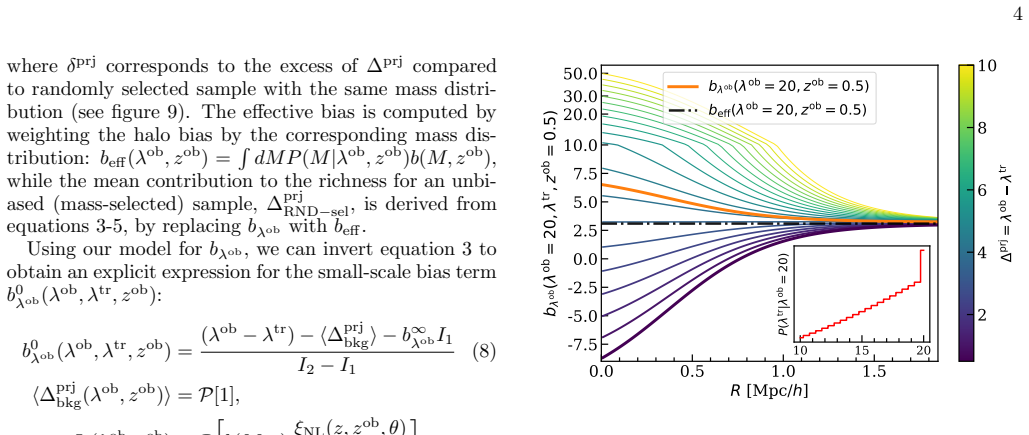
computed by weightingb λob(λob, λtr, z, θ) by the distribu- tionP(λ tr|λob = 20) (equation 17) which is displayed in the inset plot with arbitrary normalization. For comparison, the expected bias for a randomly selected sample with the same mass distribution,b eff, is shown with a dot-dashedblackline. Aboveb λob = 10 the y-axis is shown on a logarithmic s...
-
[2]
Themiddlepanel shows the 2-halo component of the projected density profile for a richness- selected sample and a random sample sharing the same mass distribution
The model is consistent with the synthetic data and correctly reproduces the dependence of the cluster en- vironment on ∆ prj. Themiddlepanel shows the 2-halo component of the projected density profile for a richness- selected sample and a random sample sharing the same mass distribution. The model prediction for the latter is obtained by replacingb λob(λ...
2022
-
[3]
Aguena M., et al., 2021, MNRAS, 502, 4435
2021
-
[4]
S., Wechsler R
Behroozi P. S., Wechsler R. H., Wu H.-Y., 2013, ApJ, 762, 109
2013
-
[5]
Bertocco S., et al., 2019, arXiv e-prints,
2019
-
[6]
Bocquet S., et al., 2024, Phys. Rev. D, 110, 083510
2024
-
[7]
Costanzi M., 2026, SelectionBias,https://github.com/ MCostanzi/SelectionBias
2026
-
[8]
Costanzi M., et al., 2019, MNRAS, 482, 490
2019
-
[9]
DES Collaboration et al., 2018, Phys. Rev. D, 98, 043526
2018
-
[10]
DES Collaboration et al., 2020, Phys. Rev. D, 102, 023509
2020
-
[11]
DES Collaboration et al., 2025, arXiv e-prints, p. arXiv:2503.13632
-
[12]
The Buzzard Flock: Dark Energy Survey Synthetic Sky Catalogs
DeRose J., et al., 2019, arXiv e-prints, p. arXiv:1901.02401
work page Pith review arXiv 2019
-
[13]
H., et al., 2025, MNRAS, 536, 931
Esteves J. H., et al., 2025, MNRAS, 536, 931
2025
-
[14]
E., Rozo E., Rykoff E
Farahi A., Evrard A. E., Rozo E., Rykoff E. S., Wechsler R. H., 2016, MNRAS, 460, 3900
2016
-
[15]
Grandis S., et al., 2025, A&A, 700, A15
2025
-
[16]
R., et al., 2020, Nature, 585, 357
Harris C. R., et al., 2020, Nature, 585, 357
2020
-
[17]
D., 2007, Computing in Science & Engineering, 9, 90
Hunter J. D., 2007, Computing in Science & Engineering, 9, 90
2007
-
[18]
E., et al., 2007, arXiv e-prints, p
Johnston D. E., et al., 2007, arXiv e-prints, p. arXiv:0709.1159
-
[19]
Lee A., et al., 2025, Phys. Rev. D, 111, 063502
2025
-
[20]
F., et al., 2025, A&A, 703, A25
Lesci G. F., et al., 2025, A&A, 703, A25
2025
-
[21]
J., 538, 473
Lewis A., Challinor A., Lasenby A., 2000, Astrophys. J., 538, 473
2000
-
[22]
Maturi M., Bellagamba F., Radovich M., Roncarelli M., Sereno M., Moscardini L., Bardelli S., Puddu E., 2019, MNRAS, 485, 498
2019
-
[23]
F., Frenk C
Navarro J. F., Frenk C. S., White S. D. M., 1997, ApJ, 490, 493
1997
-
[24]
Nyarko Nde T., Wu H.-Y., Cao S., Muthoni Kamau G., Tamosiunas A., To C.-H., Zhou C., 2025, arXiv e-prints, p. arXiv:2510.00753
work page internal anchor Pith review Pith/arXiv arXiv 2025
-
[25]
Oguri M., Hamana T., 2011, MNRAS, 414, 1851
2011
-
[26]
S., et al., 2014, ApJ, 785, 104
Rykoff E. S., et al., 2014, ApJ, 785, 104
2014
-
[27]
N., Wu H.-Y., Rozo E., Weinberg D
Salcedo A. N., Wu H.-Y., Rozo E., Weinberg D. H., To C.-H., Sunayama T., Lee A., 2024, Phys. Rev. Lett., 133, 221002
2024
-
[28]
Springel V., 2005, MNRAS, 364, 1105
2005
-
[29]
Sunayama T., 2023, MNRAS, 521, 5064
2023
-
[30]
Sunayama T., et al., 2020, MNRAS, 496, 4468
2020
-
[31]
Sunayama T., et al., 2024, Phys. Rev. D, 110, 083511
2024
-
[32]
Taffoni G., Becciani U., Garilli B., Maggio G., Pasian F., Umana G., Smareglia R., Vitello F., 2020, arXiv e-prints, p. arXiv:2002.01283
-
[33]
V., Klypin A., Abazajian K., War- ren M., Yepes G., Gottl¨ ober S., Holz D
Tinker J., Kravtsov A. V., Klypin A., Abazajian K., War- ren M., Yepes G., Gottl¨ ober S., Holz D. E., 2008, ApJ, 688, 709
2008
-
[34]
L., Robertson B
Tinker J. L., Robertson B. E., Kravtsov A. V., Klypin A., Warren M. S., Yepes G., Gottl¨ ober S., 2010, ApJ, 724, 878
2010
-
[35]
To C.-H., et al., 2025, Phys. Rev. D, 112, 063537
2025
-
[36]
E., et al., 2020, Nature Methods, 17, 261
Virtanen P., Gommers R., Oliphant T. E., et al., 2020, Nature Methods, 17, 261
2020
-
[37]
Wojtak R., et al., 2018, MNRAS, 481, 324
2018
-
[38]
Wu H.-Y., et al., 2022, MNRAS, 515, 4471
2022
-
[39]
J., van den Bosch F
Yang X., Mo H. J., van den Bosch F. C., Jing Y. P., Weinmann S. M., Meneghetti M., 2006, MNRAS, 373, 1159 11
2006
-
[40]
N., Wu H.-Y., Hirata C
Zeng C., Salcedo A. N., Wu H.-Y., Hirata C. M., 2023, MNRAS, 523, 4270
2023
-
[41]
Zhang Y., Adhikari S., Costanzi M., Frieman J., Annis J., Chang C., 2023a, The Open Journal of Astrophysics, 6, 46
-
[42]
Zhang Z., et al., 2023b, MNRAS, 523, 1994
1994
-
[43]
Zhou C., et al., 2024, Phys. Rev. D, 110, 103508
2024
-
[44]
Zu Y., Mandelbaum R., Simet M., Rozo E., Rykoff E. S., 2017, MNRAS, 470, 551 Appendix A: Analytical model forb λob To derive an empirical model for the optical clus- ter bias, we consider the ratio of the projected cluster- halo correlation functions derived from our mock cata- log for a richness-selected sample and a random-selected sample having the sam...
2017
discussion (0)
Sign in with ORCID, Apple, or X to comment. Anyone can read and Pith papers without signing in.