Recognition: 2 theorem links
· Lean TheoremDynamical decoupling and quantum error correction with SU(d) symmetries
Pith reviewed 2026-05-10 18:25 UTC · model grok-4.3
The pith
Finite subgroups of SU(d) that decouple operators in qudit systems also define quantum error-correcting codes through their one-dimensional symmetry sectors.
A machine-rendered reading of the paper's core claim, the machinery that carries it, and where it could break.
Core claim
Whenever a finite subgroup of SU(d) acts as a decoupling group for the relevant set of operators, the associated one-dimensional symmetry sectors define codespaces satisfying the Knill-Laflamme conditions. The framework extends group-theory methods to higher dimensions by analyzing access to irreducible components of the operator space via Lie-group representation theory, and it yields explicit new protocols for qutrits and spin-1 particles.
What carries the argument
Finite subgroups of SU(d) identified as decoupling groups by their irreducible representations in the operator space, which isolate one-dimensional symmetry sectors usable for both decoupling and coding.
If this is right
- New pulse sequences for interacting qutrit systems derived from finite subgroups of SU(3).
- Shorter, more practical decoupling protocols for spin-1 systems with large zero-field splitting obtained via subgroup factorizations.
- The same symmetry construction supplies quantum error-correcting codes in any multi-level system where the decoupling property holds.
- Systematic search for decoupling groups across dimensions by checking which finite subgroups access all relevant irreducible operator components.
Where Pith is reading between the lines
- Hardware already used for dynamical decoupling in qudits could implement the derived codes without new control resources.
- The unification points toward hybrid protocols that switch between decoupling and active correction using the same group elements.
- Extensions to other compact Lie groups beyond SU(d) could produce additional families of qudit codes.
Load-bearing premise
That a finite subgroup of SU(d) acting as a decoupling group for a given set of operators directly implies its one-dimensional symmetry sectors satisfy the Knill-Laflamme conditions.
What would settle it
A concrete counter-example: a specific finite subgroup of SU(3) shown to decouple a chosen set of operators on a qutrit yet whose one-dimensional sectors violate the Knill-Laflamme conditions for that error model.
Figures






read the original abstract
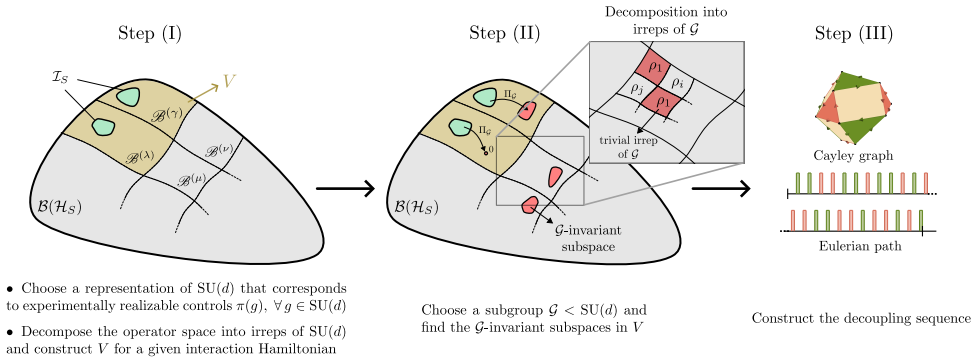
Dynamical decoupling is a long-established and effective way to suppress unwanted interactions in qubit systems, enabling advances in fields ranging from quantum metrology to quantum computing. For general qudit systems, however, comparable protocols remain rare, mainly because Hamiltonian engineering in higher dimensions lacks the geometric intuition available for qubits. Here we present a general framework for dynamical decoupling in qudit systems, based on Lie group representation theory. By extending the group theory approach to dynamical decoupling, we show how decoupling groups can be systematically identified among the finite subgroups of SU(d) by analyzing their access to the irreducible components of the operator space. As an application, we construct new pulse sequences for interacting qutrit systems based on finite subgroups of SU(3), and show how subgroup factorizations and group orientations can be exploited to obtain shorter and more experimentally practical protocols for spin-1 systems with large zero-field splitting. We further show that the same symmetry-based framework yields quantum error-correcting codes: whenever a finite subgroup of SU(d) acts as a decoupling group for the relevant set of operators, the associated one-dimensional symmetry sectors define codespaces satisfying the Knill-Laflamme conditions, thereby unifying dynamical decoupling and quantum error correction in multi-level quantum systems.
Editorial analysis
A structured set of objections, weighed in public.
Referee Report
Summary. The paper develops a representation-theoretic framework for dynamical decoupling in qudit systems by identifying finite subgroups of SU(d) that act as decoupling groups through analysis of irreducible components in the operator space. It constructs explicit pulse sequences for interacting qutrit systems and spin-1 systems with zero-field splitting, exploiting subgroup factorizations and orientations. The central claim is that the same finite subgroups yield one-dimensional symmetry sectors that serve as codespaces satisfying the Knill-Laflamme conditions, thereby unifying dynamical decoupling and quantum error correction.
Significance. If the unification holds, the work supplies a systematic, parameter-free method (relying on standard Lie-group representation theory) for designing both decoupling protocols and error-correcting codes in higher-dimensional systems, where geometric intuition is limited. The practical constructions for qutrits and the exploitation of group factorizations for shorter sequences are concrete strengths.
major comments (1)
- [§4] §4 (unification of DD and QEC): The claim that a finite subgroup G of SU(d) acting as a decoupling group for a set of operators automatically implies that its one-dimensional symmetry sectors satisfy the Knill-Laflamme conditions is load-bearing for the central unification result. The manuscript states the result but does not derive that group averaging projects the error operators such that ⟨ψ|E_i† E_j |φ⟩ = c_ij ⟨ψ|φ⟩ holds with c_ij state-independent for |ψ⟩, |φ⟩ in the same 1D irrep sector; an explicit step showing how the trivial-representation projection forces the required scalar action on the code subspace is needed.
minor comments (2)
- [Abstract] The abstract and introduction would benefit from a brief concrete example of one of the new qutrit pulse sequences (e.g., the explicit group elements or timing) to illustrate the framework before the general claims.
- [§2] Notation for the symmetry sectors and the relevant operator set should be introduced with a short table or diagram in §2 to aid readability when the same objects are reused in the QEC section.
Simulated Author's Rebuttal
We thank the referee for their careful reading of the manuscript and for highlighting the need for greater explicitness in the unification argument. We address the comment below and will revise the manuscript to incorporate an explicit derivation.
read point-by-point responses
-
Referee: [§4] §4 (unification of DD and QEC): The claim that a finite subgroup G of SU(d) acting as a decoupling group for a set of operators automatically implies that its one-dimensional symmetry sectors satisfy the Knill-Laflamme conditions is load-bearing for the central unification result. The manuscript states the result but does not derive that group averaging projects the error operators such that ⟨ψ|E_i† E_j |φ⟩ = c_ij ⟨ψ|φ⟩ holds with c_ij state-independent for |ψ⟩, |φ⟩ in the same 1D irrep sector; an explicit step showing how the trivial-representation projection forces the required scalar action on the code subspace is needed.
Authors: We agree that an explicit derivation would strengthen the presentation of the unification result. Although the connection follows directly from the representation-theoretic setup (group averaging and Schur's lemma), the manuscript presents the implication concisely rather than spelling out every algebraic step. In the revised manuscript we will add a short dedicated paragraph in §4 that derives the Knill-Laflamme condition from the decoupling assumption. The argument proceeds as follows. Let P(E) = (1/|G|) ∑_{g∈G} U(g) E U(g)^† denote the group-average projector onto G-invariant operators. Because G is a decoupling group for the relevant error set, each error E_k satisfies P(E_k) = λ_k I on the one-dimensional symmetry sectors (the code subspaces). For any two states |ψ⟩, |φ⟩ belonging to the same one-dimensional irrep with character χ, the matrix element is invariant under averaging: ⟨ψ| E |φ⟩ = ⟨ψ| P(E) |φ⟩. This holds because U(g)|ψ⟩ = χ(g)|ψ⟩ and U(g)|φ⟩ = χ(g)|φ⟩ imply that each term in the average equals the original matrix element. Since P(E) commutes with every U(g), Schur's lemma guarantees that P(E) acts as multiplication by a scalar λ on the entire one-dimensional irrep. Consequently ⟨ψ| P(E) |φ⟩ = λ ⟨ψ|φ⟩, so ⟨ψ| E |φ⟩ = λ ⟨ψ|φ⟩ with λ independent of the particular states. The same reasoning applies to the composite operators E_i† E_j (which remain within the averaged operator space under the decoupling assumption), yielding the required Knill-Laflamme form with state-independent coefficients c_ij. We will include the full calculation with all intermediate equalities in the revision. revision: yes
Circularity Check
No circularity; derivation self-contained via standard representation theory
full rationale
The paper's central unification claim—that finite SU(d) subgroups acting as decoupling groups yield 1D symmetry sectors satisfying Knill-Laflamme conditions—is presented as a direct consequence of group averaging and irrep decomposition applied to the operator space. No step reduces by definition to its own inputs, renames a fitted parameter as a prediction, or relies on load-bearing self-citation whose content is unverified within the paper. The framework invokes standard Lie-group representation theory (irreducible components, projection onto trivial representation) without smuggling ansatzes or uniqueness theorems from the authors' prior work. The identification of decoupled operators with the error set is an explicit modeling choice, not a hidden tautology, and the resulting code-space property follows from the averaging projector vanishing non-invariant matrix elements on 1D sectors. The derivation is therefore independent of the target result and externally falsifiable against known DD and QEC examples.
Axiom & Free-Parameter Ledger
axioms (1)
- domain assumption Finite subgroups of SU(d) can be systematically identified as decoupling groups by analyzing their access to irreducible components of the operator space.
Lean theorems connected to this paper
-
IndisputableMonolith/Cost/FunctionalEquation.leanwashburn_uniqueness_aczel unclear?
unclearRelation between the paper passage and the cited Recognition theorem.
whenever a finite subgroup of SU(d) acts as a decoupling group for the relevant set of operators, the associated one-dimensional symmetry sectors define codespaces satisfying the Knill-Laflamme conditions
-
IndisputableMonolith/Foundation/AbsoluteFloorClosure.leanreality_from_one_distinction unclear?
unclearRelation between the paper passage and the cited Recognition theorem.
decomposition of the operator space into irreducible representations (irreps) of SU(d)
What do these tags mean?
- matches
- The paper's claim is directly supported by a theorem in the formal canon.
- supports
- The theorem supports part of the paper's argument, but the paper may add assumptions or extra steps.
- extends
- The paper goes beyond the formal theorem; the theorem is a base layer rather than the whole result.
- uses
- The paper appears to rely on the theorem as machinery.
- contradicts
- The paper's claim conflicts with a theorem or certificate in the canon.
- unclear
- Pith found a possible connection, but the passage is too broad, indirect, or ambiguous to say the theorem truly supports the claim.
Reference graph
Works this paper leans on
-
[1]
Quantum sensing
C. L. Degen, F. Reinhard, and P. Cappel- laro. “Quantum sensing”. Rev. Mod. Phys.89, 035002 (2017)
2017
-
[2]
Quantum computation and quantum informa- tion: 10th anniversary edition
Michael A. Nielsen and Isaac L. Chuang. “Quantum computation and quantum informa- tion: 10th anniversary edition”. Cambridge University Press. (2010)
2010
-
[3]
Quantum Computing in the NISQ era and beyond
John Preskill. “Quantum Computing in the NISQ era and beyond”. Quantum2, 79 (2018)
2018
-
[4]
Noisy intermediate-scale quantum algorithms
Kishor Bharti, Alba Cervera-Lierta, Thi Ha Kyaw, Tobias Haug, Sumner Alperin-Lea, Ab- hinav Anand, Matthias Degroote, Hermanni Heimonen, Jakob S. Kottmann, Tim Menke, Wai-Keong Mok, Sukin Sim, Leong-Chuan Kwek, and Al´ an Aspuru-Guzik. “Noisy intermediate-scale quantum algorithms”. Rev. Mod. Phys.94, 015004 (2022)
2022
-
[5]
Quantum error correction
Daniel A Lidar and Todd A Brun. “Quantum error correction”. Cambridge university press. (2013)
2013
-
[6]
Quantum error correction for quantum memories
Barbara M. Terhal. “Quantum error correction for quantum memories”. Rev. Mod. Phys.87, 307–346 (2015)
2015
-
[7]
Spin dynamics: Basics of nuclear magnetic resonance
Malcom H. Levitt. “Spin dynamics: Basics of nuclear magnetic resonance”. Wiley. (2008). 2 edition
2008
-
[8]
High-sensitivity diamond magnetometer with nanoscale resolution
J. M. Taylor, P. Cappellaro, L. Childress, L. Jiang, D. Budker, P. R. Hemmer, A. Ya- coby, R. Walsworth, and M. D. Lukin. “High-sensitivity diamond magnetometer with nanoscale resolution”. Nature Physics4, 810–816 (2008)
2008
-
[9]
Quan- tum metrology with strongly interacting spin systems
Hengyun Zhou, Joonhee Choi, Soonwon Choi, Renate Landig, Alexander M. Douglas, Junichi Isoya, Fedor Jelezko, Shinobu Onoda, Hitoshi Sumiya, Paola Cappellaro, Helena S. Knowles, Hongkun Park, and Mikhail D. Lukin. “Quan- tum metrology with strongly interacting spin systems”. Phys. Rev. X10, 031003 (2020)
2020
-
[10]
Robust higher-order hamiltonian engineering for quan- tum sensing with strongly interacting systems
Hengyun Zhou, Leigh S. Martin, Matthew Tyler, Oksana Makarova, Nathaniel Leitao, Hongkun Park, and Mikhail D. Lukin. “Robust higher-order hamiltonian engineering for quan- tum sensing with strongly interacting systems”. Phys. Rev. Lett.131, 220803 (2023)
2023
-
[11]
Quantum sensing with a spin ensemble in a two-dimensional material
Souvik Biswas, Giovanni Scuri, Noah Huff- man, Eric I. Rosenthal, Ruotian Gong, Thomas Poirier, Xingyu Gao, Sumukh Vaidya, Abigail J. Stein, Tsachy Weissman, James H. Edgar, Tongcang Li, Chong Zu, Jelena Vuˇ ckovi´ c, and Joonhee Choi. “Quantum sensing with a spin ensemble in a two-dimensional material” (2025). arXiv:2509.08984
work page internal anchor Pith review Pith/arXiv arXiv 2025
-
[12]
Coherent dynamics of coupled electron and nuclear spin qubits in di- amond
L Childress, MV Gurudev Dutt, JM Taylor, AS Zibrov, F Jelezko, J Wrachtrup, PR Hem- mer, and MD Lukin. “Coherent dynamics of coupled electron and nuclear spin qubits in di- amond”. Science314, 281–285 (2006)
2006
-
[13]
Quantum register based on individual electronic and nu- clear spin qubits in diamond
M. V. Gurudev Dutt, L. Childress, L. Jiang, E. Togan, J. Maze, F. Jelezko, A. S. Zibrov, P. R. Hemmer, and M. D. Lukin. “Quantum register based on individual electronic and nu- clear spin qubits in diamond”. Science316, 1312–1316 (2007)
2007
-
[14]
Sensing single remote nu- clear spins
Nan Zhao, Jan Honert, Bernhard Schmid, Michael Klas, Junichi Isoya, Matthew Markham, Daniel Twitchen, Fedor Jelezko, Ren-Bao Liu, Helmut Fedder, and J¨ org Wrachtrup. “Sensing single remote nu- clear spins”. Nature Nanotechnology7, 657–662 (2012). 34
2012
-
[15]
Sensing distant nuclear spins with a single elec- tron spin
Shimon Kolkowitz, Quirin P. Unterreithmeier, Steven D. Bennett, and Mikhail D. Lukin. “Sensing distant nuclear spins with a single elec- tron spin”. Phys. Rev. Lett.109, 137601 (2012)
2012
-
[16]
Detection and control of individual nu- clear spins using a weakly coupled electron spin
T. H. Taminiau, J. J. T. Wagenaar, T. van der Sar, F. Jelezko, V. V. Dobrovitski, and R. Han- son. “Detection and control of individual nu- clear spins using a weakly coupled electron spin”. Phys. Rev. Lett.109, 137602 (2012)
2012
-
[17]
Di- amond NV centers for quantum computing and quantum networks
Lilian Childress and Ronald Hanson. “Di- amond NV centers for quantum computing and quantum networks”. MRS Bulletin38, 134–138 (2013)
2013
-
[18]
Coherent control of single spins in silicon carbide at room temperature
Matthias Widmann, Sang-Yun Lee, Torsten Rendler, Nguyen Tien Son, Helmut Fedder, Seoyoung Paik, Li-Ping Yang, Nan Zhao, Sen Yang, Ian Booker, Andrej Denisenko, Moham- mad Jamali, S. Ali Momenzadeh, Ilja Gerhardt, Takeshi Ohshima, Adam Gali, Erik Janz´ en, and J¨ org Wrachtrup. “Coherent control of single spins in silicon carbide at room temperature”. Natu...
2015
-
[19]
Dynami- cal decoupling for superconducting qubits: A performance survey
Nic Ezzell, Bibek Pokharel, Lina Tewala, Gre- gory Quiroz, and Daniel A. Lidar. “Dynami- cal decoupling for superconducting qubits: A performance survey”. Phys. Rev. Appl.20, 064027 (2023)
2023
-
[20]
Experimen- tal uhrig dynamical decoupling using trapped ions
Michael J. Biercuk, Hermann Uys, Aaron P. VanDevender, Nobuyasu Shiga, Wayne M. Itano, and John J. Bollinger. “Experimen- tal uhrig dynamical decoupling using trapped ions”. Phys. Rev. A79, 062324 (2009)
2009
-
[21]
Optimized dy- namical decoupling in a model quantum mem- ory
Michael J. Biercuk, Hermann Uys, Aaron P. VanDevender, Nobuyasu Shiga, Wayne M. Itano, and John J. Bollinger. “Optimized dy- namical decoupling in a model quantum mem- ory”. Nature458, 996–1000 (2009)
2009
-
[22]
Multi-ion frequency reference using dynamical decoupling
Lennart Pelzer, Kai Dietze, V´ ıctor Jos´ e Mart´ ınez-Lahuerta, Ludwig Krinner, Johannes Kramer, Fabian Dawel, Nicolas C. H. Speth- mann, Klemens Hammerer, and Piet O. Schmidt. “Multi-ion frequency reference using dynamical decoupling”. Phys. Rev. Lett.133, 033203 (2024)
2024
-
[23]
Quan- tum computing with circular rydberg atoms
Sam R. Cohen and Jeff D. Thompson. “Quan- tum computing with circular rydberg atoms”. PRX Quantum2, 030322 (2021)
2021
-
[24]
A quantum processor based on coherent transport of entan- gled atom arrays
Dolev Bluvstein, Harry Levine, Giulia Semegh- ini, Tout T. Wang, Sepehr Ebadi, Marcin Kali- nowski, Alexander Keesling, Nishad Maskara, Hannes Pichler, Markus Greiner, Vladan Vuleti´ c, and Mikhail D. Lukin. “A quantum processor based on coherent transport of entan- gled atom arrays”. Nature604, 451–456 (2022)
2022
-
[25]
Coherence of a dynamically decoupled single neutral atom
Chang Hoong Chow, Boon Long Ng, and Chris- tian Kurtsiefer. “Coherence of a dynamically decoupled single neutral atom”. J. Opt. Soc. Am. B38, 621–629 (2021)
2021
-
[26]
Simplifying quantum logic using higher-dimensional Hilbert spaces
Ben Lanyon, Marco Barbieri, Marcelo Almeida, Thomas Jennewein, Timothy Ralph, Kevin Resch, Geoff Pryde, Jeremy O’Brien, Alexei Gilchrist, and Andrew White. “Simplifying quantum logic using higher-dimensional Hilbert spaces”. Nat. Phys.5(2009)
2009
-
[27]
Qudits and high-dimensional quantum computing
Yuchen Wang, Zixuan Hu, Barry C. Sanders, and Sabre Kais. “Qudits and high-dimensional quantum computing”. Frontiers in Physics8, 589504 (2020)
2020
-
[28]
Em- ulation of a Quantum Spin with a Supercon- ducting Phase Qudit
Matthew Neeley, Markus Ansmann, Ra- doslaw C. Bialczak, Max Hofheinz, Erik Lucero, Aaron D. O’Connell, Daniel Sank, Haohua Wang, James Wenner, Andrew N. Cleland, Michael R. Geller, and John M. Martinis. “Em- ulation of a Quantum Spin with a Supercon- ducting Phase Qudit”. Science325, 722 (2009)
2009
-
[29]
Digital Quantum Simulation of a (1+1)D SU(2) Lattice Gauge Theory with Ion Qudits
Giuseppe Calaj´ o, Giuseppe Magnifico, Claire Edmunds, Martin Ringbauer, Simone Mon- tangero, and Pietro Silvi. “Digital Quantum Simulation of a (1+1)D SU(2) Lattice Gauge Theory with Ion Qudits”. PRX Quantum5, 040309 (2024)
2024
-
[30]
Variational quan- tum simulation of U(1) lattice gauge theo- ries with qudit systems
Pavel P. Popov, Michael Meth, Maciej Lewest- ein, Philipp Hauke, Martin Ringbauer, Erez Zo- har, and Valentin Kasper. “Variational quan- tum simulation of U(1) lattice gauge theo- ries with qudit systems”. Phys. Rev. Res.6, 013202 (2024)
2024
-
[31]
Quantum simulation of Fermi-Hubbard model based on transmon qu- dit interaction
Arian Vezvaee, Nathan Earnest-Noble, and Khadijeh Najafi. “Quantum simulation of Fermi-Hubbard model based on transmon qu- dit interaction” (2024). arXiv:2402.01243
-
[32]
Encoding a qubit in an oscillator
Daniel Gottesman, Alexei Kitaev, and John Preskill. “Encoding a qubit in an oscillator”. Phys. Rev. A64, 012310 (2001)
2001
-
[33]
Quantum stabilizer codes embed- ding qubits into qudits
Carlo Cafaro, Federico Maiolini, and Stefano Mancini. “Quantum stabilizer codes embed- ding qubits into qudits”. Phys. Rev. A86, 022308 (2012)
2012
-
[34]
Over- coming erasure errors with multilevel systems
Sreraman Muralidharan, Chang-Ling Zou, Lin- shu Li, Jianming Wen, and Liang Jiang. “Over- coming erasure errors with multilevel systems”. New Journal of Physics19, 013026 (2017)
2017
-
[35]
Robust encoding of a qubit in a molecule
Victor V. Albert, Jacob P. Covey, and John Preskill. “Robust encoding of a qubit in a molecule”. Phys. Rev. X10, 031050 (2020)
2020
-
[36]
Designing codes around interactions: The case of a spin
Jonathan A. Gross. “Designing codes around interactions: The case of a spin”. Phys. Rev. Lett.127, 010504 (2021). 35
2021
-
[37]
Hardware- efficient error-correcting codes for large nuclear spins
Jonathan A. Gross, Cl´ ement Godfrin, Alexan- dre Blais, and Eva Dupont-Ferrier. “Hardware- efficient error-correcting codes for large nuclear spins”. Phys. Rev. Appl.22, 014006 (2024)
2024
-
[38]
Fault-tolerant qubit encoding using a spin-7/2 qudit
Sumin Lim, Junjie Liu, and Arzhang Ardavan. “Fault-tolerant qubit encoding using a spin-7/2 qudit”. Phys. Rev. A108, 062403 (2023)
2023
-
[39]
Design- ing quantum error correction codes for prac- tical spin qudit systems
Sumin Lim and Arzhang Ardavan. “Design- ing quantum error correction codes for prac- tical spin qudit systems”. Phys. Rev. A112, 022418 (2025)
2025
-
[40]
Qudit-based quantum error-correcting codes from irreducible representations of SU(d)
Robert Frederik Uy and Dorian A. Gangloff. “Qudit-based quantum error-correcting codes from irreducible representations of SU(d)”. Phys. Rev. A112, 042402 (2025)
2025
-
[41]
Native qudit entanglement in a trapped ion quantum processor
Pavel Hrmo, Benjamin Wilhelm, Lukas Gerster, Martin W. van Mourik, Marcus Huber, Rainer Blatt, Philipp Schindler, Thomas Monz, and Martin Ringbauer. “Native qudit entanglement in a trapped ion quantum processor”. Nature Communications14, 2242 (2023)
2023
-
[42]
A universal qu- dit quantum processor with trapped ions
Martin Ringbauer, Michael Meth, Lukas Postler, Roman Stricker, Rainer Blatt, Philipp Schindler, and Thomas Monz. “A universal qu- dit quantum processor with trapped ions”. Na- ture Physics18, 1053 (2022)
2022
-
[43]
High-fidelity qutrit entangling gates for superconducting circuits
Noah Goss, Alexis Morvan, Brian Marinelli, Bradley K. Mitchell, Long B. Nguyen, Ravi K. Naik, Larry Chen, Christian J¨ unger, John Mark Kreikebaum, David I. Santiago, Joel J. Wall- man, and Irfan Siddiqi. “High-fidelity qutrit entangling gates for superconducting circuits”. Nature Communications13, 7481 (2022)
2022
-
[44]
Quan- tum control and measurement of atomic spins in polarization spectroscopy
Ivan H. Deutsch and Poul S. Jessen. “Quan- tum control and measurement of atomic spins in polarization spectroscopy”. Optics Commu- nications283, 681–694 (2010)
2010
-
[45]
Quantum optimal control of ten-level nuclear spin qudits in 87Sr
Sivaprasad Omanakuttan, Anupam Mitra, Michael J. Martin, and Ivan H. Deutsch. “Quantum optimal control of ten-level nuclear spin qudits in 87Sr”. Phys. Rev. A104, L060401 (2021)
2021
-
[46]
Effects of dif- fusion on free precession in nuclear magnetic resonance experiments
H. Y. Carr and E. M. Purcell. “Effects of dif- fusion on free precession in nuclear magnetic resonance experiments”. Phys. Rev.94, 630– 638 (1954)
1954
-
[47]
Dynamical sup- pression of decoherence in two-state quantum systems
Lorenza Viola and Seth Lloyd. “Dynamical sup- pression of decoherence in two-state quantum systems”. Phys. Rev. A58, 2733–2744 (1998)
1998
-
[48]
Qudit-generalization of the qubit echo and its application to a qutrit-based tof- foli gate
Yutaro Iiyama, Wonho Jang, Naoki Kanazawa, Ryu Sawada, Tamiya Onodera, and Koji Terashi. “Qudit-generalization of the qubit echo and its application to a qutrit-based tof- foli gate” (2024). arXiv:2405.14752
-
[49]
Qudit dynamical decoupling on a su- perconducting quantum processor
Vinay Tripathi, Noah Goss, Arian Vezvaee, Long B. Nguyen, Irfan Siddiqi, and Daniel A. Lidar. “Qudit dynamical decoupling on a su- perconducting quantum processor”. Phys. Rev. Lett.134, 050601 (2025)
2025
-
[50]
Dynamical decoupling of open quantum sys- tems
Lorenza Viola, Emanuel Knill, and Seth Lloyd. “Dynamical decoupling of open quantum sys- tems”. Phys. Rev. Lett.82, 2417–2421 (1999)
1999
-
[51]
Robust dy- namical decoupling of quantum systems with bounded controls
Lorenza Viola and Emanuel Knill. “Robust dy- namical decoupling of quantum systems with bounded controls”. Phys. Rev. Lett.90, 037901 (2003)
2003
-
[52]
Simulating hamilto- nians in quantum networks: Efficient schemes and complexity bounds
Pawel Wocjan, Martin R¨ otteler, Dominik Janz- ing, and Thomas Beth. “Simulating hamilto- nians in quantum networks: Efficient schemes and complexity bounds”. Phys. Rev. A65, 042309 (2002)
2002
-
[53]
Efficient decoupling schemes with bounded controls based on eulerian orthog- onal arrays
Pawel Wocjan. “Efficient decoupling schemes with bounded controls based on eulerian orthog- onal arrays”. Phys. Rev. A73, 062317 (2006)
2006
-
[54]
Equivalence of de- coupling schemes and orthogonal arrays
M. Rotteler and P. Wocjan. “Equivalence of de- coupling schemes and orthogonal arrays”. IEEE Transactions on Information Theory52, 4171– 4181 (2006)
2006
-
[55]
Combi- natorial approaches to dynamical decoupling
Martin R¨ otteler and Pawel Wocjan. “Combi- natorial approaches to dynamical decoupling”. Page 376–394. Cambridge University Press. (2013)
2013
-
[56]
Dynamical engineering of interactions in qudit ensembles
Soonwon Choi, Norman Y. Yao, and Mikhail D. Lukin. “Dynamical engineering of interactions in qudit ensembles”. Phys. Rev. Lett.119, 183603 (2017)
2017
-
[57]
Approach to High-Resolution nmr in Solids
J. S. Waugh, L. M. Huber, and U. Haeberlen. “Approach to High-Resolution nmr in Solids”. Phys. Rev. Lett.20, 180 (1968)
1968
-
[58]
Robust hamiltonian engi- neering for interacting qudit systems
Hengyun Zhou, Haoyang Gao, Nathaniel T. Leitao, Oksana Makarova, Iris Cong, Alexan- der M. Douglas, Leigh S. Martin, and Mikhail D. Lukin. “Robust hamiltonian engi- neering for interacting qudit systems”. Phys. Rev. X14, 031017 (2024)
2024
-
[59]
Lie groups, lie algebras, and representations : An elementary introduction
Brian C. Hall. “Lie groups, lie algebras, and representations : An elementary introduction”. Springer Cham. (2015)
2015
-
[60]
Representation theory: a first course
William Fulton and Joe Harris. “Representation theory: a first course”. Volume 129. Springer Science & Business Media. (2013)
2013
-
[61]
Scaling and time reversal of spin couplings in zero-field nmr
A. Llor, Z. Olejniczak, J. Sachleben, and A. Pines. “Scaling and time reversal of spin couplings in zero-field nmr”. Phys. Rev. Lett. 67, 1989–1992 (1991)
1989
-
[62]
Co- herent isotropic averaging in zero-field nuclear 36 magnetic resonance. i. general theory and icosa- hedral sequences
A. Llor, Z. Olejniczak, and A. Pines. “Co- herent isotropic averaging in zero-field nuclear 36 magnetic resonance. i. general theory and icosa- hedral sequences”. The Journal of Chemical Physics103, 3966–3981 (1995)
1995
-
[63]
Coherent isotropic averaging in zero-field nuclear mag- netic resonance. ii. cubic sequences and time- reversal of spin couplings
A. Llor, Z. Olejniczak, and A. Pines. “Coherent isotropic averaging in zero-field nuclear mag- netic resonance. ii. cubic sequences and time- reversal of spin couplings”. The Journal of Chemical Physics103, 3982–3997 (1995)
1995
-
[64]
Platonic dynamical decoupling sequences for interacting spin systems
Colin Read, Eduardo Serrano-Ens´ astiga, and John Martin. “Platonic dynamical decoupling sequences for interacting spin systems”. Quan- tum9, 1661 (2025)
2025
-
[65]
Dynamical decoupling of inter- acting spins through group factorization
Colin Read, Eduardo Serrano-Ens´ astiga, and John Martin. “Dynamical decoupling of inter- acting spins through group factorization”. Phys. Rev. A112, 042601 (2025)
2025
-
[66]
Spin echoes
E. L. Hahn. “Spin echoes”. Phys. Rev.80, 580– 594 (1950)
1950
-
[67]
Symmetry-based pulse sequences in magic-angle spinning solid-state nmr
Malcolm H. Levitt. “Symmetry-based pulse sequences in magic-angle spinning solid-state nmr”. John Wiley and Sons, Ltd. (2007)
2007
-
[68]
Five decades of homonuclear dipolar decoupling in solid-state nmr: Status and out- look
Kaustubh R. Mote, Vipin Agarwal, and P.K. Madhu. “Five decades of homonuclear dipolar decoupling in solid-state nmr: Status and out- look”. Progress in Nuclear Magnetic Resonance Spectroscopy97, 1–39 (2016)
2016
-
[69]
Symmetrizing evolutions
Paolo Zanardi. “Symmetrizing evolutions”. Physics Letters A258, 77–82 (1999)
1999
-
[70]
Opti- mized dynamical decoupling via genetic algo- rithms
Gregory Quiroz and Daniel A. Lidar. “Opti- mized dynamical decoupling via genetic algo- rithms”. Phys. Rev. A88, 052306 (2013)
2013
-
[71]
Deep reinforcement learning for quantum hamiltonian engineering
Pai Peng, Xiaoyang Huang, Chao Yin, Linta Joseph, Chandrasekhar Ramanathan, and Paola Cappellaro. “Deep reinforcement learning for quantum hamiltonian engineering”. Phys. Rev. Appl.18, 024033 (2022)
2022
-
[72]
Near-limit quantum control be- yond analytic tractability in many-body spin systems
Jixing Zhang, Bo Peng, Yang Wang, Cheuk Kit Cheung, Guodong Bian, Hualuo Pang, An- drew M. Edmonds, Matthew Markham, Zhe Zhao, Yuan Hou, Durga Bhaktavatsala Rao Dasari, Ruoming Peng, Ye Wei, and J¨ org Wrachtrup. “Near-limit quantum control be- yond analytic tractability in many-body spin systems” (2026). arXiv:2510.07802
-
[73]
Robust dynamic hamilto- nian engineering of many-body spin systems
Joonhee Choi, Hengyun Zhou, Helena S. Knowles, Renate Landig, Soonwon Choi, and Mikhail D. Lukin. “Robust dynamic hamilto- nian engineering of many-body spin systems”. Phys. Rev. X10, 031002 (2020)
2020
-
[74]
Higher-order methods for hamiltonian engi- neering pulse sequence design
Matthew Tyler, Hengyun Zhou, Leigh S. Mar- tin, Nathaniel Leitao, and Mikhail D. Lukin. “Higher-order methods for hamiltonian engi- neering pulse sequence design”. Phys. Rev. A 108, 062602 (2023)
2023
-
[75]
Resource-efficient context-aware dynamical decoupling embedding for arbitrary large-scale quantum algorithms
Paul Coote, Roman Dimov, Smarak Maity, Gavin S. Hartnett, Michael J. Biercuk, and Yu- val Baum. “Resource-efficient context-aware dynamical decoupling embedding for arbitrary large-scale quantum algorithms”. PRX Quan- tum6, 010332 (2025)
2025
-
[76]
Color it, code it, cancel it: k-local dynamical decoupling from classical additive codes
Minh T. P. Nguyen, Maximilian Rimbach-Russ, and Stefano Bosco. “Color it, code it, cancel it: k-local dynamical decoupling from classical additive codes” (2025). arXiv:2508.08213
-
[77]
Keeping a quantum bit alive by optimizedπ-pulse sequences
G¨ otz S. Uhrig. “Keeping a quantum bit alive by optimizedπ-pulse sequences”. Phys. Rev. Lett. 98, 100504 (2007)
2007
-
[78]
Optimized noise filtration through dynamical decoupling
Hermann Uys, Michael J. Biercuk, and John J. Bollinger. “Optimized noise filtration through dynamical decoupling”. Phys. Rev. Lett.103, 040501 (2009)
2009
-
[79]
Near-optimal dynamical decoupling of a qubit
Jacob R. West, Bryan H. Fong, and Daniel A. Lidar. “Near-optimal dynamical decoupling of a qubit”. Phys. Rev. Lett.104, 130501 (2010)
2010
-
[80]
Cyclicity of interaction-frame transforma- tions
Michael C. D. Tayler and Mohamed Sabba. “Cyclicity of interaction-frame transforma- tions”. Phys. Rev. A112, 052432 (2025)
2025
discussion (0)
Sign in with ORCID, Apple, or X to comment. Anyone can read and Pith papers without signing in.