Recognition: 2 theorem links
· Lean TheoremMonte-Carlo Event Generation for X-Ray Thomson Scattering Analysis
Pith reviewed 2026-05-10 19:24 UTC · model grok-4.3
The pith
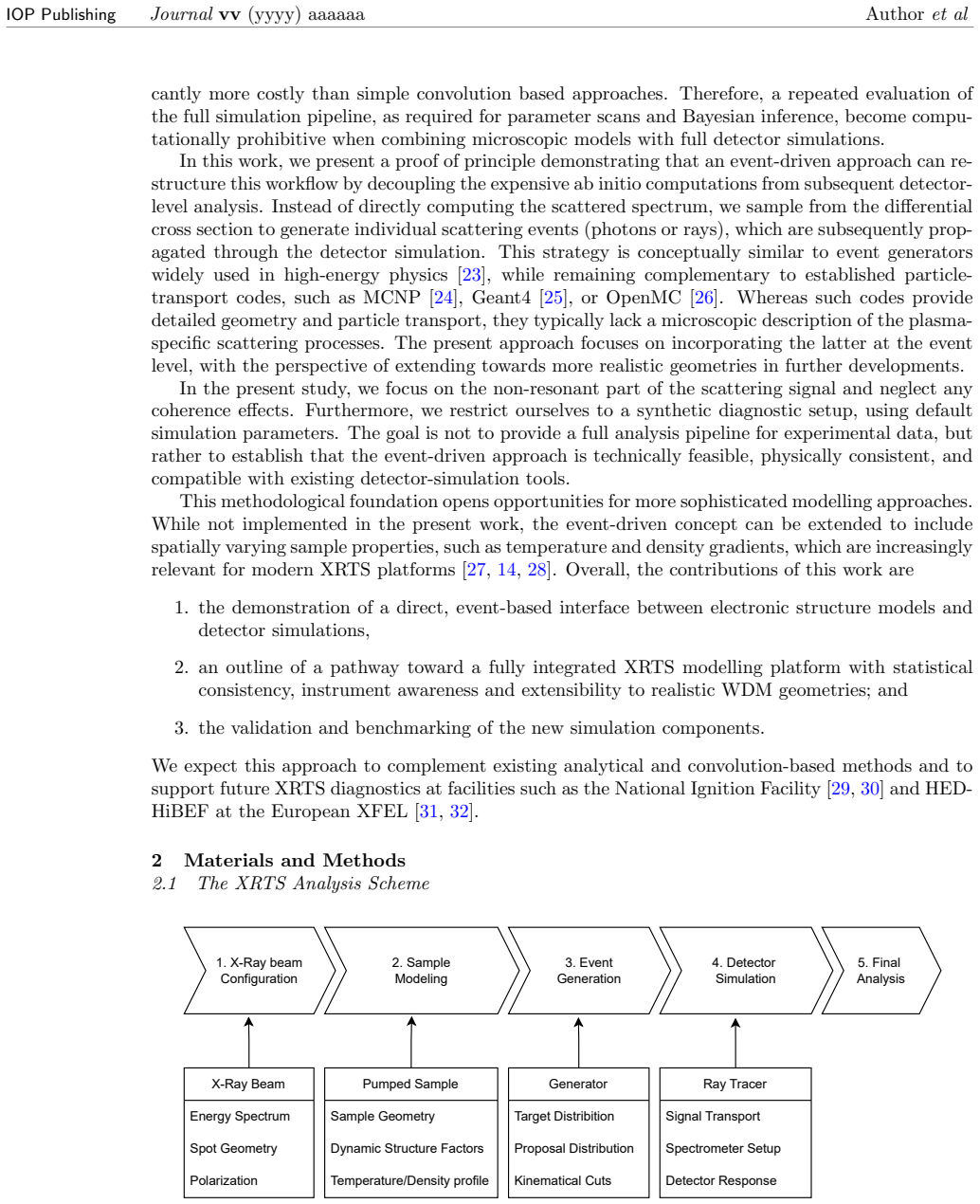
X-ray Thomson scattering signals can be built by sampling individual scattering events from the differential cross section and propagating them through a spectrometer simulation.
A machine-rendered reading of the paper's core claim, the machinery that carries it, and where it could break.
Core claim
The central discovery is that sampling scattering events directly from the differential cross section and feeding them through a spectrometer simulation produces a statistically consistent XRTS signal representation that retains complete kinematic information, supports geometry-aware analysis, and decouples the expensive event-generation step from subsequent detector-level processing.
What carries the argument
Event-driven Monte Carlo sampling of scattering events from the differential cross section, followed by propagation through a spectrometer simulation.
If this is right
- Sampled events can be reused across multiple detector models or analysis pipelines without regenerating the microscopic scattering data.
- Computational cost drops for repeated evaluations because only the detector simulation needs to be rerun.
- Geometry-dependent effects can be studied directly by changing how events are propagated rather than by re-deriving spectra.
- The framework remains compatible with any microscopic model that supplies a differential cross section.
- Inference tasks gain access to the full kinematic information carried by each individual event.
Where Pith is reading between the lines
- The same sampled events could later be filtered or weighted to explore how different resonant or collective contributions would appear in the measured signal.
- Uncertainty propagation becomes more straightforward because statistical fluctuations are carried explicitly by the finite event sample rather than by analytic approximations.
- Combining this generator with other diagnostics, such as X-ray diffraction or emission spectroscopy, would require only a common event list and separate detector modules.
Load-bearing premise
That drawing events from the differential cross section and passing them through the spectrometer simulation will automatically maintain physical consistency and correct statistics for real experimental geometries and for resonant or collective scattering effects.
What would settle it
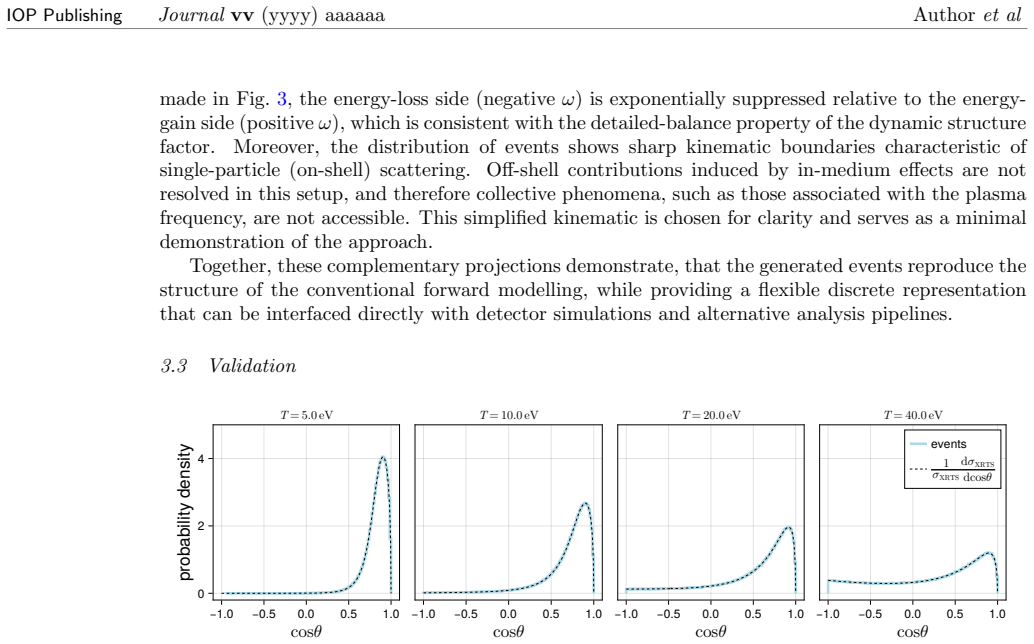
A side-by-side comparison in which the binned energy-angle spectrum obtained from the event-sampled events differs measurably from the spectrum produced by a conventional forward model under identical input conditions and geometry.
Figures




read the original abstract
A key diagnostic in warm-dense matter (WDM) experiments is X-ray Thomson scattering (XRTS), but its interpretation is often limited by complex instrument effects and the high computationally expensive combinations of microscopic models with detector simulations. We present a proof-of-principle implementation of an event-driven approach to XRTS modelling, inspired by particle physics event-generators. Instead of computing the spectra via forward models, individual scattering events are sampled from the differential cross section and sent through a spectrometer simulation. This provides a statistically consistent representation that preserves full kinematic information and enables flexible and geometry-aware analysis. We demonstrate the feasibility and physical consistency of the method for non-resonant XRTS in a synthetic setup. By decoupling event generation from detector-level analysis, the framework allows efficient reuse of the sampled events and reduces computational overhead associated with repeated evaluations. The method is model-agnostic and establishes a new connection between particle-physics event generation techniques and WDM diagnostics, providing a scalable foundation for advanced XRTS analysis and inference.
Editorial analysis
A structured set of objections, weighed in public.
Referee Report
Summary. The paper presents a proof-of-principle implementation of an event-driven Monte-Carlo approach to X-ray Thomson scattering (XRTS) modeling for warm-dense matter diagnostics. Individual scattering events are sampled from the differential cross section and propagated through a spectrometer simulation, demonstrated on synthetic non-resonant data. The method is described as model-agnostic, preserving full kinematic information, enabling geometry-aware analysis, and allowing efficient reuse of events to reduce computational overhead compared to repeated forward-model evaluations.
Significance. If the statistical consistency and physical accuracy are established, the framework could offer a scalable, flexible alternative to traditional XRTS forward modeling by decoupling event generation from detector analysis and bridging techniques from particle-physics event generators to WDM experiments. This may facilitate advanced inference with complex instrument effects while maintaining kinematic fidelity.
major comments (1)
- The demonstration of feasibility and physical consistency (synthetic non-resonant setup) provides no quantitative validation metrics, error analysis, or direct comparisons against established forward models or analytic spectra. This absence makes it impossible to verify the claimed statistical consistency or assess accuracy for the sampled events.
Simulated Author's Rebuttal
We thank the referee for their constructive review and for recognizing the potential of the event-driven Monte-Carlo framework. We address the single major comment below and will revise the manuscript to incorporate quantitative validation as requested.
read point-by-point responses
-
Referee: The demonstration of feasibility and physical consistency (synthetic non-resonant setup) provides no quantitative validation metrics, error analysis, or direct comparisons against established forward models or analytic spectra. This absence makes it impossible to verify the claimed statistical consistency or assess accuracy for the sampled events.
Authors: We agree that the present proof-of-principle demonstration lacks the quantitative metrics, error analysis, and direct comparisons needed for rigorous verification. In the revised manuscript we will add: (i) direct numerical comparisons of the Monte-Carlo-generated spectra against the analytic non-resonant differential cross-section for the same synthetic geometry, including integrated intensity ratios and point-wise residuals; (ii) statistical consistency tests (e.g., chi-squared per degree of freedom and Kolmogorov-Smirnov tests on binned spectra); and (iii) an error budget quantifying sampling variance and propagation through the spectrometer simulation. These additions will allow readers to assess the accuracy and statistical fidelity of the sampled events. revision: yes
Circularity Check
No significant circularity detected
full rationale
The manuscript describes a proof-of-principle Monte-Carlo sampling framework that generates individual XRTS scattering events directly from the differential cross section and routes them through a spectrometer model. This construction is a straightforward adaptation of standard event-generator techniques; the output spectra are not defined in terms of any fitted parameters or prior results from the same work. No equations, self-citations, or uniqueness claims are presented that would reduce the central method to its own inputs by construction. The demonstration is limited to non-resonant synthetic cases and remains self-contained against external benchmarks.
Axiom & Free-Parameter Ledger
Lean theorems connected to this paper
-
IndisputableMonolith/Cost/FunctionalEquation.leanwashburn_uniqueness_aczel unclear?
unclearRelation between the paper passage and the cited Recognition theorem.
we use the standard acceptance-rejection algorithm ... VEGAS-style proposal ... quantile-reduction method (QR)
-
IndisputableMonolith/Foundation/AbsoluteFloorClosure.leanreality_from_one_distinction unclear?
unclearRelation between the paper passage and the cited Recognition theorem.
differential cross section ... F(p_in, pout) = ω'/ω_X S(Q) ... RPA ... Lindhard function
What do these tags mean?
- matches
- The paper's claim is directly supported by a theorem in the formal canon.
- supports
- The theorem supports part of the paper's argument, but the paper may add assumptions or extra steps.
- extends
- The paper goes beyond the formal theorem; the theorem is a base layer rather than the whole result.
- uses
- The paper appears to rely on the theorem as machinery.
- contradicts
- The paper's claim conflicts with a theorem or certificate in the canon.
- unclear
- Pith found a possible connection, but the passage is too broad, indirect, or ambiguous to say the theorem truly supports the claim.
Forward citations
Cited by 2 Pith papers
-
Model-free interpretation of X-ray Thomson scattering measurements
The paper reviews the use of the imaginary-time correlation function to extract temperature, normalization, and Rayleigh weight from XRTS spectra without model dependence.
-
Overview of X-ray Thomson scattering measurements of extreme states of matter
XRTS has become a leading diagnostic for extreme states of matter, and this review compiles prior experiments, analysis methods, and future directions.
Reference graph
Works this paper leans on
-
[1]
Theoretical model of x-ray scattering as a dense matter probe
Gregori G, Glenzer SH, Rozmus W, Lee R, Landen O. Theoretical model of x-ray scattering as a dense matter probe. Physical Review E. 2003;67(2):026412
2003
-
[2]
X-ray Thomson scattering in high energy density plasmas
Glenzer SH, Redmer R. X-ray Thomson scattering in high energy density plasmas. Reviews of Modern Physics. 2009;81(4):1625-63
2009
-
[3]
Plasma scattering of electromagnetic radiation: theory and measurement techniques
Sheffield J, Froula D, Glenzer SH, Luhmann Jr NC. Plasma scattering of electromagnetic radiation: theory and measurement techniques. Academic press; 2010
2010
-
[4]
Experimental methods for warm dense matter research
Falk K. Experimental methods for warm dense matter research. High Power Laser Science and Engineering. 2018;6:e59
2018
-
[5]
Frontiers and challenges in warm dense matter
Graziani F, Desjarlais MP, Redmer R, Trickey SB. Frontiers and challenges in warm dense matter. vol. 96. Springer Science & Business; 2014
2014
-
[6]
Roadmap for warm dense matter physics
Vorberger J, Graziani F, Riley D, Baczewski AD, Baraffe I, Bethkenhagen M, et al. Roadmap for warm dense matter physics. arXiv preprint arXiv:250502494. 2025
2025
-
[7]
Inertial-confinement fusion with lasers
Betti R, Hurricane O. Inertial-confinement fusion with lasers. Nature Physics. 2016;12(5):435- 48
2016
-
[8]
Physics principles of inertial confinement fusion and US program overview
Hurricane OA, Patel P, Betti R, Froula DH, Regan S, Slutz SA, et al. Physics principles of inertial confinement fusion and US program overview. Reviews of Modern Physics. 2023;95(2):025005
2023
-
[9]
Present understanding of ignition and gain using indirect-drive inertial confinement fusion target designs on the US National Ignition Facility
Hurricane O, Allen A, Bachmann B, Baker K, Baxamusa S, Bhandarkar S, et al. Present understanding of ignition and gain using indirect-drive inertial confinement fusion target designs on the US National Ignition Facility. Plasma Physics and Controlled Fusion. 2024;67(1):015019
2024
-
[10]
Dense plasmas in astrophysics: from giant planets to neutron stars
Chabrier G, Saumon D, Potekhin A. Dense plasmas in astrophysics: from giant planets to neutron stars. Journal of Physics A: Mathematical and General. 2006;39(17):4411
2006
-
[11]
Understanding Jupiter’s interior
Militzer B, Soubiran F, Wahl SM, Hubbard W. Understanding Jupiter’s interior. Journal of Geophysical Research: Planets. 2016;121(9):1552-72
2016
-
[12]
Understanding dense hydrogen at planetary conditions
Helled R, Mazzola G, Redmer R. Understanding dense hydrogen at planetary conditions. Nature Reviews Physics. 2020;2(10):562-74
2020
-
[13]
Current challenges in the physics of white dwarf stars
Saumon D, Blouin S, Tremblay PE. Current challenges in the physics of white dwarf stars. Physics Reports. 2022;988:1-63
2022
-
[14]
Simulating x-ray Thomson scattering signals from high-density, millimetre-scale plasmas at the National Ignition Facility
Chapman DA, Kraus D, Kritcher AL, Bachmann B, Collins GW, Falcone RW, et al. Simulating x-ray Thomson scattering signals from high-density, millimetre-scale plasmas at the National Ignition Facility. Physics of Plasmas. 2014 08;21(8):082709
2014
-
[15]
Strong geometry dependence of the x-ray Thomson scattering spectrum in single crystal silicon
Gawne T, Moldabekov ZA, Humphries OS, Appel K, Baehtz C, Bouffetier V, et al. Strong geometry dependence of the x-ray Thomson scattering spectrum in single crystal silicon. Elec- tronic Structure. 2025;7(2):025002. 12 IOP PublishingJournalvv(yyyy) aaaaaa Authoret al
2025
-
[16]
A Composite Ansatz for Calculation of Dynamical Structure Factor
Zhang Y, Mo C, Zhang P, Kang W. A Composite Ansatz for Calculation of Dynamical Structure Factor. Chinese Physics Letters. 2024 jan;41(1):017801
2024
-
[17]
Unravel- ing electronic correlations in warm dense quantum plasmas
Dornheim T, D¨ oppner T, Tolias P, B¨ ohme MP, Fletcher LB, Gawne T, et al. Unravel- ing electronic correlations in warm dense quantum plasmas. Nature Communications. 2025 Jun;16(1):5103
2025
-
[18]
Ab initio Path Integral Monte Carlo Results for the Dynamic Structure Factor of Correlated Electrons: From the Electron Liquid to Warm Dense Matter
Dornheim T, Groth S, Vorberger J, Bonitz M. Ab initio Path Integral Monte Carlo Results for the Dynamic Structure Factor of Correlated Electrons: From the Electron Liquid to Warm Dense Matter. Phys Rev Lett. 2018;121:255001
2018
-
[19]
X-ray Thomson Scattering in Warm Dense Matter without the Chihara Decomposition
Baczewski AD, Shulenburger L, Desjarlais MP, Hansen SB, Magyar RJ. X-ray Thomson Scattering in Warm Dense Matter without the Chihara Decomposition. Phys Rev Lett. 2016;116:115004
2016
-
[20]
X-ray Thomson scattering spectra from density functional theory molecular dynamics simulations based on a modified Chihara formula
Sch¨ orner M, Bethkenhagen M, D¨ oppner T, Kraus D, Fletcher LB, Glenzer SH, et al. X-ray Thomson scattering spectra from density functional theory molecular dynamics simulations based on a modified Chihara formula. Phys Rev E. 2023 Jun;107:065207
2023
-
[21]
Applying the Liouville–Lanczos method of time-dependent density-functional theory to warm dense matter
Moldabekov ZA, Schwalbe S, Gawne T, Preston TR, Vorberger J, Dornheim T. Applying the Liouville–Lanczos method of time-dependent density-functional theory to warm dense matter. Matter and Radiation at Extremes. 2025 05;10(4):047601
2025
-
[22]
Dynamical structure factors of warm dense matter from time-dependent orbital- free and mixed-stochastic-deterministic density functional theory
White AJ. Dynamical structure factors of warm dense matter from time-dependent orbital- free and mixed-stochastic-deterministic density functional theory. Electronic Structure. 2025 feb;7(1):014001
2025
-
[23]
General-purpose event generators for LHC physics
Buckley A, Butterworth J, Gieseke S, Grellscheid D, H¨ oche S, Hoeth H, et al. General-purpose event generators for LHC physics. Physics Reports. 2011;504(5):145-233
2011
-
[24]
MCNP-a general Monte Carlo code for neutron and photon transport
Forster R, Godfrey T. MCNP-a general Monte Carlo code for neutron and photon transport. In: Monte-Carlo Methods and Applications in Neutronics, Photonics and Statistical Physics: Proceedings of the Joint Los Alamos National Laboratory-Commissariat ` a l’Energie Atomique Meeting Held at Cadarache Castle, Provence, France April 22–26, 1985. Springer; 2006. p. 33-55
1985
-
[25]
Geant4—a sim- ulation toolkit
Agostinelli S, Allison J, Amako Ka, Apostolakis J, Araujo H, Arce P, et al. Geant4—a sim- ulation toolkit. Nuclear instruments and methods in physics research section A: Accelerators, Spectrometers, Detectors and Associated Equipment. 2003;506(3):250-303
2003
-
[26]
The OpenMC monte carlo particle transport code
Romano PK, Forget B. The OpenMC monte carlo particle transport code. Annals of Nuclear Energy. 2013;51:274-81
2013
-
[27]
Simulation of X-ray scattering diagnostics in multi-dimensional plasma
Golovkin I, MacFarlane JJ, Woodruff P, Hall I, Gregori G, Bailey J, et al. Simulation of X-ray scattering diagnostics in multi-dimensional plasma. High Energy Density Physics. 2013;9(3):510- 5
2013
-
[28]
Investigating the impact of intermediate-mode perturbations on diagnosing plasma conditions in DT cryogenic implo- sions via synthetic x-ray Thomson scattering
Poole H, Cao D, Epstein R, Golovkin I, Goncharov VN, Hu SX, et al. Investigating the impact of intermediate-mode perturbations on diagnosing plasma conditions in DT cryogenic implo- sions via synthetic x-ray Thomson scattering. Plasma Physics and Controlled Fusion. 2024 dec;67(1):015034
2024
-
[29]
Ob- serving the onset of pressure-driven K-shell delocalization
D¨ oppner T, Bethkenhagen M, Kraus D, Neumayer P, Chapman DA, Bachmann B, et al. Ob- serving the onset of pressure-driven K-shell delocalization. Nature. 2023 May
2023
-
[30]
The colliding planar shocks platform to study warm dense matter at the National Ignition Facility
MacDonald MJ, Di Stefano CA, Doeppner T, Fletcher L, Flippo KA, Kalantar D, et al. The colliding planar shocks platform to study warm dense matter at the National Ignition Facility. Physics of Plasmas. 2023;30(6)
2023
-
[31]
Experimen- tal Evidence for the Breakdown of Uniform-Electron-Gas Models in Warm Dense Aluminium
Bespalov DS, Zastrau U, Moldabekov ZA, Gawne T, Dornheim T, Meshhal M, et al.. Experimen- tal Evidence for the Breakdown of Uniform-Electron-Gas Models in Warm Dense Aluminium
-
[32]
Available from:https://arxiv.org/abs/2509.10107
work page internal anchor Pith review Pith/arXiv arXiv
-
[33]
Ultrahigh resolution x-ray Thomson scattering measurements at the European X-ray Free Electron Laser
Gawne T, Moldabekov ZA, Humphries OS, Appel K, Baehtz C, Bouffetier V, et al. Ultrahigh resolution x-ray Thomson scattering measurements at the European X-ray Free Electron Laser. Physical Review B. 2024;109(24):L241112. 13 IOP PublishingJournalvv(yyyy) aaaaaa Authoret al
2024
-
[34]
The matter in extreme conditions instrument at the Linac coherent light source
Nagler B, Arnold B, Bouchard G, Boyce RF, Boyce RM, Callen A, et al. The matter in extreme conditions instrument at the Linac coherent light source. Synchrotron Radiation. 2015;22(3):520- 5
2015
-
[35]
Matter under extreme conditions experiments at the Linac Coherent Light Source
Glenzer S, Fletcher L, Galtier E, Nagler B, Alonso-Mori R, Barbrel B, et al. Matter under extreme conditions experiments at the Linac Coherent Light Source. Journal of Physics B: Atomic, Molecular and Optical Physics. 2016;49(9):092001
2016
-
[36]
Design of inertial fusion implosions reaching the burning plasma regime
Kritcher A, Young C, Robey H, Weber C, Zylstra A, Hurricane O, et al. Design of inertial fusion implosions reaching the burning plasma regime. Nature Physics. 2022;18(3):251-8
2022
-
[37]
Design and performance characterisation of the HAPG von H´ amos spectrometer at the high energy density instrument of the European XFEL
Preston T, G¨ ode S, Schwinkendorf JP, Appel K, Brambrink E, Cerantola V, et al. Design and performance characterisation of the HAPG von H´ amos spectrometer at the high energy density instrument of the European XFEL. Journal of Instrumentation. 2020;15(11):P11033-3
2020
-
[38]
Effects of mosaic crystal instrument functions on x-ray Thomson scattering diagnostics
Gawne T, Bellenbaum H, Fletcher LB, Appel K, Baehtz C, Bouffetier V, et al. Effects of mosaic crystal instrument functions on x-ray Thomson scattering diagnostics. Journal of Applied Physics. 2024 09;136(10):105902
2024
-
[39]
Physics of shock waves and high-temperature hydrodynamic phe- nomena
Zel’Dovich YB, Raizer YP. Physics of shock waves and high-temperature hydrodynamic phe- nomena. Courier Corporation; 2002
2002
-
[40]
The equations of radiation hydrodynamics
Pomraning GC. The equations of radiation hydrodynamics. Courier Corporation; 2005
2005
-
[41]
Foundations of radiation hydrodynamics
Mihalas D, Mihalas BW. Foundations of radiation hydrodynamics. Courier Corporation; 2013
2013
-
[42]
Con- temporary particle-in-cell approach to laser-plasma modelling
Arber TD, Bennett K, Brady CS, Lawrence-Douglas A, Ramsay MG, Sircombe NJ, et al. Con- temporary particle-in-cell approach to laser-plasma modelling. Plasma Physics and Controlled Fusion. 2015 sep;57(11):113001
2015
-
[43]
Plasma physics via computer simulation
Birdsall CK, Langdon AB. Plasma physics via computer simulation. CRC press; 2018
2018
-
[44]
Bayesian inference and the analytic continuation of imaginary-time quantum Monte Carlo data
Jarrell M, Gubernatis JE. Bayesian inference and the analytic continuation of imaginary-time quantum Monte Carlo data. Physics Reports. 1996;269(3):133-95
1996
-
[45]
PyLIT: Reformulation and implementation of the analytic continuation problem using kernel representation methods
Benedix Robles A, Hofmann PA, Chuna T, Dornheim T, Hecht M. PyLIT: Reformulation and implementation of the analytic continuation problem using kernel representation methods. Computer Physics Communications. 2026;319:109904
2026
-
[46]
Chuna T, Barnfield N, Hamann P, Schwalbe S, Friedlander MP, Dornheim T. The noiseless limit and improved-prior limit of the maximum entropy method and their implications for the analytic continuation problem; 2025. Available from:https://arxiv.org/abs/2511.06915
-
[47]
Various techniques used in connection with random digits
Von Neumann J. Various techniques used in connection with random digits. John von Neumann, Collected Works. 1963;5:768-70
1963
-
[48]
Von Neumann’s comparison method for random sampling from the normal and other distributions
Forsythe GE. Von Neumann’s comparison method for random sampling from the normal and other distributions. Mathematics of Computation. 1972;26(120):817-26
1972
-
[49]
Monte Carlo theory and practice
James F. Monte Carlo theory and practice. Reports on progress in Physics. 1980;43(9):1145
1980
-
[50]
Nonuniform random variate generation
Devroye L. Nonuniform random variate generation. Handbooks in operations research and management science. 2006;13:83-121
2006
-
[51]
Monte carlo and quasi-monte carlo sampling
Lemieux C. Monte carlo and quasi-monte carlo sampling. Springer Series in Statistics. Springer New York, NY; 2009
2009
-
[52]
Handbook of monte carlo methods
Kroese DP, Taimre T, Botev ZI. Handbook of monte carlo methods. John Wiley & Sons; 2013
2013
-
[53]
Simulation and the Monte Carlo method
Rubinstein RY, Kroese DP. Simulation and the Monte Carlo method. John Wiley & Sons; 2016
2016
-
[54]
A New Algorithm for Adaptive Multidimensional Integration
Lepage GP. A New Algorithm for Adaptive Multidimensional Integration. J Comput Phys. 1978;27:192
1978
-
[55]
Vegas revisited: Adaptive Monte Carlo integration beyond factorization
Ohl T. Vegas revisited: Adaptive Monte Carlo integration beyond factorization. Comput Phys Commun. 1999;120:13-9. 14 IOP PublishingJournalvv(yyyy) aaaaaa Authoret al
1999
-
[56]
Adaptive multidimensional integration: VEGAS enhanced
Lepage GP. Adaptive multidimensional integration: VEGAS enhanced. J Comput Phys. 2021;439:110386
2021
-
[57]
Survey Sampling
Kish L. Survey Sampling. Wiley Classics Library. John Wiley & Sons; 1995
1995
-
[58]
Accelerating Monte Carlo event generation– rejection sampling using neural network event-weight estimates
Danziger K, Janßen T, Schumann S, Siegert F. Accelerating Monte Carlo event generation– rejection sampling using neural network event-weight estimates. SciPost Physics. 2022;12(5):164
2022
-
[59]
HEART: A new X-ray tracing code for mosaic crystal spectrometers
Gawne T, Schwalbe S, Chuna T, Acosta UH, Preston TR, Dornheim T. HEART: A new X-ray tracing code for mosaic crystal spectrometers. Computer Physics Communications. 2025:109878
2025
-
[60]
Julia: A fresh approach to numerical computing
Bezanson J, Edelman A, Karpinski S, Shah VB. Julia: A fresh approach to numerical computing. SIAM Review. 2017;59(1):65-98
2017
-
[61]
XRTSProbing.jl (Version v0.0.1); 2026
Uwe Hernandez Acosta. XRTSProbing.jl (Version v0.0.1); 2026. Available from:https:// github.com/JuliaXRTS/XRTSProbing.jl
2026
-
[62]
ElectronicStructureModels.jl (Version v0.2.1); 2025-12-19
Hernandez Acosta U. ElectronicStructureModels.jl (Version v0.2.1); 2025-12-19. Available from: https://github.com/JuliaXRTS/ElectronicStructureModels.jl
2025
-
[63]
QuantumElectrody- namics.jl (Version v0.4.0); 2026-03-30
Hernandez Acosta U, Reinhard A, Ehrig S, Steiniger K, Bussmann M. QuantumElectrody- namics.jl (Version v0.4.0); 2026-03-30. http://doi.org/10.14278/rodare.4584. Available from: https://github.com/QEDjl-project/QuantumElectrodynamics.jl
-
[64]
The uniform electron gas at warm dense matter conditions
Dornheim T, Groth S, Bonitz M. The uniform electron gas at warm dense matter conditions. Phys Reports. 2018;744:1-86
2018
-
[65]
The fluctuation-dissipation theorem
Kubo R. The fluctuation-dissipation theorem. Reports on progress in physics. 1966;29(1):255- 84
1966
-
[66]
CODATA recommended values of the fundamental physical constants: 2022
Mohr PJ, Newell DB, Taylor BN, Tiesinga E. CODATA recommended values of the fundamental physical constants: 2022. Reviews of Modern Physics. 2025;97(2):025002
2022
-
[67]
Quantum theory of the electron liquid
Giuliani G, Vignale G. Quantum theory of the electron liquid. Cambridge university press; 2008
2008
-
[68]
Char- acterization results of the JUNGFRAU full scale readout ASIC
Mozzanica A, Bergamaschi A, Brueckner M, Cartier S, Dinapoli R, Greiffenberg D, et al. Char- acterization results of the JUNGFRAU full scale readout ASIC. Journal of Instrumentation. 2016;11(02):C02047-7
2016
-
[69]
A conceptual model for ray tracing calculations with mosaic crystals
Sanchez del Rio M, Bernstorff S, Savoia A, Cerrina F. A conceptual model for ray tracing calculations with mosaic crystals. Review of scientific instruments. 1992;63(1):932-5
1992
-
[70]
Focal aberra- tions of large-aperture HOPG von-H` amos x-ray spectrometers
Zastrau U, Brown C, D¨ oppner T, Glenzer S, Gregori G, Lee H, et al. Focal aberra- tions of large-aperture HOPG von-H` amos x-ray spectrometers. Journal of Instrumentation. 2012;7(09):P09015-5
2012
-
[71]
Inverse problem in- stabilities in large-scale modeling of matter in extreme conditions
Kasim MF, Galligan TP, Topp-Mugglestone J, Gregori G, Vinko SM. Inverse problem in- stabilities in large-scale modeling of matter in extreme conditions. Physics of Plasmas. 2019 11;26(11):112706
2019
-
[72]
On the properties of a gas of charged particles
Lindhard J. On the properties of a gas of charged particles. Kgl Danske Videnskab Selskab Mat-Fys Medd. 1953;28
1953
-
[73]
Efficient technique to evaluate the Lindhard dielectric function
Ancarani LU, Jouin H. Efficient technique to evaluate the Lindhard dielectric function. The European Physical Journal Plus. 2016;131(4):114. 15
2016
discussion (0)
Sign in with ORCID, Apple, or X to comment. Anyone can read and Pith papers without signing in.