Recognition: no theorem link
Quantum Machine Learning for particle scattering entanglement classification
Pith reviewed 2026-05-10 19:48 UTC · model grok-4.3
The pith
Quantum convolutional neural networks classify particle scattering entanglement from fermion density profiles, matching or exceeding classical CNN performance especially at small sizes.
A machine-rendered reading of the paper's core claim, the machinery that carries it, and where it could break.
Core claim
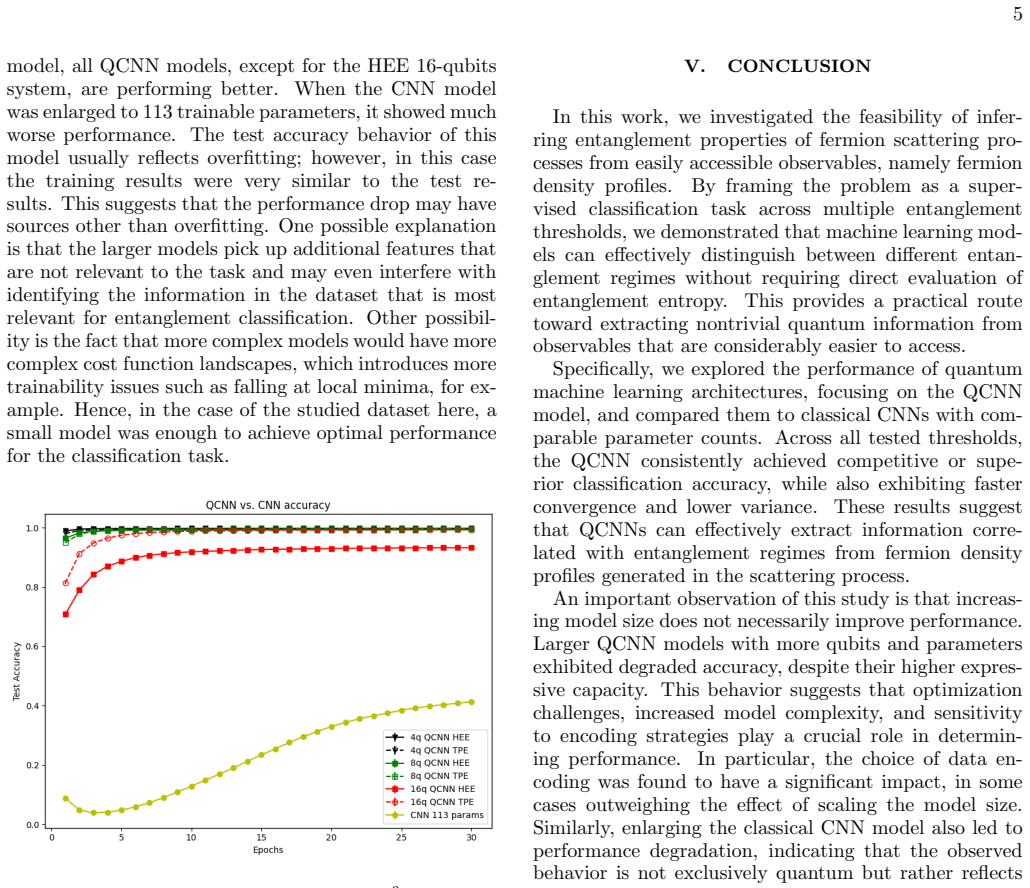
In the Thirring model of fermion scattering, fermion density profiles can serve as input features for classifying the degree of entanglement across various thresholds. Quantum Convolutional Neural Networks achieve consistently competitive or superior accuracy compared to classical Convolutional Neural Networks with similar parameter counts, along with faster convergence and lower variance across runs. The study finds that larger model sizes do not enhance performance and that bigger models are more sensitive to encoding choices, with a compact 4-qubit QCNN yielding the optimal results. This indicates that trainability and encoding strategies are more critical than model scaling for this task
What carries the argument
Quantum Convolutional Neural Networks (QCNNs), quantum circuit architectures that apply convolutional-like operations to quantum states, used to process fermion density profiles and output classifications of entanglement thresholds.
If this is right
- QCNNs can extract nontrivial quantum information from accessible observables in particle scattering processes.
- Compact quantum models can outperform larger ones for entanglement-related tasks due to better trainability.
- Encoding choices critically affect the success of quantum machine learning architectures in physics applications.
- These methods carry implications for analyzing quantum correlations in high-energy physics and many-body systems.
Where Pith is reading between the lines
- The same density-to-entanglement mapping could be tested in other quantum field theory models or lattice gauge theories.
- If the approach scales, it may allow entanglement studies on quantum hardware without full state reconstruction.
- Similar quantum ML pipelines might classify other hard-to-measure quantities such as topological invariants from local density data.
- Real experimental data from quantum simulators or particle detectors could directly test whether the observed accuracy advantage persists outside numerical simulations.
Load-bearing premise
Fermion density profiles contain enough information to serve as reliable proxies for entanglement when the task is framed as classification across multiple entanglement thresholds.
What would settle it
In a new set of Thirring-model scattering configurations with independently computed entanglement values, the 4-qubit QCNN classification accuracy drops below that of a comparable classical CNN or shows no correlation with the true entanglement thresholds.
Figures

read the original abstract
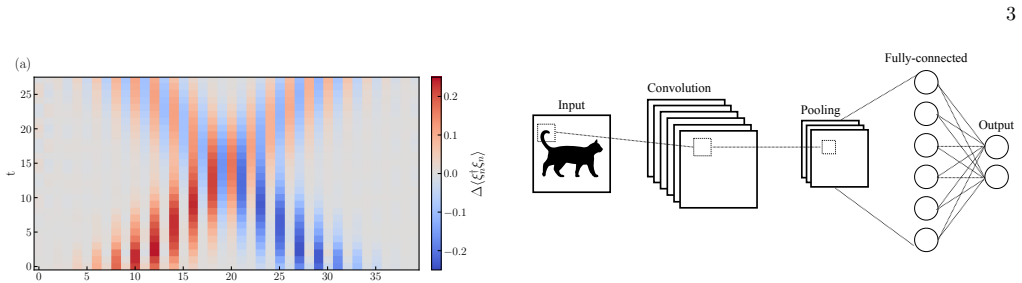
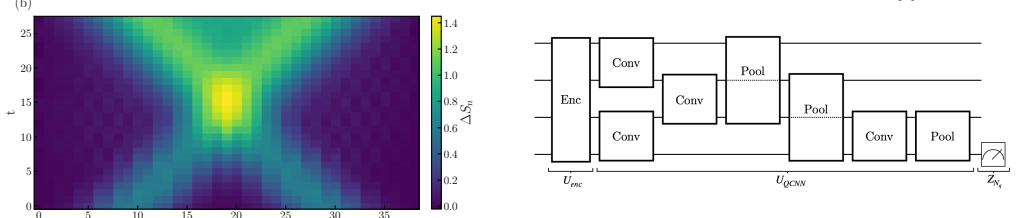
Entanglement is a key quantity for characterizing quantum correlations in particle scattering processes, but its direct evaluation is computationally demanding on quantum hardware. In this work, we investigate whether fermion density profiles, which are easier to access, can serve as proxies for entanglement by framing the problem as a classification task across multiple entanglement thresholds. Using the fermion scattering in the Thirring model as a test bed, we compare Quantum Convolutional Neural Networks (QCNNs) with classical CNNs of comparable parameter counts, and find that QCNNs achieve consistently competitive or superior accuracy with faster convergence and lower variance. Notably, we observe that increasing the model size does not improve the performance within the architectures studied here, and larger models appear to be more sensitive to the choice of encoding. Instead, a compact 4-qubits QCNN provides the best results, suggesting the importance of trainability and encoding choices over model scaling. These findings demonstrate the potential of quantum and quantum-inspired machine learning models for extracting nontrivial quantum information from accessible observables, with implications for high-energy physics and quantum many-body systems.
Editorial analysis
A structured set of objections, weighed in public.
Referee Report
Summary. The manuscript frames entanglement classification in Thirring-model fermion scattering as a multi-threshold task using fermion density profiles as input features. It compares quantum convolutional neural networks (QCNNs) against classical CNNs of comparable parameter count and reports that QCNNs achieve competitive or superior accuracy, faster convergence, and lower variance, with a compact 4-qubit QCNN emerging as optimal; the work concludes that trainability and encoding choices matter more than model scaling for extracting nontrivial quantum information from accessible observables.
Significance. If the empirical comparison holds under proper statistical controls, the result would indicate that compact quantum machine-learning architectures can extract entanglement information from local density profiles in quantum field theory simulations more efficiently than classical counterparts, with direct relevance to high-energy physics and many-body systems. The reported observation that increasing model size does not improve performance and that larger models are more sensitive to encoding is a concrete, useful datum for understanding QML trainability limits.
major comments (3)
- [Abstract] Abstract: the central claim that QCNNs achieve 'consistently competitive or superior accuracy with faster convergence and lower variance' is presented without any quantitative support (dataset size, number of independent runs, error bars, exact baseline accuracies, or training protocols), rendering the performance comparison unverifiable from the text.
- [Introduction / Methods] The assumption that fermion density profiles serve as reliable proxies for entanglement thresholds (von Neumann entropy across bipartitions) is load-bearing for the entire classification task, yet no correlation, mutual-information, or ablation diagnostic is supplied to confirm that the input features carry nontrivial signal rather than spurious correlations.
- [Results] Results section: the assertion that a 4-qubit QCNN is optimal and that larger models are more sensitive to encoding lacks tabulated accuracy values, variance measures, or statistical significance tests against the classical CNN baselines, so the model-size and encoding conclusions cannot be assessed.
minor comments (1)
- [Abstract] Clarify whether 'quantum-inspired' models beyond QCNNs are actually evaluated, as the abstract mentions them but the comparison appears limited to QCNNs versus classical CNNs.
Simulated Author's Rebuttal
We thank the referee for their constructive and detailed comments, which have helped us identify areas where the manuscript can be strengthened for greater clarity, verifiability, and rigor. We have revised the manuscript to address all three major comments by adding the requested quantitative details, validation analyses, and statistical measures. Our point-by-point responses follow.
read point-by-point responses
-
Referee: [Abstract] Abstract: the central claim that QCNNs achieve 'consistently competitive or superior accuracy with faster convergence and lower variance' is presented without any quantitative support (dataset size, number of independent runs, error bars, exact baseline accuracies, or training protocols), rendering the performance comparison unverifiable from the text.
Authors: We agree that the abstract requires explicit quantitative support to make the performance claims verifiable. In the revised manuscript we have updated the abstract to state the dataset size, the number of independent runs, the reported accuracies with error bars, and direct references to the baseline values and training protocols now detailed in the Methods section. These additions preserve the abstract's brevity while ensuring the comparison is fully supported by the text. revision: yes
-
Referee: [Introduction / Methods] The assumption that fermion density profiles serve as reliable proxies for entanglement thresholds (von Neumann entropy across bipartitions) is load-bearing for the entire classification task, yet no correlation, mutual-information, or ablation diagnostic is supplied to confirm that the input features carry nontrivial signal rather than spurious correlations.
Authors: We acknowledge that a direct diagnostic of the proxy relationship strengthens the foundation of the work. Although the classification results provide supporting evidence, we have added a new subsection to the Methods section containing Pearson correlation coefficients between the density-profile features and the target entanglement-entropy thresholds, together with an ablation study that systematically removes feature subsets. These analyses confirm that the inputs carry nontrivial signal. revision: yes
-
Referee: [Results] Results section: the assertion that a 4-qubit QCNN is optimal and that larger models are more sensitive to encoding lacks tabulated accuracy values, variance measures, or statistical significance tests against the classical CNN baselines, so the model-size and encoding conclusions cannot be assessed.
Authors: We agree that tabulated values and statistical tests are necessary to substantiate the model-size and encoding conclusions. In the revised Results section we have inserted a new table that reports accuracy, convergence metrics, and variance (with standard deviations across runs) for every QCNN size and encoding variant, together with p-values from two-sample t-tests against the classical CNN baselines. This table directly supports the optimality of the 4-qubit architecture and the greater encoding sensitivity of larger models. revision: yes
Circularity Check
No circularity: empirical ML comparison with externally verifiable results
full rationale
The paper reports numerical experiments training QCNNs and CNNs to classify entanglement thresholds from fermion density profiles in the Thirring model. No equations, derivations, or fitted parameters are presented whose outputs reduce by construction to the inputs (e.g., no self-definitional ratios or predictions forced by subset fits). Reported accuracies, convergence, and variance are direct experimental outcomes on held-out data and can be reproduced independently. The proxy assumption (density profiles as entanglement indicators) is an empirical hypothesis evaluated by classification performance rather than a definitional tautology. No load-bearing self-citations or uniqueness theorems appear in the provided text.
Axiom & Free-Parameter Ledger
axioms (1)
- domain assumption Fermion density profiles contain sufficient information to classify entanglement levels when framed as a multi-threshold classification task
Reference graph
Works this paper leans on
- [1]
-
[2]
Classification with Quantum Neural Networks on Near Term Processors
E. Farhi and H. Neven, arXiv preprint arXiv:1802.06002 (2018), arXiv:1802.06002
work page Pith review arXiv 2018
-
[3]
K. Mitarai, M. Negoro, M. Kitagawa, and K. Fujii, Phys- ical Review A98, 10.1103/physreva.98.032309 (2018)
-
[4]
Parameterized quantum circuits as machine learning models,
M. Benedetti, E. Lloyd, S. Sack, and M. Fioren- tini, Quantum Sci. Technol.4, 043001 (2019), arXiv:1906.07682 [quant-ph]
-
[5]
Schuld, A
M. Schuld, A. Bocharov, K. M. Svore, and N. Wiebe, Phys. Rev. A101, 032308 (2020)
2020
- [6]
- [7]
-
[8]
J. Y. Araz and M. Spannowsky, Journal of High Energy Physics2021, 10.1007/jhep08(2021)112 (2021)
-
[9]
J. Y. Araz and M. Spannowsky, Physical Review A106, 10.1103/physreva.106.062423 (2022)
-
[10]
A. Gianelle, P. Koppenburg, D. Lucchesi, D. Nico- tra, E. Rodrigues, L. Sestini, J. de Vries, and D. Zuliani, Journal of High Energy Physics2022, 10.1007/jhep08(2022)014 (2022)
-
[11]
Belis, P
V. Belis, P. Odagiu, and T. K. Aarrestad, Reviews in Physics12, 100091 (2024)
2024
- [12]
- [13]
-
[14]
Y. Chai, A. Crippa, K. Jansen, S. K¨ uhn, V. R. Pascuzzi, F. Tacchino, and I. Tavernelli, Quantum9, 1638 (2025)
2025
-
[15]
Davoudi, C.-C
Z. Davoudi, C.-C. Hsieh, and S. V. Kadam, Quantum8, 1520 (2024)
2024
-
[16]
Z. Davoudi, C.-C. Hsieh, and S. V. Kadam, Quantum computation of hadron scattering in a lattice gauge the- ory (2025), arXiv:2505.20408 [quant-ph]
-
[17]
R. C. Farrell, M. Illa, A. N. Ciavarella, and M. J. Savage, Phys. Rev. D109, 114510 (2024)
2024
- [18]
-
[19]
N. A. Zemlevskiy, Physical Review D112, 10.1103/qr72- 51v1 (2025)
- [20]
-
[21]
J. Schuhmacher, G.-X. Su, J. J. Osborne, A. Gandon, J. C. Halimeh, and I. Tavernelli, Observation of hadron scattering in a lattice gauge theory on a quantum com- puter (2025), arXiv:2505.20387 [quant-ph]
-
[22]
I. Cong, S. Choi, and M. D. Lukin, Nature Physics (2019) https://doi.org/10.1038/s41567-019-0648-8 (2019)
-
[23]
T. Hur, L. Kim, and D. K. Park, Quantum Machine Intel- ligence 4, 3 (2022) https://doi.org/10.1007/s42484-021- 00061-x (2021)
- [24]
-
[25]
W. E. Thirring, Annals of Physics3, 91 (1958)
1958
-
[26]
Kogut and L
J. Kogut and L. Susskind, Phys. Rev. D11, 395 (1975)
1975
-
[27]
Susskind, Phys
L. Susskind, Phys. Rev. D16, 3031 (1977)
1977
-
[28]
M. C. Ba˜ nuls, K. Cichy, Y.-J. Kao, C.-J. D. Lin, Y.-P. Lin, and D. T.-L. Tan, Phys. Rev. D100, 094504 (2019)
2019
-
[29]
Rigobello, S
M. Rigobello, S. Notarnicola, G. Magnifico, and S. Mon- tangero, Phys. Rev. D104, 114501 (2021)
2021
-
[30]
S. Thanasilp, S. Wang, N. A. Nghiem, P. J. Coles, and M. Cerezo, arXiv e-prints , arXiv:2110.14753 (2021), arXiv:2110.14753 [quant-ph]
-
[31]
D. P. Kingma and J. Ba, arXiv e-prints , arXiv:1412.6980 (2014), arXiv:1412.6980 [cs.LG]
work page internal anchor Pith review Pith/arXiv arXiv 2014
discussion (0)
Sign in with ORCID, Apple, or X to comment. Anyone can read and Pith papers without signing in.