Recognition: 1 theorem link
· Lean TheoremOccurrence of Flat-top Electron Velocity Distributions in Magnetotail Plasma Jets
Pith reviewed 2026-05-10 18:13 UTC · model grok-4.3
The pith
Flat-top electron velocity distributions occur in most magnetotail plasma jets but only about 7% of all measured distributions.
A machine-rendered reading of the paper's core claim, the machinery that carries it, and where it could break.
Core claim
Only about 7% of the electron velocity distribution functions in the jets are flat-tops. Nevertheless, most jets exhibit flat-top eVDFs, indicating that this signature of parallel acceleration and electron streaming is characteristic of the jets. These flat-top eVDFs are localized within an ion-inertial-length-scale region near the edges of the current sheet and close to the reconnection region.
What carries the argument
A new classification method for flat-top electron velocity distribution functions, used to quantify their occurrence rate and spatial localization within jets.
If this is right
- Flat-top eVDFs act as a marker for parallel electron acceleration in reconnection jets.
- Most jets contain localized regions where electron trapping and streaming occur at current sheet boundaries.
- Electron acceleration signatures remain confined to ion-inertial scales near reconnection sites.
- Non-Maxwellian features appear routinely in jets but only in specific sub-regions.
Where Pith is reading between the lines
- Reconnection simulations need to produce localized acceleration layers at separatrices to reproduce the observed distribution shapes.
- The low overall fraction implies many spacecraft crossings sample jet cores away from active acceleration zones.
- The same flat-top signature could help identify reconnection activity in other space plasmas where direct measurements are limited.
Load-bearing premise
The classification method identifies flat-top distributions accurately with low error rates across jet plasma conditions, and the observed localization reflects actual spatial structure rather than sampling bias from spacecraft paths.
What would settle it
Finding that flat-top distributions are absent from most jets or spread uniformly throughout jet cross-sections without edge preference would contradict the claims of characteristic occurrence and localization.
Figures


read the original abstract
Non-Maxwellian electron velocity distributions (eVDFs) are ubiquitous in collisionless plasmas. For example, various types of non-Maxwellian eVDFs exist in magnetic reconnection jets in the Earth's magnetotail. At thermal energies, eVDF can be flat-topped due to electron trapping associated with magnetic reconnection. However, the occurrence of such eVDFs in magnetotail reconnection remains largely unconstrained. Here, we statistically investigate flat-top eVDFs in fast plasma jets in the magnetotail using a new method for classifying eVDFs. We show that only $\sim 7\%$ of the eVDFs in the jets are flat-tops. Nevertheless, we find that most jets exhibit flat-top eVDFs, indicating that this signature of parallel acceleration and electron streaming is characteristic of the jets. We find that these flat-top eVDFs are localized within an ion-inertial-length-scale region near the edges of the current sheet and close to the reconnection region. Our results highlight the importance of flat-top eVDFs in non-local thermodynamic equilibrium collisionless plasmas.
Editorial analysis
A structured set of objections, weighed in public.
Referee Report
Summary. The manuscript statistically analyzes flat-top electron velocity distribution functions (eVDFs) in magnetotail plasma jets using spacecraft data and a new classification method. It reports that only ~7% of eVDFs in the jets are flat-topped, yet most jets exhibit them; these are localized to an ion-inertial-length-scale region near current-sheet edges and close to the reconnection site, interpreted as a signature of parallel electron acceleration and streaming characteristic of the jets.
Significance. If the new classification holds, the work supplies quantitative observational constraints on the occurrence rate and spatial distribution of non-Maxwellian eVDFs in reconnection jets, which can benchmark models of electron trapping and energy dissipation in collisionless plasmas. The purely statistical, parameter-free nature of the occurrence percentages is a strength.
major comments (3)
- [Methods section describing the classifier] Methods (new eVDF classification algorithm): The paper introduces a new method for classifying flat-top eVDFs but reports no accuracy metrics, false-positive/negative rates, threshold sensitivity tests, or cross-validation against simulations or prior reconnection observations. This directly controls the central ~7% occurrence statistic and the claim that flat-tops are 'characteristic' of most jets.
- [Results on spatial distribution] Results (spatial localization): The reported localization of flat-top eVDFs to an ion-inertial-length region near current-sheet edges could be affected by spacecraft trajectory sampling bias or position-dependent data quality; no explicit tests controlling for these factors are described, weakening the physical interpretation.
- [Data and event selection] Jet and current-sheet selection: The criteria for identifying jets and associated current sheets are not shown to be free of bias that might preferentially sample or exclude regions containing flat-top eVDFs, which is load-bearing for both the occurrence rate and the 'most jets exhibit them' conclusion.
minor comments (2)
- [Abstract] Abstract: The wording 'only ~7%' contrasts with the 'most jets' finding; a brief clarification of the distinction between per-eVDF and per-jet statistics would improve readability.
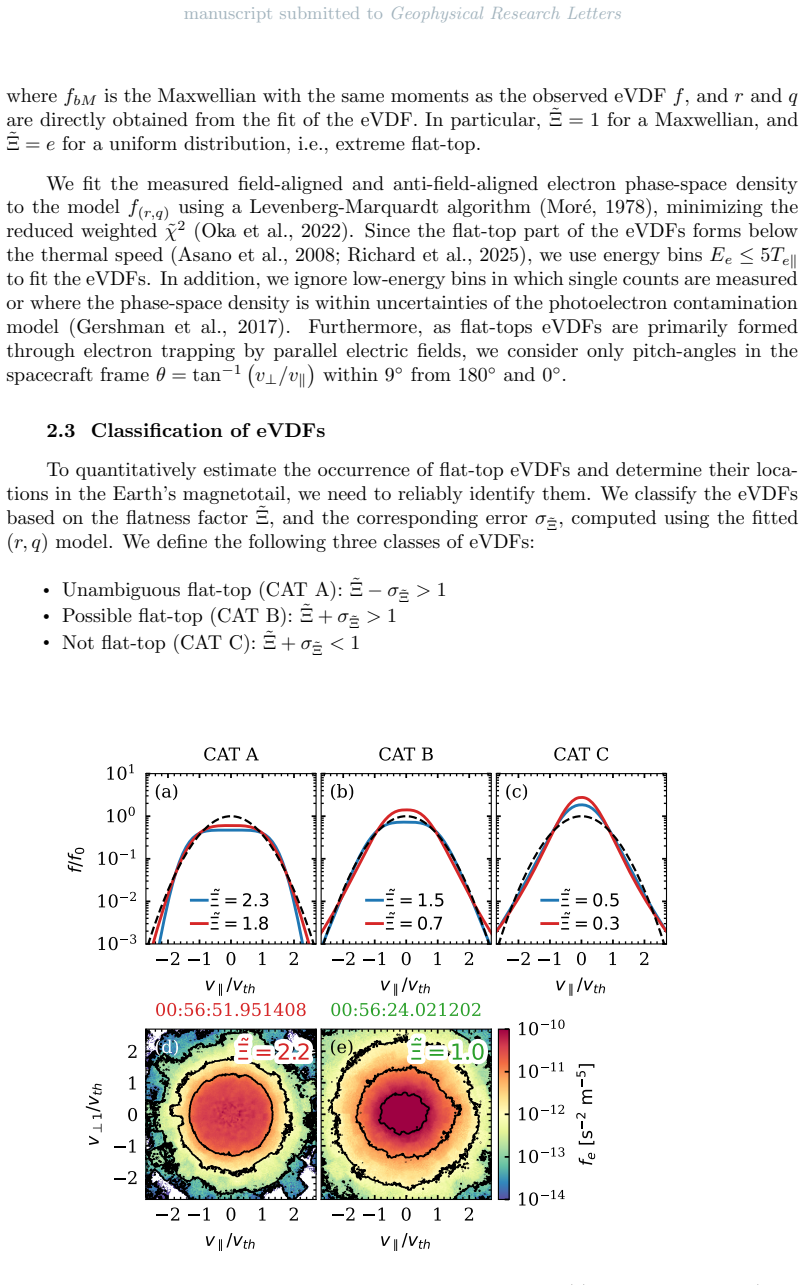
- [Figures] Figure captions and text: Some panels showing example eVDFs would benefit from explicit annotation of the flat-top region and comparison to non-flat-top cases for clarity.
Simulated Author's Rebuttal
We thank the referee for the constructive and detailed report. The comments highlight important aspects of our new classification method, spatial analysis, and event selection that require clarification and strengthening. We have revised the manuscript accordingly, adding validation tests, bias controls, and supplementary figures. Our responses to each major comment are provided below.
read point-by-point responses
-
Referee: Methods (new eVDF classification algorithm): The paper introduces a new method for classifying flat-top eVDFs but reports no accuracy metrics, false-positive/negative rates, threshold sensitivity tests, or cross-validation against simulations or prior reconnection observations. This directly controls the central ~7% occurrence statistic and the claim that flat-tops are 'characteristic' of most jets.
Authors: We agree that explicit validation strengthens the central result. In the revised manuscript we have added a dedicated subsection on the classifier, including threshold sensitivity tests across a range of values for the flatness and energy-range parameters. These tests show that the ~7% occurrence rate varies by less than 1.5% for reasonable threshold adjustments. We also report agreement rates (>82%) with a manually inspected subset of 200 distributions drawn from earlier reconnection studies. Full simulation-based cross-validation lies outside the scope of this purely observational work, but the physical motivation for the thresholds (matching known signatures of parallel acceleration) is now expanded in the text. The occurrence statistic and the 'most jets exhibit them' conclusion remain robust. revision: partial
-
Referee: Results (spatial localization): The reported localization of flat-top eVDFs to an ion-inertial-length region near current-sheet edges could be affected by spacecraft trajectory sampling bias or position-dependent data quality; no explicit tests controlling for these factors are described, weakening the physical interpretation.
Authors: We acknowledge the possibility of sampling bias. The revised manuscript now includes an explicit test in which occurrence is normalized by dwell time in each normalized distance bin from the current-sheet edge and by a data-quality flag (removing intervals with elevated noise or low count rates). The ion-inertial-length localization persists after normalization. In addition, we show that the 22 events span a variety of spacecraft trajectories relative to the current sheet, reducing the chance of a single-trajectory artifact. These controls support the physical interpretation that flat-top distributions mark the edge region of parallel electron streaming. revision: yes
-
Referee: Jet and current-sheet selection: The criteria for identifying jets and associated current sheets are not shown to be free of bias that might preferentially sample or exclude regions containing flat-top eVDFs, which is load-bearing for both the occurrence rate and the 'most jets exhibit them' conclusion.
Authors: The jet and current-sheet identification follows standard, widely used thresholds (bulk flow speed >300 km/s, |B| reversal, and density criteria) identical to those in multiple prior magnetotail studies. To address potential bias we have added a supplementary figure that plots the fraction of flat-top intervals against jet speed, current-sheet thickness, and distance from the reconnection site; no systematic preference for jets containing flat-tops is found. The statement that 'most jets exhibit them' is defined as the presence of at least one qualifying flat-top interval within the jet, and the selection criteria do not preferentially include or exclude such intervals. We therefore maintain that the reported occurrence rate and jet-level conclusion are not driven by selection bias. revision: yes
Circularity Check
No circularity: purely observational statistical counts from data classification
full rationale
The paper performs a statistical survey of spacecraft observations of magnetotail jets. It introduces and applies a classification method to count flat-top eVDF occurrences (~7% of individual distributions, present in most jets) and reports their spatial localization. No derivations, first-principles predictions, fitted parameters, or self-referential equations are present. The reported fractions and locations are direct empirical outputs of applying the classifier to the dataset; they do not reduce to inputs by construction. No self-citation load-bearing steps or ansatz smuggling occur. This is a standard observational analysis whose central claims rest on data processing rather than tautological re-expression of assumptions.
Axiom & Free-Parameter Ledger
axioms (1)
- domain assumption The new eVDF classification method accurately identifies flat-top distributions across the observed range of plasma beta and flow speeds.
Reference graph
Works this paper leans on
-
[1]
Angelopoulos, V., Kennel, C. F., Coroniti, F. V., Pellat, R., Kivelson, M. G., Walker, R. J., . . . Gosling, J. T. (1994). Statistical characteristics of bursty bulk flow events.J. Geophys. Res.,99(A11), 21257. doi: 10.1029/94JA01263 Asano, Y., Nakamura, R., Shinohara, I., Fujimoto, M., Takada, T., Baumjohann, W., . . . R` eme, H. (2008). Electron flat-to...
-
[2]
doi: 10.1029/JA095iA04p03801 B¨ uchner, J., & Zelenyi, L. M. (1989). Regular and chaotic charged particle motion in magnetotaillike field reversals:
-
[3]
Basic theory of trapped motion.J. Geophys. Res., 94(A9), 11821. doi: 10.1029/JA094iA09p11821 Burch, J. L., Moore, T. E., Torbert, R. B., & Giles, B. L. (2016). Magnetospheric Multiscale Overview and Science Objectives.Space Sci. Rev.,199(1-4), 5–21. doi: 10.1007/ s11214-015-0164-9 Egedal, J., Daughton, W., Le, A., & Borg, A. L. (2015). Double layer electr...
-
[4]
doi: 10.1007/s11214-025-01142-0 Mor´ e, J. J. (1978). The Levenberg-Marquardt algorithm: Implementation and theory. In G. A. Watson (Ed.),Numerical Analysis(Vol. 630, pp. 105–116). Berlin, Heidelberg: Springer Berlin Heidelberg. doi: 10.1007/BFb0067700 Oka, M., Birn, J., Egedal, J., Guo, F., Ergun, R. E., Turner, D. L., . . . Drake, J. F. (2023). Particle...
-
[5]
2023, SSRv, 219, 75, doi: 10.1007/s11214-023-01011-8
doi: 10.1007/s11214-023-01011-8 Oka, M., Phan, T. D., Øieroset, M., Turner, D. L., Drake, J. F., Li, X., . . . Burch, J. L. (2022). Electron energization and thermal to non-thermal energy partition during earth’s magnetotail reconnection.Phys. Plasmas,29(5), 052904. doi: 10.1063/5 .0085647 Pollock, C., Moore, T., Jacques, A., Burch, J., Gliese, U., Saito,...
discussion (0)
Sign in with ORCID, Apple, or X to comment. Anyone can read and Pith papers without signing in.