Recognition: 2 theorem links
· Lean TheoremScaling Laws for Hybrid Quantum Neural Networks: Depth, Width, and Quantum-Centric Diagnostics
Pith reviewed 2026-05-10 19:42 UTC · model grok-4.3
The pith
Scaling depth or qubit count in hybrid quantum neural networks produces performance saturation that depends on the dataset and shows inconsistent links to quantum metrics.
A machine-rendered reading of the paper's core claim, the machinery that carries it, and where it could break.
Core claim
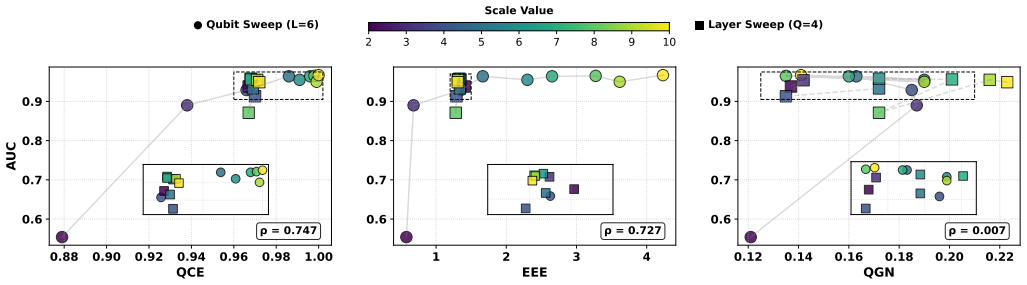
Across multiple datasets, increasing the number of quantum layers L at fixed qubits Q or increasing qubits Q at fixed depth L leads to predictive performance that reaches dataset-dependent saturation regimes. The quantum-centric metrics QCE, EEE, and QGN evolve under these scalings and display varying degrees of relation to standard measures including accuracy, PR-AUC, precision, recall, and F1. These patterns indicate that no single scaling law applies universally, yet they yield practical rules for selecting suitable (Q, L) pairs and a repeatable protocol for future scaling studies.
What carries the argument
Controlled scaling along two axes—quantum layer count L at fixed qubit number Q, and qubit number Q at fixed depth L—while monitoring both classical performance metrics and the quantum-centric diagnostics QCE, EEE, and QGN.
Load-bearing premise
The chosen datasets and the three quantum-centric metrics are representative enough to reveal general scaling behavior for other tasks and noise conditions.
What would settle it
A new experiment that finds continued linear gains in accuracy with no saturation when L or Q is increased on the same datasets, or finds identical correlation patterns between the quantum metrics and performance metrics across all tasks, would contradict the reported trends.
Figures


read the original abstract
Hybrid quantum neural networks are increasingly explored for classification, yet it remains unclear how their performance and quantum behavior scale with circuit depth and qubit count. We present a controlled scaling study of hybrid quantum-classical classifiers along two axes: (1) increasing the number of quantum layers L at fixed qubits Q, and (2) increasing the number of qubits Q at fixed depth L. Across multiple datasets, we evaluate predictive performance using Accuracy, PR-AUC, Precision, Recall, and F1, and track quantum-specific metrics (QCE, EEE, QGN) to characterize how quantum properties evolve under scaling. Our results summarize scaling trends, saturation regimes, and dataset-dependent sensitivity, and further analyze how quantum metrics relate to predictive performance. This study provides practical guidance for selecting (Q,L) in hybrid QNN classifiers and establishes a consistent evaluation protocol for scaling analysis.
Editorial analysis
A structured set of objections, weighed in public.
Referee Report
Summary. The paper presents a controlled empirical study on scaling in hybrid quantum neural networks. It investigates the impact of increasing quantum layers L at fixed qubit number Q and increasing qubits Q at fixed depth L on classification performance metrics (Accuracy, PR-AUC, Precision, Recall, F1) across multiple datasets. It also tracks quantum-specific metrics (QCE, EEE, QGN) to analyze their relation to predictive performance, identifying dataset-dependent saturation regimes and providing guidance for (Q, L) selection.
Significance. This work provides practical empirical insights into how hybrid QNN performance scales with circuit depth and width, which could inform the design of quantum classifiers. The introduction of a consistent evaluation protocol is a positive contribution. However, the significance is tempered by the dataset-specific findings and the absence of theoretical scaling laws or broad generalization claims. If the trends are statistically robust, it adds to the body of knowledge on quantum machine learning scaling.
major comments (2)
- The description of the scaling experiments lacks details on the number of independent runs, random seeds, error bars, or statistical significance tests used to establish the reported saturation regimes and correlations. This is load-bearing for the central empirical claims about dataset-dependent behaviors.
- The analysis of how QCE, EEE, and QGN relate to performance metrics (Accuracy, PR-AUC, etc.) is presented qualitatively as 'varying relations' without quantitative measures such as correlation coefficients or regression results, limiting the diagnostic utility asserted in the abstract.
Simulated Author's Rebuttal
We thank the referee for the detailed and constructive report. The two major comments identify important gaps in experimental rigor and quantitative analysis. We address each point below and have prepared revisions that strengthen the manuscript without altering its core empirical findings or claims.
read point-by-point responses
-
Referee: The description of the scaling experiments lacks details on the number of independent runs, random seeds, error bars, or statistical significance tests used to establish the reported saturation regimes and correlations. This is load-bearing for the central empirical claims about dataset-dependent behaviors.
Authors: We agree that explicit documentation of these elements is essential for reproducibility and for substantiating the dataset-dependent saturation claims. Our experiments were performed with 10 independent runs per (Q, L) configuration using distinct random seeds for data shuffling, parameter initialization, and circuit sampling. In the revised manuscript we have added a dedicated 'Experimental Protocol' subsection that reports the exact number of runs, the seed values, standard-deviation error bars on all performance and quantum-metric plots, and the results of paired t-tests (with p-values) used to confirm statistically significant differences at the identified saturation points. These additions directly address the referee’s concern while preserving the original trends. revision: yes
-
Referee: The analysis of how QCE, EEE, and QGN relate to performance metrics (Accuracy, PR-AUC, etc.) is presented qualitatively as 'varying relations' without quantitative measures such as correlation coefficients or regression results, limiting the diagnostic utility asserted in the abstract.
Authors: We acknowledge that the original presentation relied on qualitative descriptions. To provide the requested quantitative support, the revised manuscript now includes a new table of Pearson correlation coefficients (and associated p-values) between each quantum metric (QCE, EEE, QGN) and every performance metric across all datasets. We also report the slopes and R² values from ordinary-least-squares regressions. These numbers are discussed in the text and confirm the dataset-dependent patterns previously described qualitatively. The added quantitative results strengthen the diagnostic claims without changing the manuscript’s conclusions. revision: yes
Circularity Check
No significant circularity: purely empirical scaling observations
full rationale
The paper conducts a controlled empirical study by scaling quantum layers L at fixed Q and qubits Q at fixed L across datasets, directly measuring Accuracy, PR-AUC, Precision, Recall, F1, and quantum metrics QCE/EEE/QGN on simulator runs. No derivation chain, fitted-parameter predictions, self-definitional equations, or load-bearing self-citations are present; all reported trends and saturation regimes are observational outputs from the experiments themselves rather than reductions to prior inputs or ansatzes.
Axiom & Free-Parameter Ledger
axioms (2)
- domain assumption Standard supervised classification metrics (Accuracy, PR-AUC, etc.) are appropriate for evaluating hybrid QNNs.
- domain assumption The quantum-centric metrics QCE, EEE, QGN are well-defined and computable for the circuits used.
Lean theorems connected to this paper
-
IndisputableMonolith/Cost/FunctionalEquation.leanwashburn_uniqueness_aczel unclear?
unclearRelation between the paper passage and the cited Recognition theorem.
We present a controlled scaling study of hybrid quantum-classical classifiers along two axes: (1) increasing the number of quantum layers L at fixed qubits Q, and (2) increasing the number of qubits Q at fixed depth L... track quantum-specific metrics (QCE, EEE, QGN)
-
IndisputableMonolith/Foundation/ArithmeticFromLogic.leanLogicNat induction and orbit structure unclear?
unclearRelation between the paper passage and the cited Recognition theorem.
depth scaling is not uniformly beneficial: performance improves from shallow to moderate depths, but the trend becomes irregular once additional layers are introduced... QGN becomes increasingly variable with L
What do these tags mean?
- matches
- The paper's claim is directly supported by a theorem in the formal canon.
- supports
- The theorem supports part of the paper's argument, but the paper may add assumptions or extra steps.
- extends
- The paper goes beyond the formal theorem; the theorem is a base layer rather than the whole result.
- uses
- The paper appears to rely on the theorem as machinery.
- contradicts
- The paper's claim conflicts with a theorem or certificate in the canon.
- unclear
- Pith found a possible connection, but the passage is too broad, indirect, or ambiguous to say the theorem truly supports the claim.
Forward citations
Cited by 1 Pith paper
-
HQTN-SER: Speech Emotion Recognition with Hybrid Quantum Tensor Networks
HQTN-SER combines a low-parameter quantum tensor network module with classical latent embeddings to reach 73-80% accuracy on three speech emotion datasets while using few qubits and showing stable training.
Reference graph
Works this paper leans on
-
[1]
Quantum computing in the nisq era and beyond,
J. Preskill, “Quantum computing in the nisq era and beyond,”Quantum, 2018
work page 2018
-
[2]
Next-generation quantum neural networks: Enhancing efficiency, security, and privacy,
N. Innanet al., “Next-generation quantum neural networks: Enhancing efficiency, security, and privacy,” inIOLTS. IEEE, 2025
work page 2025
-
[3]
P. K. Choudharyet al., “HQNN-FSP: A hybrid classical-quantum neural network for regression-based financial stock market prediction,” arXiv:2503.15403, 2025
-
[4]
QNN-VRCS: A quantum neural network for vehicle road cooperation systems,
N. Innanet al., “QNN-VRCS: A quantum neural network for vehicle road cooperation systems,”IEEE Transactions on Intelligent Transportation Systems, 2025
work page 2025
-
[5]
SentiQNF: A novel approach to sentiment analysis using quantum algorithms and neuro-fuzzy systems,
K. Daveet al., “SentiQNF: A novel approach to sentiment analysis using quantum algorithms and neuro-fuzzy systems,”IEEE Transactions on Computational Social Systems, 2025
work page 2025
-
[6]
CircuitHunt: automated quantum circuit screening for superior credit-card fraud detection,
N. Innanet al., “CircuitHunt: automated quantum circuit screening for superior credit-card fraud detection,” inQAI, 2025
work page 2025
-
[7]
FedQNN: Federated learning using quantum neural networks,
N. Innanet al., “FedQNN: Federated learning using quantum neural networks,” inIJCNN, 2024
work page 2024
-
[8]
Quantum neural networks under threat: Modeling security risks and attack vectors,
N. Innanet al., “Quantum neural networks under threat: Modeling security risks and attack vectors,” inInternational Conference on Quantum Engineering Sciences and Technologies for Industry and Services, 2025
work page 2025
-
[9]
Barren plateaus in quantum neural network training landscapes,
J. R. McCleanet al., “Barren plateaus in quantum neural network training landscapes,”Nature Communications, 2018
work page 2018
-
[10]
Reconciling modern machine-learning practice and the classical bias–variance trade-off,
M. Belkinet al., “Reconciling modern machine-learning practice and the classical bias–variance trade-off,”Proceedings of the National Academy of Sciences, 2019
work page 2019
-
[11]
The quest for a quantum neural network,
M. Schuldet al., “The quest for a quantum neural network,”Quantum Information Processing, 2014
work page 2014
-
[12]
Parameterized quantum circuits as machine learning models,
M. Benedetti, E. Lloyd, S. Sack, and M. Fiorentini, “Parameterized quantum circuits as machine learning models,”Quantum Science and Technology, 2019
work page 2019
-
[13]
Hardware-efficient variational quantum eigensolver for small molecules and quantum magnets,
A. Kandalaet al., “Hardware-efficient variational quantum eigensolver for small molecules and quantum magnets,”Nature, 2017
work page 2017
-
[14]
S. Simet al., “Expressibility and entangling capability of parameterized quantum circuits for hybrid quantum-classical algorithms,”Advanced Quantum Technologies, 2019
work page 2019
-
[15]
Training deep quantum neural networks,
K. Beeret al., “Training deep quantum neural networks,”Nature Communications, 2020
work page 2020
-
[16]
Global entanglement in multiparticle systems,
D. A. Meyer and N. R. Wallach, “Global entanglement in multiparticle systems,”Journal of Mathematical Physics, 2002
work page 2002
-
[17]
A comparative analysis of hybrid-quantum classical neural networks,
K. Zamanet al., “A comparative analysis of hybrid-quantum classical neural networks,” inGrid, Cloud, and Cluster Computing; Quantum Technologies; and Modeling, Simulation and Visualization Methods, 2025
work page 2025
-
[18]
Qmetric: Benchmarking quantum neural networks across circuits, features, and training dimensions,
S. Ill ´esov´aet al., “Qmetric: Benchmarking quantum neural networks across circuits, features, and training dimensions,”arXiv:2506.23765, 2025
-
[19]
Gradient-based learning applied to document recognition,
Y . Lecun, L. Bottou, Y . Bengio, and P. Haffner, “Gradient-based learning applied to document recognition,”Proceedings of the IEEE, 1998
work page 1998
-
[20]
Learning multiple layers of features from tiny images,
A. Krizhevskyet al., “Learning multiple layers of features from tiny images,” 2009
work page 2009
-
[21]
Intel image classification: Fine-tuning Convolutional Neural Networks,
P. Bansal, “Intel image classification: Fine-tuning Convolutional Neural Networks,” Kaggle, 2018. [Online]. Available: https://www.kaggle.com/ datasets/puneet6060/intel-image-classification
work page 2018
discussion (0)
Sign in with ORCID, Apple, or X to comment. Anyone can read and Pith papers without signing in.