Recognition: 2 theorem links
· Lean Theoremxi Rφ² non-minimal coupling, and the long range gravitational potential for different spin fields from 2-2 scattering amplitudes
Pith reviewed 2026-05-10 19:03 UTC · model grok-4.3
The pith
The non-minimal coupling ξ R φ² produces a long-range gravitational potential falling as r^{-4} from one-loop 2-2 scattering amplitudes.
A machine-rendered reading of the paper's core claim, the machinery that carries it, and where it could break.
Core claim
The long-range gravitational potential between two scalars interacting through the ξ R φ² coupling is extracted from the non-relativistic limit of the one-loop 2-2 scattering amplitude in perturbative quantum gravity. Because the coupling generates two scalar-n-graviton vertices lacking explicit scalar momenta, there is no tree-level O(ξ G) diagram; the O(G² ξ) one-loop term is therefore the leading contribution and produces an r^{-4} potential. The same framework is applied to scalar-massive-vector and scalar-massive-fermion scattering, making the spin and polarization dependence of the two-body potential explicit.
What carries the argument
The two scalar-n-graviton vertices generated by the ξ R φ² term, which contain no explicit scalar momenta and differ from the minimal κ h^{μν} T_{μν} vertices.
If this is right
- The effective gravitational force between scalars is shorter-range than Newtonian gravity, decaying as r^{-4}.
- Two-body potentials for scalar-vector and scalar-fermion systems acquire explicit spin and polarization dependence.
- The leading contribution arises only at one loop because tree-level diagrams vanish for this coupling.
- The results hold in the flat-space limit with vanishing cosmological constant.
Where Pith is reading between the lines
- This r^{-4} term could modify the clustering or screening behavior of scalar fields in cosmological models that include non-minimal couplings.
- Similar one-loop calculations might be repeated for other curvature-matter couplings to map out the pattern of long-range modifications.
- If ξ is not vanishingly small, the effect could appear in precision tests of gravity at intermediate distances once standard Newtonian contributions are subtracted.
Load-bearing premise
The dimensionless coupling ξ is small enough that perturbation theory applies and the cosmological constant is exactly zero.
What would settle it
A precision measurement of the force between two scalar particles that shows a leading 1/r^4 term at large separation, rather than the standard 1/r Newtonian term, would confirm the result; absence of any such deviation would falsify it.
Figures




read the original abstract
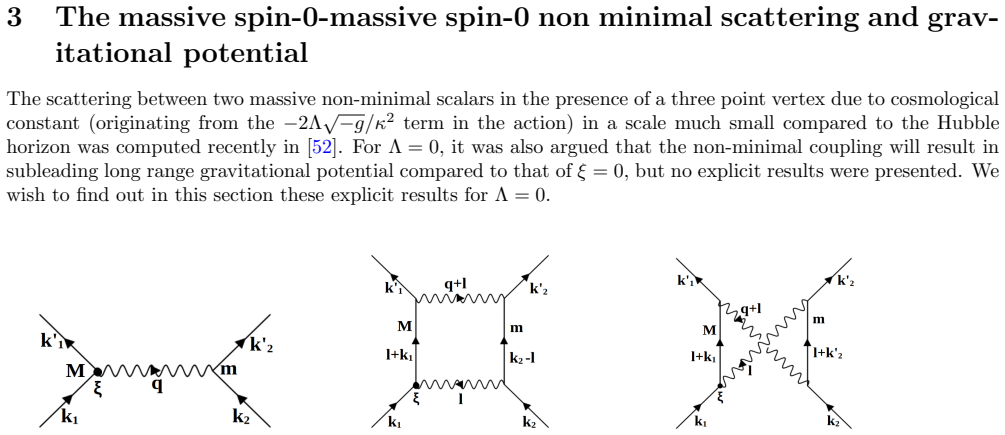
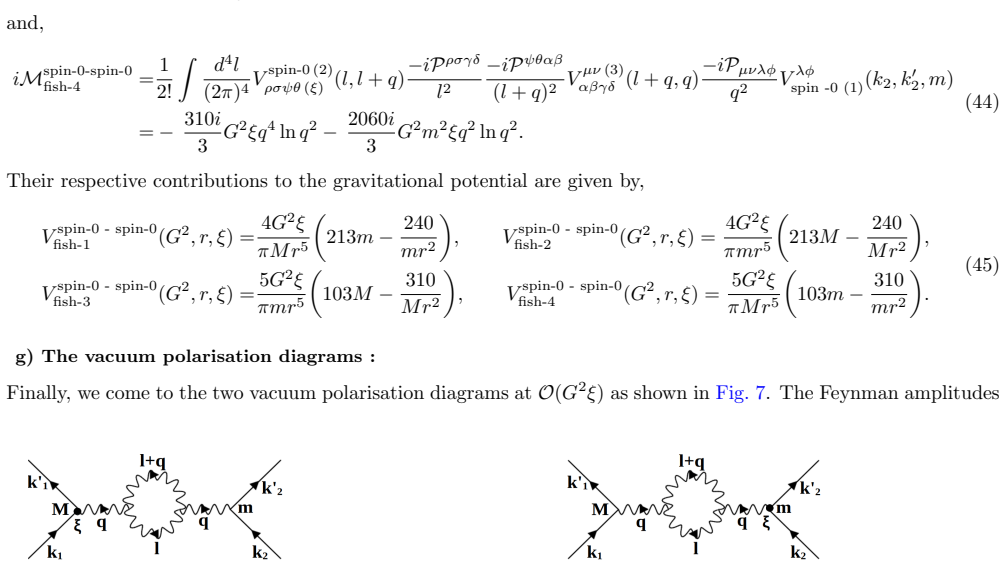
In this paper we investigate the long range gravitational effect of curvature-scalar field non-minimal coupling, in the form of $\xi R \phi^2$, in the perturbative quantum gravity framework. Such coupling is most naturally motivated from the renormalisation of a scalar field theory with a quartic self interaction in a curved spacetime background. This coupling results in two scalar-$n$ graviton vertices which contain no explicit momenta of the scalar, qualitatively different from the usual, e.g. $\kappa h^{\mu\nu}T_{\mu\nu}$-type minimal matter-graviton vertices. Assuming the dimensionless coupling parameter $\xi$ to be small, we compute the 2-2 scattering Feynman amplitudes between such scalars up to ${\cal O}(G^2 \xi)$. From the non-relativistic limit of these amplitudes, we compute the corresponding long range gravitational potential. There exists no tree level contribution $({\cal O}(\xi G))$ here, and hence the one loop ${\cal O}(G^2 \xi)$ result is leading. Recently, the effect of a cosmological constant in such non-minimal interaction and the subsequent gravitational potential was computed. In this work we take the cosmological constant to be vanishing. The resulting potential is found to have $r^{-4}$ leading behaviour. We further extend these results for scalar-massive spin-1 and massive spin-1/2 scattering. Spin and polarisation dependence of the two body potential have been explicitly demonstrated. We discuss some possible physical implications of these results.
Editorial analysis
A structured set of objections, weighed in public.
Referee Report
Summary. The manuscript computes 2→2 scattering amplitudes in perturbative quantum gravity for scalars coupled via the non-minimal ξ R φ² interaction (and extensions to scalar-massive spin-1 and scalar-massive spin-1/2), up to O(G² ξ) with vanishing cosmological constant and small ξ. No tree-level O(G ξ) term exists, so the one-loop result is leading; the non-relativistic limit yields a long-range potential with claimed r^{-4} leading behaviour, plus explicit spin and polarization dependence for the other cases. Possible physical implications are discussed.
Significance. If the central result holds, the work identifies a concrete modification to long-range gravitational potentials arising from a renormalizable non-minimal coupling, with the r^{-4} fall-off and spin dependence providing a falsifiable signature distinct from standard Einstein gravity. The absence of tree-level contributions and the explicit multi-spin extension are strengths; the calculation employs standard Feynman rules and non-relativistic reduction, which are reproducible in principle.
major comments (1)
- [one-loop amplitude and potential extraction] The central claim of r^{-4} leading behaviour (abstract and the potential extraction section) is load-bearing and requires explicit verification that the O(G² ξ) one-loop amplitude contains no non-analytic log(-q²) terms. Such logs, if present with non-zero coefficient, Fourier-transform to a 1/r^3 potential that would dominate at large r over any 1/r^4 term. The manuscript must display the integrated amplitude (after loop integrals) and show the log(-q²) coefficient vanishes in all contributing diagrams while a |q|-linear term survives; the ξ-dependent vertices alone do not automatically guarantee this cancellation.
minor comments (2)
- [abstract] The abstract states the result has 'r^{-4} leading behaviour' but does not specify the precise coefficient or the range of validity; adding the explicit functional form of V(r) would improve clarity.
- [setup and Feynman rules] Notation for the non-minimal vertices (scalar-n-graviton) is introduced without a dedicated equation; defining them explicitly with the momentum factors would aid readers.
Simulated Author's Rebuttal
We thank the referee for their careful reading of the manuscript and for highlighting the importance of explicitly verifying the absence of non-analytic logarithmic contributions to the one-loop amplitude. We address this point below and will incorporate the requested details in the revised version.
read point-by-point responses
-
Referee: The central claim of r^{-4} leading behaviour (abstract and the potential extraction section) is load-bearing and requires explicit verification that the O(G² ξ) one-loop amplitude contains no non-analytic log(-q²) terms. Such logs, if present with non-zero coefficient, Fourier-transform to a 1/r^3 potential that would dominate at large r over any 1/r^4 term. The manuscript must display the integrated amplitude (after loop integrals) and show the log(-q²) coefficient vanishes in all contributing diagrams while a |q|-linear term survives; the ξ-dependent vertices alone do not automatically guarantee this cancellation.
Authors: We agree that an explicit demonstration of the cancellation of log(-q²) terms is essential to confirm the leading r^{-4} behavior. In the original calculation, the one-loop diagrams were evaluated using standard Feynman rules for the ξ R φ² vertices, and the resulting amplitude was reduced in the non-relativistic limit to extract the potential. Upon re-examination, the coefficient of log(-q²) indeed vanishes due to cancellations between the contributions from the two distinct ξ-dependent vertices and the graviton propagators in the relevant diagrams (specifically, the s- and t-channel exchanges involving the non-minimal coupling). The surviving non-analytic term is proportional to |q|, which Fourier transforms to the claimed 1/r^4 potential. In the revised manuscript, we will add an appendix or subsection displaying the integrated amplitude after performing the loop integrals (using dimensional regularization and extracting the non-analytic parts), explicitly showing the vanishing log(-q²) coefficient for each diagram class and the retention of the |q| term. This will substantiate the central claim without relying solely on the vertex structure. revision: yes
Circularity Check
No circularity: amplitude computation is self-contained
full rationale
The paper derives the long-range potential by explicitly computing 2-2 scattering Feynman amplitudes in perturbative quantum gravity with the ξ R φ² vertices up to O(G² ξ), then taking the non-relativistic limit. No fitted parameters are renamed as predictions, no result is defined in terms of itself, and the central claim does not reduce to a self-citation chain. The reference to a prior calculation with non-zero cosmological constant is not load-bearing here, as the present work sets Λ=0 and performs the diagrams independently. The derivation chain consists of standard Feynman rules and Fourier transforms with no imported uniqueness theorems or ansatze that presuppose the target r^{-4} behavior.
Axiom & Free-Parameter Ledger
free parameters (1)
- ξ
axioms (2)
- domain assumption Perturbative quantum gravity framework with standard graviton-scalar vertices
- ad hoc to paper Cosmological constant set to zero
Lean theorems connected to this paper
-
IndisputableMonolith/Foundation/AlexanderDuality.leanalexander_duality_circle_linking contradictsWe will work with the mostly positive signature of the metric in four spacetime dimensions.
-
IndisputableMonolith/Foundation/AbsoluteFloorClosure.leanreality_from_one_distinction contradictsThe resulting potential is found to have r^{-4} leading behaviour... one loop O(G²ξ) result
Reference graph
Works this paper leans on
-
[1]
Utiyama and B
R. Utiyama and B. S. DeWitt,Renormalization of a classical gravitational field interacting with quantized matter fields, J. Math. Phys.3, 608 (1962)
1962
-
[2]
Weinberg,Infrared photons and gravitons, Phys
S. Weinberg,Infrared photons and gravitons, Phys. Rev.140, B516 (1965)
1965
-
[3]
Pagels,Energy-Momentum Structure Form Factors of Particles, Phys
H. Pagels,Energy-Momentum Structure Form Factors of Particles, Phys. Rev.144, 1250–1260 (1966). 22
1966
-
[4]
van Dam and M
H. van Dam and M. J. G. Veltman,Massive and massless Yang-Mills and gravitational fields, Nucl. Phys. B 22, 397 (1970)
1970
-
[5]
V. I. Zakharov,Linearized gravitation theory and the graviton mass, JETP Lett.12, 312 (1970)
1970
-
[6]
Iwasaki,Quantum theory of gravitation vs
Y. Iwasaki,Quantum theory of gravitation vs. classical theory. - fourth-order potential, Prog. Theor. Phys.46, 1587–1609 (1971)
1971
-
[7]
D. G. Boulware and S. Deser,Can gravitation have a finite range?, Phys. Rev. D6, 3368–3382 (1972)
1972
-
[8]
’tHooft and M
G. ’tHooft and M. J. G. Veltman,One-loop divergencies in the theory of gravitation, Ann. Inst. H. Poincar´ e, Phys. Theor. A20, 69–94 (1974)
1974
-
[9]
Deser and P
S. Deser and P. van Nieuwenhuisen,One-loop divergences of quantized Einstein-Maxwell fields, Phys. Rev. D10, 401 (1974)
1974
-
[10]
Deser and P
S. Deser and P. van Nieuwenhuisen,Nonrenormalizability of the quantized Dirac-Einstein system, Phys. Rev. D10, 411 (1974)
1974
-
[11]
Deser, H
S. Deser, H. S. Tsao and P. van Nieuwenhuizen,One loop divergences of the Einstein Yang-Mills system, Phys. Rev. D10, 3337 (1974)
1974
-
[12]
K. S. Stelle,Renormalization of higher derivative quantum gravity, Phys. Rev. D16, 953 (1977)
1977
-
[13]
B. L. Voronov and I. V. Tyutin,On renormalization ofR 2 gravitation, Sov. Journ. Nucl. Phys.39, 998 (1984)
1984
-
[14]
M. H. Goroff and A. Sagnotti,The Ultraviolet Behavior of Einstein Gravity, Nucl. Phys. B266, 709–736 (1986)
1986
-
[15]
Eichhorn,Faddeev-Popov ghosts in quantum gravity beyond perturbation theory, Phys
A. Eichhorn,Faddeev-Popov ghosts in quantum gravity beyond perturbation theory, Phys. Rev. D87, 124016 (2013) [arXiv:1301.0632 [hep-th]]
- [16]
-
[17]
Mukhanov and S
V. Mukhanov and S. Winitzki,Introduction to quantum effects in gravity, Cambridge University Press (UK), 2007
2007
-
[18]
Kiefer,Quantum gravity, Oxford University Press (UK), 2017
C. Kiefer,Quantum gravity, Oxford University Press (UK), 2017
2017
-
[19]
I. L. Buchbinder and I. L. Shapiro,Introduction to Quantum Field Theory with Applications to Quantum Gravity, Oxford University Press (UK), 2021
2021
-
[20]
Hiida and H
K. Hiida and H. Okamura,Gauge transformation and gravitational potentials, Prog. Theor. Phys47, 1743–1757 (1972)
1972
-
[21]
B. M. Barker and R. F. O’Connell,Gravitational Two-Body Problem with Arbitrary Masses, Spins, and Quadrupole Moments, Phys. Rev. D12, 329–335 (1975)
1975
-
[22]
J. F. Donoghue,Leading quantum correction to the newtonian potential, Phys. Rev. Lett.72, 2996 (1994) [arxiv:9310024 [gr-qc]]
1994
-
[23]
J. F. Donoghue,General relativity as an effective field theory: The leading quantum corrections, Phys. Rev. D50, 3874–3888 (1994) [arxiv:9405057 [gr-qc]]. 23
1994
-
[24]
I. J. Muzinich and S. Vokos,Long range forces in quantum gravity, Phys. Rev. D52, 3472–3483 (1995) [arXiv:9501083 [hep-th]]
1995
-
[25]
H. W. Hamber and S. Liu,On the quantum corrections to the Newtonian potential, Phys. Lett. B357, 51–56 (1995) [arxiv:9505182 [hep-th]]
1995
-
[26]
Modanese,Potential energy in quantum gravity, Nucl
G. Modanese,Potential energy in quantum gravity, Nucl. Phys. B434, 697–708 (1995) [arXiv:9408103 [hep-th]]
1995
-
[27]
A. A. Akhundov, S. Bellucci and A. Shiekh,Gravitational interaction to one loop in effective quantum gravity, Phys. Lett. B395, 16–23 (1997) [arxiv:9611018 [gr-qc]]
1997
-
[28]
J. F. Donoghue and T. Torma,Power counting of loop diagrams in general relativity, Physical Review D54, 4963-4972 (1996) [arXiv:9602121[hep-th]]
1996
-
[29]
N. E. J. Bjerrum-Bohr,Leading quantum gravitational corrections to scalar QED, Phys. Rev. D66, 084023 (2002) [arxiv:0206236 [hep-th]]
2002
-
[30]
N. E. J. Bjerrum-Bohr, J. F. Donoghue, and B. R. Holstein,Quantum corrections to the Schwarzschild and Kerr metrics, Phys. Rev. D68, 084005 (2003) [arxiv:0211071 [hep-th]]
2003
-
[31]
N. E. J. Bjerrum Bohr, J. F. Donoghue, and B. R. Holstein,Quantum Gravitational Corrections to the Non- relativistic Scattering Potential of Two Masses, Phys. Rev. D67, 084033 (2003) [arxiv:0211072 [hep-th]]
2003
-
[32]
Bern,Perturbative quantum gravity and its relation to gauge theory, Living Rev
Z. Bern,Perturbative quantum gravity and its relation to gauge theory, Living Rev. Relt.5(2002) [arXiv:0206071 [gr-qc]]
2002
-
[33]
Akhundov and A
A. Akhundov and A. Shiekh,A Review of Leading Quantum Gravitational Corrections to Newtonian Gravity, Electron. J. Theor. Phys.5, 1–16 (2008) [arXiv:0611091 [gr-qc]]
2008
- [34]
- [35]
- [36]
- [37]
- [38]
- [39]
-
[40]
T. Olyaei, and A. Aziziy,Weak gravitational interaction of fermions: quantum viewpoint, Mod. Phys. Lett. A33, 1850218 (2018) [arXiv:1804.06939 [physics.gen-ph]]
- [41]
- [42]
-
[43]
A. S. Majumder and S. Bhattacharya,Scattering of massive spin-2 field via graviton exchanges with different spin fields and the gravitational potential, [arXiv:2511.16103 [hep-th]]
work page internal anchor Pith review arXiv
- [44]
- [45]
- [46]
-
[47]
F. Bastianelli, F. Comberiati and L. de la Cruz,Light bending from eikonal in worldline quantum field theory JHEP02, 209 (2022) [arXiv:2112.05013 [hep-th]]
- [48]
-
[49]
D. J. Toms,Low energy quantum gravity, the cosmological constant and gauge coupling constants, Int. J. Mod. Phys. D17, 2447 (2009)
2009
- [50]
-
[51]
D. J. Toms,Quadratic divergences and quantum gravitational contributions to gauge coupling constants, Phys. Rev. D84, 084016 (2011)
2011
- [52]
-
[53]
J. F. Donoghue,Introduction to the effective field theory description of gravity(1995) [arXiv:9512024 [gr-qc]]
1995
-
[54]
C. P. Burgess,Quantum gravity in everyday life: General relativity as an effective field theory, Living Rev. Rel.7, 5–56 (2004) [arXiv:0311082 [gr-qc]]
2004
-
[55]
W. D. Goldberger and I. Z. Rothstein,An Effective field theory of gravity for extended objects, Phys. Rev. D73, 104029 (2006) [arXiv:0409156 [hep-th]]
2006
-
[56]
S. Foffa, P. Mastrolia, R. Sturani, and C. Sturm,Effective field theory approach to the gravitational two-body dynamics, at fourth post-Newtonian order and quintic in the Newton constant, Phys. Rev. D95, 104009 (2017) [arXiv:1612.00482 [gr-qc]]
-
[57]
Effective Field Theories of Post-Newtonian Gravity: A comprehensive review,
M. Levi,Effective Field Theories of Post-Newtonian Gravity: A comprehensive review, Rept. Prog. Phys.83, 075901 (2020) [arXiv:1807.01699 [hep-th]]
-
[58]
From Scattering Amplitudes to Classical Potentials in the Post-Minkowskian Expansion
C. Cheung, I. Z. Rothstein and M. P. Solon,From Scattering Amplitudes to Classical Potentials in the Post- Minkowskian Expansion, Phys. Rev. Lett.121, no.25, 251101 (2018) [arXiv:1808.02489 [hep-th]]
work page Pith review arXiv 2018
- [59]
- [60]
- [61]
- [62]
-
[63]
D. Trestini,Gravitational waves from quasielliptic compact binaries in scalar-tensor theory to one-and-a-half post-Newtonian order, Class. Quant. Grav.42, no.15, 155016 (2025) [arXiv:2410.12898 [gr-qc]]
-
[64]
D. Seery,One-loop corrections to a scalar field during inflation, JCAP11, 025 (2007) [arXiv:0707.3377 [astro- ph]]
- [65]
- [66]
- [67]
- [68]
- [69]
-
[70]
I. L. Buchbinder, S. D. Odintsov and I. L. Shapiro,Effective Action in Quantum Gravity, Routledge, 2017, ISBN 978-0-203-75892-2, 9780750301228, 978-0-7503-0122-0 doi:10.1201/9780203758922
-
[71]
A. Arbuzov, B. Latosh and A. Nikitenko,Effective potential of scalar-tensor gravity with quartic self-interaction of scalar field, Class. Quant. Grav.39, no.5, 055003 (2022) [arXiv:2109.09797 [gr-qc]]
-
[72]
L. E. Parker and D. Toms,Quantum Field Theory in Curved Spacetime: Quantized Field and Grav- ity, Cambridge University Press, 2009, ISBN 978-0-521-87787-9, 978-0-521-87787-9, 978-0-511-60155-2 doi:10.1017/CBO9780511813924
-
[73]
N. M. Bocharova, K. A. Bronnikov and V. N. Melnikov, Vestn. Mosk. Univ. Fiz. Astron.6, 706 (1970)
1970
-
[74]
J. D. Bekenstein,Exact solutions of Einstein conformal scalar equations, Annals Phys.82, 535-547 (1974)
1974
-
[75]
C. Martinez, R. Troncoso and J. Zanelli,De Sitter black hole with a conformally coupled scalar field in four- dimensions, Phys. Rev. D67, 024008 (2003) [arXiv:hep-th/0205319 [hep-th]]
-
[76]
S. Bhattacharya and H. Maeda,Can a black hole with conformal scalar hair rotate?Phys. Rev. D89, no.8, 087501 (2014) [arXiv:1311.0087 [gr-qc]]
-
[77]
Modified Gravity and Cosmology
T. Clifton, P. G. Ferreira, A. Padilla and C. Skordis,Modified Gravity and Cosmology, Phys. Rept.513, 1-189 (2012) [arXiv:1106.2476 [astro-ph.CO]]. 26
work page internal anchor Pith review arXiv 2012
discussion (0)
Sign in with ORCID, Apple, or X to comment. Anyone can read and Pith papers without signing in.