Recognition: no theorem link
Nonvariational quantum optimisation approaches to pangenome-guided sequence assembly
Pith reviewed 2026-05-10 19:10 UTC · model grok-4.3
The pith
Pangenome assembly is established as a biologically motivated problem class where quantum optimization may first provide practical value.
A machine-rendered reading of the paper's core claim, the machinery that carries it, and where it could break.
Core claim
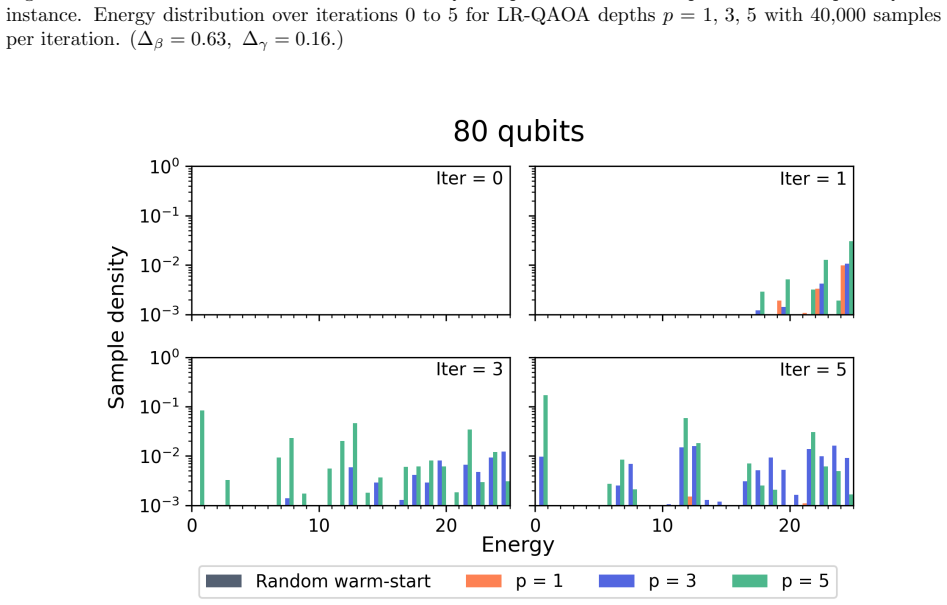
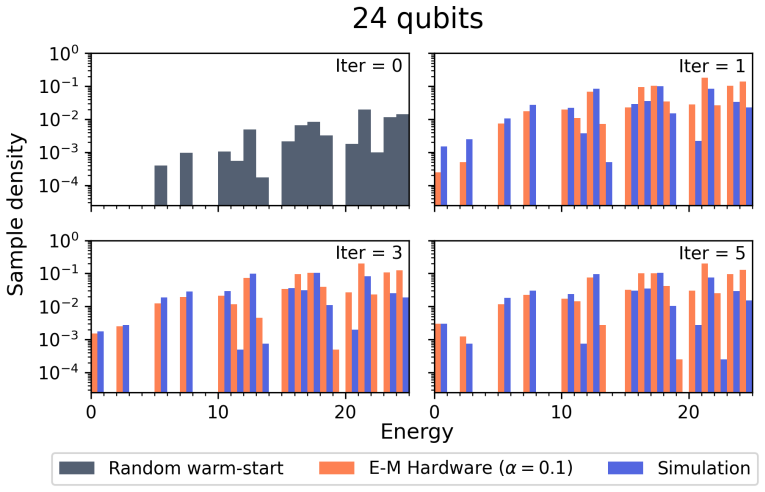
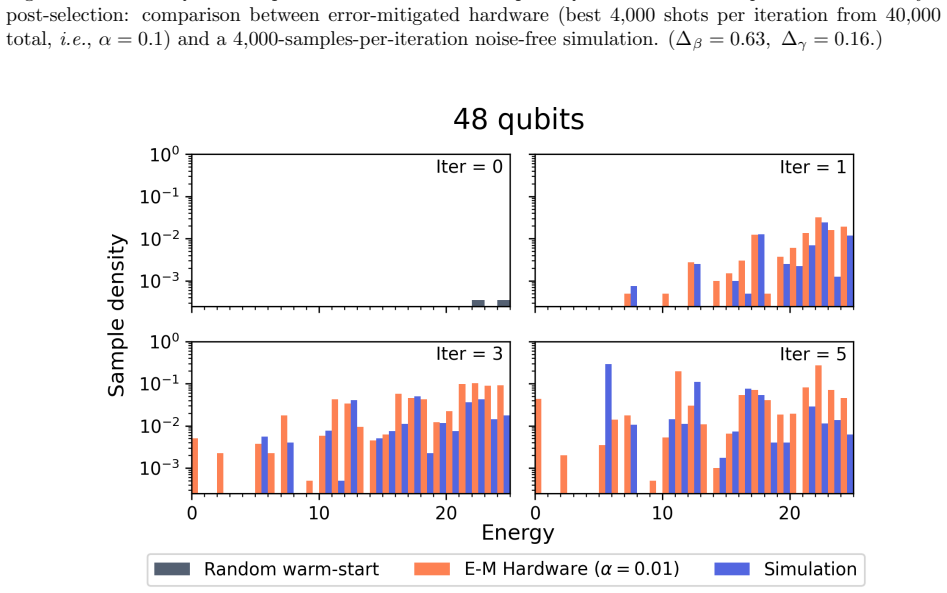
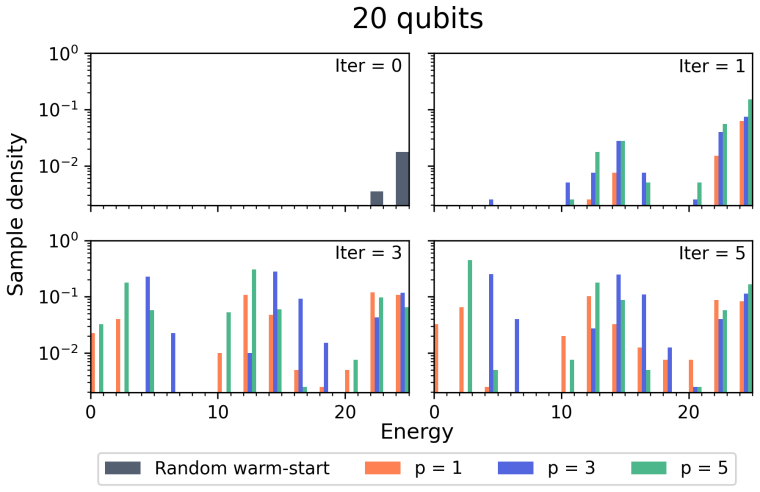
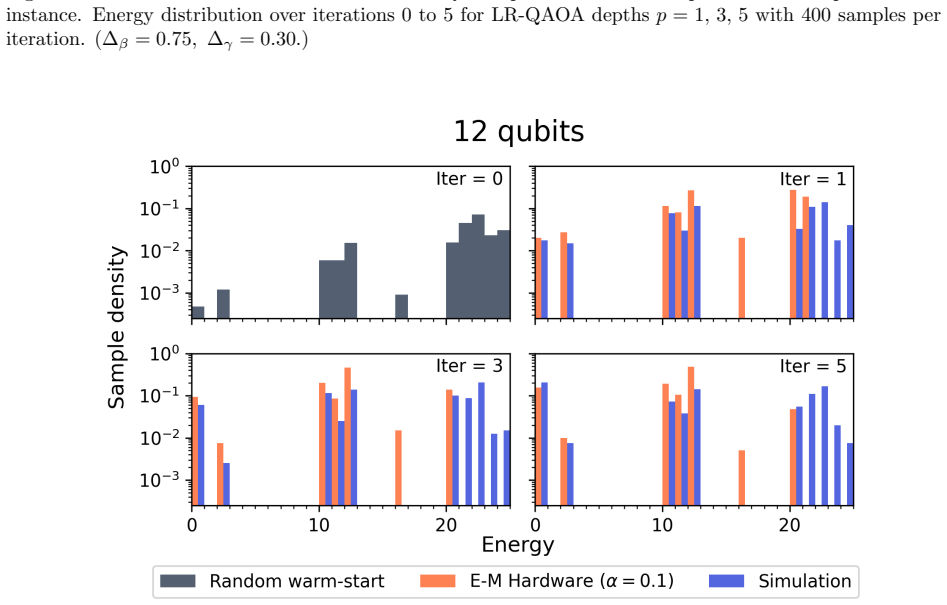
We encode the identification of a genome walk matching read copy numbers as QUBO and HUBO problems and demonstrate that Iterative-QAOA solves them effectively, reliably recovering optimal assemblies in noiseless simulations from minuscule fractions of the search space and reproducing relevant results on quantum hardware for the QUBO formulation.
What carries the argument
Iterative-QAOA, which applies a fixed linear-ramp QAOA schedule with iterative warm-start bias updates after custom circuit compilation, applied to the QUBO and HUBO encodings of the genome walk problem.
If this is right
- Moderate-sized pangenome instances fit within the qubit budgets of current devices via the higher-order encoding.
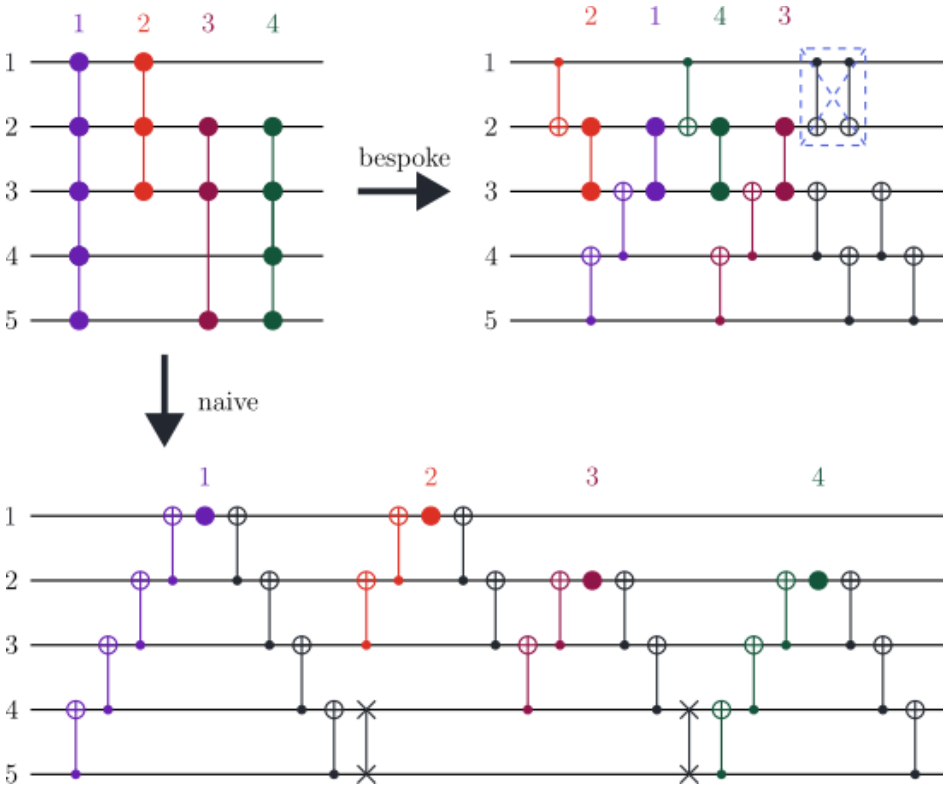
- Custom compilation reduces gate overhead by up to 67 percent compared with standard tools for these circuits.
- Post-selection sampling allows quantum hardware to produce useful assembly results despite noise for the quadratic encoding.
- The nonvariational approach avoids the overhead of full QAOA parameter optimization while still locating optimal solutions.
Where Pith is reading between the lines
- The variable-reduction technique in the higher-order encoding could be adapted to other graph-walk or path-finding problems in bioinformatics.
- Systematic scaling tests on real pangenome datasets would clarify where the qubit-depth trade-off limits performance.
- The observed noise sensitivity suggests exploring hybrid classical post-processing steps to refine quantum outputs for higher-order problems.
Load-bearing premise
The QUBO and HUBO encodings accurately represent the biological constraints from read copy numbers, and the quantum solutions map back to valid genome walks under real sequencing noise and graph complexity.
What would settle it
Running Iterative-QAOA on a real pangenome graph from sequencing data and finding that no returned solutions produce walks whose visit counts match the input copy numbers within acceptable bounds on noisy hardware or at larger sizes.
Figures





read the original abstract
Assembling genomes from short-read sequencing data remains difficult in repetitive regions, where reference bias and combinatorial complexity limit existing methods. Pangenome-guided sequence assembly (PGSA) mitigates reference bias by reconstructing an individual genome as a walk through a population-level graph. The associated problem, identifying a walk whose node visits match read-derived copy numbers, is NP-hard and already challenges classical solvers at a moderate scale. We develop near-term quantum optimisation approaches for this computational bottleneck. We consider two problem encodings: an established quadratic unconstrained binary optimisation and a new higher-order binary optimisation (HUBO) formulation. The latter reduces the number of variables from $O(N^2)$ to $O(N\log N)$ and places moderate-sized instances within the qubit budget of current devices. We solve both using the Iterative-QAOA framework, which combines a fixed linear-ramp QAOA schedule with iterative warm-start bias updates, avoiding the overhead of full variational parameter optimisation. A custom circuit compilation strategy reduces hardware gate overhead by up to 67\% compared with standard tools. In noiseless simulations of QUBO problems, Iterative-QAOA reliably identifies optimal assemblies from as few as $10^{-17}\%$ of all candidate solutions, and \textit{IBM} quantum hardware closely reproduces relevant results with sufficient sampling via CVaR-style post-selection. For HUBO, the variable reduction comes at the cost of deeper compiled circuits and greater noise sensitivity: an expected qubit--depth trade-off. Our findings establish pangenome assembly as a concrete, biologically motivated problem class at the scale where quantum optimisation may first provide practical value.
Editorial analysis
A structured set of objections, weighed in public.
Referee Report
Summary. The manuscript develops nonvariational Iterative-QAOA methods for the NP-hard pangenome-guided sequence assembly (PGSA) problem. It introduces a standard QUBO encoding and a new HUBO encoding that reduces variables from O(N²) to O(N log N), solves both with a fixed linear-ramp QAOA schedule plus iterative warm-start bias updates, and reports a custom compilation that cuts gate overhead by up to 67%. Noiseless simulations are said to recover optimal assemblies from as few as 10^{-17}% of candidates, while IBM hardware runs reproduce relevant results under CVaR post-selection. The central claim is that PGSA constitutes a concrete, biologically motivated problem class at the scale where near-term quantum optimisation may first deliver practical value.
Significance. If the QUBO/HUBO encodings are shown to faithfully encode copy-number constraints and the decoded walks remain valid under realistic noise, the work would be significant: it supplies a non-toy, NP-hard genomics application that fits current qubit budgets, demonstrates a parameter-free schedule that avoids full variational overhead, and achieves substantial compilation savings. These elements address two common barriers (variable count and optimisation cost) for near-term quantum optimisation.
major comments (4)
- [Abstract] Abstract: the claim that Iterative-QAOA 'reliably identifies optimal assemblies' is not supported by any reported instance sizes (N), qubit counts, success probabilities, or error bars across repeated runs; without these metrics it is impossible to assess whether the 10^{-17}% figure is reproducible or scales.
- [Abstract] Abstract: no explicit verification is provided that the bit-strings returned by the optimiser decode to walks whose node-visit counts exactly match the input read-derived copy numbers; this check is load-bearing for the claim that the solutions are biologically valid assemblies.
- [Abstract] Abstract: hardware results are reported only after CVaR-style post-selection, yet no quantitative comparison (e.g., overlap with noiseless optima, fidelity, or distance to feasible set) is given between post-selected samples and the target solutions, nor are error bars supplied for the hardware data.
- [Abstract] Abstract: the manuscript contains no experiments that inject realistic sequencing error into the copy-number vector or that decode walks on pangenome graphs containing repeats; without such tests the assertion that quantum optimisation 'may first provide practical value' rests on an unexamined assumption that the encodings remain faithful under noise.
minor comments (1)
- [Abstract] The 67% gate-overhead reduction is stated without identifying the baseline compiler, the specific instances, or the circuit depth before/after the custom strategy.
Simulated Author's Rebuttal
We thank the referee for their thorough and constructive review of our manuscript. We address each major comment point by point below. Revisions have been made to the abstract and main text to incorporate additional metrics, verifications, and clarifications where feasible.
read point-by-point responses
-
Referee: [Abstract] Abstract: the claim that Iterative-QAOA 'reliably identifies optimal assemblies' is not supported by any reported instance sizes (N), qubit counts, success probabilities, or error bars across repeated runs; without these metrics it is impossible to assess whether the 10^{-17}% figure is reproducible or scales.
Authors: We agree that the abstract would benefit from explicit quantitative support. The full manuscript reports results on specific moderate-scale instances (N up to approximately 20 for QUBO encodings, with corresponding qubit counts of 20-40 depending on the formulation). Success probabilities are derived from sampling 10^4-10^5 shots, with the 10^{-17}% figure reflecting the fraction of the total search space explored. We have revised the abstract to include representative values for N, qubit counts, success probabilities, and error bars from repeated runs, and expanded the scaling discussion in the results section. revision: yes
-
Referee: [Abstract] Abstract: no explicit verification is provided that the bit-strings returned by the optimiser decode to walks whose node-visit counts exactly match the input read-derived copy numbers; this check is load-bearing for the claim that the solutions are biologically valid assemblies.
Authors: We have conducted this verification for all reported solutions in the noiseless simulations, confirming exact matches between decoded node-visit counts and the input copy-number vectors. To make this explicit, we have added a statement to the revised abstract and inserted a new paragraph in the methods section describing the decoding procedure along with a summary table verifying constraint satisfaction across the tested instances. revision: yes
-
Referee: [Abstract] Abstract: hardware results are reported only after CVaR-style post-selection, yet no quantitative comparison (e.g., overlap with noiseless optima, fidelity, or distance to feasible set) is given between post-selected samples and the target solutions, nor are error bars supplied for the hardware data.
Authors: We acknowledge that additional quantitative metrics would strengthen the hardware results presentation. In the revision, we have added to the abstract and hardware section explicit comparisons including the overlap fraction between post-selected samples and noiseless optima, average Hamming distance to the feasible set, and error bars computed from multiple independent hardware runs (typically 5-10 repetitions). revision: yes
-
Referee: [Abstract] Abstract: the manuscript contains no experiments that inject realistic sequencing error into the copy-number vector or that decode walks on pangenome graphs containing repeats; without such tests the assertion that quantum optimisation 'may first provide practical value' rests on an unexamined assumption that the encodings remain faithful under noise.
Authors: The present study establishes baseline performance of the encodings and Iterative-QAOA solver under ideal conditions to demonstrate feasibility on current hardware. We agree that injecting realistic sequencing errors and testing on repeat-rich graphs would be necessary to fully substantiate practical utility claims. Such experiments lie outside the scope of this initial work, as they would require new datasets and graph constructions. We have therefore revised the abstract to moderate the claim and added a limitations paragraph in the discussion that explicitly notes this gap and identifies it as important future work. revision: partial
Circularity Check
No significant circularity detected
full rationale
The paper introduces a novel HUBO encoding that explicitly reduces variable count from O(N²) to O(N log N) via a new formulation of the walk-matching constraints, then applies Iterative-QAOA (defined in the manuscript as a fixed linear-ramp schedule plus warm-start bias updates) to solve the resulting instances. No equation or claim reduces a reported result to a parameter fitted from the target quantity itself, nor does any load-bearing step rely on a self-citation whose content is unverified or tautological. Simulation and hardware results are obtained from independent runs on the encoded problems and do not presuppose the final claim of practical relevance. The derivation chain is therefore self-contained.
Axiom & Free-Parameter Ledger
axioms (2)
- standard math Standard assumptions of gate-based quantum computation (unitary evolution, projective measurement)
- domain assumption The chosen QUBO/HUBO objective exactly encodes the copy-number matching constraint of the pangenome walk problem
Reference graph
Works this paper leans on
-
[1]
Pangenome-guided sequence assembly via binary optimization
Josh Cudby, James Bonfield, Chenxi Zhou, et al. “Pangenome-guided sequence assembly via binary optimization”. In:Briefings in Bioinformatics27.1 (Jan. 2026).doi:10.1093/bib/bbag084
-
[2]
A non-variational quantum approach to the job shop scheduling problem
Miguel Angel Lopez-Ruiz, Emily L. Tucker, Emma M. Arnold, et al.A Non-Variational Quantum Approach to the Job Shop Scheduling Problem. arXiv:2510.26859 [quant-ph]. Oct. 2025.doi:10.48550/ arXiv.2510.26859
-
[3]
A Quantum Approximate Optimization Algorithm
Edward Farhi, Jeffrey Goldstone, and Sam Gutmann.A Quantum Approximate Optimization Algo- rithm. arXiv:1411.4028 [quant-ph]. Nov. 2014.doi:10.48550/arXiv.1411.4028
work page internal anchor Pith review Pith/arXiv arXiv doi:10.48550/arxiv.1411.4028 2014
-
[4]
Space-efficient binary optimization for variational computing,
Adam Glos, Aleksandra Krawiec, and Zolt´ an Zimbor´ as.Space-efficient binary optimization for varia- tional computing. arXiv:2009.07309 [cond-mat, physics:quant-ph]. Sept. 2020
-
[5]
Ruslan Shaydulin, Changhao Li, Shouvanik Chakrabarti, et al. “Evidence of Scaling Advantage for the Quantum Approximate Optimization Algorithm on a Classically Intractable Problem”. In:Science Advances10.22 (May 2024).doi:10.1126/sciadv.adm6761. 16
-
[6]
J. A. Monta˜ nez-Barrera and Kristel Michielsen. “Toward a linear-ramp QAOA protocol: evidence of a scaling advantage in solving some combinatorial optimization problems”. In:npj Quantum Information 11.1 (Aug. 2025).doi:10.1038/s41534-025-01082-1
-
[7]
Performance of the quantum approximate optimization algorithm on the maximum cut problem,
Gavin E. Crooks.Performance of the Quantum Approximate Optimization Algorithm on the Maximum Cut Problem. Version Number: 1. 2018.doi:10.48550/ARXIV.1811.08419
-
[8]
Classical Algorithms and Quantum Limitations for Maximum Cut on High-Girth Graphs
Boaz Barak and Kunal Marwaha. “Classical Algorithms and Quantum Limitations for Maximum Cut on High-Girth Graphs”. In:LIPIcs, Volume 215, ITCS 2022215 (2022). Ed. by Mark Braverman. doi:10.4230/LIPICS.ITCS.2022.14
-
[9]
Characterizing barren plateaus in quantum ans ¨atze with the adjoint representation,
Enrico Fontana, Dylan Herman, Shouvanik Chakrabarti, et al. “Characterizing barren plateaus in quantum ans¨ atze with the adjoint representation”. In:Nature Communications15.1 (Aug. 2024).doi: 10.1038/s41467-024-49910-w
-
[10]
Warm-starting quantum optimization,
Daniel J. Egger, Jakub Marecek, and Stefan Woerner. “Warm-starting quantum optimization”. In: Quantum5 (June 2021).doi:10.22331/q-2021-06-17-479
-
[11]
Dennis Willsch, Madita Willsch, Fengping Jin, et al. “GPU-accelerated simulations of quantum anneal- ing and the quantum approximate optimization algorithm”. In:Computer Physics Communications 278 (2022).doi:https://doi.org/10.1016/j.cpc.2022.108411
-
[13]
Transfer learning of optimal QAOA parameters in combinatorial optimization
J. A. Montanez-Barrera, Dennis Willsch, and Kristel Michielsen. “Transfer learning of optimal QAOA parameters in combinatorial optimization”. In:Quantum Information Processing24.5 (May 2025).doi: 10.1007/s11128-025-04743-4
-
[14]
Parameter Transfer for Quantum Ap- proximate Optimization of Weighted MaxCut
Ruslan Shaydulin, Phillip C. Lotshaw, Jeffrey Larson, et al. “Parameter Transfer for Quantum Ap- proximate Optimization of Weighted MaxCut”. In:ACM Transactions on Quantum Computing4.3 (Sept. 2023).doi:10.1145/3584706
-
[15]
Combining hard and soft decoders for hypergraph product codes,
Shree Hari Sureshbabu, Dylan Herman, Ruslan Shaydulin, et al. “Parameter Setting in Quantum Approximate Optimization of Weighted Problems”. In:Quantum8 (Jan. 2024).doi:10.22331/q- 2024-01-18-1231
work page doi:10.22331/q- 2024
-
[16]
Quantum alternating operator ansatz (QAOA) beyond low depth with gradually changing unitaries,
Vladimir Kremenetski, Anuj Apte, Tad Hogg, et al.Quantum Alternating Operator Ansatz (QAOA) beyond low depth with gradually changing unitaries. arXiv:2305.04455 [quant-ph]. July 2023.doi:10. 48550/arXiv.2305.04455
-
[17]
Extrapolation method to optimize linear-ramp QAOA parameters: Evaluation of QAOA runtime scaling,
Vanessa Dehn, Martin Zaefferer, Gerhard Hellstern, et al.Extrapolation method to optimize linear-ramp QAOA parameters: Evaluation of QAOA runtime scaling. arXiv:2504.08577 [quant-ph]. Apr. 2025.doi: 10.48550/arXiv.2504.08577
-
[18]
May 2025
Ryo Sakai, Hiromichi Matsuyama, Wai-Hong Tam, et al.Transferring linearly fixed QAOA angles: performance and real device results. May 2025
2025
-
[19]
Jonathan Wurtz and Danylo Lykov. “Fixed-angle conjectures for the quantum approximate optimiza- tion algorithm on regular MaxCut graphs”. In:Physical Review A: Atomic, Molecular, and Optical Physics104.5 (Nov. 2021).doi:10.1103/PhysRevA.104.052419
-
[20]
Haomu Yuan, Songqinghao Yang, and Crispin H. W. Barnes.Iterative quantum optimisation with a warm-started quantum state. Version Number: 1. 2025.doi:10.48550/ARXIV.2502.09704
-
[21]
Quantum Computing for Genomics: Conceptual Challenges and Practical Perspectives
Aurora Maurizio and Guglielmo Mazzola. “Quantum Computing for Genomics: Conceptual Challenges and Practical Perspectives”. In:PRX Life3.4 (Oct. 2025).doi:10.1103/h49j-bsc6
-
[22]
Noise tailoring for scalable quantum computation via random- ized compiling
Joel J. Wallman and Joseph Emerson. “Noise tailoring for scalable quantum computation via random- ized compiling”. In:Physical Review A94.5 (Nov. 2016).doi:10.1103/PhysRevA.94.052325
-
[23]
Scaling of the quantum approximate optimization algorithm on superconducting qubit based hardware
Johannes Weidenfeller, Lucia C. Valor, Julien Gacon, et al. “Scaling of the quantum approximate optimization algorithm on superconducting qubit based hardware”. In:Quantum6 (Dec. 2022).doi: 10.22331/q-2022-12-07-870
-
[24]
A SAT Approach to the Initial Mapping Problem in SWAP Gate Insertion for Commuting Gates
Atsushi Matsuo, Shigeru Yamashita, and Daniel J. Egger. “A SAT Approach to the Initial Mapping Problem in SWAP Gate Insertion for Commuting Gates”. In:IEICE Transactions on Fundamen- tals of Electronics, Communications and Computer SciencesE106.A.11 (Nov. 2023).doi:10.1587/ transfun.2022EAP1159. 17
2023
-
[25]
NuWLS: Improving Local Search for (Weighted) Partial MaxSAT by New Weighting Techniques
Yi Chu, Shaowei Cai, and Chuan Luo. “NuWLS: Improving Local Search for (Weighted) Partial MaxSAT by New Weighting Techniques”. In:Proceedings of the AAAI Conference on Artificial In- telligence37.4 (June 2023).doi:10.1609/aaai.v37i4.25505
-
[26]
Improving Variational Quantum Optimization using CVaR
Panagiotis Kl Barkoutsos, Giacomo Nannicini, Anton Robert, et al. “Improving Variational Quantum Optimization using CVaR”. In:Quantum4 (Apr. 2020).doi:10.22331/q-2020-04-20-256
-
[27]
Provable bounds for noise-free expectation values computed from noisy samples
Samantha V. Barron, Daniel J. Egger, Elijah Pelofske, et al. “Provable bounds for noise-free expectation values computed from noisy samples”. In:Nature Computational Science4.11 (Nov. 2024).doi:10. 1038/s43588-024-00709-1
2024
-
[28]
Valerie A. Schneider, Tina Graves-Lindsay, Kerstin Howe, et al. “Evaluation of GRCh38 and de novo haploid genome assemblies demonstrates the enduring quality of the reference assembly”. In:Genome Research27.5 (May 2017).doi:10.1101/gr.213611.116
-
[29]
Vladimir Kremenetski, Tad Hogg, Stuart Hadfield, et al.Quantum Alternating Operator Ansatz (QAOA) Phase Diagrams and Applications for Quantum Chemistry. arXiv:2108.13056 [quant-ph]. Oct. 2021. doi:10.48550/arXiv.2108.13056. 18 Supplementary Information S1 A primer on genomics and sequence assembly This appendix briefly introduces the biological and comput...
discussion (0)
Sign in with ORCID, Apple, or X to comment. Anyone can read and Pith papers without signing in.