Recognition: 2 theorem links
· Lean TheoremKey Role of Charge Disproportionation in Monoclinic Semiconducting Fe₂PO₅, a Room-Temperature d-Wave Altermagnet Candidate
Pith reviewed 2026-05-10 18:45 UTC · model grok-4.3
The pith
An electronic instability in the tetragonal metallic state of Fe₂PO₅ drives charge disproportionation that stabilizes the monoclinic semiconducting phase.
A machine-rendered reading of the paper's core claim, the machinery that carries it, and where it could break.
Core claim
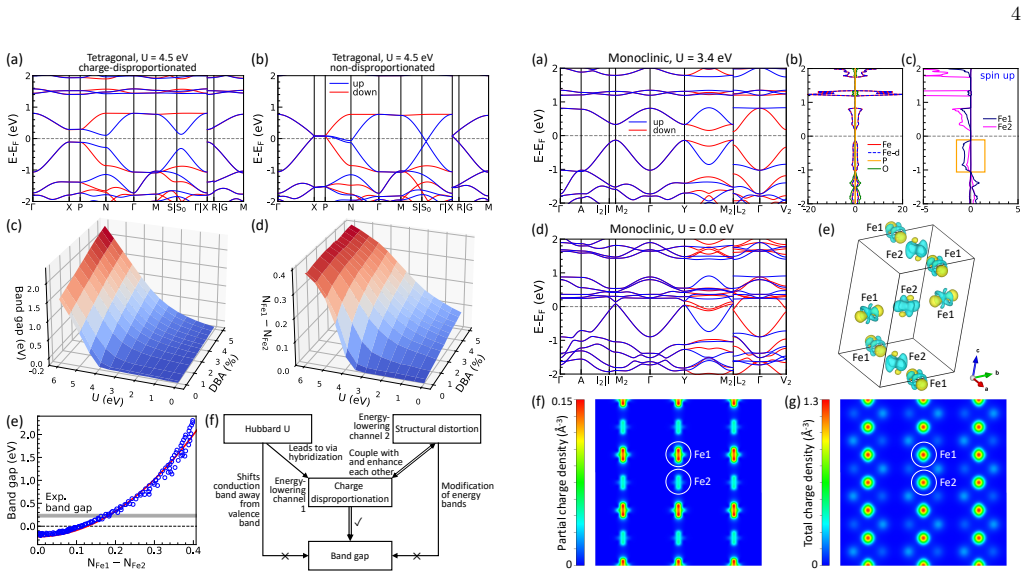
An electronic instability appears in the tetragonal metallic state as the joint effect of density functional theory and Hubbard U correction and results in a charge disproportionation, which in turn stabilizes the monoclinic distortion with narrow gap formation. The successful capture of this effect requires accounting for the relevant symmetry-breaking energy-lowering channels of charge disproportionation and structural distortion; otherwise tetragonal-symmetry-constrained calculations yield only a metallic state. Fe₂PO₅ is thus best described as a correlation- and hybridization-assisted, distortion-coupled, charge-disproportionated semiconductor and a rare room-temperature semiconducting d
What carries the argument
charge disproportionation between Fe sites that couples to monoclinic lattice distortion and opens the gap
If this is right
- The monoclinic phase remains semiconducting with a narrow gap at room temperature.
- Large band spin splitting and orthogonal transport channels for opposite spins survive the distortion.
- The material provides a platform for studying coexistence of altermagnetism and charge density wave order in quasi-one-dimensional systems.
- Symmetry-constrained calculations miss the ground state and incorrectly predict metallicity.
Where Pith is reading between the lines
- Similar correlation-driven charge instabilities may turn other metallic altermagnet candidates into semiconductors once symmetry breaking is allowed.
- Quasi-one-dimensional chain compounds with strong electron correlations could be screened for analogous distortion-coupled gaps.
- Transport and magnetic measurements along the distinct crystallographic directions would test whether the altermagnetic spin splitting remains intact after the monoclinic distortion.
Load-bearing premise
The DFT+U treatment must be allowed to break symmetry through both charge disproportionation and structural relaxation; otherwise the calculation remains stuck in the tetragonal metallic state.
What would settle it
Spectroscopic or diffraction data that show no measurable charge difference between Fe sites together with metallic conductivity in the monoclinic phase would falsify the proposed instability.
Figures


read the original abstract
$\beta$-Fe$_2$PO$_5$ is an emerging room-temperature d-wave altermagnet featuring quasi-one-dimensional crystal and magnetic structures, orthogonal transport channels for opposite spins, and large band spin splitting, which is a promising material for next-generation spintronics and magnonics. However, its crystal and electronic structures remain inconclusive. Here, joint experimental and theoretical studies confirm and explain the appearance of its monoclinic structure and semiconducting band gap. We discover that an electronic instability appears in the tetragonal metallic state as the joint effect of density functional theory and Hubbard U correction (DFT+U) and results in a charge disproportionation, which in turn stabilizes the monoclinic distortion with narrow gap formation. The successful capture of this effect within DFT+U requires accounting for the relevant symmetry-breaking energy-lowering channels -- charge disproportionation and structural distortion; otherwise, tetragonal-symmetry-constrained calculations yield only a metallic state. Fe$_2$PO$_5$ is thus best described as a correlation- and hybridization-assisted, distortion-coupled, charge-disproportionated semiconductor. It represents a rare room-temperature semiconducting d-wave altermagnet. It also provides a rare platform for studying the coexistence of altermagnetism and charge density wave in quasi-one-dimensional systems.
Editorial analysis
A structured set of objections, weighed in public.
Referee Report
Summary. The manuscript reports joint experimental and theoretical work on β-Fe₂PO₅, confirming its monoclinic crystal structure and semiconducting gap. DFT+U calculations reveal an electronic instability in the tetragonal metallic phase that produces charge disproportionation; this disproportionation then stabilizes the monoclinic distortion and opens a narrow gap. The work emphasizes that symmetry-breaking channels (charge disproportionation plus structural relaxation) must be allowed, as tetragonal-constrained calculations remain metallic, and positions the compound as a rare room-temperature semiconducting d-wave altermagnet candidate.
Significance. If the computational results hold with full details provided, the paper identifies a rare room-temperature semiconducting d-wave altermagnet and supplies a concrete platform for examining the interplay of correlation-driven charge disproportionation, structural distortion, and altermagnetism in quasi-one-dimensional systems. The joint experimental confirmation of structure and gap adds value, though the absence of quantitative computational parameters limits immediate reproducibility.
major comments (2)
- [Computational Methods] Computational details section (or equivalent): the specific Hubbard U value, its determination method (e.g., linear response or empirical), and any convergence tests are not reported. Because the central claim states that the charge-disproportionation instability appears only as the joint effect of DFT and the U correction, and that symmetry-constrained calculations remain metallic, the U parameter is load-bearing and must be stated explicitly with sensitivity checks.
- [Results] Results section and abstract: no numerical values are given for the computed or measured band gap, the magnitude of charge disproportionation (e.g., site-resolved Fe valences or Bader charges), or experimental error bars on lattice parameters and transport data. Without these, it is difficult to assess how narrow the gap is, how well theory matches experiment, or the robustness of the monoclinic stabilization claim.
minor comments (2)
- [Abstract] Abstract: the phrase 'narrow gap formation' would benefit from a parenthetical numerical estimate (e.g., ~0.2 eV) to give readers an immediate sense of scale.
- [Figures] Figures: ensure all plots of density of states or band structures include the Fermi level reference and that any experimental spectra are overlaid with theory where direct comparison is claimed.
Simulated Author's Rebuttal
We thank the referee for the careful reading of our manuscript and for the constructive comments, which have helped us improve the clarity and reproducibility of the work. We address each major comment below and have revised the manuscript accordingly.
read point-by-point responses
-
Referee: [Computational Methods] Computational details section (or equivalent): the specific Hubbard U value, its determination method (e.g., linear response or empirical), and any convergence tests are not reported. Because the central claim states that the charge-disproportionation instability appears only as the joint effect of DFT and the U correction, and that symmetry-constrained calculations remain metallic, the U parameter is load-bearing and must be stated explicitly with sensitivity checks.
Authors: We agree that explicit reporting of the Hubbard U parameter is essential given its central role in stabilizing the charge disproportionation. In the revised manuscript we have expanded the Computational Methods section to state the specific U value employed, the linear-response procedure used to determine it, and the results of convergence tests with respect to U and k-point sampling. These additions confirm that the electronic instability and subsequent monoclinic stabilization remain robust for U values near the chosen one. revision: yes
-
Referee: [Results] Results section and abstract: no numerical values are given for the computed or measured band gap, the magnitude of charge disproportionation (e.g., site-resolved Fe valences or Bader charges), or experimental error bars on lattice parameters and transport data. Without these, it is difficult to assess how narrow the gap is, how well theory matches experiment, or the robustness of the monoclinic stabilization claim.
Authors: We thank the referee for noting the absence of quantitative values. We have revised both the Results section and the abstract to report the computed and measured band-gap magnitudes, the site-resolved Bader charges that quantify the charge disproportionation, and the experimental uncertainties on the lattice parameters and transport data. These additions allow direct assessment of the narrow-gap semiconducting state and the agreement between theory and experiment. revision: yes
Circularity Check
No significant circularity; derivation is self-contained
full rationale
The paper's central claim rests on standard DFT+U calculations applied to the tetragonal phase, where allowing symmetry-breaking channels (charge disproportionation and structural relaxation) produces an instability leading to monoclinic distortion and gap opening, while symmetry-constrained runs remain metallic. This is a conventional computational protocol for correlation-driven instabilities and does not reduce any target quantity (gap, distortion) to a fitted parameter defined by the result itself. No equations, self-citations, or ansatzes are presented that would make the outcome equivalent to its inputs by construction. The description is internally consistent with external benchmarks for DFT+U in mixed-valence compounds.
Axiom & Free-Parameter Ledger
axioms (1)
- domain assumption DFT+U with appropriate symmetry breaking reproduces the ground-state structure and gap of transition-metal phosphates
Lean theorems connected to this paper
-
IndisputableMonolith/Foundation/Cost/FunctionalEquation.leanwashburn_uniqueness_aczel unclear?
unclearRelation between the paper passage and the cited Recognition theorem.
an electronic instability appears in the tetragonal metallic state as the joint effect of density functional theory and Hubbard U correction (DFT+U) and results in a charge disproportionation, which in turn stabilizes the monoclinic distortion with narrow gap formation
-
IndisputableMonolith/Foundation/AbsoluteFloorClosure.leanabsolute_floor_iff_bare_distinguishability unclear?
unclearRelation between the paper passage and the cited Recognition theorem.
The successful capture of this effect within DFT+U requires accounting for the relevant symmetry-breaking energy-lowering channels -- charge disproportionation and structural distortion
What do these tags mean?
- matches
- The paper's claim is directly supported by a theorem in the formal canon.
- supports
- The theorem supports part of the paper's argument, but the paper may add assumptions or extra steps.
- extends
- The paper goes beyond the formal theorem; the theorem is a base layer rather than the whole result.
- uses
- The paper appears to rely on the theorem as machinery.
- contradicts
- The paper's claim conflicts with a theorem or certificate in the canon.
- unclear
- Pith found a possible connection, but the passage is too broad, indirect, or ambiguous to say the theorem truly supports the claim.
Reference graph
Works this paper leans on
-
[1]
Figure 1(d) shows the X-ray diffraction (XRD) pattern recorded at room temperature for theβ-Fe 2PO5 powder sample
and the semiconducting nature [14] ofβ-Fe 2PO5, we have synthesized it (see Methods) and measured its elec- trical transport properties. Figure 1(d) shows the X-ray diffraction (XRD) pattern recorded at room temperature for theβ-Fe 2PO5 powder sample. The Rietveld analysis of the XRD pattern indicates thatβ-Fe 2PO5 crystallizes into a m-structure (space g...
-
[2]
L. ˇSmejkal, J. Sinova, and T. Jungwirth, Beyond Conventional Ferromagnetism and Antiferromagnetism: A Phase with Nonrelativistic Spin and Crystal Ro- tation Symmetry, Phys. Rev. X12, 031042 (2022). https://doi.org/10.1103/PhysRevX.12.031042
-
[3]
L. ˇSmejkal, J. Sinova, and T. Jungwirth, 7 Emerging Research Landscape of Altermag- netism, Phys. Rev. X12, 040501 (2022). https://doi.org/10.1103/PhysRevX.12.040501
-
[4]
L. D. Yuan, Z. Wang, J. W. Luo, E. I. Rashba, and A. Zunger, Giant momentum-dependent spin splitting in centrosymmetric low-Z antifer- romagnets, Phys. Rev. B102, 014422 (2020). https://doi.org/10.1103/PhysRevB.102.014422
-
[5]
L. D. Yuan, Z. Wang, J. W. Luo, and A. Zunger, Prediction of low-Z collinear and noncollinear an- tiferromagnetic compounds having momentum- dependent spin splitting even without spin-orbit coupling, Phys. Rev. Mater.5, 014409 (2021). https://doi.org/10.1103/PhysRevMaterials.5.014409
-
[6]
K. H. Ahn, A. Hariki, K. W. Lee, and J. Kuneˇ s, Antiferromagnetism in RuO2 asd-wave Pomer- anchuk instability, Phys. Rev. B99, 184432 (2019). https://doi.org/10.1103/PhysRevB.99.184432
-
[7]
M. Naka, S. Hayami, H. Kusunose, Y. Yanagi, Y. Motome, and H. Seo, Spin current generation in or- ganic antiferromagnets, Nat. Commun.10, 4305 (2019). https://doi.org/10.1038/s41467-019-12229-y
-
[8]
H. Y. Ma, M. Hu, N. Li, J. Liu, W. Yao, J. F. Jia, and J. Liu, Multifunctional antiferromag- netic materials with giant piezomagnetism and non- collinear spin current, Nat. Commun.12, 2846 (2021). https://doi.org/10.1038/s41467-021-23127-7
-
[9]
S. V. Gallego, J. M. Perez-Mato, L. Elcoro, E. S. Tasci, R. M. Hanson, K. Momma, M. I. Aroyo, and G. Madariaga, MAGNDATA: towards a database of magnetic struc- tures. I. The commensurate case, J. Appl. Cryst.49, 1750 (2016). https://doi.org/10.1107/S1600576716012863
-
[10]
T. He, L. Li, C. Cui, R.-W. Zhang, Z.-M. Yu, G. Liu, and X. Zhang, Quasi-One-Dimensional Spin Transport in AltermagneticZ 3 Nodal Net Metals, Phys. Rev. Lett.133, 146602 (2024). https://doi.org/10.1103/PhysRevLett.133.146602
-
[11]
Sen Zhang et al., X-type stacking in cross- chain antiferromagnets, Newton1, 100068 (2025)
S. Sen Zhang et al., X-type stacking in cross- chain antiferromagnets, Newton1, 100068 (2025). https://doi.org/10.1016/j.newton.2025.100068
-
[12]
A. Modaressi, A. Courtois, R. Gerardin, B. Malaman, and C. Gleitzer, Fe2PO5, un phosphate de fer de valence mixte. Pr´ eparation et ´ etudes structurale, m¨ ossbauer et magn´ etique, J. Solid State Chem.40, 301 (1981). https://doi.org/10.1016/0022-4596(81)90396-0
-
[13]
M. Ijjaali, B. Malaman, G. Venturini, C. Gleitzer, G. J. Long, and F. Grandjeam, A neutron diffrac- tion and Mossbauer effect study of the (FeO 2)n ferromagnetic sheets in antiferromagneticα- Fe2(PO4)O, J. Phys. Condens. Matter3, 9597 (1991). https://doi.org/10.1088/0953-8984/3/48/002
-
[14]
J. K. Warner, A. K. Cheetham, D. E. Cox, and R. B. Von Dreele, Valence Contrast between Iron Sites inα- Fe2PO5: A Comparative Study by Magnetic Neutron and Resonant X-ray Powder Diffraction, J. Am. Chem. Soc. 114, 6074 (1992). https://doi.org/10.1021/ja00041a027
-
[15]
B. Ech-Chahed, F. Jeannot, B. Malaman, and C. Gleitzer, Pr´ eparation et ´ etude d’une vari´ et´ e basse temp´ erature de l’oxyphosphate de fer de valence mixte βFe2(PO4)O et de NiCr(PO 4)O: Un cas d’´ echange ´ electronique rapide, J. Solid State Chem.74, 47 (1988). https://doi.org/10.1016/0022-4596(88)90330-1
-
[16]
M. Ijjaali, B. Malaman, C. Gleitzer, J. K. Warner, J. A. Hriljac, and A. K. Cheetham, Stability, structure refinement, and magnetic properties ofβ- Fe2(PO4)O, J. Solid State Chem.86, 195 (1990). https://doi.org/10.1016/0022-4596(90)90135-K
-
[17]
E. Elka¨ ım, J. F. Berar, C. Gleitzer, B. Malaman, M. Ijjaali, and C. Lecomte, Occurrence of a monoclinic distortion inβ-Fe 2PO5, Acta Cryst.B52, 428 (1996). https://doi.org/10.1107/S0108768195014273
-
[18]
See Supplemental Material for more computational and experimental details
-
[19]
X. Zhang, J. X. Xiong, and A. Zunger, Hidden mag- netism and split off flat bands in the insulator metal transition in VO 2, Npj Comput. Mater.10, 217 (2024). https://doi.org/10.1038/s41524-024-01382-8
-
[20]
J. P. Allen and G. W. Watson, Occupation matrix control of d- and f-electron localisations using DFT + U, Phys. Chem. Chem. Phys.16, 21016 (2014). https://doi.org/10.1039/C4CP01083C
-
[21]
Note that the tiny unphysical band spin splitting along the nodal planes or lines in the charge-disproportionated band structure is due to numerical errors in symmetry- unconstrained calculations, which is negligible and can be reduced by increasing computational accuracy
-
[22]
I. I. Mazin, D. I. Khomskii, R. Lengsdorf, J. A. Alonso, W. G. Marshall, R. M. Ibberson, A. Podlesnyak, M. J. Mart´ ınez-Lope, and M. M. Abd- Elmeguid, Charge Ordering as Alternative to Jahn- Teller Distortion, Phys. Rev. Lett.98, 176406 (2007). https://doi.org/10.1103/PhysRevLett.98.176406
-
[23]
H. Park, A. J. Millis, and C. A. Marianetti, Site-Selective Mott Transition in Rare-Earth-Element Nickelates, Phys. Rev. Lett.109, 156402 (2012). https://doi.org/10.1103/PhysRevLett.109.156402
-
[24]
J. Varignon, M. Bibes, and A. Zunger, Origin of band gaps in 3dperovskite oxides, Nat. Commun.10, 1658 (2019). https://doi.org/10.1038/s41467-019-09698-6
-
[25]
G. M. Dalpian, Q. Liu, J. Varignon, M. Bibes, and A. Zunger, Bond disproportionation, charge self-regulation, and ligand holes ins-pand in d-electronABX 3 perovskites by density func- tional theory, Phys. Rev. B98, 075135 (2018). https://doi.org/10.1103/PhysRevB.98.075135
-
[26]
Jiang et al., A metallic room-temperature d- wave altermagnet, Nat
B. Jiang et al., A metallic room-temperature d- wave altermagnet, Nat. Phys.21, 754 (2025). https://doi.org/10.1038/s41567-025-02822-y
-
[27]
F. Zhang et al., Crystal-symmetry-paired spin–valley locking in a layered room-temperature metallic al- termagnet candidate, Nat. Phys.21, 760 (2025). https://doi.org/10.1038/s41567-025-02864-2
-
[28]
H. Reichlova et al., Observation of a spontaneous anomalous Hall response in the Mn 5Si3 d-wave alter- magnet candidate, Nat. Commun.15, 4961 (2024). https://doi.org/10.1038/s41467-024-48493-w
-
[29]
A. Badura et al., Observation of the anomalous Nernst effect in altermagnetic candidate Mn 5Si3, Nat. Com- mun.16, 7111 (2025). https://doi.org/10.1038/s41467- 025-62331-7
-
[30]
Han et al., Electrical 180°switching of N´ eel vector in spin-splitting antiferromagnet, Sci
L. Han et al., Electrical 180°switching of N´ eel vector in spin-splitting antiferromagnet, Sci. Adv.10, eadn0479 (2024). https://doi.org/10.1126/sciadv.adn0479
-
[31]
P. Keßler et al., Absence of magnetic order in RuO2: insights fromµSR spectroscopy and neu- tron diffraction, Npj Spintronics2, 50 (2024). https://doi.org/10.1038/s44306-024-00055-y
-
[32]
M. Hiraishi, H. Okabe, A. Koda, R. Kadono, 8 T. Muroi, D. Hirai, and Z. Hiroi, Nonmagnetic Ground State in RuO 2 Revealed by Muon Spin Rotation, Phys. Rev. Lett.132, 166702 (2024). https://doi.org/10.1103/PhysRevLett.132.166702
-
[33]
A. Smolyanyuk, I. I. Mazin, L. Garcia-Gassull, and R. Valent´ ı, Fragility of the magnetic order in the prototypi- cal altermagnet RuO2, Phys. Rev. B109, 134424 (2024). https://doi.org/10.1103/PhysRevB.109.134424
-
[34]
T. He, X. Zhang, W. Meng, L. Jin, X. Dai, and G. Liu, Topological nodal lines and nodal points in the antifer- romagnetic materialβ-Fe 2PO5, J. Mater. Chem. C7, 12657 (2019). https://doi.org/10.1039/C9TC04046C
-
[35]
ˇSmejkal et al., Chiral Magnons in Altermag- netic RuO 2, Phys
L. ˇSmejkal et al., Chiral Magnons in Altermag- netic RuO 2, Phys. Rev. Lett.131, 256703 (2023). https://doi.org/10.1103/PhysRevLett.131.256703
-
[36]
Z. Liu, M. Ozeki, S. Asai, S. Itoh, and T. Ma- suda, Chiral Split Magnon in Altermagnetic MnTe, Phys. Rev. Lett.133, 156702 (2024). https://doi.org/10.1103/PhysRevLett.133.156702
-
[37]
Y. F. Zhang, X. S. Ni, K. Chen, and K. Cao, Chiral magnon splitting in altermagnetic CrSb from first principles, Phys. Rev. B111, 174451 (2025). https://doi.org/10.1103/PhysRevB.111.174451
-
[38]
V. P. Kravchuk, K. V. Yershov, J. I. Facio, Y. Guo, O. Janson, O. Gomonay, J. Sinova, and J. van den Brink, Chiral magnetic excitations and domain textures ofg- wave altermagnets, Phys. Rev. B112, 144421 (2025). https://doi.org/10.1103/zn8d-ft9b
-
[39]
Z. Zhang, E. H. Gamage, G. Amobi, S. Pradhan, A. Kutepov, K. D. Belashchenko, Y. Sun, K. Kovnir, and V. Antropov, Discovery and Synthesis of a Family of Boride Altermagnets, J. Am. Chem. Soc.147, 30117 (2025). https://doi.org/10.1021/jacs.5c07874
-
[40]
J. P. Perdew, K. Burke, and M. Ernzer- hof, Generalized Gradient Approximation Made Simple, Phys. Rev. Lett.77, 3865 (1996). https://doi.org/10.1103/PhysRevLett.77.3865
-
[41]
G. Kresse and J. Furthm¨ uller, Efficient iterative schemes forab initiototal-energy calculations using a plane- wave basis set, Phys. Rev. B54, 11169 (1996). https://doi.org/10.1103/PhysRevB.54.11169
-
[42]
R. E. Prange and V. Korenman, Local-band the- ory of itinerant ferromagnetism. IV. Equivalent Heisenberg model, Phys. Rev. B19, 4691 (1979). https://doi.org/10.1103/PhysRevB.19.4691
-
[43]
X. He, N. Helbig, M. J. Verstraete, and E. Bousquet, TB2J: A python package for computing magnetic interac- tion parameters, Comput. Phys. Commun.264, 107938 (2021). https://doi.org/10.1016/j.cpc.2021.107938
-
[44]
Ozaki ,\ https://doi.org/10.1103/PhysRevB.67.155108 journal journal Phys
T. Ozaki, Variationally optimized atomic orbitals for large-scale electronic structures, Phys. Rev. B67, 155108 (2003). https://doi.org/10.1103/PhysRevB.67.155108
-
[45]
S. L. Dudarev, G. A. Botton, S. Y. Savrasov, C. J. Humphreys, and A. P. Sutton, Electron-energy-loss spectra and the structural stability of nickel oxide: An LSDA+U study, Phys. Rev. B57, 1505 (1998). https://doi.org/10.1103/PhysRevB.57.1505
-
[46]
QUANTUM ESPRESSO: A modular and open -source software project for quantum simulations of materials
S. Toth and B. Lake, Linear spin wave theory for single-Q incommensurate magnetic structures, J. Phys. Condens. Matter27, 166002 (2015). https://doi.org/10.1088/0953- 8984/27/16/166002
-
[47]
R. Nelson, C. Ertural, J. George, V. L. Deringer, G. Hautier, and R. Dronskowski, LOBSTER: Local or- bital projections, atomic charges, and chemical-bonding analysis from projector-augmented-wave-based density- functional theory, J. Comput. Chem.41, 1931 (2020). https://doi.org/10.1002/jcc.26353
discussion (0)
Sign in with ORCID, Apple, or X to comment. Anyone can read and Pith papers without signing in.