Recognition: 1 theorem link
· Lean TheoremSMT-AD: a scalable quantum-inspired anomaly detection approach
Pith reviewed 2026-05-10 19:46 UTC · model grok-4.3
The pith
A quantum-inspired tensor network detects anomalies competitively with linear parameter growth.
A machine-rendered reading of the paper's core claim, the machinery that carries it, and where it could break.
Core claim
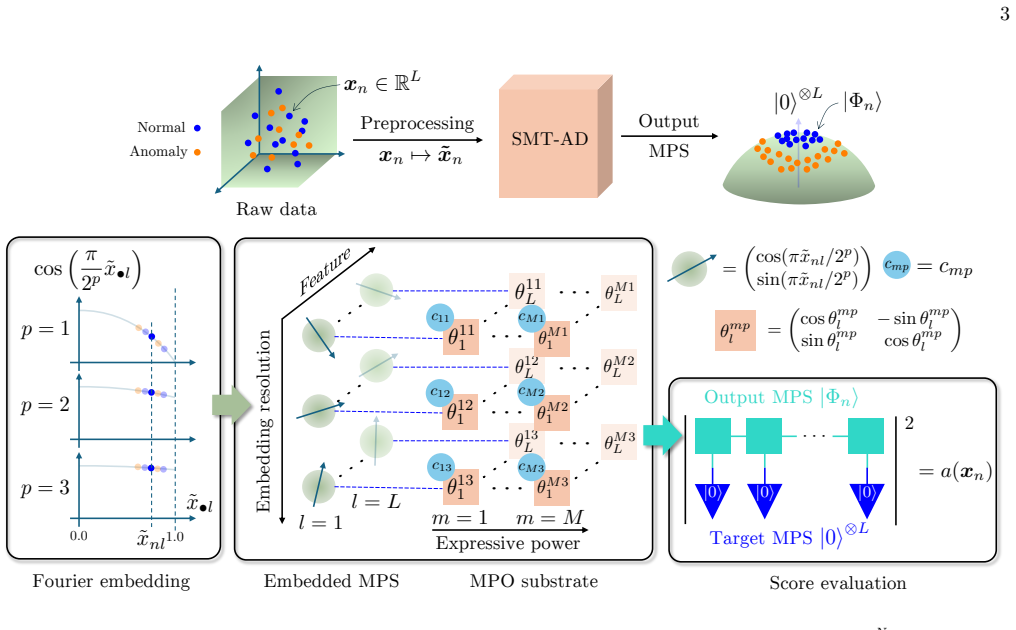
SMT-AD transforms input data using the superposition of bond-dimension-1 matrix product operators with Fourier-assisted multiresolution feature embedding. The number of learnable parameters grows linearly with feature size, embedding resolutions, and the number of additional components in the operator structure. When applied to standard anomaly detection datasets including credit card transactions, the method achieves competitive performance against established baselines even with minimal configurations. It further supplies a straightforward way to reduce model weight and improve performance by highlighting the most relevant input features.
What carries the argument
Superposition of bond-dimension-1 matrix product operators combined with Fourier-assisted multiresolution embedding, which performs the data transformation for anomaly separation.
If this is right
- Competitive anomaly detection on datasets including credit card transactions against established baselines.
- Linear growth of learnable parameters with feature size, embedding resolutions, and additional operator components.
- Direct reduction of model weight while potentially improving performance through selection of relevant input features.
- High parallelizability that supports efficient computation on large inputs.
Where Pith is reading between the lines
- The linear scaling and parallel structure may extend practical use to datasets much larger than those tested in the paper.
- The built-in feature highlighting could increase model interpretability in applications such as fraud detection.
- The tensor network construction might serve as a starting point for analogous methods in other unsupervised learning tasks.
Load-bearing premise
The superposition of bond-dimension-1 matrix product operators combined with Fourier-assisted multiresolution embedding can reliably separate anomalous from normal patterns in real data.
What would settle it
Direct tests on the credit card transactions dataset showing SMT-AD performance falling below standard baselines such as isolation forests or autoencoders, even after minimal configuration tuning, would falsify the competitive performance claim.
Figures


read the original abstract
Quantum-inspired tensor networks algorithms have shown to be effective and efficient models for machine learning tasks, including anomaly detection. Here, we propose a highly parallelizable quantum-inspired approach which we call SMT-AD from Superposition of Multiresolution Tensors for Anomaly Detection. It is based upon the superposition of bond-dimension-1 matrix product operators to transform the input data with Fourier-assisted feature embedding, where the number of learnable parameters grows linearly with feature size, embedding resolutions, and the number of additional components in the matrix product operators structure. We demonstrate successful anomaly detection when applied to standard datasets, including credit card transactions, and find that, even with minimal configurations, it achieves competitive performance against established anomaly detection baselines. Furthermore, it provides a straightforward way to reduce the weight of the model and even improve the performance by highlighting the most relevant input features.
Editorial analysis
A structured set of objections, weighed in public.
Referee Report
Summary. The manuscript introduces SMT-AD, a quantum-inspired anomaly detection approach based on the superposition of bond-dimension-1 matrix product operators combined with Fourier-assisted multiresolution feature embedding. The number of learnable parameters is stated to scale linearly with feature size, embedding resolutions, and the number of additional MPO components. The central empirical claim is that even minimal configurations of this model achieve competitive performance against established anomaly detection baselines on standard datasets including credit-card transactions, while also enabling straightforward model compression and highlighting of relevant input features.
Significance. If the reported empirical results hold under scrutiny, SMT-AD could represent a practical, scalable alternative for anomaly detection tasks where linear parameter growth and parallelizability are advantageous. The combination of tensor-network structure with multiresolution embedding and the optional feature-highlighting mechanism offers potential interpretability benefits not always present in black-box detectors.
minor comments (3)
- [Abstract] Abstract: the statement that the method 'achieves competitive performance against established anomaly detection baselines' would be more informative if it named the specific baselines and reported quantitative metrics (e.g., AUC-ROC or F1 scores) rather than leaving these details for the experimental section.
- [Section 4] Section 4 (Experiments): the description of 'minimal configurations' should explicitly list the values chosen for the number of additional MPO components and embedding resolutions, together with the precise train/test splits and any preprocessing steps applied to the credit-card and other datasets.
- [Figures] Figure captions and legends: ensure every performance-comparison plot includes axis labels, units, and a clear legend distinguishing SMT-AD variants from the baselines.
Simulated Author's Rebuttal
We thank the referee for their positive evaluation of our work on SMT-AD and for recommending minor revision. We appreciate the recognition of its potential as a scalable, parallelizable quantum-inspired anomaly detection method with linear parameter scaling and interpretability features.
Circularity Check
No significant circularity; model and results are independently defined and empirically validated
full rationale
The paper defines SMT-AD directly via its tensor-network construction (superposition of bond-dimension-1 MPOs with Fourier-assisted multiresolution embedding) and reports linear parameter scaling as a property of that construction. Performance claims are supported solely by experimental results on external datasets (credit-card transactions and others) compared against standard baselines; no equation or claim reduces to a fitted parameter renamed as a prediction, no self-citation supplies a load-bearing uniqueness theorem, and no ansatz is smuggled in. The derivation chain is therefore self-contained against external benchmarks.
Axiom & Free-Parameter Ledger
free parameters (2)
- number of additional MPO components
- embedding resolutions
axioms (1)
- domain assumption Bond-dimension-1 matrix product operators can be superposed to form an effective feature transformer for anomaly detection
invented entities (1)
-
Superposition of Multiresolution Tensors (SMT)
no independent evidence
Lean theorems connected to this paper
-
IndisputableMonolith/Cost/FunctionalEquation.leanwashburn_uniqueness_aczel unclear?
unclearRelation between the paper passage and the cited Recognition theorem.
superposition of bond-dimension-1 matrix product operators ... Fourier-assisted feature embedding ... normality score a_Θ(x_n) := |⟨0⋯0|Φ_n⟩|² = 1/Z_n [∑ c_mp ∏_l cos(θ_mp^l + π x_nl / 2^p)]²
What do these tags mean?
- matches
- The paper's claim is directly supported by a theorem in the formal canon.
- supports
- The theorem supports part of the paper's argument, but the paper may add assumptions or extra steps.
- extends
- The paper goes beyond the formal theorem; the theorem is a base layer rather than the whole result.
- uses
- The paper appears to rely on the theorem as machinery.
- contradicts
- The paper's claim conflicts with a theorem or certificate in the canon.
- unclear
- Pith found a possible connection, but the passage is too broad, indirect, or ambiguous to say the theorem truly supports the claim.
Reference graph
Works this paper leans on
-
[1]
V. Chandola, A. Banerjee, and V. Kumar, Anomaly detection: A survey, ACM Computing Surveys41, 15 (2009)
work page 2009
-
[2]
G. Pang, C. Shen, L. Cao, and A. V. D. Hengel, Deep learning for anomaly detection: A review, ACM computing surveys (CSUR)54, 1 (2021)
work page 2021
-
[3]
B. Schölkopf, J. C. Platt, J. Shawe-Taylor, A. J. Smola, and R. C. Williamson, Estimating the support of a high-dimensional distribution, Neural Computation13, 1443 (2001)
work page 2001
-
[4]
F. T. Liu, K. M. Ting, and Z.-H. Zhou, Isolation forest, inProceedings of the 2008 Eighth IEEE International Conference on Data Mining(2008) pp. 413–422
work page 2008
-
[5]
F. T. Liu, K. M. Ting, and Z.-H. Zhou, Isolation-based anomaly detection, ACM Transactions on Knowledge Discovery from Data6, 3:1 (2012)
work page 2012
-
[6]
D. Xu, E. Ricci, Y. Yan, J. Song, and N. Sebe, Learning deep representations of appearance and motion for anomalous event detection, inBritish Machine Vision Conference (BMVC)(2015)
work page 2015
-
[7]
J. Andrews, E. Morton, and L. Griffin, Detecting anomalous data using auto-encoders, International Journal of Machine Learning and Computing6, 21 (2016)
work page 2016
-
[8]
P. Seeböck, S. M. Waldstein, S. Klimscha, H. Bogunović, T. Schlegl, B. S. Gerendas, R. Donner, U. Schmidt-Erfurth, and G. Langs, Unsupervised identification of disease marker candidates in retinal oct imaging data, IEEE Transactions on Medical Imaging38, 1037 (2019)
work page 2019
-
[9]
S. M. Erfani, S. Rajasegarar, S. Karunasekera, and C. Leckie, High-dimensional and large-scale anomaly detection using a linear one-class svm with deep learning, Pattern Recognition58, 121 (2016)
work page 2016
-
[10]
I. J. Goodfellow, J. Pouget-Abadie, M. Mirza, B. Xu, D. Warde-Farley, S. Ozair, A. Courville, and Y. Bengio, Generative adversarial nets, inAdvances in Neural Information Processing Systems (NeurIPS), Vol. 27 (2014) pp. 2672–2680
work page 2014
-
[11]
T. Schlegl, P. Seeböck, S. M. Waldstein, G. Langs, and U. Schmidt-Erfurth, f-anogan: Fast unsupervised anomaly detection with generative adversarial networks, Medical image analysis54, 30 (2019)
work page 2019
-
[12]
Ef- ficient gan-based anomaly detection.arXiv preprint arXiv:1802.06222, 2018
H. Zenati, C. S. Foo, B. Lecouat, G. Manek, and V. R. Chandrasekhar, Efficient gan-based anomaly detection, arXiv preprint arXiv:1802.06222 (2018)
-
[13]
arXiv preprint arXiv:1605.09782 , year=
J. Donahue, P. Krähenbühl, and T. Darrell, Adversarial feature learning, arXiv preprint arXiv:1605.09782 (2016)
- [14]
- [15]
-
[16]
L. Bergman and Y. Hoshen, Classification-based anomaly detection for general data, inInternational Conference on Learning Representations(2020)
work page 2020
-
[17]
S. R. White, Density matrix formulation for quantum renormalization groups, Physical Review Letters69, 2863 (1992)
work page 1992
-
[18]
Schollwöck, The density-matrix renormalization group, Reviews of Modern Physics77, 259 (2005)
U. Schollwöck, The density-matrix renormalization group, Reviews of Modern Physics77, 259 (2005)
work page 2005
-
[19]
U. Schollwöck, The density-matrix renormalization group in the age of matrix product states, Annals of Physics326, 96 (2011)
work page 2011
-
[20]
R. Orús, A practical introduction to tensor networks: Matrix product states and projected entangled pair states, Annals of Physics349, 117 (2014)
work page 2014
-
[21]
E. Stoudenmire and D. J. Schwab, Supervised learning with tensor networks, Advances in neural information processing systems29(2016)
work page 2016
-
[22]
S. Efthymiou, J. Hidary, and S. Leichenauer, Tensornetwork for machine learning, arXiv preprint arXiv:1906.06329 (2019)
-
[23]
Z.-Y. Han, J. Wang, H. Fan, L. Wang, and P. Zhang, Unsupervised generative modeling using matrix product states, Phys. Rev. X8, 031012 (2018)
work page 2018
-
[24]
C. Guo, Z. Jie, W. Lu, and D. Poletti, Matrix product operators for sequence-to-sequence learning, Phys. Rev. E98, 042114 (2018)
work page 2018
-
[25]
C. Guo, K. Modi, and D. Poletti, Tensor-network-based machine learning of non-markovian quantum processes, Phys. Rev. A102, 062414 (2020)
work page 2020
-
[26]
H. P. Casagrande, B. Xing, W. J. Munro, C. Guo, and D. Poletti, Tensor-networks-based learning of probabilistic cellular automata dynamics, Phys. Rev. Res.6, 043202 (2024)
work page 2024
-
[27]
A. Novikov, M. Trofimov, and I. Oseledets, Exponential machines, arXiv preprint arXiv:1605.03795 (2017)
-
[28]
I. V. Oseledets, Tensor-train decomposition, SIAM Journal on Scientific Computing33, 2295 (2011)
work page 2011
-
[29]
A. Cichocki, Era of big data processing: A new approach via tensor networks and tensor decompositions, arXiv preprint arXiv:1403.2048 (2014). 11
- [30]
-
[31]
B. Aizpurua, S. Palmer, and R. Orus, Tensor networks for explainable machine learning in cybersecurity, Neurocomputing , 130211 (2025)
work page 2025
-
[32]
Žunkovič, Positive unlabeled learning with tensor networks, Neurocomputing552, 126556 (2023)
B. Žunkovič, Positive unlabeled learning with tensor networks, Neurocomputing552, 126556 (2023)
work page 2023
- [33]
-
[34]
Kaggle and M. L. G. ULB, Credit card fraud detection dataset (2013), dataset containing anonymized credit card trans- actions with fraud labels
work page 2013
-
[35]
https://github.com/sutd-mdqs/smt-ad
discussion (0)
Sign in with ORCID, Apple, or X to comment. Anyone can read and Pith papers without signing in.