Recognition: 2 theorem links
· Lean TheoremAccelerating Quantum State Encoding with SIMD: Design, Implementation, and Benchmarking
Pith reviewed 2026-05-10 19:19 UTC · model grok-4.3
The pith
A Rust SIMD kernel for angle encoding accelerates quantum simulators by 5.4% at 64 qubits on Apple Silicon.
A machine-rendered reading of the paper's core claim, the machinery that carries it, and where it could break.
Core claim
The paper claims that implementing angle encoding with SIMD vectorization in Rust, processing four double-precision rotations per operation using AVX lanes and pre-calculated factors, yields consistent performance improvements in quantum state encoding, demonstrated by a 5.4% speedup at 64 qubits on Apple Silicon where benefits increase with data size beyond cache limits and memory-bound approaches do not improve.
What carries the argument
Hybriqu Encoder: a SIMD-aware Rust kernel that vectorizes angle rotations to four doubles at a time, integrates with Python via CFFI, and manages cache-friendly data layout with pre-computed trig values.
If this is right
- Vectorized angle encoding outperforms standard methods when computation dominates over memory access.
- Performance advantages scale with larger data volumes that exceed small caches.
- SIMD optimizations in safe languages like Rust can be integrated into quantum simulators without compromising safety.
- Memory bandwidth constraints limit further acceleration for full state vector updates.
Where Pith is reading between the lines
- Similar SIMD approaches could be applied to other encoding methods or qubit sizes to verify generalizability.
- Combining this with multi-threading might yield multiplicative speedups in encoding phases.
- Adoption in existing quantum frameworks could reduce runtime for data-intensive hybrid algorithms.
Load-bearing premise
The speedups are attributable to the SIMD vectorization and pre-calculated trigonometric factors rather than other implementation details or hardware specifics.
What would settle it
Running the same benchmark with a version of the kernel that disables SIMD but keeps all other optimizations would show zero or negative speedup if the vectorization is not the cause.
Figures


read the original abstract
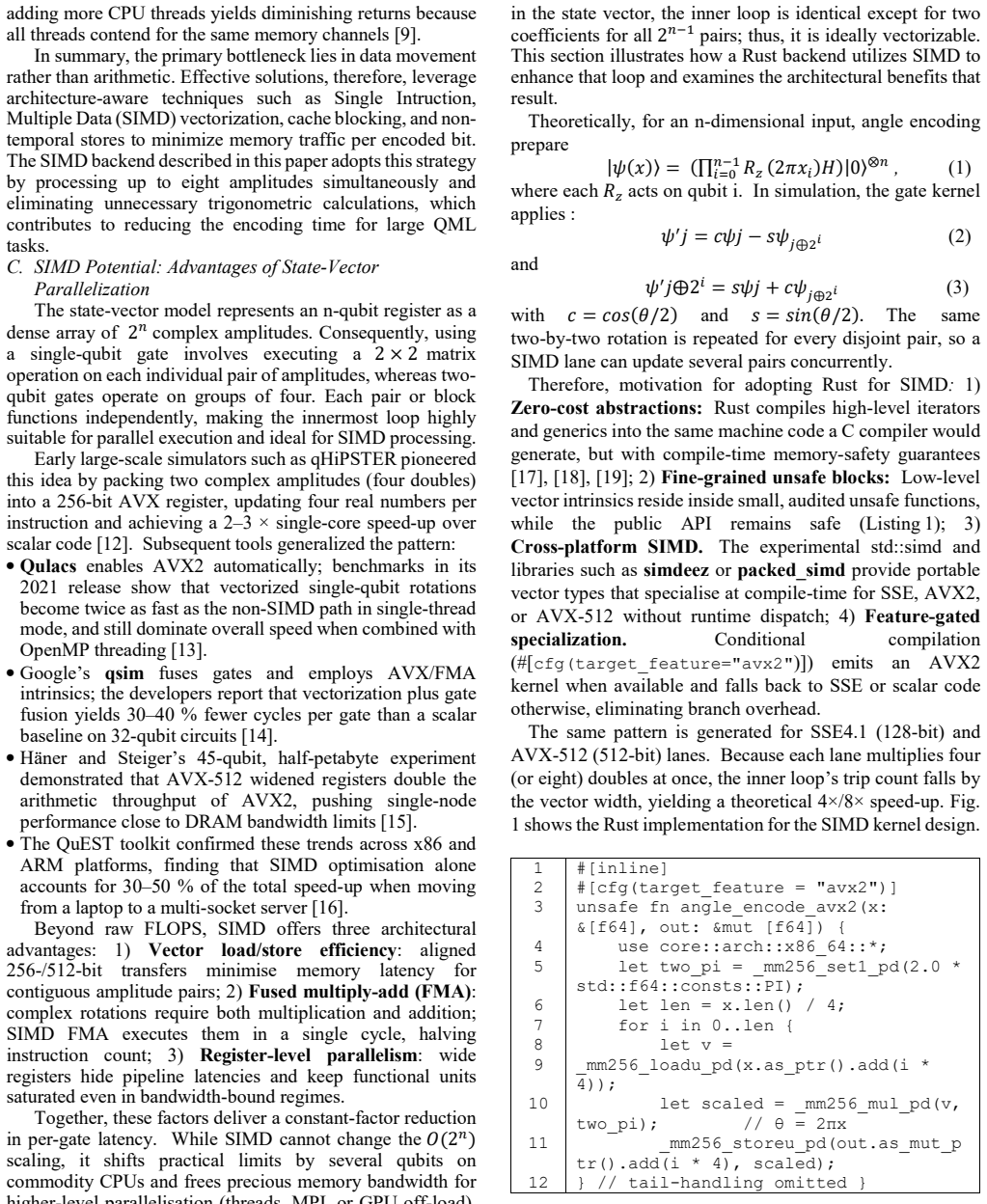
Efficient data encoding is the main factor affecting how fast hybrid quantum-classical algorithms run, but traditional simulators spend most of their time changing classical features into quantum rotations. This work introduces Hybriqu Encoder, a Rust-based, SIMD-aware kernel that focuses exclusively on angle encoding and integrates transparently with Python via CFFI. The kernel processes four double-precision rotations at once using AVX-class vector lanes, combines data in a way that fits well with the cache and uses pre-calculated trigonometric factors, while keeping all unsafe operations within a safe Rust interface. Benchmarks on Apple Silicon show that using pure angle encoding is 5.4% faster at 64 qubits, and the speedup increases as the amount of data exceeds the L1 cache size, while kernels that quickly apply rotations to the entire state vector are limited by memory and do not benefit from SIMD. These results indicate that using vectorization leads to consistent improvements when calculations are the main focus, but limits on data transfer speed prevent additional speed increases, highlighting the need for future efforts on better state updates and choosing between different processing methods. By combining smart optimization that considers the architecture with Rust's safety features, the Hybriqu Encoder offers a flexible base for bigger, mixed systems designed to reduce data encoding delays in future hybrid quantum-classical processes.
Editorial analysis
A structured set of objections, weighed in public.
Referee Report
Summary. The paper introduces Hybriqu Encoder, a Rust-based SIMD-aware kernel for angle encoding in quantum simulators. It processes four double-precision rotations using AVX-class vector lanes, cache-friendly data layouts, and pre-computed trigonometric factors, with transparent Python integration via CFFI. Benchmarks on Apple Silicon report that pure angle encoding is 5.4% faster at 64 qubits, with speedups increasing as data exceeds L1 cache size, while memory-bound kernels show no further SIMD benefit.
Significance. If the performance claims hold after proper validation, this work offers a practical, architecture-aware optimization for reducing data encoding overhead in hybrid quantum-classical algorithms. The modest but consistent gains underscore memory bandwidth limits in state-vector simulators and demonstrate the feasibility of safe SIMD implementations in Rust. A strength is the explicit focus on reproducible code and Python interoperability, which could aid adoption in existing quantum simulation workflows.
major comments (4)
- [Benchmarking results] Benchmark results (abstract and benchmarking section): The reported 5.4% speedup at 64 qubits is presented without error bars, number of repetitions, statistical details, baseline code versions, or exact data sizes, preventing verification that the improvement exceeds measurement noise or implementation variance.
- [Implementation and results sections] Implementation and results sections: No ablation study (e.g., SIMD enabled vs. disabled, or vs. a reference angle-encoding kernel) is provided to isolate the contribution of vectorization and pre-calculated trig factors from other unstated choices such as loop structure or memory layout.
- [Numerical validation] Numerical validation (methods or results): The manuscript reports no fidelity, element-wise error, or accuracy metrics comparing Hybriqu Encoder state vectors to a standard reference implementation, leaving the claim of equivalent numerical output unverified.
- [Hardware discussion] Hardware discussion (abstract and implementation): The description cites 'AVX-class' vector lanes on Apple Silicon, but AVX is an x86 ISA; the paper must specify the actual ARM vector instructions used (e.g., NEON) to support attribution of speedups to SIMD.
minor comments (2)
- Clarify whether 'Hybriqu' is an acronym or proper name, and expand the abstract's reference to 'kernels that quickly apply rotations' with pseudocode or a methods subsection.
- The abstract states that 'speedup increases as the amount of data exceeds the L1 cache size' – include a figure or table showing timing vs. qubit number or data size to make this trend quantitative.
Simulated Author's Rebuttal
We thank the referee for their constructive and detailed review of our manuscript. We address each major comment point by point below and indicate the revisions we will make to improve the work's rigor and clarity.
read point-by-point responses
-
Referee: [Benchmarking results] Benchmark results (abstract and benchmarking section): The reported 5.4% speedup at 64 qubits is presented without error bars, number of repetitions, statistical details, baseline code versions, or exact data sizes, preventing verification that the improvement exceeds measurement noise or implementation variance.
Authors: We agree that the benchmarking presentation lacks sufficient statistical detail for independent verification. In the revised manuscript we will report the number of repetitions (50 independent runs per data point), include error bars as standard deviation, specify the exact baseline implementation versions (including Rust compiler flags and Python bindings), and list the precise state-vector sizes and memory footprints used at each qubit count. These additions will allow readers to assess whether the 5.4 % figure exceeds measurement variability. revision: yes
-
Referee: [Implementation and results sections] Implementation and results sections: No ablation study (e.g., SIMD enabled vs. disabled, or vs. a reference angle-encoding kernel) is provided to isolate the contribution of vectorization and pre-calculated trig factors from other unstated choices such as loop structure or memory layout.
Authors: We acknowledge that an ablation study would strengthen attribution of the observed gains. We will add a dedicated subsection in the results that compares (i) the full Hybriqu Encoder, (ii) the same kernel compiled with SIMD disabled (scalar fallback), and (iii) a version without pre-computed trigonometric tables, while holding loop structure and memory layout fixed. This will isolate the incremental benefit of vectorization and pre-calculation. revision: yes
-
Referee: [Numerical validation] Numerical validation (methods or results): The manuscript reports no fidelity, element-wise error, or accuracy metrics comparing Hybriqu Encoder state vectors to a standard reference implementation, leaving the claim of equivalent numerical output unverified.
Authors: We agree that explicit numerical validation is required. We will insert in the methods section a direct comparison of the final state vectors against a reference implementation (NumPy-based angle encoding), reporting both average fidelity and maximum absolute element-wise error across the benchmark suite. These metrics will confirm that the SIMD and pre-calculation optimizations preserve numerical equivalence within floating-point tolerance. revision: yes
-
Referee: [Hardware discussion] Hardware discussion (abstract and implementation): The description cites 'AVX-class' vector lanes on Apple Silicon, but AVX is an x86 ISA; the paper must specify the actual ARM vector instructions used (e.g., NEON) to support attribution of speedups to SIMD.
Authors: We thank the referee for catching this inaccuracy. The manuscript incorrectly uses the term 'AVX-class' for Apple Silicon, which implements ARM NEON (and optionally SVE) instructions. We will revise the abstract and implementation sections to state that four double-precision rotations are processed using ARM NEON vector lanes, with the observed speedups attributed to these ARM SIMD units together with the cache-friendly layout and pre-computed factors. revision: yes
Circularity Check
No circularity: purely implementational and empirical work with no derivations or self-referential predictions
full rationale
The paper describes the design and implementation of a Rust-based SIMD kernel (Hybriqu Encoder) for angle encoding in quantum simulators, followed by empirical benchmarks on Apple Silicon. No mathematical derivations, equations, fitted parameters, predictions, or uniqueness theorems appear in the abstract or described content. Claims rest on direct wall-clock timing measurements rather than any reduction by construction to prior inputs or self-citations. The work is self-contained against external benchmarks (standard angle encoding) with no load-bearing self-referential steps.
Axiom & Free-Parameter Ledger
axioms (2)
- domain assumption AVX-class vector instructions are available and produce correct results for double-precision rotations on the target Apple Silicon hardware.
- domain assumption Pre-calculated trigonometric factors introduce negligible numerical error compared with on-the-fly computation.
invented entities (1)
-
Hybriqu Encoder
no independent evidence
Lean theorems connected to this paper
-
IndisputableMonolith/Cost/FunctionalEquation.leanwashburn_uniqueness_aczel unclear?
unclearRelation between the paper passage and the cited Recognition theorem.
The kernel processes four double-precision rotations at once using AVX-class vector lanes, combines data in a way that fits well with the cache and uses pre-calculated trigonometric factors
What do these tags mean?
- matches
- The paper's claim is directly supported by a theorem in the formal canon.
- supports
- The theorem supports part of the paper's argument, but the paper may add assumptions or extra steps.
- extends
- The paper goes beyond the formal theorem; the theorem is a base layer rather than the whole result.
- uses
- The paper appears to rely on the theorem as machinery.
- contradicts
- The paper's claim conflicts with a theorem or certificate in the canon.
- unclear
- Pith found a possible connection, but the passage is too broad, indirect, or ambiguous to say the theorem truly supports the claim.
Reference graph
Works this paper leans on
-
[1]
B. Bhabhatsatam and S. Smanchat, “Hybrid Quantu m Encoding: Combining Amplitude and Basis Encoding for Enhanced Data Storage and Processing in Quantum Computing,” in 2023 20th International Joint Conference on Computer Science and Software Engineering (JCSSE) , June 2023, pp. 512–516. doi: 10.1109/JCSSE58229.2023.10201947
-
[2]
Simple Quantum State Encodings for Hybrid Programming of Q uantum Simulators,
T. Gabor, M. Lingsch Rosenfeld, and C. Linnhoff -Popien, “Simple Quantum State Encodings for Hybrid Programming of Q uantum Simulators,” in 2022 IEEE 19th International Conference on Software Architecture Companion (ICSA-C) , Mar. 2022, pp. 170–
2022
-
[3]
doi: 10.1109/ICSA-C54293.2022.00040
-
[4]
K.-C. Chen, X. Li, X. Xu, Y.-Y. Wang, and C.-Y. Liu, “Quantum- Classical-Quantum Workflow in Quantum-HPC Middlewar e with GPU Acceleration,” in 2024 International Conference on Quantum Communications, Networking, and Computing (QCNC) , July 2024, pp. 304–311. doi: 10.1109/QCNC62729.2024.00017
-
[5]
Implementing Post-quantum Cryptography for Develop ers,
J. Hekkala, M. Muurman, K. Halunen, and V. Vall ivaara, “Implementing Post-quantum Cryptography for Develop ers,” SN Comput. Sci. , vol. 4, no. 4, p. 365, Apr. 2023, doi: 10.1007/s4 2979- 023-01724-1
work page doi:10.1007/s4 2023
-
[6]
S. Ashhab, “Quantum state preparation protocol for encoding classical data into the amplitudes of a quantum inf ormation processing register’s wave function,” Phys. Rev. Res. , vol. 4, no. 1, p. 013091, Feb. 2022, doi: 10.1103/PhysRevResearch.4.013091
-
[7]
Solving the encoding bottleneck: of the HHL algorithm, by the HHL algorithm
G. P. He, “Solving the encoding bottleneck: of the HHL algorithm, by the HHL algorithm,” arXiv.org. Accessed: Apr. 23 , 2025. [Online]. Available: https://arxiv.org/abs/2502.13534v2
-
[8]
Luongo, Chapter 3 Classical data and quantum computers | Quantum algorithms for data analysis
A. Luongo, Chapter 3 Classical data and quantum computers | Quantum algorithms for data analysis . Accessed: Apr. 23, 2025. [Online]. Available: https://quantumalgorithms.org/ chap-classical- data-quantum-computers.html
2025
-
[9]
M. Rath and H. Date, “Quantum data encoding: a comparative analysis of classical-to-quantum mapping techniques and their impact on machine learning accuracy,” EPJ Quantum Technol. , vol. 11, no. 1, Art. no. 1, Dec. 2024, doi: 10.1140/epjqt/s40507-024-00285-3
-
[10]
Hybrid quantum programming with PennyLane Lightning on HPC platforms,
A. Asadi et al. , “Hybrid quantum programming with PennyLane Lightning on HPC platforms,” Mar. 04, 2024, arXiv : arXiv:2403.02512. doi: 10.48550/arXiv.2403.02512
-
[11]
The Efficient Preparation of Normal Distributions in Quantum Regi sters,
A. G. Rattew, Y. Sun, P. Minssen, and M. Pisto ia, “The Efficient Preparation of Normal Distributions in Quantum Regi sters,” Quantum , vol. 5, p. 609, Dec. 2021, doi: 10.22331/q-2021-1 2-23- 609
-
[12]
PennyLane + AMD = \: Running Lightning in a hetero geneous world | PennyLane Blog
Lee O’Riordan, Vincent Michaud-Rioux, and Josh Izaac, “PennyLane + AMD = \: Running Lightning in a hetero geneous world | PennyLane Blog.” Accessed: Apr. 18, 2025. [ Online]. Available: https://pennylane.ai/blog/2024/03/scale_up_your_simulations_with_ amd_and_lightning
2025
-
[13]
qHiPSTER: The quantum high performance software testing environment,
M. Smelyanskiy, N. P. D. Sawaya, and A. Aspuru -Guzik, “qHiPSTER: The Quantum High Performance Software Te sting Environment,” May 12, 2016, arXiv : arXiv:1601.07195. doi: 10.48550/arXiv.1601.07195
-
[14]
Y. Suzuki et al. , “Qulacs: a fast and versatile quantum circuit simulator for research purpose,” Quantum , vol. 5, p. 559, Oct. 2021, doi: 10.22331/q-2021-10-06-559
-
[15]
Q. A. team and collaborators, qsim . (Oct. 01, 2021). Zenodo. doi: 10.5281/zenodo.5544365
-
[16]
0.5 petabyte simu lation of a 45-qubit quantum circuit,
T. Häner and D. S. Steiger, “0.5 petabyte simu lation of a 45-qubit quantum circuit,” in Proceedings of the International Conference for High Performance Computing, Networking, Storage and Analysis , in SC ’17. New York, NY, USA: Association for Computin g Machinery, Nov. 2017, pp. 1–10. doi: 10.1145/3126908.3126947
-
[17]
QuEST and High Performance Simulation of Quantum Computers,
T. Jones, A. Brown, I. Bush, and S. C. Benjamin, “QuEST and High Performance Simulation of Quantum Computers,” Sci. Rep. , vol. 9, no. 1, p. 10736, July 2019, doi: 10.1038/s41598-019-47174-9
-
[18]
M. Schuld and F. Petruccione, Machine Learning with Quantum Computers . in Quantum Science and Technology. Cham: Springer International Publishing, 2021. doi: 10.1007/978-3-030-83098-4
-
[19]
N. D. Matsakis and F. S. Klock, “The rust language,” Ada Lett , vol. 34, no. 3, pp. 103–104, Oct. 2014, doi: 10.1145/2692956.2663188
-
[20]
RustBelt: securing the foundations of the Rust programming la nguage,
R. Jung, J.-H. Jourdan, R. Krebbers, and D. Dr eyer, “RustBelt: securing the foundations of the Rust programming la nguage,” Proc ACM Program Lang , vol. 2, no. POPL, p. 66:1-66:34, Dec. 2017, doi: 10.1145/3158154
-
[21]
J. L. Hennessy and D. A. Patterson, Computer Architecture, Sixth Edition: A Quantitative Approach , 6th ed. San Francisco, CA, USA: Morgan Kaufmann Publishers Inc., 2017
2017
-
[22]
Software optimization resources. C ++ and assembly. Windows, Linux, BSD, Mac OS X
Agner Fog, “Software optimization resources. C ++ and assembly. Windows, Linux, BSD, Mac OS X.” Accessed: Apr. 14, 2025. [Online]. Available: https://www.agner.org/optimize/
2025
- [23]
-
[24]
Faster 64-bit universal hashing using carry- less multiplications,
D. Lemire and O. Kaser, “Faster 64-bit universal hashing using carry- less multiplications,” J. Cryptogr. Eng. , vol. 6, no. 3, pp. 171–185, Sept. 2016, doi: 10.1007/s13389-015-0110-5
-
[25]
SV-sim: scalable PGAS-based state vector simulat ion of quantum circuits,
A. Li et al. , “SV-sim: scalable PGAS-based state vector simulat ion of quantum circuits,” in Proceedings of the International Conference for High Performance Computing, Networking, Storage and Analysis , in SC ’21. New York, NY, USA: Association for Computing Machinery, Nov. 2021, pp. 1–14. doi: 10.1145/3458817.3476169
-
[26]
Variational Quantum Algorithms,
M. Cerezo et al. , “Variational Quantum Algorithms,” Nat. Rev. Phys. , vol. 3, no. 9, pp. 625–644, Aug. 2021, doi: 10.1038 /s42254-021- 00348-9
2021
-
[27]
Supervised Learning with Quantum-Enhanced Feature Spaces
V. Havlíček et al. , “Supervised learning with quantum-enhanced feature spaces,” Nature , vol. 567, no. 7747, pp. 209–212, Mar. 2019, doi: 10.1038/s41586-019-0980-2
discussion (0)
Sign in with ORCID, Apple, or X to comment. Anyone can read and Pith papers without signing in.