Recognition: 2 theorem links
· Lean TheoremProbabilistic and approximate universal quantum purification machines
Pith reviewed 2026-05-10 19:12 UTC · model grok-4.3
The pith
A machine that purifies two quantum inputs of different ranks with non-zero probability cannot be described by any linear positive map.
A machine-rendered reading of the paper's core claim, the machinery that carries it, and where it could break.
Core claim
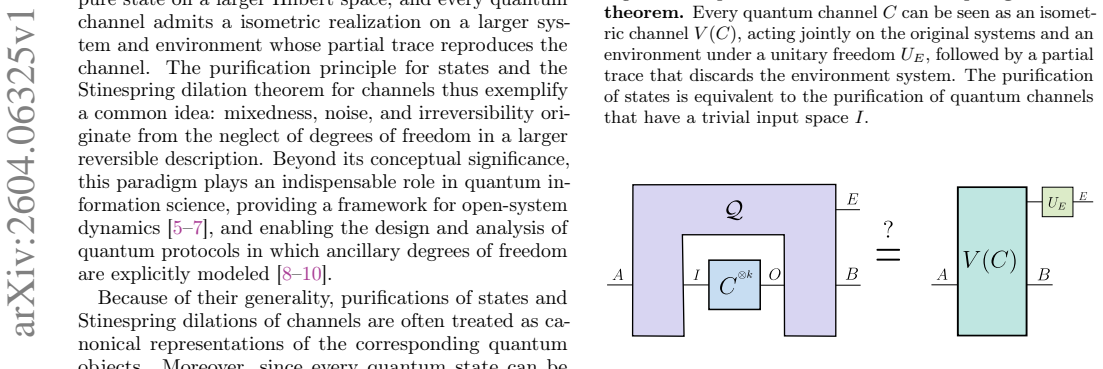
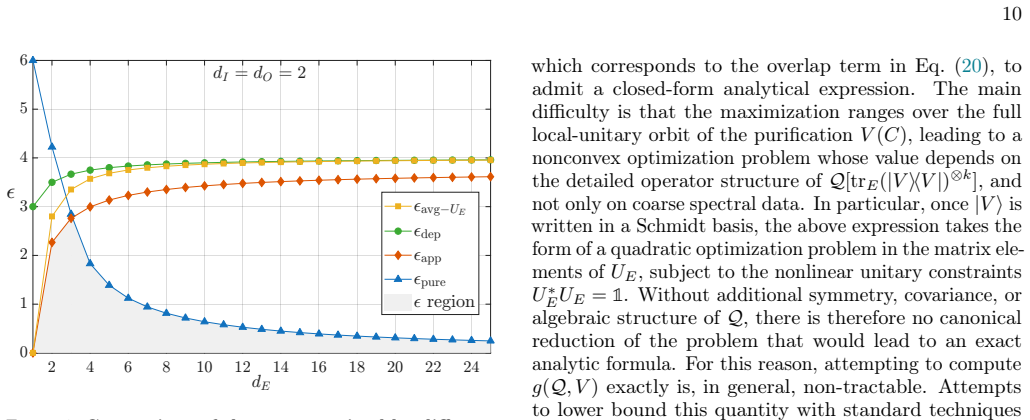
We formalize quantum purification machines that, given finite uses of a black-box input, output a corresponding purification or Stinespring dilation. In the probabilistic exact setting, the simple requirement that such a machine purifies two inputs of different rank with non-zero probability already implies that it cannot be a linear positive map. This recovers the impossibility of universal probabilistic purification from finitely many copies. In the approximate setting, pure-output strategies, including the optimal one that always produces a maximally entangled purification of the fully depolarizing channel, perform best for large environment dimension, while append-environment strategies,
What carries the argument
The quantum purification machine, a device that processes finite copies or uses of a black-box state or channel to produce a purification or dilation, with the central mechanism being the linearity obstruction induced by rank variation.
If this is right
- Universal probabilistic purification machines from finitely many copies are impossible.
- Any probabilistic purifier that handles inputs of varying rank must be nonlinear or non-positive.
- Pure-output strategies achieve the lowest minimum average error among those considered when the environment dimension is large.
- Append-environment strategies yield better performance at small environment dimensions.
- The minimum average error is bounded above by an expression that becomes tight in a specific regime of environment dimension.
Where Pith is reading between the lines
- The rank-based obstruction may limit other quantum tasks that attempt to extract purifications or dilations from black-box objects in a uniform way.
- Practical devices will likely need to choose between pure-output and append-environment approaches depending on the expected environment size rather than seeking a single universal machine.
- Relaxing the exactness or linearity requirement opens the door to dimension-dependent approximate protocols that can still be useful in finite-resource settings.
Load-bearing premise
The input arrives through a finite number of uses of a black-box state or channel whose rank is allowed to vary.
What would settle it
An explicit linear positive map that, with non-zero probability, produces a valid purification for at least two states or channels of different ranks would falsify the central impossibility claim.
Figures




read the original abstract
We study the task of lifting arbitrary quantum states and channels to purifications and Stinespring dilations, respectively, in both the probabilistic exact and deterministic approximate settings. We formalize this task through a general framework of quantum purification machines that, given a finite number of copies or uses of a black-box input, aim to output a corresponding purification or Stinespring dilation. In the probabilistic exact setting, we show that universality is not necessary to rule out such transformations: the simple requirement that a machine purifies two inputs of different rank with non-zero probability already implies that it cannot be described by a linear positive map. This simple argument captures a fundamental obstruction of quantum theory and recovers the impossibility of universal probabilistic purification from finitely many copies. In the approximate setting, we allow for general machines that are not required, in general, to produce a pure output. Using the minimum average error as our figure of merit, we derive analytical expressions for the performance of several physically motivated strategies as well as a general upper bound on the achievable error, which is tight in a specific regime. Our analysis reveals a trade-off: strategies that produce a pure output - among which we prove the optimal to be a strategy that produces as a fixed output a maximally entangled purification of the fully depolarizing channel - perform optimally between those considered for large environment dimension, while append-environment strategies that generally produce non-pure outputs perform better at small environment dimension.
Editorial analysis
A structured set of objections, weighed in public.
Referee Report
Summary. The manuscript introduces a general framework for quantum purification machines that, given finite copies or uses of a black-box state or channel, output a purification or Stinespring dilation. In the probabilistic exact setting, it proves that any machine succeeding with non-zero probability on two inputs of different ranks cannot be realized by a linear positive map, thereby recovering the impossibility of universal probabilistic purification from finitely many copies without invoking universality. In the approximate setting, it analyzes several strategies under the minimum average error figure of merit, derives closed-form performance expressions, and establishes a general upper bound on achievable error that is tight in a specific regime, while identifying a trade-off between pure-output strategies (optimal for large environment dimension) and append-environment strategies (better for small environment dimension).
Significance. The simple linearity-based obstruction provides a clean, fundamental insight into why probabilistic exact purification is impossible in quantum theory, independent of universality assumptions, and directly recovers known finite-copy no-go results. The approximate analysis supplies explicit, analytically tractable performance bounds and identifies optimal strategies among those considered, which could guide practical implementations in quantum state preparation, channel simulation, and error mitigation protocols. The work is strengthened by its use of explicit strategies and a general upper bound rather than purely numerical optimization.
major comments (2)
- [§3] §3 (probabilistic exact setting): the central impossibility argument shows that a positive linear map cannot map two distinct-rank inputs to normalized pure outputs with positive probabilities p1, p2 > 0 while preserving the input upon partial trace; the manuscript should include the explicit convex-combination calculation demonstrating that the output mixture's partial trace equals the input only if p1 = p2 and the purified states coincide, which is impossible for r1 ≠ r2.
- [§5] §5 (approximate setting, upper bound): the claim that the derived general upper bound is tight in a specific regime requires an explicit statement of the regime (e.g., limit of environment dimension d_E → ∞) together with the parameter values at which equality is achieved by the fixed maximally-entangled-output strategy; without this, it is unclear whether the bound is saturated or merely approached asymptotically.
minor comments (3)
- [Abstract] Abstract: the phrase 'tight in a specific regime' should name the regime (large vs. small environment dimension) to allow readers to assess the result without reading the full text.
- [Notation] Notation throughout: ensure that the symbols for input rank, environment dimension, and number of copies are defined once and used consistently; occasional re-use of d for both input and environment dimension creates ambiguity in the approximate analysis.
- [Figures] Figure captions (e.g., performance plots): add explicit labels for the curves corresponding to each strategy (pure-output, append-environment, etc.) and indicate the regime in which the upper bound is tight.
Simulated Author's Rebuttal
We thank the referee for their careful reading of our manuscript and for the constructive comments. We address each of the major comments below and have incorporated the suggested improvements into the revised version.
read point-by-point responses
-
Referee: [§3] §3 (probabilistic exact setting): the central impossibility argument shows that a positive linear map cannot map two distinct-rank inputs to normalized pure outputs with positive probabilities p1, p2 > 0 while preserving the input upon partial trace; the manuscript should include the explicit convex-combination calculation demonstrating that the output mixture's partial trace equals the input only if p1 = p2 and the purified states coincide, which is impossible for r1 ≠ r2.
Authors: We agree that an explicit calculation would enhance the clarity of the impossibility proof. In the revised manuscript, we have included a detailed convex-combination argument in §3. We explicitly compute the partial trace of the probabilistic mixture of the two output states and demonstrate that it recovers the input mixture if and only if p1 = p2 and the two purified states are the same. This leads to an immediate contradiction for inputs of different ranks r1 ≠ r2, as the partial traces would then have to be equal while having different ranks. This addition makes the argument self-contained and does not alter the main result. revision: yes
-
Referee: [§5] §5 (approximate setting, upper bound): the claim that the derived general upper bound is tight in a specific regime requires an explicit statement of the regime (e.g., limit of environment dimension d_E → ∞) together with the parameter values at which equality is achieved by the fixed maximally-entangled-output strategy; without this, it is unclear whether the bound is saturated or merely approached asymptotically.
Authors: We appreciate this suggestion for improving the precision of our claims. We have updated §5 to explicitly identify the regime of tightness as the limit d_E → ∞. In this limit, the fixed maximally-entangled-output strategy saturates the upper bound when the input is the maximally mixed state (i.e., the fully depolarizing channel), with the average error approaching the bound value. We have added the corresponding parameter specifications and a note confirming that equality is achieved exactly in this asymptotic regime. revision: yes
Circularity Check
No significant circularity; derivation follows from standard quantum axioms
full rationale
The central claim—that any machine purifying two different-rank inputs with non-zero probability cannot be a linear positive map—follows directly from the linearity and positivity axioms of quantum theory applied to convex combinations of states. No equation or step reduces the target result to a fitted parameter, self-defined quantity, or self-citation chain. Approximate bounds are obtained from explicit strategies and a general upper bound derived independently. The paper is self-contained against external benchmarks and does not invoke uniqueness theorems or ansatzes from prior author work.
Axiom & Free-Parameter Ledger
axioms (2)
- standard math Quantum channels are completely positive trace-preserving maps and admit Stinespring dilations.
- domain assumption The machine receives only a finite number of uses of the unknown input.
Lean theorems connected to this paper
-
IndisputableMonolith/Cost/FunctionalEquation.leanwashburn_uniqueness_aczel unclear?
unclearRelation between the paper passage and the cited Recognition theorem.
the simple requirement that a machine purifies two inputs of different rank with non-zero probability already implies that it cannot be described by a linear positive map
-
IndisputableMonolith/Foundation/AbsoluteFloorClosure.leanabsolute_floor_iff_bare_distinguishability unclear?
unclearRelation between the paper passage and the cited Recognition theorem.
Q[(q|ψ0⟩⟨ψ0|+(1-q)|ψ1⟩⟨ψ1|)⊗k] = p01 |ϕ01⟩⟨ϕ01| with trE(|ϕ01⟩⟨ϕ01|)=q|ψ0⟩⟨ψ0|+(1-q)|ψ1⟩⟨ψ1|
What do these tags mean?
- matches
- The paper's claim is directly supported by a theorem in the formal canon.
- supports
- The theorem supports part of the paper's argument, but the paper may add assumptions or extra steps.
- extends
- The paper goes beyond the formal theorem; the theorem is a base layer rather than the whole result.
- uses
- The paper appears to rely on the theorem as machinery.
- contradicts
- The paper's claim conflicts with a theorem or certificate in the canon.
- unclear
- Pith found a possible connection, but the passage is too broad, indirect, or ambiguous to say the theorem truly supports the claim.
Reference graph
Works this paper leans on
-
[1]
J80vdRQJSjHT/8ZKav3NggGiodU=
This quantity is interesting in the current scenario because it captures several of its defining charac- teristics. In the present setting, we have that Qϵ C ⊗k − |VUE(C)⟩ ⟨VUE(C)| 2 2 = = tr h Qϵ C ⊗k 2i + tr h |VUE(C)⟩ ⟨VUE(C)|2 i + −2 tr Qϵ C ⊗k |VUE(C)⟩ ⟨VUE(C)| . (17) The first term,tr [Qϵ C ⊗k 2 ], quantifies the purity of the outputofthemachine. No...
2030
-
[2]
W. F. Stinespring, Positive functions onC*-algebras, Proc. Am. Math. Soc.6, 211 (1955)
1955
-
[3]
M. A. Naimark, On a representation of additive operator set functions, inDokl. Akad. Nauk SSSR, Vol. 41 (1943) 13 pp. 373–375
1943
-
[4]
Ozawa, Quantum measuring processes of continu- ous observables, Journal of Mathematical Physics25, 79 (1984)
M. Ozawa, Quantum measuring processes of continu- ous observables, Journal of Mathematical Physics25, 79 (1984)
1984
-
[5]
Nagy, On contractions in hilbert space, Acta Scien- tiarum Mathematicarum79, 235 (2013)
B. Nagy, On contractions in hilbert space, Acta Scien- tiarum Mathematicarum79, 235 (2013)
2013
-
[6]
D. E. Evans and J. T. Lewis, Dilations of irreversible evolutions in algebraic quantum theory (Dublin Institute for Advanced Studies, Dublin, 1977) ORCA repository
1977
-
[7]
Attal and Y
S. Attal and Y. Pautrat, From repeated to continu- ous quantum interactions, Annales Henri Poincare7, 59 (2006), arXiv:0311002 [math-ph]
2006
- [8]
-
[9]
A. Acín, J. Bae, E. Bagan, M. Baig, L. Masanes, and R. Muñoz-Tapia, Secrecy properties of quantum channels, Phys. Rev. A73, 012327 (2006), arXiv:0411092 [quant- ph]
2006
- [10]
- [11]
- [12]
-
[13]
In:arXiv:2511.15806 [quant-ph](2025)
A. Pelecanos, J. Spilecki, E. Tang, and J. Wright, Mixed state tomography reduces to pure state tomography (2025), arXiv:2511.15806 [quant-ph]
-
[14]
F. Girardi, F. A. Mele, H. Zhao, M. Fanizza, and L. Lami, Random stinespring superchannel: converting channel queries into dilation isometry queries (2025), arXiv:2512.20599 [quant-ph]
-
[15]
W. K. Wootters and W. H. Zurek, A single quantum cannot be cloned, Nature299, 802 (1982)
1982
- [16]
-
[17]
Z. Gavorová, M. Seidel, and Y. Touati, Topological ob- structions to quantum computation with unitary or- acles, Phys. Rev. A109, 032625 (2024), arXiv:2011.10031 [quant-ph]
-
[18]
E. Tang, J. Wright, and M. Zhandry, Conjugate queries can help (2025), arXiv:2510.07622 [quant-ph]
work page internal anchor Pith review arXiv 2025
-
[19]
S. Yoshida, R. Niwa, and M. Murao, Random dilation superchannel (2025), arXiv:2512.21260 [quant-ph]
-
[20]
G. Chiribella, G. M. D’Ariano, and P. Perinotti, Quantum circuit architecture, Phys. Rev. Lett.101, 060401 (2008), arXiv:0712.1325 [quant-ph]
-
[21]
G. Chiribella, G. M. D’Ariano, and P. Perinotti, Trans- forming quantum operations: Quantum supermaps, EPL 83, 30004 (2008), arXiv:0804.0180 [quant-ph]
-
[22]
Higher-order quantum operations,
P. Taranto, S. Milz, M. Murao, M. T. Quintino, and K. Modi, Higher-order quantum operations, arXiv:2503.09693 [quant-ph] (2025)
-
[23]
Quantum computa- tions without definite causal structure
G. Chiribella, G. M. D’Ariano, P. Perinotti, and B. Valiron, Quantum computations without definite causal structure, Phys. Rev. A88, 022318 (2013), arXiv:0912.0195 [quant-ph]
- [24]
-
[26]
B. Collins and I. Nechita, Random matrix techniques in quantum information theory, Journal of Mathematical Physics57, 015215 (2016), arXiv:1509.04689 [quant-ph]
- [27]
- [28]
- [29]
-
[30]
F. Girardi, F. A. Mele, and L. Lami, Random purification channel made simple (2026), arXiv:2511.23451 [quant-ph]
-
[31]
V. A. Marčenko and L. A. Pastur, Distribution of eigen- values for some sets of random matrices, Mathematics of the USSR-Sbornik1, 457 (1967)
1967
-
[32]
B. Collins and I. Nechita, Gaussianization and eigenvalue statistics for random quantum channels (III), Ann. Appl. Probab.21, 1136 (2011), arXiv:0910.1768 [quant-ph]
-
[33]
Collins and P
B. Collins and P. Śniady, Integration with respect to the haar measure on unitary, orthogonal and symplectic groups, Communications in Mathematical Physics264, 773 (2006), arXiv:0402073 [math-ph]
2006
-
[34]
Z. Puchała and J. A. Miszczak, Symbolic integration with respect to the haar measure on the unitary group, Bulletin of the Polish Academy of Sciences Technical Sciences65, 21–27 (2017), arXiv:1109.4244 [physics.comp-ph]
-
[35]
R. Kukulski, I. Nechita, Ł. Pawela, Z. Puchała, and K. Życzkowski, Generating random quantum channels, Journal of Mathematical Physics62, 062201 (2021), arXiv:2011.02994 [quant-ph]
-
[36]
I. Nechita, Z. Puchała, Ł. Pawela, and K. Życzkowski, Almost all quantum channels are equidistant, Journal of Mathematical Physics59, 052201 (2018), arXiv:1612.00401 [quant-ph]
-
[37]
most mixed
G. W. Anderson, A. Guionnet, and O. Zeitouni, An Introduction to Random Matrices(Cambridge Uni- versity Press, 2010). 14 APPENDIX Appendix A: Random Choi operators We collect here the random-matrix facts used throughout the paper. Standard references are [24, 25, 30, 31]. We begin with the ensemble of quantum channels induced by Haar-distributed Stinespri...
2010
-
[38]
[12, 13, 17, 18], on k copies of the (normalized) Choi operators of the input quantum channels C
Apply the random (purification) dilation superchannel, as defined in Refs. [12, 13, 17, 18], on k copies of the (normalized) Choi operators of the input quantum channels C. This maps C dI ⊗k to 1 dk I EUE [(1⊗ UE |V(C)⟩ ⟨V(C)|(1⊗U ∗ E)]⊗k where|V(C)⟩ ⟨V(C)|is a uniformly random purification ofC
-
[39]
Perform the (pure-state) Choi tomography algorithm of Refs. [12, (Theorem 4.7)] and [13], which, given k = O (dI dO + log(1/δ))/ϵ copies of an unknown pure state inCdI dO, outputs an estimate bV(C) E satisfying D bV(C) V(C) E2 ≥1−ϵwith probability≥1−δ. We defineQtomo to be the superchannel corresponding to this protocol, such that Qtomo(C ⊗k) := bV(C) ED ...
discussion (0)
Sign in with ORCID, Apple, or X to comment. Anyone can read and Pith papers without signing in.