Recognition: no theorem link
Operator Learning for Surrogate Modeling of Wave-Induced Forces from Sea Surface Waves
Pith reviewed 2026-05-10 17:56 UTC · model grok-4.3
The pith
Deep operator networks can accurately surrogate the SWAN wave model for predicting radiation stress and wave heights.
A machine-rendered reading of the paper's core claim, the machinery that carries it, and where it could break.
Core claim
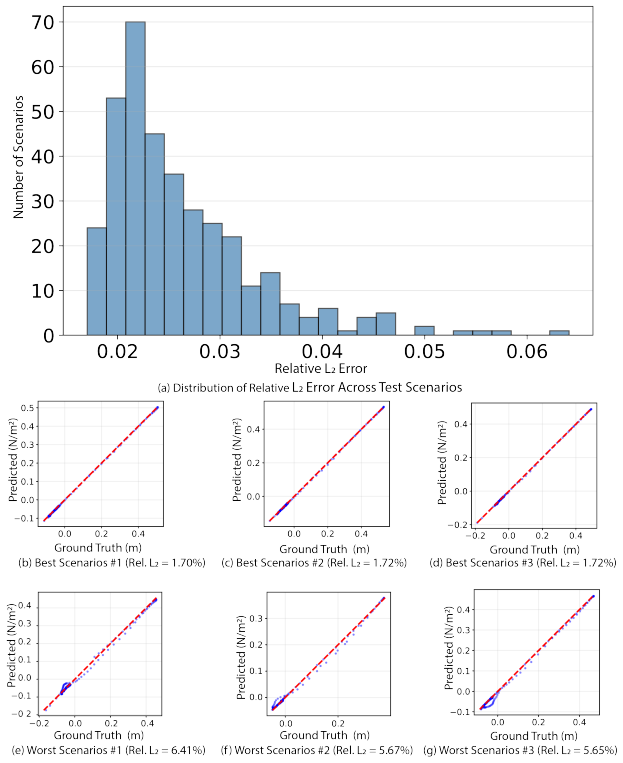
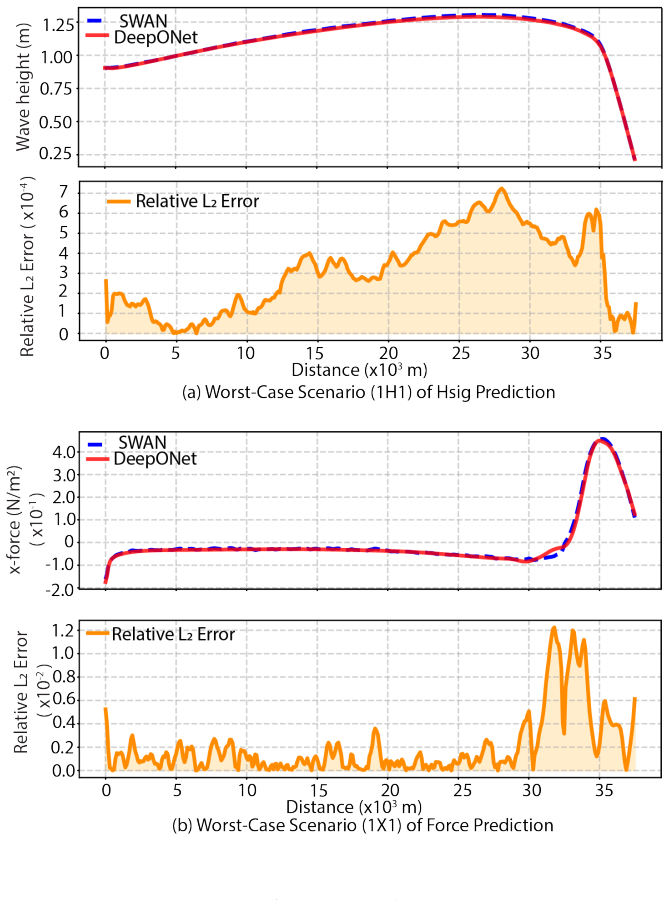
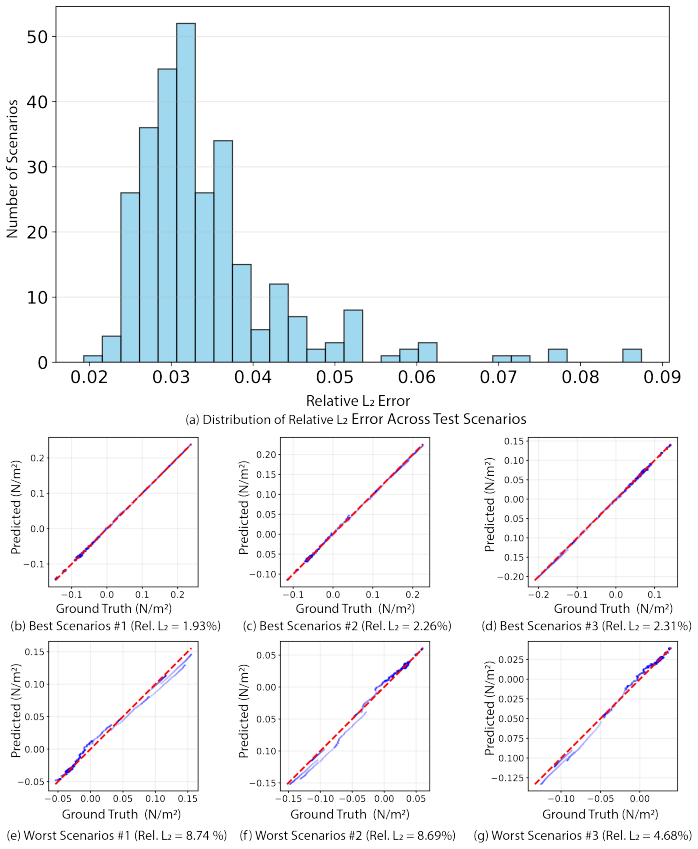
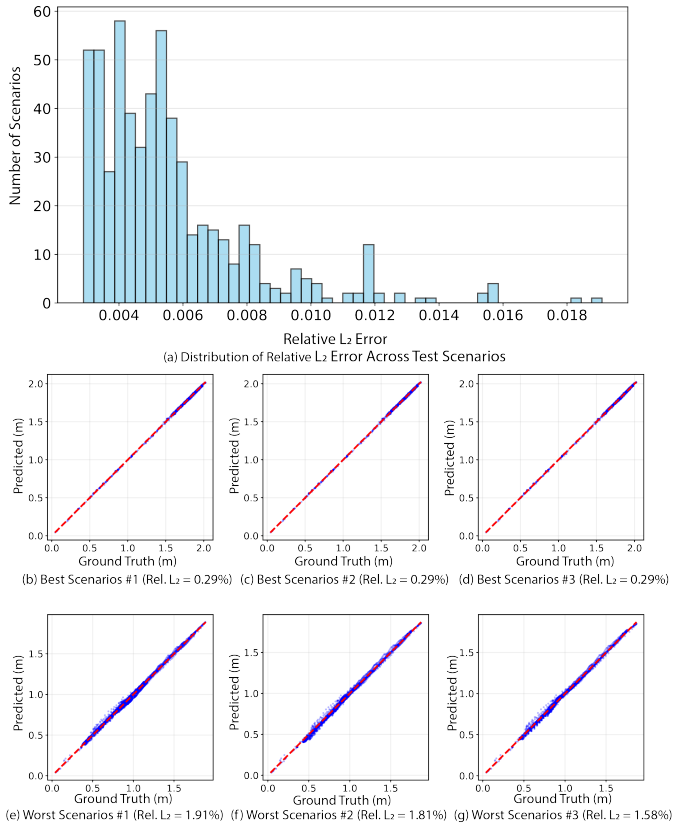
The authors show that a DeepONet, trained exclusively on steady-state wave simulations, reproduces the radiation stress gradient components and significant wave height produced by the full SWAN model across multiple representative scenarios with variable boundary conditions and wind forcing, including a realistic application to the Duck, NC coastline.
What carries the argument
Deep Operator Networks that learn the mapping from input functions (boundary wave spectra and wind fields) to output functions (radiation stress gradients and significant wave height) as a direct surrogate for the SWAN solver.
Load-bearing premise
Performance measured on steady-state examples will carry over when the surrogate is inserted into the unsteady, time-evolving coupled wave-circulation models used in practice.
What would settle it
A side-by-side run of the surrogate and the full SWAN model on an unsteady simulation with time-varying winds and boundaries, checking whether errors in the radiation stress gradient components remain small over many time steps.
Figures









read the original abstract
Wave setup plays a significant role in transferring wave-induced energy to currents and causing an increase in water elevation. This excess momentum flux, known as radiation stress, motivates the coupling of circulation models with wave models to improve the accuracy of storm surge prediction, however, traditional numerical wave models are complex and computationally expensive. As a result, in practical coupled simulations, wave models are often executed at much coarser temporal resolution than circulation models. In this work, we explore the use of Deep Operator Networks (DeepONets) as a surrogate for the Simulating WAves Nearshore (SWAN) numerical wave model. The proposed surrogate model was tested on three distinct 1-D and 2-D steady-state numerical examples with variable boundary wave conditions and wind fields. When applied to a realistic numerical example of steady state wave simulation in Duck, NC, the model achieved consistently high accuracy in predicting the components of the radiation stress gradient and the significant wave height across representative scenarios.
Editorial analysis
A structured set of objections, weighed in public.
Referee Report
Summary. The manuscript proposes Deep Operator Networks (DeepONets) as a surrogate for the SWAN numerical wave model to predict wave-induced forces, specifically the components of the radiation stress gradient and significant wave height, from boundary wave conditions and wind fields. The surrogate is trained and tested exclusively on steady-state solutions from three 1-D and 2-D numerical examples, including a realistic case in Duck, NC, where it reports consistently high accuracy.
Significance. If the operator generalizes beyond the steady-state regime, the work could enable computationally efficient surrogates for wave modeling in coupled circulation-wave systems, improving storm surge predictions. The choice of DeepONet for field-to-field mapping is appropriate for this physics application, and the inclusion of a realistic coastal geometry (Duck, NC) provides a concrete test of practical relevance.
major comments (2)
- [Abstract and Introduction] Abstract and Introduction: The motivation explicitly states that practical coupled simulations run wave models at coarser temporal resolution under unsteady conditions, yet all training, validation, and testing data consist of steady-state snapshots with fixed boundary conditions and wind fields. No time-dependent marching, circulation feedback, or temporal subsampling experiments are reported, so the learned operator has no demonstrated applicability to the stated target regime.
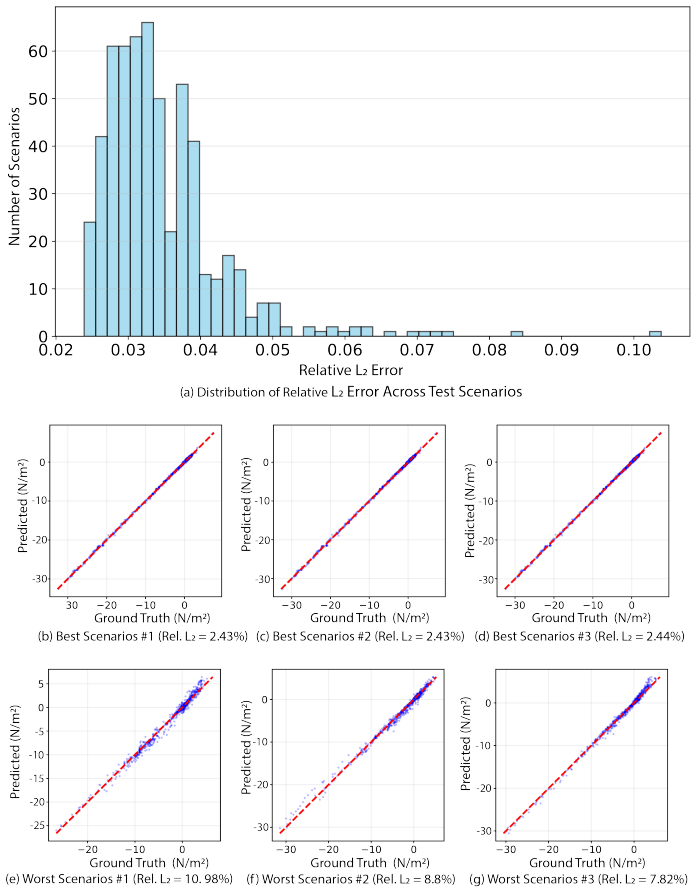
- [Duck, NC example] Duck, NC results: The claim of 'consistently high accuracy' in predicting radiation stress gradient components and significant wave height is presented without quantitative metrics (e.g., RMSE or relative L2 error with error bars), training/validation split details, baseline comparisons, or hyperparameter sensitivity analysis, weakening the evidential support for the surrogate's performance.
minor comments (1)
- [Methods] Clarify the precise input/output function spaces for the DeepONet (branch and trunk networks) and how they align with the SWAN discretization.
Simulated Author's Rebuttal
We thank the referee for their insightful comments, which have helped us improve the clarity and rigor of our manuscript. We address each major comment below and outline the revisions we plan to make.
read point-by-point responses
-
Referee: [Abstract and Introduction] Abstract and Introduction: The motivation explicitly states that practical coupled simulations run wave models at coarser temporal resolution under unsteady conditions, yet all training, validation, and testing data consist of steady-state snapshots with fixed boundary conditions and wind fields. No time-dependent marching, circulation feedback, or temporal subsampling experiments are reported, so the learned operator has no demonstrated applicability to the stated target regime.
Authors: We agree that the current work focuses exclusively on steady-state conditions. This choice is motivated by the practical use of wave models at coarser temporal resolutions in coupled simulations, where the wave field can be approximated as steady-state for each time step. The DeepONet is trained to learn the mapping operator under these conditions. We will update the abstract and introduction to clarify that the surrogate is for steady-state wave modeling and include a discussion on the limitations regarding unsteady dynamics, along with plans for future extensions to time-dependent cases. revision: partial
-
Referee: [Duck, NC example] Duck, NC results: The claim of 'consistently high accuracy' in predicting radiation stress gradient components and significant wave height is presented without quantitative metrics (e.g., RMSE or relative L2 error with error bars), training/validation split details, baseline comparisons, or hyperparameter sensitivity analysis, weakening the evidential support for the surrogate's performance.
Authors: We thank the referee for highlighting this. We will revise the manuscript to include explicit quantitative metrics, including RMSE and relative L2 errors with error bars computed over multiple independent training runs, detailed information on the training, validation, and test data splits, comparisons against baseline methods such as linear interpolation or simpler neural network architectures, and a hyperparameter sensitivity study. These additions will provide stronger evidential support for the reported accuracy. revision: yes
Circularity Check
No significant circularity; data-driven surrogate trained on independent SWAN simulations.
full rationale
The paper trains DeepONets on data generated by running the SWAN numerical wave model on steady-state 1-D and 2-D examples with prescribed boundary conditions and wind fields, then evaluates the learned operator on held-out test cases from the same steady-state regime (including the Duck, NC example). The central results are learned mappings from input fields to radiation-stress gradients and significant wave height; these are not equivalent to the inputs by construction, nor are any fitted parameters renamed as predictions. No load-bearing self-citations, uniqueness theorems, or ansatzes reduce the claim to prior author work. The derivation is self-contained against the numerical benchmarks used for training and testing.
Axiom & Free-Parameter Ledger
free parameters (1)
- DeepONet hyperparameters (branch and trunk net sizes, etc.)
axioms (1)
- domain assumption DeepONet can approximate the operator mapping from wave boundary conditions to radiation stress fields
Reference graph
Works this paper leans on
-
[1]
Booij, R
N. Booij, R. C. Ris, L. H. Holthuijsen, A third-generation wave model for coastal regions: 1. model description and validation, Journal of geo- physical research: Oceans 104 (C4) (1999) 7649–7666
1999
-
[2]
L. H. Holthuijsen, Waves in oceanic and coastal waters, Cambridge uni- versity press, 2010
2010
-
[3]
S. Causio, S. Shirinov, I. Federico, G. De Cillis, E. Clementi, L. Men- taschi, G. Coppini, Coupling ocean currents and waves for seamless cross-scale modeling during medicane ianos, Ocean Science 21 (3) (2025) 1105–1123. doi:10.5194/os-21-1105-2025. URLhttps://os.copernicus.org/articles/21/1105/2025/
-
[4]
M. S. Longuet-Higgins, R. W. Stewart, Radiation stress and mass trans- port in gravity waves, with application to ‘surf beats’, Journal of Fluid Mechanics 13 (4) (1962) 481–504. doi:10.1017/S0022112062000877. 41
-
[5]
Dietrich, M
J. Dietrich, M. Zijlema, J. Westerink, L. Holthuijsen, C. Dawson, R. Luettich Jr, R. Jensen, J. Smith, G. Stelling, G. Stone, Modeling hurricane waves and storm surge using integrally-coupled, scalable com- putations, Coastal Engineering 58 (1) (2011) 45–65
2011
-
[6]
S.-C. Hsiao, H. Chen, W.-B. Chen, C.-H. Chang, L.-Y. Lin, Quantify- ing the contribution of nonlinear interactions to storm tide simulations during a super typhoon event, Ocean Engineering 194 (2019) 106661. doi:10.1016/j.oceaneng.2019.106661
-
[7]
O. M. Phillips, On the generation of waves by turbulent wind, Journal of fluid mechanics 2 (5) (1957) 417–445
1957
-
[8]
J. W. Miles, On the generation of surface waves by shear flows, Journal of Fluid Mechanics 3 (2) (1957) 185–204
1957
-
[9]
Hasselmann, On the spectral dissipation of ocean waves due to white capping, Boundary-Layer Meteorology 6 (1974) 107–127
K. Hasselmann, On the spectral dissipation of ocean waves due to white capping, Boundary-Layer Meteorology 6 (1974) 107–127
1974
-
[10]
Shemdin, K
O. Shemdin, K. Hasselmann, S. Hsiao, K. Herterich, Nonlinear and lin- ear bottom interaction effects in shallow water, Turbulent fluxes through the sea surface, wave dynamics, and prediction (1978) 347–372
1978
-
[11]
J. A. Battjes, J. Janssen, Energy loss and set-up due to breaking of random waves, in: Coastal engineering 1978, 1978, pp. 569–587
1978
-
[12]
Eldeberky, V
Y. Eldeberky, V. Polnikov, J. Battjes, A statistical approach for model- ing triad interactions in dispersive waves, in: Coastal Engineering 1996, 1996, pp. 1088–1101
1996
-
[13]
T. W. Group, The WAM model — a third generation ocean wave predic- tion model, Journal of physical oceanography 18 (12) (1988) 1775–1810
1988
-
[14]
P. A. Janssen, Progress in ocean wave forecasting, Jour- nal of Computational Physics 227 (7) (2008) 3572–3594. doi:https://doi.org/10.1016/j.jcp.2007.04.029
-
[15]
A. Roland, F. Ardhuin, On the developments of spectral wave models: numerics and parameterizations for the coastal ocean, Ocean Dynamics 64 (6) (2014) 833–846. doi:https://doi.org/10.1007/s10236-014-0711-z. 42
-
[16]
Janssen, The Interaction of Ocean Waves and Wind, Cambridge Uni- versity Press, 2004
P. Janssen, The Interaction of Ocean Waves and Wind, Cambridge Uni- versity Press, 2004. URLhttps://books.google.com/books?id=Rb0fRcrTiBUC
2004
-
[17]
N. Booij, R. C. Ris, L. H. Holthuijsen, A third-generation wave model for coastal regions: 1. model description and validation, Jour- nal of Geophysical Research: Oceans 104 (C4) (1999) 7649–7666. doi:https://doi.org/10.1029/98jc02622
-
[18]
H. L. Tolman, A third-generation model for wind waves on slowly varying, unsteady, and inhomogeneous depths and currents, Journal of Physical Oceanography 21 (6) (1991) 782–797. doi:https://doi.org/10.1175/1520- 0485(1991)021<0782:ATGMFW>2.0.CO;2
-
[19]
Jörges, C
C. Jörges, C. Berkenbrink, H. Gottschalk, B. Stumpe, Spatial ocean wave height prediction with cnn mixed-data deep neural networks us- ing random field simulated bathymetry, Ocean Engineering 271 (2023) 113699
2023
-
[20]
LeCun, Y
Y. LeCun, Y. Bengio, G. Hinton, Deep learning, nature 521 (7553) (2015) 436–444
2015
-
[21]
G. Bai, Z. Wang, X. Zhu, Y. Feng, Development of a 2-D deep learning regional wave field forecast model based on convolutional neural network and the application in South China Sea, Applied Ocean Research 118 (2022) 103012
2022
-
[22]
H. Choi, M. Park, G. Son, J. Jeong, J. Park, K. Mo, P. Kang, Real-time significant wave height estimation from raw ocean images based on 2d and 3d deep neural networks, Ocean Engineering 201 (2020) 107129
2020
-
[23]
Z. Wei, A. Davison, A convolutional neural network based model to predict nearshore waves and hydrodynamics, Coastal Engineering 171 (2022) 104044
2022
-
[24]
X. Feng, G. Ma, S.-F. Su, C. Huang, M. K. Boswell, P. Xue, A multi-layer perceptron approach for accelerated wave forecasting in Lake Michigan, Ocean Engineering 211 (2020) 107526. 43
2020
-
[25]
S. Fan, N. Xiao, S. Dong, A novel model to predict significant wave height based on long short-term memory network, Ocean Engineering 205 (2020) 107298
2020
-
[26]
L. Lu, P. Jin, G. Pang, Z. Zhang, G. E. Karniadakis, DeepONet: Learn- ing nonlinear operators based on the universal approximation theo- rem of operators, Nature Machine Intelligence 3 (3) (2021) 218–229. doi:10.1038/s42256-021-00302-5. URLhttp://dx.doi.org/10.1038/s42256-021-00302-5
-
[27]
J. D. Osorio, Z. Wang, G. Karniadakis, S. Cai, C. Chryssosto- midis, M. Panwar, R. Hovsapian, Forecasting solar-thermal sys- tems performance under transient operation using a data-driven ma- chine learning approach based on the deep operator network ar- chitecture, Energy Conversion and Management 252 (2022) 115063. doi:https://doi.org/10.1016/j.enconman...
-
[28]
S. Mao, R. Dong, L. Lu, K. M. Yi, S. Wang, P. Perdikaris, Ppdonet: Deep operator networks for fast prediction of steady-state solutions in disk–planet systems, The Astrophysical Journal Letters 950 (2) (2023) L12. doi:https://doi.org/10.3847/2041-8213/acd77f
-
[29]
S. Kushwaha, J. Park, S. Koric, J. He, I. Jasiuk, D. Abuei- dda, Advanced deep operator networks to predict mul- tiphysics solution fields in materials processing and ad- ditive manufacturing, Additive manufacturing (2024) 104266–104266doi:https://doi.org/10.1016/j.addma.2024.104266
-
[30]
W. Diab, M. Al Kobaisi, U-deeponet: U-net enhanced deep operator network for geologic carbon sequestration, Scientific Reports 14 (1) (Sep 2024). doi:https://doi.org/10.1038/s41598-024-72393-0
-
[31]
P. Rivera-Casillas, S. Dutta, S. Cai, M. Loveland, K. Nath, K. Shukla, C. Trahan, J. Lee, M. Farthing, C. Dawson, A neural operator emulator for coastal and riverine shallow water dynamics (2026). arXiv:2502.14782. URLhttps://arxiv.org/abs/2502.14782
-
[32]
J. Zhang, X. Zhao, D. Greaves, S. Jin, Modeling of a hinged- raft wave energy converter via deep operator learning and 44 wave tank experiments, Applied Energy 341 (2023) 121072. doi:https://doi.org/10.1016/j.apenergy.2023.121072. URLhttps://www.sciencedirect.com/science/article/pii/ S0306261923004361
-
[33]
Q. Cao, S. Goswami, T. Tripura, S. Chakraborty, G. E. Karniadakis, Deep neural operators can predict the real-time response of floating offshore structures under irregular waves, Computers & Structures 291 (2024) 107228
2024
-
[34]
Zhang, H
Q. Zhang, H. Zhang, X. Zhao, J. Ding, D. Xu, Multiple-input operator network prediction method for nonlinear wave energy converter, Ocean Engineering 317 (2025) 120106
2025
-
[35]
Zheng, A
Y. Zheng, A. G. Borthwick, Z. Lin, Phase-resolved wave prediction from radar observations based on a multi-scale fourier neural operator, Physics of Fluids 37 (11) (2025)
2025
-
[36]
Zhang, Q
H. Zhang, Q. Zhang, P. Li, J. Zhou, D. Xu, A deep operator network method for high-precision and robust real-time ocean wave prediction, Physics of Fluids 37 (3) (2025)
2025
-
[37]
URLhttps://apps.dtic.mil/sti/citations/ADA330026
1990 DELILAH nearshore experiment: Summary report, Technical re- port chl-97-24, US Army Corps of Engineers Waterways Experimenta- tion Station (1997). URLhttps://apps.dtic.mil/sti/citations/ADA330026
1990
-
[38]
R. Ris, L. Holthuijsen, J. M. Smith, N. Booij, A. v. Dongeren, The ONR test bed for coastal and oceanic wave models, in: Coastal Engineering 2002: Solving Coastal Conundrums, World Scientific, 2003, pp. 380–391
2002
-
[39]
T. S. team, SWAN Technical Documentation, Delft University of Tech- nology, Faculty of Civil Engineering and Geosciences, Environmental Fluid Mechanics Section, Delft, The Netherlands, sWAN Cycle III ver- sion 40.51 (2006). URLhttp://www.fluidmechanics.tudelft.nl/swan/index.htm
2006
-
[40]
R. A. Luettich, J. J. Westerink, N. W. Scheffner, ADCIRC : an advanced three-dimensional circulation model for shelves, coasts, and estuaries. Report 1, Theory and methodology of ADCIRC-2DD1 and 45 ADCIRC-3DL, Tech. rep., US Army Engineer Waterways Experiment Station (Nov. 1992). URLhttps://erdc-library.erdc.dren.mil/items/ 81b728f7-629f-4ef8-e053-411ac80adeb3
1992
-
[41]
D. R. Lynch, W. G. Gray, A wave equation model for finite element tidal computations, Computers & fluids 7 (3) (1979) 207–228
1979
-
[42]
Dawson, J
C. Dawson, J. J. Westerink, J. C. Feyen, D. Pothina, Continuous, dis- continuousandcoupleddiscontinuous–continuousgalerkinfiniteelement methods for the shallow water equations, International journal for nu- merical methods in fluids 52 (1) (2006) 63–88
2006
-
[43]
T. C. Massey, M. E. Anderson, J. M. Smith, J. Gomez, R. Jones, STWAVE: Steady-State Spectral Wave Model User’s Manual for STWAVE, Version 6.0, Tech. Rep. ERDC/CHL TR-11-1, US Army Corps of Engineers (Sep. 2011). URLhttps://apps.dtic.mil/sti/citations/ADA388197
2011
-
[44]
Hasselmann, T
K. Hasselmann, T. P. Barnett, E. Bouws, H. Carlson, D. E. Cartwright, K. Enke, J. Ewing, A. Gienapp, D. Hasselmann, P. Kruseman, et al., Measurements of wind-wave growth and swell decay during the joint north sea wave project (jonswap)., Ergaenzungsheft zur Deutschen Hy- drographischen Zeitschrift, Reihe A (1973)
1973
-
[45]
T. Chen, H. Chen, Universal approximation to nonlinear operators by neural networks with arbitrary activation functions and its application to dynamical systems, IEEE Transactions on Neural Networks 6 (4) (1995) 911–917. doi:10.1109/72.392253
-
[46]
Akiba, S
T. Akiba, S. Sano, T. Yanase, T. Ohta, M. Koyama, Optuna: A next- generation hyperparameter optimization framework, in: Proceedings of the 25th ACM SIGKDD international conference on knowledge discov- ery & data mining, 2019, pp. 2623–2631
2019
-
[47]
Akiba, S
T. Akiba, S. Sano, T. Yanase, T. Ohta, M. Koyama, Optuna: A next- generation hyperparameter optimization framework, in: Proceedings of the 25th ACM SIGKDD International Conference on Knowledge Dis- covery and Data Mining, 2019. 46
2019
discussion (0)
Sign in with ORCID, Apple, or X to comment. Anyone can read and Pith papers without signing in.