Recognition: 2 theorem links
· Lean TheoremLow-Scale Leptogenesis from Resonant Thermal Lepton Flavour Coherences
Pith reviewed 2026-05-10 18:26 UTC · model grok-4.3
The pith
Resonant thermal lepton-flavour coherences enable low-scale leptogenesis down to GeV masses without degeneracy
A machine-rendered reading of the paper's core claim, the machinery that carries it, and where it could break.
Core claim
After further developing the flavour-covariant Kadanoff-Baym formalism, we study in detail a novel dominant mechanism for low-scale leptogenesis which becomes greatly enhanced by resonant thermal lepton-flavour coherences at the two-loop level. This mechanism works successfully for both Dirac and Majorana singlet neutrinos, and it does not rely on whether these singlet neutrinos are quasi-degenerate or not. In particular, it implies that successful low-scale leptogenesis in the type-I seesaw framework can be naturally realised with heavy neutrino masses that could be as low as GeV.
What carries the argument
Resonant thermal lepton-flavour coherences at the two-loop level, isolated within the flavour-covariant Kadanoff-Baym equations
If this is right
- Low-scale leptogenesis works for singlet neutrino masses as low as a few GeV in the type-I seesaw.
- The asymmetry generation succeeds without quasi-degeneracy between the singlet neutrino masses.
- The same mechanism applies to both Dirac and Majorana singlet neutrinos.
- The observed baryon asymmetry can be explained naturally without additional parameter tuning beyond the seesaw.
- Laboratory searches for GeV-scale heavy neutrinos become directly relevant to leptogenesis.
Where Pith is reading between the lines
- Beam-dump or collider experiments searching for GeV-scale sterile neutrinos could simultaneously constrain or discover this leptogenesis channel.
- Thermal coherence effects may need inclusion in other early-universe calculations involving neutrino mixing.
- The mechanism could relax lower bounds on the seesaw scale in model-building exercises.
- Numerical solutions of the full quantum transport equations could be used to map the viable parameter space for different CP phases.
Load-bearing premise
The further-developed flavour-covariant Kadanoff-Baym formalism correctly isolates the two-loop resonant thermal lepton-flavour coherences as the dominant contribution that is not overwhelmed by higher-order terms or other thermal effects.
What would settle it
A complete higher-order or non-perturbative calculation showing that the lepton asymmetry produced at GeV-scale non-degenerate singlet neutrino masses falls short of the observed baryon asymmetry by more than an order of magnitude.
Figures




read the original abstract
Resonant heavy-neutrino mixing and sterile neutrino oscillations are two prominent mechanisms to realize low-scale leptogenesis, with singlet neutrino masses below TeV energies that could be probed in current and future laboratory experiments. In their minimal settings, both mechanisms require a significant degree of degeneracy in the singlet neutrino masses to compensate for the suppression that results from the small neutrino Yukawa couplings. After further developing the flavour-covariant Kadanoff-Baym formalism, we study in detail a novel dominant mechanism for low-scale leptogenesis which becomes greatly enhanced by resonant thermal lepton-flavour coherences at the two-loop level. This mechanism works successfully for both Dirac and Majorana singlet neutrinos, and it does not rely on whether these singlet neutrinos are quasi-degenerate or not. In particular, it implies that successful low-scale leptogenesis in the type-I seesaw framework can be naturally realised with heavy neutrino masses that could be as low as GeV.
Editorial analysis
A structured set of objections, weighed in public.
Referee Report
Summary. The manuscript develops the flavour-covariant Kadanoff-Baym formalism to isolate a two-loop contribution from resonant thermal lepton-flavour coherences as a novel source of CP asymmetry for low-scale leptogenesis. The central claim is that this mechanism generates sufficient asymmetry for successful baryogenesis in the type-I seesaw for both Dirac and Majorana singlet neutrinos, without requiring quasi-degeneracy, and remains viable down to singlet masses of order 1 GeV.
Significance. If the two-loop coherence term is shown to dominate parametrically, the result would meaningfully expand the viable parameter space for low-scale leptogenesis by removing the degeneracy requirement that typically suppresses the asymmetry when Yukawa couplings are small. The first-principles treatment via an extended Kadanoff-Baym approach is a methodological strength that could be applied more broadly to thermal leptogenesis calculations.
major comments (2)
- [Development of the flavour-covariant Kadanoff-Baym equations] The central claim that the two-loop resonant coherence contribution dominates over one-loop washout, three-loop corrections, and other thermal self-energies at GeV-scale masses without degeneracy is load-bearing. Explicit parametric estimates or numerical benchmarks comparing the magnitude of this term to higher-order contributions across the relevant temperature range (e.g., near the electroweak scale down to the GeV regime) are required to substantiate that it is not suppressed by the small Yukawa couplings.
- [Numerical results and parameter scans] The assertion that successful leptogenesis is achieved for non-degenerate singlets as light as ~1 GeV must be supported by concrete results. The manuscript should include explicit calculations or plots of the generated lepton asymmetry (and subsequent baryon asymmetry) as a function of singlet mass and temperature, with comparisons to the observed value and sensitivity checks to the truncation of the thermal expansion.
minor comments (2)
- [Abstract] The abstract states the mechanism 'works successfully' but does not specify the range of Yukawa couplings or temperatures over which the dominance holds; a brief qualification would improve clarity.
- [Formalism section] Notation for the coherence terms and the precise definition of the two-loop diagrams should be cross-referenced to earlier Kadanoff-Baym literature to aid readers familiar with the formalism.
Simulated Author's Rebuttal
We thank the referee for their thorough review and positive evaluation of the significance of our work. We address each of the major comments below and have made revisions to the manuscript to incorporate the requested clarifications and additional results.
read point-by-point responses
-
Referee: [Development of the flavour-covariant Kadanoff-Baym equations] The central claim that the two-loop resonant coherence contribution dominates over one-loop washout, three-loop corrections, and other thermal self-energies at GeV-scale masses without degeneracy is load-bearing. Explicit parametric estimates or numerical benchmarks comparing the magnitude of this term to higher-order contributions across the relevant temperature range (e.g., near the electroweak scale down to the GeV regime) are required to substantiate that it is not suppressed by the small Yukawa couplings.
Authors: We agree that demonstrating the dominance of the two-loop resonant coherence term is crucial for the validity of our central claim. The manuscript develops the flavour-covariant Kadanoff-Baym formalism and derives the two-loop contribution analytically, showing its resonant enhancement due to thermal lepton-flavour coherences. However, to provide stronger substantiation, we have added explicit parametric estimates in the revised version, comparing the two-loop term to one-loop washout and three-loop corrections. These estimates confirm that for GeV-scale masses and small Yukawa couplings, the coherence term is not suppressed and dominates in the relevant temperature range from the electroweak scale down to GeV temperatures. We have also included numerical benchmarks for representative parameter points. revision: yes
-
Referee: [Numerical results and parameter scans] The assertion that successful leptogenesis is achieved for non-degenerate singlets as light as ~1 GeV must be supported by concrete results. The manuscript should include explicit calculations or plots of the generated lepton asymmetry (and subsequent baryon asymmetry) as a function of singlet mass and temperature, with comparisons to the observed value and sensitivity checks to the truncation of the thermal expansion.
Authors: We acknowledge that concrete numerical results are necessary to support the claim of successful leptogenesis down to ~1 GeV without degeneracy. In the original manuscript, we presented the analytical framework and argued for the viability based on the enhanced CP asymmetry from the two-loop term. To address this, we have now included explicit calculations and plots showing the evolution of the lepton asymmetry as a function of temperature for various singlet masses, demonstrating that the asymmetry reaches the required level for baryogenesis even for non-degenerate singlets at GeV scales. We also provide comparisons to the observed baryon asymmetry and sensitivity analyses to the truncation of the thermal expansion, confirming that the results are robust. revision: yes
Circularity Check
No significant circularity; derivation self-contained in formalism extension
full rationale
The paper's central result follows from further developing the flavour-covariant Kadanoff-Baym equations within this manuscript to isolate a two-loop resonant thermal lepton-flavour coherence term. This term is derived from the equations rather than presupposed, fitted to data, or reduced to a prior self-citation by construction. No self-definitional loops, fitted inputs renamed as predictions, or load-bearing uniqueness theorems imported from overlapping-author citations appear in the derivation chain. The mechanism's applicability to non-degenerate Dirac/Majorana cases at GeV scales is presented as a consequence of the developed equations, making the analysis self-contained against external benchmarks.
Axiom & Free-Parameter Ledger
axioms (2)
- domain assumption The flavour-covariant Kadanoff-Baym formalism remains valid and can be extended to capture two-loop resonant thermal lepton-flavour coherences in the early universe.
- ad hoc to paper Two-loop contributions from resonant coherences dominate over higher-order effects in the relevant temperature regime.
Lean theorems connected to this paper
-
IndisputableMonolith/Cost/FunctionalEquation.leanwashburn_uniqueness_aczel unclear?
unclearRelation between the paper passage and the cited Recognition theorem.
After further developing the flavour-covariant Kadanoff-Baym formalism, we study in detail a novel dominant mechanism for low-scale leptogenesis which becomes greatly enhanced by resonant thermal lepton-flavour coherences at the two-loop level.
-
IndisputableMonolith/Foundation/RealityFromDistinction.leanreality_from_one_distinction unclear?
unclearRelation between the paper passage and the cited Recognition theorem.
the CP-violating source exhibits a large, finite-temperature induced resonant enhancement in the quasi-thermal SM leptons rather than in the nonthermal sterile neutrinos
What do these tags mean?
- matches
- The paper's claim is directly supported by a theorem in the formal canon.
- supports
- The theorem supports part of the paper's argument, but the paper may add assumptions or extra steps.
- extends
- The paper goes beyond the formal theorem; the theorem is a base layer rather than the whole result.
- uses
- The paper appears to rely on the theorem as machinery.
- contradicts
- The paper's claim conflicts with a theorem or certificate in the canon.
- unclear
- Pith found a possible connection, but the passage is too broad, indirect, or ambiguous to say the theorem truly supports the claim.
Reference graph
Works this paper leans on
-
[1]
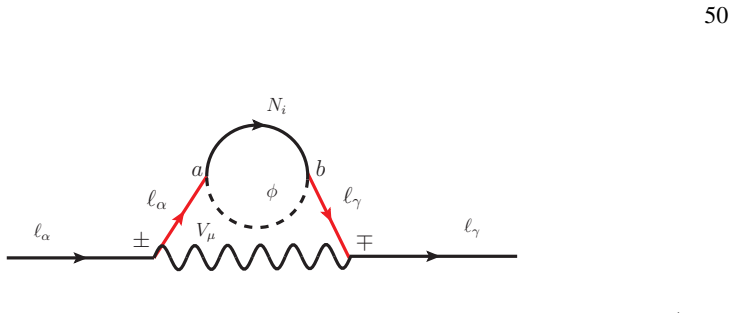
Source and damping effects in off-diagonal correlations From the collision rateC αβ defined in (III.7), we first calculate the one-loop self-energy am- plitudes[iΣ <,>]αγ from neutrino Yukawa interactions, as shown in Fig. 4. We then discuss the one-loop collision rates from charged-lepton Yukawa and gauge interactions that determine the evolution of∆n αβ...
-
[2]
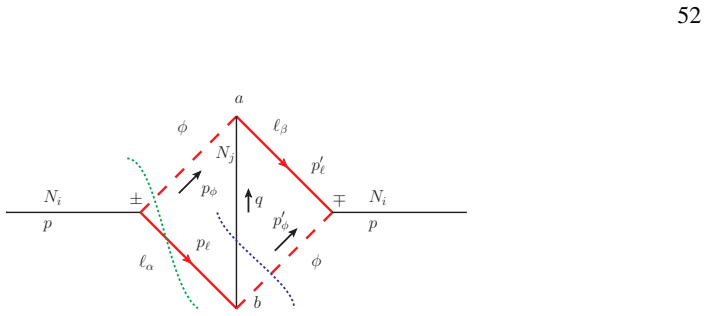
Source and washout effects for lepton-number asymmetry The collision rate for the lepton-number asymmetry of lepton doublets can be derived by using the same expressions ofC αβ andC † αβ given in the previous appendix, but this time we should keep the full dependence off αβ both in the diagonal and off-diagonal entries, and also keep the differences off N...
-
[3]
Minkowski,µ→eγat a Rate of One Out of10 9 Muon Decays?,Phys
P. Minkowski,µ→eγat a Rate of One Out of10 9 Muon Decays?,Phys. Lett. B67(1977) 421–428
1977
-
[4]
R. N. Mohapatra and G. Senjanovic,Neutrino Mass and Spontaneous Parity Nonconservation,Phys. Rev. Lett.44(1980) 912
1980
-
[5]
Yanagida,Horizontal Symmetry and Masses of Neutrinos,Prog
T. Yanagida,Horizontal Symmetry and Masses of Neutrinos,Prog. Theor. Phys.64(1980) 1103
1980
-
[6]
Schechter and J
J. Schechter and J. W. F. Valle,Neutrino Masses in SU(2) x U(1) Theories,Phys. Rev. D22(1980) 2227
1980
-
[7]
Schechter and J
J. Schechter and J. W. F. Valle,Neutrino Decay and Spontaneous Violation of Lepton Number,Phys. Rev. D25(1982) 774
1982
-
[8]
Fukugita and T
M. Fukugita and T. Yanagida,Baryogenesis Without Grand Unification,Phys. Lett. B174(1986) 45–47
1986
-
[9]
M. A. Luty,Baryogenesis via leptogenesis,Phys. Rev. D45(1992) 455–465
1992
-
[10]
Sterile Neutrinos as Dark Matter
S. Dodelson and L. M. Widrow,Sterile-neutrinos as dark matter,Phys. Rev. Lett.72(1994) 17–20, [hep-ph/9303287]
work page Pith review arXiv 1994
- [11]
-
[12]
T. Asaka and M. Shaposhnikov,TheνMSM, dark matter and baryon asymmetry of the universe, Phys. Lett. B620(2005) 17–26, [hep-ph/0505013]
- [13]
-
[14]
Pilaftsis,CP violation and baryogenesis due to heavy Majorana neutrinos,Phys
A. Pilaftsis,CP violation and baryogenesis due to heavy Majorana neutrinos,Phys. Rev. D56(1997) 5431–5451, [hep-ph/9707235]
-
[15]
A. Pilaftsis and T. E. J. Underwood,Resonant leptogenesis,Nucl. Phys. B692(2004) 303–345, [hep-ph/0309342]
work page Pith review arXiv 2004
-
[16]
A. Pilaftsis and T. E. J. Underwood,Electroweak-scale resonant leptogenesis,Phys. Rev. D72(2005) 113001, [hep-ph/0506107]
- [17]
- [18]
-
[19]
Pilaftsis,Resonant CP violation induced by particle mixing in transition amplitudes,Nucl
A. Pilaftsis,Resonant CP violation induced by particle mixing in transition amplitudes,Nucl. Phys. B504(1997) 61–107, [hep-ph/9702393]
-
[20]
A lower bound on the right-handed neutrino mass from leptogenesis
S. Davidson and A. Ibarra,A Lower bound on the right-handed neutrino mass from leptogenesis, Phys. Lett. B535(2002) 25–32, [hep-ph/0202239]
work page Pith review arXiv 2002
-
[21]
Pilaftsis,Resonant tau-leptogenesis with observable lepton number violation,Phys
A. Pilaftsis,Resonant tau-leptogenesis with observable lepton number violation,Phys. Rev. Lett.95 (2005) 081602, [hep-ph/0408103]
- [22]
-
[23]
V . A. Kuzmin, V . A. Rubakov, and M. E. Shaposhnikov,On the Anomalous Electroweak Baryon Number Nonconservation in the Early Universe,Phys. Lett. B155(1985) 36
1985
-
[24]
M. Drewes and B. Garbrecht,Leptogenesis from a GeV Seesaw without Mass Degeneracy,JHEP03 63 (2013) 096, [arXiv:1206.5537]
-
[25]
L. Canetti, M. Drewes, and B. Garbrecht,Probing leptogenesis with GeV-scale sterile neutrinos at LHCb and Belle II,Phys. Rev. D90(2014), no. 12 125005, [arXiv:1404.7114]
- [26]
- [27]
-
[28]
Chou, Z.-b
K.-c. Chou, Z.-b. Su, B.-l. Hao, and L. Yu,Equilibrium and Nonequilibrium Formalisms Made Unified,Phys. Rept.118(1985) 1–131
1985
-
[29]
Calzetta and B
E. Calzetta and B. L. Hu,Nonequilibrium Quantum Fields: Closed Time Path Effective Action, Wigner Function and Boltzmann Equation,Phys. Rev. D37(1988) 2878
1988
-
[30]
T. Prokopec, M. G. Schmidt, and S. Weinstock,Transport equations for chiral fermions to order h bar and electroweak baryogenesis. Part 1,Annals Phys.314(2004) 208–265, [hep-ph/0312110]
-
[31]
T. Prokopec, M. G. Schmidt, and S. Weinstock,Transport equations for chiral fermions to order h-bar and electroweak baryogenesis. Part II,Annals Phys.314(2004) 267–320, [hep-ph/0406140]
- [32]
- [33]
-
[34]
Dominant Thermal Resonant Mechanism for Low-Scale Leptogenesis
S.-P. Li and A. Pilaftsis,Dominant Thermal Resonant Mechanism for Low-Scale Leptogenesis, arXiv:2601.15921
work page internal anchor Pith review Pith/arXiv arXiv
- [35]
-
[36]
Garbrecht,Leptogenesis: The Other Cuts,Nucl
B. Garbrecht,Leptogenesis: The Other Cuts,Nucl. Phys. B847(2011) 350–366, [arXiv:1011.3122]
- [37]
-
[38]
Garbrecht,Baryogenesis from Mixing of Lepton Doublets,Nucl
B. Garbrecht,Baryogenesis from Mixing of Lepton Doublets,Nucl. Phys. B868(2013) 557–576, [arXiv:1210.0553]
-
[39]
T. Frossard, M. Garny, A. Hohenegger, A. Kartavtsev, and D. Mitrouskas,Systematic approach to thermal leptogenesis,Phys. Rev. D87(2013), no. 8 085009, [arXiv:1211.2140]
-
[40]
Y . Hamada and R. Kitano,Primordial Lepton Oscillations and Baryogenesis,JHEP11(2016) 010, [arXiv:1609.05028]
- [41]
- [42]
-
[43]
G. F. Giudice, A. Notari, M. Raidal, A. Riotto, and A. Strumia,Towards a complete theory of thermal leptogenesis in the SM and MSSM,Nucl. Phys. B685(2004) 89–149, [hep-ph/0310123]
work page internal anchor Pith review Pith/arXiv arXiv 2004
-
[44]
T. Hambye and D. Teresi,Higgs doublet decay as the origin of the baryon asymmetry,Phys. Rev. Lett.117(2016), no. 9 091801, [arXiv:1606.00017]
-
[45]
T. Hambye and D. Teresi,Baryogenesis from L-violating Higgs-doublet decay in the density-matrix 64 formalism,Phys. Rev. D96(2017), no. 1 015031, [arXiv:1705.00016]
- [46]
-
[47]
S. Kanemura and S.-P. Li,Resonant Forbidden CP Asymmetry from Soft Leptons,Phys. Rev. Lett.134 (2025), no. 21 211802, [arXiv:2408.06555]
-
[48]
S. Kanemura and S.-P. Li,Forbidden neutrinogenesis,JHEP08(2025) 001, [arXiv:2412.18278]
-
[49]
J. Klari ´c, M. Shaposhnikov, and I. Timiryasov,Uniting Low-Scale Leptogenesis Mechanisms,Phys. Rev. Lett.127(2021), no. 11 111802, [arXiv:2008.13771]
-
[50]
Sigl and G
G. Sigl and G. Raffelt,General kinetic description of relativistic mixed neutrinos,Nucl. Phys. B406 (1993) 423–451
1993
-
[51]
H. A. Weldon,Effective Fermion Masses of Order gT in High Temperature Gauge Theories with Exact Chiral Invariance,Phys. Rev. D26(1982) 2789
1982
-
[52]
M. Drewes and J. U. Kang,The Kinematics of Cosmic Reheating,Nucl. Phys. B875(2013) 315–350, [arXiv:1305.0267]. [Erratum: Nucl.Phys.B 888, 284–286 (2014)]
-
[53]
S.-P. Li,Dark matter freeze-in via a light fermion mediator: forbidden decay and scattering,JCAP 05(2023) 008, [arXiv:2301.02835]
-
[54]
Srednicki,Quantum field theory
M. Srednicki,Quantum field theory. Cambridge University Press, 1, 2007
2007
-
[55]
Wolfenstein,Neutrino Oscillations in Matter,Phys
L. Wolfenstein,Neutrino Oscillations in Matter,Phys. Rev. D17(1978) 2369–2374
1978
-
[56]
S. P. Mikheyev and A. Y . Smirnov,Resonance Amplification of Oscillations in Matter and Spectroscopy of Solar Neutrinos,Sov. J. Nucl. Phys.42(1985) 913–917
1985
- [57]
-
[58]
P. Elmfors, K. Enqvist, G. Raffelt, and G. Sigl,Neutrinos with magnetic moment: Depolarization rate in plasma,Nucl. Phys. B503(1997) 3–23, [hep-ph/9703214]
-
[59]
A. Boyarsky, V . Cheianov, O. Ruchayskiy, and O. Sobol,Evolution of the Primordial Axial Charge across Cosmic Times,Phys. Rev. Lett.126(2021), no. 2 021801, [arXiv:2007.13691]
-
[60]
S.-P. Li and X.-J. Xu,Neutrino magnetic moments meet precision N ef f measurements,JHEP02 (2023) 085, [arXiv:2211.04669]
-
[61]
Li,Scattering versus forbidden decay in dark matter freeze-in,Phys
S.-P. Li,Scattering versus forbidden decay in dark matter freeze-in,Phys. Rev. D108(2023), no. 1 015014, [arXiv:2211.16802]
-
[62]
M. E. Carrington,The Effective potential at finite temperature in the Standard Model,Phys. Rev. D 45(1992) 2933–2944
1992
- [63]
-
[64]
C. Kiessig and M. Plumacher,Hard-Thermal-Loop Corrections in Leptogenesis I: CP-Asymmetries, JCAP07(2012) 014, [arXiv:1111.1231]
-
[65]
C. Kiessig and M. Plumacher,Hard-Thermal-Loop Corrections in Leptogenesis II: Solving the Boltzmann Equations,JCAP09(2012) 012, [arXiv:1111.1235]
- [66]
-
[67]
D. Karamitros, T. McKelvey, and A. Pilaftsis,Varying entropy degrees of freedom effects in low-scale leptogenesis,Phys. Rev. D109(2024), no. 5 055007, [arXiv:2310.03703]. 65
-
[68]
M. D’Onofrio, K. Rummukainen, and A. Tranberg,Sphaleron Rate in the Minimal Standard Model, Phys. Rev. Lett.113(2014), no. 14 141602, [arXiv:1404.3565]
- [69]
-
[70]
Breuer and F
H.-P. Breuer and F. Petruccione,The Theory of Open Quantum Systems. Oxford University Press, 01, 2007
2007
-
[71]
B. Garbrecht and I. Izaguirre,Phenomenology of Baryogenesis from Lepton-Doublet Mixing,Nucl. Phys. B896(2015) 412–439, [arXiv:1411.2834]
- [72]
-
[73]
Braaten, R
E. Braaten, R. D. Pisarski, and T.-C. Yuan,Production of Soft Dileptons in the Quark - Gluon Plasma,Phys. Rev. Lett.64(1990) 2242
1990
- [74]
-
[75]
J. A. Harvey and M. S. Turner,Cosmological baryon and lepton number in the presence of electroweak fermion number violation,Phys. Rev. D42(1990) 3344–3349. [74]PlanckCollaboration, N. Aghanim et al.,Planck 2018 results. VI. Cosmological parameters,Astron. Astrophys.641(2020) A6, [arXiv:1807.06209]. [Erratum: Astron.Astrophys. 652, C4 (2021)]
work page internal anchor Pith review Pith/arXiv arXiv 1990
-
[76]
A. Anisimov, D. Besak, and D. Bodeker,Thermal production of relativistic Majorana neutrinos: Strong enhancement by multiple soft scattering,JCAP03(2011) 042, [arXiv:1012.3784]
-
[77]
D. Besak and D. Bodeker,Thermal production of ultrarelativistic right-handed neutrinos: Complete leading-order results,JCAP03(2012) 029, [arXiv:1202.1288]
-
[78]
B. Garbrecht, F. Glowna, and P. Schwaller,Scattering Rates For Leptogenesis: Damping of Lepton Flavour Coherence and Production of Singlet Neutrinos,Nucl. Phys. B877(2013) 1–35, [arXiv:1303.5498]
-
[79]
M. Laine,Thermal right-handed neutrino production rate in the relativistic regime,JHEP08(2013) 138, [arXiv:1307.4909]
-
[80]
L. Canetti, M. Drewes, T. Frossard, and M. Shaposhnikov,Dark Matter, Baryogenesis and Neutrino Oscillations from Right Handed Neutrinos,Phys. Rev. D87(2013) 093006, [arXiv:1208.4607]
discussion (0)
Sign in with ORCID, Apple, or X to comment. Anyone can read and Pith papers without signing in.