Recognition: 2 theorem links
· Lean TheoremArea bounds and gauge fixing: alternative canonical variables for loop gravity
Pith reviewed 2026-05-10 18:35 UTC · model grok-4.3
The pith
A canonical parametrization of twisted geometries supplies analytical lower bounds on the total area in a two-vertex loop-gravity model.
A machine-rendered reading of the paper's core claim, the machinery that carries it, and where it could break.
Core claim
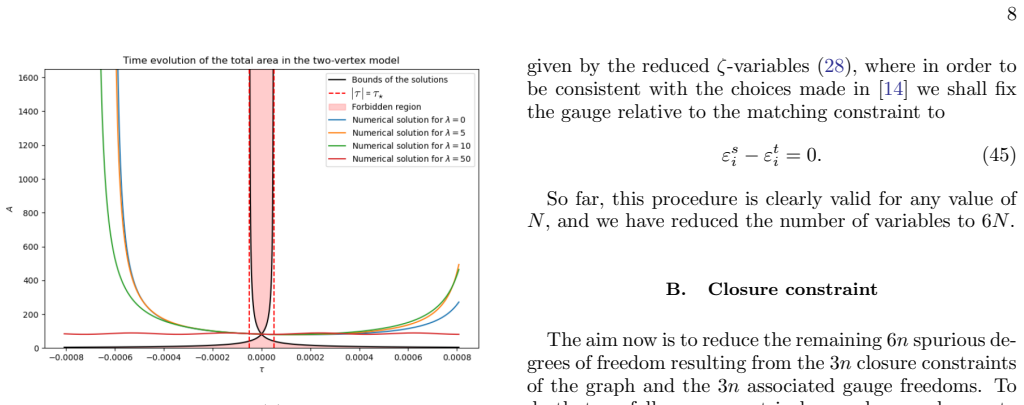
By adopting a canonical parametrization of twisted geometries, the authors establish explicit links to frame bases and spinorial descriptions of the loop-gravity phase space on a fixed graph. For the two-vertex model they derive closed-form bounds on the time evolution of the total area, demonstrating that this area remains strictly positive at all finite times. The same parametrization reduces the gauge-fixing procedure to a simpler form that applies to graphs with more than four links.
What carries the argument
The canonical parametrization of twisted geometries, which supplies coordinates on the classical phase space that correspond directly to frame bases and spinors.
If this is right
- The total area of the two-vertex model remains bounded away from zero at all finite times.
- The dynamics exhibit a bounce-like behavior instead of collapse to vanishing area.
- Gauge fixing is reduced to a simpler algebraic procedure that applies beyond the four-link case.
- Analytical methods become available for area dynamics that previously required numerical integration.
Where Pith is reading between the lines
- The same parametrization could be applied to graphs with more vertices to test whether the positive lower bound persists.
- The explicit spinorial correspondence might allow the construction of new quantum operators or coherent states directly in these coordinates.
- Simplified gauge fixing could reduce the technical overhead when imposing the Gauss constraint in larger discrete geometries.
Load-bearing premise
The chosen canonical parametrization accurately represents the entire classical phase space of loop gravity on a fixed graph.
What would settle it
An explicit calculation or simulation of the two-vertex area evolution that reaches zero at some finite time would violate the derived lower bound.
Figures




read the original abstract
We use a canonical parametrization of twisted geometries describing the classical phase space of loop quantum gravity on a fixed graph, and establish its explicit correspondence with the associated frame bases and spinorial descriptions. Applied to the two-vertex model, this framework yields analytical bounds on the evolution of the total area, proving the existence of a non-vanishing lower bound at finite times. These findings, previously observed only numerically, suggest a bounce-like behavior and highlight the usefulness of these variables for the study of more general configurations. As a second result, the canonical variables are shown to simplify the gauge-fixing procedure, generalizing previous results restricted to two-vertex models with four links.
Editorial analysis
A structured set of objections, weighed in public.
Referee Report
Summary. The manuscript introduces a canonical parametrization of twisted geometries for the classical phase space of loop quantum gravity on a fixed graph and establishes its explicit correspondence with frame bases and spinorial descriptions. Applied to the two-vertex model, the framework derives analytical bounds on the evolution of the total area, proving a non-vanishing lower bound at finite times and suggesting bounce-like behavior. As a secondary result, the variables are shown to simplify the gauge-fixing procedure, generalizing prior results limited to two-vertex models with four links.
Significance. If the central claims hold, the work upgrades previous numerical observations of area bounds in the two-vertex model to analytical proofs, providing stronger evidence for bounce-like dynamics in this simplified LQG setting. The new variables may offer practical advantages for gauge fixing and for extending such analyses to more general graph configurations.
major comments (1)
- [section establishing the parametrization and correspondence with frame bases and spinorial descriptions] The weakest assumption underlying the central claim is that the canonical parametrization of twisted geometries constitutes a valid global chart on the phase space with complete, explicit correspondence to all frame bases and spinorial descriptions. This must be demonstrated rigorously (with any potential singularities or missing sectors identified) before the derived area bounds can be considered reliable, as the two-vertex application and the inequality proving A(t) > 0 for finite t rest directly on this completeness.
minor comments (1)
- [Abstract] The abstract asserts the existence of analytical bounds and a proof of the non-vanishing lower limit but supplies no outline of the key evolution equations, inequality steps, or error estimates used; adding a brief indication of these would improve accessibility without altering the technical content.
Simulated Author's Rebuttal
We thank the referee for their careful reading of the manuscript and for the positive evaluation of its significance. We address the single major comment below and have revised the text to provide additional clarification on the domain of the parametrization.
read point-by-point responses
-
Referee: [section establishing the parametrization and correspondence with frame bases and spinorial descriptions] The weakest assumption underlying the central claim is that the canonical parametrization of twisted geometries constitutes a valid global chart on the phase space with complete, explicit correspondence to all frame bases and spinorial descriptions. This must be demonstrated rigorously (with any potential singularities or missing sectors identified) before the derived area bounds can be considered reliable, as the two-vertex application and the inequality proving A(t) > 0 for finite t rest directly on this completeness.
Authors: We thank the referee for this observation. Section 2 of the manuscript constructs the canonical parametrization directly from the twisted-geometry phase space on a fixed graph and supplies explicit, invertible maps to the holonomy-flux frame variables (Eqs. (2.5)–(2.8)) and to the spinorial variables (Section 3). These maps are bijective on the open set where all face areas are strictly positive and the closure constraints are satisfied, which is precisely the sector relevant to loop quantum gravity. The dimension of the parameter space matches that of the reduced phase space after gauge fixing, establishing that the chart covers the entire non-degenerate twisted-geometry manifold for the given graph. We have added a new paragraph in Section 2.3 that explicitly identifies the only potential singularities: loci where one or more areas vanish. These degenerate configurations lie outside the standard LQG phase space and are excluded by the positivity of areas. In the two-vertex model the derived lower bound on the total area guarantees that the evolution remains inside the regular domain for all finite times, so the analytical proof of A(t) > 0 does not encounter singularities. This clarification makes the completeness of the correspondence fully explicit without altering the original claims. revision: yes
Circularity Check
No significant circularity; bounds derived from dynamics in new variables
full rationale
The paper defines a canonical parametrization of twisted geometries for the LQG phase space on a fixed graph, shows its explicit correspondence to frame bases and spinorial variables, and applies the resulting evolution equations to the two-vertex model. The analytical lower bound on total area A(t) > 0 for finite t follows from inequalities on those equations rather than from any redefinition or fit of the bound itself. No step equates a derived quantity to its own input by construction, and no load-bearing premise reduces to a self-citation chain or ansatz smuggled from prior work by the same authors. The upgrade from numerical to analytical is therefore an independent consequence of the new chart.
Axiom & Free-Parameter Ledger
axioms (1)
- domain assumption Twisted geometries provide a faithful parametrization of the classical phase space of loop quantum gravity on a fixed graph
Lean theorems connected to this paper
-
IndisputableMonolith/Foundation/AbsoluteFloorClosure.leanreality_from_one_distinction unclear?
unclearRelation between the paper passage and the cited Recognition theorem.
We use a canonical parametrization of twisted geometries... proving the existence of a non-vanishing lower bound at finite times... A(τ) ≥ A0/(1+16A0|γ||τ|)
-
IndisputableMonolith/Cost/FunctionalEquation.leanwashburn_uniqueness_aczel unclear?
unclearRelation between the paper passage and the cited Recognition theorem.
ζ-variables satisfy {R,ε}={ϕ,ζ}=1... reduced to six independent canonical quantities {A,Φ,ϕs,ζs,ϕt,ζt}
What do these tags mean?
- matches
- The paper's claim is directly supported by a theorem in the formal canon.
- supports
- The theorem supports part of the paper's argument, but the paper may add assumptions or extra steps.
- extends
- The paper goes beyond the formal theorem; the theorem is a base layer rather than the whole result.
- uses
- The paper appears to rely on the theorem as machinery.
- contradicts
- The paper's claim conflicts with a theorem or certificate in the canon.
- unclear
- Pith found a possible connection, but the passage is too broad, indirect, or ambiguous to say the theorem truly supports the claim.
Reference graph
Works this paper leans on
-
[1]
This, together withϕ ν 1, provides all the information needed to recover ⃗X ν 1 and ⃗X ν 2
On the other hand, givenx ν =ζ ν 1 +ζ ν 2 together withA 1 andA 2, we deter- mine the angle between the vectors ⃗X ν 1 and ⃗X ν 2 using the fact that ⃗X ν 1 + ⃗X ν 2 is parallel to thez-axis pointing towards positivez. This, together withϕ ν 1, provides all the information needed to recover ⃗X ν 1 and ⃗X ν 2 . Applying the same reasoning, knowingx ν =−ζ ν...
-
[2]
Given the values ofA i, i.e
First, define the variablesx ν 1 :=ζ ν 1 +ζ ν 2 andφ ν 1 := ϕν 1 −ϕν Nν at each nodeν. Given the values ofA i, i.e. the areas of the faces, fromx ν 1 andφ ν 1 we determine ⃗X ν 1 , ⃗X ν 2 ,ϕ ν Nν
-
[3]
Since we already knowϕ ν Nν from the previous step, fromφ ν 2 we obtainϕ ν Nν −1
Next, definex ν 2 :=PNν −1 j=3 ζ ν j andφ ν 2 :=ϕ ν Nν −1 − ϕν Nν. Since we already knowϕ ν Nν from the previous step, fromφ ν 2 we obtainϕ ν Nν −1. Additionally, in virtue of the closure constraint, fromx ν 1 andx ν 2 we recoverζ ν Nν. Hence, givenϕ ν Nν,ζ ν Nν andA ν Nν we determine ⃗X ν Nν. Therefore, at this step we have al- ready defined the quantiti...
-
[4]
Thus, at this step we have defined the variables needed to recover⃗X ν 1 , ⃗X ν 2 , ⃗X ν Nν, ⃗X ν Nν −1,ϕ ν Nν −2
Now, givenx ν 3 := PNν −2 j=3 ζ ν j andφ ν 3 :=ϕ ν Nν −2 − ϕν Nν −1, we recoverϕ ν Nν −2 and ⃗X ν Nν −1 in virtue, again, of the closure constraint. Thus, at this step we have defined the variables needed to recover⃗X ν 1 , ⃗X ν 2 , ⃗X ν Nν, ⃗X ν Nν −1,ϕ ν Nν −2
-
[5]
Iterate step 3 until we have defined the 2N ν −6 variables encoding the physical degrees of freedom at nodeνthat remain after the matching constraint reduction. To sum up, at the end of the iteration we end up having defined the variables xν 1 :=ζ ν 1 +ζ ν 2 , φ ν 1 :=ϕ ν 1 −ϕ ν Nν , xν i := Nν+1−iX j=3 ζ ν j , i= 2, . . . , N ν −3,(52) φν i :=ϕ ν Nν+1−i ...
-
[6]
Rovelli,Quantum Gravity(Cambridge University Press, 2004)
C. Rovelli,Quantum Gravity(Cambridge University Press, 2004)
2004
-
[7]
Thiemann,Modern Canonical Quantum General Rela- tivity, Cambridge Monographs on Mathematical Physics (Cambridge University Press, Cambridge, 2007)
T. Thiemann,Modern Canonical Quantum General Rela- tivity, Cambridge Monographs on Mathematical Physics (Cambridge University Press, Cambridge, 2007)
2007
-
[8]
L. Freidel and S. Speziale, Twisted geometries: A ge- ometric parametrisation of su(2) phase space, Physical Review D82, 084040 (2010), arXiv:1001.2748
-
[9]
L. Freidel and S. Speziale, From twistors to twisted geometries, Physical Review D82, 084041 (2010), arXiv:1006.0199
- [10]
- [11]
- [12]
- [13]
-
[14]
C. Rovelli and F. Vidotto, Stepping out of homogene- ity in loop quantum cosmology, Classical and Quantum Gravity25, 225024 (2008), arXiv:0805.4585
- [15]
- [16]
-
[17]
E. Aranguren, I. Garay, and E. R. Livine, Classical dy- namics for loop gravity: The two-vertex model, Phys. Rev. D105, 126024 (2022), arXiv:2204.00307 [gr-qc]
- [18]
-
[19]
Garay, L
I. Garay, L. J. Garay, and D. H. Gugliotta, Two-vertex model of loop quantum gravity: Anisotropic reduced sec- tors, Physical Review D111, 086009 (2025)
2025
- [20]
-
[21]
M. Assanioussi and E. R. Livine, Elementary blocks of Loop Quantum Gravity, (2026), arXiv:2601.21644 [gr- qc]
-
[22]
A. D. Alexandrov,Convex Polyhedra, Springer Mono- graphs in Mathematics (Springer, 2005) translated from the 1950 Russian edition by N.S. Dairbekov, S.S. Kutate- ladze, and A.B. Sossinsky
2005
-
[23]
L. Freidel and J. Hnybida, A Discrete and Coherent Basis of Intertwiners, Class. Quant. Grav.31, 015019 (2014), arXiv:1305.3326 [math-ph]
-
[24]
Tisza,Applied Geometric Algebra(MIT Press, 2005)
L. Tisza,Applied Geometric Algebra(MIT Press, 2005)
2005
- [25]
-
[26]
M. Dupuis and E. R. Livine, Holomorphic Simplicity Constraints for 4d Spinfoam Models, Class. Quant. Grav. 28, 215022 (2011), arXiv:1104.3683 [gr-qc]
-
[27]
Bojowald, Absence of singularity in loop quantum cosmology, Phys
M. Bojowald, Absence of singularity in loop quantum cosmology, Phys. Rev. Lett.86, 5227 (2001), arXiv:gr- qc/0102069
-
[28]
Quantum Nature of the Big Bang
A. Ashtekar, T. Pawlowski, and P. Singh, Quantum na- ture of the big bang, Phys. Rev. Lett.96, 141301 (2006), arXiv:gr-qc/0602086
work page Pith review arXiv 2006
-
[29]
Quantum nature o f the big bang: Improved dynamics
A. Ashtekar, T. Pawlowski, and P. Singh, Quantum Na- ture of the Big Bang: Improved dynamics, Phys. Rev. D 74, 084003 (2006), arXiv:gr-qc/0607039
discussion (0)
Sign in with ORCID, Apple, or X to comment. Anyone can read and Pith papers without signing in.