Recognition: 2 theorem links
· Lean TheoremDatabase Reordering for Compact Grover Oracles with ESOP Minimization
Pith reviewed 2026-05-10 18:44 UTC · model grok-4.3
The pith
Reordering the database before ESOP minimization reduces quantum state preparation circuit size in Grover oracles.
A machine-rendered reading of the paper's core claim, the machinery that carries it, and where it could break.
Core claim
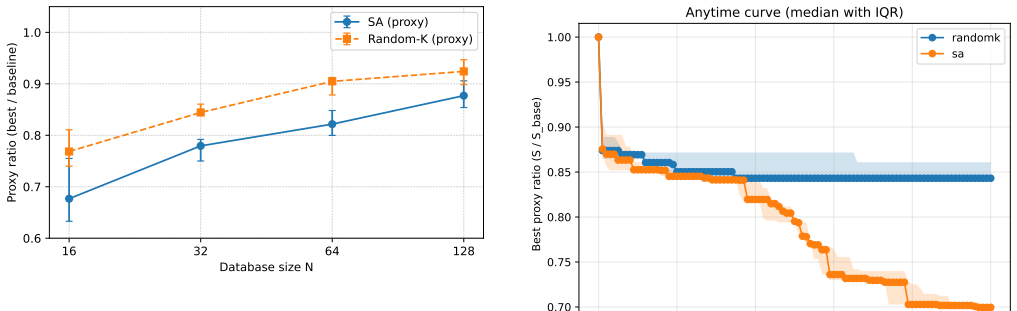
Permuting the assignment of data values to addresses in a database, followed by ESOP minimization of the new truth table, yields a correct yet more compact quantum state-preparation circuit for the QROM inside a Grover oracle; the oracle remains valid because every original datum is still present at some address. For N=8 an exhaustive enumeration of all orderings confirms that circuit size varies by up to a factor of approximately two. A simulated-annealing search driven by a proxy metric that estimates size without full compilation finds orderings giving an average 30 percent reduction and circuits near the optimum. For N=64 and N=128 the same search outperforms random ordering.
What carries the argument
Database reordering before ESOP minimization on the QROM truth table, searched via simulated annealing with a proxy size metric.
If this is right
- Circuit size for the state-preparation stage varies by up to a factor of two solely due to address ordering.
- Simulated annealing with the proxy metric recovers orderings that reduce gate count by about 30 percent versus the original ordering.
- The resulting oracle still encodes every required datum at some address, so search correctness is unchanged.
- For databases larger than 8 the same search procedure continues to outperform random reordering.
Where Pith is reading between the lines
- The reordering technique could be applied on top of other circuit-optimization passes such as gate cancellation or template matching for additional savings.
- Databases whose entries already exhibit structure or repetition may admit even larger reductions once optimally ordered.
- The proxy metric might be adapted to rank orderings for minimization methods other than ESOP.
- Hardware experiments on small Grover instances could confirm whether the simulated depth reductions translate to measurable runtime gains.
Load-bearing premise
Any re-assignment of data to addresses preserves oracle correctness and the proxy metric reliably ranks orderings without requiring full quantum compilation.
What would settle it
An exhaustive enumeration of all 16! orderings for an N=16 database, followed by full circuit compilation of each, would falsify the claim if the ordering returned by simulated annealing is not among the smallest circuits.
Figures


read the original abstract
Grover's algorithm searches for data satisfying a desired condition in an unstructured database. This algorithm can search a space of size $N$ in $\sqrt{N}$ queries, thereby achieving a quadratic speedup. However, within the Grover oracle circuit that is repeatedly applied, the quantum state preparation circuit -- which embeds database information into quantum states -- suffers from a large gate count and circuit depth. To address this problem, we propose reducing the quantum state preparation circuit by reordering the database. Specifically, we consider a Quantum Read-Only Memory (QROM), where data are assigned to addresses, and assume that the address assignment of data can be freely permuted. By applying Exclusive Sum-of-Products (ESOP) minimization to the resulting truth table, we reduce the quantum circuit. Although the resulting circuit logic differs from the original, the state preparation remains correct in the sense that every desired datum is encoded at some address. Furthermore, we propose a proxy metric that estimates circuit size without compilation, and combine it with simulated annealing to efficiently find a near-optimal data ordering. In our experiments, an exhaustive search over all orderings for databases of size $N=8$ reveals that circuit size varies by up to approximately a factor of two depending on the ordering, demonstrating the utility of reordering. Compared with applying ESOP minimization without reordering, simulated annealing reduces the circuit size by approximately 30\% and yields circuits close to optimal. For $N=64$ and $128$, simulated annealing is shown to discover smaller circuits compared with random search.
Editorial analysis
A structured set of objections, weighed in public.
Referee Report
Summary. The manuscript claims that permuting the address-to-data mapping in a QROM-based Grover oracle, followed by ESOP minimization of the resulting truth table, reduces the quantum state-preparation circuit size. A proxy metric is introduced to estimate size without full compilation; simulated annealing using this proxy yields ~30% smaller circuits than ESOP minimization alone for N=8 (where exhaustive search confirms up to 2× variation) and outperforms random search for N=64 and 128.
Significance. If the proxy reliably ranks orderings by post-compilation gate count, the approach supplies a practical, scalable heuristic for oracle optimization that avoids exhaustive enumeration or repeated full synthesis. The N=8 exhaustive verification and the concrete 30% figure are concrete strengths; the method could be useful for Grover oracles and other QROM-based state preparation once the proxy is validated.
major comments (2)
- [proxy metric and simulated-annealing sections] The central optimization loop for N>8 rests on the unverified assumption that the proxy metric produces the same ranking of permutations as the actual compiled ESOP circuit size. No table, figure, or correlation coefficient is provided that compares proxy values against post-compilation gate counts across the N=8 exhaustive set; without this, it is impossible to know whether the reported 30% gain and the N=64/128 improvements are artifacts of proxy misalignment.
- [N=8 exhaustive experiments] The abstract and experimental claims state that SA “yields circuits close to optimal” for N=8, yet no quantitative measure (e.g., ratio of SA size to the true minimum found by exhaustive search, or distribution over multiple SA runs) is supplied. This datum is load-bearing for the claim that the heuristic is near-optimal.
minor comments (2)
- [abstract and experiments] The abstract reports an approximate 30% reduction but supplies neither error bars nor the number of independent SA runs; a short statistical summary would strengthen the result.
- [proxy definition] Notation for the proxy metric (its exact functional form, weighting of product terms, etc.) is introduced without a numbered equation; adding one would improve reproducibility.
Simulated Author's Rebuttal
We thank the referee for their thorough review and valuable feedback on our manuscript. We appreciate the opportunity to clarify and strengthen our claims regarding the proxy metric and the performance of simulated annealing. Below, we address each major comment in detail.
read point-by-point responses
-
Referee: [proxy metric and simulated-annealing sections] The central optimization loop for N>8 rests on the unverified assumption that the proxy metric produces the same ranking of permutations as the actual compiled ESOP circuit size. No table, figure, or correlation coefficient is provided that compares proxy values against post-compilation gate counts across the N=8 exhaustive set; without this, it is impossible to know whether the reported 30% gain and the N=64/128 improvements are artifacts of proxy misalignment.
Authors: We agree that a direct validation of the proxy metric's ranking ability is necessary to substantiate its use for larger N. Although the proxy was designed based on the structure of ESOP minimization to correlate with circuit size, we did not include a comparative analysis in the original submission. In the revised manuscript, we will add a new figure or table that plots proxy values versus actual compiled gate counts for the exhaustive set of N=8 orderings, including the Pearson correlation coefficient. This will demonstrate the strength of the correlation and support the reported improvements for N=64 and 128. revision: yes
-
Referee: [N=8 exhaustive experiments] The abstract and experimental claims state that SA “yields circuits close to optimal” for N=8, yet no quantitative measure (e.g., ratio of SA size to the true minimum found by exhaustive search, or distribution over multiple SA runs) is supplied. This datum is load-bearing for the claim that the heuristic is near-optimal.
Authors: The referee correctly identifies that the statement 'yields circuits close to optimal' lacks supporting quantitative data in the current manuscript. While our exhaustive search confirmed significant variation and SA found good solutions, we omitted the specific ratios and run statistics. We will revise the experimental section and abstract to include the average ratio of SA circuit size to the optimal size found by exhaustive search, as well as the distribution or standard deviation over multiple independent SA runs with different initializations. This will provide a clear measure of how close the heuristic comes to optimality. revision: yes
Circularity Check
No significant circularity; central result is empirical optimization outcome
full rationale
The paper presents an empirical method: database reordering followed by ESOP minimization, with a proposed proxy metric guiding simulated annealing to discover orderings. For N=8 the improvement is validated against exhaustive enumeration and random baselines; for larger N it is compared to random search. No equation or derivation reduces the reported circuit-size reduction to a fitted parameter defined from the same data, a self-definition, or a self-citation chain. The proxy is an auxiliary search heuristic whose correlation with final compiled size is an empirical question, not a definitional identity. The derivation chain therefore remains self-contained and externally falsifiable.
Axiom & Free-Parameter Ledger
axioms (2)
- domain assumption QROM allows arbitrary permutation of data-to-address assignments while preserving oracle semantics.
- domain assumption ESOP minimization applied to the reordered truth table yields a correct (though logically different) state-preparation circuit.
Lean theorems connected to this paper
-
IndisputableMonolith/Cost/FunctionalEquation.leanwashburn_uniqueness_aczel unclear?
unclearRelation between the paper passage and the cited Recognition theorem.
reordering the database before ESOP minimization... proxy metric that estimates circuit size without compilation, and combine it with simulated annealing
-
IndisputableMonolith/Foundation/AlexanderDuality.leanalexander_duality_circle_linking unclear?
unclearRelation between the paper passage and the cited Recognition theorem.
circuit size varies by up to approximately a factor of two depending on the ordering
What do these tags mean?
- matches
- The paper's claim is directly supported by a theorem in the formal canon.
- supports
- The theorem supports part of the paper's argument, but the paper may add assumptions or extra steps.
- extends
- The paper goes beyond the formal theorem; the theorem is a base layer rather than the whole result.
- uses
- The paper appears to rely on the theorem as machinery.
- contradicts
- The paper's claim conflicts with a theorem or certificate in the canon.
- unclear
- Pith found a possible connection, but the passage is too broad, indirect, or ambiguous to say the theorem truly supports the claim.
Reference graph
Works this paper leans on
-
[1]
A fast quantum mechanical algorithm for database search,
L. K. Grover, “A fast quantum mechanical algorithm for database search,” inProceedings of the Twenty-Eighth Annual ACM Symposium on Theory of Computing, ser. STOC ’96. New York, NY , USA: Association for Computing Machinery, 1996, p. 212–219. [Online]. Available: https://doi.org/10.1145/237814.237866
-
[2]
Disentangling hype from practicality: On realistically achieving quantum advantage,
T. Hoefler, T. Häner, and M. Troyer, “Disentangling hype from practicality: On realistically achieving quantum advantage,”Commun. ACM, vol. 66, no. 5, p. 82–87, Apr. 2023. [Online]. Available: https://doi.org/10.1145/3571725
-
[3]
Opening the black box inside grover’s algorithm,
E. M. Stoudenmire and X. Waintal, “Opening the black box inside grover’s algorithm,”Phys. Rev. X, vol. 14, p. 041029, Nov
-
[4]
Mazin, Editorial: Altermagnetism—a new punch line of fundamental magnetism, Phys
[Online]. Available: https://link.aps.org/doi/10.1103/PhysRevX. 14.041029
-
[5]
Fowler, Matteo Mariantoni, John M
A. G. Fowler, M. Mariantoni, J. M. Martinis, and A. N. Cleland, “Surface codes: Towards practical large-scale quantum computation,” Phys. Rev. A, vol. 86, p. 032324, Sep 2012. [Online]. Available: https://link.aps.org/doi/10.1103/PhysRevA.86.032324
-
[6]
Circuit-based quantum random access memory for classical data,
D. K. Park, F. Petruccione, and J.-K. K. Rhee, “Circuit-based quantum random access memory for classical data,”Scientific Reports, vol. 9, no. 1, Mar. 2019. [Online]. Available: http: //dx.doi.org/10.1038/s41598-019-40439-3
-
[7]
Optimization of quantum read-only memory circuits,
K. Phalak, M. Alam, A. Ash-Saki, R. Onur Topaloglu, and S. Ghosh, “Optimization of quantum read-only memory circuits,” in2022 IEEE 40th International Conference on Computer Design (ICCD), 2022, pp. 117–123
2022
-
[8]
Elementary gates for quantum computation,
A. Barenco, C. H. Bennett, R. Cleve, D. P. DiVincenzo, N. Margolus, P. Shor, T. Sleator, J. A. Smolin, and H. Weinfurter, “Elementary gates for quantum computation,”Phys. Rev. A, vol. 52, pp. 3457–3467, Nov
-
[9]
Fowler, Matteo Mariantoni, John M
[Online]. Available: https://link.aps.org/doi/10.1103/PhysRevA. 52.3457
-
[10]
Scaling-up esop synthesis for quantum compilation,
B. Schmitt, M. Soeken, G. De Micheli, and A. Mishchenko, “Scaling-up esop synthesis for quantum compilation,” in2019 IEEE 49th Interna- tional Symposium on Multiple-Valued Logic (ISMVL), 2019, pp. 13–18
2019
-
[11]
Fast heuristic minimization of exclusive-sum-of-products,
A. Mishchenko and M. Perkowski, “Fast heuristic minimization of exclusive-sum-of-products,” inProceedings of the Reed–Muller Work- shop, 2001
2001
-
[12]
Science376(6594), 5197 (2022) https://doi.org/10.1126/science
S. Kirkpatrick, C. D. Gelatt, and M. P. Vecchi, “Optimization by simulated annealing,”Science, vol. 220, no. 4598, pp. 671–680, 1983. [Online]. Available: https://www.science.org/doi/abs/10.1126/science. 220.4598.671
-
[13]
Contemporary Mathematics705(2018) https://doi.org/10.1090/conm/ 705/14202
G. Brassard, P. Høyer, M. Mosca, and A. Tapp, “Quantum amplitude amplification and estimation,”Quantum Computation and Information, p. 53–74, 2002. [Online]. Available: http://dx.doi.org/10.1090/conm/ 305/05215
-
[14]
C. Jones, “Low-overhead constructions for the fault-tolerant toffoli gate,”Phys. Rev. A, vol. 87, p. 022328, Feb 2013. [Online]. Available: https://link.aps.org/doi/10.1103/PhysRevA.87.022328
-
[15]
Physical Review Letters100(16) (2008) https://doi
V . Giovannetti, S. Lloyd, and L. Maccone, “Quantum random access memory,”Phys. Rev. Lett., vol. 100, p. 160501, Apr 2008. [Online]. Available: https://link.aps.org/doi/10.1103/PhysRevLett.100.160501
-
[16]
A transformation based algorithm for reversible logic synthesis,
D. Miller, D. Maslov, and G. Dueck, “A transformation based algorithm for reversible logic synthesis,” inProceedings 2003. Design Automation Conference (IEEE Cat. No.03CH37451), 2003, pp. 318–323
2003
-
[17]
Synthesis of reversible logic circuits,
V . V . Shende, A. K. Prasad, I. L. Markov, and J. P. Hayes, “Synthesis of reversible logic circuits,”Trans. Comp.-Aided Des. Integ. Cir. Sys., vol. 22, no. 6, p. 710–722, Nov. 2006. [Online]. Available: https://doi.org/10.1109/TCAD.2003.811448
-
[18]
Reversible logic synthesis with output permutation,
R. Wille, D. Große, G. W. Dueck, and R. Drechsler, “Reversible logic synthesis with output permutation,” in2009 22nd International Conference on VLSI Design, 2009, pp. 189–194
2009
-
[19]
K. Datta, I. Sengupta, H. Rahaman, and R. Drechsler,An Approach to Reversible Logic Synthesis Using Input and Output Permutations. Berlin, Heidelberg: Springer Berlin Heidelberg, 2014, pp. 92–110. [Online]. Available: https://doi.org/10.1007/978-3-662-45711-5_6
-
[20]
Rise of conditionally clean ancillae for efficient quantum circuit constructions,
T. Khattar and C. Gidney, “Rise of conditionally clean ancillae for efficient quantum circuit constructions,”Quantum, vol. 9, p. 1752, May 2025. [Online]. Available: http://dx.doi.org/10.22331/ q-2025-05-21-1752
2025
discussion (0)
Sign in with ORCID, Apple, or X to comment. Anyone can read and Pith papers without signing in.