Recognition: 2 theorem links
· Lean TheoremSpin-charge induced scalarization of Kerr-Newman black holes in the Einstein-Maxwell-scalar theory with scalar potential
Pith reviewed 2026-05-10 18:30 UTC · model grok-4.3
The pith
Kerr-Newman black holes develop scalar hair when spin and charge exceed instability thresholds in Einstein-Maxwell-scalar theory.
A machine-rendered reading of the paper's core claim, the machinery that carries it, and where it could break.
Core claim
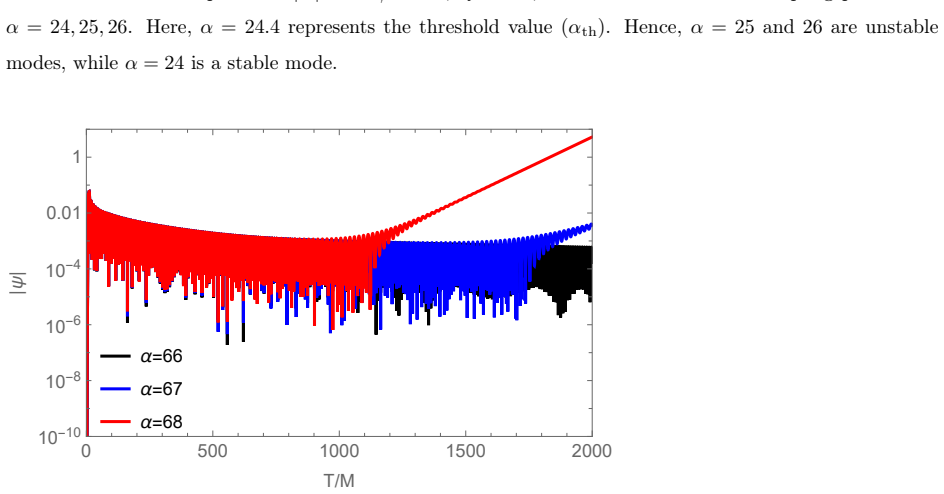
In the Einstein-Maxwell-scalar theory with scalar potential and positive coupling, Kerr-Newman black holes undergo spin-charge-induced scalarization. Analysis of the effective scalar mass term in the θ-direction reveals an onset spin a_c below which the negative-mass region signals instability for 0 < a < a_0. Numerical solution of the (2+1)-dimensional evolution equation locates the unstable region and produces scalarized Kerr-Newman black holes, with the threshold curve depending on charge Q, scalar mass m_φ, coupling α, and spin a subject to the bound a² ≤ M² - Q².
What carries the argument
The effective scalar mass term in the θ-direction together with the (2+1)-dimensional numerical evolution equation for the scalar field.
If this is right
- Kerr-Newman black holes become unstable to scalar perturbations and form scalar hair for spins below a critical value determined by charge, scalar mass, and coupling.
- The threshold curve in parameter space marks the boundary between stable and scalarized Kerr-Newman solutions.
- Scalarization requires the combined presence of spin and charge, with the unstable domain bounded above by the extremality condition a² ≤ M² - Q².
- The resulting scalarized configurations are the nonlinear end states reached after the linear instability grows.
Where Pith is reading between the lines
- The same reduced-dimensional approach could be applied to test scalarization in other rotating black hole spacetimes within modified gravity.
- Scalar hair on astrophysical black holes might produce measurable shifts in their shadow sizes or ringdown frequencies if the theory parameters are realized in nature.
- Further work could check whether the scalarized Kerr-Newman solutions remain stable against additional perturbations such as gravitational waves.
Load-bearing premise
The (2+1)-dimensional reduction and linearized effective-mass analysis in the θ-direction fully capture the onset and nonlinear development of the instability without requiring full 4D simulations or higher-order corrections.
What would settle it
A complete four-dimensional simulation that finds no growing scalar field for parameter values inside the predicted unstable region, or an observed Kerr-Newman black hole with spin below the computed threshold that shows no scalar hair.
Figures




read the original abstract
We investigate the spin-charge-induced scalarization of Kerr--Newman (KN) black holes in the Einstein--Maxwell-scalar (EMS) theory with a scalar potential and positive coupling parameter. In the linearized theory, there exists a bound of $0<a<a_0$ with onset spin $a_c$ for the negative region signaling instability by analyzing the effective scalar mass term in the $\theta$-direction. Solving the $(2+1)$-dimensional evolution equation numerically, we find the region where the KN black hole becomes unstable, giving rise to scalarized KN black holes. The threshold curve for representing the boundary between stable and unstable KN black holes depends on charge $Q$, scalar mass $m_\phi$, coupling parameter $\alpha$, and spin parameter $a$ with upper bound $a^2\le M^2-Q^2$.
Editorial analysis
A structured set of objections, weighed in public.
Referee Report
Summary. The manuscript investigates spin-charge induced scalarization of Kerr-Newman black holes in the Einstein-Maxwell-scalar theory with a scalar potential. In the linearized theory, analysis of the effective scalar mass term in the θ-direction identifies an instability region for 0 < a < a0 with an onset spin ac. The authors then numerically evolve a (2+1)-dimensional system to map the unstable parameter region, producing threshold curves separating stable and unstable Kerr-Newman black holes that depend on charge Q, scalar mass m_φ, coupling parameter α, and spin a, subject to the bound a² ≤ M² - Q².
Significance. If the numerical results hold, the work would demonstrate a new mechanism for scalarization of charged rotating black holes driven by both spin and charge, extending scalarization studies to include a scalar potential and providing potential implications for black hole stability in modified gravity. The combination of linearized effective-mass analysis with numerical evolution of the reduced system is a standard approach in the field, but the absence of supporting numerical details currently limits the strength of the conclusions.
major comments (2)
- [Abstract] Abstract and numerical evolution section: The manuscript states that solving the (2+1)-dimensional evolution equation numerically reveals the instability region and threshold curves, but supplies no information on discretization scheme, grid resolution, convergence tests, boundary conditions, or validation against known limits (e.g., the non-rotating Reissner-Nordström case). This omission is load-bearing because the central claim rests on the reported unstable region in the (Q, m_φ, α, a) space.
- [Linearized theory section] Linearized analysis and (2+1)D reduction: The instability is identified via the sign of the effective scalar mass squared obtained from the θ-direction in the linearized Klein-Gordon equation on the Kerr-Newman background. The manuscript does not demonstrate that the (2+1)D reduction preserves the θ-dependent unstable modes, including any spin-induced couplings arising from the g_{tφ} and g_{φφ} terms. If the reduction averages over θ or assumes equatorial symmetry without explicit justification, the mapped threshold curves may not correspond to actual growing modes in the full system.
minor comments (2)
- [Abstract] The abstract refers to a 'positive coupling parameter' but does not clarify whether the sign of α is fixed throughout or how the scalar potential modifies the effective coupling; this should be stated explicitly in the theory section.
- Notation for the scalar mass is given as m_φ in the abstract; ensure consistent use of this symbol (versus m or μ) throughout the equations and figures.
Simulated Author's Rebuttal
We thank the referee for the careful reading of our manuscript and the constructive comments. We address the two major comments point by point below, indicating where revisions will be made to strengthen the presentation.
read point-by-point responses
-
Referee: [Abstract] Abstract and numerical evolution section: The manuscript states that solving the (2+1)-dimensional evolution equation numerically reveals the instability region and threshold curves, but supplies no information on discretization scheme, grid resolution, convergence tests, boundary conditions, or validation against known limits (e.g., the non-rotating Reissner-Nordström case). This omission is load-bearing because the central claim rests on the reported unstable region in the (Q, m_φ, α, a) space.
Authors: We agree that the numerical methods section requires additional detail to support the reported threshold curves. In the revised manuscript we will add a dedicated subsection describing the discretization scheme (second-order finite differences in r and φ with appropriate horizon-penetrating coordinates), grid resolutions employed (including convergence tests at multiple resolutions), boundary conditions (ingoing at the horizon and outgoing or Dirichlet at spatial infinity), and explicit validation against the known scalarization thresholds for the non-rotating Reissner-Nordström limit (a = 0). These additions will allow independent assessment of the numerical results. revision: yes
-
Referee: [Linearized theory section] Linearized analysis and (2+1)D reduction: The instability is identified via the sign of the effective scalar mass squared obtained from the θ-direction in the linearized Klein-Gordon equation on the Kerr-Newman background. The manuscript does not demonstrate that the (2+1)D reduction preserves the θ-dependent unstable modes, including any spin-induced couplings arising from the g_{tφ} and g_{φφ} terms. If the reduction averages over θ or assumes equatorial symmetry without explicit justification, the mapped threshold curves may not correspond to actual growing modes in the full system.
Authors: We acknowledge that the manuscript does not explicitly derive or justify the (2+1)D reduction in sufficient detail. The reduction is performed by integrating the linearized Klein-Gordon equation over the θ coordinate after identifying the unstable effective mass term in that direction, while retaining the metric cross terms g_{tφ} and g_{φφ} in the resulting effective potential. In the revised version we will insert a step-by-step derivation of the reduced equations, explicitly showing how the θ-integrated unstable modes and the spin-induced couplings are preserved. We will also state the assumptions of axisymmetry and the absence of θ dependence in the perturbations, together with a brief argument why these capture the dominant instability. This should clarify the correspondence between the linearized analysis and the numerically evolved threshold curves. revision: yes
Circularity Check
No significant circularity; central claims from direct numerical evolution
full rationale
The paper identifies an instability bound via linearized analysis of the effective scalar mass term in the θ-direction on the KN background, then numerically solves the (2+1)D evolution equations to map the unstable region and threshold curves in parameters (Q, m_φ, α, a). No load-bearing step reduces by construction to its inputs: the numerical results are independent computations, not fitted parameters renamed as predictions, self-definitional relations, or chains justified solely by overlapping-author citations. The provided excerpts contain no equations or text exhibiting the specific reductions required by the hard rules for flagging circularity. This is the expected honest non-finding for a paper whose core output is numerical.
Axiom & Free-Parameter Ledger
free parameters (2)
- coupling parameter α
- scalar mass m_φ
axioms (2)
- domain assumption Einstein-Maxwell-scalar theory with scalar potential is the correct effective description
- domain assumption Linearized effective-mass analysis in θ-direction correctly identifies the onset of instability
Lean theorems connected to this paper
-
IndisputableMonolith/Foundation/AlexanderDuality.leanalexander_duality_circle_linking unclear?
unclearRelation between the paper passage and the cited Recognition theorem.
In the linearized theory, there exists a bound of 0<a<a0 with onset spin ac for the negative region signaling instability by analyzing the effective scalar mass term in the θ-direction. Solving the (2+1)-dimensional evolution equation numerically...
-
IndisputableMonolith/Cost/FunctionalEquation.leanwashburn_uniqueness_aczel unclear?
unclearRelation between the paper passage and the cited Recognition theorem.
μ²_eff = α F²/2 + ½ m_φ² = -α Q²(r⁴-6a²r²cos²θ+a⁴cos⁴θ)/(r²+a²cos²θ)⁴ + ½ m_φ²
What do these tags mean?
- matches
- The paper's claim is directly supported by a theorem in the formal canon.
- supports
- The theorem supports part of the paper's argument, but the paper may add assumptions or extra steps.
- extends
- The paper goes beyond the formal theorem; the theorem is a base layer rather than the whole result.
- uses
- The paper appears to rely on the theorem as machinery.
- contradicts
- The paper's claim conflicts with a theorem or certificate in the canon.
- unclear
- Pith found a possible connection, but the passage is too broad, indirect, or ambiguous to say the theorem truly supports the claim.
Reference graph
Works this paper leans on
-
[1]
The whole negative region is found in the near-horizon
One finds the whole negative region in the near-horizon.(c)θ= 0.9π 2 . The whole negative region is found in the near-horizon. 0 0.5 1 1.5 r+ (M=1,Q=0.4,) μeff 2 =(r,0.4,,0.5,65,0) 0.0 0.2 0.4 0.6 0.8 1.0 1.0 1.5 2.0 2.5 r μeff 2 (r∈[r+ ,2.5],Q=0.4,,mϕ=0.5,α=65,θ=0) (a)Q= 0.4,θ= 0 -0.25 0 0 0.25 0.50.751 r+ (M=1,Q=0.4,) μeff 2 =(r,0.4,,0.5,65,π/3) ...
-
[2]
outer-boundary problem
One finds that the negative region is given by0< a < a o(=0.9062, red dot). (c)θ= 0.9π 2 . One finds the whole negative region in the near-horizon. 6 III. SPIN-CHARGE-INDUCED SCALARIZA TION We adopt the numerical method to solve the linearized scalar equation. For this purpose, the Kerr azimuthal coordinateφ∗and the tortoise coordinatexare introduced as d...
-
[3]
Axisymmetric Black Hole Has Only Two Degrees of Freedom,
B. Carter, “Axisymmetric Black Hole Has Only Two Degrees of Freedom,” Phys. Rev. Lett.26(1971), 331-333
1971
-
[4]
Introducing the black hole,
R. Ruffini and J. A. Wheeler, “Introducing the black hole,” Phys. Today24(1971) no.1, 30
1971
-
[5]
Exact solutions of Einstein conformal scalar equations,
J. D. Bekenstein, “Exact solutions of Einstein conformal scalar equations,” Annals Phys.82, 535 (1974)
1974
-
[6]
Black Holes with Scalar Charge,
J. D. Bekenstein, “Black Holes with Scalar Charge,” Annals Phys.91, 75 (1975)
1975
-
[7]
Instability of Black Holes with Scalar Charge,
K. A. Bronnikov and Y. .N. Kireev, “Instability of Black Holes with Scalar Charge,” Phys. Lett. A67, 95 (1978)
1978
-
[8]
Nonperturbative strong field effects in tensor - scalar theories of gravitation,
T. Damour and G. Esposito-Farese, “Nonperturbative strong field effects in tensor - scalar theories of gravitation,” Phys. Rev. Lett.70(1993), 2220-2223
1993
-
[9]
D. D. Doneva and S. S. Yazadjiev, “New Gauss-Bonnet Black Holes with Curvature-Induced Scalariza- tioninExtendedScalar-TensorTheories,” Phys.Rev.Lett.120, no.13, 131103(2018)[arXiv:1711.01187 [gr-qc]]
work page Pith review arXiv 2018
-
[10]
Spontaneous scalarization of black holes and compact stars from a Gauss-Bonnet coupling
H. O. Silva, J. Sakstein, L. Gualtieri, T. P. Sotiriou and E. Berti, “Spontaneous scalarization of black holes and compact stars from a Gauss-Bonnet coupling,” Phys. Rev. Lett.120, no.13, 131104 (2018) [arXiv:1711.02080 [gr-qc]]
work page Pith review arXiv 2018
-
[11]
Evasion of No-Hair Theorems and Novel Black-Hole Solutions in Gauss-Bonnet Theories
G. Antoniou, A. Bakopoulos and P. Kanti, “Evasion of No-Hair Theorems and Novel Black-Hole Solu- tions in Gauss-Bonnet Theories,” Phys. Rev. Lett.120, no.13, 131102 (2018) [arXiv:1711.03390 [hep- th]]
work page Pith review arXiv 2018
-
[12]
Spontaneous Scalarisation of Charged Black Holes: Coupling Dependence and Dynamical Features,
P. G. S. Fernandes, C. A. R. Herdeiro, A. M. Pombo, E. Radu and N. Sanchis-Gual, “Spontaneous Scalarisation of Charged Black Holes: Coupling Dependence and Dynamical Features,” Class. Quant. Grav.36(2019) no.13, 134002 [erratum: Class. Quant. Grav.37(2020) no.4, 049501] [arXiv:1902.05079 [gr-qc]]
-
[13]
Black hole scalarization from the breakdown of scale invariance,
C. A. R. Herdeiro and E. Radu, “Black hole scalarization from the breakdown of scale invariance,” Phys. Rev. D99(2019) no.8, 084039 [arXiv:1901.02953 [gr-qc]]
-
[14]
Spontaneous scalarisation of charged black holes
C. A. R. Herdeiro, E. Radu, N. Sanchis-Gual and J. A. Font, “Spontaneous Scalarization of Charged Black Holes,” Phys. Rev. Lett.121, no.10, 101102 (2018) [arXiv:1806.05190 [gr-qc]]
work page Pith review arXiv 2018
-
[15]
Instability of Reissner–Nordström black hole in Einstein-Maxwell-scalar theory,
Y. S. Myung and D. C. Zou, “Instability of Reissner–Nordström black hole in Einstein-Maxwell-scalar theory,” Eur. Phys. J. C79, no.3, 273 (2019) [arXiv:1808.02609 [gr-qc]]
- [16]
-
[17]
S. J. Zhang, B. Wang, A. Wang and J. F. Saavedra, “Object picture of scalar field perturbation on Kerr black hole in scalar-Einstein-Gauss-Bonnet theory,” Phys. Rev. D102(2020) no.12, 124056 [arXiv:2010.05092 [gr-qc]]
-
[18]
Black hole scalarization induced by the spin: 2+1 time evolution,
D. D. Doneva, L. G. Collodel, C. J. Krüger and S. S. Yazadjiev, “Black hole scalarization induced by the spin: 2+1 time evolution,” Phys. Rev. D102, no.10, 104027 (2020) [arXiv:2008.07391 [gr-qc]]. 12
- [19]
-
[20]
Spin-induced black hole spontaneous scalarization,
A. Dima, E. Barausse, N. Franchini and T. P. Sotiriou, “Spin-induced black hole spontaneous scalar- ization,” Phys. Rev. Lett.125, no.23, 231101 (2020) [arXiv:2006.03095 [gr-qc]]
-
[21]
Spontaneously Scalarized Kerr Black Holes in Extended Scalar-Tensor–Gauss-Bonnet Gravity,
P.V.P.Cunha, C.A.R.HerdeiroandE.Radu, “SpontaneouslyScalarizedKerrBlackHolesinExtended Scalar-Tensor–Gauss-Bonnet Gravity,” Phys. Rev. Lett.123, no.1, 011101 (2019) [arXiv:1904.09997 [gr-qc]]
-
[22]
Spinning and excited black holes in Einstein-scalar-Gauss–Bonnet theory,
L. G. Collodel, B. Kleihaus, J. Kunz and E. Berti, “Spinning and excited black holes in Einstein-scalar- Gauss–Bonnet theory,” Class. Quant. Grav.37, no.7, 075018 (2020) [arXiv:1912.05382 [gr-qc]]
-
[23]
Spin-induced scalarized black holes,
C. A. R. Herdeiro, E. Radu, H. O. Silva, T. P. Sotiriou and N. Yunes, “Spin-induced scalarized black holes,” Phys. Rev. Lett.126, no.1, 011103 (2021) [arXiv:2009.03904 [gr-qc]]
-
[24]
Rotating scalarized black holes in scalar couplings to two topological terms,
D. C. Zou and Y. S. Myung, “Rotating scalarized black holes in scalar couplings to two topological terms,” Phys. Lett. B820(2021), 136545 [arXiv:2104.06583 [gr-qc]]
-
[25]
Spontaneous nonlinear scalarization of Kerr black holes,
D. D. Doneva, L. G. Collodel and S. S. Yazadjiev, “Spontaneous nonlinear scalarization of Kerr black holes,” [arXiv:2208.02077 [gr-qc]]
-
[26]
Spin-induced scalarization of Kerr black holes with a massive scalar field,
D. D. Doneva, L. G. Collodel, C. J. Krüger and S. S. Yazadjiev, “Spin-induced scalarization of Kerr black holes with a massive scalar field,” Eur. Phys. J. C80(2020) no.12, 1205 [arXiv:2009.03774 [gr-qc]]
-
[27]
Massive scalar field perturbation on Kerr black holes in dynamical Chern–Simons gravity,
S. J. Zhang, “Massive scalar field perturbation on Kerr black holes in dynamical Chern–Simons gravity,” Eur. Phys. J. C81(2021) no.5, 441 [arXiv:2102.10479 [gr-qc]]
-
[28]
Spin-charge induced scalarization of Kerr-Newman black-hole spacetimes,
S. Hod, “Spin-charge induced scalarization of Kerr-Newman black-hole spacetimes,” JHEP08(2022), 272 [arXiv:2206.12074 [gr-qc]]
-
[29]
Spin-induced scalarization of Kerr-Newman black holes in Einstein-Maxwell-scalar theory,
M. Y. Lai, Y. S. Myung, R. H. Yue and D. C. Zou, “Spin-induced scalarization of Kerr-Newman black holes in Einstein-Maxwell-scalar theory,” Phys. Rev. D106(2022) no.4, 044045 [arXiv:2206.11587 [gr-qc]]
-
[30]
Zenginoglu, Hyperboloidal foliations and scri-fixing.Class
A. Zenginoglu, Hyperboloidal foliations and scri-fixing.Class. Quant. Grav.2008,25, 145002. arXiv:0712.4333
-
[31]
Spin-charge induced spontaneous scalarization of Kerr-Newman black holes,
M. Y. Lai, Y. S. Myung, R. H. Yue and D. C. Zou, “Spin-charge induced spontaneous scalarization of Kerr-Newman black holes,” Phys. Rev. D106(2022) no.8, 084043 [arXiv:2208.11849 [gr-qc]]
-
[32]
Scalarized charged black holes with scalar mass term,
D. C. Zou and Y. S. Myung, “Scalarized charged black holes with scalar mass term,” Phys. Rev. D100 (2019) no.12, 124055 [arXiv:1909.11859 [gr-qc]]
discussion (0)
Sign in with ORCID, Apple, or X to comment. Anyone can read and Pith papers without signing in.