Recognition: no theorem link
Quantifying magic via quantum (α,β) Jensen-Shannon divergence
Pith reviewed 2026-05-10 18:35 UTC · model grok-4.3
The pith
Two new magic quantifiers are defined using quantum (α,β) Jensen-Shannon divergences.
A machine-rendered reading of the paper's core claim, the machinery that carries it, and where it could break.
Core claim
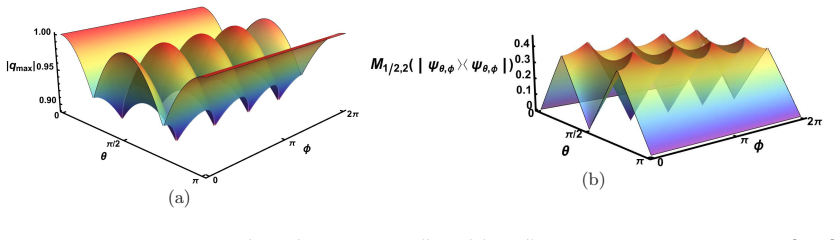
We propose two new magic quantifiers by introducing two versions of quantum (α,β) Jensen-Shannon divergence based on the quantum (α,β) entropy and the quantum (α,β)-relative entropy, respectively. We derive many desirable properties for our magic quantifiers, and find that they are efficiently computable in low-dimensional Hilbert spaces. We also show that the initial nonstabilizerness in the input state can boost the magic generating power for our magic quantifiers with appropriate parameter ranges for a certain class of quantum gates.
What carries the argument
Quantum (α,β) Jensen-Shannon divergence, which generalizes the standard Jensen-Shannon divergence using parameterized quantum entropy or relative entropy to measure distance from stabilizer states.
Load-bearing premise
The (α,β) divergences must qualify as valid magic monotones, satisfying faithfulness and monotonicity under free operations across all parameter values and dimensions.
What would settle it
An explicit example of a stabilizer state where a proposed quantifier gives a positive value, or a free operation that increases the value of the quantifier for some state, would falsify the proposal.
Figures


read the original abstract
Magic states play an important role in fault-tolerant quantum computation, and so the quantification of magic for quantum states is of great significance. In this work, we propose two new magic quantifiers by introducing two versions of quantum $(\alpha,\beta)$ Jensen-Shannon divergence based on the quantum $(\alpha,\beta)$ entropy and the quantum $(\alpha,\beta)$-relative entropy, respectively. We derive many desirable properties for our magic quantifiers, and find that they are efficiently computable in low-dimensional Hilbert spaces. We also show that the initial nonstabilizerness in the input state can boost the magic generating power for our magic quantifiers with appropriate parameter ranges for a certain class of quantum gates. Our magic quantifiers may provide new tools for addressing some specific problems in magic resource theory.
Editorial analysis
A structured set of objections, weighed in public.
Referee Report
Summary. The paper proposes two new quantifiers of magic (non-stabilizerness) for quantum states, defined via quantum (α,β) Jensen-Shannon divergences constructed from the quantum (α,β) entropy and the quantum (α,β)-relative entropy. It asserts that these measures satisfy many desirable properties of magic monotones (including faithfulness and monotonicity under free operations), are efficiently computable in low-dimensional Hilbert spaces, and can quantify how initial non-stabilizerness boosts magic generation under certain gates for appropriate parameter ranges.
Significance. If the claimed properties hold for suitable ranges of α and β, the tunable divergences would provide flexible, computable additions to the set of magic monotones, potentially aiding analysis of magic-state distillation and gate synthesis in fault-tolerant quantum computation. The low-dimensional computability is a practical strength.
major comments (3)
- [§3] §3 (Properties of the magic quantifiers): The monotonicity under stabilizer operations and other free operations is asserted for the full claimed domain of α,β without an explicit proof or derivation of the required data-processing or joint-convexity inequalities for the (α,β) entropies; these inequalities typically hold only for restricted parameter regimes (e.g., α,β ≥ 1 or α+β = 1), so the central claim that both quantifiers are valid magic monotones rests on unshown steps.
- [§4] §4 (Numerical examples and computability): While efficient computation is demonstrated for qubits and qutrits, no systematic counterexample search or faithfulness verification is reported for qudits or higher-dimensional cases; this is load-bearing because a single counterexample to monotonicity or faithfulness would invalidate the quantifiers as general magic measures.
- [Definitions] Definition of the (α,β)-JS divergences (Eqs. (10)–(12) or equivalent): The paper does not specify the precise domain restrictions on α,β needed for non-negativity, convexity, and monotonicity; without these, the claim of 'many desirable properties' for arbitrary parameters cannot be assessed.
minor comments (2)
- [§2] Notation for the two versions of the quantifier is introduced without a clear table or side-by-side comparison, making it hard to track which properties apply to each.
- [Abstract and §4] The abstract and introduction cite 'efficient computability in low-dimensional Hilbert spaces' but provide no runtime scaling or pseudocode; a brief complexity remark would improve clarity.
Simulated Author's Rebuttal
We thank the referee for the thorough review and valuable feedback on our manuscript. The comments correctly identify areas where the presentation of our results can be strengthened, particularly regarding the explicit justification of key properties and the scope of our claims. We will make major revisions to address these points by adding derivations, specifying parameter domains, and expanding numerical checks. Our responses to each major comment are provided below.
read point-by-point responses
-
Referee: [§3] §3 (Properties of the magic quantifiers): The monotonicity under stabilizer operations and other free operations is asserted for the full claimed domain of α,β without an explicit proof or derivation of the required data-processing or joint-convexity inequalities for the (α,β) entropies; these inequalities typically hold only for restricted parameter regimes (e.g., α,β ≥ 1 or α+β = 1), so the central claim that both quantifiers are valid magic monotones rests on unshown steps.
Authors: We acknowledge that the monotonicity under free operations requires explicit support from the data-processing inequality and joint convexity of the underlying (α,β) quantities. The original manuscript derived the magic quantifier properties assuming these hold in the regimes where the (α,β) divergences are known to be well-behaved, but did not include the step-by-step verification. We will revise §3 to include a dedicated derivation (or appendix) establishing monotonicity for the valid parameter ranges (such as α, β > 0 with α + β = 1, where the relevant inequalities are established in the literature on (α,β) entropies). We will also update all claims to apply only within these restricted domains, ensuring the quantifiers qualify as magic monotones. This constitutes a major revision. revision: yes
-
Referee: [§4] §4 (Numerical examples and computability): While efficient computation is demonstrated for qubits and qutrits, no systematic counterexample search or faithfulness verification is reported for qudits or higher-dimensional cases; this is load-bearing because a single counterexample to monotonicity or faithfulness would invalidate the quantifiers as general magic measures.
Authors: We agree that broader verification would increase confidence in the general applicability. The manuscript emphasizes efficient computability specifically in low-dimensional spaces (qubits and qutrits), where we explicitly computed the quantifiers and confirmed faithfulness and monotonicity for the tested states and operations. No exhaustive counterexample search was conducted for d > 3 due to computational cost. In the revision, we will expand §4 with additional numerical examples for qutrits and a 4-dimensional case to further check faithfulness, while adding a note on the practical limitations for higher dimensions. This addresses the concern through expanded verification but remains partial, as a fully exhaustive search across all dimensions is not feasible. revision: partial
-
Referee: [Definitions] Definition of the (α,β)-JS divergences (Eqs. (10)–(12) or equivalent): The paper does not specify the precise domain restrictions on α,β needed for non-negativity, convexity, and monotonicity; without these, the claim of 'many desirable properties' for arbitrary parameters cannot be assessed.
Authors: This observation is correct and we will correct the omission. The definitions section will be revised to explicitly state the domain of α and β (e.g., α > 0, β > 0, α + β = 1 for the Jensen-Shannon form to ensure non-negativity, convexity, and the data-processing inequality). We will also update the abstract, introduction, and property statements to qualify that the desirable properties, including those of the magic quantifiers, hold for appropriate parameter ranges, consistent with the phrasing already used for the magic-boosting examples. This clarification will be implemented in the revised manuscript. revision: yes
Circularity Check
No circularity: definitions are independent constructions from generalized entropies with derived properties.
full rationale
The paper constructs two magic quantifiers explicitly from the quantum (α,β) Jensen-Shannon divergence, which itself is defined in terms of the quantum (α,β) entropy and relative entropy (standard generalized quantities). No self-definitional reduction, fitted parameter renamed as prediction, or load-bearing self-citation chain appears in the provided abstract or claims. Properties such as faithfulness and monotonicity are stated as derived results rather than assumed by construction or imported via author-overlapping citations. The measures are presented as new tools for low-dimensional computation without any equation reducing the output to the input by definition. This is the common case of an honest proposal of a resource measure; any open questions about parameter ranges for monotonicity belong to correctness, not circularity.
Axiom & Free-Parameter Ledger
free parameters (1)
- α, β
axioms (1)
- standard math Quantum (α,β) entropy and relative entropy satisfy standard properties (positivity, monotonicity) from quantum information theory.
Reference graph
Works this paper leans on
-
[1]
Gottesman D 1997 Stabilizer Codes and Quantum Error Corr ection PhD Thesis California Institute of Technology
1997
-
[2]
Gottesman D 1998 The Heisenberg representation of quant um computers arXiv:quant-ph/9807006
work page internal anchor Pith review arXiv 1998
-
[3]
Gottesman D and Chuang I L 1999 Demonstrating the viabili ty of universal quantum computation using teleportation and single-qubit operati ons Nature 402 390
1999
-
[4]
Aaronson S and Gottesman D 2004 Improved simulation of st abilizer circuits Phys. Rev. A 70 052328
2004
-
[5]
Veitch V, Mousavian S H, Gottesman D and Emerson J 2014 The resource theory of stabilizer quantum computation New J. Phys. 16 013009
2014
-
[6]
Veitch V, Ferrie C, Gross D and Emerson J 2012 Negative qua si-probability as a resource for quantum computation New J. Phys. 14 113011
2012
-
[7]
Bravyi S and Haah J 2012 Magic-state distillation with lo w overhead Phys. Rev. A 86 052329 26
2012
-
[8]
Anwar H, Campbell E T and Browne D E 2012 Qutrit magic state distillation New J. Phys. 14 063006
2012
-
[9]
Campbell E T, Anwar H and Browne D E 2012 Magic-state disti llation in all prime dimensions using quantum Reed-Muller codes Phys. Rev. X 2 041021
2012
-
[10]
Meier A M, Eastin B, Knill E 2012 Magic state distillatio n with the four-qubit code Quantum Inf. Comput. 13 195
2012
-
[11]
Dawkins H and Howard M 2015 Qutrit magic state distillat ion tight in some direc- tions Phys. Rev. Lett. 115 030501
2015
-
[12]
Campbell E T and Howard M 2017 Unifying gate synthesis an d magic state distil- lation Phys. Rev. Lett. 118 060501
2017
-
[13]
Wang X, Wilde M M and Su Y 2020 Efficiently computable bound s for magic state distillation Phys. Rev. Lett. 124 090505
2020
-
[14]
Peres A 1996 Separability criterion for density matric es Phys. Rev. Lett. 77 1413
1996
-
[15]
Horodecki M, Horodecki P and Horodecki 1998 Mixed-stat e entanglement and dis- tillation: Is there a “bound” entanglement in nature? Phys. Rev. Lett. 80 5239
1998
-
[16]
Rains E M 2002 A semidefinite program for distillable ent anglement IEEE Trans. Inf. Theory 47 2921
2002
-
[17]
Wang X and Duan R 2016 Improved semidefinite programming upper bound on distillable entanglement Phys. Rev. A 94 050301
2016
-
[18]
Wang X and Duan R 2017 Nonadditivity of Rains’ bound for d istillable entanglement Phys. Rev. A 95 062322
2017
-
[19]
Fang K, Wang X, Tomamichel M and Duan R 2019 Non-asymptot ic entanglement distillation IEEE Trans. Inf. Theory 65 6454
2019
-
[20]
Howard M and Campbell E 2017 Application of a resource th eory for magic states to fault-tolerant quantum computing Phys. Rev. Lett. 118 090501
2017
-
[21]
Heinrich M and Gross D 2019 Robustness of magic and symme tries of the stabiliser polytope Quantum 3 132
2019
-
[22]
Liu Z and Winter A 2022 Many-body quantum magic PRX Quant um 3 020333
2022
-
[23]
Bravyi S, Smith G and Smolin J A 2016 Trading classical an d quantum computa- tional resources Phys. Rev. X 6 021043
2016
-
[24]
Heimendahl A, Montealegre-Mora F, Vallentin F and Gros s D 2021 Stabilizer extent is not multiplicative Quantum 5 400 27
2021
-
[25]
Leone L, Oliviero S F E and Hamma A 2022 Stabilizer R´ enyi entropies Phys. Rev. Lett. 128 050402
2022
-
[26]
Leone L and Lennart B 2024 Stabilizer entropies are mono tones for magic-state resource theory Phys. Rev. A 110 040403
2024
-
[27]
Feng L and Luo S 2022 From stabilizer states to SIC-POVM fi ducial states Theor. Math. Phys. 213 1474
2022
-
[28]
Dai H, Fu S and Luo S 2022 Detecting magic states via chara cteristic functions Inter. J. Theor. Phys. 61 35
2022
-
[29]
Wang X, Wilde M M and Su Y 2019 Quantifying the magic of qua ntum channels New J. Phys. 21 103002
2019
-
[30]
Saxena G and Gour G 2022 Quantifying multiqubit magic ch annels with completely stabilizer-preserving operations Phys. Rev. A 106 042422
2022
-
[31]
Seddon J R and Campbell E 2019 Quantifying magic for mult i-qubit operations Proc. R. Soc. A 475 20190251
2019
-
[32]
Li X and Luo S 2025 Quantifying magic resource for quantu m channels via channel- state duality Phys. Rev. A 111 052420
2025
-
[33]
Hu X and Ye Z 2006 Generalized quantum entropy J. Math. Ph ys. 47 023502
2006
-
[34]
Wang J, Wu J and Minhyung C 2011 Unified ( r,s )-relative entropy Int. J. Theor. Phys. 50 1282
2011
-
[35]
Mu H and Li Y 2020 Quantum uncertainty relations of two qu antum relative en- tropies of coherence Phys. Rev. A 102 022217
2020
-
[36]
Wu C and Wu Z 2025 Two imaginarity monotones induced by un ified (α,β )-relative entropy Commun. Theor. Phys. 77 095101
2025
-
[37]
Cheng B and Wu Z 2025 Uncertainty relations for unified ( α,β )-relative entropy of coherence under mutually unbiased equiangular tight frame s Int. J. Theor. Phys. 64 249
2025
-
[38]
Majtey A P, Lamberti P W and Prato D P 2005 Jensen-Shannon divergence as a measure of distinguishability between mixed quantum stat es Phys. Rev. A 72 052310
2005
-
[39]
Virosztek D 2021 The metric property of the quantum Jens en-Shannon divergence Adv. Math. 380 107595 28
2021
-
[40]
Tian P and Sun Y 2024 Quantifying magic resource via quan tum Jensen-Shannon divergence J. Phys. A: Math. Theor. 58 015303
2024
-
[41]
Tian P and Sun Y 2025 Generalized quantum Jensen-Shanno n divergence of imagi- narity Phys. Lett. A 544 130479
2025
- [42]
-
[43]
Li X and Luo S 2023 Optimal diagonal qutrit gates for crea ting Wigner negativity Phys. Lett. A 460 128620
2023
-
[44]
Li X and Luo S 2023 Optimality of T -gate for generating magic resource Commun. Theor. Phys. 75 045101
2023
-
[45]
Feng L and Luo S 2024 Optimality of the Howard-Vala T -gate in stabilizer quantum computation Phys. Scr. 99 115226
2024
-
[46]
Sra S 2021 Metrics induced by Jensen-Shannon and relate d divergences on positive definite matrices Linear Algebra Appl. 616 125
2021
-
[47]
Natl Acad
Schwinger J 1960 Unitary operator bases Proc. Natl Acad . Sci. USA 46 570
1960
-
[48]
Appleby D M 2005 Symmetric informationally complete-p ositive operator valued measures and the extended Clifford group J. Math. Phys. 46 052107
2005
-
[49]
Chitambar E and Gour G 2019 Quantum resource theories Re v. Mod. Phys. 91 025001
2019
-
[50]
Rastegin A E 2011 Some general properties of unified entr opies J. Stat. Phys. 143 1120-1135
2011
-
[51]
Bravyi S, Browne D, Calpin P, Campbell E, Gosset D and How ard M 2019 Simula- tion of quantum circuits by low-rank stabilizer decomposit ions Quantum 3 181
2019
-
[52]
Rathie P N 1991 Unified ( r,s )-entropy and its bivariate measures Inf. Sci. 54 23-39 29
1991
discussion (0)
Sign in with ORCID, Apple, or X to comment. Anyone can read and Pith papers without signing in.