Recognition: 2 theorem links
· Lean TheoremStrong-field ionization of atoms with bright squeezed vacuum light
Pith reviewed 2026-05-10 17:49 UTC · model grok-4.3
The pith
Bright squeezed vacuum light selectively enhances spider-like holographic structures in atomic photoelectron momentum distributions.
A machine-rendered reading of the paper's core claim, the machinery that carries it, and where it could break.
Core claim
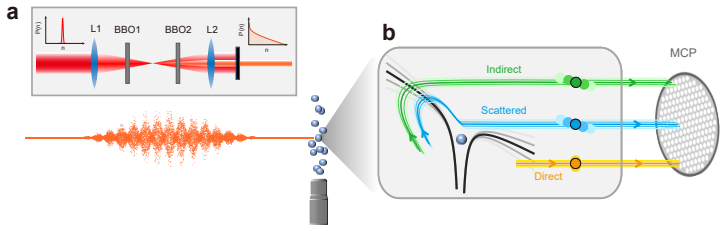
Strong-field ionization of xenon with bright squeezed vacuum light, which has zero mean field and strong intensity fluctuations, selectively enhances the spider-like holographic structures in the photoelectron momentum distributions. The quantum-light-corrected quantum-trajectory Monte Carlo model attributes this enhancement to the intrinsic coherence of trajectory pairs emitted within the same subcycle field fluctuation; these dynamically correlated paths exhibit enhanced phase stability and remain robust against dephasing, whereas asynchronous paths are filtered out by field noise.
What carries the argument
the intrinsic coherence of trajectory pairs emitted within the same subcycle field fluctuation of bright squeezed vacuum
If this is right
- Bright squeezed vacuum acts as a coherence filter that favors dynamically correlated electron paths.
- Asynchronous trajectory pairs are suppressed by field fluctuations while subcycle pairs survive.
- The mechanism reveals a quantum-fluctuation route to noise-resilient coherence in strong-field processes.
- This establishes a regime of quantum-enabled ultrafast dynamics that differs from coherent-state driving.
Where Pith is reading between the lines
- The coherence-filtering effect may appear in other strong-field processes such as high-harmonic generation when driven by the same light.
- Varying the squeezing parameter in future experiments could map the threshold at which subcycle coherence protection becomes dominant.
- Similar filtering might be tested in molecular or solid targets to check whether the protection generalizes beyond atomic xenon.
Load-bearing premise
The attribution of the observed enhancement to subcycle trajectory coherence assumes that the quantum-light-corrected trajectory model faithfully includes all relevant effects and that no other experimental factors produce the same selective boost.
What would settle it
An experiment or simulation that reproduces the spider-like structure enhancement even after removing the subcycle-correlation term from the model, or that produces the same pattern with ordinary coherent light of matched average intensity, would falsify the proposed mechanism.
Figures


read the original abstract
Strong-field ionization is the cornerstone of attosecond physics, which has been extensively studied under coherent-state driving. Recently, the interface between attosecond physics and quantum optics has emerged as a new frontier. Yet, owing to experimental limitations, the role of the quantum nature of light in atomic strong-field ionization has remained unexplored. Here, we demonstrate strong-field ionization of xenon atoms driven by bright squeezed vacuum (BSV) with average pulse energy up to 10 \textmu J. We show that, as a nonclassical state with zero mean field and strong intensity fluctuations, BSV selectively enhances the spider-like holographic structures in the photoelectron momentum distributions. Using a quantum-light-corrected quantum-trajectory Monte Carlo (q-QTMC) model, we attribute this effect to the intrinsic coherence of trajectory pairs emitted within the same subcycle field fluctuation. These dynamically correlated paths exhibit enhanced phase stability and remain robust against dephasing, whereas asynchronous paths are filtered out by field noise. Our results reveal a quantum-fluctuation-induced mechanism for coherence protection in strong-field processes, positioning BSV as an effective coherence filter and establishing a new regime of quantum-enabled noise-resilient ultrafast dynamics.
Editorial analysis
A structured set of objections, weighed in public.
Referee Report
Summary. The manuscript reports an experimental demonstration of strong-field ionization of xenon atoms driven by bright squeezed vacuum (BSV) light with average pulse energies up to 10 μJ. BSV, characterized by zero mean field and strong intensity fluctuations, is shown to selectively enhance spider-like holographic structures in the photoelectron momentum distributions relative to coherent-state driving. A quantum-light-corrected quantum-trajectory Monte Carlo (q-QTMC) model is introduced to attribute the enhancement to the intrinsic coherence of trajectory pairs emitted within the same subcycle field fluctuation; these paths exhibit enhanced phase stability while asynchronous paths are filtered by field noise. The work positions BSV as a coherence filter and proposes a quantum-fluctuation-induced mechanism for noise-resilient ultrafast dynamics.
Significance. If the attribution to nonclassical quantum-light effects holds after addressing controls, the result would establish a new interface between quantum optics and attosecond physics by demonstrating how intensity fluctuations in BSV can protect coherence in strong-field processes. The experimental realization with BSV and the development of the q-QTMC model represent clear strengths. The work supplies a falsifiable mechanistic claim linking specific PMD features to subcycle trajectory correlations, which is a positive feature.
major comments (1)
- [Theoretical modeling and q-QTMC description] The central claim that the selective enhancement requires the nonclassical properties of BSV (zero mean field plus quantum fluctuations) rests on the q-QTMC model. However, BSV has thermal-like photon statistics, so a classical ensemble of coherent states with randomly sampled intensities matching those statistics could produce equivalent filtering of asynchronous paths via fluctuation-induced dephasing. No indication is given that such a classical control simulation was performed to isolate the quantum contribution; this comparison is load-bearing for the mechanistic attribution.
minor comments (2)
- [Experimental methods] The abstract and main text should explicitly state the pulse duration, central wavelength, and repetition rate of the BSV source to allow quantitative comparison with prior coherent-state experiments.
- [Results and figures] Error bars, statistical significance, and the number of experimental shots or averaging procedure for the PMD comparisons are not mentioned in the provided summary; these should be added to support the reported enhancement.
Simulated Author's Rebuttal
We thank the referee for their careful reading of the manuscript and for highlighting the importance of isolating the quantum contribution in our theoretical modeling. We address this point directly below and commit to revisions that will strengthen the mechanistic attribution.
read point-by-point responses
-
Referee: The central claim that the selective enhancement requires the nonclassical properties of BSV (zero mean field plus quantum fluctuations) rests on the q-QTMC model. However, BSV has thermal-like photon statistics, so a classical ensemble of coherent states with randomly sampled intensities matching those statistics could produce equivalent filtering of asynchronous paths via fluctuation-induced dephasing. No indication is given that such a classical control simulation was performed to isolate the quantum contribution; this comparison is load-bearing for the mechanistic attribution.
Authors: We agree that this comparison is essential. While BSV exhibits thermal-like photon-number statistics, its quantum state is distinguished by a vanishing mean field and quadrature squeezing, which introduce nonclassical correlations absent in a classical mixture. The q-QTMC model treats the driving field via quantum operators, preserving phase stability specifically for trajectory pairs born within the same subcycle fluctuation of the squeezed vacuum; a classical ensemble with random phases per intensity sample would introduce additional dephasing not present in the quantum case. To make this distinction explicit, we will perform the suggested classical control simulation (ensemble of coherent states with matching intensity distribution) and include the results in the revised manuscript, either as a new panel or supplementary section. This will directly test whether the observed spider enhancement survives under purely classical fluctuations. revision: yes
Circularity Check
No significant circularity detected in the derivation chain.
full rationale
The paper reports experimental results on strong-field ionization driven by BSV and interprets the selective enhancement of spider-like structures via a q-QTMC model that attributes the effect to subcycle trajectory coherence. No equations, self-citations, or model-construction details are provided in the available text that would reduce the central attribution to a fitted parameter, a self-referential definition, or a load-bearing prior result by the same authors. The model is introduced as an interpretive tool rather than a quantity whose output is forced by construction to match the input data. The derivation therefore remains self-contained, with the experimental observation and the modeling step retaining independent content.
Axiom & Free-Parameter Ledger
Lean theorems connected to this paper
-
IndisputableMonolith/Cost/FunctionalEquation.leanwashburn_uniqueness_aczel unclear?
unclearRelation between the paper passage and the cited Recognition theorem.
Using a quantum-light-corrected quantum-trajectory Monte Carlo (q-QTMC) model, we attribute this effect to the intrinsic coherence of trajectory pairs emitted within the same subcycle field fluctuation.
-
IndisputableMonolith/Foundation/ArrowOfTime.leanarrow_from_z echoes?
echoesECHOES: this paper passage has the same mathematical shape or conceptual pattern as the Recognition theorem, but is not a direct formal dependency.
quantum-fluctuation-induced mechanism for coherence protection... BSV as an effective coherence filter
What do these tags mean?
- matches
- The paper's claim is directly supported by a theorem in the formal canon.
- supports
- The theorem supports part of the paper's argument, but the paper may add assumptions or extra steps.
- extends
- The paper goes beyond the formal theorem; the theorem is a base layer rather than the whole result.
- uses
- The paper appears to rely on the theorem as machinery.
- contradicts
- The paper's claim conflicts with a theorem or certificate in the canon.
- unclear
- Pith found a possible connection, but the passage is too broad, indirect, or ambiguous to say the theorem truly supports the claim.
Forward citations
Cited by 1 Pith paper
-
Attosecond Access to the Quantum Noise of Light
Attosecond streaking enables phase-sensitive access to quantum fluctuations in driving light fields, with the second central moment of photoelectron momentum showing modulation at twice the driving frequency for squee...
Reference graph
Works this paper leans on
-
[1]
Ionization in the field of a strong electromagnetic wave.Journal of Experimental and Theoretical Physics20, 1307–1314 (1965)
Keldysh, L. Ionization in the field of a strong electromagnetic wave.Journal of Experimental and Theoretical Physics20, 1307–1314 (1965)
1965
-
[2]
& Rahman, N
Agostini, P., Fabre, F., Mainfray, G., Petite, G. & Rahman, N. K. Free-free transitions following six-photon ionization of xenon atoms.Physical Review Letters42, 1127 (1979).230
1979
-
[3]
Ferray, M.et al.Multiple-harmonic conversion of 1064 nm radiation in rare gases.Journal of Physics B: Atomic, Molecular and Optical Physics21, L31–L35 (1988)
1988
-
[4]
Yu., L’Huillier, A
Lewenstein, M., Balcou, Ph., Ivanov, M. Yu., L’Huillier, A. & Corkum, P. B. Theory of high-harmonic generation by low-frequency laser fields.Physical Review A49, 2117–2132 (1994)
1994
-
[5]
Corkum, P. B. Plasma perspective on strong field multiphoton ionization.Physical Review Letters71, 1994–1997 (1993)
1994
-
[6]
Itatani, J.et al.Tomographic imaging of molecular orbitals.Nature432, 867–871 (2004)
2004
-
[7]
Huismans, Y.et al.Time-resolved holography with photoelectrons.Science331, 61–64 (2011). 9
2011
-
[8]
G., Persson, E
Arb´ o, D. G., Persson, E. & Burgd¨ orfer, J. Time double-slit interferences in strong-field240 tunneling ionization.Physical Review A74, 063407 (2006)
2006
-
[9]
Bian, X.-B.et al.Subcycle interference dynamics of time-resolved photoelectron holography with midinfrared laser pulses.Physical Review A84, 043420 (2011)
2011
-
[10]
& Bandrauk, A
Bian, X.-B. & Bandrauk, A. D. Attosecond time-resolved imaging of molecular structure by photoelectron holography.Physical Review Letters108, 263003 (2012)
2012
-
[11]
Physical Review A89, 033425 (2014)
Li, M.et al.Recollision-induced subcycle interference of molecules in strong laser fields. Physical Review A89, 033425 (2014)
2014
-
[12]
Spanner, M., Smirnova, O., Corkum, P. B. & Ivanov, M. Y. Reading diffraction images in strong field ionization of diatomic molecules.Journal of Physics B: Atomic, Molecular and Optical Physics37, L243–L250 (2004).250
2004
-
[13]
Meckel, M.et al.Signatures of the continuum electron phase in molecular strong-field photoelectron holography.Nature Physics10, 594–600 (2014)
2014
-
[14]
Porat, G.et al.Attosecond time-resolved photoelectron holography.Nature Communications 9, 2805 (2018)
2018
-
[15]
D.et al.Direct visualization of laser-driven electron multiple scattering and tunneling distance in strong-field ionization.Physical Review Letters109, 073004 (2012)
Hickstein, D. D.et al.Direct visualization of laser-driven electron multiple scattering and tunneling distance in strong-field ionization.Physical Review Letters109, 073004 (2012)
2012
-
[16]
Khurelbaatar, T.et al.Strong-field photoelectron holography in the subcycle limit.Light: Science & Applications13, 108 (2024)
2024
-
[17]
Walker, B.et al.Precision measurement of strong field double ionization of helium.Physical Review Letters73, 1227 (1994).260
1994
-
[18]
Science292, 902–905 (2001)
Sali` eres, P.et al.Feynman’s path-integral approach for intense-laser-atom interactions. Science292, 902–905 (2001)
2001
-
[19]
& Kaminer, I
Gorlach, A., Neufeld, O., Rivera, N., Cohen, O. & Kaminer, I. The quantum-optical nature of high harmonic generation.Nature Communications11, 4598 (2020)
2020
-
[20]
Rivera-Dean, J.et al.Light-matter entanglement after above-threshold ionization processes in atoms.Physical Review A106, 063705 (2022)
2022
-
[21]
Bhattacharya, U.et al.Strong–laser–field physics, non–classical light states and quantum information science.Reports on Progress in Physics86, 094401 (2023)
2023
-
[22]
Even Tzur, M.et al.Photon-statistics force in ultrafast electron dynamics.Nature Photonics 17, 501–509 (2023).270
2023
-
[23]
Gorlach, A.et al.High-harmonic generation driven by quantum light.Nature Physics19, 1689–1696 (2023)
2023
-
[24]
S., Hansen, T
Lange, C. S., Hansen, T. & Madsen, L. B. Electron-correlation-induced nonclassicality of light from high-order harmonic generation.Physical Review A109, 033110 (2024). 10
2024
-
[25]
Rivera-Dean, J.et al.Squeezed states of light after high-order harmonic generation in excited atomic systems.Physical Review A110, 063118 (2024)
2024
-
[26]
Absence of quantum optical coherence in high harmonic generation.Physical Review Research6, L032033 (2024)
Stammer, P. Absence of quantum optical coherence in high harmonic generation.Physical Review Research6, L032033 (2024)
2024
-
[27]
Scully, M. O. & Zubairy, M. S.Quantum Optics(Cambridge University Press, 1997)
1997
-
[28]
S.Quantum Optics in Phase Space(Wiley, 2001).280
Wolfgang, P. S.Quantum Optics in Phase Space(Wiley, 2001).280
2001
-
[29]
Photon bunching in high-harmonic emission controlled by quantum light.Nature Photonics19, 150 (2025)
Lemieux, S. Photon bunching in high-harmonic emission controlled by quantum light.Nature Photonics19, 150 (2025)
2025
-
[30]
E.et al.Attosecond-resolved quantum fluctuations of light and matter
Tzur, M. E.et al.Attosecond-resolved quantum fluctuations of light and matter. Preprent at https://arxiv.org/abs/2511.18362 (2025)
-
[31]
& Liu, Y
Lyu, Z., Sun, F., Fang, Y., He, Q. & Liu, Y. Effect of photon quantum statistics on electrons in above-threshold ionization.Physical Review Research7, L012072 (2025)
2025
-
[32]
Heimerl, J.et al.Multiphoton electron emission with non-classical light.Nature Physics20, 945–950 (2024)
2024
-
[33]
Heimerl, J.et al.Quantum light drives electrons strongly at metal needle tips.Nature Physics 21, 1899–1904 (2025).290
1904
-
[34]
Iskhakov, T., P´ erez, A
Sh. Iskhakov, T., P´ erez, A. M., Yu. Spasibko, K., Chekhova, M. V. & Leuchs, G. Superbunched bright squeezed vacuum state.Optics Letters37, 1919 (2012)
1919
-
[35]
M.et al.Bright squeezed-vacuum source with 1.1 spatial mode.Optics Letters39, 2403 (2014)
P´ erez, A. M.et al.Bright squeezed-vacuum source with 1.1 spatial mode.Optics Letters39, 2403 (2014)
2014
-
[36]
Reports on Progress in Physics66, 1463–1545 (2003)
Ullrich, J.et al.Recoil-ion and electron momentum spectroscopy: Reaction-microscopes. Reports on Progress in Physics66, 1463–1545 (2003)
2003
-
[37]
D¨ orner, R.et al.Cold target recoil ion momentum spectroscopy: A ‘momentum microscope’ to view atomic collision dynamics.Physics Reports330, 95–192 (2000)
2000
-
[38]
& Liu, Y
Fang, Y., Sun, F.-X., He, Q. & Liu, Y. Strong-field ionization of hydrogen atoms with quantum light.Physical Review Letters130, 253201 (2023).300
2023
-
[39]
Li, M.et al.Classical-quantum correspondence for above-threshold ionization.Physical Review Letters112, 113002 (2014)
2014
-
[40]
A.et al.Interference carpets in above-threshold ionization: From the coulomb- free to the coulomb-dominated regime.Physical Review Letters108, 223601 (2012)
Korneev, Ph. A.et al.Interference carpets in above-threshold ionization: From the coulomb- free to the coulomb-dominated regime.Physical Review Letters108, 223601 (2012)
2012
-
[41]
M¨ oller, M.et al.Off-axis low-energy structures in above-threshold ionization.Physical Review A90, 023412 (2014)
2014
-
[42]
& Cohen, O
Even Tzur, M. & Cohen, O. Motion of charged particles in bright squeezed vacuum.Light: Science & Applications13, 41 (2024). 11
2024
-
[43]
Drescher, M.et al.Time-resolved atomic inner-shell spectroscopy.Nature419, 803–807 (2002).310
2002
-
[44]
& Liu, Y
Long, X., Li, P. & Liu, Y. Hydrogen molecular dissociation driven by quantum light.Physical Review Letters135, 153201 (2025)
2025
-
[45]
Barakat, I.et al.Simultaneous measurement of multimode squeezing through multimode phase-sensitive amplification.Optica Quantum3, 36 (2025)
2025
-
[46]
& Bondani, M
Allevi, A. & Bondani, M. Statistics of twin-beam states by photon-number resolving detectors up to pump depletion.Journal of the Optical Society of America B31, B14 (2014)
2014
-
[47]
V., Delone, N
Ammosov, M. V., Delone, N. B. & Krainov, V. P. Tunnel ionization of complex atoms and atomic ions in electromagnetic field.SPIE64, 1191 (1986)
1986
-
[48]
Delone, N. B. & Krainov, V. P. Energy and angular electron spectra for the tunnel ionization of atoms by strong low-frequency radiation.Journal of the Optical Society of America B8,320 1207 (1991). Methods Experimental methods BSV generation and Characterization Spectrometer-1 Spectrometer-2 Collimated BSV Delay Stage COLTRIMS P FM PBS1 PBS2 BBO Extended ...
1991
discussion (0)
Sign in with ORCID, Apple, or X to comment. Anyone can read and Pith papers without signing in.