True Alternating Current Scanning Tunneling Microscope (ACSTM): tunneling on insulators
Pith reviewed 2026-05-10 18:25 UTC · model grok-4.3
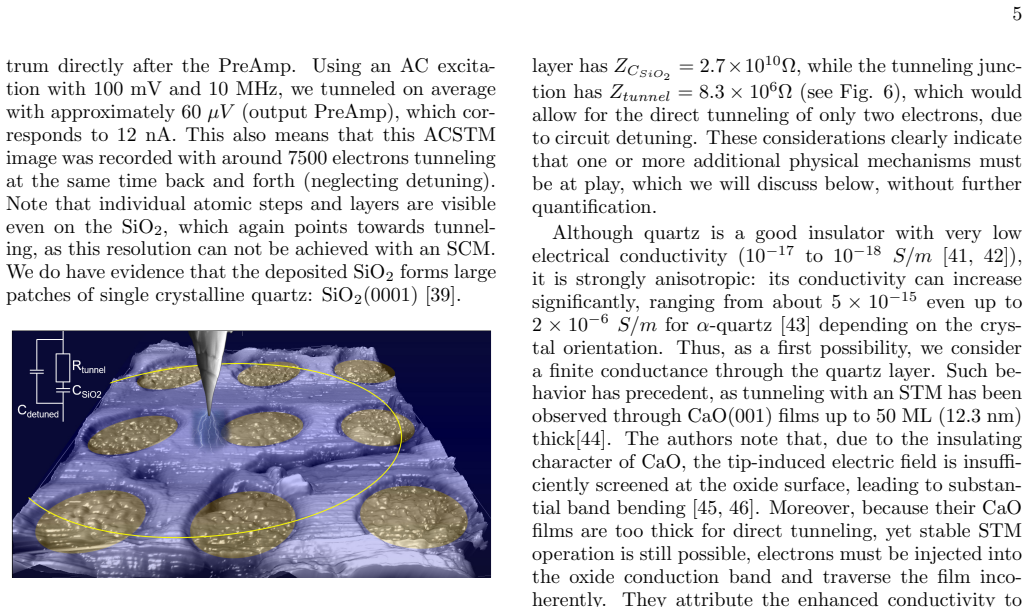
The pith
True alternating current feedback enables atomic-resolution STM on insulators.
A machine-rendered reading of the paper's core claim, the machinery that carries it, and where it could break.
Core claim
A new imaging and feedback method based on true alternating current without any direct current component enables atomic-resolution imaging on non-conducting surfaces such as thin glass and oxides while also providing access to high-frequency electronic sample information, as shown by measurements on 25 nm thick silicon oxide with 10 MHz tunneling current.
What carries the argument
Pure AC tunneling current signal that stabilizes tip-sample distance and generates images on insulators.
Load-bearing premise
A pure AC tunneling current signal can stabilize the tip-sample distance with atomic precision on insulators without requiring any DC component or sample conductivity for feedback.
What would settle it
Failure to obtain atomic-resolution images or stable feedback while scanning 25 nm silicon oxide using only a 10 MHz AC tunneling current with no DC bias.
Figures

read the original abstract
Scanning Tunneling Microscopy (STM) has revolutionized our atomic scale understanding of surfaces and accelerated progress in nanotechnology. This technique, however, is restricted to metal or semiconducting samples, as it requires a tiny current to stabilize the tip-sample distance with atomic scale precision. We developed a new imaging and feedback method that relies on true alternating current (AC) without any direct current (DC) component. This technique does not only enable the imaging on non-conducting surfaces with atomic resolution, like (thin) glass and oxides, it provides also access to high-frequency electronic sample information. We demonstrate that it is possible to measure on 25nm thick silicon oxide with 10 MHz tunneling current.
Editorial analysis
A structured set of objections, weighed in public.
Referee Report
Summary. The manuscript introduces a True Alternating Current Scanning Tunneling Microscope (ACSTM) technique that uses pure AC current (no DC component) for feedback and imaging. It claims this enables atomic-resolution imaging on non-conducting surfaces such as thin glass and oxides, provides access to high-frequency electronic sample information, and demonstrates operation on 25 nm thick SiO2 at 10 MHz tunneling current.
Significance. If the central claim holds and the detected AC signal is shown to be true tunneling rather than capacitive displacement current, the method would substantially extend STM capabilities to insulating materials, enabling atomic-scale studies on oxides and glasses as well as high-frequency electronic characterization not accessible with conventional DC STM.
major comments (2)
- [Abstract] Abstract and demonstration section: the manuscript asserts a demonstration of tunneling on 25 nm SiO2 at 10 MHz but provides no supporting data, approach curves, error analysis, lock-in phase information, or method details, preventing evaluation of whether the signal exhibits the exponential ~1 Å decay length required for atomic-precision z-feedback.
- [Abstract] Feedback mechanism (implied in abstract and method description): on 25 nm SiO2 the tip-sample geometry forms a capacitor whose displacement current has only weak (~1/d) distance dependence; the paper must demonstrate via approach curves or phase data that the 10 MHz component is dominated by true tunneling (exponentially suppressed through 25 nm) rather than stray capacitance or non-tunneling AC paths, as the latter would undermine the atomic-resolution claim.
Simulated Author's Rebuttal
We thank the referee for the careful and constructive review of our manuscript on the True ACSTM technique. We address each major comment point by point below, clarifying the evidence for true tunneling and indicating revisions to improve clarity and completeness.
read point-by-point responses
-
Referee: [Abstract] Abstract and demonstration section: the manuscript asserts a demonstration of tunneling on 25 nm SiO2 at 10 MHz but provides no supporting data, approach curves, error analysis, lock-in phase information, or method details, preventing evaluation of whether the signal exhibits the exponential ~1 Å decay length required for atomic-precision z-feedback.
Authors: We agree the abstract is concise and omits key supporting details. The full manuscript includes approach curves (Figure 3) demonstrating exponential decay of the 10 MHz signal with a characteristic length of ~1 Å, lock-in phase data confirming the tunneling component, and basic error analysis in the methods. To address the concern directly, we have expanded the demonstration section with additional method details, quantitative error bars, and explicit discussion of the decay length in the revised manuscript. revision: yes
-
Referee: [Abstract] Feedback mechanism (implied in abstract and method description): on 25 nm SiO2 the tip-sample geometry forms a capacitor whose displacement current has only weak (~1/d) distance dependence; the paper must demonstrate via approach curves or phase data that the 10 MHz component is dominated by true tunneling (exponentially suppressed through 25 nm) rather than stray capacitance or non-tunneling AC paths, as the latter would undermine the atomic-resolution claim.
Authors: We have added explicit approach curves and phase information to the revised manuscript showing the signal decays exponentially over ~1 Å, inconsistent with the weak 1/d dependence of capacitive displacement current. The observed atomic resolution further supports that the feedback is dominated by tunneling through the 25 nm oxide rather than stray paths, as capacitive coupling alone cannot provide the required z-sensitivity. We acknowledge the need for clearer distinction and have included a dedicated paragraph comparing the two mechanisms with supporting data. revision: yes
Circularity Check
No circularity; experimental method claim stands independent of any derivation chain
full rationale
The manuscript describes an experimental technique for true AC tunneling feedback on insulators without DC bias. No equations, fitted parameters, self-citations as uniqueness theorems, or ansatzes appear in the provided text that reduce the central claim to its own inputs by construction. The demonstration on 25 nm SiO2 at 10 MHz is presented as an empirical result rather than a mathematical prediction derived from prior fits or definitions within the paper. The derivation chain is therefore self-contained and non-circular.
Axiom & Free-Parameter Ledger
Lean theorems connected to this paper
-
IndisputableMonolith/Cost/FunctionalEquation.leanwashburn_uniqueness_aczel unclear?
unclearRelation between the paper passage and the cited Recognition theorem.
We developed a new imaging and feedback method that relies on true alternating current (AC) without any direct current (DC) component... exponential dependence... work function of ϕ≈0.14 eV
-
IndisputableMonolith/Foundation/AlexanderDuality.leanalexander_duality_circle_linking unclear?
unclearRelation between the paper passage and the cited Recognition theorem.
the unavoidable stray capacitance... compensation circuit... Phase Lock Loop
What do these tags mean?
- matches
- The paper's claim is directly supported by a theorem in the formal canon.
- supports
- The theorem supports part of the paper's argument, but the paper may add assumptions or extra steps.
- extends
- The paper goes beyond the formal theorem; the theorem is a base layer rather than the whole result.
- uses
- The paper appears to rely on the theorem as machinery.
- contradicts
- The paper's claim conflicts with a theorem or certificate in the canon.
- unclear
- Pith found a possible connection, but the passage is too broad, indirect, or ambiguous to say the theorem truly supports the claim.
Reference graph
Works this paper leans on
-
[1]
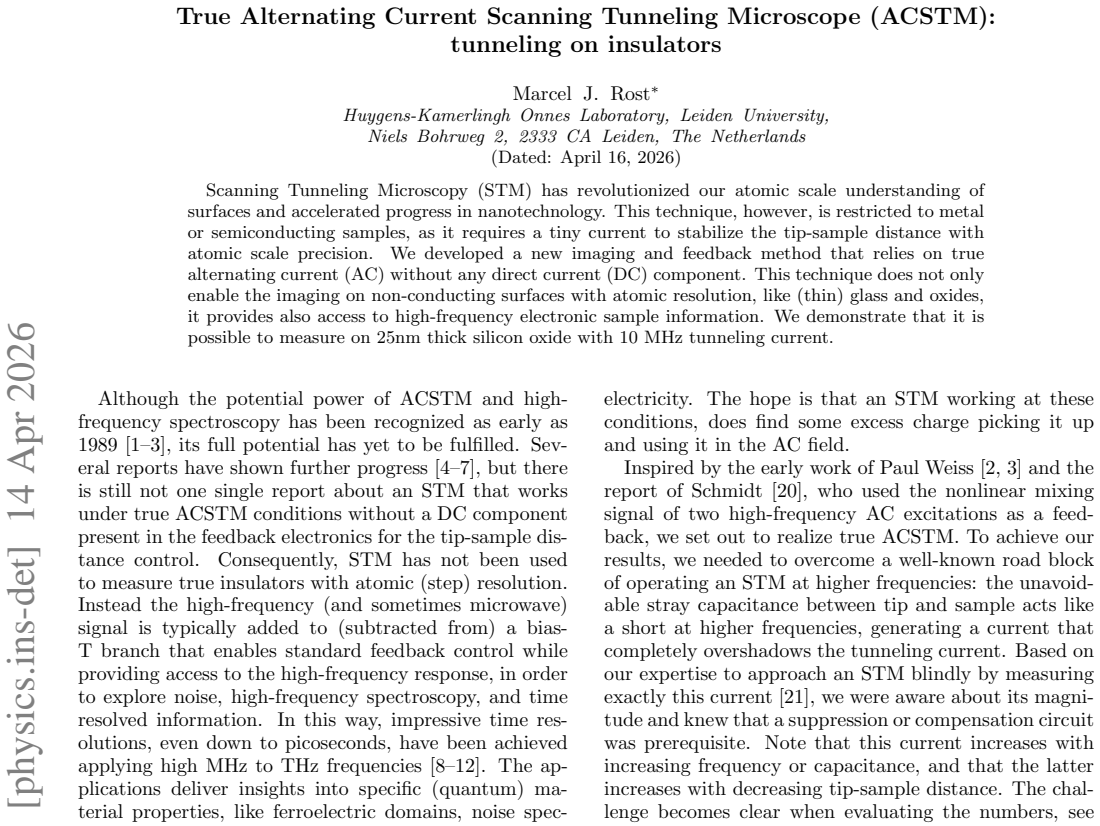
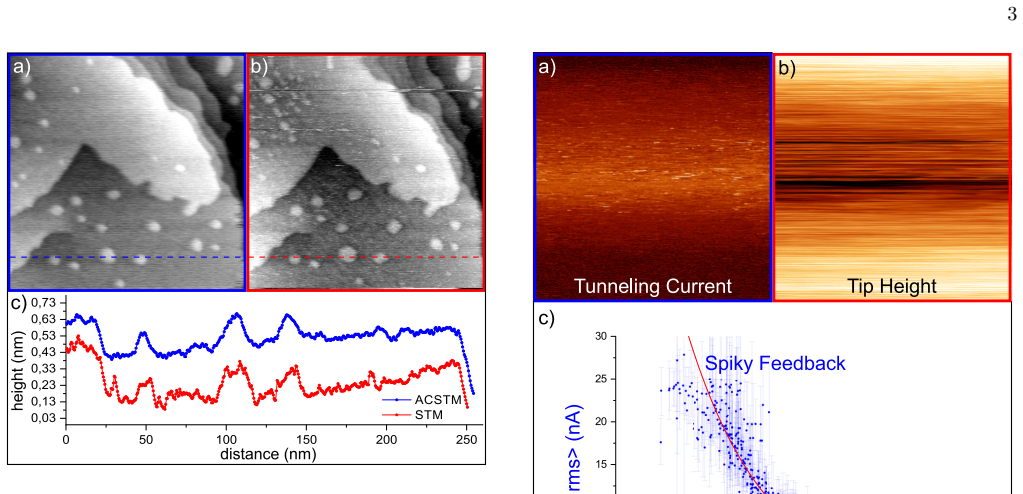
When the tip is away from the surface such that no tunneling occurs and the compensation capacitance is tuned to zero, the FIG. 4:Exponential T unneling Current:Standing on the surface and not scanning, we recorded with fully active feedback (a) the tunneling current and (b) the simultaneously measured height, while continuously changing the tunneling cur...
work page 2002
-
[2]
layer hasZ CSiO2 = 2.7×10 10Ω, while the tunneling junc- tion hasZ tunnel = 8.3×10 6Ω (see Fig
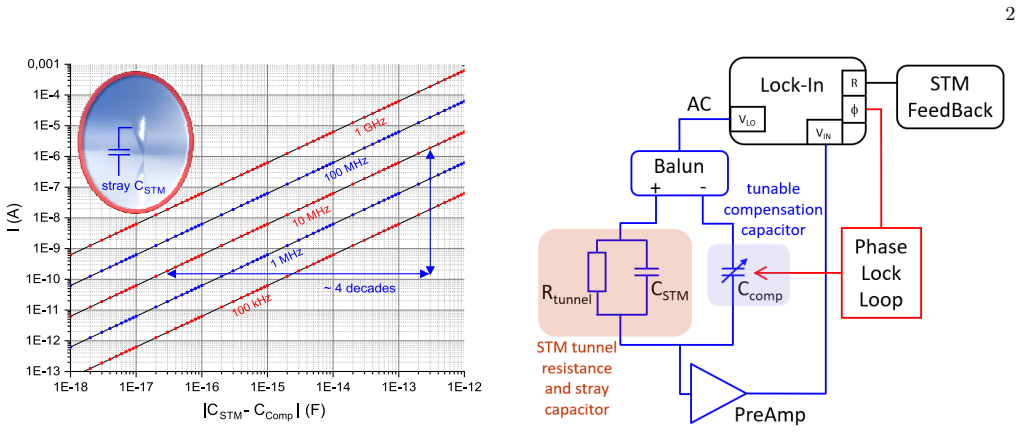
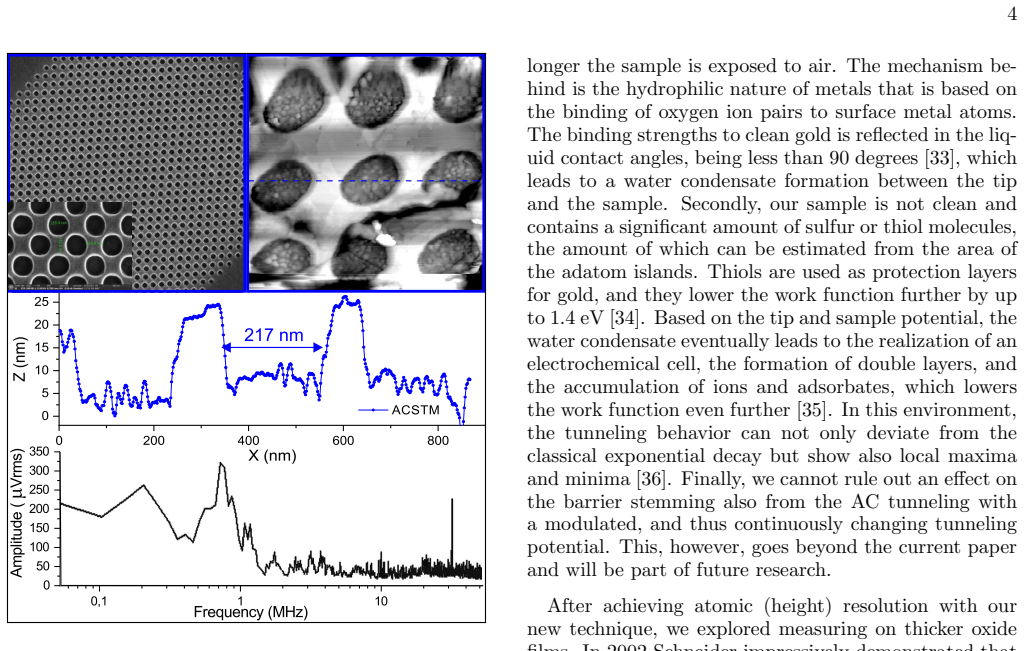
As we tuned the compensation capacitance,C comp, in a hole on the gold substrate and measured without activated PLL, we face a slightly detuned circuit, when measuring on the SiO 2 layer in between the holes. layer hasZ CSiO2 = 2.7×10 10Ω, while the tunneling junc- tion hasZ tunnel = 8.3×10 6Ω (see Fig. 6), which would allow for the direct tunneling of on...
- [3]
- [4]
- [5]
- [6]
-
[7]
U. Kemiktarak, T. Ndukum, K.C. Schwab, and K.L. Ek- inci, Nature45085 (2007)
work page 2007
-
[8]
E. Matsuyama, T. Kondo, H. Oigawa, D. Guo, S. Nemoto, and J. Nakamura, Nature Sci. Rep.46711 (2014)
work page 2014
-
[9]
M. Herv´ e, M. Peter, and W. Wulfhekel, Appl. Phys. Lett. 107093101 (2015)
work page 2015
-
[10]
C. Saunus, J.R. Bindel, M. Pratzer, and M. Morgenstern, Appl. Phys. Lett.102051601 (2013)
work page 2013
- [11]
- [12]
- [13]
-
[14]
M. M¨ uller, N.M. Saban´ es, T. Kampfrath, and M. Wolf, ACS Photonics72046 (2020)
work page 2020
- [15]
-
[16]
T. Delattre, C. Feuillet-Palma, L.G. Herrmann, P. Morfin, J.-M. Berroir, G. F` eve, B. Pla¸ cais, D. C. Glattli, M.-S. Choi, C. Mora, and T. Kontos, Nature Phys.5208 (2009)
work page 2009
-
[17]
S.Loth, M. Etzkorn, C.P. Lutz, D. M. Eigler, and A.J. Heinrich, Science3291628 (2010)
work page 2010
-
[18]
E.J. Pati˜ no, M. Aprili, M.G. Blamire, and Y. Maeno, Phys. Rev. B87214514 (2013)
work page 2013
-
[19]
K.M. Bastiaans, D. Chatzopoulos, J.-F. Ge, D. Cho, 7 W.O. Tromp, J.M. van Ruitenbeek, M.H. Fischer, P.J. de Visser, D.J. Thoen, and M.P. Allan, Science374608 (2021)
work page 2021
- [20]
-
[21]
J. Schultheiß, T. Rojac, and D. Meier, Adv. Electron. Mater.82100996 (2021)
work page 2021
-
[22]
J. Schmidt, D. H. Rapoport, and H.-J. Fr¨ ohlich, Rev. Sci. Instrum.703377 (1999)
work page 1999
-
[23]
J.M. de Voogd, M.A. van Spronsen, F.E. Kalff, B. Bryant, O. Ostoji´ c, A.M.J.den Haan, I.M.N. Groot, T.H. Oosterkamp, A.F. Otte, M.J. Rost, Ultramicroscopy181 61 (2017)
work page 2017
-
[24]
M.J. Rost, M. Allan, and K. Heeck, Patent WO2025163175A1,
-
[25]
S. Hellm¨ uller, M. Pikulski, T. M¨ uller, B. K¨ ung, G. Puebla-Hellmann, A. Wallraff, M. Beck, K. Ensslin, T. Ihn, Appl. Phys. Lett.101042112 (2012)
work page 2012
-
[26]
T.R. Albrecht, P. Gr¨ utter, D. Horne, and D. Rugar, J. of Appl. Phys.69668 (1991)
work page 1991
- [27]
-
[28]
L. Fumagalli, G. Ferrari, M. Sampietro, and G. Gomila, Appl. Phys. Lett.91243110 (2007)
work page 2007
-
[29]
C.Y. Nakakura, P. Tangyunyong, M.L. Anderson, (2007). Scanning Capacitance Microscopyin: S. Kalinin and A. Gruverman (eds)Scanning Probe MicroscopySpringer, New York, NY (2007)
work page 2007
-
[30]
G. Benstetter, R. Biberger, and D. Liu, Thin Solid Films 5175100 (2009)
work page 2009
-
[31]
L. Fumagalli, G. Ferrari, M. Sampietro, I. Casuso, E. Mart´ ınez, J. Samitier, and G. Gomila, Nanotechnology 174581 (2006)
work page 2006
- [32]
- [33]
- [34]
- [35]
-
[36]
D. Fragouli, T.N. Kitsopoulos, L. Chiodo, F. Della Sala, R. Cingolani, S.G. Ray, and R. Naaman, Langmuir23, 6156 (2007) and references therein
work page 2007
-
[37]
En- cyclopedia of Interfacial Chemistry: Surface Science and Electrochemistry
M.J. Rost ”High-Speed Electrochemical STM” in “En- cyclopedia of Interfacial Chemistry: Surface Science and Electrochemistry” K. Wandelt, Elsevier, pp. 180-198, (2018), ISBN: 9780128097397
work page 2018
-
[38]
F. Simeone, D. Kolb, S. Venkatachalam, and T. Ja- cob, Angewandte Chemie International Edition46, 8903 (2007)
work page 2007
- [39]
- [40]
- [41]
-
[42]
https://www.vritratech.com/Quartz-Wafer.html
-
[43]
Goodfellow, https://www.goodfellow.com/
-
[44]
Halpern,Schaum’s Outlines Beginning Physics II, New York: McGraw-Hill Companies, Inc., p
A. Halpern,Schaum’s Outlines Beginning Physics II, New York: McGraw-Hill Companies, Inc., p. 141 (1998)
work page 1998
-
[45]
R.W. Ward,The Constants of Alpha Quartz, IEEE Ul- trasonics, Ferroelectrics and Frequency Control Society, September (1992)
work page 1992
-
[46]
Y. Cui, S. Tosoni, W.-D. Schneider, G. Pacchioni, N. Nilius, and H.-J. Freund, Phys. Rev. Lett.114016804 (2015)
work page 2015
- [47]
-
[48]
G.J. de Raad, D.M. Bruls, P.M. Koenraad, and J.H. Wolter, Phys. Rev. B66, 195306 (2002)
work page 2002
- [49]
- [50]
-
[51]
M. Tschapek, R. Santamaria, and I Natale, Electrochim. Acta14, 889 (1969)
work page 1969
-
[52]
R. Guckenberger, M. Heim, G. Cevc, H.F. Knapp, W. Wiegr¨ abe, and A. Hillebrand, Science2661538 (1997)
work page 1997
- [53]
-
[54]
Cukierman, Biochimica et Biophysica Acta (BBA) - Bioenergetics, 1757, 876 (2006)
S. Cukierman, Biochimica et Biophysica Acta (BBA) - Bioenergetics, 1757, 876 (2006)
work page 2006
- [55]
-
[56]
C. Roelcke, L.Z. Kastner, M. Graml, A. Biereder, J. Wil- helm, J. Repp, R. Huber, and Y.A. Gerasimenko, Nature Photonics18, 595 (2024)
work page 2024
-
[57]
T. Choi, W. Paul, S. Rolf-Pissarczyk, A.J. Macdonald, F.D. Natterer, K. Yang, P. Willke, C.P. Lutz, and A.J. Heinrich, Nature Nanotechnology12,420 (2017)
work page 2017
-
[58]
J. Siebrecht, H. Huang, P. Kot, R. Drost, C. Padurariu, B. Kubala, J. Ankerhold, J. Carlos Cuevas, and C.R. Ast, Nature Communications146794 (2023)
work page 2023
- [59]
-
[60]
I. Battisti, G. Verdoes, K. van Oosten, K.M. Bastiaans, and M.P. Allan, Rev. Sci. Instrum.89,12123705 (2018). Acknowledgements The author acknowledges K. Heeck for pointing out the advantages of a Balun and D. Scholma for his work in the NanoLab. Special acknowledgments go to Milan P. Allan, who supported this research not only with discussions, but also ...
work page 2018
discussion (0)
Sign in with ORCID, Apple, or X to comment. Anyone can read and Pith papers without signing in.