Recognition: 2 theorem links
· Lean TheoremBusemann energy-based attention for emotion analysis in Poincar\'e discs
Pith reviewed 2026-05-10 17:52 UTC · model grok-4.3
The pith
EmBolic places emotion analysis in the Poincaré disc and scores alignments with Busemann energy to capture semantic hierarchies.
A machine-rendered reading of the paper's core claim, the machinery that carries it, and where it could break.
Core claim
EmBolic is a novel fully hyperbolic deep learning architecture for fine-grained emotion analysis from textual messages. The underlying idea is that hyperbolic geometry efficiently captures hierarchies between both words and emotions that arise from semantic ambiguities. EmBolic aims to infer the curvature on the continuous space of emotions rather than treating them as a categorical set without any metric structure. The model generates queries from text and lets keys emerge automatically at the boundary of the disc; predictions rest on the Busemann energy between those queries and keys, measuring alignment with class directions.
What carries the argument
The Busemann energy attention mechanism inside the Poincaré disc, in which text-derived query points are scored against automatically generated boundary keys that represent emotion classes.
If this is right
- Affective computing tasks benefit from hyperbolic representations that preserve hierarchy induced by ambiguity.
- The architecture can infer a metric curvature on the space of emotions instead of using flat categorical labels.
- Prediction accuracy stays reasonable even when the representation dimension is reduced.
- Strong generalization is observed across different textual emotion datasets.
Where Pith is reading between the lines
- The same query-to-boundary alignment could be tested on other NLP problems that involve graded or overlapping categories, such as multi-label intent detection.
- Because performance holds in low dimensions, the approach may reduce memory and compute costs for real-time emotion monitoring on edge devices.
- The automatic emergence of class keys suggests the model discovers emotion prototypes directly from data rather than requiring hand-specified directions.
Load-bearing premise
Hyperbolic geometry is especially good at representing the hierarchical relations among words and emotions that come from semantic ambiguities, and the Busemann energy supplies a sufficient score for deciding which emotion a message expresses.
What would settle it
An otherwise identical Euclidean attention model trained on the same emotion datasets achieves equal or higher accuracy and generalization across the same range of embedding dimensions.
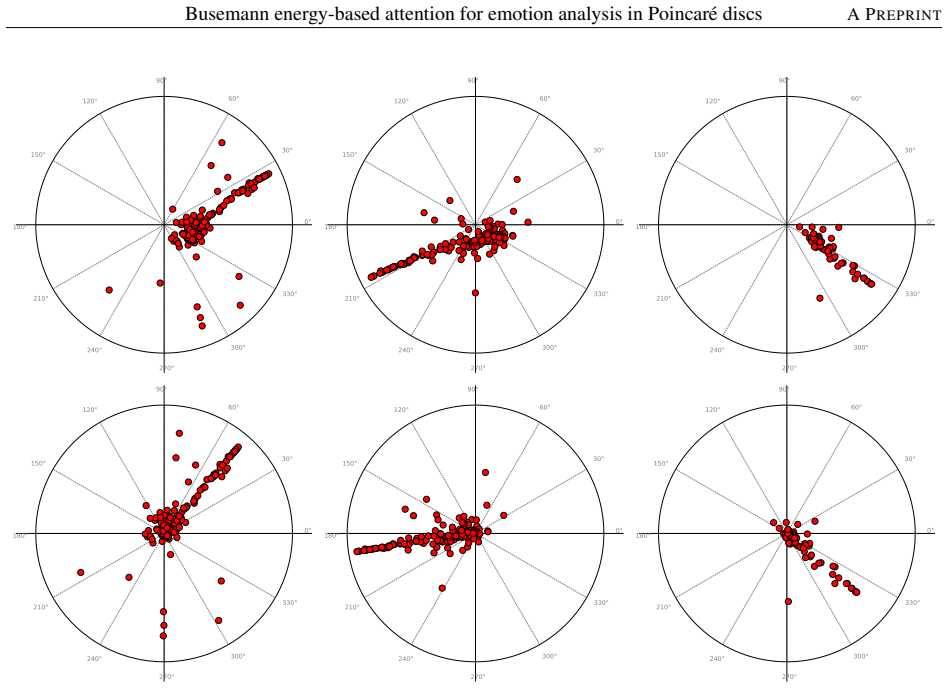
Figures




read the original abstract
We present EmBolic - a novel fully hyperbolic deep learning architecture for fine-grained emotion analysis from textual messages. The underlying idea is that hyperbolic geometry efficiently captures hierarchies between both words and emotions. In our context, these hierarchical relationships arise from semantic ambiguities. EmBolic aims to infer the curvature on the continuous space of emotions, rather than treating them as a categorical set without any metric structure. In the heart of our architecture is the attention mechanism in the hyperbolic disc. The model is trained to generate queries (points in the hyperbolic disc) from textual messages, while keys (points at the boundary) emerge automatically from the generated queries. Predictions are based on the Busemann energy between queries and keys, evaluating how well a certain textual message aligns with the class directions representing emotions. Our experiments demonstrate strong generalization properties and reasonably good prediction accuracy even for small dimensions of the representation space. Overall, this study supports our claim that affective computing is one of the application domains where hyperbolic representations are particularly advantageous.
Editorial analysis
A structured set of objections, weighed in public.
Referee Report
Summary. The paper introduces EmBolic, a novel fully hyperbolic deep learning architecture for fine-grained emotion analysis from textual messages using Poincaré discs. The model generates queries from text and derives boundary keys automatically, basing predictions on the Busemann energy between queries and keys to align with emotion class directions. It claims that hyperbolic geometry captures hierarchies arising from semantic ambiguities and demonstrates strong generalization and good prediction accuracy even in small representation dimensions.
Significance. If the experimental results hold, this work would provide evidence that hyperbolic representations are particularly advantageous for affective computing tasks, enabling effective modeling of hierarchical semantic structures with low-dimensional embeddings and potentially improving generalization in emotion classification.
major comments (2)
- [Abstract] Abstract: The abstract asserts experimental results including 'strong generalization properties' and 'reasonably good prediction accuracy' but provides no details on the datasets used, baseline models, training procedures, quantitative metrics, error bars, or statistical tests. This makes it impossible to determine whether the performance follows from the Busemann energy-based attention or from other design choices, which is central to validating the main claim.
- [Architecture description] Architecture description: The statement that keys 'emerge automatically from the generated queries' risks circularity, as the alignment score via Busemann energy may depend on the same learned mapping that produces the queries. The paper should clarify how this setup ensures an independent and meaningful alignment measure, perhaps by providing a parameter-free derivation or external benchmark.
minor comments (1)
- The abstract contains a LaTeX escape sequence 'Poincaré' which should be rendered properly in the final version.
Simulated Author's Rebuttal
Thank you for the opportunity to respond to the referee's comments on our manuscript arXiv:2604.06752. We address each major comment below and propose targeted revisions to improve clarity and support for our claims regarding EmBolic.
read point-by-point responses
-
Referee: [Abstract] Abstract: The abstract asserts experimental results including 'strong generalization properties' and 'reasonably good prediction accuracy' but provides no details on the datasets used, baseline models, training procedures, quantitative metrics, error bars, or statistical tests. This makes it impossible to determine whether the performance follows from the Busemann energy-based attention or from other design choices, which is central to validating the main claim.
Authors: We agree that the abstract is high-level and would benefit from additional specifics to better contextualize the results. Abstracts are length-constrained, but we will revise it to name the evaluation datasets, report key quantitative metrics (accuracy and generalization measures), and reference the baselines. The full experimental details—including training procedures, metrics with error bars, and statistical tests—are already provided in the Experiments section. Our ablation studies and direct comparisons to Euclidean and other hyperbolic baselines demonstrate that the reported performance and generalization arise specifically from the Busemann energy-based attention rather than ancillary design choices; we will add a concise statement to the abstract highlighting this attribution. revision: yes
-
Referee: [Architecture description] Architecture description: The statement that keys 'emerge automatically from the generated queries' risks circularity, as the alignment score via Busemann energy may depend on the same learned mapping that produces the queries. The paper should clarify how this setup ensures an independent and meaningful alignment measure, perhaps by providing a parameter-free derivation or external benchmark.
Authors: We thank the referee for identifying this potential ambiguity. The queries are produced by a dedicated hyperbolic text encoder that maps input embeddings into the Poincaré disc. The keys are class-specific ideal points on the boundary, learned as directional prototypes for each emotion; they are not outputs of the query-generation mapping. The Busemann energy itself is the standard, parameter-free Busemann function of hyperbolic geometry, which measures alignment between an interior point and a boundary direction using only the fixed hyperbolic metric. We will revise the architecture section to explicitly separate these components with equations, remove the potentially misleading phrasing, and include an ablation isolating the contribution of the Busemann scoring. This will confirm the alignment measure is geometrically independent and meaningful. revision: yes
Circularity Check
No significant circularity; derivation is self-contained
full rationale
The paper applies standard hyperbolic geometry tools (Poincaré disc model and Busemann functions) to a supervised text classification task. Queries are generated from input text via a learned mapping, keys are derived from those queries as class-direction representatives, and alignment is scored via Busemann energy; this is an ordinary attention-style architecture whose parameters are optimized against labeled data. No equation or claim reduces a prediction to its own fitted inputs by construction, no uniqueness theorem is imported from the authors' prior work, and no ansatz is smuggled via self-citation. The central claim rests on experimental generalization results rather than tautological redefinition of inputs as outputs.
Axiom & Free-Parameter Ledger
Lean theorems connected to this paper
-
IndisputableMonolith/Foundation/AlexanderDuality.leanalexander_duality_circle_linking echoes?
echoesECHOES: this paper passage has the same mathematical shape or conceptual pattern as the Recognition theorem, but is not a direct formal dependency.
hyperbolic geometry efficiently captures hierarchies between both words and emotions... semantic ambiguities
What do these tags mean?
- matches
- The paper's claim is directly supported by a theorem in the formal canon.
- supports
- The theorem supports part of the paper's argument, but the paper may add assumptions or extra steps.
- extends
- The paper goes beyond the formal theorem; the theorem is a base layer rather than the whole result.
- uses
- The paper appears to rely on the theorem as machinery.
- contradicts
- The paper's claim conflicts with a theorem or certificate in the canon.
- unclear
- Pith found a possible connection, but the passage is too broad, indirect, or ambiguous to say the theorem truly supports the claim.
Reference graph
Works this paper leans on
-
[1]
Low distortion delaunay embedding of trees in hyperbolic plane
Rik Sarkar. Low distortion delaunay embedding of trees in hyperbolic plane. In International symposium on graph drawing, pages 355–366. Springer, 2011. doi: 10.1007/978-3-642-25878-7_34
-
[2]
Hyperbolic geometry of complex networks
Dmitri Krioukov, Fragkiskos Papadopoulos, Maksim Kitsak, Amin V ahdat, and Marián Boguná. Hyperbolic geometry of complex networks. Physical Review EStatistical, Nonlinear , and Soft Matter Physics, 82(3):036106,
-
[3]
doi: 10.1103/PhysRevE.82.036106
-
[4]
Poincaré embeddings for learning hierarchical representations
Maximillian Nickel and Douwe Kiela. Poincaré embeddings for learning hierarchical representations. Advances in neural information processing systems , 30, 2017
2017
-
[5]
Poincaré glove: Hyperbolic word embeddings
Alexandru Tifrea, Gary Bécigneul, and Octavian-Eugen Ganea. Poincaré glove: Hyperbolic word embeddings. arXiv preprint arXiv:1810.06546, 2018. doi: 10.48550/arXiv.1810.06546
-
[6]
Skip-gram word embeddings in hyperbolic space
M Leimeister and BJ Wilson. Skip-gram word embeddings in hyperbolic space. arXiv preprint arXiv:1809.01498, 2018. doi: 10.48550/arXiv.1809.01498
-
[7]
Learning continuous hierarchies in the lorentz model of hyperbolic geom- etry
Maximillian Nickel and Douwe Kiela. Learning continuous hierarchies in the lorentz model of hyperbolic geom- etry. In International conference on machine learning , pages 3779–3788. PMLR, 2018
2018
-
[8]
Representation tradeoffs for hyperbolic embeddings
Frederic Sala, Chris De Sa, Albert Gu, and Christopher Ré. Representation tradeoffs for hyperbolic embeddings. In International conference on machine learning , pages 4460–4469. PMLR, 2018
2018
-
[9]
A graph-based algo- rithm for inducing lexical taxonomies from scratch
Sarang Patil, Zeyong Zhang, Yiran Huang, Tengfei Ma, and Mengjia Xu. Hyperbolic large language models. arXiv preprint arXiv:2509.05757, 2025. doi: 10.48550/arXiv.2509.05757
-
[10]
Affective computing
Rosalind W Picard. Affective computing. MIT press, 2000
2000
-
[11]
Fuzzy concepts in a fuzzy hierarchy: varieties of anger
James A Russell and Beverly Fehr. Fuzzy concepts in a fuzzy hierarchy: varieties of anger. Journal of personality and social psychology, 67(2):186, 1994. doi: 10.1037/0022-3514.67.2.186
-
[12]
James A Russell. A circumplex model of affect. Journal of personality and social psychology , 39(6):1161, 1980. doi:10.1037/h0077714
-
[13]
A cross-cultural study of a circumplex model of affect
James A Russell, Maria Lewicka, and Toomas Niit. A cross-cultural study of a circumplex model of affect. Journal of personality and social psychology , 57(5):848, 1989. doi: 10.1037/0022-3514.57.5.848
-
[14]
What are emotions? and how can they be measured? Social science information , 44(4): 695–729, 2005
Klaus R Scherer. What are emotions? and how can they be measured? Social science information , 44(4): 695–729, 2005. doi: 10.1177/0539018405058216
-
[15]
Seeing stars of valence and arousal in blog posts
Georgios Paltoglou and Michael Thelwall. Seeing stars of valence and arousal in blog posts. IEEE Transactions on Affective Computing, 4(1):116–123, 2012. doi: 10.1109/T-AFFC.2012.36
-
[16]
Klaus R Scherer, V era Shuman, Johnny RJ Fontaine, and Cristina Soriano. The grid meets the wheel: Assess- ing emotional feeling via self-report. Components of emotional meaning: A sourcebook , 53:1689–1699, 2013. doi:10.1093/acprof:oso/9780199592746.003.0019
work page doi:10.1093/acprof:oso/9780199592746.003.0019 2013
-
[17]
Asymmetrical facial expressions based on an advanced interpretation of two-dimensional russells emotional model
Junghyun Ahn, Stephane Gobron, Quentin Silvestre, and Daniel Thalmann. Asymmetrical facial expressions based on an advanced interpretation of two-dimensional russells emotional model. Proceedings of ENGAGE, 2, 2010
2010
-
[18]
C. Tomasi. The Circumplex Model of Affects: Understanding the Science Behind It and How Emotion AI Leverages Its Power. https://www.morphcast.com/blog/circumplex-model-of-affects/ , 2024
2024
-
[19]
Semeval-2007 task 14: Affective text
Carlo Strapparava and Rada Mihalcea. Semeval-2007 task 14: Affective text. In Proceedings of the fourth international workshop on semantic evaluations (SemEval-2007) , pages 70–74, 2007
2007
-
[20]
Semeval-2018 task 1: Affect in tweets
Saif Mohammad, Felipe Bravo-Marquez, Mohammad Salameh, and Svetlana Kiritchenko. Semeval-2018 task 1: Affect in tweets. In Proceedings of the 12th international workshop on semantic evaluation , pages 1–17, 2018. doi:10.18653/v1/S18-1001
-
[21]
Dens: A dataset for multi-class emotion analysis
Chen Liu, Muhammad Osama, and Anderson De Andrade. Dens: A dataset for multi-class emotion analysis. arXiv preprint arXiv:1910.11769, 2019. doi: 10.18653/v1/D19-1656
-
[22]
An argument for basic emotions
Paul Ekman. An argument for basic emotions. Cognition & emotion , 6(3-4):169–200, 1992. doi:10.1080/02699939208411068
-
[23]
A general psychoevolutionary theory of emotion
Robert Plutchik. A general psychoevolutionary theory of emotion. In Theories of emotion, pages 3–33. Elsevier,
-
[24]
doi: 10.1016/B978-0-12-558701-3.50007-7
-
[25]
G o E motions: A Dataset of Fine-Grained Emotions
Dorottya Demszky, Dana Movshovitz-Attias, Jeongwoo Ko, Alan Cowen, Gaurav Nemade, and Sujith Ravi. GoEmotions: A dataset of fine-grained emotions. In Proceedings of the 58th Annual Meeting of the As- sociation for Computational Linguistics , pages 4040–4054. Association for Computational Linguistics, 2020. doi:10.18653/v1/2020.acl-main.372. 20 Busemann ene...
-
[26]
Fine-grained emotion detection in health-related online posts
Hamed Khanpour and Cornelia Caragea. Fine-grained emotion detection in health-related online posts. In Proceedings of the 2018 conference on empirical methods in natural language processing , pages 1160–1166,
2018
-
[27]
doi: 10.18653/v1/D18-1147
-
[28]
Bert: Pre-training of deep bidirectional transformers for language understanding
Jacob Devlin, Ming-Wei Chang, Kenton Lee, and Kristina Toutanova. Bert: Pre-training of deep bidirectional transformers for language understanding. In Proceedings of the 2019 conference of the North American chapter of the association for computational linguistics: human language technologies, volume 1 (long and short papers), pages 4171–4186, 2019
2019
-
[29]
arXiv preprint arXiv:2403.06108 , year=
Kaipeng Wang, Zhi Jing, Y ongye Su, and Yikun Han. Large language models on fine-grained emotion detection dataset with data augmentation and transfer learning. arXiv preprint arXiv:2403.06108 , 2024. doi:10.48550/arXiv.2403.06108
-
[30]
Da Yin, Tao Meng, and Kai-Wei Chang. Sentibert: A transferable transformer-based architecture for composi- tional sentiment semantics. arXiv preprint arXiv:2005.04114, 2020. doi: 10.18653/v1/2020.acl-main.341
-
[31]
emlm: A new pre-training objective for emotion related tasks
Tiberiu Sosea and Cornelia Caragea. emlm: A new pre-training objective for emotion related tasks. In Pro- ceedings of the 59th Annual Meeting of the Association for Computational Linguistics and the 11th Interna- tional Joint Conference on Natural Language Processing (V olume 2: Short Papers) , pages 286–293, 2021. doi:10.18653/v1/2021.acl-short.38
-
[32]
Not all negatives are equal: Label-aware contrastive loss for fine-grained text classification
V arsha Suresh and Desmond Ong. Not all negatives are equal: Label-aware contrastive loss for fine-grained text classification. In Proceedings of the 2021 conference on empirical methods in natural language processing , pages 4381–4394, 2021. doi: 10.18653/v1/2021.emnlp-main.359
-
[33]
Cluster-level contrastive learning for emotion recognition in conversations
Kailai Y ang, Tianlin Zhang, Hassan Alhuzali, and Sophia Ananiadou. Cluster-level contrastive learning for emotion recognition in conversations. IEEE Transactions on Affective Computing , 14(4):3269–3280, 2023. doi:10.1109/TAFFC.2023.3243463
-
[34]
Rethinking tabular data understanding with large language models
Fangxu Y u, Junjie Guo, Zhen Wu, and Xinyu Dai. Emotion-anchored contrastive learning framework for emotion recognition in conversation. In Findings of the Association for Computational Linguistics: NAACL 2024 , pages 4521–4534, 2024. doi: 10.18653/v1/2024.findings-naacl.282
-
[35]
Pinyi Zhang, Jingyang Chen, Junchen Shen, Zijie Zhai, Ping Li, Jie Zhang, and Kai Zhang. Message pass- ing on semantic-anchor-graphs for fine-grained emotion representation learning and classification. In Proceed- ings of the 2024 Conference on Empirical Methods in Natural Language Processing , pages 2771–2783, 2024. doi:10.18653/v1/2024.emnlp-main.162
-
[36]
Label-aware hyperbolic embeddings for fine- grained emotion classification
Chih-Y ao Chen, Tun Min Hung, Yi-Li Hsu, and Lun-Wei Ku. Label-aware hyperbolic embeddings for fine- grained emotion classification. In Proceedings of the 61st Annual Meeting of the Association for Computational Linguistics (V olume 1: Long Papers), pages 10947–10958, 2023. doi: 10.18653/v1/2023.acl-long.613
-
[37]
Semantic alignment in hyperbolic space for fine-grained emotion classifi- cation
Ashish Kumar and Durga Toshniwal. Semantic alignment in hyperbolic space for fine-grained emotion classifi- cation. In Proceedings of the 63rd Annual Meeting of the Association for Computational Linguistics (V olume 4: Student Research Workshop), pages 806–813, 2025. doi: 10.18653/v1/2025.acl-srw.55
-
[38]
Visual complex analysis
Tristan Needham. Visual complex analysis. Oxford University Press, 2023
2023
-
[39]
Conformal and holomorphic barycenters in hyperbolic balls
Vladimir Jaimovi and David Kalaj. Conformal and holomorphic barycenters in hyperbolic balls. Annales Fennici Mathematici, 50(2):407421, 2025. doi: 10.54330/afm.163349
-
[40]
A group-theoretic framework for machine learning in hyperbolic spaces
Vladimir Ja ´cimovi´c. A group-theoretic framework for machine learning in hyperbolic spaces. arXiv preprint arXiv:2501.06934, 2025. doi: 10.48550/arXiv.2501.06934
-
[41]
Vladimir Jacimovic and Marijan Markovic. Conformally natural families of probability distributions on hyperbolic disc with a view on geometric deep learning. arXiv preprint arXiv:2407.16733 , 2024. doi:10.48550/arXiv.2407.16733
-
[42]
Probabilistic matrix factorization
Andriy Mnih and Ruslan Salakhutdinov. Probabilistic matrix factorization. in advances in neural information processing systems. Advances in neural information processing systems , 2007
2007
-
[43]
Peter McCullagh. Möbius transformation and cauchy parameter estimation. The Annals of Statistics , 24(2): 787–808, 1996. doi: 10.1214/aos/1032894465
-
[44]
Poincaré and his disk
Étienne Ghys. Poincaré and his disk. The scientific legacy of Poincaré, 36:17, 2006
2006
-
[45]
Hyperbolic busemann neural networks
Ziheng Chen, Bernhard Schölkopf, and Nicu Sebe. Hyperbolic busemann neural networks. arXiv preprint arXiv:2602.18858, 2026. doi: 10.48550/arXiv.2602.18858
-
[46]
Hyperbolic busemann learning with ideal proto- types
Mina Ghadimi Atigh, Martin Keller-Ressel, and Pascal Mettes. Hyperbolic busemann learning with ideal proto- types. Advances in neural information processing systems , 34:103–115, 2021. 21
2021
discussion (0)
Sign in with ORCID, Apple, or X to comment. Anyone can read and Pith papers without signing in.