Recognition: unknown
Monte Carlo Simulations of Suprathermal Enhancement in Advanced Nuclear Fusion Fuels
Pith reviewed 2026-05-10 17:26 UTC · model grok-4.3
The pith
Suprathermal chain reactions cannot occur in pure deuterium under any realistic plasma conditions.
A machine-rendered reading of the paper's core claim, the machinery that carries it, and where it could break.
Core claim
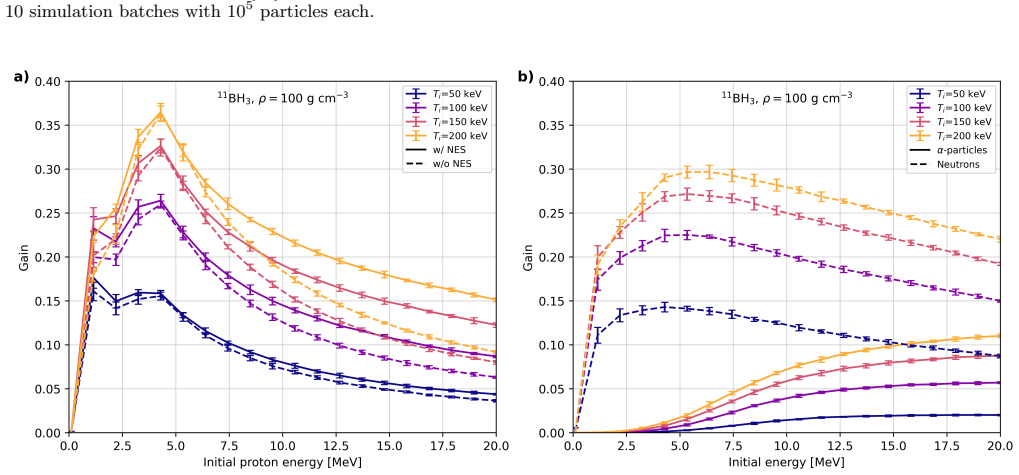
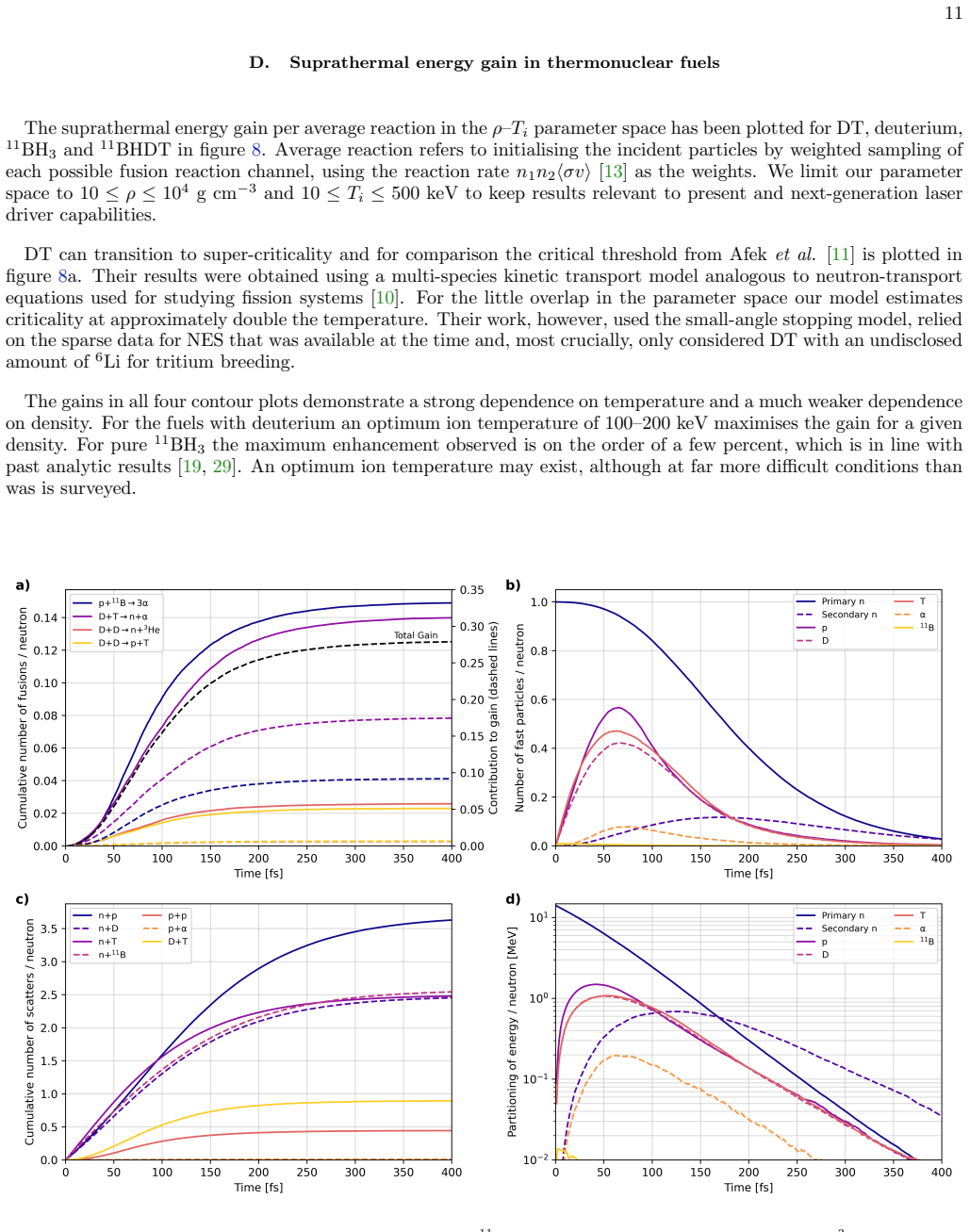
A Monte Carlo code that follows particle trajectories with modified Li-Petrasso stopping powers, thermal cross-section broadening, anisotropic elastic scattering, and a physical p11B alpha spectrum shows that suprathermal criticality in pure deuterium is overestimated by more than an order of magnitude. No realistic density-temperature regime supports a self-sustaining chain reaction. Only DT exhibits criticality when neutron leakage is absent. Fast protons in 11BH3 reach maximum enhancement at 4 MeV but add at most 40 percent to the initial beam energy. Ionic stopping is dominated by small energy transfers, ruling out alpha-driven avalanches, while neutron-driven ion up-scattering dominates
What carries the argument
0D time-dependent Monte Carlo code that integrates modified stopping powers, anisotropic nuclear and neutron elastic scattering, and thermal broadening of fusion cross sections to compute net suprathermal energy gain.
If this is right
- Pure deuterium cannot support self-sustaining suprathermal fusion in inertial confinement regimes.
- DT fuel reaches criticality only in geometries that retain all neutrons.
- Proton-beam-driven 11B fuels gain at most 40 percent extra energy from fast reactions at the 4 MeV optimum.
- Alpha-particle avalanches are impossible because stopping collisions transfer little energy per event.
- Any multiplication in neutron-producing fuels is driven by ion up-scattering rather than direct fusion chains.
Where Pith is reading between the lines
- The limited role of suprathermal effects narrows design options for aneutronic inertial fusion targets.
- Experimental campaigns could test the result by comparing yields in deuterium-filled targets with and without added fast ions at fixed density.
- Prior analytic estimates likely omitted the full spectrum of small-angle scattering losses captured here.
- The findings shift attention toward neutron management as the decisive factor for any suprathermal gain in mixed fuels.
Load-bearing premise
The chosen Monte Carlo treatment of stopping and scattering fully represents real plasma behavior without missing reaction channels or unmodeled particle losses.
What would settle it
Fusion yield measurements in a pure deuterium plasma at densities around 10^25 cm^-3 and temperatures near 10 keV that match pure thermal predictions without detectable excess neutrons or protons.
Figures



read the original abstract
Suprathermal fusion reactions, initiated by energetic particles slowing down and scattering in dense plasmas, can modify the burn dynamics at inertial confinement fusion (ICF) regimes. A 0D time-dependent Monte-Carlo code has been developed to assess the suprathermal energy gain from fast fusions in DT, deuterium, $^{11}$BH$_3$ and $^{11}$BHDT fuels. It incorporates modified Li-Petrasso stopping powers, thermal broadening of cross-sections, anisotropic nuclear elastic and neutron elastic scattering, and a physical model for the p$^{11}$B alpha-particle spectra. Results show that earlier predictions of suprathermal criticality in pure deuterium are overestimated by more than an order of magnitude; no realistic density-temperature regime supports a self-sustaining chain reaction. Only DT demonstrates a critical regime provided there is no neutron leakage. Fast protons in $^{11}$BH$_3$ have an optimum energy of 4 MeV for maximising suprathermal enhancement. In this case the additional energy from fast fusions is unlikely to exceed 40% of the initial proton beam energy. The possibility of an alpha-particle-driven "avalanche" mechanism is ruled out since the ionic stopping is dominated by collisions involving small energy transfer. Suprathermal multiplication processes are dominated by neutron-driven ion up-scattering and likely play a limited role in purely aneutronic fuels.
Editorial analysis
A structured set of objections, weighed in public.
Referee Report
Summary. The manuscript develops a 0D time-dependent Monte Carlo code to model suprathermal fusion reactions in DT, pure deuterium, 11BH3, and 11BHDT fuels. It incorporates modified Li-Petrasso stopping powers, thermal broadening of cross sections, anisotropic nuclear and neutron elastic scattering, and a physical p-11B alpha-particle spectrum. The central claims are that earlier predictions of suprathermal criticality in pure deuterium are overestimated by more than an order of magnitude with no realistic density-temperature regime supporting self-sustained reactions; only DT reaches criticality (provided no neutron leakage); fast protons in 11BH3 have an optimum energy of 4 MeV yielding at most 40% additional energy from fast fusions; alpha-driven avalanches are ruled out because ionic stopping is dominated by small energy transfers; and neutron-driven ion up-scattering dominates suprathermal multiplication in aneutronic fuels.
Significance. If the numerical results hold after validation, the work would provide a useful quantitative bound on the role of suprathermal processes in advanced fusion fuels, particularly by weakening the case for self-sustaining suprathermal chains in pure deuterium and aneutronic mixtures. The forward Monte Carlo approach with explicit scattering kernels and the physical alpha spectrum model are strengths that avoid circular fitting.
major comments (3)
- [Abstract and §2 (Methods)] The quantitative form of the 'modified Li-Petrasso stopping powers' is never stated, nor are any benchmark comparisons to experimental stopping data, other codes, or the original Li-Petrasso formulation provided. Because the order-of-magnitude reduction in deuterium criticality rests directly on this modification, the absence of validation or sensitivity tests is load-bearing.
- [§3 (Results for deuterium) and §4 (Discussion)] The 0D treatment plus the chosen anisotropic scattering kernels is asserted to capture the relevant physics, yet no test is shown for possible missing suprathermal up-scattering channels or neutron leakage effects that would be present in a spatially resolved geometry. This directly affects the claim that 'no realistic density-temperature regime supports a self-sustaining chain reaction' in deuterium.
- [§3.1 (DT results)] The statement that DT exhibits a critical regime 'provided there is no neutron leakage' is made without any quantitative estimate of how leakage would alter the multiplication factor in a finite geometry; the 0D model cannot address this, so the contrast drawn with other fuels requires additional justification.
minor comments (3)
- [§2] Define the precise functional form of the thermal broadening applied to the cross sections and state the energy range over which it is active.
- [Figure captions and §3] Add error bars or convergence tests to the Monte Carlo results shown in the figures for the reported energy gains and criticality thresholds.
- [§2] Clarify whether the p-11B alpha spectrum model is taken from a specific reference or derived in the paper; a short derivation or citation is needed.
Simulated Author's Rebuttal
We thank the referee for their careful and constructive review of our manuscript. We address each major comment below and indicate the revisions we will make to strengthen the presentation and justification of our results.
read point-by-point responses
-
Referee: [Abstract and §2 (Methods)] The quantitative form of the 'modified Li-Petrasso stopping powers' is never stated, nor are any benchmark comparisons to experimental stopping data, other codes, or the original Li-Petrasso formulation provided. Because the order-of-magnitude reduction in deuterium criticality rests directly on this modification, the absence of validation or sensitivity tests is load-bearing.
Authors: We agree that the explicit functional form of the modified Li-Petrasso stopping powers should have been stated in Section 2. In the revised manuscript we will provide the precise mathematical expression used for the modification, a direct comparison to the original Li-Petrasso formulation, and a sensitivity study demonstrating how changes in the stopping-power parameters affect the deuterium criticality threshold. While comprehensive experimental benchmarks for the exact plasma conditions are not available in the literature, we will cite the relevant stopping-power data sets that informed the modification. revision: yes
-
Referee: [§3 (Results for deuterium) and §4 (Discussion)] The 0D treatment plus the chosen anisotropic scattering kernels is asserted to capture the relevant physics, yet no test is shown for possible missing suprathermal up-scattering channels or neutron leakage effects that would be present in a spatially resolved geometry. This directly affects the claim that 'no realistic density-temperature regime supports a self-sustaining chain reaction' in deuterium.
Authors: The 0D formulation is designed to furnish an upper bound on suprathermal multiplication by assuming perfect particle confinement. In the revised version we will add a sensitivity analysis in which the anisotropy parameters of the scattering kernels are varied over a physically plausible range; the results of these tests will be presented in Section 3. We will also insert a paragraph in Section 4 noting that any neutron leakage present in a finite geometry can only decrease the effective multiplication factor relative to the ideal 0D case. Consequently, the conclusion that no realistic density-temperature regime supports a self-sustaining chain in deuterium remains robust even when spatial losses are considered. revision: partial
-
Referee: [§3.1 (DT results)] The statement that DT exhibits a critical regime 'provided there is no neutron leakage' is made without any quantitative estimate of how leakage would alter the multiplication factor in a finite geometry; the 0D model cannot address this, so the contrast drawn with other fuels requires additional justification.
Authors: We acknowledge that the 0D model cannot supply a quantitative leakage correction. The qualifier 'provided there is no neutron leakage' is intended to describe the most optimistic confinement scenario. In the revised manuscript we will expand the discussion in Section 3.1 and the abstract to state that neutron leakage in any realistic finite geometry would raise the density or temperature required for criticality in DT, while the other fuels remain far below criticality even under the ideal 0D assumptions. This preserves the contrast among fuels without claiming a precise leakage factor. revision: yes
Circularity Check
Monte Carlo forward simulation yields independent results; no circular reduction to inputs
full rationale
The paper's central claims (overestimation of pure-D suprathermal criticality by >10×, absence of realistic self-sustaining regimes, limited role in aneutronic fuels) are generated by running a 0D time-dependent Monte Carlo code that samples particle trajectories, stopping, scattering, and fusion events using supplied physical models (modified Li-Petrasso stopping powers, thermal broadening, anisotropic scattering kernels, p-11B alpha spectra). These models and the code itself are inputs; the reported gains, criticalities, and optimum energies are computed outputs, not parameters fitted to the target quantities or defined in terms of them. No equation reduces a prediction to a fit by construction, no self-citation is invoked as a uniqueness theorem or load-bearing premise, and no ansatz or known result is renamed as a new derivation. The chain is therefore self-contained computational physics rather than tautological.
Axiom & Free-Parameter Ledger
axioms (2)
- domain assumption Modified Li-Petrasso stopping powers accurately describe ion slowing in the relevant density-temperature range
- domain assumption Neutron leakage can be set to zero for the DT critical-regime case
Reference graph
Works this paper leans on
-
[1]
This stopping model is equivalent to removing the dielectric and 1/ln Λ CLS terms in equation 5
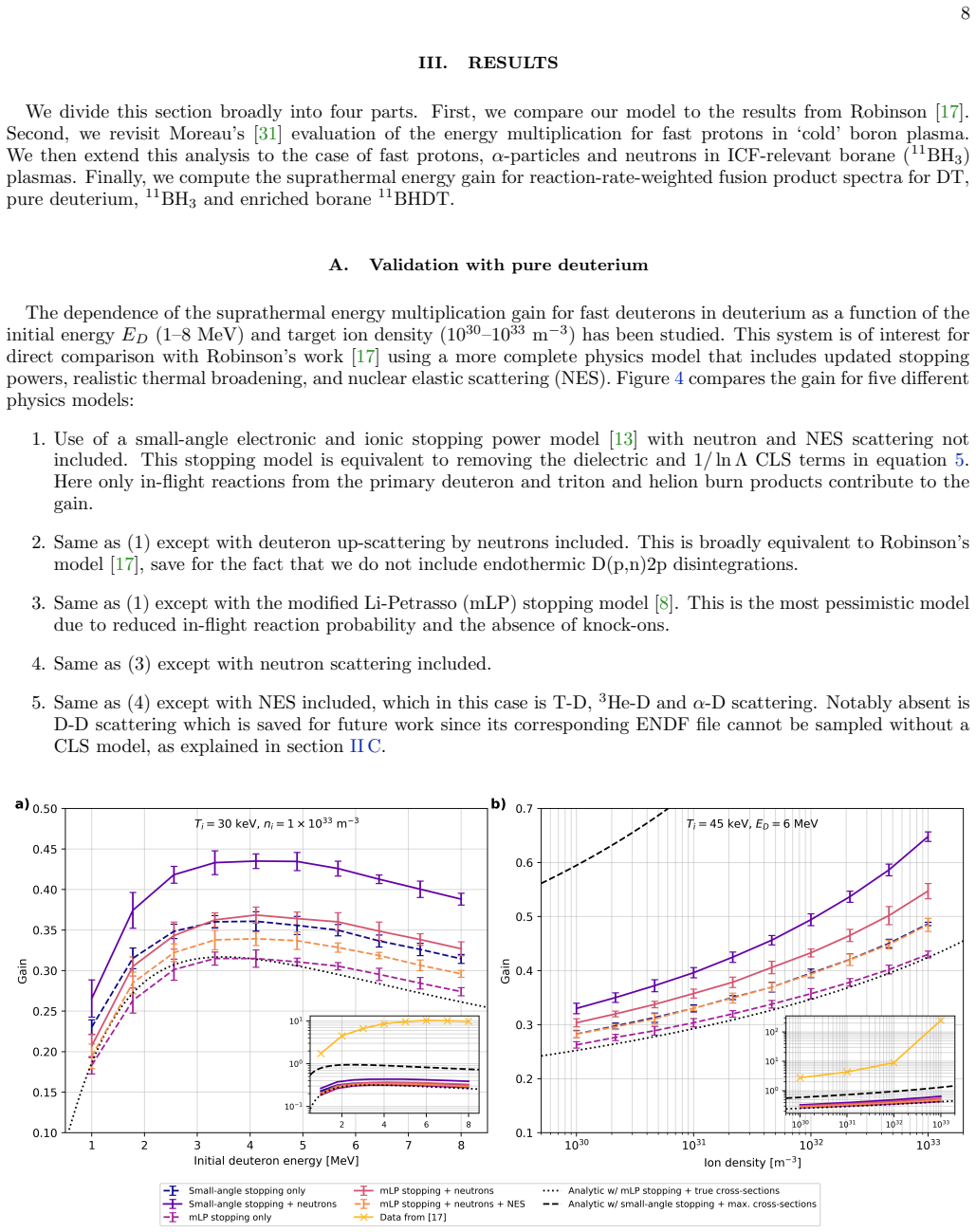
Use of a small-angle electronic and ionic stopping power model [13] with neutron and NES scattering not included. This stopping model is equivalent to removing the dielectric and 1/ln Λ CLS terms in equation 5. Here only in-flight reactions from the primary deuteron and triton and helion burn products contribute to the gain
-
[2]
This is broadly equivalent to Robinson’s model [17], save for the fact that we do not include endothermic D(p,n)2p disintegrations
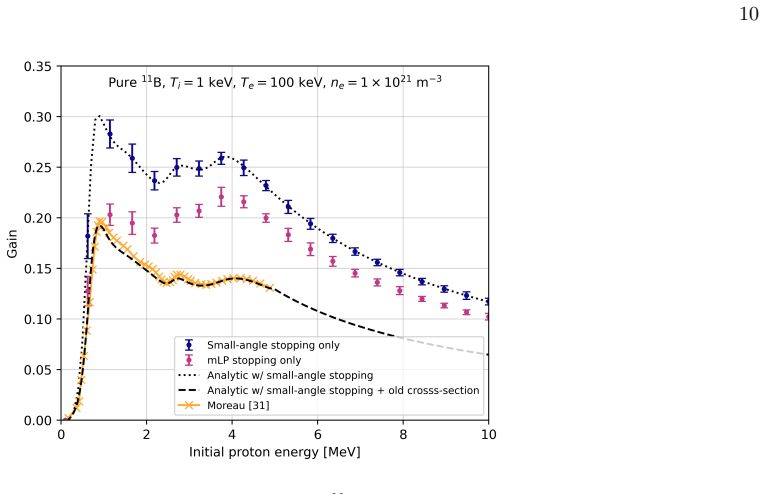
Same as (1) except with deuteron up-scattering by neutrons included. This is broadly equivalent to Robinson’s model [17], save for the fact that we do not include endothermic D(p,n)2p disintegrations
-
[3]
This is the most pessimistic model due to reduced in-flight reaction probability and the absence of knock-ons
Same as (1) except with the modified Li-Petrasso (mLP) stopping model [8]. This is the most pessimistic model due to reduced in-flight reaction probability and the absence of knock-ons
-
[4]
Same as (3) except with neutron scattering included
-
[5]
Notably absent is D-D scattering which is saved for future work since its corresponding ENDF file cannot be sampled without a CLS model, as explained in section II C
Same as (4) except with NES included, which in this case is T-D, 3He-D andα-D scattering. Notably absent is D-D scattering which is saved for future work since its corresponding ENDF file cannot be sampled without a CLS model, as explained in section II C. FIG. 4. Dependence of gain on (a) deuteron energy and (b) ion number density for fast deuterons in d...
-
[6]
Abu-Shawareb, R
H. Abu-Shawareb, R. Acree, P. Adams, J. Adams, B. Addis, R. Aden, P. Adrian, B. B. Afeyan, M. Aggleton, L. Aghaian, et al.(The Indirect Drive ICF Collaboration), Phys. Rev. Lett.132, 065102 (2024)
2024
-
[7]
E. P. Hartouni, A. S. Moore, A. J. Crilly, B. D. Appelbe, P. A. Amendt, K. L. Baker, D. T. Casey, D. S. Clark, T. D¨ oppner, M. J. Eckart,et al., Nature Physics19, 72 (2023)
2023
-
[8]
Y. Xue, D. Wu, and J. Zhang, Science Bulletin70, 359 (2025)
2025
-
[9]
A. E. Turrell, M. Sherlock, and S. J. Rose, Phys. Rev. Lett.112, 245002 (2014)
2014
-
[10]
J. J. van de Wetering, J. R. Angus, W. Farmer, V. Geyko, D. Ghosh, D. Grote, C. Weber, and G. Zimmerman, Phys. Rev. E112, 045207 (2025)
2025
-
[11]
Ray Angus and J
J. Ray Angus and J. Johgan van de Wetering, Journal of Computational Physics545, 114484 (2026)
2026
-
[12]
Li and R
C.-K. Li and R. D. Petrasso, Phys. Rev. Lett.70, 3063 (1993)
1993
-
[13]
A. B. Zylstra, H. G. Rinderknecht, J. A. Frenje, C. K. Li, and R. D. Petrasso, Phys. Plasmas26, 122703 (2019)
2019
-
[14]
Gryzinski, Phys
M. Gryzinski, Phys. Rev.111, 900 (1958)
1958
-
[15]
Peres and D
A. Peres and D. Shvarts, Nuclear Fusion15, 687 (1975)
1975
-
[16]
Y. Afek, A. Dar, A. Peres, A. Ron, R. Shachar, and D. Shvarts, Journal of Physics D: Applied Physics11, 2171 (1978)
1978
-
[17]
Kumar, J
A. Kumar, J. P. Ligou, and S. B. N. and, Fusion Technology12, 476 (1987)
1987
-
[18]
Atzeni and J
S. Atzeni and J. M. ter Vehn,The Physics of Inertial Fusion, International Series of Monographs on Physics (Oxford University Press, 2004)
2004
-
[19]
W. M. Nevins, Journal of Fusion Energy17, 25 (1998)
1998
-
[20]
H. S. Bosch and G. M. Hale, Nuclear Fusion32, 611 (1992)
1992
-
[22]
A. P. L. Robinson, Plasma Physics and Controlled Fusion66, 065020 (2024). 17
2024
-
[23]
A. P. L. Robinson, Plasma Physics and Controlled Fusion66, 125003 (2024)
2024
-
[24]
Belloni, Laser and Particle Beams2022, e11 (2022)
F. Belloni, Laser and Particle Beams2022, e11 (2022)
2022
-
[25]
Weaver, G
T. Weaver, G. Zimmerman, and L. Wood,Exotic CTR Fuels: Non-Thermal Effects and Laser Fusion Applications, Tech. Rep. (Lawrence Livermore Laboratory, University of California, Livermore, California, 1973)
1973
-
[26]
Zimmerman, T
G. Zimmerman, T. Scharlemann, L. Wood, T. Weaver, T. Chu, and G. Lee,FOKN: a relativistic Fokker-Planck code with large angle scattering and radiation losses, Tech. Rep. (Lawrence Livermore Lab, 1976)
1976
-
[27]
S. V. Putvinski, D. D. Ryutov, and P. N. Yushmanov, Nuclear Fusion59, 076018 (2019)
2019
-
[28]
M. H. Sikora and H. R. Weller, Journal of Fusion Energy35, 538 (2016)
2016
-
[29]
Ghorbanpour and F
E. Ghorbanpour and F. Belloni, Frontiers in Physics12, 1405435 (2024)
2024
-
[30]
I. Morozov, T. A. Mehlhorn, E. Ghorbanpour, M. Borscz, M. Tabak, A. Fuerbach, F. Ladouceur, and S. Pikuz, Physics of Plasmas 10.1063/5.03224469 (2026), in press
-
[31]
Eliezer, H
S. Eliezer, H. Hora, G. Korn, N. Nissim, and J. M. Martinez Val, Physics of Plasmas23, 050704 (2016)
2016
-
[32]
Picciotto, D
A. Picciotto, D. Margarone, A. Velyhan, P. Bellutti, J. Krasa, A. Szydlowsky, G. Bertuccio, Y. Shi, A. Mangione, J. Proku- pek, A. Malinowska, E. Krousky, J. Ullschmied, L. Laska, M. Kucharik, and G. Korn, Phys. Rev. X4, 031030 (2014)
2014
-
[33]
Belloni, Plasma Physics and Controlled Fusion63, 055020 (2021)
F. Belloni, Plasma Physics and Controlled Fusion63, 055020 (2021)
2021
-
[34]
Hirose, T
S. Hirose, T. Johzaki, W. Kim, and T. Endo, Plasma Physics and Controlled Fusion67, 105022 (2025)
2025
-
[35]
T. A. Mehlhorn, L. Labun, B. M. Hegelich, D. Margarone, M. F. Gu, D. Batani, E. M. Campbell, S. X. Hu, and B. Ra- makrishna, Laser and Particle Beams2022, e1 (2022)
2022
-
[36]
D. C. Moreau, Nuclear Fusion17, 13 (1977)
1977
-
[37]
Ghosh and S
K. Ghosh and S. V. G. Menon, Nuclear Fusion47, 1176 (2007)
2007
-
[38]
G. P. A. Nobre, R. Capote, M. T. Pigni, A. Trkov, C. M. Mattoon, D. Neudecker, D. A. Brown, M. B. Chadwick, A. C. Kahler, N. A. Kleedtke,et al., ENDF/B-VIII.1: Updated nuclear reaction data library for science and applications (2025), arXiv:2511.03564 [physics.app-ph]
work page internal anchor Pith review Pith/arXiv arXiv 2025
-
[39]
J. L. Quebert and L. Marquez, Nuclear Physics A126, 646 (1969)
1969
-
[40]
Belloni, D
F. Belloni, D. Margarone, A. Picciotto, F. Schillaci, and L. Giuffrida, Physics of Plasmas25, 020701 (2018)
2018
-
[41]
Tentori and F
A. Tentori and F. Belloni, Nuclear Fusion63, 086001 (2023)
2023
-
[42]
Son and N
S. Son and N. J. Fisch, Physics Letters A329, 76 (2004)
2004
-
[43]
M. J. Lavell, A. J. Kish, A. T. Sexton, R. L. Masti, I. Mohammad, M. J. Kim, A. Srinivasan, K. Jarvis, W. Scullin, J. G. Shaw, and A. B. Sefkow, Physics of Plasmas31, 043902 (2024)
2024
discussion (0)
Sign in with ORCID, Apple, or X to comment. Anyone can read and Pith papers without signing in.