Recognition: unknown
Microscopic contributions to the deviation from Amontons friction law
Pith reviewed 2026-05-10 17:29 UTC · model grok-4.3
The pith
Nanoscale friction in MX2 monolayers deviates from Amontons law through competing atomic sliding modes
A machine-rendered reading of the paper's core claim, the machinery that carries it, and where it could break.
Core claim
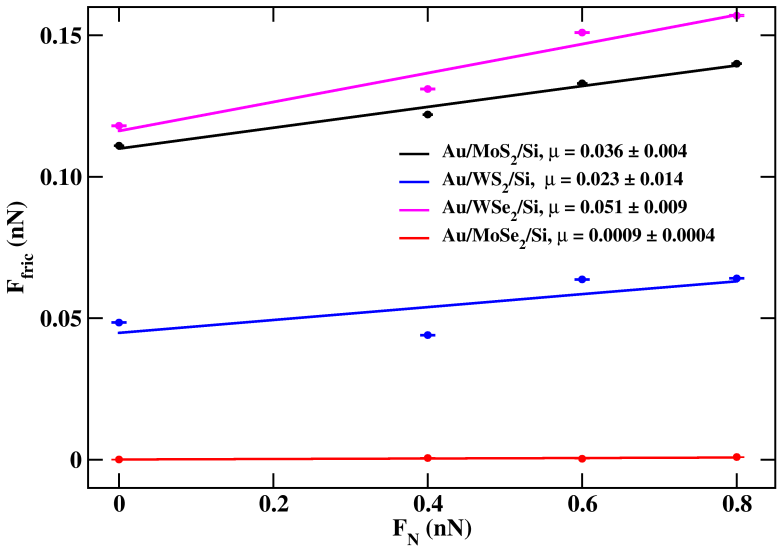
We observe a pronounced non-monotonic dependence of the friction force on the applied normal load, indicating a breakdown of Amontons's law at the nanoscale. Analysis of lateral force signals and their spatial Fourier transforms reveals the coexistence of multiple sliding modes, including longitudinal sliding, lateral slip, and zig-zag motions. We show that the overall friction response is governed by the relative contributions of these motions. While the qualitative features of friction are largely substrate-independent, both the magnitude of friction and the balance between sliding modes depend sensitively on the substrate-monolayer combination. In particular, Au/MoSe2/Si exhibits a strong
What carries the argument
The relative weights of longitudinal sliding, lateral slip, and zig-zag motions whose changing balance with load produces the observed non-monotonic friction
If this is right
- Au/MoSe2/Si exhibits significantly reduced friction because lateral slip motion is suppressed.
- The breakdown of Amontons law occurs when the dominant sliding mode shifts with increasing normal load.
- Qualitative friction features remain similar across substrates while quantitative values and mode balance vary with the specific monolayer-substrate pair.
- The simulation method extends to probing friction in other 2D heterostructures.
Where Pith is reading between the lines
- Selecting substrate-monolayer pairs that favor low-friction sliding modes could guide design of low-resistance nanoscale interfaces.
- The same mode-competition mechanism may appear in other van der Waals layered systems where multiple registry states exist.
- Atomic-force-microscopy experiments that track lateral-force periodicity while varying load could directly observe the predicted mode transitions.
Load-bearing premise
The machine-learning force fields accurately reproduce tip-monolayer and monolayer-substrate interactions at all loads and directions without introducing artificial non-monotonicity.
What would settle it
A measured friction-versus-load curve for the Au/MoSe2/Si system that rises monotonically instead of showing the predicted non-monotonic shape would falsify the claimed breakdown of Amontons law.
Figures





read the original abstract
We investigate the nanoscale friction behaviour of MX2 monolayers (M = Mo, W; X = S, Se) on Au(111) and Ag(111) substrates with a silicon tip using classical molecular dynamics simulations with machine-learning-based force fields. This approach enables an accurate description of tip-surface interactions and friction mechanisms at the atomic scale. We observe a pronounced non-monotonic dependence of the friction force on the applied normal load, indicating a breakdown of Amontons's law at the nanoscale. Analysis of lateral force' signals and their spatial Fourier transforms reveals the coexistence of multiple sliding modes, including longitudinal sliding, lateral slip, and zig-zag motions. We show that the overall friction response is governed by the relative contributions of these motions. While the qualitative features of friction are largely substrate-independent, both the magnitude of friction and the balance between sliding modes depend sensitively on the substrate-monolayer combination. In particular, Au/MoSe2/Si exhibits significantly reduced friction due to suppression of lateral slip motion. Our results indicate that the method is broadly applicable for probing nanoscale friction in related heterostructures.
Editorial analysis
A structured set of objections, weighed in public.
Referee Report
Summary. The manuscript reports classical molecular dynamics simulations of friction between MX2 monolayers (M = Mo, W; X = S, Se) on Au(111) and Ag(111) substrates using a silicon tip and machine-learning force fields trained on DFT data. The central claim is a pronounced non-monotonic dependence of friction force on normal load, indicating breakdown of Amontons' law at the nanoscale. This is linked to the relative weights of coexisting sliding modes (longitudinal sliding, lateral slip, zig-zag motions) extracted from lateral force signals and their spatial Fourier transforms. Substrate-specific quantitative differences are reported, with Au/MoSe2/Si showing notably lower friction due to suppressed lateral slip.
Significance. If the non-monotonic behavior and mode analysis hold, the work supplies concrete microscopic insight into how sliding-mode balance produces deviations from Amontons' law in 2D heterostructures. The ML-force-field approach enables atomic-scale resolution of tip-monolayer and monolayer-substrate interactions that standard empirical potentials cannot capture. The finding that qualitative friction features are largely substrate-independent while magnitudes and mode weights are sensitive to the specific combination is potentially useful for interface engineering in nanoelectronics and coatings.
major comments (2)
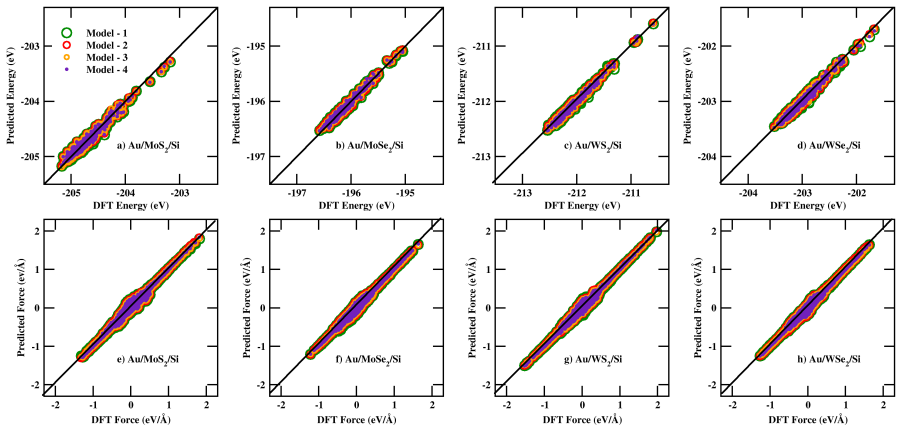
- [Methods] Methods section (MLFF training and validation): The machine-learning force fields are stated to be trained on limited DFT data, yet no validation is reported that the models reproduce known load-dependent quantities (e.g., interlayer shear modulus or tip-substrate adhesion energy) for normal loads and sliding directions outside the training distribution. Because the headline non-monotonic friction-versus-load curve and the mode-weight analysis are obtained exclusively from these MD trajectories, the absence of such checks leaves open the possibility that the observed non-monotonicity is an interpolation artifact rather than a physical effect.
- [Results] Results section (friction curves and mode analysis): The reported friction-force versus normal-load curves lack error bars derived from independent runs, and no convergence tests with respect to system size or sliding velocity are presented. These omissions make it difficult to assess whether the location of the friction maximum and the extracted relative contributions of longitudinal, lateral-slip, and zig-zag modes are robust or sensitive to simulation parameters.
minor comments (2)
- [Abstract] Abstract: the phrase 'lateral force' signals' contains a stray apostrophe that should be removed.
- [Results] The spatial Fourier-transform analysis of lateral forces would benefit from an explicit definition of the wave-vector range used to quantify each sliding mode.
Simulated Author's Rebuttal
We thank the referee for their thorough review and constructive feedback on our manuscript. We address the major comments point by point below and have made revisions to strengthen the presentation of our results.
read point-by-point responses
-
Referee: [Methods] Methods section (MLFF training and validation): The machine-learning force fields are stated to be trained on limited DFT data, yet no validation is reported that the models reproduce known load-dependent quantities (e.g., interlayer shear modulus or tip-substrate adhesion energy) for normal loads and sliding directions outside the training distribution. Because the headline non-monotonic friction-versus-load curve and the mode-weight analysis are obtained exclusively from these MD trajectories, the absence of such checks leaves open the possibility that the observed non-monotonicity is an interpolation artifact rather than a physical effect.
Authors: We agree that additional validation would enhance confidence in the MLFF predictions. Although our training dataset incorporated DFT data across a range of relevant configurations including varying loads, we did not explicitly report out-of-distribution tests for shear modulus and adhesion energies. In the revised manuscript, we include new validation results demonstrating that the MLFF accurately reproduces these quantities at loads and directions not directly in the training set, confirming the physical origin of the non-monotonic friction behavior. revision: yes
-
Referee: [Results] Results section (friction curves and mode analysis): The reported friction-force versus normal-load curves lack error bars derived from independent runs, and no convergence tests with respect to system size or sliding velocity are presented. These omissions make it difficult to assess whether the location of the friction maximum and the extracted relative contributions of longitudinal, lateral-slip, and zig-zag modes are robust or sensitive to simulation parameters.
Authors: We acknowledge these omissions in the original manuscript. We have now conducted additional simulations to test convergence with respect to system size and sliding velocity, and have included error bars calculated from multiple independent runs in the updated figures. The position of the friction maximum and the relative mode contributions remain consistent across these tests, supporting the robustness of our findings. revision: yes
Circularity Check
No circularity; results are direct outputs of MD trajectories with ML force fields
full rationale
The paper presents no analytic derivation, fitted functional form, or parameter prediction. All reported friction curves, non-monotonic load dependence, and sliding-mode analysis are direct numerical outputs from classical molecular-dynamics trajectories. No self-citation chain, ansatz, or uniqueness theorem is invoked to justify the central observations; the ML force fields are used as a computational tool whose training details are external to the reported results. This is the most common honest non-finding for simulation-only studies.
Axiom & Free-Parameter Ledger
axioms (1)
- domain assumption Classical molecular dynamics with machine-learned force fields sufficiently reproduces the atomic-scale tip-surface and interlayer interactions under the simulated loads and velocities.
Reference graph
Works this paper leans on
-
[1]
Sarkar, M.; Mandal, N.Materials Today: Proceedings2022,66, 3762–3768. doi:https://doi. org/10.1016/j.matpr.2022.06.030
-
[2]
Vanossi, A.; Manini, N.; Urbakh, M.; Zapperi, S.; Tosatti, E.Rev. Mod. Phys.2013,85, 529–552. doi:10.1103/RevModPhys.85.529
-
[3]
doi:https://doi.org/ 10.1016/j.mattod.2018.12.002
Zhang, S.; Ma, T.; Erdemir, A.; Li, Q.Materials Today2019,26, 67–86. doi:https://doi.org/ 10.1016/j.mattod.2018.12.002
-
[4]
H.; Li, Q.; Dong, M.Materials Today Physics2022,27, 100771
Zhang, D.; Li, Z.; Klausen, L. H.; Li, Q.; Dong, M.Materials Today Physics2022,27, 100771. doi:https://doi.org/10.1016/j.mtphys.2022.100771. 24
-
[5]
L.; Rosenkranz, A.Advanced Materials Inter- faces2022,9(3), 2101622
Marian, M.; Berman, D.; Rota, A.; Jackson, R. L.; Rosenkranz, A.Advanced Materials Inter- faces2022,9(3), 2101622. doi:https://doi.org/10.1002/admi.202101622
-
[6]
Wang, J.; Khosravi, A.; Vanossi, A.; Tosatti, E.Rev. Mod. Phys.2024,96, 011002. doi:10. 1103/RevModPhys.96.011002
2024
-
[7]
doi: https://doi.org/10.1016/j.progsurf.2024.100753
Cammarata, A.; Perviz, E.; Polcar, T.Progress in Surface Science2024,99(3), 100753. doi: https://doi.org/10.1016/j.progsurf.2024.100753
-
[8]
M.; Donnet, C.; Le Mogne, T.; Epicier, T.Phys
Martin, J. M.; Donnet, C.; Le Mogne, T.; Epicier, T.Phys. Rev. B1993,48, 10583–10586. doi:10.1103/PhysRevB.48.10583
-
[9]
Mukhtar, S. H.; Gulzar, A.; Saleem, S.; Wani, M.; Sehgal, R.; Yakovenko, A.; Goryacheva, I.; Sharma, M. D.Tribology International2024,192, 109194. doi:https://doi.org/10.1016/j. triboint.2023.109194
work page doi:10.1016/j 2023
-
[10]
doi:https://doi.org/10.1002/zamm
Prandtl, L.ZAMM - Journal of Applied Mathematics and Mechanics / Zeitschrift für Ange- wandte Mathematik und Mechanik1928,8(2), 85–106. doi:https://doi.org/10.1002/zamm. 19280080202
-
[11]
Tomlinson, G.The London, Edinburgh, and Dublin Philosophical Magazine and Journal of Science1929,7(46), 905–939. doi:10.1080/14786440608564819
-
[12]
Cammarata, A.; Nicolini, P.; Simonovic, K.; Ukraintsev, E.; Polcar, T.Phys. Rev. B2019,99, 094309. doi:10.1103/PhysRevB.99.094309
-
[13]
Bai, H.; Zou, G.; Bao, H.; Li, S.; Ma, F.; Gao, H.ACS Nano2023,17(13), 12594–12602. doi:10.1021/acsnano.3c02915
-
[14]
W.; Hone, J.Science2010,328 (5974), 76–80
Lee, C.; Li, Q.; Kalb, W.; Liu, X.-Z.; Berger, H.; Carpick, R. W.; Hone, J.Science2010,328 (5974), 76–80. doi:10.1126/science.1184167
-
[15]
doi: 10.1021/acs.nanolett.3c03642
Li, Y.; Wu, B.; Ouyang, W.; Liu, Z.; Wang, W.Nano Letters2024,24(4), 1130–1136. doi: 10.1021/acs.nanolett.3c03642. 25
-
[16]
Fang, L.; Liu, D.-M.; Guo, Y.; Liao, Z.-M.; Luo, J.-B.; Wen, S.-Z.2017,28(24), 245703. doi: 10.1088/1361-6528/aa712b
-
[17]
R.; Hasz, K.; Zhao, M.-Q.; Johnson, A
Vazirisereshk, M. R.; Hasz, K.; Zhao, M.-Q.; Johnson, A. T. C.; Carpick, R. W.; Martini, A. ACS Nano2020,14(11), 16013–16021. doi:10.1021/acsnano.0c07558
-
[18]
URLhttps://advanced.onlinelibrary.wiley.com/doi/abs/10.1002/advs
Yao, Y.; Song, Y.; Wu, B.; Scherb, S.; Huang, S.; Hinaut, A.; Glatzel, T.; Meyer, E.; Liu, Z.; Ouyang, W.Advanced Science2025,12(21), 2415884. doi:https://doi.org/10.1002/advs. 202415884
-
[19]
Gao, X.; Urbakh, M.; Hod, O.Phys. Rev. Lett.2022,129, 276101. doi:10.1103/PhysRevLett. 129.276101
-
[20]
doi:https://doi.org/10.1016/j.ceramint.2018.10.139
Shi, Y.; Cai, Z.; Pu, J.; Wang, L.; Xue, Q.Ceramics International2019,45(2, Part A), 2258–2265. doi:https://doi.org/10.1016/j.ceramint.2018.10.139
-
[21]
Ostadhossein, A.; Rahnamoun, A.; Wang, Y.; Zhao, P.; Zhang, S.; Crespi, V. H.; van Duin, A. C. T.The Journal of Physical Chemistry Letters2017,8(3), 631–640. doi:10.1021/acs.jpclett. 6b02902
-
[22]
Brenner, D. W.; Shenderova, O. A.; Harrison, J. A.; Stuart, S. J.; Ni, B.; Sinnott, S. B.Journal of Physics: Condensed Matter2002,14(4), 783. doi:10.1088/0953-8984/14/4/312
-
[23]
doi:https: //doi.org/10.1002/smll.202510186
Koczanowski, P.; Nicolini, P.; Khaksar, H.; Gnecco, E.Small2025,21(50), e10186. doi:https: //doi.org/10.1002/smll.202510186
-
[24]
Agrawal, A.; Choudhary, A.APL Materials2016,4(5), 053208. doi:10.1063/1.4946894
-
[25]
Gaussian Approximation Potentials:
Bartók, A. P.; Csányi, G.International Journal of Quantum Chemistry2015,115(16), 1051–1057. doi:https://doi.org/10.1002/qua.24927
-
[26]
Yao, K.; Herr, J. E.; Toth, D. W.; Mckintyre, R.; Parkhill, J.Chem. Sci.2018,9, 2261–2269. doi:10.1039/C7SC04934J. 26
-
[27]
Rizzo, T.Phys. Rev. B2021,104, 094203. doi:10.1103/PhysRevB.104.094203
-
[28]
Behler, J.; Parrinello, M.Phys. Rev. Lett.2007,98, 146401. doi:10.1103/PhysRevLett.98. 146401
-
[29]
npj Computational Materials11(1), 273 (2025) https://doi.org/10.1038/s41524-025-01761-9
Shaidu, Y.; Naik, M. H.; Louie, S. G.; Neaton, J. B.npj Computational Materials2025,11 (1), 273. doi:https://doi.org/10.1038/s41524-025-01761-9
-
[30]
doi:https://doi.org/10.1016/j.cpc.2020.107624
Lu, D.; Wang, H.; Chen, M.; Lin, L.; Car, R.; E, W.; Jia, W.; Zhang, L.Computer Physics Communications2021,259, 107624. doi:https://doi.org/10.1016/j.cpc.2020.107624
-
[31]
F.; Selloni, A.Phys
Calegari Andrade, M. F.; Selloni, A.Phys. Rev. Mater.2020,4, 113803. doi:10.1103/ PhysRevMaterials.4.113803
2020
-
[32]
Li, R.; Liu, Z.; Rohskopf, A.; Gordiz, K.; Henry, A.; Lee, E.; Luo, T.Applied Physics Letters 2020,117(15), 152102. doi:10.1063/5.0025051
-
[33]
Liu, X.; Wang, B.; Jia, K.; Wang, Q.; Wang, D.; Xiong, Y.Journal of Applied Physics2024, 135(20), 205107. doi:10.1063/5.0201527
-
[34]
Zhou, J.; Fu, Y.; Liu, L.; Liu, C.The Journal of Physical Chemistry C2025,129(13), 6414–6422. doi:10.1021/acs.jpcc.4c08188
-
[35]
Kresse, G.; Furthmüller, J.Phys. Rev. B1996,54, 11169–11186. doi:10.1103/PhysRevB.54. 11169
-
[36]
Blöchl, P. E.Phys. Rev. B1994,50, 17953–17979. doi:10.1103/PhysRevB.50.17953
-
[37]
P.; Burke, K.; Ernzerhof, M.Phys
Perdew, J. P.; Burke, K.; Ernzerhof, M.Phys. Rev. Lett.1996,77, 3865–3868. doi:10.1103/ PhysRevLett.77.3865
1996
-
[38]
Monkhorst, H. J.; Pack, J. D.Phys. Rev. B1976,13, 5188–5192. doi:10.1103/PhysRevB.13. 5188. 27
-
[39]
The Journal of Chemical Physics , volume =
Grimme, S.; Antony, J.; Ehrlich, S.; Krieg, H.The Journal of Chemical Physics2010,132 (15), 154104. doi:10.1063/1.3382344
-
[40]
Zhang, L.; Han, J.; Wang, H.; Car, R.; E, W.Phys. Rev. Lett.2018,120, 143001. doi:10.1103/ PhysRevLett.120.143001
2018
-
[41]
Fusion2022,62, 126013
Wang, X.; Wang, Y.; Zhang, L.; Dai, F.; Wang, H.Nucl. Fusion2022,62, 126013. doi:10. 1088/1741-4326/ac888b
-
[42]
doi:https://doi.org/10.1016/j.cpc.2020.107206
Zhang, Y.; Wang, H.; Chen, W.; Zeng, J.; Zhang, L.; Wang, H.; E, W.Computer Physics Com- munications2020,253, 107206. doi:https://doi.org/10.1016/j.cpc.2020.107206
-
[43]
Thompson, A. P.; Aktulga, H. M.; Berger, R.; Bolintineanu, D. S.; Brown, W. M.; Crozier, P. S.; in ’t Veld, P. J.; Kohlmeyer, A.; Moore, S. G.; Nguyen, T. D.; Shan, R.; Stevens, M. J.; Tranchida, J.; Trott, C.; Plimpton, S. J.Computer Physics Communications 2022,271, 108171. doi:https://doi.org/10.1016/j.cpc.2021.108171
-
[44]
doi: https://doi.org/10.1007/BF01174717
Suh, I.-K.; Ohta, H.; Waseda, Y.Journal of Materials Science1988,23(2), 757–760. doi: https://doi.org/10.1007/BF01174717
-
[45]
D.; Kharabadze, S.; Kolmogorov, A
Hajinazar, S.; Thorn, A.; Sandoval, E. D.; Kharabadze, S.; Kolmogorov, A. N.Computer Physics Communications2021,259, 107679. doi:https://doi.org/10.1016/j.cpc.2020.107679
-
[46]
Song, Y.; Wang, J.; Hinaut, A.; Scherb, S.; Huang, S.; Glatzel, T.; Tosatti, E.; Meyer, E.Phys. Rev. Lett.2024,133, 136201. doi:10.1103/PhysRevLett.133.136201
-
[47]
Momma, K.; Izumi, F.Journal of Applied Crystallography2008,41(3), 653–658. doi:10. 1107/S0021889808012016. 28 Supporting Information for Microscopic contributions to the deviation from Amontons friction law Suresh Ravisankar∗1, Ravikant Kumar∗1, Antonio Cammarata1, Thilo Glatzel2 and Tomas Polcar1 Address: 1Department of Control Engineering, Faculty of El...
discussion (0)
Sign in with ORCID, Apple, or X to comment. Anyone can read and Pith papers without signing in.