Recognition: 2 theorem links
· Lean TheoremCosmological Dynamics of Exponential Quintessence Constrained by BAO, Cosmic Chronometers, and DES-SN5YR/Pantheon+ Data
Pith reviewed 2026-05-10 18:16 UTC · model grok-4.3
The pith
An exponential potential quintessence model fits the latest cosmological data and remains statistically comparable to LambdaCDM.
A machine-rendered reading of the paper's core claim, the machinery that carries it, and where it could break.
Core claim
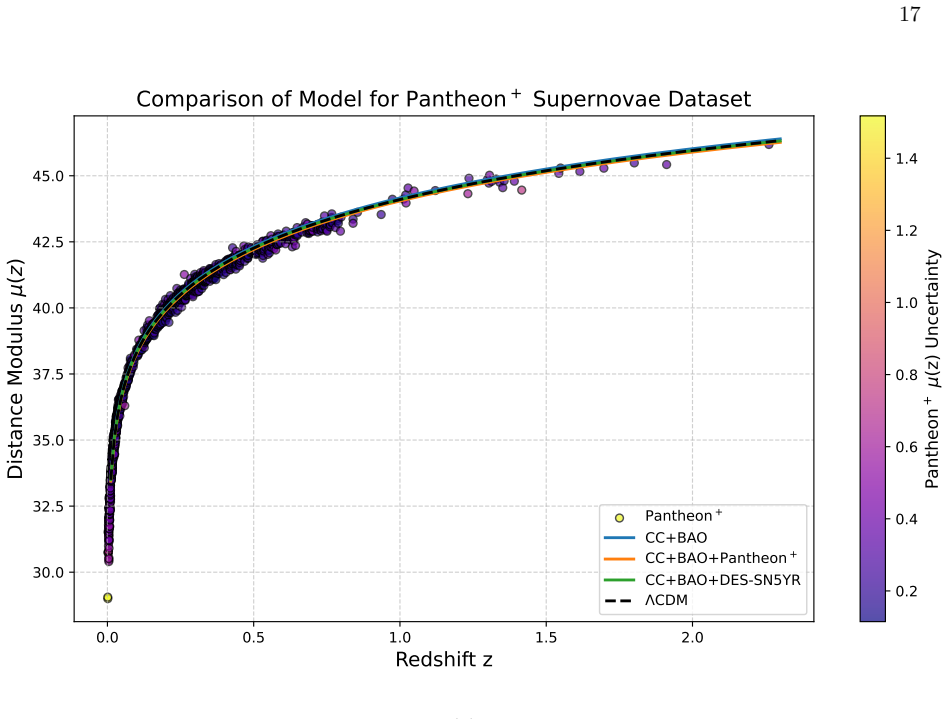
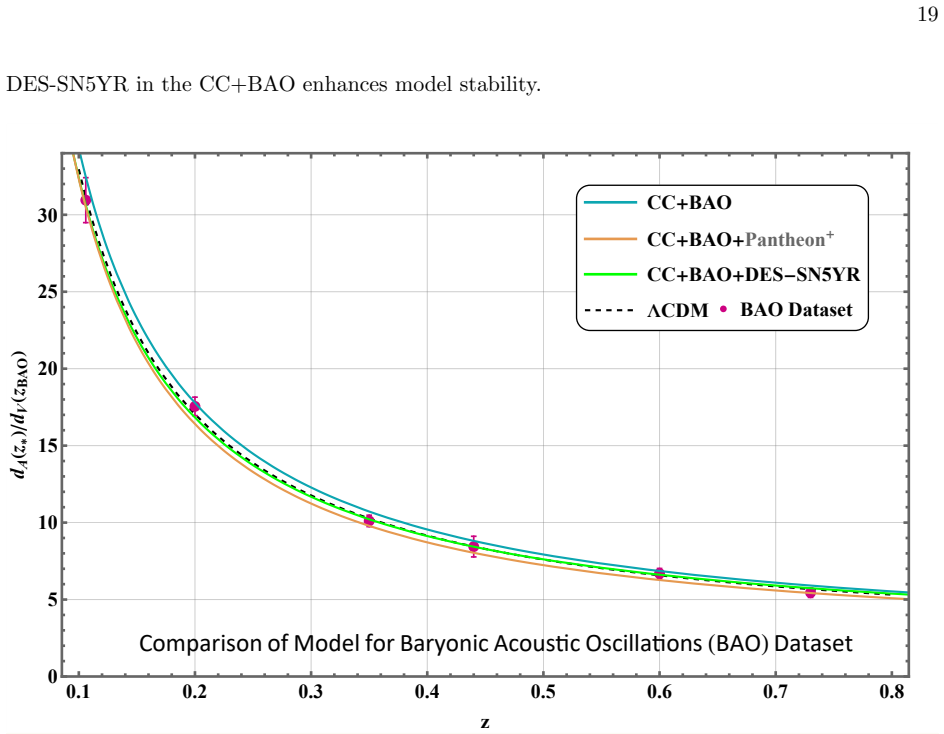
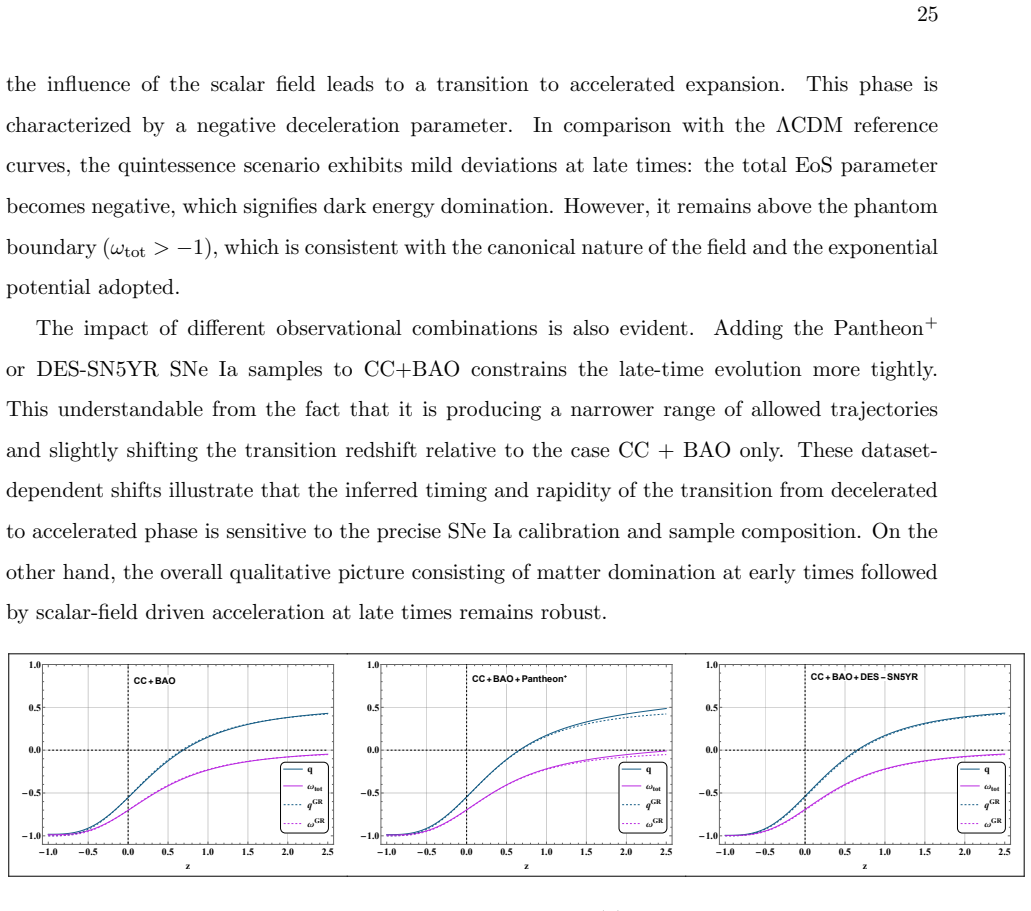
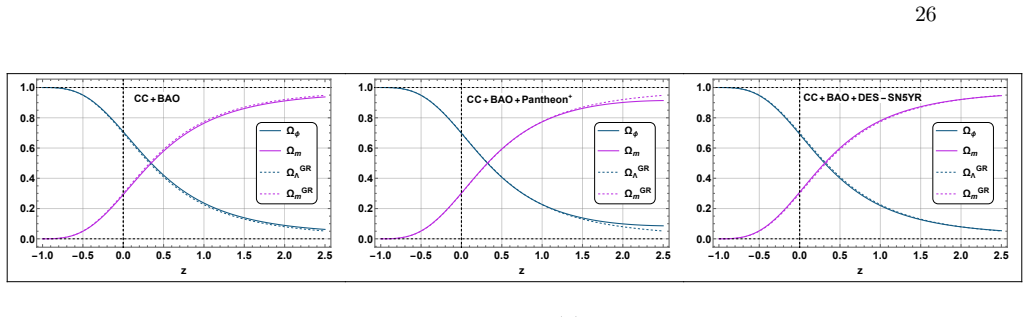
Markov Chain Monte Carlo sampling of the exponential quintessence model against the combined BAO, cosmic chronometer, Pantheon+, and DES-SN5YR datasets produces well-constrained values for H0, Omega_m0, eta0, and gamma. The model reproduces the observed Hubble parameter H(z), distance modulus mu(z), and scaled comoving angular diameter distance, successfully captures the shift from matter domination to acceleration, and yields an age of the universe consistent with Planck 2018. Information criteria show the model is statistically comparable to LambdaCDM despite the extra parameters, statefinder trajectories approach the LambdaCDM fixed point, and energy conditions remain satisfied except for
What carries the argument
The canonical quintessence scalar field evolving in an exponential potential, sampled via MCMC against multiple late-universe datasets.
If this is right
- The model maintains a total equation of state greater than -1 throughout cosmic history.
- Statefinder diagnostics show trajectories that approach the LambdaCDM fixed point with only small deviations.
- Energy condition analysis confirms physical viability, with the strong energy condition violated only at late times as needed for acceleration.
- The predicted Hubble parameter, distance modulus, and angular diameter distance remain in good agreement with observations.
Where Pith is reading between the lines
- If the small deviations from LambdaCDM persist in future data, they could be used to distinguish this potential from a pure cosmological constant.
- The same MCMC pipeline can be applied to other scalar-field potentials to see which forms survive the tightening bounds.
- A detection of w_tot significantly below -1 in next-generation surveys would immediately exclude the model as currently formulated.
Load-bearing premise
The exponential shape is the right functional form for the potential and the quoted measurement errors fully capture all systematic uncertainties in the data.
What would settle it
Future measurements that drive the total equation of state below -1 at high significance or that produce a decisive Akaike information criterion difference favoring one model over the other would rule out the present parameter space.
Figures






read the original abstract
We perform a comprehensive observational test of a canonical quintessence model driven by an exponential potential, motivated by its emergence in higher-dimensional theories, string-inspired scenarios, and modified gravity. Using a Markov Chain Monte Carlo framework, we constrain the model with the latest high-precision observational datasets including Cosmic Chronometers, Baryon Acoustic Oscillation, Pantheon+, and DES-SN5YR Type Ia Supernovae. The combined data significantly tighten the parameter bounds on (H0, Omega_m0, eta0, gamma) and yield predictions for the Hubble parameter H(z), the distance modulus mu(z), and the scaled comoving angular diameter distance that remain in excellent agreement with observations and closely follow the LCDM baseline. An information-theoretic model comparison using the Akaike Information Criterion shows that the exponential quintessence model remains statistically comparable with LCDM despite having additional parameters. The model successfully reproduces the transition from matter domination to late-time acceleration, maintains w_tot > -1, and provides an age of the universe consistent with Planck 2018. Statefinder diagnostics indicate trajectories approaching the LCDM fixed point with small deviations, and energy condition analysis confirms physical viability, with only the Strong Energy Condition violated at late times as required for acceleration.
Editorial analysis
A structured set of objections, weighed in public.
Referee Report
Summary. The paper performs MCMC parameter estimation for a canonical exponential quintessence model (with parameters eta0 and gamma) using Cosmic Chronometers, BAO, Pantheon+, and DES-SN5YR datasets. It reports that the combined data tighten bounds on (H0, Omega_m0, eta0, gamma), produce H(z), mu(z), and scaled angular-diameter-distance predictions in excellent agreement with observations and close to LCDM, yield an AIC value statistically comparable to LCDM, reproduce the matter-to-acceleration transition with w_tot > -1, and pass statefinder and energy-condition checks.
Significance. If the posteriors are robust, the work supplies updated observational limits on a theoretically motivated quintessence scenario and demonstrates consistency with current data. The inclusion of statefinder trajectories and energy-condition analysis adds diagnostic value, but the model does not outperform LCDM and the extra parameters remain compatible with LCDM limits, so the incremental impact on the field is modest.
major comments (3)
- [§4] §4 (MCMC methodology) and Table 2: Convergence diagnostics (Gelman-Rubin R-hat, effective sample size, or autocorrelation lengths) are not reported. Without these, the claimed tightening of the (eta0, gamma) posteriors cannot be verified as reliable rather than prior- or chain-length dependent.
- [§3.2] §3.2 (Supernova likelihood) and §5.1 (parameter constraints): The analysis adopts the published covariance matrices for Pantheon+ and DES-SN5YR without additional robustness tests against unmodeled calibration, host-mass, or selection systematics. Given that these systematics are known to affect SN constraints at the level that can shift H0 and Omega_m by several sigma, the reported tightening on eta0 and gamma may be overstated.
- [§5.3] §5.3 (model comparison): The AIC difference is presented as evidence of statistical comparability, but the effective number of free parameters for the quintessence model is not quantified (e.g., via Bayesian evidence or degeneracy analysis). If eta0 and gamma are partially degenerate with LCDM parameters, the AIC penalty may be misestimated.
minor comments (2)
- [Figure 3] Figure 3 caption and §5.2: The statement that predictions 'closely follow the LCDM baseline' should be quantified with a chi-squared or residual plot rather than visual inspection alone.
- [§2] §2 (model definition): The mapping from the exponential potential parameters to the dimensionless eta0 and gamma should be stated explicitly with the exact normalization used in the numerical integration.
Simulated Author's Rebuttal
We thank the referee for the careful reading of the manuscript and the constructive comments. We address each major point below and indicate the changes we will implement in the revised version.
read point-by-point responses
-
Referee: [§4] §4 (MCMC methodology) and Table 2: Convergence diagnostics (Gelman-Rubin R-hat, effective sample size, or autocorrelation lengths) are not reported. Without these, the claimed tightening of the (eta0, gamma) posteriors cannot be verified as reliable rather than prior- or chain-length dependent.
Authors: We agree that explicit convergence diagnostics are necessary to substantiate the reliability of the MCMC posteriors. In the revised manuscript we will add the Gelman-Rubin R-hat values (all < 1.01), effective sample sizes, and autocorrelation lengths for every parameter and chain. These diagnostics confirm that the chains are well converged and that the reported tightening of the (eta0, gamma) constraints is not an artifact of insufficient sampling or prior dependence. revision: yes
-
Referee: [§3.2] §3.2 (Supernova likelihood) and §5.1 (parameter constraints): The analysis adopts the published covariance matrices for Pantheon+ and DES-SN5YR without additional robustness tests against unmodeled calibration, host-mass, or selection systematics. Given that these systematics are known to affect SN constraints at the level that can shift H0 and Omega_m by several sigma, the reported tightening on eta0 and gamma may be overstated.
Authors: We followed the standard practice of employing the covariance matrices released by the Pantheon+ and DES-SN5YR collaborations. While we recognize that unmodeled systematics could in principle shift the supernova-derived constraints, the joint analysis incorporates independent BAO and cosmic-chronometer data that are insensitive to supernova calibration issues. In the revision we will add an explicit discussion of this limitation and note that the multi-probe consistency already provides a degree of robustness against supernova-specific systematics. revision: partial
-
Referee: [§5.3] §5.3 (model comparison): The AIC difference is presented as evidence of statistical comparability, but the effective number of free parameters for the quintessence model is not quantified (e.g., via Bayesian evidence or degeneracy analysis). If eta0 and gamma are partially degenerate with LCDM parameters, the AIC penalty may be misestimated.
Authors: The AIC values were computed using the nominal number of free parameters (two additional parameters for the exponential quintessence model). To address the concern about possible degeneracies, the revised manuscript will include a short degeneracy analysis (via correlation coefficients from the posterior) and will clarify that the AIC penalty is applied to the full parameter count. We maintain that the AIC comparison remains informative, but we agree that the additional context improves transparency. revision: partial
Circularity Check
No significant circularity detected in derivation chain
full rationale
The paper describes a standard MCMC parameter estimation procedure for an exponential quintessence model using BAO, cosmic chronometers, and SN datasets. The claimed 'predictions' for H(z), mu(z), and angular diameter distance are model evaluations at the posterior best-fit values of (H0, Omega_m0, eta0, gamma), which are then compared to the same input data for consistency. This is the conventional workflow in cosmological fitting and does not reduce to a self-definitional or fitted-input-called-prediction circularity by construction, as the underlying Friedmann equations and potential form are independent of the specific data likelihoods. No load-bearing self-citations, uniqueness theorems, or ansatz smuggling are identifiable in the abstract or described chain. The model comparison via AIC and statefinder diagnostics likewise rest on the fitted posteriors without tautological reduction.
Axiom & Free-Parameter Ledger
free parameters (4)
- eta0
- gamma
- H0
- Omega_m0
axioms (3)
- standard math FLRW metric and Friedmann equations govern the background cosmology
- domain assumption Quintessence scalar field with exponential potential V(phi) = V0 exp(-lambda phi)
- domain assumption Observational datasets are independent and their covariance matrices capture all relevant systematics
Lean theorems connected to this paper
-
IndisputableMonolith/Cost/FunctionalEquation.leanwashburn_uniqueness_aczel (J uniquely forced) contradicts?
contradictsCONTRADICTS: the theorem conflicts with this paper passage, or marks a claim that would need revision before publication.
V(ϕ)=V0e^{−κγ(ϕ−ϕ0)}; dimensionless system dη/dz=… , dξ/dz=3ξ/(1+z), dh/dz=…; MCMC on (H0,Ωm0,η0,γ)
-
IndisputableMonolith/Foundation/RealityFromDistinction.leanreality_from_one_distinction unclear?
unclearRelation between the paper passage and the cited Recognition theorem.
AIC comparison shows exponential quintessence statistically comparable to ΛCDM despite two extra parameters
What do these tags mean?
- matches
- The paper's claim is directly supported by a theorem in the formal canon.
- supports
- The theorem supports part of the paper's argument, but the paper may add assumptions or extra steps.
- extends
- The paper goes beyond the formal theorem; the theorem is a base layer rather than the whole result.
- uses
- The paper appears to rely on the theorem as machinery.
- contradicts
- The paper's claim conflicts with a theorem or certificate in the canon.
- unclear
- Pith found a possible connection, but the passage is too broad, indirect, or ambiguous to say the theorem truly supports the claim.
Forward citations
Cited by 2 Pith papers
-
Exponential Quintessence: Analytic Relationship Between the Current Equation of State Parameter and the Potential Parameter
For an exponential quintessence potential, an analytic formula links the current equation-of-state w_φ0 to the potential slope λ while enforcing prior radiation and matter domination, yielding the bound λ < 1.94 at Ω_...
-
No evidence for phantom crossing: local goodness-of-fit improvements do not persist under global Bayesian model comparison
Local goodness-of-fit gains for w0wa and phantom crossing vanish under global Bayesian evidence, showing no statistically robust evidence for dynamical dark energy across datasets.
Reference graph
Works this paper leans on
-
[1]
A. G. Riess, A. V. Filippenko, P. Challis, A. Clocchiatti, A. Diercks, P. M. Garnavich, R. L. Gilliland, C. J. Hogan, S. Jha, R. P. Kirshner, et al., The astronomical journal116, 1009 (1998)
1998
-
[2]
Perlmutter, G
S. Perlmutter, G. Aldering, G. Goldhaber, R. A. Knop, P. Nugent, P. G. Castro, S. Deustua, S. Fabbro, A. Goobar, D. E. Groom, et al., The Astrophysical Journal517, 565 (1999)
1999
-
[3]
Tegmark, The Astrophysical Journal Letters514, L69 (1999)
M. Tegmark, The Astrophysical Journal Letters514, L69 (1999)
1999
-
[4]
D. N. Spergel et al., Astrophys. J. Supp. Ser.148, 175 (2003)
2003
-
[5]
P. A. Ade, N. Aghanim, C. Armitage-Caplan, M. Arnaud, M. Ashdown, F. Atrio-Barandela, J. Au- mont, C. Baccigalupi, A. J. Banday, R. Barreiro, et al., Astronomy & Astrophysics571, A16 (2014)
2014
-
[6]
P. A. Ade, N. Aghanim, M. Arnaud, M. Ashdown, J. Aumont, C. Baccigalupi, A. Banday, R. Barreiro, J. Bartlett, N. Bartolo, et al., Astronomy & Astrophysics594, A13 (2016)
2016
-
[7]
D. J. Eisenstein, I. Zehavi, D. W. Hogg, R. Scoccimarro, et al., The Astrophysical Journal633, 560 (2005), astro-ph/0501171
work page Pith review arXiv 2005
-
[8]
Sollerman, E
J. Sollerman, E. M¨ ortsell, T. M. Davis, M. Blomqvist, B. Bassett, A. C. Becker, D. Cinabro, A. V. Filippenko, R. J. Foley, J. Frieman, et al., The Astrophysical Journal703, 1374 (2009)
2009
-
[9]
Cosmological parameters from SDSS and WMAP
M. Tegmark et al., Phys. Rev. D69(2004), astro-ph/0310723
work page Pith review arXiv 2004
-
[10]
Nojiri, S
S. Nojiri, S. D. Odintsov, and O. Gorbunova, Journal of Physics A: Mathematical and General39, 6627 (2006)
2006
-
[11]
Nojiri, S
S. Nojiri, S. D. Odintsov, and M. Sami, Physical Review D—Particles, Fields, Gravitation, and Cosmology74, 046004 (2006)
2006
-
[12]
P. J. E. Peebles and B. Ratra, Rev. Mod. Phys.75, 559 (2003), astro-ph/0207347
work page Pith review arXiv 2003
-
[13]
P. J. E. Peebles,Principles of physical cosmology(Princeton university press, 2020)
2020
-
[14]
Sahni and A
V. Sahni and A. Starobinsky, International Journal of Modern Physics D9, 373 (2000)
2000
-
[15]
The Cosmological constant problems,
S. Weinberg, Rev. Mod. Phys.61, 1 (1989), astro-ph/0005265
work page internal anchor Pith review arXiv 1989
-
[16]
Quartin, M
M. Quartin, M. O. Calvao, S. E. Joras, R. R. Reis, and I. Waga, Journal of Cosmology and Astropar- ticle Physics2008, 007 (2008)
2008
-
[17]
H. E. Velten, R. F. vom Marttens, and W. Zimdahl, The European Physical Journal C74, 3160 (2014)
2014
-
[18]
A. G. Riess, S. Casertano, W. Yuan, J. B. Bowers, L. Macri, J. C. Zinn, and D. Scolnic, The Astro- physical Journal Letters908, L6 (2021)
2021
-
[19]
A. G. Riess, S. Casertano, W. Yuan, et al., Astrophys. J.876, 85 (2019), 1903.07603
work page Pith review arXiv 2019
-
[20]
Joudaki, H
S. Joudaki, H. Hildebrandt, D. Traykova, N. Chisari, C. Heymans, A. Kannawadi, K. Kuijken, A. Wright, M. Asgari, T. Erben, et al., Astronomy & Astrophysics638, L1 (2020)
2020
-
[21]
Aghanim and others (Planck Collaboration), Astronomy & Astrophysics641, A6 (2020)
N. Aghanim and others (Planck Collaboration), Astronomy & Astrophysics641, A6 (2020). 37
2020
-
[22]
S. D. Odintsov, D. S.-C. G´ omez, and G. S. Sharov, Nuclear Physics B966, 115377 (2021)
2021
-
[23]
Lusso, E
E. Lusso, E. Piedipalumbo, G. Risaliti, M. Paolillo, S. Bisogni, E. Nardini, and L. Amati, Astronomy & Astrophysics628, L4 (2019)
2019
-
[24]
Clifton, P
T. Clifton, P. G. Ferreira, A. Padilla, and C. Skordis, Physics reports513, 1 (2012)
2012
-
[25]
Koyama, Reports on Progress in Physics79, 046902 (2016)
K. Koyama, Reports on Progress in Physics79, 046902 (2016)
2016
-
[26]
Silvestri, L
A. Silvestri, L. Pogosian, and R. V. Buniy, Physical Review D—Particles, Fields, Gravitation, and Cosmology87, 104015 (2013)
2013
-
[27]
Bamba and S
K. Bamba and S. D. Odintsov, Symmetry7, 220 (2015)
2015
-
[28]
E. J. Copeland, M. Sami, and S. Tsujikawa, International Journal of Modern Physics D15, 1753 (2006)
2006
-
[29]
S. Pan, W. Yang, E. Di Valentino, E. N. Saridakis, and S. Chakraborty, Physical Review D100, 103520 (2019)
2019
-
[30]
Karwal, M
T. Karwal, M. Raveri, B. Jain, J. Khoury, and M. Trodden, Physical Review D105, 063535 (2022)
2022
-
[31]
Murgia, G
R. Murgia, G. F. Abell´ an, and V. Poulin, Physical Review D103, 063502 (2021)
2021
-
[32]
Krishnan, E
C. Krishnan, E. ´O Colg´ ain, M. Sheikh-Jabbari, and T. Yang, Physical Review D103, 103509 (2021)
2021
-
[33]
Bamba, S
K. Bamba, S. Capozziello, S. Nojiri, and S. D. Odintsov, Astrophysics and Space Science342, 155 (2012)
2012
-
[34]
Niedermann and M
F. Niedermann and M. S. Sloth, Physical Review D102, 063527 (2020)
2020
-
[35]
U. Alam, V. Sahni, and A. A. Starobinsky, Journal of Cosmology and Astroparticle Physics2004, 008 (2004)
2004
-
[36]
J. S. Peracaula, A. G´ omez-Valent, J. de Cruz P´ erez, and C. Moreno-Pulido, Europhysics Letters134, 19001 (2021)
2021
-
[37]
Antoniadis, P
I. Antoniadis, P. O. Mazur, and E. Mottola, New Journal of physics9, 11 (2007)
2007
-
[38]
R. R. Caldwell, R. Dave, and P. J. Steinhardt, Phys. Rev. Lett.80, 1582 (1998)
1998
-
[39]
Armendariz-Picon, V
C. Armendariz-Picon, V. Mukhanov, and P. J. Steinhardt, Phys. Rev. Lett.85, 4438 (2000)
2000
-
[40]
Kamenshchik, U
A. Kamenshchik, U. Moschella, and V. Pasquier, Phys. Lett. B511, 265 (2001)
2001
-
[41]
Zlatev, L
I. Zlatev, L. Wang, and P. J. Steinhardt, Physical Review Letters82, 896 (1999)
1999
-
[42]
Tsujikawa, Classical and Quantum Gravity30, 214003 (2013)
S. Tsujikawa, Classical and Quantum Gravity30, 214003 (2013)
2013
-
[43]
Caldwell and E
R. Caldwell and E. V. Linder, Physical review letters95, 141301 (2005)
2005
-
[44]
Chiba and K
T. Chiba and K. Kohri, Progress of Theoretical Physics107, 631 (2002)
2002
-
[45]
Brax and J
P. Brax and J. Martin, Physical Review D61, 103502 (2000)
2000
-
[46]
Jesus, R
J. Jesus, R. Santos, J. Alcaniz, and J. A. S. d. Lima, Physical Review D—Particles, Fields, Gravitation, and Cosmology78, 063514 (2008)
2008
-
[47]
Perrotta, C
F. Perrotta, C. Baccigalupi, and S. Matarrese, Physical Review D61, 023507 (1999)
1999
-
[48]
L. P. Chimento, A. S. Jakubi, and D. Pav´ on, Physical Review D62, 063508 (2000)
2000
-
[49]
Affleck, M
I. Affleck, M. Dine, and N. Seiberg, Nuclear Physics B256, 557 (1985)
1985
-
[50]
Nomura, T
Y. Nomura, T. Watari, and T. Yanagida, Physics Letters B484, 103 (2000). 38
2000
-
[51]
J. E. Kim and H.-P. Nilles, Physics Letters B553, 1 (2003)
2003
-
[52]
Panda, Y
S. Panda, Y. Sumitomo, and S. P. Trivedi, Physical Review D—Particles, Fields, Gravitation, and Cosmology83, 083506 (2011)
2011
-
[53]
S. M. Carroll, Phys. Rev. Lett.81, 3067 (1998)
1998
-
[54]
Armendariz-Picon, V
C. Armendariz-Picon, V. Mukhanov, and P. J. Steinhardt, Physical Review D63, 103510 (2001)
2001
-
[55]
Malquarti, E
M. Malquarti, E. J. Copeland, A. R. Liddle, and M. Trodden, Physical Review D67, 123503 (2003)
2003
-
[56]
A. D. Rendall, Classical and Quantum Gravity23, 1557 (2006)
2006
-
[57]
Armendariz-Picon and E
C. Armendariz-Picon and E. A. Lim, Journal of Cosmology and Astroparticle Physics2005, 007 (2005)
2005
-
[58]
E. J. Copeland, A. R. Liddle, and D. Wands, Physical Review D57, 4686 (1998)
1998
-
[59]
A. Alho, J. Hell, and C. Uggla, Classical and Quantum Gravity32, 145005 (2015)
2015
-
[60]
C. T. Hill and G. G. Ross, Physics Letters B203, 125 (1988)
1988
-
[61]
Amendola, Physical Review D62, 043511 (2000)
L. Amendola, Physical Review D62, 043511 (2000)
2000
-
[62]
Amendola, T
L. Amendola, T. Barreiro, and N. J. Nunes, Physical Review D90, 083508 (2014)
2014
-
[63]
J¨ arv, T
L. J¨ arv, T. Mohaupt, and F. Saueressig, Journal of Cosmology and Astroparticle Physics2004, 016 (2004)
2004
-
[64]
Matos, J.-R
T. Matos, J.-R. Luevano, I. Quiros, L. A. Urena-Lopez, and J. A. Vazquez, Physical Review D—Particles, Fields, Gravitation, and Cosmology80, 123521 (2009)
2009
-
[65]
W. Fang, Y. Li, K. Zhang, and H.-Q. Lu, Classical and Quantum Gravity26, 155005 (2009)
2009
-
[66]
Odintsov and V
S. Odintsov and V. Oikonomou, Physical Review D92, 024058 (2015)
2015
-
[67]
G. Leon, S. Chakraborty, S. Ghosh, R. Solanki, P. Sahoo, and E. Gonz´ alez, Fortschritte der Physik 71, 2300006 (2023)
2023
-
[68]
A. A. Coley,Dynamical systems and cosmology, vol. 291 (Springer Science & Business Media, 2003)
2003
-
[69]
Bhagat and B
R. Bhagat and B. Mishra, Journal of High Energy Astrophysics p. 100483 (2025)
2025
-
[70]
C. R. Fadragas, G. Leon, and E. N. Saridakis, Classical and Quantum Gravity31, 075018 (2014)
2014
-
[71]
C. G. Boehmer, N. Chan, and R. Lazkoz, Physics Letters B714, 11 (2012)
2012
-
[72]
Pradhan, G
S. Pradhan, G. N. Gadbail, S. Mandal, P. Sahoo, and K. Bamba, Monthly Notices of the Royal Astronomical Society543, 1273 (2025)
2025
-
[73]
Raushan, S
R. Raushan, S. Angit, and R. Chaubey, The European Physical Journal Plus136, 1 (2021)
2021
-
[74]
Bhagat and B
R. Bhagat and B. Mishra, Astroparticle Physics163, 103011 (2024)
2024
-
[75]
Wiggins,Introduction to applied nonlinear dynamical systems and chaos(Springer, 2003)
S. Wiggins,Introduction to applied nonlinear dynamical systems and chaos(Springer, 2003)
2003
-
[76]
Carr,Applications of centre manifold theory, vol
J. Carr,Applications of centre manifold theory, vol. 35 (Springer Science & Business Media, 2012)
2012
-
[77]
I. P. C. Heard and D. Wands, Classical and Quantum Gravity19, 5435 (2002)
2002
-
[78]
Shahalam, W
M. Shahalam, W. Yang, R. Myrzakulov, and A. Wang, European Physical Journal C77, 894 (2017)
2017
-
[79]
J. G. Russo, Physics Letters B600, 185 (2004)
2004
-
[80]
I. P. Neupane, Classical and Quantum Gravity21, 4383 (2004)
2004
discussion (0)
Sign in with ORCID, Apple, or X to comment. Anyone can read and Pith papers without signing in.