Recognition: 1 theorem link
· Lean TheoremMeasurement of inclusive J/psi polarization in Ru+Ru and Zr+Zr collisions at sqrt{s_{rm NN}}=200 GeV at STAR
Pith reviewed 2026-05-10 17:59 UTC · model grok-4.3
The pith
J/ψ mesons show no net polarization in Ru+Ru and Zr+Zr collisions at 200 GeV.
A machine-rendered reading of the paper's core claim, the machinery that carries it, and where it could break.
Core claim
The central claim is that the inclusive J/ψ polarization parameters λ_θ and λ_φ remain consistent with zero across the measured transverse-momentum range 0.2 < p_T < 10 GeV/c and across collision centralities 0-80 percent in both the helicity and Collins-Soper frames. This is the first such measurement in Ru+Ru and Zr+Zr isobar collisions at RHIC, and the null result agrees with corresponding measurements in p+p collisions at the same collision energy as well as with transport-model calculations.
What carries the argument
The polarization parameters λ_θ and λ_φ, obtained from the angular distribution of J/ψ decay electrons in the helicity and Collins-Soper frames.
If this is right
- The null polarization indicates that the dominant J/ψ production mechanisms generate no measurable spin alignment in these heavy-ion systems.
- Agreement with p+p results implies that any medium-induced polarization effects are smaller than experimental precision.
- Consistency with transport-model calculations supports the use of those models for describing J/ψ spin dynamics at RHIC energies.
- The result holds across a wide centrality range, showing that varying medium density does not induce detectable polarization.
Where Pith is reading between the lines
- The absence of polarization may mean that any initial-state spin correlations from gluon fusion are randomized by interactions in the medium.
- Extending the measurement to higher p_T or to other quarkonia such as the Υ could test whether the null result is universal.
- Higher-luminosity runs at RHIC or the LHC could reveal small non-zero values that current statistics cannot resolve.
- The result constrains the parameter space of models that link quarkonium polarization to the presence of a quark-gluon plasma.
Load-bearing premise
Detector acceptance, efficiency corrections, and background subtraction introduce no significant bias in the extracted polarization parameters.
What would settle it
A high-statistics measurement in the same kinematic range that finds λ_θ or λ_φ significantly different from zero would falsify the claim of consistency with zero.
Figures


read the original abstract
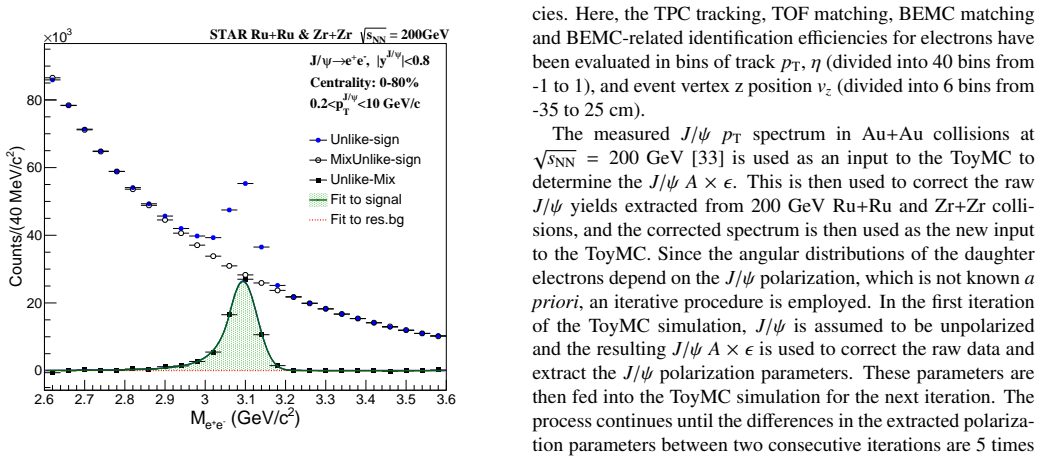
The first measurement of inclusive J/psi polarization at mid-rapidity (|y^{J/psi}| < 0.8) in 200 GeV Ru+Ru and Zr+Zr collisions at sqrt(s_NN) = 200 GeV with the STAR experiment at RHIC is presented. J/psi mesons are reconstructed through their di-electron (e+e-) decay channel. The polarization parameters (lambda_theta, lambda_phi) are measured as a function of the J/psi transverse momentum (p_T) and collision centrality in both the helicity and the Collins-Soper frames. These polarization parameters are found to be consistent with zero across the measured J/psi p_T range of 0.2 < p_T < 10 GeV/c and across collision centralities within 0-80 percent in both frames. These results are consistent with corresponding measurements p+p collisions at the same collision energy and with transport-model calculations.
Editorial analysis
A structured set of objections, weighed in public.
Referee Report
Summary. The manuscript presents the first measurement of inclusive J/ψ polarization in Ru+Ru and Zr+Zr collisions at √s_NN = 200 GeV with the STAR experiment. J/ψ mesons are reconstructed via the di-electron decay channel at mid-rapidity (|y| < 0.8). Polarization parameters λ_θ and λ_φ are extracted as functions of J/ψ p_T (0.2–10 GeV/c) and collision centrality (0–80%) in both the helicity and Collins-Soper frames. The central result is that both parameters are consistent with zero across the measured kinematic range in both collision systems, and the measurements agree with prior p+p data at the same energy as well as with transport-model calculations.
Significance. This is the first polarization measurement in isobar collisions at RHIC. If the result holds, it provides direct experimental input constraining the relative contributions of different J/ψ production mechanisms (color-singlet vs. color-octet) and the role of the medium in heavy-ion collisions. The consistency with zero polarization and with p+p data is a clear, falsifiable statement that can be used to test model predictions for quarkonium dynamics.
minor comments (3)
- The manuscript should explicitly state the functional form used for the angular distribution fit (e.g., the exact expression for the decay angular distribution in terms of λ_θ and λ_φ) and confirm that the fit is performed in the full 3D acceptance-corrected space rather than projected distributions.
- Section describing systematic uncertainties: the contribution from background subtraction and from the choice of signal and sideband regions should be quantified separately for each p_T and centrality bin, with the total systematic uncertainty shown as a separate band on the figures.
- The comparison to transport models would benefit from overlaying the model predictions with their theoretical uncertainty bands on the same plots as the data points.
Simulated Author's Rebuttal
We thank the referee for the positive summary of our manuscript and the recommendation for minor revision. The referee correctly identifies this as the first inclusive J/ψ polarization measurement in isobar collisions at RHIC, with results showing λ_θ and λ_φ consistent with zero across the measured p_T and centrality ranges in both frames, in agreement with p+p data and transport models. No specific major comments were raised in the report.
Circularity Check
No circularity: direct experimental measurement with external comparisons
full rationale
The paper reports a direct experimental extraction of inclusive J/ψ polarization parameters (λ_θ, λ_φ) from di-electron decays in Ru+Ru and Zr+Zr collisions. The analysis chain consists of reconstruction, acceptance/efficiency corrections, background subtraction, and fits to the angular distribution in helicity and Collins-Soper frames. The central claim—that the parameters are consistent with zero over the measured p_T and centrality range—is a data-driven result, not a derivation that reduces to its own inputs by construction. Consistency with prior p+p measurements and transport models is an external comparison, not a self-referential step. No self-definitional relations, fitted inputs renamed as predictions, or load-bearing self-citations appear in the derivation. The result is self-contained against external benchmarks.
Axiom & Free-Parameter Ledger
axioms (2)
- domain assumption J/ψ mesons are reconstructed via their decay to electron-positron pairs.
- standard math The angular distribution of decay products is parameterized by λ_θ and λ_φ in the helicity and Collins-Soper frames.
Lean theorems connected to this paper
-
IndisputableMonolith/Cost/FunctionalEquation.leanwashburn_uniqueness_aczel unclearThese polarization parameters are found to be consistent with zero across the measured J/ψ p_T range of 0.2 < p_T < 10 GeV/c and across collision centralities within 0-80 percent in both frames.
Reference graph
Works this paper leans on
-
[1]
Ulrich Heinz and Maurice Jacob. Evidence for a new state of matter: An assessment of the results from the CERN lead beam programme.arXiv preprint nucl-th/0002042, 2000
-
[2]
Braun-Munzinger, V
P. Braun-Munzinger, V . Koch, T. Schäfer, and J. Stachel. Properties of hot and dense matter from relativistic heavy- ion collisions.Phys. Rep., 621:76–126, 2016
2016
-
[3]
J. W. Harris and B. Müller. QGP signatures revisited.Eur. Phys. J. C, 84(3):247, 2024
2024
-
[4]
Matsui and H
T. Matsui and H. Satz. J/ψSuppression by Quark-Gluon Plasma Formation.Phys. Lett. B, 178:416–422, 1986
1986
-
[5]
Rothkopf
A. Rothkopf. Heavy Quarkonium in Extreme Conditions. Phys. Rept., 858:1–117, 2020
2020
-
[6]
R. L. Thews, M. Schroedter, and J. Rafelski. Enhanced J/ψProduction in Deconfined Quark Matter.Phys. Rev. C, 63:054905, 2001
2001
-
[7]
Z. B. Tang, W. M. Zha, and Y . F. Zhang. An experimental review of open heavy flavor and quarkonium production at RHIC.Nucl. Sci. Tech., 31(8):81, 2020
2020
-
[8]
A. Andronic, R. Arnaldi, et al. Quarkonia and Decon- fined Quark-Gluon Matter in Heavy-Ion Collisions.arXiv preprint arXiv:2501.08290, 2025
-
[9]
Faccioli et al
P. Faccioli et al. Towards the Experimental Clarification of Quarkonium Polarization.Eur. Phys. J. C, 69:657–673, 2010
2010
-
[10]
B. L. Ioffe and D. E. Kharzeev. Quarkonium Polariza- tion in Heavy Ion Collisions as a Possible Signature of the Quark-Gluon Plasma.Phys. Rev. C, 68:061902, 2003
2003
-
[11]
Observation ofχ c and χb nuclear suppression via dilepton polarization measure- ments.Phys
Pietro Faccioli and Joao Seixas. Observation ofχ c and χb nuclear suppression via dilepton polarization measure- ments.Phys. Rev. D, 85(7):074005, 2012
2012
-
[12]
Faccioli, C
P. Faccioli, C. Lourenço, J. Seixas, and H. K. Wöhri. De- termination ofχ c andψ ′ polarization in high-energy colli- sions.Phys. Rev. D, 83:096001, 2011
2011
-
[13]
Jiaxing Zhao and Baoyi Chen.J/ψpolarization in rela- tivistic heavy ion collisions.Eur. Phys. J. C, 84(8):875, 2024. 7 Table 2: InclusiveJ/ψpolarization parameters in the HX and CS frames for differentp J/ψ T bins within|y J/ψ|<0.8 in 0–80% Ru+Ru and Zr+Zr collisions at√sNN =200 GeV . The first uncertainty is statistical and the second systematic. pT (GeV...
2024
-
[14]
Zhao and S
J. Zhao and S. Shi. Detecting Nuclear Mass Distribution in Isobar Collisions via Charmonium.Eur. Phys. J. C, 83:571, 2023
2023
-
[15]
Vector meson’s spin alignments in high energy reactions.Science China Physics, Mechanics &Astronomy, 68(2):211001, 2025
Jin-Hui Chen, Zuo-Tang Liang, Yu-Gang Ma, Xin-Li 8 Sheng, and Qun Wang. Vector meson’s spin alignments in high energy reactions.Science China Physics, Mechanics &Astronomy, 68(2):211001, 2025
2025
-
[16]
Acharya et al
S. Acharya et al. First measurement of quarkonium po- larization in nuclear collisions at the LHC.Phys. Lett. B, 815:136146, 2021
2021
-
[17]
Aaij et al
R. Aaij et al. Measurement of J/ψpolarization inppcol- lisions at √s=7 TeV.Eur. Phys. J. C, 73:2431, 2013
2013
-
[18]
Faccioli and C
P. Faccioli and C. Lourenço.Particle Polarization in High Energy Physics: An Introduction and Case Studies on Vector Particle Production at the LHC. Springer Nature, 2023
2023
-
[19]
Y . F. Xu et al. Physics performance of the STAR zero degree calorimeter at relativistic heavy ion collider.Nucl. Sci. Tech., 27(6):126, 2016
2016
-
[20]
Anderson et al
M. Anderson et al. The STAR time projection chamber: a unique tool for studying high multiplicity events at RHIC. Nucl. Instrum. Methods Phys. Res. A, 499(2-3):659–678, 2003
2003
-
[21]
Bonner et al
B. Bonner et al. A single Time-of-Flight tray based on multigap resistive plate chambers for the STAR experi- ment at RHIC.Nucl. Instrum. Methods Phys. Res. A, 508(1-2):181–184, 2003
2003
-
[22]
Beddo et al
M. Beddo et al. The STAR barrel electromagnetic calorimeter.Nucl. Instrum. Methods Phys. Res. A, 499(2- 3):725–739, 2003
2003
-
[23]
Bergsma et al
F. Bergsma et al. The STAR detector magnet subsystem. Nucl. Instrum. Methods Phys. Res. A, 499(2-3):633–639, 2003
2003
-
[24]
Search for the chiral magnetic effect with isobar colli- sions at √sNN =200 GeV by the STAR Collaboration at the BNL Relativistic Heavy Ion Collider.Phys
BE Aboona, JR Adams, JK Adkins, MM Aggarwal, et al. Search for the chiral magnetic effect with isobar colli- sions at √sNN =200 GeV by the STAR Collaboration at the BNL Relativistic Heavy Ion Collider.Phys. Rev. C, 105(1):014901, 2022
2022
-
[25]
H. Bichsel. Comparison of Bethe-Bloch and Bichsel func- tions, STAR note SN0439. Technical report, Technical report, Dec. 20, 2001
2001
-
[26]
Oreglia, D
M. Oreglia, D. Butler, ..., and N. AuthorLast. Study of the reactionψ ′ →γγψ.Phys. Rev. D, 25(9):2259, 1982
1982
-
[27]
Charmonium spectroscopy from ra- diative decays of the J/ψandψ ′.Stanford University, 1983
John Erthal Gaiser. Charmonium spectroscopy from ra- diative decays of the J/ψandψ ′.Stanford University, 1983
1983
-
[28]
A study of the radiative cascade tran- sitions between theΥ ′ andΥresonances.DESY, 1986
Tomasz Skwarnicki. A study of the radiative cascade tran- sitions between theΥ ′ andΥresonances.DESY, 1986
1986
-
[29]
RooCrystalBall Class Ref- erence.https://root.cern.ch/doc/master/ classRooCrystalBall.html, 2025
ROOT Collaboration. RooCrystalBall Class Ref- erence.https://root.cern.ch/doc/master/ classRooCrystalBall.html, 2025. [Online; accessed 1-September-2025]
2025
-
[30]
Adam et al.Φmeson production in Au+Au and p+p collisions at √sNN =200 GeV.Phys
J. Adam et al.Φmeson production in Au+Au and p+p collisions at √sNN =200 GeV.Phys. Rev. C, 71(6):064902, 2005
2005
-
[31]
Adare et al
A. Adare et al. Detailed measurement of the e + e− pair continuum in p+p and Au+Au collisions at √sNN =200 GeV and implications for direct photon production.Phys. Rev. C, 81(3):034911, 2010
2010
-
[32]
Atomssa et al
E.T. Atomssa et al. J/ψproduction measurements by the PHENIX experiment.Eur. Phys. J. C, 61:683–686, 2009
2009
-
[33]
Adam et al
J. Adam et al. Measurement of inclusive J/ψsuppres- sion in Au+Au collisions at √sNN =200 GeV through the dimuon channel at STAR.Phys. Lett. B, 797:134917, 2019
2019
-
[34]
Adam et al
J. Adam et al. Measurement of inclusive J/ψpolarization inp+pcollisions at √s=200 GeV by the STAR experi- ment.Phys. Rev. D, 102(9):092009, 2020
2020
-
[35]
R. Barlow. Systematic errors: facts and fictions.arXiv preprint hep-ex/0207026, 2002
work page internal anchor Pith review arXiv 2002
-
[36]
B. E. Aboona et al. Observation of charmonium se- quential suppression in heavy-ion collisions at the rela- tivistic heavy ion collider.Phys. Rev. Lett., 136:122302,
- [37]
-
[38]
Bodwin, E
G.T. Bodwin, E. Braaten, and G.P. Lepage. Rigorous QCD analysis of inclusive annihilation and production of heavy quarkonium.Phys. Rev. D, 51(3):1125, 1995
1995
-
[39]
Butenschoen and B.A
M. Butenschoen and B.A. Kniehl. J/ψpolarization at the Tevatron and the LHC: nonrelativistic-QCD factorization at the crossroads.Phys. Rev. D, 82(3):034029, 2010
2010
-
[40]
Gong, L.P
B. Gong, L.P. Wan, J.X. Wang, and H.F. Zhang. Polariza- tion for prompt J/ψandψ(2s) production at the Tevatron and LHC.Phys. Rev. Lett., 110, 2013
2013
-
[41]
K. T. Chao et al. J/ψpolarization at hadron colliders in nonrelativistic QCD.Phys. Rev. Lett., 108(24):242004, 2012
2012
-
[42]
Y . Q. Ma et al. J/ψpolarization in the CGC+NRQCD approach.J. High Energy Phys., 2018(12):1–27, 2018
2018
-
[43]
Adamczyk et al
L. Adamczyk et al. J/ψproduction at high transverse mo- menta inp+pand Au+Au collisions at √sNN =200 GeV. Phys. Lett. B, 722:55–62, 2013. 9
2013
discussion (0)
Sign in with ORCID, Apple, or X to comment. Anyone can read and Pith papers without signing in.