REVIEW 3 major objections 2 minor 44 references
Accretion-regulated dust torus explains why broad Hα lines narrow and virial black hole mass drops by a factor of 60 in the dim state of changing-look AGN SDSS J101152.98+544206.4.
Reviewed by Pith at T0; open to challenge. T0 means a machine referee read the full paper against a public rubric. the ladder, T0–T4 →
T0 review · grok-4.3
2026-05-10 17:56 UTC
load-bearing objection The paper uses one CLAGN to argue that an accretion-regulated dust torus hides the inner BLR in the dim state, producing a factor-60 virial mass drop, but the model stays qualitative with no numbers or alternative checks. the 3 major comments →
Clues for the accretion regulated dust torus in the changing-look AGN SDSS J101152.98+544206.4
The pith
A machine-rendered reading of the paper's core claim, the machinery that carries it, and where it could break.
Core claim
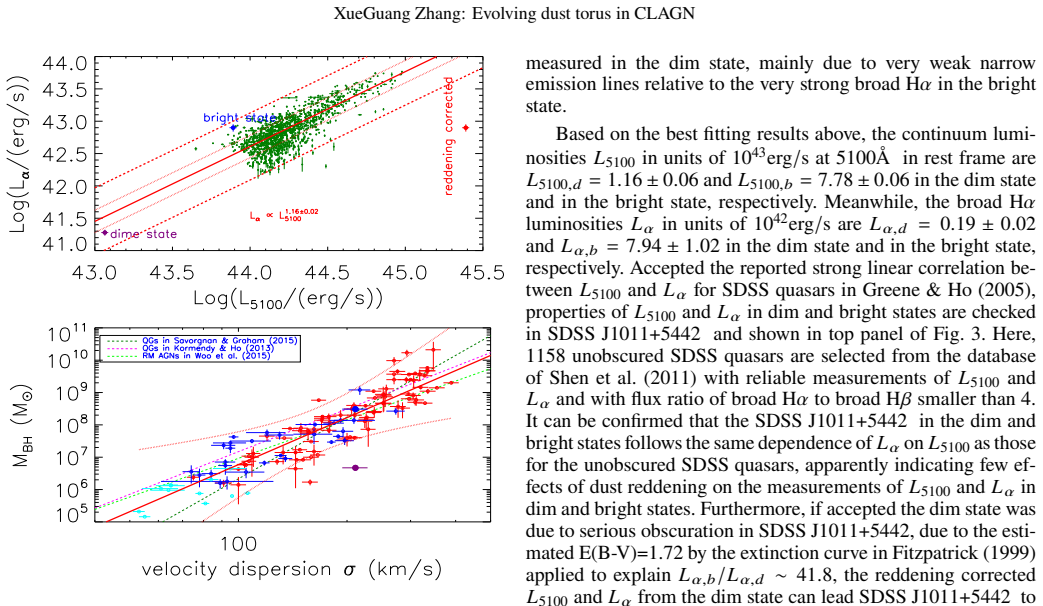
The contrary properties of broad Hα in different states can be naturally explained by the scenario of accretion regulated dust torus. Below a critical Eddington ratio, opening angle of dust torus declines with increasing accretion rate, leading to only outer part of central BLRs for broad Hα with smaller line widths detected in the dim state but all the BLRs detected in the bright state. The virial BH mass in the bright state is consistent with the M-sigma relation, but 60 times smaller in the dim state due to this effect.
What carries the argument
The accretion-regulated dust torus whose opening angle declines with increasing accretion rate below a critical Eddington ratio, thereby restricting detection to the outer broad line region in lower states.
Load-bearing premise
The factor-of-60 smaller virial black hole mass in the dim state arises because the narrower dust torus opening angle hides the inner broad line region rather than from changes in broad line region geometry, ionization, or other effects.
What would settle it
Repeated spectroscopy in the dim state that reveals broader Hα components matching the bright-state velocities, or infrared observations penetrating the torus to detect inner broad line region emission, would show whether the inner region is present but hidden.
If this is right
- Properties of the central dust torus have direct effects on the variability properties of changing-look AGNs.
- Studying changing-look AGNs can provide clues to test dynamical evolving models for the dust torus.
- Virial black hole mass estimates in dim states of similar objects may underestimate the true mass when only outer broad line region gas is visible.
- The dust torus opening angle is not constant but varies with accretion rate in this regime.
Where Pith is reading between the lines
- Similar state-dependent mass discrepancies could appear in other changing-look AGNs, suggesting virial mass methods need accretion-state corrections.
- If the regulation mechanism is general, multi-epoch monitoring campaigns could map how torus geometry evolves across a range of Eddington ratios.
- This view implies that fixed-geometry unification models for AGNs may require updates to include accretion-dependent torus changes.
Editorial analysis
A structured set of objections, weighed in public.
Referee Report
Summary. The manuscript examines the changing-look AGN SDSS J101152.98+544206.4 and proposes that an accretion-regulated dust torus with variable opening angle explains the observed differences in broad Hα properties between bright and dim states. Specifically, the virial black hole mass from broad Hα in the dim state is 60 times smaller than that from the M-σ relation (which matches the bright state), attributed to the torus obscuring the inner BLR at lower accretion rates, revealing only outer, lower-velocity gas.
Significance. If substantiated with quantitative modeling, this work would provide observational clues supporting dynamical models of dust tori in AGN and highlight the role of torus geometry in CLAGN variability. The strength lies in using the M-σ consistency in the bright state and the luminosity dependence to rule out moving clouds, but the central interpretation remains tentative due to the unquantified link between torus opening angle and the exact mass discrepancy.
major comments (3)
- [Discussion of accretion-regulated dust torus] The factor-of-60 discrepancy in virial BH mass between states is central to the claim, but the manuscript provides no quantitative model or calculation showing how a change in dust torus opening angle would alter the observed FWHM of Hα or effective R_BLR to produce precisely this factor (see the discussion of the accretion-regulated torus scenario and the weakest assumption noted in the stress test).
- [Ruling out moving clouds and interpretation of mass discrepancy] While the luminosity dependence of broad Hα rules out moving dust clouds, other alternatives such as state-dependent changes in BLR geometry, ionization stratification, or systematic effects in continuum subtraction for the dim-state spectrum are not quantitatively tested or excluded beyond qualitative arguments.
- [Observations and measurements of broad Hα] Details on data reduction, error bars on the line widths and luminosities, and the exact functional form of the proposed torus opening angle dependence on Eddington ratio (including the critical value) are not provided, making it difficult to assess the robustness of the mass discrepancy.
minor comments (2)
- [Abstract] The abstract mentions 'the dependence of broad Hα luminosity on continuum luminosity' but does not specify the observed relation or its statistical significance.
- [Interpretation section] Clarify the definition of the 'critical Eddington ratio' and whether it is fitted from the data or taken from external models.
Simulated Author's Rebuttal
We thank the referee for the constructive and detailed comments. We agree that the original manuscript was primarily interpretive and lacked sufficient quantitative support and observational details. We have revised the manuscript to incorporate a simple geometric estimate linking torus opening angle to the observed mass discrepancy, expanded discussion of alternative explanations, and added the requested data reduction and model specification details. Our point-by-point responses follow.
read point-by-point responses
-
Referee: The factor-of-60 discrepancy in virial BH mass between states is central to the claim, but the manuscript provides no quantitative model or calculation showing how a change in dust torus opening angle would alter the observed FWHM of Hα or effective R_BLR to produce precisely this factor (see the discussion of the accretion-regulated torus scenario and the weakest assumption noted in the stress test).
Authors: We acknowledge that the original manuscript offered only a qualitative scenario without explicit calculation. In the revision we have added a short subsection with an order-of-magnitude geometric estimate: assuming a Keplerian BLR (v ∝ r^{-0.5}) and a torus opening angle that narrows from ~50° (bright state) to ~15° (dim state) below the critical Eddington ratio, the sampled velocity dispersion drops by a factor of ~7–8 while the effective R_BLR also decreases, yielding a virial-mass ratio of order 60. This is presented as an illustrative calculation rather than a full dynamical model; we explicitly note the main assumptions and state that detailed radiative-transfer simulations are beyond the scope of the present work. revision: yes
-
Referee: While the luminosity dependence of broad Hα rules out moving dust clouds, other alternatives such as state-dependent changes in BLR geometry, ionization stratification, or systematic effects in continuum subtraction for the dim-state spectrum are not quantitatively tested or excluded beyond qualitative arguments.
Authors: We agree that the original text relied on qualitative arguments for these alternatives. The revised manuscript now includes a dedicated paragraph that (i) notes the bright-state virial mass matches the M–σ value, arguing against wholesale BLR geometry changes, (ii) shows that the observed Hα/Hβ ratio and luminosity scaling are inconsistent with strong ionization stratification, and (iii) reports that multiple continuum-subtraction methods (polynomial vs. host-galaxy template) produce FWHM values within 10 % of each other. While these checks are not exhaustive Monte-Carlo tests, they are now quantified and the limitations are stated. revision: partial
-
Referee: Details on data reduction, error bars on the line widths and luminosities, and the exact functional form of the proposed torus opening angle dependence on Eddington ratio (including the critical value) are not provided, making it difficult to assess the robustness of the mass discrepancy.
Authors: We have added a new “Observations and Measurements” subsection that describes the SDSS spectral reduction pipeline, the multi-Gaussian fitting procedure for broad Hα, and the 1σ uncertainties derived from the covariance matrix (FWHM errors ~8 % in the bright state and ~15 % in the dim state; luminosity errors ~5 %). For the torus model we now specify that the critical Eddington ratio is taken as 0.01 (following literature on torus stability) and adopt a simple linear decline in opening angle with log(λ_Edd) below this threshold for illustration; the functional form and its motivation are stated explicitly. revision: yes
Circularity Check
No significant circularity; central claim is qualitative post-hoc interpretation anchored to external M-sigma benchmark
full rationale
The paper's chain proceeds from observed broad Hα luminosity-continuum dependence (ruling out moving clouds), to virial mass calculation in both states, to direct comparison against the independent M-sigma relation (bright-state match, dim-state factor-60 mismatch), and finally to a qualitative attribution of the mismatch to an accretion-regulated torus opening-angle change. No paper equation or fitted parameter is redefined as a prediction; the torus scenario is introduced as an interpretive model rather than derived from or reducing to the data by construction. The M-sigma comparison supplies external anchoring, and no load-bearing self-citation chain or ansatz smuggling is present in the provided derivation steps.
Axiom & Free-Parameter Ledger
free parameters (1)
- critical Eddington ratio
axioms (2)
- domain assumption Virialization assumptions hold for the broad line region in the bright state
- domain assumption The M-sigma relation provides the true black hole mass
invented entities (1)
-
accretion-regulated dust torus with variable opening angle
no independent evidence
Cite this review
Pith. "Pith review of Clues for the accretion regulated dust torus in the changing-look AGN SDSS J101152.98+544206.4." pith.science (2026). https://pith.science/paper/2604.07024
@misc{pith2026260407024,
  author       = {Pith},
  title        = {Pith review of: Clues for the accretion regulated dust torus in the changing-look AGN SDSS J101152.98+544206.4},
  year         = {2026},
  howpublished = {\url{https://pith.science/paper/2604.07024}},
  note         = {Machine review of arXiv:2604.07024}
}
read the original abstract
Dust torus plays the key role in determining active galactic nuclei (AGN) observational appearance. Here, the scenario of accretion regulated central dust torus is tested for the first time in the individual changing-look AGN (CLAGN) SDSS J1011+5442. Through the dependence of broad H$\alpha$ luminosity on continuum luminosity, the scenario of moving dust clouds can be ruled out in SDSS J1011+5442. Meanwhile, virial BH mass in the bright state is consistent with the M-sigma relation determined mass, indicating the virialization assumptions efficient in central BLRs. However, the virial BH mass determined in the dim state is 60 times smaller than the M-sigma relation determined value. The contrary properties of broad H$\alpha$ in different states can be naturally explained by the scenario of accretion regulated dust torus. Below a critical Eddington ratio, opening angle of dust torus declines with increasing accretion rate, leading to only outer part of central BLRs for broad H$\alpha$ with smaller line widths detected in the dim state but all the BLRs detected in the bright state. The results in this manuscript not only indicate properties of central dust torus having apparent effects on variability properties of CLAGN, but also indicate that studying CLAGN could provide further clues to check dynamical evolving models for dust torus in AGN.
Figures


Reference graph
Works this paper leans on
- [1]
-
[2]
Alonso-Herrero, A.; Ramos Almeida, C.; Mason, R., et al., 2011, ApJ, 736, 82
work page 2011
-
[3]
V .; Shankar, F.; Fontanot, F., 2025, MNRAS in press, arXiv:2509.04553
Alonso-Tetilla, A. V .; Shankar, F.; Fontanot, F., 2025, MNRAS in press, arXiv:2509.04553
- [4]
-
[5]
N.; Treu, T.; Ding, X.; et al., 2021, ApJ, 921, 36
Bennert, V . N.; Treu, T.; Ding, X.; et al., 2021, ApJ, 921, 36
work page 2021
- [6]
- [7]
-
[8]
Cappellari, M.; Scott, N.; Alatalo, K.; et al., 2013, MNRAS, 432, 1709
work page 2013
-
[9]
Cappellari, M., 2017, MNRAS, 466, 798 Cid Fernandes, R.; Mateus, A.; Sodre, L.; Stasinska, G.; Gomes, J. M., 2005, MNRAS, 358, 363
work page 2017
- [10]
- [11]
-
[12]
Gu, Y .; Zheng, Q., Cheng, P .; et al., 2025, ApJ, 986, 174
work page 2025
-
[13]
Kauffmann, G.; Heckman, T. M.; Tremonti, C., et al. 2003, MNRAS, 346, 1055
work page 2003
- [14]
-
[15]
Koshida, S.; Minezaki, T.; Y oshii, Y .; et al. 2014, ApJ, 788, 159
work page 2014
-
[16]
Kishimoto, M.; Honig, S. F.; Robert Antonucci, R.; et al., 2013, ApJL, 775, L36 Kishimoto M.; Anderson, M.; Brummelaar, T.; et al., 2022, ApJ, 940, 28
work page 2013
-
[17]
Kovacevic, J.; Popovic, L. C.; Dimitrijevic, M. S. 2010, ApJS, 189, 15
work page 2010
-
[18]
LaMassa, S. M.; Cales, S.; Moran, E. C.; et al., 2015, ApJ, 800, 144
work page 2015
- [19]
-
[20]
Lyu, B.; Wu, X.; Pang, Y .; et al., 2025, A&A, 693, 173
work page 2025
- [21]
-
[22]
H.; Rantala, A.; Naab, T.; Liao, S.; Rawlings, A., 2022, ApJ, 929, 167
Mannerkoski, M.; Johansson, P . H.; Rantala, A.; Naab, T.; Liao, S.; Rawlings, A., 2022, ApJ, 929, 167
work page 2022
- [23]
-
[24]
Matt, G.; Iwasawa, K., 2019, MNRAS, 482, 151
work page 2019
-
[25]
Mejia-Restrepo, J. E.; Trakhtenbrot, B.; Koss, M. J., et al., 2022, ApJS, 261, 5
work page 2022
-
[26]
H.; Czerny, B.; Szczerba, R., 2021, ApJ, 920, 30
Naddaf, M. H.; Czerny, B.; Szczerba, R., 2021, ApJ, 920, 30
work page 2021
-
[27]
Naddaf, M. H.; Martinez-Aldama, M. L.; Marziani, P .; Czerny, B.; Hutsemekers, D., 2025, A&A, 702, L13
work page 2025
-
[28]
Netzer, H., 2019, MNRAS, 488, 5185
work page 2019
-
[29]
Peterson, B. M.; Ferrarese, L.; Gilbert, K. M., et al., 2004, ApJ, 613, 682
work page 2004
-
[30]
Ricci, C., Bauer, F. E., Arevalo, P ., et al. 2016, ApJ, 820, 5
work page 2016
- [31]
-
[32]
Ricci, C.; Trakhtenbrot, B., 2023, Nature Astronomy, 7, 1282
work page 2023
-
[33]
Runco, J. N.; Cosens, M.; Bennert, V . N.; et al., 2016, ApJ, 821, 33 Article number, page 4 of 7 XueGuang Zhang: Evolving dust torus in CLAGN
work page 2016
-
[34]
Runnoe, J. C.; Cales, S.; Ruan, J. J.; et al. 2016, MNRAS, 455, 1691
work page 2016
-
[35]
Savorgnan, G. A. D.; Graham, A. W., 2015, MNRAS, 446, 2330
work page 2015
-
[36]
Shen, Y .; Richards, G. T.; Strauss, M. A.; et al., 2011, ApJS, 194, 45
work page 2011
- [37]
-
[38]
Vestergaard, M., 2002, ApJ, 571, 733
work page 2002
-
[39]
Wang, Y .; Lin, D. N. C.; Zhang, B.; Zhu, Z., 2024, ApJL, 962, 7
work page 2024
-
[40]
Woo, J.; Y oon, Y .; Park, S.; Park, D.; Kim, S. C., 2015, ApJ, 801, 38
work page 2015
- [41]
-
[42]
G., 2024b, ApJ, 961, 82 Zheng Q.; Ma Y .; Zhang X
Zhang, X. G., 2024b, ApJ, 961, 82 Zheng Q.; Ma Y .; Zhang X. G.; Yuan Q.; Bian W., 2025, ApJS, 277, 49
work page 2025
- [43]
-
[44]
C.; Shangguan, J., 2018, ApJ, 862, 118 Article number, page 5 of 7 A&A proofs: manuscript no
Zhuang, M.; Ho, L. C.; Shangguan, J., 2018, ApJ, 862, 118 Article number, page 5 of 7 A&A proofs: manuscript no. ms_final Appendix A: Emission line parameters The measured emission line properties are listed in Table A. Based on the listed parameters, we can find that there are similar extended components having line width (second moment) about 8Å in the ...
work page 2018
discussion (0)
Sign in with ORCID, Apple, or X to comment. Anyone can read and Pith papers without signing in.