Recognition: no theorem link
Continuous-variable two-dimensional cluster states in the microwave domain
Pith reviewed 2026-05-10 18:01 UTC · model grok-4.3
The pith
A Josephson parametric amplifier pumped by multiple coherent tones produces two-dimensional continuous-variable cluster states spanning 191 microwave modes.
A machine-rendered reading of the paper's core claim, the machinery that carries it, and where it could break.
Core claim
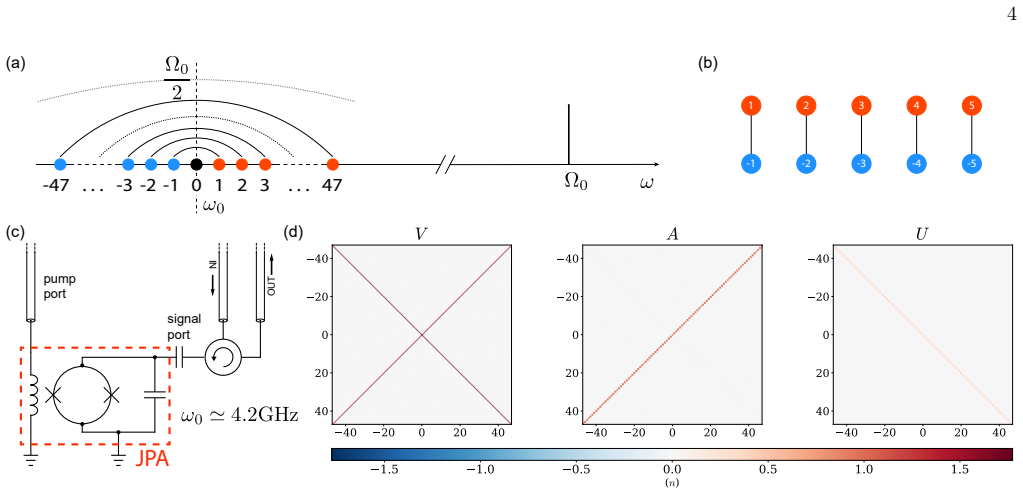
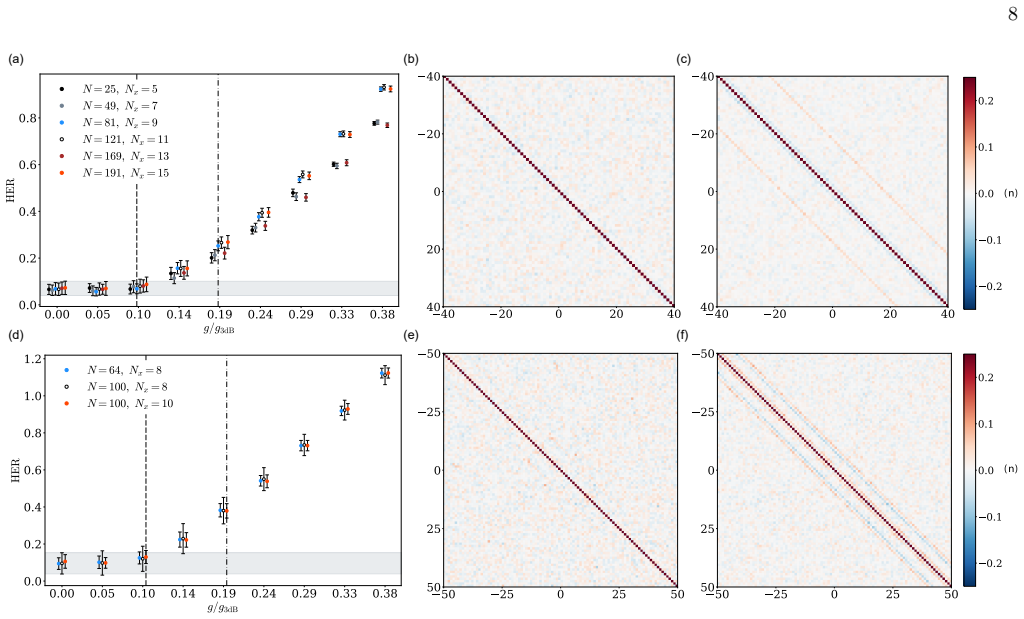
By exposing vacuum fluctuations to the input of a Josephson Parametric Amplifier parametrically pumped by a sum of three or four coherent tones around twice its resonant frequency, interference between mixing products is engineered to realize honeycomb and square lattice CV cluster states involving 191 modes, confirmed by a nullifier test that reaches up to -1.2 dB squeezing and by a hidden-entanglement analysis showing negligible hidden entanglement at optimal squeezing.
What carries the argument
Parametric pumping of the Josephson parametric amplifier by a sum of coherent tones, whose frequencies, amplitudes and phases are chosen so that the interference among the generated mixing products produces the quadrature correlations required for the target lattice cluster state.
If this is right
- A single device can generate cluster states whose size is set by the amplifier bandwidth rather than by the number of separate squeezers.
- Lattice geometry can be switched between honeycomb and square simply by changing the number of pump tones from three to four.
- The measured nullifier squeezing directly quantifies the quality of the generated resource for measurement-based protocols.
- Hidden entanglement stays low across the range of squeezing values tested, indicating that the observed correlations are not an artifact of partial information.
Where Pith is reading between the lines
- The same multi-tone pumping technique could be applied to wider-bandwidth amplifiers or to cascaded devices to reach thousands of modes.
- Because the entire process occurs inside a superconducting circuit, the generated states are immediately compatible with existing microwave quantum-control hardware.
- Extending the method to include frequency-dependent phase shifts or additional tones could produce cluster states with different connectivity graphs or higher effective dimension.
Load-bearing premise
The observed nullifier squeezing together with the hidden-entanglement measurements are enough to establish genuine multipartite cluster-state entanglement without unaccounted experimental artifacts or post-selection.
What would settle it
A complete measurement of the 191-mode covariance matrix that yields nullifier variances no lower than the vacuum level, or that fails to match the specific linear combinations expected for the honeycomb or square lattice, would falsify the claim.
Figures




read the original abstract
We demonstrate the experimental realization of two-dimensional, continuous variable (CV) cluster states between 191 microwave frequency modes. This result is obtained by exposing vacuum fluctuations to the input of a Josephson Parametric Amplifier, parametrically pumped by a sum of coherent tones around twice its resonant frequency. By carefully tuning pump frequencies, amplitudes, and phases we engineer the interference between mixing products and realize honeycomb and square lattice CV cluster states with three and four pump tones respectively. We prove the presence of the cluster states with a suitable nullifier test, reaching up to $-1.2$ dB of squeezing of the cluster state's nullifiers. We study hidden entanglement (HE) and show no hidden entanglement up to $\sim -1$ dB of squeezing and negligible HE at optimal squeezing.
Editorial analysis
A structured set of objections, weighed in public.
Referee Report
Summary. The manuscript reports an experimental demonstration of two-dimensional continuous-variable cluster states spanning 191 microwave modes, generated by multi-tone parametric pumping of a Josephson Parametric Amplifier. Honeycomb and square lattices are realized with three and four pump tones, respectively, and certified via a nullifier test reaching -1.2 dB squeezing together with a hidden-entanglement analysis showing negligible hidden entanglement at optimal squeezing.
Significance. If the lattice-specific certification holds, the result would be a notable advance in scalable microwave-domain CV quantum information processing, showing that multi-tone pumping can deterministically engineer large 2D cluster-state graphs from vacuum fluctuations. The approach offers a potentially parameter-efficient route to high-mode-number entanglement without requiring individual mode addressing.
major comments (2)
- [Results / nullifier test] The nullifier test (results section describing the squeezing measurements): while an average or collective squeezing of -1.2 dB is reported, the manuscript does not present per-nullifier variances or the full 382-dimensional covariance matrix. For a claim of a specific 2D lattice (honeycomb or square), each nullifier must be shown to match the exact linear combination dictated by the target adjacency matrix; an aggregate squeezing value alone cannot exclude alternative connectivities (e.g., 1D chains or denser graphs) produced by the same pump tones.
- [Hidden entanglement analysis] Hidden-entanglement analysis (section on HE): the biseparability test is performed in the nullifier basis chosen for the intended lattice. Without an independent verification that the measured correlations are inconsistent with other graphs compatible with the pump spectrum, the HE bound does not fully rule out that a subset of the 191 modes remains unentangled or connected differently.
minor comments (2)
- [Figures and Methods] Figure captions and methods should explicitly list the pump-tone frequencies, amplitudes, and phases used for each lattice, together with the precise nullifier operators employed in the squeezing measurement.
- [Results] Error bars, statistical significance, and calibration procedures for the -1.2 dB squeezing value are not detailed in the provided text; these should be added to allow quantitative assessment of the result.
Simulated Author's Rebuttal
We thank the referee for their careful reading of our manuscript and for the constructive comments. We address each major point below and indicate the revisions we will make.
read point-by-point responses
-
Referee: The nullifier test (results section describing the squeezing measurements): while an average or collective squeezing of -1.2 dB is reported, the manuscript does not present per-nullifier variances or the full 382-dimensional covariance matrix. For a claim of a specific 2D lattice (honeycomb or square), each nullifier must be shown to match the exact linear combination dictated by the target adjacency matrix; an aggregate squeezing value alone cannot exclude alternative connectivities (e.g., 1D chains or denser graphs) produced by the same pump tones.
Authors: We agree that reporting the individual nullifier variances strengthens the certification of the specific lattice. In the revised manuscript we will add a table (or supplementary figure) listing the measured variance for each nullifier of the honeycomb and square lattices, confirming that every nullifier reaches squeezing consistent with the target adjacency matrix. The full 382-by-382 covariance matrix cannot be displayed in the main text or supplementary material because of its size; however, the nullifier test is the established, efficient method for verifying the exact linear combinations required by the graph. The multi-tone pump frequencies, amplitudes and phases are chosen to produce only the mixing products that realize the desired adjacency matrix, and we will add a short discussion explaining why other connectivities (such as 1D chains) are incompatible with the observed interference pattern. revision: partial
-
Referee: Hidden-entanglement analysis (section on HE): the biseparability test is performed in the nullifier basis chosen for the intended lattice. Without an independent verification that the measured correlations are inconsistent with other graphs compatible with the pump spectrum, the HE bound does not fully rule out that a subset of the 191 modes remains unentangled or connected differently.
Authors: The hidden-entanglement bound is evaluated in the nullifier basis to detect entanglement beyond the nullifiers. We acknowledge that an exhaustive comparison against every graph compatible with the pump spectrum would be desirable. In revision we will expand the HE section to note that the discrete set of pump tones restricts the generated correlations to the specific mixing products required by the target lattice; alternative connectivities would require different pump frequencies and are therefore excluded by the experimental configuration. We will also clarify that the HE analysis already shows negligible hidden entanglement at the optimal squeezing level, supporting the conclusion that the full 191-mode cluster state is realized. revision: partial
Circularity Check
No circularity in experimental demonstration
full rationale
The paper reports a direct experimental realization of 2D CV cluster states by multi-tone pumping of a JPA, with certification via measured nullifier squeezing (up to -1.2 dB) and hidden entanglement analysis. No mathematical derivation, prediction, or first-principles result is presented that reduces to self-defined quantities, fitted parameters renamed as predictions, or load-bearing self-citations. The nullifier test applies standard CV cluster-state definitions to the engineered graph; any question of whether the measurements fully certify the exact 191-mode lattice connectivity is an evidentiary concern, not a circular reduction by construction. The work is self-contained against external benchmarks.
Axiom & Free-Parameter Ledger
free parameters (1)
- Pump tone frequencies, amplitudes, and phases
axioms (1)
- standard math Standard quantum mechanics of parametric amplification and vacuum fluctuations
Reference graph
Works this paper leans on
-
[1]
H.J. Briegel, D.E. Browne, W. D¨ ur, R. Raussendorf, M. Van Den Nest, Measurement-based quantum com- putation. Nature Physics5(1), 19–26 (2009). doi: 10.1038/nphys1157. URLhttps://www.nature.com/ articles/nphys1157
-
[2]
N.C. Menicucci, P. van Loock, M. Gu, C. Weed- brook, T.C. Ralph, M.A. Nielsen, Universal Quantum Computation with Continuous-Variable Cluster States. Physical Review Letters97(11), 110501 (2006). doi: 10.1103/PhysRevLett.97.110501. URLhttps://link. aps.org/doi/10.1103/PhysRevLett.97.110501
-
[3]
R. Raussendorf, H.J. Briegel, A One-Way Quantum Computer. Physical Review Letters86(22), 5188–5191 (2001). doi:10.1103/PhysRevLett.86.5188. URLhttps: //link.aps.org/doi/10.1103/PhysRevLett.86.5188
-
[4]
R. Raussendorf, D.E. Browne, H.J. Briegel, Measurement-based quantum computation with cluster states. Physical Review A68(2), 022312 (2003). doi:10.1103/PhysRevA.68.022312. URLhttp://arxiv.org/abs/quant-ph/0301052. ArXiv:quant-ph/0301052
-
[5]
Menicucci, One-Way Quantum Computing in the Optical Frequency Comb
N.C. Menicucci, One-Way Quantum Computing in the Optical Frequency Comb. Physical Review Letters 101(13) (2008). doi:10.1103/PhysRevLett.101.130501 10
-
[6]
M. Gu, C. Weedbrook, N.C. Menicucci, T.C. Ralph, P. Van Loock, Quantum computing with continuous- variable clusters. Physical Review A79(6), 062318 (2009). doi:10.1103/PhysRevA.79.062318. URLhttps: //link.aps.org/doi/10.1103/PhysRevA.79.062318
-
[7]
J. Zhang, S.L. Braunstein, Continuous-variable Gaussian analog of cluster states. Physical Review A73(3), 032318 (2006). doi:10.1103/PhysRevA.73.032318. URLhttps: //link.aps.org/doi/10.1103/PhysRevA.73.032318
-
[8]
Weedbrooket al., Gaussian quantum in- formation, Rev
C. Weedbrook, S. Pirandola, R. Garc´ ıa-Patr´ on, N.J. Cerf, T.C. Ralph, J.H. Shapiro, S. Lloyd, Gaussian quan- tum information. Reviews of Modern Physics84(2), 621–669 (2012). doi:10.1103/RevModPhys.84.621. URL https://link.aps.org/doi/10.1103/RevModPhys.84. 621
-
[9]
N.C. Menicucci, Fault-Tolerant Measurement-Based Quantum Computing with Continuous-Variable Cluster States. Physical Review Letters112(12), 120504 (2014). doi:10.1103/PhysRevLett.112.120504. URLhttps:// link.aps.org/doi/10.1103/PhysRevLett.112.120504
-
[10]
M. Chen, N.C. Menicucci, O. Pfister, Experimen- tal Realization of Multipartite Entanglement of 60 Modes of a Quantum Optical Frequency Comb. Phys- ical Review Letters112(12), 120505 (2014). doi: 10.1103/PhysRevLett.112.120505. URLhttps://link. aps.org/doi/10.1103/PhysRevLett.112.120505
-
[11]
Pfister, Continuous-variable quantum computing in the quantum optical frequency comb
O. Pfister, Continuous-variable quantum computing in the quantum optical frequency comb. Journal of Physics B: Atomic, Molecular and Optical Physics 53(1), 012001 (2020). doi:10.1088/1361-6455/ab526f. URLhttps://iopscience.iop.org/article/10.1088/ 1361-6455/ab526f
-
[12]
M. Yukawa, R. Ukai, P. Van Loock, A. Furusawa, Ex- perimental generation of four-mode continuous-variable cluster states. Physical Review A78(1), 012301 (2008). doi:10.1103/PhysRevA.78.012301. URLhttps://link. aps.org/doi/10.1103/PhysRevA.78.012301
-
[13]
N.C. Menicucci, X. Ma, T.C. Ralph, Arbitrar- ily Large Continuous-Variable Cluster States from a Single Quantum Nondemolition Gate. Physi- cal Review Letters104(25), 250503 (2010). doi: 10.1103/PhysRevLett.104.250503. URLhttps://link. aps.org/doi/10.1103/PhysRevLett.104.250503
-
[14]
Menicucci, Temporal-mode continuous-variable cluster states using linear optics
N.C. Menicucci, Temporal-mode continuous-variable cluster states using linear optics. Physical Review A 83(6), 062314 (2011). doi:10.1103/PhysRevA.83.062314. URLhttps://link.aps.org/doi/10.1103/PhysRevA. 83.062314
-
[15]
S. Yokoyama, R. Ukai, S.C. Armstrong, C. Sorn- phiphatphong, T. Kaji, S. Suzuki, J.i. Yoshikawa, H. Yonezawa, N.C. Menicucci, A. Furusawa, Ultra-large- scale continuous-variable cluster states multiplexed in the time domain. Nature Photonics7(12), 982–986 (2013). doi:10.1038/nphoton.2013.287. URLhttps: //www.nature.com/articles/nphoton.2013.287
-
[16]
Y. Cai, J. Roslund, G. Ferrini, F. Arzani, X. Xu, C. Fabre, N. Treps, Multimode entanglement in recon- figurable graph states using optical frequency combs. Nature Communications8(1), 15645 (2017). doi: 10.1038/ncomms15645. URLhttps://www.nature.com/ articles/ncomms15645
-
[17]
W. Asavanant, Y. Shiozawa, S. Yokoyama, B. Charoen- sombutamon, H. Emura, R.N. Alexander, S. Takeda, J.i. Yoshikawa, N.C. Menicucci, H. Yonezawa, A. Furusawa, Generation of time-domain-multiplexed two-dimensional cluster state. Science366(6463), 373–376 (2019). doi: 10.1126/science.aay2645. URLhttps://www.science. org/doi/10.1126/science.aay2645
-
[18]
M.V. Larsen, X. Guo, C.R. Breum, J.S. Neergaard- Nielsen, U.L. Andersen, Deterministic generation of a two-dimensional cluster state. Science366(6463), 369– 372 (2019). doi:10.1126/science.aay4354. URLhttps: //www.science.org/doi/10.1126/science.aay4354
-
[19]
L.S. Madsen, F. Laudenbach, M.F. Askarani, F. Rortais, T. Vincent, J.F.F. Bulmer, F.M. Miatto, L. Neuhaus, L.G. Helt, M.J. Collins, A.E. Lita, T. Gerrits, S.W. Nam, V.D. Vaidya, M. Menotti, I. Dhand, Z. Ver- non, N. Quesada, J. Lavoie, Quantum computational advantage with a programmable photonic processor. Nature606(7912), 75–81 (2022). doi:10.1038/s41586...
-
[20]
A full-stack analog optical quantum computing platform with one hundred inputs
S. Yokoyama, A. Sakaguchi, W. Asavanant, K. Takase, Y.R. Chen, H. Nagayoshi, J.i. Yoshikawa, T. Kashi- wazaki, A. Inoue, T. Umeki, T. Hashimoto, T. Hiraoka, A. Furusawa, H. Yonezawa. Full-stack Analog Optical Quantum Computer with A Hundred Inputs (2025). doi: 10.48550/arXiv.2506.16147. URLhttp://arxiv.org/ abs/2506.16147. ArXiv:2506.16147 [quant-ph]
work page internal anchor Pith review Pith/arXiv arXiv doi:10.48550/arxiv.2506.16147 2025
-
[21]
E.P. Menzel, R. Di Candia, F. Deppe, P. Eder, L. Zhong, M. Ihmig, M. Haeberlein, A. Baust, E. Hoffmann, D. Ballester, K. Inomata, T. Yamamoto, Y. Naka- mura, E. Solano, A. Marx, R. Gross, Path Entan- glement of Continuous-Variable Quantum Microwaves. Physical Review Letters109(25), 250502 (2012). doi: 10.1103/PhysRevLett.109.250502. URLhttps://link. aps.o...
-
[22]
S.W. Jolin, G. Andersson, J.C.R. Hern´ andez, I. Strand- berg, F. Quijandr´ ıa, J. Aumentado, R. Borgani, M.O. Thol´ en, D.B. Haviland, Multipartite Entan- glement in a Microwave Frequency Comb. Phys- ical Review Letters130(12), 120601 (2023). doi: 10.1103/PhysRevLett.130.120601. URLhttps://link. aps.org/doi/10.1103/PhysRevLett.130.120601
-
[23]
J.C.R. Hern´ andez, F. Lingua, S.W. Jolin, D.B. Havi- land, Control of multi-modal scattering in a microwave frequency comb. APL Quantum1(3), 036101 (2024). doi: 10.1063/5.0203426. URLhttp://arxiv.org/abs/2402. 09068. ArXiv:2402.09068 [quant-ph]
-
[24]
C. Eichler, D. Bozyigit, C. Lang, M. Baur, L. Steffen, J.M. Fink, S. Filipp, A. Wallraff, Observation of Two- Mode Squeezing in the Microwave Frequency Domain. Physical Review Letters107(11), 113601 (2011). doi: 10.1103/PhysRevLett.107.113601. URLhttps://link. aps.org/doi/10.1103/PhysRevLett.107.113601
-
[25]
K.V. Petrovnin, M.R. Perelshtein, T. Korkalainen, V. Vesterinen, I. Lilja, G.S. Paraoanu, P.J. Hako- nen, Generation and Structuring of Multipartite En- tanglement in a Josephson Parametric System. Ad- vanced Quantum Technologies6(1), 2200031 (2023). doi: 10.1002/qute.202200031. URLhttps://onlinelibrary. wiley.com/doi/abs/10.1002/qute.202200031
-
[26]
A. Alocco, A. Celotto, E. Palumbo, B. Galvano, P. Livreri, L. Fasolo, L. Callegaro, E. Enrico. Pro- grammable Microwave Cluster States via Josephson Metamaterials (2025). doi:10.48550/arXiv.2507.22823. URLhttp://arxiv.org/abs/2507.22823. ArXiv:2507.22823 [quant-ph] 11
-
[27]
F. Lingua, J. Rivera Hern´ andez, M. Cortinovis, D.B. Haviland, Continuous-Variable Square-Ladder Cluster States in a Microwave Frequency Comb. Physi- cal Review Letters134(18), 183602 (2025). doi: 10.1103/PhysRevLett.134.183602. URLhttps://link. aps.org/doi/10.1103/PhysRevLett.134.183602
-
[28]
J. O’Sullivan, K. Reuer, A. Grigorev, X. Dai, A. Hern´ andez-Ant´ on, M.H. Mu˜ noz-Arias, C. Hellings, A. Flasby, D. Colao Zanuz, J.C. Besse, A. Blais, D. Malz, C. Eichler, A. Wallraff, Deterministic generation of two- dimensional multi-photon cluster states. Nature Com- munications16(1), 5505 (2025). doi:10.1038/s41467- 025-60472-3. URLhttps://www.nature...
-
[29]
N.C. Menicucci, S.T. Flammia, P. Van Loock, Graphi- cal calculus for Gaussian pure states. Physical Review A 83(4), 042335 (2011). doi:10.1103/PhysRevA.83.042335. URLhttps://link.aps.org/doi/10.1103/PhysRevA. 83.042335
-
[30]
P. Van Loock, C. Weedbrook, M. Gu, Building Gaus- sian cluster states by linear optics. Physical Review A 76(3), 032321 (2007). doi:10.1103/PhysRevA.76.032321. URLhttps://link.aps.org/doi/10.1103/PhysRevA. 76.032321
-
[31]
M. Ohliger, K. Kieling, J. Eisert, Limitations of quantum computing with Gaussian cluster states. Physical Review A82(4), 042336 (2010). doi: 10.1103/PhysRevA.82.042336. URLhttps://link.aps. org/doi/10.1103/PhysRevA.82.042336
-
[32]
C. Gonz´ alez-Arciniegas, P. Nussenzveig, M. Martinelli, O. Pfister, Cluster States from Gaussian States: Essen- tial Diagnostic Tools for Continuous-Variable One-Way Quantum Computing. PRX Quantum2(3), 030343 (2021). doi:10.1103/PRXQuantum.2.030343. URL https://link.aps.org/doi/10.1103/PRXQuantum.2. 030343
-
[33]
R. Simon, E.C.G. Sudarshan, N. Mukunda, Gaussian pure states in quantum mechanics and the symplectic group. Physical Review A37(8), 3028–3038 (1988). doi: 10.1103/PhysRevA.37.3028. URLhttps://link.aps. org/doi/10.1103/PhysRevA.37.3028
-
[34]
See Supplemental Material aturl_provided_by_publisher, which includes Refs
Supplemental material: Continuous-variable two- dimensional cluster states in the microwave domain. See Supplemental Material aturl_provided_by_publisher, which includes Refs. [39-43]
-
[35]
M. Cortinovis, F. Lingua, D.B. Haviland. The inverse parametric problem (2025). doi: 10.48550/arXiv.2512.15453. URLhttp://arxiv. org/abs/2512.15453. ArXiv:2512.15453 [quant-ph]
-
[36]
M.O. Thol´ en, R. Borgani, G.R. Di Carlo, A. Bengtsson, C. Kriˇ zan, M. Kudra, G. Tancredi, J. Bylander, P. Dels- ing, S. Gasparinetti, D.B. Haviland, Measurement and control of a superconducting quantum processor with a fully integrated radio-frequency system on a chip. Re- view of Scientific Instruments93(10), 104711 (2022). doi: 10.1063/5.0101398. URLh...
-
[37]
M. Mariantoni, E.P. Menzel, F. Deppe, M.A. Araque Ca- ballero, A. Baust, T. Niemczyk, E. Hoffmann, E. Solano, A. Marx, R. Gross, Planck Spectroscopy and Quan- tum Noise of Microwave Beam Splitters. Physi- cal Review Letters105(13), 133601 (2010). doi: 10.1103/PhysRevLett.105.133601. URLhttps://link. aps.org/doi/10.1103/PhysRevLett.105.133601
-
[38]
E. Shchukin, P. van Loock, Recovering Quan- tum Properties of Continuous-Variable States in the Presence of Measurement Errors. Physical Review Letters117(14), 140504 (2016). doi: 10.1103/PhysRevLett.117.140504. URLhttps://link. aps.org/doi/10.1103/PhysRevLett.117.140504
-
[39]
M. Malnou, M. Vissers, J. Wheeler, J. Aumen- tado, J. Hubmayr, J. Ullom, J. Gao, Three-Wave Mixing Kinetic Inductance Traveling-Wave Am- plifier with Near-Quantum-Limited Noise Per- formance. PRX Quantum2(1), 010302 (2021). doi:10.1103/PRXQuantum.2.010302. URLhttps: //link.aps.org/doi/10.1103/PRXQuantum.2.010302
-
[40]
A.S. Holevo, R.F. Werner, Evaluating capacities of bosonic Gaussian channels. Physical Review A 63(3), 032312 (2001). doi:10.1103/PhysRevA.63.032312. URLhttps://link.aps.org/doi/10.1103/PhysRevA. 63.032312
-
[41]
A.A. Clerk, M.H. Devoret, S.M. Girvin, F. Mar- quardt, R.J. Schoelkopf, Introduction to quantum noise, measurement, and amplification. Reviews of Modern Physics82(2), 1155–1208 (2010). doi: 10.1103/RevModPhys.82.1155. URLhttps://link. aps.org/doi/10.1103/RevModPhys.82.1155
-
[42]
R. Simon, N. Mukunda, B. Dutta, Quantum-noise ma- trix for multimode systems: U(n) invariance, squeezing, and normal forms. Physical Review A49(3), 1567–1583 (1994). doi:10.1103/PhysRevA.49.1567. URLhttps: //link.aps.org/doi/10.1103/PhysRevA.49.1567
-
[43]
ˆpi− P j∈Gi hij ˆxj # Y k,j∈G eiAkj xkxj |x1⟩. . .|x i⟩. . .|x n⟩= = 1 2π ZZ d⃗ x e −iξi
Y. Yamamoto, K. Semba (eds.),Principles and Meth- ods of Quantum Information Technologies,Lecture Notes in Physics, vol. 911 (Springer Japan, Tokyo, 2016). doi:10.1007/978-4-431-55756-2. URLhttps://link. springer.com/10.1007/978-4-431-55756-2 Supplemental material: Continuous-variable two-dimensional cluster states in the microwave domain Fabio Lingua,1,∗...
-
[44]
Pfister, Journal of Physics B: Atomic, Molecular and Optical Physics53, 012001 (2020)
O. Pfister, Journal of Physics B: Atomic, Molecular and Optical Physics53, 012001 (2020)
2020
-
[45]
Malnou, M
M. Malnou, M. Vissers, J. Wheeler, J. Aumentado, J. Hubmayr, J. Ullom, and J. Gao, PRX Quantum2, 010302 (2021)
2021
-
[46]
A. S. Holevo and R. F. Werner, Physical Review A63, 032312 (2001)
2001
-
[47]
Weedbrook, S
C. Weedbrook, S. Pirandola, R. Garc´ ıa-Patr´ on, N. J. Cerf, T. C. Ralph, J. H. Shapiro, and S. Lloyd, Reviews of Modern Physics84, 621 (2012)
2012
-
[48]
K. V. Petrovnin, M. R. Perelshtein, T. Korkalainen, V. Vesterinen, I. Lilja, G. S. Paraoanu, and P. J. Hako- nen, Advanced Quantum Technologies6, 2200031 (2023)
2023
-
[49]
Mariantoni, E
M. Mariantoni, E. P. Menzel, F. Deppe, M. A. Araque Caballero, A. Baust, T. Niemczyk, E. Hoffmann, E. Solano, A. Marx, and R. Gross, Physical Review Let- ters105, 133601 (2010)
2010
-
[50]
A. A. Clerk, M. H. Devoret, S. M. Girvin, F. Marquardt, and R. J. Schoelkopf, Reviews of Modern Physics82, 1155 (2010)
2010
-
[51]
M. O. Thol´ en, R. Borgani, G. R. Di Carlo, A. Bengtsson, 6 C. Kriˇ zan, M. Kudra, G. Tancredi, J. Bylander, P. Dels- ing, S. Gasparinetti, and D. B. Haviland, Review of Sci- entific Instruments93, 104711 (2022)
2022
-
[52]
Simon, N
R. Simon, N. Mukunda, and B. Dutta, Physical Review A49, 1567 (1994)
1994
-
[53]
Shchukin and P
E. Shchukin and P. van Loock, Physical Review Letters 117, 140504 (2016)
2016
-
[54]
Yamamoto and K
Y. Yamamoto and K. Semba, eds.,Principles and Meth- ods of Quantum Information Technologies, Lecture Notes in Physics, Vol. 911 (Springer Japan, Tokyo, 2016)
2016
discussion (0)
Sign in with ORCID, Apple, or X to comment. Anyone can read and Pith papers without signing in.