Recognition: unknown
LightCurveLynx: Forward Modeling of Time-Domain Surveys with Application to ZTF SN Ia DR2
Pith reviewed 2026-05-10 17:37 UTC · model grok-4.3
The pith
LightCurveLynx generates realistic supernova light curve simulations that closely match ZTF observations in distributions and completeness.
A machine-rendered reading of the paper's core claim, the machinery that carries it, and where it could break.
Core claim
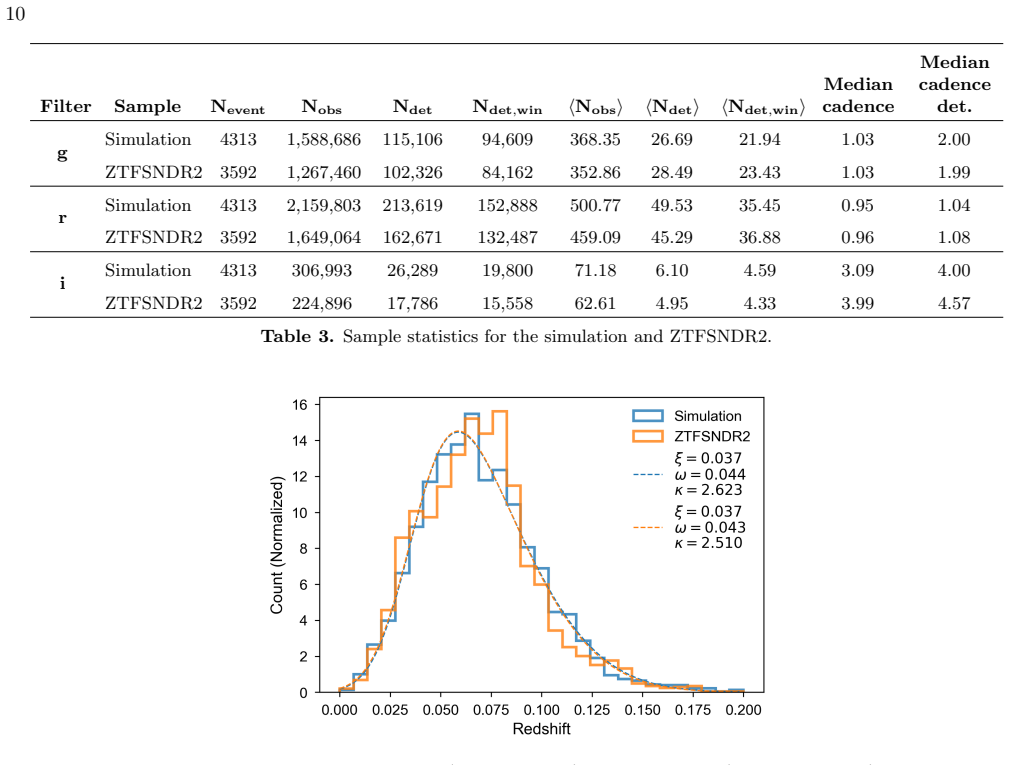
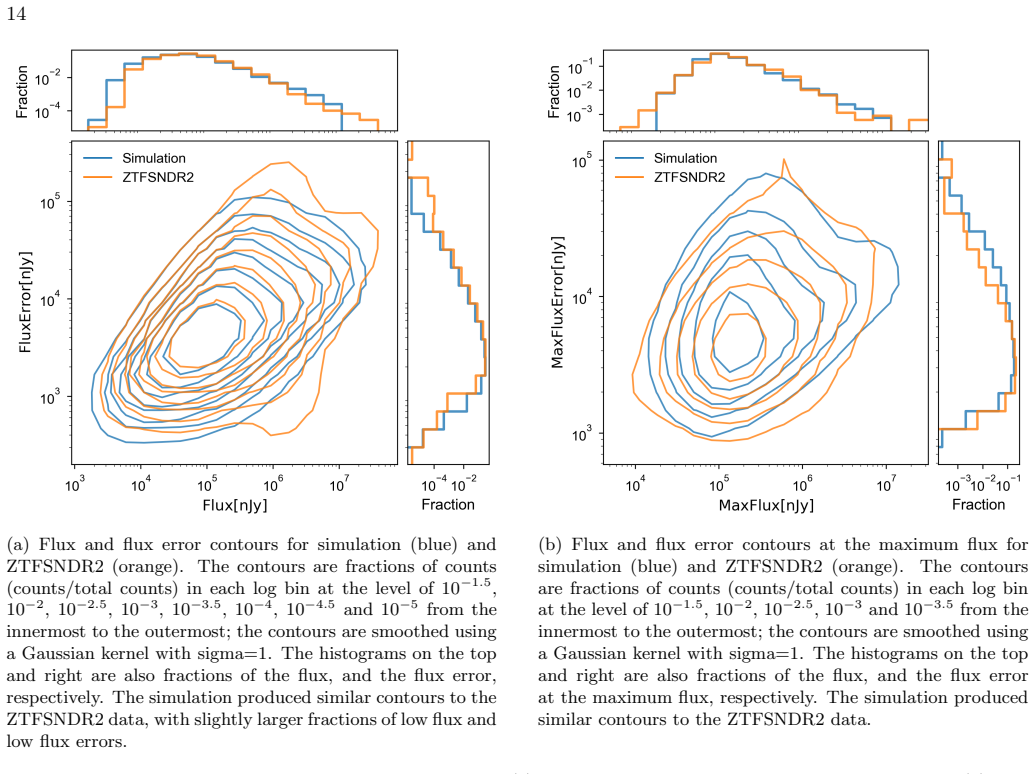
LightCurveLynx produces a realistic simulation of Type Ia supernovae representative of the ZTF SN Ia Data Release 2, achieving excellent agreement with the observed sample in parameter distributions (Kullback-Leibler divergence values around 0.01-0.02) and noise properties, while the generated Hubble diagram indicates sample completeness up to redshift 0.06 consistent with prior work.
What carries the argument
LightCurveLynx, a flexible and extensible software framework that performs end-to-end forward modeling of time-domain light curves from real survey metadata, forecasted plans, or user-defined mock strategies.
If this is right
- Analysis pipelines for time-domain surveys can be developed and validated using the simulated samples as ground truth.
- Survey strategies can be optimized by generating forecasts from planned metadata and comparing outcomes.
- Simulation-based inference studies become feasible for cosmological parameters derived from supernova samples.
- The framework supports extension to other transient types or surveys by swapping in new metadata and models.
Where Pith is reading between the lines
- The same forward-modeling approach could help quantify selection biases in future large surveys where real data will be even more incomplete.
- Integration with cosmological fitting codes might allow direct propagation of simulation uncertainties into Hubble diagram analyses.
- The low divergence values suggest the tool could serve as a benchmark for comparing different supernova population models.
Load-bearing premise
The input survey metadata, supernova population models, and forward-modeling assumptions accurately reproduce real observational selection effects and intrinsic supernova properties without introducing unaccounted biases.
What would settle it
Running LightCurveLynx on an independent time-domain survey dataset and obtaining Kullback-Leibler divergence values substantially larger than 0.01-0.02 across multiple parameters would indicate the framework fails to generalize.
Figures






read the original abstract
We present LightCurveLynx, a flexible and extensible software framework for end-to-end forward modeling time-domain light curves. Given the growing need for realistic simulations in the time-domain astronomy community, LightCurveLynx is designed to support a wide range of applications, including the development and validation of analysis pipelines, the optimization of survey strategies, and simulation-based inference studies. Realistic simulations can be generated from real survey metadata, forecasted survey plans, or user-defined mock survey strategies. We demonstrate the functionality of LightCurveLynx by generating a realistic simulation of Type Ia supernovae that is representative of the ZTF SN Ia Data Release 2 dataset and perform extensive comparisons between the simulated and observed samples to validate the software. The simulation shows excellent agreement with the data in parameter distributions (with the Kullback-Leibler divergence values around 0.01-0.02) and in noise properties. The Hubble diagram generated from the simulation also indicates that the sample is complete up to redshift 0.06, which is consistent with previous studies. Our results confirm that LightCurveLynx is robust, accurate, and ready for community use and contribution.
Editorial analysis
A structured set of objections, weighed in public.
Referee Report
Summary. The paper presents LightCurveLynx, a flexible software framework for end-to-end forward modeling of time-domain light curves from real survey metadata, forecasted plans, or user-defined strategies. It demonstrates the framework by generating a simulation of Type Ia supernovae representative of the ZTF SN Ia DR2 dataset, with validation showing excellent agreement in parameter distributions (KL divergences of 0.01-0.02), noise properties, and a Hubble diagram indicating completeness to z=0.06 consistent with prior work. The authors conclude the tool is robust and ready for community use.
Significance. If the forward-modeling pipeline reproduces observational selection effects and intrinsic properties without unaccounted biases, LightCurveLynx would provide a valuable extensible tool for pipeline validation, survey optimization, and simulation-based inference in time-domain astronomy. The reported quantitative matches with external ZTF data support potential utility, but significance hinges on whether input models were held fixed from independent sources.
major comments (2)
- [Abstract and demonstration/validation sections] Abstract and demonstration/validation sections: the claim that the simulation is 'representative of' the ZTF SN Ia DR2 and shows 'excellent agreement' (KL divergences 0.01-0.02) does not specify whether supernova population parameters (rate, stretch/color distributions) and detection-efficiency/selection functions were taken exclusively from independent literature sources and frozen before any comparison, or whether modest adjustments were made to minimize the reported divergences. Without this, the validation tests calibration rather than the correctness of the simulation engine, undermining the central claim that LightCurveLynx is bias-free for new surveys or inference tasks.
- [Validation results (Hubble diagram and completeness statement)] Validation results (Hubble diagram and completeness statement): the conclusion that the sample is complete up to redshift 0.06 is presented as confirmation of the framework, but this rests on the same unstated assumption about input fidelity; if selection effects were tuned to match the observed redshift distribution, the agreement does not independently establish that the forward-modeling of survey metadata and light-curve generation is accurate for uncalibrated applications.
minor comments (2)
- The abstract lacks any mention of model construction details, error propagation, or the exact sources of input metadata and population models; adding a brief statement would improve clarity without altering the technical content.
- Consider including a dedicated table or subsection listing all fixed input parameters (e.g., SN rate, stretch/color priors, efficiency curves) with explicit literature citations to aid reproducibility.
Simulated Author's Rebuttal
We thank the referee for their careful review and insightful comments, which highlight the importance of clearly documenting the independence of our input models. We address each major comment below and will revise the manuscript accordingly to strengthen the presentation of our validation approach.
read point-by-point responses
-
Referee: [Abstract and demonstration/validation sections] Abstract and demonstration/validation sections: the claim that the simulation is 'representative of' the ZTF SN Ia DR2 and shows 'excellent agreement' (KL divergences 0.01-0.02) does not specify whether supernova population parameters (rate, stretch/color distributions) and detection-efficiency/selection functions were taken exclusively from independent literature sources and frozen before any comparison, or whether modest adjustments were made to minimize the reported divergences. Without this, the validation tests calibration rather than the correctness of the simulation engine, undermining the central claim that LightCurveLynx is bias-free for new surveys or inference tasks.
Authors: All supernova population parameters (rate, stretch, and color distributions) and detection-efficiency/selection functions were taken exclusively from independent literature sources and held fixed before generating the simulation or performing any comparisons. No adjustments were made to minimize the reported KL divergences; the values of 0.01-0.02 therefore reflect the fidelity of the LightCurveLynx forward-modeling engine itself. We will revise the abstract and validation sections to explicitly state that inputs were frozen from independent sources, thereby confirming that the tests validate the simulation framework rather than calibrate it. revision: yes
-
Referee: [Validation results (Hubble diagram and completeness statement)] Validation results (Hubble diagram and completeness statement): the conclusion that the sample is complete up to redshift 0.06 is presented as confirmation of the framework, but this rests on the same unstated assumption about input fidelity; if selection effects were tuned to match the observed redshift distribution, the agreement does not independently establish that the forward-modeling of survey metadata and light-curve generation is accurate for uncalibrated applications.
Authors: The completeness to z=0.06 is a direct output of applying the ZTF survey metadata and literature-derived selection functions within the forward-modeling pipeline; no tuning was performed to match the observed redshift distribution. This agreement with prior studies therefore provides an independent check on the accuracy of the end-to-end simulation. We will add explicit language in the validation section clarifying the fixed, independent nature of the inputs and the resulting completeness assessment. revision: yes
Circularity Check
No significant circularity; validation uses independent external data.
full rationale
The paper presents the LightCurveLynx framework and validates it by generating simulations from survey metadata, SN population models, and selection effects drawn from literature sources, then directly comparing the output distributions and noise properties to the independent ZTF SN Ia DR2 observations via KL divergence and Hubble diagram. No equations or steps in the provided text reduce any claimed result to a fitted parameter or self-referential definition by construction; the agreement is tested against external observed quantities rather than internal model outputs.
Axiom & Free-Parameter Ledger
Reference graph
Works this paper leans on
-
[1]
, " * write output.state after.block = add.period write newline
ENTRY address archivePrefix author booktitle chapter doi edition editor eprint howpublished institution journal key month number organization pages publisher school series title misctitle type volume year version url label extra.label sort.label short.list INTEGERS output.state before.all mid.sentence after.sentence after.block FUNCTION init.state.consts ...
-
[2]
write newline
" write newline "" before.all 'output.state := FUNCTION format.url url empty "" new.block "" url * "" * if FUNCTION format.eprint eprint empty "" archivePrefix empty "" archivePrefix "arXiv" = new.block " " eprint * " " * new.block " " eprint * " " * if if if FUNCTION format.doi doi empty "" " " doi * " " * if FUNCTION format.pid doi empty eprint empty ur...
-
[3]
c֭ _,E4 .^,_ ՛o ٬5-[hѪR͛t *X,Y dSN駟 ғO>UF z7u 'g*=zdz|=88X 4H ʲ_ bnuG
thebibliography [1] 20pt to REFERENCES 6pt =0pt \@twocolumntrue 12pt -12pt 10pt plus 3pt =0pt =0pt =1pt plus 1pt =0pt =0pt -12pt =13pt plus 1pt =20pt =13pt plus 1pt \@M =10000 =-1.0em =0pt =0pt 0pt =0pt =1.0em @enumiv\@empty 10000 10000 `\.\@m \@noitemerr \@latex@warning Empty `thebibliography' environment \@ifnextchar \@reference \@latexerr Missing key o...
2017
-
[4]
Amenouche, M., Smith, M., Rosnet, P., et al. 2025, title ZTF SN Ia DR2: Simulations and volume-limited sample, Astronomy & Astrophysics, 694, A3, 10.1051/0004-6361/202452134
-
[5]
Astropy Collaboration , Robitaille , T. P., Tollerud , E. J., et al. 2013, title Astropy: A community Python package for astronomy , , 558, A33, 10.1051/0004-6361/201322068
-
[6]
The Astronomical Journal , author =
Astropy Collaboration , Price-Whelan , A. M., Sip o cz , B. M., et al. 2018, title The Astropy Project: Building an Open-science Project and Status of the v2.0 Core Package , , 156, 123, 10.3847/1538-3881/aabc4f
-
[7]
Astropy Collaboration , Price-Whelan , A. M., Lim , P. L., et al. 2022, title The Astropy Project: Sustaining and Growing a Community-oriented Open-source Project and the Latest Major Release (v5.0) of the Core Package , , 935, 167, 10.3847/1538-4357/ac7c74
work page internal anchor Pith review doi:10.3847/1538-4357/ac7c74 2022
-
[8]
2023, title sfdmap2: E(B-V) values from SFD dust map data, , 0.2.2 https://github.com/AmpelAstro/sfdmap2
Barbary, K., & AmpelAstro . 2023, title sfdmap2: E(B-V) values from SFD dust map data, , 0.2.2 https://github.com/AmpelAstro/sfdmap2
2023
-
[9]
2016, title SNCosmo: Python library for supernova cosmology , 10.5281/zenodo.592747
Barbary , K., Bailey , S., Barentsen , G., et al. 2016, title SNCosmo: Python library for supernova cosmology , 10.5281/zenodo.592747
-
[10]
Barbary, K., Bailey, S., Barentsen, G., et al. 2025, title SNCosmo, , v2.12.1 Zenodo, 10.5281/zenodo.15019859
-
[11]
Bellm, E. C., Kulkarni, S. R., Graham, M. J., et al. 2019, title The Zwicky Transient Facility: System Overview, Performance, and First Results, Publications of the Astronomical Society of the Pacific, 131, 018002, 10.1088/1538-3873/aaecbe
-
[12]
M., Grayling, M., Thorp, S., & Mandel, K
Boyd, B. M., Grayling, M., Thorp, S., & Mandel, K. S. 2024, title Accounting for Selection Effects in Supernova Cosmology with Simulation-Based Inference and Hierarchical Bayesian Modelling, arXiv preprint. 2407.15923
-
[13]
Crenshaw, J. F., Kalmbach, J. B., Gagliano, A., et al. 2024, title Probabilistic Forward Modeling of Galaxy Catalogs with Normalizing Flows, The Astronomical Journal, 168, 80, 10.3847/1538-3881/ad54bf
-
[14]
Dekany, R. G., Smith, R. M., Riddle, R., et al. 2020, title The Zwicky Transient Facility: Observing System, Publications of the Astronomical Society of the Pacific, 132, 038001, 10.1088/1538-3873/ab4ca2
-
[15]
Dilday , B., Smith , M., Bassett , B., et al. 2010, title Measurements of the Rate of Type Ia Supernovae at Redshift lsim0.3 from the Sloan Digital Sky Survey II Supernova Survey , , 713, 1026, 10.1088/0004-637X/713/2/1026
-
[16]
in prep, title ELAsTiCC ,
ELAsTiCC Team . in prep, title ELAsTiCC ,
-
[17]
Fitzpatrick , E. L. 1999, title Correcting for the Effects of Interstellar Extinction , , 111, 63, 10.1086/316293
-
[18]
Frohmaier, C., Sullivan, M., Nugent, P. E., et al. 2019, title The volumetric rate of normal type Ia supernovae in the local Universe discovered by the Palomar Transient Factory, Monthly Notices of the Royal Astronomical Society, 486, 2308, 10.1093/mnras/stz807
-
[19]
Gagliano , A., Narayan , G., Engel , A., Carrasco Kind , M., & LSST Dark Energy Science Collaboration . 2021, title GHOST: Using Only Host Galaxy Information to Accurately Associate and Distinguish Supernovae , , 908, 170, 10.3847/1538-4357/abd02b
-
[20]
Ginolin , M., Rigault , M., Copin , Y., et al. 2025, title ZTF SN Ia DR2: Colour standardisation of type Ia supernovae and its dependence on the environment , , 694, A4, 10.1051/0004-6361/202450943
-
[21]
Gordon, K. D. 2024, title dust_extinction: Interstellar Dust Extinction Models, Journal of Open Source Software, 9, 7023, 10.21105/joss.07023
-
[22]
Gris, P., Awan, H., Becker, M. R., et al. 2024, title A Cohesive Deep Drilling Field Strategy for LSST Cosmology, The Astrophysical Journal Supplement Series, 275, 21, 10.3847/1538-4365/ad79f5
-
[23]
R., Kuhlmann , S., Kovacs , E., et al
Gupta, R. R., Kuhlmann, S., Kovacs, E., et al. 2016, title Host Galaxy Identification for Supernova Surveys, The Astronomical Journal, 152, 154, 10.3847/0004-6256/152/6/154
-
[24]
2007, , 466, 11, 10.1051/0004-6361:20066930
Guy, J., Astier, P., Baumont, S., et al. 2007, title SALT2: using distant supernovae to improve the use of Type Ia supernovae as distance indicators, Astronomy & Astrophysics, 466, 11, 10.1051/0004-6361:20066930
-
[25]
Guy, J., Sullivan, M., Conley, A., et al. 2010, title The Supernova Legacy Survey 3-year sample: Type Ia Supernovae photometric distances and cosmological constraints, Astronomy & Astrophysics, 523, A7, 10.1051/0004-6361/201014468
-
[26]
Harris, C. R., Millman, K. J., van der Walt, S. J., et al. 2020, title Array programming with NumPy , Nature, 585, 357, 10.1038/s41586-020-2649-2
-
[27]
Hlozek, R., Malz, A. I., Ponder, K. A., et al. 2023, title Results of the Photometric LSST Astronomical Time-series Classification Challenge (PLAsTiCC), The Astrophysical Journal Supplement Series, 267, 25, 10.3847/1538-4365/accd6a
-
[28]
Hunter, J. D. 2007, title Matplotlib: A 2D graphics environment, Computing in Science & Engineering, 9, 90, 10.1109/MCSE.2007.55
-
[29]
Ivezi \'c , Z ., Kahn, S. M., Tyson, J. A., et al. 2019, title LSST: From Science Drivers to Reference Design and Anticipated Data Products, The Astrophysical Journal, 873, 111, 10.3847/1538-4357/ab042c
-
[30]
2016, arXiv e-prints, arXiv:1611.03087
Jennings, E., Wolf, R., & Sako, M. 2016, title A new approach for obtaining cosmological constraints from Type Ia Supernovae using Approximate Bayesian Computation, arXiv preprint. 1611.03087
-
[31]
Johansson , J., Thomas , D., Pforr , J., et al. 2013, title SN Ia host galaxy properties from Sloan Digital Sky Survey-II spectroscopy , , 435, 1680, 10.1093/mnras/stt1408
-
[32]
Kenworthy, W. D., Jones, D. O., Dai, M., et al. 2021, title SALT3: An Improved Type Ia Supernova Model for Measuring Cosmic Distances, The Astrophysical Journal, 923, 265, 10.3847/1538-4357/ac30d8
-
[33]
Kessler, R., & Scolnic, D. 2017, title Correcting Type Ia Supernova Distances for Selection Biases and Contamination in Photometrically Identified Samples, The Astrophysical Journal, 836, 56, 10.3847/1538-4357/836/1/56
-
[34]
Kessler, R., Bernstein, J. P., Cinabro, D., et al. 2009, title SNANA: A Public Software Package for Supernova Analysis, The Astrophysical Journal Supplement Series, 185, 32, 10.1088/0067-0049/185/1/32
-
[35]
Kessler, R., Bassett, B. A., Belov, P., et al. 2010, title Results from the Supernova Photometric Classification Challenge, Publications of the Astronomical Society of the Pacific, 122, 1415, 10.1086/657607
-
[36]
Kessler, R., Narayan, G., Avelino, A., et al. 2019, title Models and Simulations for the Photometric LSST Astronomical Time Series Classification Challenge (PLAsTiCC), Publications of the Astronomical Society of the Pacific, 131, 094501, 10.1088/1538-3873/ab26f1
-
[37]
Kubica et al. , J. in prep, title LightCurveLynx ,
-
[38]
2025, title nested-pandas: Efficient Pandas Representation for Nested Associated Datasets, , 0.6.8 https://github.com/lincc-frameworks/nested-pandas
LINCC Frameworks . 2025, title nested-pandas: Efficient Pandas Representation for Nested Associated Datasets, , 0.6.8 https://github.com/lincc-frameworks/nested-pandas
2025
-
[39]
2018, title Optimizing the LSST Observing Strategy for Dark Energy Science: DESC Recommendations for the Wide--Fast--Deep Survey, arXiv preprint
Lochner, M., Scolnic, D., Awan, H., et al. 2018, title Optimizing the LSST Observing Strategy for Dark Energy Science: DESC Recommendations for the Wide--Fast--Deep Survey, arXiv preprint
2018
-
[40]
Lokken , M., Gagliano , A., Narayan , G., et al. 2023, title The simulated catalogue of optical transients and correlated hosts (SCOTCH) , , 520, 2887, 10.1093/mnras/stad302
-
[41]
LSST Science Book, Version 2.0
LSST Science Collaborations and LSST Project . 2009, LSST Science Book, Version 2.0. 0912.0201
work page Pith review arXiv 2009
-
[42]
pandas development team, T. 2020, title pandas-dev/pandas: Pandas, , latest Zenodo, 10.5281/zenodo.3509134
-
[43]
2011, title Scikit-learn: Machine Learning in P ython, Journal of Machine Learning Research, 12, 2825
Pedregosa, F., Varoquaux, G., Gramfort, A., et al. 2011, title Scikit-learn: Machine Learning in P ython, Journal of Machine Learning Research, 12, 2825
2011
-
[44]
A., Fremling, C., Sollerman, J., et al
Perley, D. A., Fremling, C., Sollerman, J., et al. 2020, title The Zwicky Transient Facility Bright Transient Survey. II. A Public Statistical Sample for Exploring Supernova Demographics, The Astrophysical Journal, 904, 35, 10.3847/1538-4357/abbd98
-
[45]
Phillips , M. M. 1993, title The Absolute Magnitudes of Type Ia Supernovae, Astrophysical Journal Letters, 413, L105, 10.1086/186970
-
[46]
Riess , A. G., Press , W. H., & Kirshner , R. P. 1996, title Improved Distances to Type Ia Supernovae with Multicolor Light-Curve Shapes, Astrophysical Journal, 473, 88, 10.1086/178129
-
[47]
Rigault, M., Smith, M., Goobar, A., et al. 2025, title ZTF SN Ia DR2: Overview, Astronomy & Astrophysics, 694, A1, 10.1051/0004-6361/202450388
-
[48]
Rigault , M., Smith , M., Regnault , N., et al. 2025, title ZTF SN Ia DR2: Study of Type Ia supernova light-curve fits , , 694, A2, 10.1051/0004-6361/202450377
-
[49]
M., Vincenzi, M., Hounsell, R., et al
Rose, B. M., Vincenzi, M., Hounsell, R., et al. 2025, title The Hourglass Simulation: A Catalog for the Roman High-Latitude Time-Domain Core Community Survey, The Astrophysical Journal, 988, 65, 10.3847/1538-4357/ade1d6
-
[50]
Sarin, N., Hübner, M., Omand, C. M. B., et al. 2024, title redback: a Bayesian inference software package for electromagnetic transients, Monthly Notices of the Royal Astronomical Society, 531, 1203, 10.1093/mnras/stae1238
-
[51]
Schlafly , E. F., & Finkbeiner , D. P. 2011, title Measuring Reddening with Sloan Digital Sky Survey Stellar Spectra and Recalibrating SFD , , 737, 103, 10.1088/0004-637X/737/2/103
work page internal anchor Pith review doi:10.1088/0004-637x/737/2/103 2011
-
[52]
Schlegel , D. J., Finkbeiner , D. P., & Davis , M. 1998, title Maps of Dust Infrared Emission for Use in Estimation of Reddening and Cosmic Microwave Background Radiation Foregrounds , , 500, 525, 10.1086/305772
work page internal anchor Pith review doi:10.1086/305772 1998
-
[53]
Wide-Field InfrarRed Survey Telescope-Astrophysics Focused Telescope Assets WFIRST-AFTA 2015 Report
Spergel , D., Gehrels , N., Baltay , C., et al. 2015, title Wide-Field InfrarRed Survey Telescope-Astrophysics Focused Telescope Assets WFIRST-AFTA 2015 Report , arXiv e-prints, arXiv:1503.03757, 10.48550/arXiv.1503.03757
work page internal anchor Pith review Pith/arXiv arXiv doi:10.48550/arxiv.1503.03757 2015
-
[54]
2011, MNRAS, 411, 955, doi: 10.1111/j.1365-2966.2010.17731.x
Sullivan , M., Conley , A., Howell , D. A., et al. 2010, title The dependence of Type Ia Supernovae luminosities on their host galaxies , , 406, 782, 10.1111/j.1365-2966.2010.16731.x
-
[55]
1998, title A two-parameter luminosity correction for Type Ia supernovae, Astronomy & Astrophysics, 331, 815
Tripp, R. 1998, title A two-parameter luminosity correction for Type Ia supernovae, Astronomy & Astrophysics, 331, 815. https://ui.adsabs.harvard.edu/abs/1998A&A...331..815T
1998
-
[56]
Vincenzi, M., Brout, D., Armstrong, P., et al. 2024, title The Dark Energy Survey Supernova Program: Cosmological Analysis and Systematic Uncertainties, The Astrophysical Journal, 975, 86, 10.3847/1538-4357/ad5e6c
-
[57]
Virtanen, P., Gommers, R., Oliphant, T. E., et al. 2020, title SciPy 1.0: Fundamental Algorithms for Scientific Computing in Python , Nature Methods, 17, 261, 10.1038/s41592-019-0686-2
-
[58]
2010, in Proceedings of the 9th Python in Science Conference, ed
W es M c K inney. 2010, in P roceedings of the 9th P ython in S cience C onference, ed. S t\'efan van der W alt & J arrod M illman, 56 -- 61, 10.25080/Majora-92bf1922-00a
-
[59]
Weyant, A., Schafer, C., & Wood-Vasey, W. M. 2013, title Likelihood-Free Cosmological Inference with Type Ia Supernovae: Approximate Bayesian Computation for a Complete Treatment of Uncertainty, The Astrophysical Journal, 764, 116, 10.1088/0004-637X/764/2/116
discussion (0)
Sign in with ORCID, Apple, or X to comment. Anyone can read and Pith papers without signing in.