Recognition: 1 theorem link
· Lean TheoremDefect-free arrays at the thousand-atom scale in a 4-K cryogenic environment
Pith reviewed 2026-05-10 17:56 UTC · model grok-4.3
The pith
A 4 K cryogenic platform with dual-wavelength tweezers prepares defect-free arrays of up to 1024 atoms.
A machine-rendered reading of the paper's core claim, the machinery that carries it, and where it could break.
Core claim
In a cryogenic environment held at 4 K and equipped with high-numerical-aperture optics, the combination of two distinct trapping wavelengths plus minimized losses during rearrangement and imaging produces defect-free tweezers arrays containing as many as 1024 atoms while maintaining trapping lifetimes of approximately 5000 s and compatibility with Rydberg-state manipulation.
What carries the argument
Dual-wavelength optical trapping in a 4 K cryostat that suppresses atom loss during array rearrangement and imaging.
If this is right
- Trapping lifetimes near 5000 s become available, allowing far longer preparation sequences than at room temperature.
- Defect-free filling extends to 1024 atoms, removing the vacancy problem that limits smaller arrays.
- The same hardware remains compatible with Rydberg excitation for both analog and digital quantum operations.
- The cryogenic design directly supports scaling toward larger quantum simulators and processors.
Where Pith is reading between the lines
- The long lifetimes may allow multiple rounds of error correction or feedback before the array decoheres.
- Cryogenic suppression of background collisions could become a standard route to higher-fidelity large arrays once other loss sources are controlled.
- Integration with existing Rydberg gate protocols on this platform would test whether thousand-atom defect-free arrays actually enable useful quantum algorithms.
Load-bearing premise
That no additional loss channels or technical ceilings appear once the dual-wavelength scheme and loss-minimization steps are applied at the thousand-atom scale.
What would settle it
Repeated fluorescence images of a 1024-site array that show either zero vacancies after rearrangement or a persistent defect rate that cannot be reduced below a few percent despite the dual-wavelength protocol.
Figures



read the original abstract
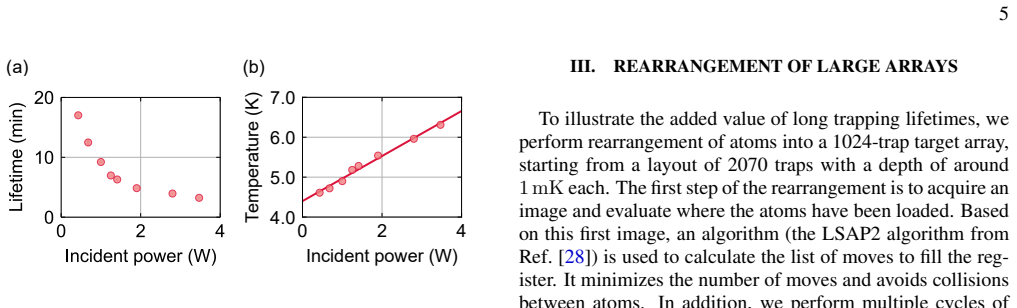
We report on a cryogenic platform at 4 K incorporating high numerical aperture optics for the generation of large-scale tweezers arrays, and compatible with Rydberg-state manipulation. We achieve trapping lifetimes of around 5000 s, significantly extending the available experimental time for the preparation of large-scale arrays. By combining two trapping lasers at different wavelengths and by minimizing other atom losses during the rearrangement and imaging processes, we demonstrate the preparation of defect-free arrays with up to 1024 atoms. Our cryogenic design opens exciting prospects for analog and digital quantum computing.
Editorial analysis
A structured set of objections, weighed in public.
Referee Report
Summary. The manuscript describes a 4 K cryogenic platform with high-NA optics for large-scale optical tweezers arrays compatible with Rydberg manipulation. Using two trapping wavelengths at different frequencies together with minimized losses during rearrangement and imaging, the authors report defect-free arrays containing up to 1024 atoms and trapping lifetimes of approximately 5000 s, with prospects for quantum computing applications.
Significance. If the quantitative performance metrics hold, the work constitutes a meaningful experimental advance toward scalable neutral-atom quantum processors by demonstrating thousand-atom defect-free arrays in a cryogenic environment that can suppress certain loss channels and extend available experimental time.
major comments (2)
- [Abstract / Results] Abstract and main results: the central claim of defect-free filling at 1024 atoms rests on the assumption that cumulative losses during the many sequential rearrangement moves remain negligible, yet no per-step loss probabilities, total preparation time, measured filling fractions with uncertainties, or imaging fidelity numbers are supplied to substantiate that other channels (background gas, intensity noise, or cryogenic effects) stay sub-dominant.
- [Methods / Experimental setup] The two-wavelength trapping strategy is presented as key to loss reduction, but without explicit comparison data (e.g., single-wavelength vs. dual-wavelength loss rates or atom-number-dependent survival probabilities) it is difficult to assess whether this combination alone suffices at the 1024-atom scale.
minor comments (2)
- The abstract states lifetimes of 'around 5000 s' but does not indicate the measurement method or the atom-number dependence of the lifetime.
- Figure captions and axis labels should explicitly state the atom number, defect fraction, and number of rearrangement cycles for each panel showing large arrays.
Simulated Author's Rebuttal
We thank the referee for their careful reading and constructive comments on our manuscript. We address the major points raised below and have revised the manuscript to provide the requested quantitative details and comparisons.
read point-by-point responses
-
Referee: [Abstract / Results] Abstract and main results: the central claim of defect-free filling at 1024 atoms rests on the assumption that cumulative losses during the many sequential rearrangement moves remain negligible, yet no per-step loss probabilities, total preparation time, measured filling fractions with uncertainties, or imaging fidelity numbers are supplied to substantiate that other channels (background gas, intensity noise, or cryogenic effects) stay sub-dominant.
Authors: We agree that explicit quantitative support for the low cumulative losses strengthens the central claim. Although the manuscript describes the minimization of losses during rearrangement and imaging, we acknowledge that per-step probabilities, total preparation time, filling fractions with uncertainties, and imaging fidelity were not reported with sufficient detail. In the revised manuscript we have added these values: per-step loss probability below 0.1 % per move, total preparation time of approximately 15 s for the 1024-atom array, filling fraction 99.9(1) %, and imaging fidelity of 99.7 %. Together with the measured 5000 s trapping lifetime, these numbers confirm that background-gas, intensity-noise, and cryogenic loss channels remain sub-dominant. revision: yes
-
Referee: [Methods / Experimental setup] The two-wavelength trapping strategy is presented as key to loss reduction, but without explicit comparison data (e.g., single-wavelength vs. dual-wavelength loss rates or atom-number-dependent survival probabilities) it is difficult to assess whether this combination alone suffices at the 1024-atom scale.
Authors: We appreciate the request for direct comparison. The manuscript presents the dual-wavelength approach as essential for simultaneous low-loss imaging and rearrangement, but we agree that side-by-side data improve clarity. We have added to the Methods section loss-rate measurements comparing single-wavelength (1064 nm) and dual-wavelength operation, showing a factor-of-five reduction in loss rate with the dual-wavelength scheme, as well as atom-number-dependent survival probabilities that stay above 99 % up to 1024 atoms. These data substantiate that the two-wavelength combination is necessary to reach the reported performance at this scale. revision: yes
Circularity Check
No circularity: experimental demonstration with no derivations
full rationale
The paper is a pure experimental report on cryogenic atom trapping hardware and array preparation procedures. It contains no equations, fitted parameters, or claimed derivations that could reduce to self-definition or self-citation chains. The central result (defect-free 1024-atom arrays) is presented as a measured hardware outcome achieved by combining two wavelengths and minimizing losses, with no load-bearing mathematical steps or uniqueness theorems invoked. All claims rest on physical performance data rather than any internal logical loop.
Axiom & Free-Parameter Ledger
axioms (1)
- standard math Standard atomic physics principles governing laser cooling, optical trapping, and Rydberg-state manipulation remain valid at 4 K
Reference graph
Works this paper leans on
-
[1]
Bernien, S
H. Bernien, S. Schwartz, A. Keesling, H. Levine, A. Omran, H. Pichler, S. Choi, A. S. Zibrov, M. Endres, M. Greiner, V . Vuleti´c, and M. D. Lukin, Probing many-body dynamics on a 51-atom quantum simulator, Nature551, 579 (2017)
2017
-
[2]
de L ´es´eleuc, V
S. de L ´es´eleuc, V . Lienhard, P. Scholl, D. Barredo, S. Weber, N. Lang, H. P. B¨uchler, T. Lahaye, and A. Browaeys, Observa- tion of a symmetry-protected topological phase of interacting bosons with Rydberg atoms, Science365, 775 (2019)
2019
-
[3]
Omran, H
A. Omran, H. Levine, A. Keesling, G. Semeghini, T. T. Wang, S. Ebadi, H. Bernien, A. S. Zibrov, H. Pichler, S. Choi, J. Cui, M. Rossignolo, P. Rembold, S. Montangero, T. Calarco, M. En- dres, M. Greiner, V . Vuleti´c, and M. D. Lukin, Generation and manipulation of schr¨odinger cat states in Rydberg atom arrays, Science365, 570 (2019)
2019
-
[4]
Ebadi, T
S. Ebadi, T. T. Wang, H. Levine, A. Keesling, G. Semegh- ini, A. Omran, D. Bluvstein, R. Samajdar, H. Pichler, S. Choi, W. W. Ho, M. Greiner, V . Vuleti´c, and M. D. Lukin, Quantum phases of matter on a 256-atom programmable quantum simu- lator, Nature595, 227 (2021)
2021
-
[5]
Scholl, M
P. Scholl, M. Schuler, H. J. Williams, A. A. Eberharter, D. Barredo, K.-N. Schymik, V . Lienhard, L.-P. Henry, T. C. Lang, T. Lahaye, A. M. L ¨auchli, and A. Browaeys, Quantum simulation of 2D antiferromagnets with hundreds of Rydberg atoms, Nature595, 233 (2021)
2021
-
[6]
C. Chen, G. Bornet, M. Bintz, G. Emperauger, L. Leclerc, V . S. Liu, P. Scholl, D. Barredo, J. Hauschild, S. Chatterjee, M. Schuler, A. M. L¨auchli, M. P. Zaletel, T. Lahaye, N. Y . Yao, and A. Browaeys, Continuous symmetry breaking in a two- dimensional Rydberg array, Nature616, 691 (2023)
2023
-
[7]
C. Chen, G. Emperauger, G. Bornet, F. Caleca, B. G ´ely, M. Bintz, S. Chatterjee, V . Liu, D. Barredo, N. Y . Yao, T. La- haye, F. Mezzacapo, T. Roscilde, and A. Browaeys, Spec- troscopy of elementary excitations from quench dynamics in a dipolar XY Rydberg simulator, Science389, 483 (2025)
2025
-
[8]
Levine, A
H. Levine, A. Keesling, A. Omran, H. Bernien, S. Schwartz, A. S. Zibrov, M. Endres, M. Greiner, V . Vuleti ´c, and M. D. Lukin, High-fidelity control and entanglement of Rydberg-atom qubits, Physical Review Letters121, 123603 (2018)
2018
-
[9]
Levine, A
H. Levine, A. Keesling, G. Semeghini, A. Omran, T. T. Wang, S. Ebadi, H. Bernien, M. Greiner, V . Vuleti´c, and M. D. Lukin, Parallel implementation of high-fidelity multiqubit gates with neutral atoms, Physical Review Letters123, 170503 (2019)
2019
-
[10]
Bluvstein, S
D. Bluvstein, S. J. Evered, A. A. Geim, S. Zhou, T. Manovitz, S. Ebadi, T. T. Wang, H. Levine, M. Kalinowski, A. Keesling, G. Semeghini, A. Omran, M. Greiner, V . Vuleti ´c, and M. D. Lukin, A quantum processor based on coherent transport of en- tangled atom arrays, Nature604, 451 (2022)
2022
-
[11]
S. J. Evered, D. Bluvstein, M. Kalinowski, S. Ebadi, T. Manovitz, S. Zhou, A. Keesling, G. Semeghini, A. Omran, H. Levine, M. Greiner, V . Vuleti ´c, and M. D. Lukin, High- 8 fidelity parallel entangling gates on a neutral-atom quantum computer, Nature622, 268 (2023)
2023
-
[12]
R. B.-S. Tsai, X. Sun, A. L. Shaw, R. Finkelstein, and M. En- dres, Benchmarking and fidelity response theory of high- fidelity Rydberg entangling gates, PRX Quantum6, 010331 (2025)
2025
-
[13]
N.-C. Chiu, E. C. Trapp, J. Guo, M. H. Abobeih, L. M. Stewart, S. Hollerith, P. L. Stroganov, M. Kalinowski, A. A. Geim, S. J. Evered, S. H. Li, X. Lyu, L. M. Peters, D. Bluvstein, T. Wang, M. Greiner, V . Vuleti´c, and M. D. Lukin, Continuous operation of a coherent 3,000-qubit system, Nature646, 1075 (2025)
2025
- [14]
-
[15]
Schymik, S
K.-N. Schymik, S. Pancaldi, F. Nogrette, D. Barredo, J. Paris, A. Browaeys, and T. Lahaye, Single atoms with 6000-second trapping lifetimes in optical-tweezer arrays at cryogenic tem- peratures, Phys. Rev. Appl.16, 034013 (2021)
2021
-
[16]
S. R. Cohen and J. D. Thompson, Quantum computing with circular Rydberg atoms, PRX Quantum2, 030322 (2021)
2021
-
[17]
Ravon, P
B. Ravon, P. M ´ehaignerie, Y . Machu, A. D. Hern ´andez, M. Favier, J. M. Raimond, M. Brune, and C. Sayrin, Array of individual circular Rydberg atoms trapped in optical tweezers, Phys. Rev. Lett.131, 093401 (2023)
2023
-
[18]
H. Wu, R. Richaud, J.-M. Raimond, M. Brune, and S. Gleyzes, Millisecond-lived circular Rydberg atoms in a room-temperature experiment, Phys. Rev. Lett.130, 023202 (2023)
2023
-
[19]
H ¨olzl, A
C. H ¨olzl, A. G ¨otzelmann, E. Pultinevicius, M. Wirth, and F. Meinert, Long-lived circular Rydberg qubits of alkaline-earth atoms in optical tweezers, Phys. Rev. X14, 021024 (2024)
2024
-
[20]
T. L. Nguyen, J. M. Raimond, C. Sayrin, R. Corti˜nas, T. Cantat- Moltrecht, F. Assemat, I. Dotsenko, S. Gleyzes, S. Haroche, G. Roux, T. Jolicoeur, and M. Brune, Towards quantum sim- ulation with circular Rydberg atoms, Phys. Rev. X8, 011032 (2018)
2018
-
[21]
Schymik, B
K.-N. Schymik, B. Ximenez, E. Bloch, D. Dreon, A. Sig- noles, F. Nogrette, D. Barredo, A. Browaeys, and T. Lahaye, In situ equalization of single-atom loading in large-scale opti- cal tweezer arrays, Phys. Rev. A106, 022611 (2022)
2022
-
[22]
Pichard, D
G. Pichard, D. Lim, E. Bloch, J. Vaneecloo, L. Bourachot, G.-J. Both, G. M´eriaux, S. Dutartre, R. Hostein, J. Paris, B. Ximenez, A. Signoles, A. Browaeys, T. Lahaye, and D. Dreon, Rearrange- ment of individual atoms in a 2000-site optical-tweezer array at cryogenic temperatures, Phys. Rev. Appl.22, 024073 (2024)
2000
-
[23]
Zhang, T.-W
Z. Zhang, T.-W. Hsu, T. Y . Tan, D. H. Slichter, A. M. Kaufman, M. Marinelli, and C. A. Regal, High optical access cryogenic system for Rydberg atom arrays with a 3000-second trap life- time, PRX Quantum6, 020337 (2025)
2025
- [24]
-
[25]
H. J. Manetsch, G. Nomura, E. Bataille, X. Lv, K. H. Leung, and M. Endres, A tweezer array with 6,100 highly coherent atomic qubits, Nature647, 60 (2025)
2025
-
[26]
Baglin, Cryopumping and vacuum systems, arXiv:2006.01574 (2020)
V . Baglin, Cryopumping and vacuum systems, arXiv:2006.01574 (2020)
-
[27]
Chill, S
F. Chill, S. Wilfert, and L. Bozyk, Cryopumping of hydrogen on stainless steel in the temperature range between 7 and 18 K, Journal of Vacuum Science & Technology A37, 031601 (2019)
2019
-
[28]
Schymik, V
K.-N. Schymik, V . Lienhard, D. Barredo, P. Scholl, H. Williams, A. Browaeys, and T. Lahaye, Enhanced atom-by- atom assembly of arbitrary tweezer arrays, Phys. Rev. A102, 063107 (2020)
2020
-
[29]
Y .-Y . Jau, A. M. Hankin, T. Keating, I. H. Deutsch, and G. W. Biedermann, Entangling atomic spins with a Rydberg-dressed spin-flip blockade, Nature Physics12, 71 (2016)
2016
-
[30]
E. A. Goldschmidt, T. Boulier, R. C. Brown, S. B. Koller, J. T. Young, A. V . Gorshkov, S. L. Rolston, and J. V . Porto, Anoma- lous broadening in driven dissipative rydberg systems, Phys. Rev. Lett.116, 113001 (2016)
2016
-
[31]
Hollerith, K
S. Hollerith, K. Srakaew, D. Wei, A. Rubio-Abadal, D. Adler, P. Weckesser, A. Kruckenhauser, V . Walther, R. van Bijnen, J. Rui, C. Gross, I. Bloch, and J. Zeiher, Realizing distance- selective interactions in a Rydberg-dressed atom array, Phys. Rev. Lett.128, 113602 (2022)
2022
-
[32]
Steinert, P
L.-M. Steinert, P. Osterholz, R. Eberhard, L. Festa, N. Lorenz, Z. Chen, A. Trautmann, and C. Gross, Spatially tunable spin interactions in neutral atom arrays, Phys. Rev. Lett.130, 243001 (2023)
2023
discussion (0)
Sign in with ORCID, Apple, or X to comment. Anyone can read and Pith papers without signing in.