Recognition: 2 theorem links
· Lean TheoremGraph Neural ODE Digital Twins for Control-Oriented Reactor Thermal-Hydraulic Forecasting Under Partial Observability
Pith reviewed 2026-05-10 18:25 UTC · model grok-4.3
The pith
A graph neural network with neural ODE dynamics forecasts reactor thermal-hydraulic states accurately at locations without sensors and adapts to real data.
A machine-rendered reading of the paper's core claim, the machinery that carries it, and where it could break.
Core claim
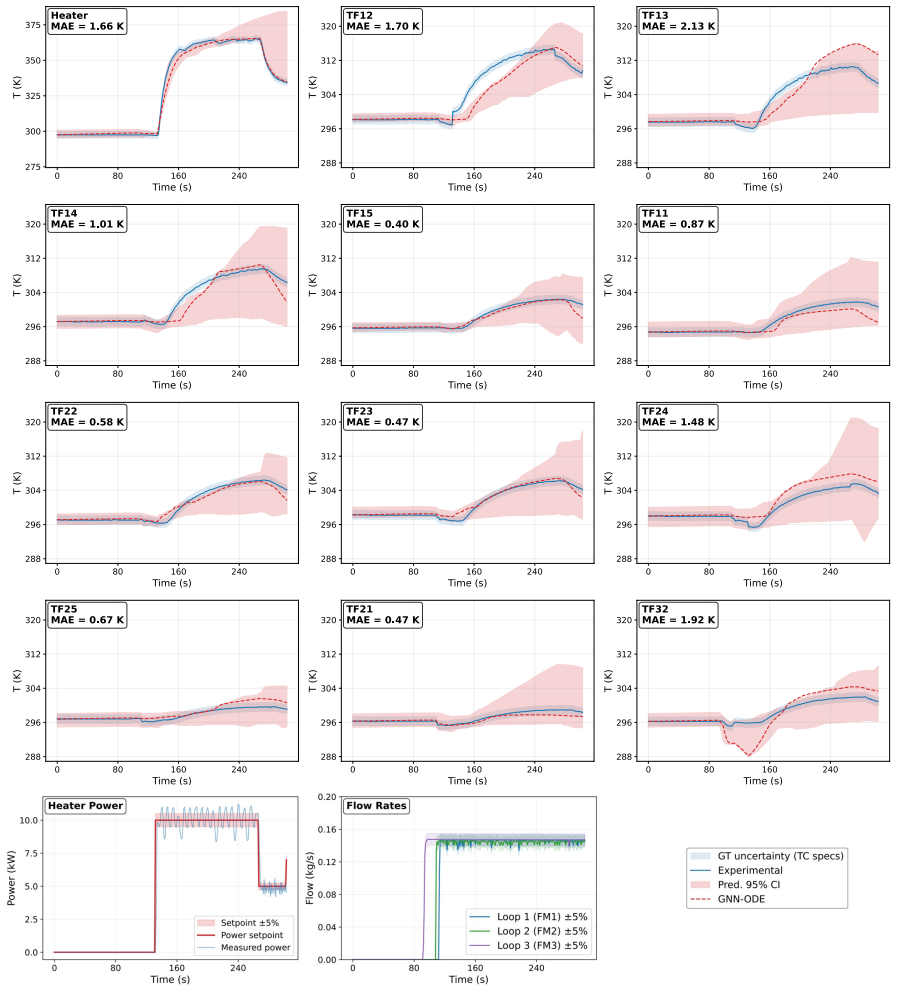
The GNN-ODE surrogate, operating on a directed sensor graph whose edges encode hydraulic connectivity through physics-informed message passing and initialized at uninstrumented nodes by topology guidance, achieves accurate continuous-time forecasting of thermal-hydraulic states. On simulation data it reaches mean absolute errors of 0.91 K after 60 s and 2.18 K after 300 s at uninstrumented nodes with R-squared up to 0.995, runs approximately 105 times faster than simulated time, and after layer-wise fine-tuning on 30 experimental sequences recovers a flow-dependent heat-transfer scaling whose Reynolds-number exponent is consistent with known correlations.
What carries the argument
Physics-informed message-passing Graph Neural Network coupled to a controlled Neural ODE on a directed sensor graph that encodes hydraulic connectivity, together with a topology-guided missing-node initializer.
If this is right
- Real-time ensemble forecasting of 64 members becomes practical for uncertainty-aware supervisory control.
- Constitutive relations such as heat-transfer scaling can be learned directly from limited experimental sequences while remaining consistent with physics.
- Reactor monitoring can operate reliably with sparse sensor placement by reconstructing states from graph topology.
- The same architecture supports rapid adaptation of digital twins when new experimental data arrive.
Where Pith is reading between the lines
- If the graph structure faithfully captures connectivity, the same construction could be tested on other sparsely instrumented thermal or fluid networks such as district heating systems or chemical process plants.
- The recovery of a physically plausible exponent after minimal fine-tuning indicates that the model may function as a hybrid learner that extracts constitutive laws rather than merely memorizing trajectories.
- A direct test of robustness would measure how prediction error changes when the assumed graph topology is deliberately perturbed or when transients exceed the duration seen in training.
Load-bearing premise
The directed sensor graph and its initializer correctly encode the true hydraulic connectivity so that the message-passing and neural ODE components can generalize from simulation to experiment without biasing the recovered constitutive relations.
What would settle it
A statistically significant mismatch between the Reynolds-number exponent recovered after fine-tuning and the range reported in established heat-transfer correlations, or a sharp rise in prediction error on new experimental transients outside the 30-sequence fine-tuning set.
Figures




read the original abstract
Real-time supervisory control of advanced reactors requires accurate forecasting of plant-wide thermal-hydraulic states, including locations where physical sensors are unavailable. Meeting this need calls for surrogate models that combine predictive fidelity, millisecond-scale inference, and robustness to partial observability. In this work, we present a physics-informed message-passing Graph Neural Network coupled with a Neural Ordinary Differential Equation (GNN-ODE) to addresses all three requirements simultaneously. We represent the whole system as a directed sensor graph whose edges encode hydraulic connectivity through flow/heat transfer-aware message passing, and we advance the latent dynamics in continuous time via a controlled Neural ODE. A topology-guided missing-node initializer reconstructs uninstrumented states at rollout start; prediction then proceeds fully autoregressively. The GNN-ODE surrogate achieves satisfactory results for the system dynamics prediction. On held-out simulation transients, the surrogate achieves an average MAE of 0.91 K at 60 s and 2.18 K at 300 s for uninstrumented nodes, with $R^2$ up to 0.995 for missing-node state reconstruction. Inference runs at approximately 105 times faster than simulated time on a single GPU, enabling 64-member ensemble rollouts for uncertainty quantification. To assess sim-to-real transfer, we adapt the pretrained surrogate to experimental facility data using layerwise discriminative fine-tuning with only 30 training sequences. The learned flow-dependent heat-transfer scaling recovers a Reynolds-number exponent consistent with established correlations, indicating constitutive learning beyond trajectory fitting. The model tracks a steep power change transient and produces accurate trajectories at uninstrumented locations.
Editorial analysis
A structured set of objections, weighed in public.
Referee Report
Summary. The paper proposes a physics-informed Graph Neural Network coupled with a Neural ODE (GNN-ODE) as a digital twin surrogate for real-time forecasting of reactor thermal-hydraulic states under partial observability. The system is modeled as a directed sensor graph with flow/heat-transfer-aware message passing and a topology-guided initializer for uninstrumented nodes; dynamics are advanced continuously via a controlled Neural ODE. On held-out simulation transients the model reports average MAE of 0.91 K at 60 s and 2.18 K at 300 s for missing nodes (R² up to 0.995) with inference ~105× faster than real time; after layerwise discriminative fine-tuning on 30 experimental sequences the learned heat-transfer scaling recovers a Reynolds-number exponent consistent with established correlations, which the authors interpret as evidence of constitutive learning beyond trajectory fitting.
Significance. If the central claims hold, the work supplies a practical, fast surrogate for control-oriented digital twins that explicitly handles partial observability and demonstrates sim-to-real transfer with an independent physical consistency check. The GNN-ODE architecture is a natural fit for graph-structured, continuous-time thermal-hydraulic dynamics, and the recovery of a literature-consistent exponent after fine-tuning on limited experimental data is a notable strength that goes beyond pure data-driven fitting. The reported speed-up enabling ensemble rollouts is also practically relevant for uncertainty quantification in supervisory control.
major comments (3)
- [Abstract] Abstract: The headline performance numbers (MAE 0.91 K / 2.18 K, R² ≤ 0.995) and the claim of constitutive learning via the recovered Reynolds exponent are presented without error bars, standard deviations across multiple runs, or any description of the training/validation/test split sizes and transient selection criteria. This absence makes it impossible to judge whether the reported accuracy is statistically robust or sensitive to particular data partitions.
- [Abstract] Abstract (fine-tuning paragraph): The assertion that fine-tuning recovers a Reynolds-number exponent “consistent with established correlations, indicating constitutive learning beyond trajectory fitting” is load-bearing for the sim-to-real contribution. However, the manuscript provides no ablation on alternative graph constructions, no independent validation of the directed sensor graph against hydraulic connectivity data, and no sensitivity analysis of the recovered exponent to the topology-guided initializer. With only 30 experimental sequences, any mismatch between the assumed graph and true flow paths could be absorbed into the learnable scaling parameter, producing a plausible exponent coincidentally.
- [Abstract] Abstract: No ablation studies are reported that isolate the contribution of the physics-informed message passing, the Neural ODE continuous-time integration, or the missing-node initializer. Without these controls it is difficult to determine whether the observed accuracy and exponent recovery are driven by the architectural choices or by the underlying simulation data distribution.
minor comments (1)
- [Abstract] The phrase “achieves satisfactory results for the system dynamics prediction” in the abstract is vague; replacing it with the concrete MAE/R² numbers already given later in the paragraph would improve precision.
Simulated Author's Rebuttal
We thank the referee for the constructive and detailed review, as well as for recognizing the potential practical value of the GNN-ODE digital twin for control-oriented forecasting under partial observability. We address each major comment point by point below. Where the comments correctly identify gaps in statistical reporting or supporting analyses, we have revised the manuscript to incorporate the requested information and studies.
read point-by-point responses
-
Referee: [Abstract] Abstract: The headline performance numbers (MAE 0.91 K / 2.18 K, R² ≤ 0.995) and the claim of constitutive learning via the recovered Reynolds exponent are presented without error bars, standard deviations across multiple runs, or any description of the training/validation/test split sizes and transient selection criteria. This absence makes it impossible to judge whether the reported accuracy is statistically robust or sensitive to particular data partitions.
Authors: We agree that error bars and explicit details on data partitioning are necessary to allow readers to assess statistical robustness. In the revised manuscript we have updated the abstract to report mean performance together with standard deviations computed across five independent training runs that use different random seeds. We have also expanded the methods section to describe the simulation dataset composition, the train/validation/test split sizes, and the criteria used to select transients so that they cover a representative range of power and flow conditions. These additions directly address the concern about sensitivity to particular partitions. revision: yes
-
Referee: [Abstract] Abstract (fine-tuning paragraph): The assertion that fine-tuning recovers a Reynolds-number exponent “consistent with established correlations, indicating constitutive learning beyond trajectory fitting” is load-bearing for the sim-to-real contribution. However, the manuscript provides no ablation on alternative graph constructions, no independent validation of the directed sensor graph against hydraulic connectivity data, and no sensitivity analysis of the recovered exponent to the topology-guided initializer. With only 30 experimental sequences, any mismatch between the assumed graph and true flow paths could be absorbed into the learnable scaling parameter, producing a plausible exponent coincidentally.
Authors: We acknowledge the referee’s caution regarding the strength of the constitutive-learning interpretation. The directed sensor graph is constructed from the independently documented hydraulic connectivity and sensor layout of the experimental facility (referenced via P&ID drawings in the methods). Nevertheless, to strengthen the claim we have added (i) an ablation comparing the directed graph against undirected and alternative connectivity graphs, (ii) a sensitivity study that perturbs the topology-guided initializer and shows the recovered exponent remains stable and aligned with literature values, and (iii) a moderation of the abstract wording from “indicating” to “suggesting” constitutive learning. While the experimental set is limited to 30 sequences, the consistency of the recovered exponent across multiple transients provides supporting evidence; we now present it as such rather than as definitive proof. revision: yes
-
Referee: [Abstract] Abstract: No ablation studies are reported that isolate the contribution of the physics-informed message passing, the Neural ODE continuous-time integration, or the missing-node initializer. Without these controls it is difficult to determine whether the observed accuracy and exponent recovery are driven by the architectural choices or by the underlying simulation data distribution.
Authors: We agree that component-wise ablations are required to attribute performance gains. The revised manuscript now contains a dedicated ablation subsection that isolates each element: replacing physics-informed message passing with a standard GNN, substituting the Neural ODE integrator with a discrete recurrent model, and removing the topology-guided initializer in favor of simpler imputation. Each ablation produces measurable degradation in both forecasting accuracy and stability of the recovered exponent, confirming that the architectural choices contribute materially beyond the simulation data distribution alone. revision: yes
Circularity Check
No significant circularity in derivation or fine-tuning claims
full rationale
The paper reports standard held-out simulation metrics (MAE 0.91 K at 60 s, R² up to 0.995) on transients separate from training data, followed by fine-tuning on 30 experimental sequences where a learned heat-transfer scaling parameter is observed to recover a Reynolds-number exponent matching external literature correlations. This match is presented as post-hoc evidence of constitutive learning rather than a quantity forced by the objective or by self-definition of the graph/message-passing rules. The directed sensor graph and topology initializer are constructed from domain knowledge of hydraulic connectivity, not derived from the target states or the recovered exponent. No equation or step reduces the reported predictions or the exponent consistency to the inputs by construction; the central claims remain independently verifiable against external benchmarks.
Axiom & Free-Parameter Ledger
axioms (2)
- domain assumption Message passing on a directed graph whose edges represent flow and heat-transfer paths can faithfully propagate thermal-hydraulic information across the reactor topology.
- domain assumption A Neural ODE can stably integrate the learned latent dynamics over multi-minute horizons without accumulating unacceptable error.
Lean theorems connected to this paper
-
IndisputableMonolith/Cost/FunctionalEquation.leanwashburn_uniqueness_aczel unclear?
unclearRelation between the paper passage and the cited Recognition theorem.
the learned flow-dependent heat-transfer scaling recovers a Reynolds-number exponent consistent with established correlations
-
IndisputableMonolith/Foundation/AlphaCoordinateFixation.leancostAlphaLog_high_calibrated_iff unclear?
unclearRelation between the paper passage and the cited Recognition theorem.
HTC∝ṁ^α_loop ... Ssrc=(ϕsrc+ϵ)^αr ... UAeff∝2·Ssrc·Sdst/(Ssrc+Sdst)
What do these tags mean?
- matches
- The paper's claim is directly supported by a theorem in the formal canon.
- supports
- The theorem supports part of the paper's argument, but the paper may add assumptions or extra steps.
- extends
- The paper goes beyond the formal theorem; the theorem is a base layer rather than the whole result.
- uses
- The paper appears to rely on the theorem as machinery.
- contradicts
- The paper's claim conflicts with a theorem or certificate in the canon.
- unclear
- Pith found a possible connection, but the passage is too broad, indirect, or ambiguous to say the theorem truly supports the claim.
Reference graph
Works this paper leans on
-
[1]
International Energy Agency.World Energy Outlook 2022. Tech. rep. Paris: IEA, 2022.url: https://www.iea.org/reports/world-energy-outlook-2022
2022
-
[2]
Economics and finance of small modular reactors: A systematic review and research agenda
Benito Mignacca and Giorgio Locatelli. “Economics and finance of small modular reactors: A systematic review and research agenda”. In:Renewable and Sustainable Energy Reviews118 (2020), p. 109519.doi:10.1016/j.rser.2019.109519
-
[3]
Assessment of technoeconomic opportunities in automation for nu- clear microreactors
I. N. de Candido et al. “Assessment of technoeconomic opportunities in automation for nu- clear microreactors”. In:Nuclear Science and Engineering(2024), pp. 1–20.doi:10.1080/ 00295639.2024.2372511
-
[4]
UO 2-fueled microreactors: Near-term solutions to emerging markets
K. Shirvan et al. “UO 2-fueled microreactors: Near-term solutions to emerging markets”. In: Nuclear Engineering and Design412 (2023), p. 112470.doi:10.1016/j.nucengdes.2023. 112470
-
[5]
Ponciroli et al.Design and Prototyping of Advanced Control Systems for Advanced Reactors Operating in the Future Electric Grid
R. Ponciroli et al.Design and Prototyping of Advanced Control Systems for Advanced Reactors Operating in the Future Electric Grid. Final Report ANL/NSE-24/40. Argonne, IL: Argonne National Laboratory, 2024
2024
-
[6]
Design of a supervisory control system for autonomous operation of advanced reactors
Akshay J Dave et al. “Design of a supervisory control system for autonomous operation of advanced reactors”. In:Annals of Nuclear Energy182 (2023), p. 109593
2023
-
[7]
A safe reinforcement learning algorithm for supervisory control of power plants
Yixuan Sun et al. “A safe reinforcement learning algorithm for supervisory control of power plants”. In:Knowledge-Based Systems301 (2024), p. 112312
2024
-
[8]
M. G. Na and B. R. Upadhyaya. “Model Predictive Control of an SP-100 Space Reactor Using Support Vector Regression and Genetic Optimization”. In:IEEE Transactions on Nuclear Science53.4 (2006), pp. 2319–2326.doi:10.1109/TNS.2006.878018
-
[9]
Deep Reinforcement Learning Control of a Boiling Water Reactor
Y. Chen and A. Ray. “Deep Reinforcement Learning Control of a Boiling Water Reactor”. In:IEEE Transactions on Nuclear Science69.8 (2022), pp. 1820–1832.doi:10.1109/TNS. 2022.3187662. 24
work page doi:10.1109/tns 2022
-
[10]
The AGN-201 Digital Twin: A test bed for remotely monitoring nuclear reactors
Ryan Stewart et al. “The AGN-201 Digital Twin: A test bed for remotely monitoring nuclear reactors”. In:Annals of Nuclear Energy213 (2025), p. 111041
2025
-
[11]
Development of whole system digital twins for advanced reactors: leveraging graph neural networks and SAM simulations
Yang Liu et al. “Development of whole system digital twins for advanced reactors: leveraging graph neural networks and SAM simulations”. In:Nuclear Technology211.9 (2025), pp. 2206– 2223
2025
-
[12]
Current status of digital twin architecture and application in nuclear energy field
Hu Mengyan et al. “Current status of digital twin architecture and application in nuclear energy field”. In:Annals of Nuclear Energy202 (2024), p. 110491
2024
-
[13]
A Digital Twin-Based Simulator for Small Modular and Mi- croreactors
Zavier Ndum Ndum et al. “A Digital Twin-Based Simulator for Small Modular and Mi- croreactors”. In:Proceedings of the 2024 Winter Simulation Conference (WSC). IEEE. Or- lando, FL, USA, 2024, pp. 2963–2974.isbn: 979-8-3315-3420-2.url:https : / / informs - sim.org/wsc24papers/con179.pdf
2024
-
[14]
A deep-learning reduced-order model for thermal hydraulic characteristics rapid estimation of steam generators
Shaopeng He et al. “A deep-learning reduced-order model for thermal hydraulic characteristics rapid estimation of steam generators”. In:International Journal of Heat and Mass Transfer 198 (2022), p. 123424
2022
-
[15]
Physics informed neural networks for surrogate modeling of accidental scenarios in nuclear power plants
Federico Antonello, Jacopo Buongiorno, and Enrico Zio. “Physics informed neural networks for surrogate modeling of accidental scenarios in nuclear power plants”. In:Nuclear Engineer- ing and Technology55.9 (2023), pp. 3409–3416
2023
-
[16]
Morphological and cytoskeleton changes in cells after EMT
K. Prantikos, S. Chatzidakis, L.H. Tsoukalas, et al. “Physics-informed neural network with transfer learning (TL-PINN) based on domain similarity measure for prediction of nuclear reactor transients.” In:Scientific Reports13 (2023), p. 16840.doi:10.1038/s41598-023- 43325-1
-
[17]
Nuclear microreactor transient and load-following control with deep rein- forcement learning
Leo Tunkle et al. “Nuclear microreactor transient and load-following control with deep rein- forcement learning”. In:Energy Conversion and Management: X27 (2025), p. 101090.doi: 10.1016/j.ecmx.2025.101090
-
[18]
A Reinforcement Learning Approach to Augment Conventional PID Control in Nuclear Power Plant Transient Operation
Aidan Rigby et al. “A Reinforcement Learning Approach to Augment Conventional PID Control in Nuclear Power Plant Transient Operation”. In:Nuclear Technology(2025), pp. 1– 19
2025
-
[19]
Development and assessment of a nearly autonomous management and control system for advanced reactors
Linyu Lin et al. “Development and assessment of a nearly autonomous management and control system for advanced reactors”. In:Annals of Nuclear Energy150 (2021), p. 107861
2021
-
[20]
Neural Ordinary Differential Equations
Tian Qi Chen et al. “Neural Ordinary Differential Equations”. In:Proceedings of the 32nd International Conference on Neural Information Processing Systems (NeurIPS 2018). 2018, pp. 6571–6583
2018
-
[21]
NeuroMANCER: Neural Modules with Adaptive Nonlinear Constraints and Efficient Regularizations
Jan Drgona et al. “NeuroMANCER: Neural Modules with Adaptive Nonlinear Constraints and Efficient Regularizations”. In: (2023).url:https://github.com/pnnl/neuromancer
2023
-
[22]
Stable and safe human-aligned reinforcement learning through neural ordinary differential equations
Liqun Zhao et al. “Stable and safe human-aligned reinforcement learning through neural ordinary differential equations”. In:arXiv preprint arXiv:2401.13148(2024).url:https: //arxiv.org/abs/2401.13148
-
[23]
Robust Model Predictive Control With Neural Ordinary Differential Equa- tions for Nonlinear Systems
Xuyu Shen et al. “Robust Model Predictive Control With Neural Ordinary Differential Equa- tions for Nonlinear Systems”. In:Optimal Control Applications and Methods(2025)
2025
-
[24]
Autonomous Control of Small-Scale Advanced Reactors via Digital Twin-Enabled Neural ODE Models
Doyeong Lim et al. “Autonomous Control of Small-Scale Advanced Reactors via Digital Twin-Enabled Neural ODE Models”. In:Nuclear Science and Engineering((In Press))
-
[25]
IEEE Transactions on Neural Networks20(1), 61–80 (2009) https://doi.org/10.1109/TNN.2008.2005605
Franco Scarselli et al. “The Graph Neural Network Model”. In:IEEE Transactions on Neural Networks20.1 (2009), pp. 61–80.doi:10.1109/TNN.2008.2005605. 25
-
[26]
Semi-Supervised Classification with Graph Convolutional Networks
Thomas N Kipf and Max Welling. “Semi-Supervised Classification with Graph Convolutional Networks”. In:arXiv preprint arXiv:1609.02907(2016)
work page internal anchor Pith review Pith/arXiv arXiv 2016
-
[27]
Graph attention Network-Based model for multiple fault detection and identification of sensors in nuclear power plant
Shuqi Liu et al. “Graph attention Network-Based model for multiple fault detection and identification of sensors in nuclear power plant”. In:Nuclear Engineering and Design419 (2024), p. 112949
2024
-
[28]
Spatial-Temporal Graph Conditionalized Normalizing Flows for Nuclear Power Plant Multivariate Anomaly Detection
Le Zhang et al. “Spatial-Temporal Graph Conditionalized Normalizing Flows for Nuclear Power Plant Multivariate Anomaly Detection”. In:IEEE Transactions on Industrial Infor- matics20.11 (2024), pp. 12945–12954
2024
-
[29]
Graph neural network based multiple accident diagnosis in nuclear power plants: Data optimization to represent the system configuration
Young Ho Chae et al. “Graph neural network based multiple accident diagnosis in nuclear power plants: Data optimization to represent the system configuration”. In:Nuclear Engi- neering and Technology54.8 (2022), pp. 2859–2870
2022
-
[30]
Interpretability study of a typical fault diagnosis model for nuclear power plant primary circuit based on a graph neural network
Xin Wang, Hang Wang, and MinJun Peng. “Interpretability study of a typical fault diagnosis model for nuclear power plant primary circuit based on a graph neural network”. In:Reliability Engineering & System Safety261 (2025), p. 111151
2025
-
[31]
W. Lin et al. “Forecasting In-Core Power Distributions in Nuclear Power Plants via a Spatial– Temporal Hierarchical-Directed Network”. In:Progress in Nuclear Energy186 (2026). Spatial– temporal hierarchical-directed network with graph-based spatial modeling, p. 109123.doi: 10.1016/j.pnucene.2025.109123
-
[32]
Learning Constrained Parametric Differen- tiable Predictive Control Policies With Guarantees
J´ an Drgoˇ na, Aaron Tuor, and Draguna Vrabie. “Learning Constrained Parametric Differen- tiable Predictive Control Policies With Guarantees”. In:IEEE Transactions on Systems, Man, and Cybernetics: Systems54.6 (2024), pp. 3596–3607.doi:10.1109/TSMC.2024.3368026
-
[33]
A 3-D Neutron Distribution Reconstruction Method Based on the Off-Situ Measurement for Reactor
Pei Cao, Chenglong Cao, and Quan Gan. “A 3-D Neutron Distribution Reconstruction Method Based on the Off-Situ Measurement for Reactor”. In:IEEE Transactions on Nu- clear Science68.12 (2021), pp. 2694–2701.doi:10.1109/TNS.2021.3123381
-
[34]
An Explicit Off-Situ Inversion Method for Neutron Fields in Reactor Core Based on Graph Structure
Pei Cao et al. “An Explicit Off-Situ Inversion Method for Neutron Fields in Reactor Core Based on Graph Structure”. In:IEEE Transactions on Nuclear Science73.3 (2026), pp. 566– 577.doi:10.1109/TNS.2026.3651311
-
[35]
Gaussian Error Linear Units (GELUs)
Dan Hendrycks and Kevin Gimpel. “Bridging Nonlinearities and Stochastic Regularizers with Gaussian Error Linear Units”. In:CoRRabs/1606.08415 (2016). arXiv:1606.08415.url: http://arxiv.org/abs/1606.08415
work page internal anchor Pith review Pith/arXiv arXiv 2016
-
[36]
Sigmoid-weighted linear units for neural net- work function approximation in reinforcement learning
Stefan Elfwing, Eiji Uchibe, and Kenji Doya. “Sigmoid-weighted linear units for neural net- work function approximation in reinforcement learning”. In:Neural Networks107 (2018), pp. 3–11
2018
-
[37]
Samy Bengio et al. “Scheduled Sampling for Sequence Prediction with Recurrent Neural Net- works”. In:Advances in Neural Information Processing Systems (NeurIPS). 2015, pp. 1171– 1179.url:https://arxiv.org/abs/1506.03099
-
[38]
Rui Hu et al.SAM user’s guide. Tech. rep. Argonne National Lab.(ANL), Argonne, IL (United States), 2021
2021
-
[39]
Rui Hu et al.SAM theory manual. Tech. rep. Argonne National Lab.(ANL), Argonne, IL (United States), 2021
2021
-
[40]
An ai-driven thermal-fluid testbed for advanced small modular reac- tors: Integration of digital twin and large language models
Doyeong Lim et al. “An ai-driven thermal-fluid testbed for advanced small modular reac- tors: Integration of digital twin and large language models”. In:AI Thermal Fluids(2025), p. 100023. 26
2025
-
[41]
Kairos power thermal hydraulics research and development
Edward Blandford et al. “Kairos power thermal hydraulics research and development”. In: Nuclear Engineering and Design364 (2020), p. 110636
2020
-
[42]
Nuclear Regulatory Commission.Human Performance Tools
U.S. Nuclear Regulatory Commission.Human Performance Tools. Tech. rep. Accession Num- ber: ML102120052. U.S. Nuclear Regulatory Commission, 2010.url:https://www.nrc.gov/ docs/ML1021/ML102120052.pdf
2010
-
[43]
Department of Energy.Human Performance Improvement Handbook, Volume 1: Con- cepts and Principles
U.S. Department of Energy.Human Performance Improvement Handbook, Volume 1: Con- cepts and Principles. Tech. rep. DOE-HDBK-1028-2009. U.S. Department of Energy, 2009. url:http://large.stanford.edu/courses/2019/ph241/simone1/docs/doe-hdbk-1028- 2009.pdf
2009
-
[44]
Jeremy Howard and Sebastian Ruder.Universal Language Model Fine-tuning for Text Clas- sification. 2018. arXiv:1801.06146 [cs.CL].url:https://arxiv.org/abs/1801.06146
work page Pith review arXiv 2018
-
[45]
Smoothing and differentiation of data by sim- plified least squares procedures
Abraham Savitzky and Marcel J. E. Golay. “Smoothing and differentiation of data by sim- plified least squares procedures”. In:Analytical Chemistry36.8 (1964), pp. 1627–1639.doi: 10.1021/ac60214a047
-
[46]
Temperature and heat flux estimation from sampled transient sensor measurements
Zaichun Feng et al. “Temperature and heat flux estimation from sampled transient sensor measurements”. In:International Journal of Thermal Sciences49.12 (2010), pp. 2385–2390. doi:10.1016/j.ijthermalsci.2010.08.004
-
[47]
Zavier Ndum Ndum et al. “Automating Monte Carlo Simulations in Nuclear Engineering with Domain Knowledge-embedded Large Language Model Agents”. In:Energy and AI21 (2025), p. 100555.issn: 2666-5468.doi:https://doi.org/10.1016/j.egyai.2025.100555. url:https://www.sciencedirect.com/science/article/pii/S2666546825000874
- [48]
- [49]
-
[50]
Large Language Model-assisted Digital Twin for Remote Monitor- ing and Control of Advanced Reactors
Zavier Ndum Ndum et al. “Large Language Model-assisted Digital Twin for Remote Monitor- ing and Control of Advanced Reactors”. In:Progress in Nuclear Energy192 (2026), p. 106172. doi:10.1016/j.pnucene.2025.106172. 27
discussion (0)
Sign in with ORCID, Apple, or X to comment. Anyone can read and Pith papers without signing in.