Recognition: 2 theorem links
· Lean TheoremLong-term stability study of single-mask triple GEM detector: impact of continuous irradiation
Pith reviewed 2026-05-10 18:31 UTC · model grok-4.3
The pith
A single-mask triple GEM detector maintained stable gain and energy resolution through 98 days of uninterrupted irradiation.
A machine-rendered reading of the paper's core claim, the machinery that carries it, and where it could break.
Core claim
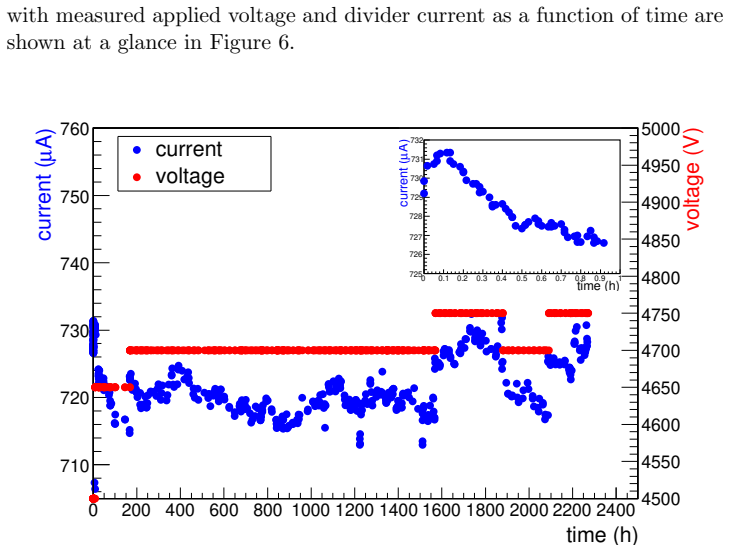
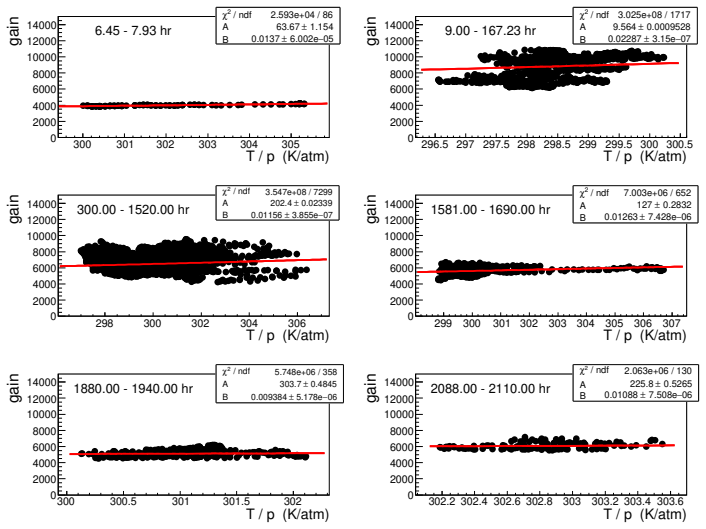
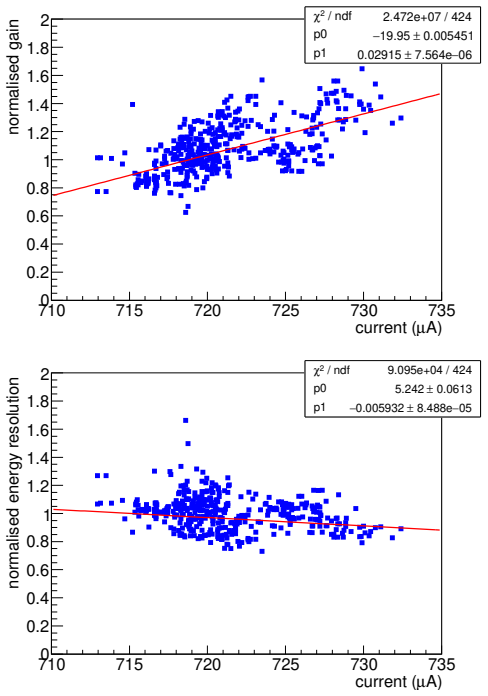
The gain and energy resolution of the single-mask triple GEM detector remained stable during 98 days of continuous, uninterrupted irradiation from a 55Fe source. Variations observed in the data were accounted for by simultaneous recordings of ambient temperature, pressure, and relative humidity, leaving no evidence of radiation-induced degradation in the tested patch.
What carries the argument
Continuous irradiation of a single patch on the detector while periodically measuring gain and energy resolution, with corrections applied for recorded ambient parameters.
If this is right
- The detector can sustain prolonged exposure without measurable performance loss in the tested conditions.
- Efficiency and count rate with a strong source also show no significant long-term decline.
- Ambient-parameter corrections are sufficient to interpret stability data over multi-month periods.
- Single-mask triple GEM chambers are viable candidates for installation in experiments requiring continuous operation.
Where Pith is reading between the lines
- Similar tests with different gas mixtures or higher particle fluxes would clarify the range of conditions under which stability holds.
- Comparison with actual beam-induced backgrounds in an accelerator hall would test whether the lab result generalizes.
- If stability persists, detector replacement intervals in large experiments could be extended beyond current assumptions.
Load-bearing premise
The laboratory 55Fe source and controlled conditions produce radiation flux, particle types, and duty cycle that match those expected in a real high-energy physics experiment.
What would settle it
A clear drop in gain or broadening of the energy resolution peak after 98 days that persists after correcting for all measured changes in temperature, pressure, and humidity.
Figures








read the original abstract
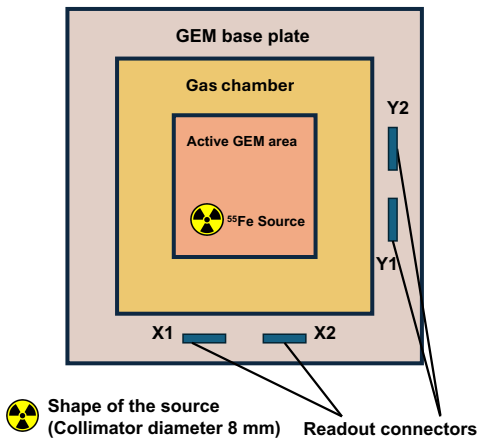
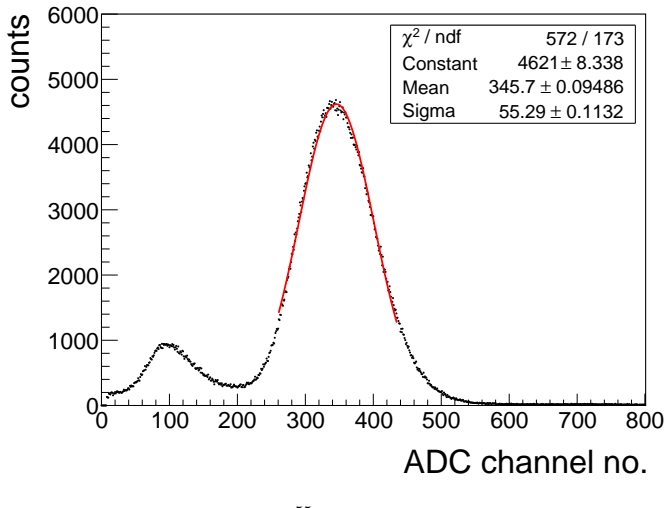
A study has been carried out to evaluate the performance stability of Gas Electron Multiplier (GEM) chamber prototypes in the laboratory using $^{55}$Fe radiation source with Argon and CO$_2$ gas mixture. This research focuses on the characterisation of the GEM detector's gain, efficiency (count rate with radioactive source), and energy resolution under varying operational conditions. A patch on the detector has been subjected to continuous and absolutely uninterrupted radiation for about 98 days. The gain and energy resolution of the detector are measured along with the ambient parameters temperature (t), pressure (p) and relative humidity (RH). In addition to that, the long-term behaviour of the count rate with a strong radioactive source are also studied. This work is very relevant for Micro Pattern Gaseous Detectors (MPGD) such as GEM before installing on large experiment. The experimental setup, methodology, and results are presented in this article.
Editorial analysis
A structured set of objections, weighed in public.
Referee Report
Summary. The manuscript reports a laboratory study of the long-term stability of a single-mask triple GEM detector under continuous, uninterrupted 55Fe irradiation for approximately 98 days in an Ar-CO2 gas mixture. The authors present time-series measurements of gain, energy resolution, and count rate, with explicit corrections applied for measured ambient temperature, pressure, and relative humidity. The central claim is that detector performance remains stable under these conditions after accounting for environmental variations.
Significance. If the results hold, the work supplies useful empirical data on GEM aging under prolonged irradiation, directly relevant to MPGD deployment in high-energy physics. Strengths include the provision of time-series data, count-rate monitoring with a strong source, and documented correction procedures for ambient parameters, which support reproducibility of the stability assessment within the controlled lab setting.
minor comments (4)
- Abstract: the phrase 'absolutely uninterrupted' is redundant; 'uninterrupted' suffices.
- Results section: time-series plots of gain and energy resolution should explicitly state the normalization procedure (e.g., the functional form used for T/P/RH corrections) and include quantitative measures of stability such as RMS variation or fitted slopes with uncertainties.
- Figure captions: include the exact gas mixture ratio (e.g., Ar:CO2 70:30), source activity, and irradiation duration for each panel to improve standalone readability.
- Discussion: the irradiation rate achieved with the 55Fe source should be compared numerically to expected rates in target experiments to clarify the scope of applicability, even if the primary claim is limited to the lab conditions.
Simulated Author's Rebuttal
We thank the referee for the careful review and positive assessment of our manuscript on the long-term stability of a single-mask triple GEM detector. The referee's summary correctly identifies the key elements of the study, including the 98-day uninterrupted irradiation, environmental corrections, and relevance to MPGD applications. We appreciate the recognition of the time-series data, count-rate monitoring, and reproducibility aspects. We will prepare a revised version addressing minor points as recommended.
Circularity Check
No circularity: purely experimental stability measurements with no derivations or self-referential predictions
full rationale
The paper reports laboratory measurements of gain, energy resolution, count rate, and ambient corrections (T, P, RH) for a triple GEM detector under continuous 55Fe irradiation over 98 days. No equations, fitted models, or predictions are claimed; results are direct time-series data with standard normalization for environmental factors. No self-citations are used to justify any derivation, and the central claim rests on independent experimental observations rather than any reduction to inputs by construction. This matches the default non-circular case for empirical reports.
Axiom & Free-Parameter Ledger
Lean theorems connected to this paper
-
IndisputableMonolith/Cost/FunctionalEquation.leanwashburn_uniqueness_aczel unclear?
unclearRelation between the paper passage and the cited Recognition theorem.
The gain and energy resolution of the detector remained stable under continuous irradiation for about 98 days, with measurements accounting for ambient parameters.
-
IndisputableMonolith/Foundation/ArithmeticFromLogic.leanreality_from_one_distinction unclear?
unclearRelation between the paper passage and the cited Recognition theorem.
A patch on the detector has been subjected to continuous and absolutely uninterrupted radiation for about 98 days.
What do these tags mean?
- matches
- The paper's claim is directly supported by a theorem in the formal canon.
- supports
- The theorem supports part of the paper's argument, but the paper may add assumptions or extra steps.
- extends
- The paper goes beyond the formal theorem; the theorem is a base layer rather than the whole result.
- uses
- The paper appears to rely on the theorem as machinery.
- contradicts
- The paper's claim conflicts with a theorem or certificate in the canon.
- unclear
- Pith found a possible connection, but the passage is too broad, indirect, or ambiguous to say the theorem truly supports the claim.
Forward citations
Cited by 1 Pith paper
-
Charging-up and reverse charging-up phenomena in a double-mask triple GEM detector
A double-mask triple GEM detector exhibits charging-up under high irradiation and reverse charging-up when irradiation decreases, causing gain to vary and stabilize in Ar/CO2 gas.
Reference graph
Works this paper leans on
-
[1]
Sauli, Nucl
F. Sauli, Nucl. Instrum. Methods Phys. Res. A 386 (1997) 531
1997
-
[2]
Buzulutskov, Instrum Exp Tech 50, (2007) 287
A.F. Buzulutskov, Instrum Exp Tech 50, (2007) 287
2007
-
[3]
Ketzeret al.,, Nucl
B. Ketzeret al.,, Nucl. Instrum. Methods Phys. Res. A 535 (2004) 314
2004
-
[4]
Galatyuk, Nucl
T. Galatyuk, Nucl. Phys. A 982 (2019) 163
2019
-
[5]
https://www.cbm.gsi.de/
-
[6]
http://www.fair-center.eu/
-
[7]
Rama Prasad Adaket al.,Nucl. Instrum. Methods Phys. Res. A 846 (2017) 29
2017
-
[8]
A. K. Sharmaet al.,Proc. DAE Symp. Nucl. Phys. 67 (2023) 1011
2023
-
[9]
Biswaset al.,Nucl
S. Biswaset al.,Nucl. Instrum. Methods Phys. Res. A 800 (2015) 93
2015
-
[10]
Oliveiraet al.,United States Patent, US 8,597,490 B2 (2013)
2013
-
[11]
Duarte Pintoet al.,JINST 4 (2009) P12009
S. Duarte Pintoet al.,JINST 4 (2009) P12009
2009
-
[12]
Karadzhinovaet al.,JINST 10 (2015) P12014
A. Karadzhinovaet al.,JINST 10 (2015) P12014
2015
-
[13]
Das, Nucl
S. Das, Nucl. Instrum. Methods Phys. Res. A 824 (2016) 518
2016
-
[14]
Shahet al.,Nucl
A. Shahet al.,Nucl. Instrum. Methods Phys. Res. A 936 (2019) 459
2019
-
[15]
Bachmannet al.,Nucl
S. Bachmannet al.,Nucl. Instrum. Methods Phys. Res. A 438 (1999) 376
1999
-
[16]
Chatterjeeet al.,Nucl
S. Chatterjeeet al.,Nucl. Instrum. Methods Phys. Res. A 1014 (2021) 165749
2021
-
[17]
Mandalet al.,Pramana - Journal of Physics (In Press), arXiv:2505.03357 (2025)
S. Mandalet al.,Pramana - Journal of Physics (In Press), arXiv:2505.03357 (2025)
-
[18]
CDT CASCADE Detector Technologies GmbH, Germany, www.n- cdt.com
-
[19]
Mandalet al.,Nucl
S. Mandalet al.,Nucl. Instrum. Methods Phys. Res. A 1064 (2024) 169389
2024
-
[20]
Thesis, University of Calcutta, 2023
Shreya Roy, Characterization Of Gaseous And Scintillator Detectors For High Energy Physics And Cosmic Ray Experiments, Ph.D. Thesis, University of Calcutta, 2023. 20
2023
-
[21]
Thesis, University of Calcutta, 2023
Arindam Sen, Development Of Resistive Plate Chamber For The CBM Experiment At FAIR And Other Application Of Radiation Detector, Ph.D. Thesis, University of Calcutta, 2023
2023
-
[22]
Thesis, University of Calcutta, 2023
Sayak Chatterjee, Performance Studies of Gas Electron Multiplier De- tector for the Muon Chamber of High Rate CBM Experiment at FAIR, Ph.D. Thesis, University of Calcutta, 2023
2023
-
[23]
Adaket al.,2016 JINST 11 T10001
R.P. Adaket al.,2016 JINST 11 T10001
2016
-
[24]
Royet al.,Nucl
S. Royet al.,Nucl. Instrum. Methods Phys. Res. A 936 (2019) 485
2019
-
[25]
Chatterjeeet al.,Nucl
S. Chatterjeeet al.,Nucl. Instrum. Methods Phys. Res. A 936 (2019) 491
2019
-
[26]
Chatterjeeet al.,Journal of Physics: Conference Series 1498 (2020) 012037
S. Chatterjeeet al.,Journal of Physics: Conference Series 1498 (2020) 012037
2020
-
[27]
Chatterjeeet al.,2020 JINST 15 T09011
S. Chatterjeeet al.,2020 JINST 15 T09011
2020
-
[28]
Chatterjeeet al.,Nucl
S. Chatterjeeet al.,Nucl. Instrum. Methods Phys. Res. A 1046 (2023) 167747
2023
-
[29]
Chatterjeeet al.,Nucl
S. Chatterjeeet al.,Nucl. Instrum. Methods Phys. Res. A 1049 (2023) 168110
2023
-
[30]
S Sahuet al.,JINST 12, C05006 (2017)
2017
-
[31]
Mandalet al.,Proc
S. Mandalet al.,Proc. DAE Symp. Nucl. Phys. 69 (2025) 1299-1300. 21
2025
discussion (0)
Sign in with ORCID, Apple, or X to comment. Anyone can read and Pith papers without signing in.