Recognition: no theorem link
Multimodal Large Language Models for Multi-Subject In-Context Image Generation
Pith reviewed 2026-05-10 19:00 UTC · model grok-4.3
The pith
MUSIC is a multimodal LLM that generates images containing multiple reference subjects more reliably by using automatic data creation, vision chain-of-thought reasoning, and semantics-driven layout planning.
A machine-rendered reading of the paper's core claim, the machinery that carries it, and where it could break.
Core claim
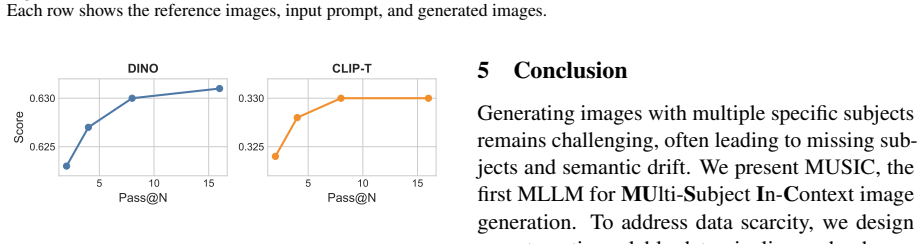
MUSIC is an MLLM for multi-subject in-context image generation. It overcomes data scarcity via an automatic scalable data generation pipeline without manual annotation. A vision chain-of-thought mechanism enhances understanding of multi-subject semantic relationships by guiding step-by-step reasoning from subject images to semantics and generation. A semantics-driven spatial layout planning method mitigates identity entanglement and manages visual complexity with test-time scalability. Training on complex subject images improves chained reasoning capacity. On the curated MSIC benchmark, MUSIC significantly surpasses other methods in both multi- and single-subject scenarios.
What carries the argument
The vision chain-of-thought mechanism together with semantics-driven spatial layout planning inside the MUSIC model, which together guide step-by-step visual reasoning and control subject placement.
If this is right
- Image generation becomes practical for prompts that name several specific subjects at once.
- Training such models no longer requires expensive manual collection of multi-subject examples.
- Layout planning scales at inference time to handle scenes with greater visual complexity.
- The MSIC benchmark provides a standardized testbed for measuring progress on this task.
Where Pith is reading between the lines
- The same automatic pipeline and reasoning steps could be adapted to generate consistent multi-subject video clips.
- Semantic layout planning may transfer to other tasks that require precise spatial arrangement of objects described in text.
- Wider adoption could support personalized illustration tools where users supply several reference photos.
Load-bearing premise
The automatic data generation pipeline produces sufficiently diverse and high-quality examples, and the vision chain-of-thought plus layout planning reliably prevent subject missing, semantic drift, and identity entanglement.
What would settle it
Evaluating MUSIC on the MSIC benchmark and finding that automatic metrics for subject fidelity or human judgments of semantic consistency show no improvement over strong baselines would falsify the central claim.
Figures





read the original abstract
Recent advances in text-to-image (T2I) generation have enabled visually coherent image synthesis from descriptions, but generating images containing multiple given subjects remains challenging. As the number of reference identities increases, existing methods often suffer from subject missing and semantic drift. To address this problem, we propose MUSIC, the first MLLM specifically designed for \textbf{MU}lti-\textbf{S}ubject \textbf{I}n-\textbf{C}ontext image generation. To overcome the data scarcity, we introduce an automatic and scalable data generation pipeline that eliminates the need for manual annotation. Furthermore, we enhance the model's understanding of multi-subject semantic relationships through a vision chain-of-thought (CoT) mechanism, guiding step-by-step reasoning from subject images to semantics and generation. To mitigate identity entanglement and manage visual complexity, we develop a novel semantics-driven spatial layout planning method and demonstrate its test-time scalability. By incorporating complex subject images during training, we improve the model's capacity for chained reasoning. In addition, we curate MSIC, a new benchmark tailored for multi-subject in-context generation. Experimental results demonstrate that MUSIC significantly surpasses other methods in both multi- and single-subject scenarios.
Editorial analysis
A structured set of objections, weighed in public.
Referee Report
Summary. The paper claims to introduce MUSIC, the first MLLM for multi-subject in-context image generation. It tackles data scarcity with an automatic scalable data generation pipeline, enhances semantic understanding via a vision chain-of-thought mechanism, and mitigates identity issues with a semantics-driven spatial layout planning method. A new benchmark MSIC is curated, and experiments purportedly show MUSIC significantly outperforming other methods in multi- and single-subject scenarios.
Significance. If validated, the work would be significant for advancing multi-subject controllable image synthesis, a key limitation in current T2I models. The automatic pipeline and MSIC benchmark provide reusable resources for the community. The vision CoT and layout planning represent creative solutions to semantic and identity challenges. These could inspire similar approaches in other multimodal generation tasks.
major comments (3)
- The automatic data generation pipeline is used to create both the training data and the MSIC benchmark without manual annotation. This setup risks the model learning pipeline-specific artifacts rather than generalizable capabilities, especially since no external validation, diversity metrics, or human quality scores are provided. This directly undermines the central claim that MUSIC significantly surpasses other methods.
- The abstract asserts that experimental results demonstrate MUSIC significantly surpasses other methods in multi- and single-subject scenarios, but supplies no metrics, baselines, ablation studies, or error analysis. Without these in the experiments section, it is impossible to assess whether gains are due to the proposed vision CoT, layout planning, or data artifacts.
- The vision chain-of-thought mechanism and semantics-driven spatial layout planning are described at a high level only. Without implementation details, pseudocode, or concrete examples showing how they prevent subject missing, semantic drift, and identity entanglement, their contribution to the claimed improvements cannot be evaluated.
minor comments (1)
- The acronym expansion for MUSIC in the abstract uses inconsistent bolding; standardize the presentation for clarity.
Simulated Author's Rebuttal
We thank the referee for the constructive and detailed feedback on our manuscript introducing MUSIC for multi-subject in-context image generation. We have reviewed each major comment carefully and provide point-by-point responses below, outlining specific revisions that will strengthen the paper's clarity, evidence, and reproducibility.
read point-by-point responses
-
Referee: The automatic data generation pipeline is used to create both the training data and the MSIC benchmark without manual annotation. This setup risks the model learning pipeline-specific artifacts rather than generalizable capabilities, especially since no external validation, diversity metrics, or human quality scores are provided. This directly undermines the central claim that MUSIC significantly surpasses other methods.
Authors: We appreciate this important point on potential pipeline artifacts. The automatic pipeline draws from diverse public image sources and multiple generative models to create varied multi-subject compositions, with the MSIC benchmark held out from training distributions. To further demonstrate generalizability, the revised manuscript will add external validation experiments on independently collected real-world multi-subject datasets, quantitative diversity metrics (e.g., embedding variance and semantic coverage scores), and human evaluation results from a study involving quality and fidelity ratings. These additions will help isolate the contributions of the proposed methods from any data-specific effects. revision: yes
-
Referee: The abstract asserts that experimental results demonstrate MUSIC significantly surpasses other methods in multi- and single-subject scenarios, but supplies no metrics, baselines, ablation studies, or error analysis. Without these in the experiments section, it is impossible to assess whether gains are due to the proposed vision CoT, layout planning, or data artifacts.
Authors: We apologize if the experimental presentation was insufficiently detailed in the current draft. The experiments section reports quantitative results using metrics such as FID, subject consistency scores, and CLIP-based semantic alignment, with comparisons to baselines including recent T2I and MLLM methods. Ablation studies on vision CoT and layout planning components are included, along with qualitative error analysis. In the revision, we will expand this into a prominent main results table summarizing all metrics, baselines, and ablations, plus a dedicated subsection with detailed error analysis to explicitly attribute performance gains to each component. revision: yes
-
Referee: The vision chain-of-thought mechanism and semantics-driven spatial layout planning are described at a high level only. Without implementation details, pseudocode, or concrete examples showing how they prevent subject missing, semantic drift, and identity entanglement, their contribution to the claimed improvements cannot be evaluated.
Authors: We agree that more granular details are required for full evaluation and reproducibility. The revised manuscript will include a new subsection with pseudocode for the vision CoT process (step-by-step subject semantics extraction and relation reasoning) and the semantics-driven layout planning algorithm. We will also add a figure with concrete examples, including reference subject images, intermediate CoT reasoning traces, generated spatial layouts, and final outputs, explicitly illustrating mitigation of subject missing, semantic drift, and identity entanglement. revision: yes
Circularity Check
No circularity in derivation chain; empirical model and benchmark are self-contained
full rationale
The paper presents an empirical contribution: a new MLLM (MUSIC) trained via an automatic data pipeline, augmented with vision CoT and semantics-driven layout planning, then evaluated on a newly curated MSIC benchmark. No mathematical derivation, equations, or first-principles predictions are claimed that reduce to the inputs by construction. The listed circularity patterns (self-definitional fits, fitted inputs renamed as predictions, load-bearing self-citations, ansatz smuggling, or renaming known results) are absent. The central claim of superior performance rests on external comparisons rather than internal self-reference, making the work self-contained against the provided benchmarks.
Axiom & Free-Parameter Ledger
axioms (2)
- domain assumption An automatic data generation pipeline can produce diverse, high-quality multi-subject training examples without manual annotation.
- ad hoc to paper Vision chain-of-thought reasoning improves the model's grasp of multi-subject semantic relationships.
invented entities (3)
-
MUSIC model
no independent evidence
-
MSIC benchmark
no independent evidence
-
semantics-driven spatial layout planning method
no independent evidence
Reference graph
Works this paper leans on
-
[1]
Large Scale GAN Training for High Fidelity Natural Image Synthesis
Large scale gan training for high fi- delity natural image synthesis.arXiv preprint arXiv:1809.11096. Tom Brown, Benjamin Mann, Nick Ryder, Melanie Subbiah, Jared D Kaplan, Prafulla Dhariwal, Arvind Neelakantan, Pranav Shyam, Girish Sastry, Amanda Askell, and 1 others. 2020. Language models are few-shot learners.Advances in neural information processing s...
work page internal anchor Pith review arXiv 2020
-
[2]
Seed-x: Multimodal models with unified multi- granularity comprehension and generation.arXiv preprint arXiv:2404.14396. Ian Goodfellow, Jean Pouget-Abadie, Mehdi Mirza, Bing Xu, David Warde-Farley, Sherjil Ozair, Aaron Courville, and Yoshua Bengio. 2020. Generative adversarial networks.Communications of the ACM, 63(11):139–144. Jian Han, Jinlai Liu, Yi Ji...
-
[3]
InACM SIGGRAPH 2024 Conference Pa- pers, pages 1–12
Subject-diffusion: Open domain personal- ized text-to-image generation without test-time fine- tuning. InACM SIGGRAPH 2024 Conference Pa- pers, pages 1–12. Zhendong Mao, Mengqi Huang, Fei Ding, Ming- cong Liu, Qian He, and Yongdong Zhang. 2024. Realcustom++: Representing images as real-word for real-time customization.arXiv preprint arXiv:2408.09744. Chon...
-
[4]
Robin Rombach, Andreas Blattmann, Dominik Lorenz, Patrick Esser, and Björn Ommer
Generating diverse high-fidelity images with vq-vae-2.Advances in neural information processing systems, 32. Robin Rombach, Andreas Blattmann, Dominik Lorenz, Patrick Esser, and Björn Ommer. 2022. High- resolution image synthesis with latent diffusion mod- els. InCVPR, pages 10684–10695. Nataniel Ruiz, Yuanzhen Li, Varun Jampani, Yael Pritch, Michael Rubi...
2022
-
[5]
InCVPR, pages 8430– 8439
Objects365: A large-scale, high-quality dataset for object detection. InCVPR, pages 8430– 8439. Jascha Sohl-Dickstein, Eric Weiss, Niru Mah- eswaranathan, and Surya Ganguli. 2015. Deep un- supervised learning using nonequilibrium thermody- namics. InICML, pages 2256–2265. pmlr. Han Song, Yucheng Zhou, Jianbing Shen, and Yu Cheng
2015
-
[6]
Denoising Diffusion Implicit Models
From broad exploration to stable synthesis: Entropy-guided optimization for autoregressive im- age generation. InThe Fourteenth International Con- ference on Learning Representations. Jiaming Song, Chenlin Meng, and Stefano Ermon. 2020. Denoising diffusion implicit models.arXiv preprint arXiv:2010.02502. Yang Song, Prafulla Dhariwal, Mark Chen, and Ilya S...
work page internal anchor Pith review Pith/arXiv arXiv 2020
-
[7]
Autoregressive Model Beats Diffusion: Llama for Scalable Image Generation
Autoregressive model beats diffusion: Llama for scalable image generation.arXiv preprint arXiv:2406.06525. Zhenxiong Tan, Songhua Liu, Xingyi Yang, Qiaochu Xue, and Xinchao Wang. 2024. Ominicontrol: Mini- mal and universal control for diffusion transformer. arXiv preprint arXiv:2411.15098, 3. XLabs AI team. 2025. x-flux. Accessed: 2025-02-07. Keyu Tian, Y...
work page internal anchor Pith review arXiv 2024
-
[8]
Maskbit: Embedding-free image generation via bit tokens.arXiv preprint arXiv:2409.16211, 2024
Maskbit: Embedding-free image generation via bit tokens.arXiv preprint arXiv:2409.16211. Jason Wei, Xuezhi Wang, Dale Schuurmans, Maarten Bosma, Fei Xia, Ed Chi, Quoc V Le, Denny Zhou, and 1 others. 2022. Chain-of-thought prompting elic- its reasoning in large language models.Advances in neural information processing systems, 35:24824– 24837. 12 Yuxiang W...
-
[9]
IP-Adapter: Text Compatible Image Prompt Adapter for Text-to-Image Diffusion Models
Ip-adapter: Text compatible image prompt adapter for text-to-image diffusion models.arXiv preprint arXiv:2308.06721. Jiahui Yu, Yuanzhong Xu, Jing Yu Koh, Thang Lu- ong, Gunjan Baid, Zirui Wang, Vijay Vasudevan, Alexander Ku, Yinfei Yang, Burcu Karagol Ayan, and 1 others. 2022. Scaling autoregressive models for content-rich text-to-image generation.arXiv ...
work page internal anchor Pith review arXiv 2022
-
[10]
Does the description avoid excessive adjectives or storytelling? (No more than 2 adjectives, no narrative.)
-
[11]
{ini- tial_prompt}
Are all classes ({’, ’.join(classes_str)}) men- tioned in the description? Output: - If any answer is ’No’, list violations like [’Miss- ing class: xx’] and end with ’Please revise.’ - If all answers are ’Yes’, say ’Meets all criteria.’ Subject Image Transformation (Simple) Image: {Image_cropped} Text: A {class_name} viewed from a different perspec- tive,...
-
[12]
Maintain a clear and logical flow, progressively describing the background, foreground, object positions, and their visual relationships
-
[13]
Include image IDs when needed to distinguish between multiple objects of the same category
-
[14]
toaster",
Language: English. Provide at least 300 words. B Data Example Data Example 1: Sampled Classes "toaster", "lamp", "plate", "potted plant", "chair couch", "radiator", "book", "sneakers", "sneakers leather shoes", "orange" Detected Classes "microwave", "desk", "potted plant", "desk cabinet", "trolley", "vase", "carpet", "carpet" 14 Caption In the cozy living...
-
[22]
ship", "sports car
others</patch>\n Now, generate an image. Data Example 2: Sampled Classes "ship", "sports car" Detected Classes "ship", "sports car" Caption A sleek red sports car speeds along a coastal high- way, its shiny body reflecting the golden hues of a setting sun, while in the distance, a large ship cuts through the waves of the ocean, its massive silhouette cont...
-
[23]
others [10] others [11] others [12] others [13] oth- ers [14] others [15] others [16] others [17] ship [18] ship [19] others [20] others [21] others [22] others
-
[24]
others [24] others [25] ship [26] ship [27] ship
-
[25]
others [29] others [30] others [31] others [32] others [33] sports car [34] sports car [35] sports car
-
[26]
sports car [37] sports car [38] others [39] others
-
[27]
sports car [41] sports car [42] sports car [43] sports car [44] sports car [45] sports car [46] sports car [47] others [48] others [49] others [50] others
-
[28]
others [52] sports car [53] sports car [54] sports car [55] others [56] others [57] others [58] others
-
[29]
trumpet",
others [60] others [61] others [62] others [63] others</patch>\n Now, generate an image. Data Example 3: Sampled Classes "trumpet", "sushi", "flute", "tissue", "brush", "bracelet", "piano", "trophy", "coffee machine", "candy", "globe" Detected Classes "piano", "person", "flower", "carpet", "chair", "stool", "frame", "desk cabinet", "cabinet", "blackboard"...
-
[30]
others [3] others [4] others [5] others [6] others
-
[31]
others [8] blackboard [9] others [10] others [11] others [12] others [13] others [14] others [15] others
-
[32]
blackboard [17] others [18] others [19] others
-
[33]
others [21] others [22] cabinet [23] cabinet [24] blackboard [25] frame [26] others [27] others [28] person [29] others [30] cabinet, flower [31] cabinet, flower [32] others [33] frame [34] others [35] person
-
[34]
person [37] chair [38] flower, piano [39] flower, piano [40] desk cabinet [41] desk cabinet [42] desk cabinet [43] person [44] chair, person [45] chair [46] piano [47] piano [48] desk cabinet [49] desk cabinet
-
[35]
desk cabinet [51] chair, person [52] carpet, chair
-
[36]
carpet, chair [54] carpet, piano [55] piano [56] desk cabinet, stool [57] desk cabinet [58] desk cab- inet [59] carpet [60] carpet [61] carpet [62] carpet
-
[37]
others</patch>\n Now, generate an image. C Complex Subject Images Data Generation Current subject-to-image generation tasks typically focus on generating scenes based on a few subject images corresponding to target objects. However, in real-world applications, users may want to se- lect specific objects from complex scene images and generate new scenes ba...
2024
discussion (0)
Sign in with ORCID, Apple, or X to comment. Anyone can read and Pith papers without signing in.