Recognition: no theorem link
Scalars at the Cosmological Collider: Full Shapes of Tree Diagrams and Bispectrum Searches using Planck Data
Pith reviewed 2026-05-10 17:43 UTC · model grok-4.3
The pith
Massive scalars during inflation generate explicit oscillatory bispectrum shapes from three tree diagrams that Planck data can test, showing a 1.5 sigma hint when a chemical potential enables heavier particles.
A machine-rendered reading of the paper's core claim, the machinery that carries it, and where it could break.
Core claim
We provide a unified evaluation of all three diagrams and derive the explicit shape functions for the bispectrum, valid across the entire kinematic space. We perform a search for these three processes with the Planck data, finding no evidence for NG. We also consider simple extensions of the minimal scenario that can counter the exponential suppression of the non-analytic signature, and produce on-shell particles with masses M ≫ H. In particular, we focus on the scalar chemical potential mechanism and extend our previous search to a wider range of chemical potential (ω) and M, finding global 1.5σ evidence for non-zero NG for the parameter space ω - M ≃ 3H.
What carries the argument
The explicit bispectrum shape functions obtained from a unified calculation of the single, double, and triple tree-level exchange diagrams of massive scalars.
If this is right
- The derived shapes supply ready-to-use templates that improve the sensitivity of bispectrum searches in current and upcoming CMB data sets.
- Current observations already constrain the allowed range of masses and couplings for these massive scalars in the minimal scenario.
- Chemical potential effects lift the exponential suppression, permitting tests of particles with masses several times the Hubble scale during inflation.
- Absence of a strong signal in the minimal model places upper limits on the interaction strengths that produce such non-Gaussianity.
Where Pith is reading between the lines
- The same shape functions could be applied to other correlation functions or to data from next-generation surveys to test whether the mild hint strengthens.
- Similar unified calculations might be performed for particles with spin or for higher-order diagrams to enlarge the set of searchable signatures.
- The parameter region around ω - M ≃ 3H could be prioritized in theoretical model building that connects inflationary dynamics to high-energy particle spectra.
Load-bearing premise
The non-analytic oscillatory signatures arise specifically from the decay of massive scalar particles into inflaton quanta, and the chemical-potential extension accurately captures the production mechanism for M ≫ H without additional confounding effects.
What would settle it
A higher-precision bispectrum measurement from a future CMB experiment that shows no oscillatory feature at the amplitude and frequency predicted for ω - M ≃ 3H would rule out the interpretation of the 1.5 sigma hint.
Figures





read the original abstract
The Cosmological Collider (CC) provides a unique opportunity to probe the particle spectrum and fundamental interactions at extremely high energies. Massive particles, via their decay into inflaton quanta, can induce a non-analytic, oscillatory, primordial non-Gaussianity (NG), including the bispectrum. At tree level, three classes of such processes contribute to the bispectrum: 'single exchange', 'double exchange', and 'triple exchange', depending on the number of massive particle propagators. We provide a unified evaluation of all three diagrams and derive the explicit shape functions for the bispectrum, valid across the entire kinematic space. We perform a search for these three processes with the Planck data, finding no evidence for NG. We also consider simple extensions of the minimal scenario that can counter the exponential suppression of the non-analytic signature, and produce on-shell particles with masses $M\gg H$, the Hubble scale during inflation. In particular, we focus on the 'scalar chemical potential' mechanism and extend our previous search to a wider range of chemical potential ($\omega$) and $M$, finding global 1.5$\sigma$ evidence for non-zero NG for the parameter space $\omega - M \simeq 3H$.
Editorial analysis
A structured set of objections, weighed in public.
Referee Report
Summary. The paper claims to provide a unified evaluation of the three tree-level diagrams (single-exchange, double-exchange, and triple-exchange) for the bispectrum induced by massive scalar particles in the cosmological collider. It derives explicit shape functions valid across the full kinematic space and performs a search for these signals in Planck CMB data, reporting no detection in the minimal model but a global 1.5σ hint for non-zero non-Gaussianity when extending to a scalar chemical potential for parameters satisfying ω - M ≃ 3H.
Significance. The explicit derivation of complete shape functions for all three diagrams supplies ready-to-use templates that advance cosmological collider phenomenology and enable more systematic data analyses in future CMB and LSS surveys. The Planck search, while returning only marginal evidence, concretely demonstrates the application of these templates and quantifies the reach of current data, particularly highlighting the role of the chemical-potential extension in mitigating Boltzmann suppression for M ≫ H.
minor comments (2)
- The abstract states that the shapes are 'valid across the entire kinematic space' but does not specify the precise boundaries or any numerical checks performed at the edges of phase space; adding a brief statement or reference to a validation plot would strengthen clarity.
- In the data-search section, the treatment of the look-elsewhere effect for the 'global' 1.5σ significance should be stated explicitly, including the number of independent parameter points scanned in the (ω, M) plane.
Simulated Author's Rebuttal
We thank the referee for their positive summary, significance assessment, and recommendation for minor revision. The referee's description accurately captures the unified tree-level bispectrum shapes for single-, double-, and triple-exchange diagrams as well as the Planck search results, including the marginal hint in the chemical-potential extension. No specific major comments were provided in the report.
Circularity Check
No circularity: derivations from standard dS QFT and independent Planck search
full rationale
The paper derives explicit bispectrum shape functions for single-, double-, and triple-exchange tree diagrams via unified evaluation of Feynman rules in de Sitter space, valid over the full kinematic range. These steps rely on standard perturbative QFT techniques rather than any self-referential definitions, fitted inputs renamed as predictions, or load-bearing self-citations. The Planck data search is performed on public maps and returns a statistically independent result (no detection in the minimal case, 1.5σ global in the chemical-potential extension). Although the text references extending a prior search, this does not reduce the new shape derivations or the reported evidence to an internal loop. The overall chain is self-contained against external benchmarks and standard methods.
Axiom & Free-Parameter Ledger
free parameters (1)
- chemical potential ω and mass M
axioms (1)
- domain assumption Quantum field theory calculations in de Sitter space during inflation are valid and tree-level diagrams capture the leading non-analytic signatures.
Reference graph
Works this paper leans on
-
[1]
background
Cosmological Bootstrap The central idea behind the Bootstrap approach is to derive a set of differential equations that the cosmological correlators satisfy. These equations can then be solved, subject to boundary conditions, to obtain the general kinematic form of the correlators. To illustrate the basic idea, consider the SE diagram with some interactio...
-
[2]
background
Coupled Mode Function Besides the bootstrap method which provides analyt- ical results for certain diagrams, we will introduce the Coupled Mode Function (CMF) method as an efficient numerical approach for evaluating cosmological correla- tors. This method deals with the quadratic mixing of fields non-perturbatively, resulting in a set of coupled mode func...
-
[3]
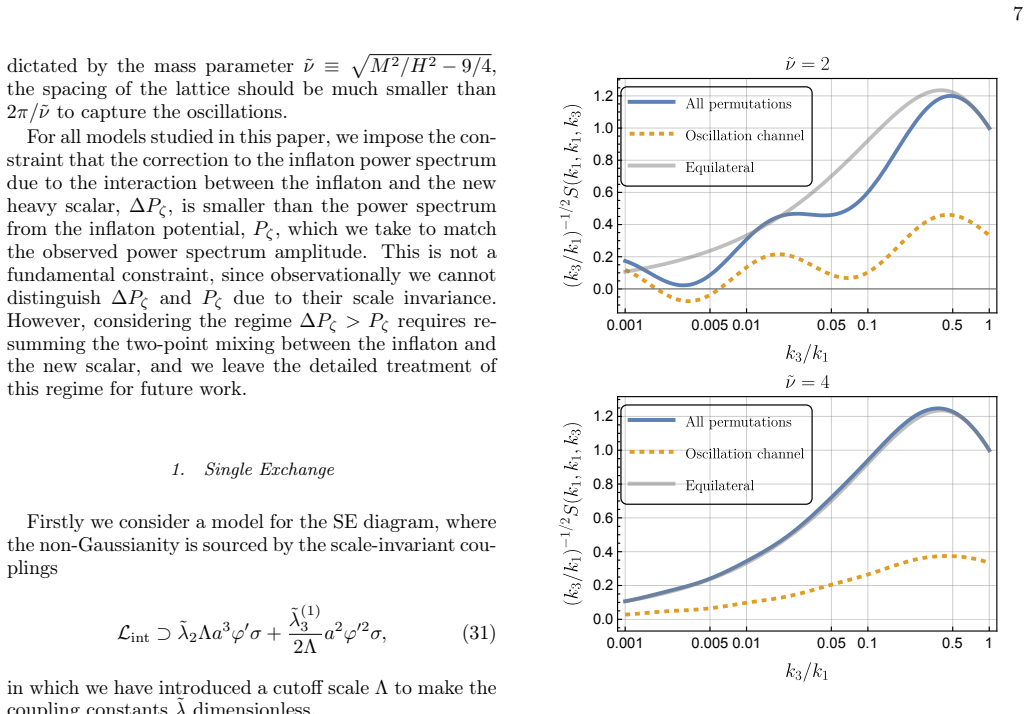
Single Exchange Firstly we consider a model for the SE diagram, where thenon-Gaussianityissourcedbythescale-invariantcou- plings Lint ⊃ ˜λ2Λa3φ′σ+ ˜λ(1) 3 2Λ a2φ′2σ,(31) in which we have introduced a cutoff scaleΛto make the coupling constants ˜λdimensionless. In Fig. 3, we show the shape functions in isosceles con- figurationS(k, k, k 3)for various masse...
-
[4]
Double Exchange Now we consider a model for the DE process. The couplings are given as Lint ⊃ ˜λ2Λa3φ′σ+ ˜λ(2) 3 a3φ′σ2.(36) Following the same procedure as in the SE model and using (26), one can construct the shape functions of DE diagrams in the(k1, k2, k3)space. The shapes in isosceles configurationsS(k 1, k1, k3)of selected masses are shown in Fig. 4...
-
[5]
Triple Exchange We consider the following model for TE, Lint ⊃ ˜λ2Λa3φ′σ+ 1 6 ˜λ(3) 3 Λa4σ3.(40) 0.001 0.005 0.01 0.05 0.1 0.5 1 -0.2 0.0 0.2 0.4 0.6 0.8 1.0 1.2 0.001 0.005 0.01 0.05 0.1 0.5 1 0.0 0.2 0.4 0.6 0.8 1.0 1.2 FIG. 4. The shape function of double exchange diagrams including all permutations (solid blue) and after normalizing to unity at equila...
-
[6]
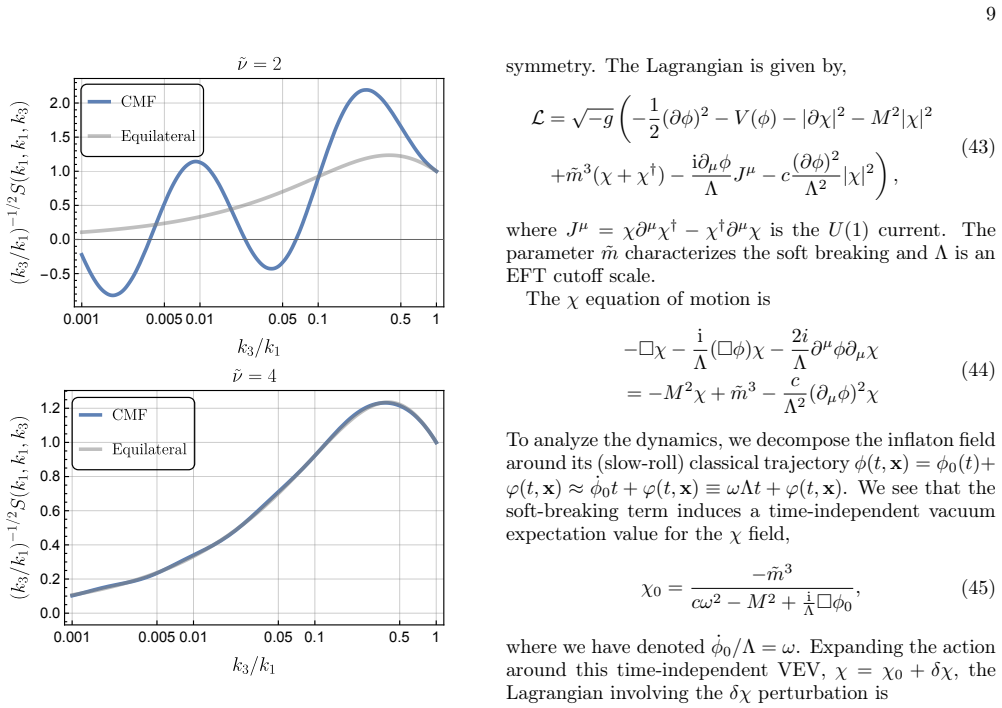
Chemical Potential For the scenarios described above, the non-analytic signal mediated by the heavy scalar become exponen- tially suppressed in theM≫Hregime, and instead the NG is dominated by ‘EFT’ contributions peaking in the equilateral configurations. Therefore, to explore the non-analytic signatures ofM≫Hparticles, we consider mechanisms where the ex...
2018
-
[7]
The result deviates from the equilateral shape only when˜ν≲1
The result becomes constant at large mass˜ν≳3and the value is almost identical to that of the standard equi- lateral shape, givingfNL = 18±42. The result deviates from the equilateral shape only when˜ν≲1. The most significant result appears at˜ν= 1.4, withfNL = 20±39 and a local significance of 0.52σ.7 1 2 3 4 5 -100 -50 0 50 100 0 1 2 3 4 5 0.0 0.2 0.4 0...
-
[8]
complete
The peak in thef NL constraint provides a hint that the CMB data prefers an oscillatory bispectrum more than a smooth (equilateral) one, although it does not necessarily mean that the TE model correctly describes the underlying physics. We will expand more on this point in the discussion of the chemical potential model in the following subsection. B. Chem...
-
[9]
To investigate the appearance of numerical instability, we calculate the shapeS(k 1, k2, k1)produced by the leftmost diagram in Fig
Single Exchange For SE, the folded limit of the bootstrap formulae appears when one of the external linesk 1 andk 2 is squeezed, andu≡2k 3/(k1 +k2 +k3)→1. To investigate the appearance of numerical instability, we calculate the shapeS(k 1, k2, k1)produced by the leftmost diagram in Fig. 1 for˜ν= 2(as a representative value) as a function ofk 2/k1 with bot...
-
[10]
As in the previous case, we evaluate the shape S(k1, k2, k1)produced by the middle diagram in Fig
Double Exchange Unlike the case of SE diagrams, the bootstrap formulae for the DE diagrams suffer a lot more from the numerical instability. As in the previous case, we evaluate the shape S(k1, k2, k1)produced by the middle diagram in Fig. 20 for˜ν= 2with both methods, and the result is shown in Fig. 20. Since the bootstrap formulae of the DE dia- grams i...
- [11]
-
[12]
Large non-Gaussianities with Intermediate Shapes from Quasi- Single Field Inflation
X. Chen and Y. Wang, Phys. Rev. D81, 063511 (2010), arXiv:0909.0496 [astro-ph.CO]. 20 0.001 0.005 0.01 0.05 0.1 0.5 1 0.0 0.5 1.0 0.001 0.005 0.01 0.05 0.1 0.5 1 0.0 0.2 0.4 0.6 0.8 1.0 0.001 0.005 0.01 0.05 0.1 0.5 1 0.0 0.2 0.4 0.6 0.8 1.0 1.2 0.001 0.005 0.01 0.05 0.1 0.5 1 0.2 0.4 0.6 0.8 1.0 1.2 FIG. 19. The shapes of SE diagrams in isosceles configu...
-
[13]
Quasi-Single Field Inflation and Non-Gaussianities
X. Chen and Y. Wang, JCAP04, 027 (2010), arXiv:0911.3380 [hep-th]
- [14]
- [15]
- [16]
-
[17]
N. Arkani-Hamed and J. Maldacena, (2015), arXiv:1503.08043 [hep-th]
work page Pith review arXiv 2015
-
[18]
D. Baumann and D. Green, JCAP09, 014 (2011), arXiv:1102.5343 [hep-th]
-
[19]
V. Assassi, D. Baumann, D. Green, and L. McAllister, JCAP01, 033 (2014), arXiv:1304.5226 [hep-th]
-
[20]
N. Craig and D. Green, JHEP07, 102 (2014), arXiv:1403.7193 [hep-ph]
-
[21]
E. Dimastrogiovanni, M. Fasiello, and M. Kamionkowski, JCAP02, 017 (2016), arXiv:1504.05993 [astro-ph.CO]
-
[22]
H. Lee, D. Baumann, and G. L. Pimentel, JHEP12, 040 (2016), arXiv:1607.03735 [hep-th]
work page Pith review arXiv 2016
- [23]
- [24]
-
[25]
X. Chen, Y. Wang, and Z.-Z. Xianyu, JHEP08, 051 (2016), arXiv:1604.07841 [hep-th]
work page Pith review arXiv 2016
- [26]
- [27]
-
[28]
X. Chen, Y. Wang, and Z.-Z. Xianyu, JCAP12, 006 (2017), arXiv:1703.10166 [hep-th]
work page Pith review arXiv 2017
-
[29]
S. Kumar and R. Sundrum, JHEP05, 011 (2018), arXiv:1711.03988 [hep-ph]
-
[30]
D. Baumann, G. Goon, H. Lee, and G. L. Pimentel, JHEP04, 140 (2018), arXiv:1712.06624 [hep-th]
- [31]
-
[32]
S. Kumar and R. Sundrum, JHEP04, 120 (2019), 21 0.001 0.005 0.01 0.05 0.1 0.5 1 0.0 0.5 1.0 1.5 0.001 0.005 0.01 0.05 0.1 0.5 1 0.0 0.2 0.4 0.6 0.8 1.0 1.2 0.001 0.005 0.01 0.05 0.1 0.5 1 -1 0 1 2 3 0.001 0.005 0.01 0.05 0.1 0.5 1 -1.0 -0.5 0.0 0.5 1.0 FIG. 21. The shapes of double exchange diagrams for˜ν= 2 and˜ν= 4, evaluated by both two methods. The up...
-
[33]
Wu, JHEP04, 125 (2019), arXiv:1812.10654 [hep- ph]
Y.-P. Wu, JHEP04, 125 (2019), arXiv:1812.10654 [hep- ph]
-
[34]
E. Dimastrogiovanni, M. Fasiello, and G. Tasinato, JCAP08, 016 (2018), arXiv:1806.00850 [astro-ph.CO]
- [35]
- [36]
- [37]
-
[38]
S. Kumar and R. Sundrum, JHEP04, 077 (2020), arXiv:1908.11378 [hep-ph]
-
[39]
L.-T. Wang and Z.-Z. Xianyu, JHEP02, 044 (2020), arXiv:1910.12876 [hep-ph]
- [40]
-
[41]
S. Alexander, S. J. Gates, L. Jenks, K. Koutrolikos, and E. McDonough, JHEP10, 156 (2019), arXiv:1907.05829 [hep-th]
-
[42]
The Scalar Chemical Potential in Cosmological Collider Physics,
A. Bodas, S. Kumar, and R. Sundrum, JHEP02, 079 (2021), arXiv:2010.04727 [hep-ph]
-
[43]
L.-T. Wang and Z.-Z. Xianyu, JHEP11, 082 (2020), arXiv:2004.02887 [hep-ph]
-
[44]
Lu, JHEP04, 157 (2022), arXiv:2103.05958 [hep-th]
S. Lu, JHEP04, 157 (2022), arXiv:2103.05958 [hep-th]
- [45]
-
[46]
E. Dimastrogiovanni, M. Fasiello, and A. E. Güm- rükcüoglü, JCAP11, 047 (2021), arXiv:2108.06722 [astro-ph.CO]
-
[47]
Y. Cui and Z.-Z. Xianyu, Phys. Rev. Lett.129, 111301 (2022), arXiv:2112.10793 [hep-ph]
-
[48]
X. Tong and Z.-Z. Xianyu, JHEP10, 194 (2022), arXiv:2203.06349 [hep-ph]
-
[49]
Z. Qin and Z.-Z. Xianyu, JHEP10, 192 (2022), arXiv:2205.01692 [hep-th]
-
[50]
M. Reece, L.-T. Wang, and Z.-Z. Xianyu, Phys. Rev. D 107, L101304 (2023), arXiv:2204.11869 [hep-ph]
- [51]
-
[52]
N. Maru and A. Okawa, Int. J. Mod. Phys. A38, 2350075 (2023), arXiv:2206.06651 [hep-ph]
- [53]
- [54]
-
[55]
J. Quintin, X. Chen, and R. Ebadi, JCAP09, 026 (2024), arXiv:2405.11016 [astro-ph.CO]
- [56]
- [57]
-
[58]
Chakraborty, (2025), arXiv:2501.07672 [hep-th]
P. Chakraborty, (2025), arXiv:2501.07672 [hep-th]
-
[59]
C. de Rham, S. Jazayeri, and A. J. Tolley, Phys. Rev. D 112, 083531 (2025), arXiv:2506.19198 [hep-th]
- [60]
-
[61]
A Compact Story of Positivity in de Sitter
P. Chakraborty, T. Cohen, D. Green, and Y. Huang, (2025), arXiv:2508.08359 [hep-th]
work page internal anchor Pith review Pith/arXiv arXiv 2025
- [62]
- [63]
-
[64]
Strongly Coupled Sectors in Inflation: Gapped Theories of Unparticles
Y. Jiang, G. L. Pimentel, and C. Yang, (2025), arXiv:2512.23796 [hep-th]
work page internal anchor Pith review Pith/arXiv arXiv 2025
- [65]
-
[66]
Cosmological Bootstrap in Slow Motion,
S. Jazayeri and S. Renaux-Petel, JHEP12, 137 (2022), arXiv:2205.10340 [hep-th]
-
[67]
BOSS constraints on massive particles during inflation: The cosmological collider in action,
G. Cabass, O. H. E. Philcox, M. M. Ivanov, K. Akitsu, S.- F. Chen, M. Simonović, and M. Zaldarriaga, Phys. Rev. D111, 063510 (2025), arXiv:2404.01894 [astro-ph.CO]
-
[68]
S. Goldstein, O. H. E. Philcox, J. C. Hill, and L. Hui, Phys. Rev. D110, 083516 (2024), arXiv:2407.08731 [astro-ph.CO]
-
[69]
Searching for cosmological collider in the Planck CMB data,
W. Sohn, D.-G. Wang, J. R. Fergusson, and E. P. S. Shellard, JCAP09, 016 (2024), arXiv:2404.07203 [astro- ph.CO]
-
[70]
P. Suman, D.-G. Wang, W. Sohn, J. R. Fergusson, and E. P. S. Shellard, (2025), arXiv:2511.17500 [astro- ph.CO]
-
[71]
P. Suman, D.-G. Wang, W. Sohn, J. R. Fergusson, and E. P. S. Shellard, (2025), arXiv:2512.22085 [astro- ph.CO]
- [72]
- [73]
-
[74]
D. Anbajagane and H. Lee, (2025), arXiv:2509.02693 [astro-ph.CO]
- [75]
- [76]
- [77]
-
[78]
N. Arkani-Hamed, D. Baumann, H. Lee, and G. L. Pi- mentel, JHEP04, 105 (2020), arXiv:1811.00024 [hep-th]
-
[79]
D. Baumann, C. Duaso Pueyo, A. Joyce, H. Lee, and G. L. Pimentel, JHEP12, 204 (2020), arXiv:1910.14051 [hep-th]
-
[80]
Z. Qin and Z.-Z. Xianyu, JHEP07, 001 (2023), arXiv:2301.07047 [hep-th]
discussion (0)
Sign in with ORCID, Apple, or X to comment. Anyone can read and Pith papers without signing in.