Recognition: unknown
The Goldilocks problem for detecting water in terrestrial planets: Constraining water abundances in the mid-IR with LIFE
Pith reviewed 2026-05-10 17:28 UTC · model grok-4.3
The pith
LIFE can constrain atmospheric water vapor abundances indicating habitable surface oceans on Earth-like exoplanets.
A machine-rendered reading of the paper's core claim, the machinery that carries it, and where it could break.
Core claim
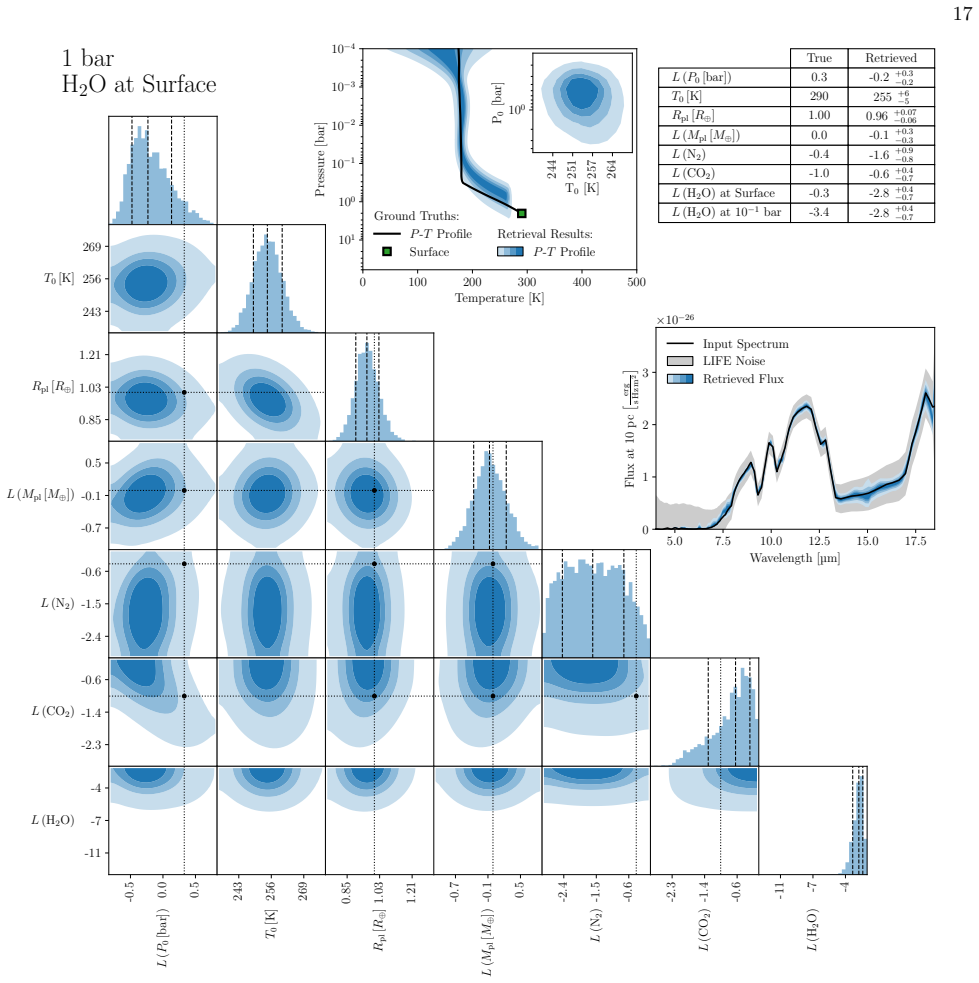
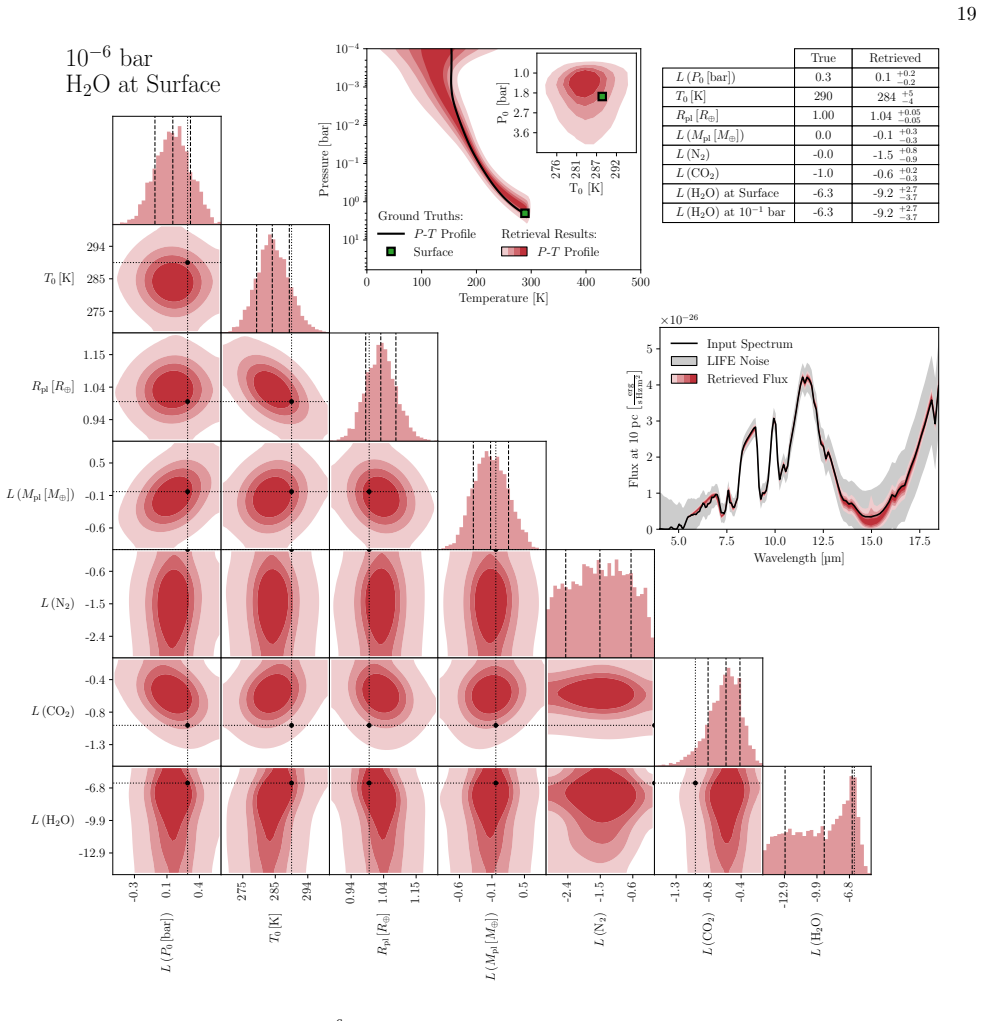
Using simulated LIFE observations and Bayesian retrievals on models with constant, Manabe-Wetherald, and diffusion-photochemistry vertical water profiles, the authors show that LIFE can place meaningful constraints on H2O surface partial pressures between approximately 10^{-3} and 1 bar for an Earth-like distribution. This interval spans values both below and above modern Earth's 10^{-2} bar and is interpreted as evidence of surface oceans because water vapor reacts rapidly with surface minerals in their absence. Water remains undetectable in all profiles for surface pressures at or below 10^{-6} bar, while the highest abundances saturate features and reduce retrieval precision.
What carries the argument
Bayesian atmospheric retrievals on mid-infrared spectra simulated with LIFEsim at R=50 and 100, testing three vertical water distributions on a cloud-free pre-biotic Earth-like planet.
Load-bearing premise
That the three chosen vertical water profiles plus the complete absence of clouds represent the range of real exoplanet atmospheres and that any detectable atmospheric water must imply surface oceans.
What would settle it
An actual mid-infrared spectrum of a known terrestrial exoplanet whose surface water abundance and vertical profile have been measured independently, with the LIFE retrieval either recovering or failing to recover the correct H2O level within the modeled uncertainties.
Figures



read the original abstract
We investigate how well the Large Interferometer for Exoplanets (LIFE) mission concept can detect habitable conditions on exoplanets through the presence of atmospheric water vapor as a proxy for surface oceans. We model the atmosphere of a pre-biotic Earth-like planet across a range of water concentrations, from water-poor to water-rich, with surface partial pressures from 10$^{-7}$ to 1 bar of H$_2$O. We simulate LIFE-like noise at spectral resolutions R = 50 and 100 using LIFEsim and perform Bayesian atmospheric retrievals to determine the technical requirements for LIFE to confirm habitability. We model three vertical water distributions: a vertically constant profile, a Manabe-Wetherald based Earth-like profile, and a diffusion and photochemistry profile to test how the assumed vertical structure influences the retrieved abundances. Clouds are not modeled. We find the ability for LIFE to detect water strongly depends on the vertical profile assumed. LIFE is unable to constrain the highest water cases and provides upper limits on low water planets. For the highest water abundances, absorption features saturate and reduce sensitivity to characterize precise H$_2$O levels. Water vapor is not detectable in any profile modeled for $\leq10^{-6}$ bar in surface water, comparable to Mars. For an Earth-like profile, LIFE could constrain H$_2$O concentrations from $\sim10^{-3}$ to 1 bar, spanning below and above present-day Earth concentrations of 10$^{-2}$ bar. Detectable atmospheric water may imply surface oceans, as water is highly reactive and rapidly removed by surface mineral reactions. Thus, LIFE can characterize water abundances indicative of habitable surface conditions.
Editorial analysis
A structured set of objections, weighed in public.
Referee Report
Summary. The manuscript models pre-biotic Earth-like exoplanet atmospheres with surface H2O partial pressures ranging from 10^{-7} to 1 bar using three vertical profiles (constant, Manabe-Wetherald, and diffusion-photochemistry). LIFEsim is used to generate noisy mid-IR spectra at R=50 and 100, followed by Bayesian retrievals to evaluate LIFE's ability to detect and constrain water vapor as a habitability proxy. Key results are that detection depends strongly on the assumed vertical profile, water is undetectable below ~10^{-6} bar, constraints are possible from ~10^{-3} to 1 bar for an Earth-like profile (with saturation at high abundances), and detectable atmospheric water may imply surface oceans due to rapid mineral reactions.
Significance. If the results hold, the work offers useful guidance for LIFE mission design by quantifying the water-abundance range accessible in the mid-IR and demonstrating sensitivity to vertical structure. The multi-profile approach and use of realistic LIFE noise simulation are strengths that help identify saturation limits and non-detections at low abundances. This contributes to habitability assessment strategies, though the findings remain conditional on the modeling assumptions.
major comments (3)
- [Abstract and modeling approach] Abstract and modeling description: the claim that LIFE 'could constrain H2O concentrations from ∼10^{-3} to 1 bar' for an Earth-like profile is derived from retrievals performed under explicitly cloud-free conditions. At the modeled abundances up to 1 bar, condensation into water clouds is expected and would add continuum opacity that can mask or saturate the H2O features central to the retrieval; no sensitivity test or justification for omitting clouds is provided, making this assumption load-bearing for the high-water and habitability conclusions.
- [Abstract and vertical-profile tests] Abstract and vertical-profile tests: the three tested distributions (constant, Manabe-Wetherald, diffusion-photochemistry) do not incorporate cloud formation or its feedback on the H2O vertical structure and temperature profile. This omission directly affects whether the reported profile-dependent constraints and saturation behavior would persist in more realistic atmospheres.
- [Conclusions] Conclusions: the statement that 'detectable atmospheric water may imply surface oceans' is presented as a qualitative inference from mineral-reaction timescales but is not quantitatively connected to the retrieval framework, error bars, or simulated spectra; it therefore does not follow directly from the technical results.
minor comments (2)
- [Abstract] Abstract: quantitative retrieval metrics (e.g., posterior uncertainties, detection significances, or reduced-chi-squared values) are not reported for the different profiles and abundance cases, making it difficult to assess the strength of the 'constrain' statements.
- [Modeling section] Notation and clarity: the precise implementation details of the three vertical profiles (e.g., how the Manabe-Wetherald profile is scaled to the surface partial-pressure range) could be stated more explicitly to allow reproduction.
Simulated Author's Rebuttal
We thank the referee for their constructive and detailed comments, which have helped us improve the clarity and balance of the manuscript. We respond to each major comment below and indicate the revisions made.
read point-by-point responses
-
Referee: [Abstract and modeling approach] Abstract and modeling description: the claim that LIFE 'could constrain H2O concentrations from ∼10^{-3} to 1 bar' for an Earth-like profile is derived from retrievals performed under explicitly cloud-free conditions. At the modeled abundances up to 1 bar, condensation into water clouds is expected and would add continuum opacity that can mask or saturate the H2O features central to the retrieval; no sensitivity test or justification for omitting clouds is provided, making this assumption load-bearing for the high-water and habitability conclusions.
Authors: We agree that performing the retrievals under cloud-free conditions is a key assumption, especially at the highest water abundances where condensation is expected. The manuscript explicitly states that clouds are not modeled, and our intent was to establish a baseline for water-vapor detectability by isolating the effects of abundance and vertical structure without the additional complexities of cloud microphysics and coverage. We have added a justification in the methods section for this choice and a dedicated paragraph in the discussion section acknowledging that continuum opacity from clouds could reduce sensitivity at high abundances and potentially alter the saturation behavior. We did not perform new cloud-inclusive sensitivity tests, as this would require substantial additional modeling assumptions outside the current scope, but we now flag this explicitly as a limitation for the high-abundance regime. revision: partial
-
Referee: [Abstract and vertical-profile tests] Abstract and vertical-profile tests: the three tested distributions (constant, Manabe-Wetherald, and diffusion-photochemistry) do not incorporate cloud formation or its feedback on the H2O vertical structure and temperature profile. This omission directly affects whether the reported profile-dependent constraints and saturation behavior would persist in more realistic atmospheres.
Authors: The referee correctly identifies that none of the three vertical profiles include cloud formation or its feedbacks on temperature and H2O structure. These profiles were chosen to systematically explore the sensitivity of the retrievals to different H2O distributions while keeping other variables fixed. In the revised manuscript we have expanded the discussion to describe how cloud formation could deplete upper-level water or modify the temperature profile, and we note that this could change the precise boundaries of the detectable range and the saturation limits we report. The profile dependence itself remains a robust qualitative result even within the simplified framework. revision: partial
-
Referee: [Conclusions] Conclusions: the statement that 'detectable atmospheric water may imply surface oceans' is presented as a qualitative inference from mineral-reaction timescales but is not quantitatively connected to the retrieval framework, error bars, or simulated spectra; it therefore does not follow directly from the technical results.
Authors: We accept that the link between detectable atmospheric water and surface oceans is an interpretive step based on known mineral-reaction chemistry rather than a direct quantitative output from the retrievals. The statement is supported by literature on rapid water-mineral reaction timescales on pre-biotic Earth, which would remove atmospheric H2O unless replenished by a surface reservoir. In the revised conclusions we have separated the technical retrieval findings from this interpretation, added specific references to the relevant reaction timescale studies, and clarified that the implication is contextual rather than a direct deduction from the simulated spectra or error bars. revision: yes
Circularity Check
No significant circularity in forward modeling and retrieval simulations
full rationale
The paper performs forward modeling of atmospheres with three specified vertical water profiles, simulates LIFE spectra via LIFEsim, and conducts Bayesian retrievals to assess constraints on H2O abundances. These steps produce outputs from external simulation and retrieval frameworks rather than reducing any claimed prediction to a quantity defined in terms of the paper's own fitted parameters or self-citations. The no-cloud modeling choice and interpretive link to surface oceans are explicit assumptions and statements, not self-definitional or load-bearing circular elements. The derivation chain is self-contained through standard methods and does not rely on uniqueness theorems or ansatzes imported from prior author work.
Axiom & Free-Parameter Ledger
free parameters (1)
- surface water partial pressure
axioms (1)
- domain assumption Detectable atmospheric water vapor implies surface oceans because water is highly reactive and rapidly removed by surface mineral reactions.
Reference graph
Works this paper leans on
-
[1]
S., Angerhausen, D., et al
Alei, E., Konrad, B. S., Angerhausen, D., et al. 2022, Astronomy & Astrophysics, 665, A106
2022
-
[2]
P., Konrad, B., et al
Alei, E., Quanz, S. P., Konrad, B., et al. 2024, Astronomy & Astrophysics, 689, A245
2024
-
[3]
Angerhausen, D., Balbi, A., Kovačević, A. B., Garvin, E. O., & Quanz, S. P. 2025, The Astronomical Journal, 169, 238, 10.3847/1538-3881/adb96d
-
[4]
2024, The Astronomical Journal, 167, 128, 10.3847/1538-3881/ad1f4b
Angerhausen, D., Pidhorodetska, D., Leung, M., et al. 2024, The Astronomical Journal, 167, 128, 10.3847/1538-3881/ad1f4b
-
[5]
K., Aigrain, S., Irwin, P
Barstow, J. K., Aigrain, S., Irwin, P. G., Kendrew, S., & Fletcher, L. N. 2016, Monthly Notices of the Royal Astronomical Society, 458, 2657
2016
-
[6]
A., et al
Bello-Arufe, A., Damiano, M., Bennett, K. A., et al. 2025, The Astrophysical Journal Letters, 980, L26
2025
-
[7]
D., Nicholls , H., & Lichtenberg , T
Boer , I. D., Nicholls , H., & Lichtenberg , T. 2025, , 987, 172, 10.3847/1538-4357/add69f
-
[8]
2020, Astronomy & Astrophysics, 637, A36
Bourrier, V., Kitzmann, D., Kuntzer, T., et al. 2020, Astronomy & Astrophysics, 637, A36
2020
-
[9]
2014, Astronomy & Astrophysics, 564, A125
Buchner, J., Georgakakis, A., Nandra, K., et al. 2014, Astronomy & Astrophysics, 564, A125
2014
-
[10]
2024, , 692, A172, 10.1051/0004-6361/202450764
Cesario , L., Lichtenberg , T., Alei , E., et al. 2024, , 692, A172, 10.1051/0004-6361/202450764
-
[11]
Claire and John Sheets and Martin Cohen and Ignasi Ribas and Victoria S
Claire , M. W., Sheets , J., Cohen , M., et al. 2012, , 757, 95, 10.1088/0004-637X/757/1/95
-
[12]
B., Lustig-Yaeger, J., Hu, R., Mayorga, L
Cowan, N. B., Lustig-Yaeger, J., Hu, R., Mayorga, L. C., & Robinson, T. D. 2025, arXiv preprint arXiv:2507.03071
-
[13]
B., Agol, E., Meadows, V
Cowan, N. B., Agol, E., Meadows, V. S., et al. 2009, The Astrophysical Journal, 700, 915
2009
-
[14]
2022, The Astronomical Journal, 163, 299
Damiano, M., & Hu, R. 2022, The Astronomical Journal, 163, 299
2022
-
[15]
Dannert, F. A. 2025, PhD thesis, ETH Zurich
2025
-
[16]
A., Ottiger, M., Quanz, S
Dannert, F. A., Ottiger, M., Quanz, S. P., et al. 2022, Astronomy & Astrophysics, 664, A22
2022
-
[17]
A., Huber, P
Dannert, F. A., Huber, P. A., Birbacher, T., et al. 2025, The Astronomical Journal, 170, 193
2025
-
[18]
2009, , 121, 952, 10.1086/605913
Deming , D., Seager , S., Winn , J., et al. 2009, , 121, 952, 10.1086/605913
-
[19]
Des Marais , D. J., Harwit , M. O., Jucks , K. W., et al. 2002, Astrobiology, 2, 153, 10.1089/15311070260192246
-
[20]
2025, Nature Astronomy, 9, 358
Ducrot, E., Lagage, P.-O., Min, M., et al. 2025, Nature Astronomy, 9, 358
2025
-
[21]
2024, in Space Telescopes and Instrumentation 2024: Optical, Infrared, and Millimeter Wave, Vol
Feinberg, L., Ziemer, J., Ansdell, M., et al. 2024, in Space Telescopes and Instrumentation 2024: Optical, Infrared, and Millimeter Wave, Vol. 13092, SPIE, 511--522
2024
-
[22]
K., Robinson, T
Feng, Y. K., Robinson, T. D., Fortney, J. J., et al. 2018, The Astronomical Journal, 155, 200
2018
-
[23]
1992, Journal of Atmospheric Sciences, 49, 2139
Fu, Q., & Liou, K. 1992, Journal of Atmospheric Sciences, 49, 2139
1992
-
[24]
2025, submitted
Fujii, Y., Angerhausen, D., Matsuo, T., & Wolf, E. 2025, submitted
2025
-
[25]
D., Li, C., & Yung, Y
Gao, P., Hu, R., Robinson, T. D., Li, C., & Yung, Y. L. 2015, The Astrophysical Journal, 806, 249
2015
-
[26]
2018, Astrobiology, 18, 856
Gebauer, S., Grenfell, J., Lehmann, R., & Rauer, H. 2018, Astrobiology, 18, 856
2018
-
[27]
J., & Conrath , B
Gierasch , P. J., & Conrath , B. J. 1985, in Recent Advances in Planetary Meteorology, ed. G. E. Hunt , 121--146
1985
-
[28]
1989, Journal of Quantitative Spectroscopy and Radiative Transfer, 42, 539
Goody, R., West, R., Chen, L., & Crisp, D. 1989, Journal of Quantitative Spectroscopy and Radiative Transfer, 42, 539
1989
-
[29]
P., Bell, T
Greene, T. P., Bell, T. J., Ducrot, E., et al. 2023, Nature, 618, 39
2023
-
[30]
L., Gebauer, S., Godolt, M., et al
Grenfell, J. L., Gebauer, S., Godolt, M., et al. 2018, The Astrophysical Journal, 861, 38
2018
-
[31]
L., Stracke, B., von Paris, P., et al
Grenfell, J. L., Stracke, B., von Paris, P., et al. 2007, , 55, 661
2007
-
[32]
2015, The Astrophysical Journal, 812, 137
Harman, C., Schwieterman, E., Schottelkotte, J., & Kasting, J. 2015, The Astrophysical Journal, 812, 137
2015
-
[33]
R., Hurford, T
Hendrix, A. R., Hurford, T. A., Barge, L. M., et al. 2019, Astrobiology, 19, 1
2019
-
[34]
A., Dannert, F
Huber, P. A., Dannert, F. A., Laugier, R., et al. 2024, in Optical and Infrared Interferometry and Imaging IX, Vol. 13095, SPIE, 382--391
2024
-
[35]
A., Dannert, F
Huber, P. A., Dannert, F. A., Laugier, R., et al. 2025, The Astronomical Journal, 170, 227
2025
-
[36]
Ingersoll, A. P. 1969, Journal of Atmospheric Sciences, 26, 1191
1969
-
[37]
1998, Journal of Geophysical Research: Atmospheres, 103, 21967
Johnston, H., & Kinnison, D. 1998, Journal of Geophysical Research: Atmospheres, 103, 21967
1998
-
[38]
Jordan, S., Shorttle, O., & Rimmer, P. B. 2025, Science Advances, 11, eadp8105
2025
-
[39]
2012, International Journal of Astrobiology, 11, 297–307, 10.1017/S1473550412000134
Kaltenegger, L., Miguel, Y., & Rugheimer, S. 2012, International Journal of Astrobiology, 11, 297–307, 10.1017/S1473550412000134
-
[40]
Kaltenegger , L., & Traub , W. A. 2009, , 698, 519, 10.1088/0004-637X/698/1/519
-
[41]
Kaltenegger , L., Traub , W. A., & Jucks , K. W. 2007, , 658, 598, 10.1086/510996
-
[42]
Kasting , J. F. 1988, Icarus, 74, 472, 10.1016/0019-1035(88)90116-9
-
[43]
F., Chen, H., & Kopparapu, R
Kasting, J. F., Chen, H., & Kopparapu, R. K. 2015, The Astrophysical Journal Letters, 813, L3
2015
-
[44]
F., Pollack , J
Kasting , J. F., Pollack , J. B., & Crisp , D. 1984, J. Atmos. Chem., 1, 403
1984
-
[45]
F., Whitmire, D
Kasting, J. F., Whitmire, D. P., & Reynolds, R. T. 1993, Icarus, 101, 108
1993
-
[46]
2019, The Astronomical Journal, 157, 213
Kawashima, Y., & Rugheimer, S. 2019, The Astronomical Journal, 157, 213
2019
-
[47]
F., & Siefert , J
Kharecha , P., Kasting , J. F., & Siefert , J. 2005, Geobiology, 3, 53
2005
-
[48]
Kitzmann , D., Patzer , A. B. C., von Paris , P., Godolt , M., & Rauer , H. 2011 a , , 531, A62, 10.1051/0004-6361/201014343
-
[49]
2011 b , , 534, A63, 10.1051/0004-6361/201117375
---. 2011 b , , 534, A63, 10.1051/0004-6361/201117375
-
[50]
2022, Astronomy & Astrophysics, 664, A23
Konrad, B., Alei, E., Quanz, S., et al. 2022, Astronomy & Astrophysics, 664, A23
2022
-
[51]
S., Quanz, S
Konrad, B. S., Quanz, S. P., Alei, E., & Wordsworth, R. 2024, The Astrophysical Journal, 975, 13
2024
-
[52]
Konrad , B. S., Alei , E., Quanz , S. P., et al. 2023, , 673, A94, 10.1051/0004-6361/202245655
-
[53]
Kopparapu , R. K., Ramirez , R., Kasting , J. F., et al. 2013, , 765, 131, 10.1088/0004-637X/765/2/131
-
[54]
Krasnopolsky, V. A. 2010, Icarus, 207, 638
2010
-
[55]
2012, Icarus, 218, 230
---. 2012, Icarus, 218, 230
2012
-
[56]
A., & Oinas, V
Lacis, A. A., & Oinas, V. 1991, Journal of Geophysical Research: Atmospheres, 96, 9027
1991
-
[57]
D., & Morley, C
Loftus, K., Wordsworth, R. D., & Morley, C. V. 2019, The Astrophysical Journal, 887, 231
2019
-
[58]
2015, Astrobiology, 15, 119
Luger , R., & Barnes , R. 2015, Astrobiology, 15, 119
2015
-
[59]
S., & Lincowski, A
Lustig-Yaeger, J., Meadows, V. S., & Lincowski, A. P. 2019, The Astrophysical Journal Letters, 887, L11
2019
-
[60]
S., Mendoza, G
Lustig-Yaeger, J., Meadows, V. S., Mendoza, G. T., et al. 2018, The Astronomical Journal, 156, 301
2018
-
[61]
Manabe, S., & Wetherald, R. T. 1967, J. atmos. Sci, 24, 241
1967
-
[62]
1981, Journal of Geophysical Research: Oceans, 86, 9859
Massie, S., & Hunten, D. 1981, Journal of Geophysical Research: Oceans, 86, 9859
1981
-
[63]
McCullough, P. R. 2006, arXiv: Astrophysics. https://api.semanticscholar.org/CorpusID:16867414
2006
-
[64]
S., Reinhard, C
Meadows, V. S., Reinhard, C. T., Arney, G. N., et al. 2018, Astrobiology, 18, 630
2018
-
[65]
Mettler, J.-N., Konrad, B. S., Quanz, S. P., & Helled, R. 2024, The Astrophysical Journal, 963, 24, 10.3847/1538-4357/ad198b
-
[66]
L., & Rugheimer , S
Miguel , Y., Kaltenegger , L., Linsky , J. L., & Rugheimer , S. 2015, MNRAS, 446, 345
2015
-
[67]
2019, Astronomy & Astrophysics, 627, A67
Molli \`e re, P., Wardenier, J., Van Boekel, R., et al. 2019, Astronomy & Astrophysics, 627, A67
2019
-
[68]
2020, Astronomy & Astrophysics, 640, A131
Molli \`e re, P., Stolker, T., Lacour, S., et al. 2020, Astronomy & Astrophysics, 640, A131
2020
-
[69]
E., Stevenson, K
Moran, S. E., Stevenson, K. B., Sing, D. K., et al. 2023, The Astrophysical Journal Letters, 948, L11
2023
-
[70]
M., et al
Nasedkin, E., Schrader, M., Vos, J. M., et al. 2025, Astronomy & Astrophysics, 702, A1
2025
-
[71]
2021, Pathways to Discovery in Astronomy and Astrophysics for the 2020s
National Academies of Sciences, E., Medicine, et al. 2021, Pathways to Discovery in Astronomy and Astrophysics for the 2020s
2021
-
[72]
Padovani, P., & Cirasuolo, M. 2023, Contemporary Physics, 64, 47, 10.1080/00107514.2023.2266921
-
[73]
Pavlov , A. A., Brown , L. L., & Kasting , J. F. 2001, , 106, 23267, 10.1029/2000JE001448
-
[74]
Pavlov , A. A., & Kasting , J. F. 2002, Astrobiology, 2, 27, 10.1089/153110702753621321
-
[75]
Pavlov , A. A., Kasting , J. F., Brown , L. L., Rages , K. A., & Freedman , R. 2000, , 105, 11981, 10.1029/1999JE001134
-
[76]
P., Kammerer, J., Defr \`e re, D., et al
Quanz, S. P., Kammerer, J., Defr \`e re, D., et al. 2018, in Optical and Infrared Interferometry and Imaging VI, Vol. 10701, SPIE, 415--431
2018
-
[77]
P., Ottiger, M., Fontanet, E., et al
Quanz, S. P., Ottiger, M., Fontanet, E., et al. 2022 a , Astronomy & Astrophysics, 664, A21
2022
-
[78]
P., Absil, O., Benz, W., et al
Quanz, S. P., Absil, O., Benz, W., et al. 2022 b , Experimental Astronomy, 54, 1197
2022
-
[79]
v., Paris, P., et al
Rauer, H., Gebauer, S. v., Paris, P., et al. 2011, , 529
2011
-
[80]
D., Meadows, V
Robinson, T. D., Meadows, V. S., & Crisp, D. 2010, The Astrophysical Journal Letters, 721, L67
2010
discussion (0)
Sign in with ORCID, Apple, or X to comment. Anyone can read and Pith papers without signing in.