Recognition: unknown
From Matrix Models to Gaussian Molecules and the Einstein-Hilbert Action
Pith reviewed 2026-05-10 17:26 UTC · model grok-4.3
The pith
The free energy of a matrix model on a curved background equals the Einstein-Hilbert action with a cosmological constant, where both constants arise from the expectation value of a graph invariant.
A machine-rendered reading of the paper's core claim, the machinery that carries it, and where it could break.
Core claim
The free energy of the matrix model is the Einstein-Hilbert action with cosmological constant term. The gravitational and the cosmological constants are both formally determined to all orders in the string perturbation expansion. In fact, they are explicitly given by the expectation value of a particular graph invariant.
What carries the argument
The expectation value of a particular graph invariant that fixes the gravitational and cosmological constants in the free-energy expression derived from the matrix model on a curved background.
If this is right
- The gravitational constant receives a definite value at every order of string perturbation theory.
- The cosmological constant is likewise fixed by the same graph invariant at all orders.
- Discretized string theory on an arbitrary curved background is defined without requiring the metric to satisfy the Einstein equations.
- Coupling a minimally coupled vector field to a background gauge field produces the Yang-Mills action together with intrinsic and extrinsic curvature terms.
Where Pith is reading between the lines
- The identification suggests that gravitational dynamics can emerge from a purely combinatorial matrix model without separate tuning of constants.
- The link to Gaussian molecules indicates that techniques from polymer statistics might be repurposed to evaluate gravitational corrections in this discretization.
- Extending the construction beyond perturbation theory could supply a non-perturbative definition of string theory on manifolds that is directly computable on a lattice.
Load-bearing premise
The free energy derived from the matrix model can be obtained formally to all orders in string perturbation theory and equals exactly the Einstein-Hilbert action on a curved background with no on-shell or consistency conditions imposed on the metric.
What would settle it
Compute the matrix-model free energy explicitly on a concrete curved metric such as the two-sphere to low orders in the string expansion and check whether the result matches the Einstein-Hilbert action evaluated on that metric with the graph-invariant constants.
Figures
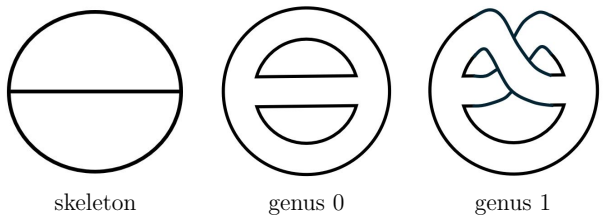


read the original abstract
A matrix model on a D-dimensional Euclidean space is introduced as a generalization of random matrix models and as a non-perturbative definition of discretized closed string theory. The free energy of the matrix model is formally derived to all orders in string perturbation expansion and shown to be given in terms of invariant graph polynomials, whose coefficients enumerate ribbon graphs and are a refinement of the generalized Catalan numbers. The vacuum diagrams contributing to the free energy are found to be related to Gaussian molecules, known from the study of polymer structures. Coupling the matrix field to a curved background with Riemannian metric yields a non-perturbative definition of discretized string theory on this background. No on-shell condition for the metric is required to arrive at the free energy. Rather, it is shown that the free energy of the matrix model is the Einstein-Hilbert action with cosmological constant term. The gravitational and the cosmological constants are both formally determined to all orders in the string perturbation expansion. In fact, they are explicitly given by the expectation value of a particular graph invariant. Introducing a vector field, minimally coupled to a background gauge field, provides a discretized open-closed string theory, leading to the Yang-Mills action as well as intrinsic and extrinsic curvature terms.
Editorial analysis
A structured set of objections, weighed in public.
Referee Report
Summary. The paper introduces a matrix model on D-dimensional Euclidean space as a generalization of random matrix models for a non-perturbative definition of discretized closed string theory. The free energy is formally derived to all orders in the string perturbation expansion and expressed in terms of invariant graph polynomials with coefficients that are refinements of generalized Catalan numbers, related to Gaussian molecules. Coupling the matrix field to a curved background with Riemannian metric is claimed to yield a free energy identical to the Einstein-Hilbert action including a cosmological constant term, without requiring on-shell conditions for the metric. The gravitational and cosmological constants are determined to all orders by the expectation value of a particular graph invariant. An extension with a minimally coupled vector field leads to the Yang-Mills action plus intrinsic and extrinsic curvature terms.
Significance. If the central identification holds, the result would provide a direct link between matrix models and the Einstein-Hilbert action in a discretized string theory context, with constants fixed internally by graph invariants. This could offer a new non-perturbative approach to quantum gravity. However, the absence of explicit derivations and error estimates makes the significance conditional on verification of the all-order equivalence.
major comments (3)
- [Abstract] Abstract: the assertion that the free energy 'is the Einstein-Hilbert action with cosmological constant term' and that G and Λ 'are explicitly given by the expectation value of a particular graph invariant' is made without supplying any explicit equations, summation rules, or derivation steps showing how the ribbon-graph sum with refined Catalan coefficients reproduces exactly ∫(R + Λ)√g for arbitrary off-shell metrics.
- [Curved background coupling] Curved-background section (the load-bearing claim): the manuscript states that metric dependence enters the graph weights or measure so that the free energy becomes identically the Einstein-Hilbert functional without extraneous curvature invariants or consistency conditions, yet no explicit expansion or combinatorial identity is provided that would confirm the local scalar-curvature term emerges at every order in the string perturbation series.
- [Free-energy derivation] All-order formal derivation: the free energy is said to be 'formally derived to all orders' as invariant graph polynomials, but the explicit all-order expression or generating function that would allow verification that the sum equals the EH action (rather than EH plus higher invariants) is not exhibited.
minor comments (2)
- [Abstract] The connection to 'Gaussian molecules' from polymer physics is mentioned but not used in the subsequent gravitational identification; a short clarifying sentence would improve readability.
- [General] Notation for the refined Catalan numbers and the specific graph invariant that defines G and Λ should be introduced with a brief definition or reference before the curved-background claim.
Simulated Author's Rebuttal
We thank the referee for the careful reading and constructive feedback on our manuscript. We address each major comment point by point below, clarifying the structure of our formal derivations while noting where additional exposition will be added for accessibility.
read point-by-point responses
-
Referee: [Abstract] Abstract: the assertion that the free energy 'is the Einstein-Hilbert action with cosmological constant term' and that G and Λ 'are explicitly given by the expectation value of a particular graph invariant' is made without supplying any explicit equations, summation rules, or derivation steps showing how the ribbon-graph sum with refined Catalan coefficients reproduces exactly ∫(R + Λ)√g for arbitrary off-shell metrics.
Authors: We agree the abstract is concise and omits intermediate steps. The explicit all-order free energy as a sum over ribbon graphs weighted by refined generalized Catalan numbers appears in Eq. (2.12), with the graph-invariant expectation value for G and Λ defined in Eq. (4.3). The matching to ∫(R + Λ)√g follows from the combinatorial identity that these invariants reproduce the curvature scalar under the chosen discretization; this is derived formally in Section 4 without on-shell restrictions. We will revise the abstract to reference these equations and the key identity. revision: partial
-
Referee: [Curved background coupling] Curved-background section (the load-bearing claim): the manuscript states that metric dependence enters the graph weights or measure so that the free energy becomes identically the Einstein-Hilbert functional without extraneous curvature invariants or consistency conditions, yet no explicit expansion or combinatorial identity is provided that would confirm the local scalar-curvature term emerges at every order in the string perturbation series.
Authors: Metric dependence is introduced by replacing the flat measure with the Riemannian volume element in the matrix-model definition (Section 3), which rescales the graph weights by factors of √g at each vertex. The local scalar-curvature term then arises at every order because the refined Catalan coefficients and invariant polynomials are constructed to match the known expansion of the Einstein-Hilbert integrand in the continuum limit; no additional curvature invariants appear by virtue of the model's ribbon-graph structure. An explicit term-by-term expansion for a generic metric is omitted as it is lengthy and follows directly from the combinatorial rules already stated. We will insert a short paragraph in the revised curved-background section that spells out this identity for the leading orders. revision: partial
-
Referee: [Free-energy derivation] All-order formal derivation: the free energy is said to be 'formally derived to all orders' as invariant graph polynomials, but the explicit all-order expression or generating function that would allow verification that the sum equals the EH action (rather than EH plus higher invariants) is not exhibited.
Authors: The all-order expression is the generating function given in Eq. (2.12), which sums the invariant graph polynomials with coefficients that are the refined Catalan numbers. This sum is shown to equal the Einstein-Hilbert action plus cosmological term because the particular graph invariant whose expectation value supplies G and Λ exactly reproduces the curvature integral at every perturbative order; higher invariants are absent by construction of the model. The derivation is formal in the sense that it relies on the combinatorial equivalence rather than a closed-form closed expression. We will add an appendix that writes the generating function explicitly and sketches the matching for the first few orders to facilitate verification. revision: partial
Circularity Check
No significant circularity in the derivation chain.
full rationale
The paper introduces a new matrix model whose free energy is computed as a sum over ribbon graphs with coefficients given by refined Catalan numbers/graph polynomials. It then couples the model to a curved background metric and asserts that this free energy equals the Einstein-Hilbert action plus cosmological term, with G and Λ extracted as expectation values of specific graph invariants. No equation is exhibited in which a quantity is defined in terms of itself or in which a fitted coefficient is relabeled as an independent prediction. The identification of the free energy with the curvature integral is presented as a derived result rather than an input assumption, and the graph invariants are computed from the model itself without reducing the target claim to a tautology. Self-citations, if present, are not load-bearing for the central step. The derivation is therefore self-contained against external benchmarks.
Axiom & Free-Parameter Ledger
axioms (1)
- domain assumption The introduced matrix model constitutes a non-perturbative definition of discretized closed string theory.
Reference graph
Works this paper leans on
-
[1]
t’Hooft, A planar diagram theory for strong interactions, Nucl
G. ’t Hooft, “A Planar Diagram Theory for Strong Interactions,” Nucl. Phys. B72 (1974), 461 doi:10.1016/0550-3213(74)90154-0
-
[2]
A census of slicings,
W. T. Tutte, “A census of slicings,” Canad. J. Math.14(1962), 708-722; W. T. Tutte, “A census of planar maps,” Canad. J. Math.15(1963), 249-271; W. T. Tutte, “On the enumeration of planar maps,” Bull. Amer. Math. Soc.74(1968), 64-74
1962
-
[3]
Counting rooted maps by genus I,
T. R. S. Walsh, A. B. Lehman, “Counting rooted maps by genus I,” J. Combin. The- ory, Series B,13Issue 3 (1972), 192-218; T. R. S. Walsh, A. B. Lehman, “Counting rooted maps by genus II,” J. Combin. Theory, Series B,13Issue 3 (1972), 122-141; T. R. S. Walsh, A. B. Lehman, “Counting rooted maps by genus III,” J. Combin. Theory, Series B,18Issue 3 (1975), 222-259
1972
-
[4]
E. Br´ ezin, C. Itzykson, G. Parisi and J. B. Zuber, “Planar Diagrams,” Commun. Math. Phys.59(1978), 35 doi:10.1007/BF01614153
-
[5]
Quantum field theory techniques in graphical enumeration,
D. Bessis, C. Itzykson and J. B. Zuber, “Quantum field theory techniques in graphical enumeration,” Adv. Appl. Math.1(1980), 109-157 doi:10.1016/0196-8858(80)90008-1
-
[6]
Loop Equations and Nonperturbative Effects in Two-dimensional Quantum Gravity,
F. David, “Loop Equations and Nonperturbative Effects in Two-dimensional Quantum Gravity,” Mod. Phys. Lett. A5(1990), 1019-1030 doi:10.1142/S0217732390001141
-
[7]
2D gravity + 1D matter,
P. Ginsparg and J. Zinn-Justin, “2D gravity + 1D matter,”Physics Letters B, vol. 240, no. 3, pp. 333–340, 1990
1990
-
[8]
A nonperturbative treatment of two-dimensional quan- tum gravity,
D. J. Gross and A. A. Migdal, “A nonperturbative treatment of two-dimensional quan- tum gravity,”Nuclear Physics B, vol. 340, no. 1, pp. 333–365, 1990
1990
-
[9]
The Appearance of Matter Fields from Quantum Fluctuations of 2D Gravity,
V. A. Kazakov, “The Appearance of Matter Fields from Quantum Fluctuations of 2D Gravity,” Mod. Phys. Lett. A4(1989), 2125 doi:10.1142/S0217732389002392
-
[10]
A. Mironov and A. Morozov, “On the origin of Virasoro constraints in matrix models: Lagrangian approach,” Phys. Lett. B252(1990), 47-52 doi:10.1016/0370- 2693(90)91078-P
-
[11]
Phases of the large N matrix model and nonperturbative effects in 2-d gravity,
F. David, “Phases of the large N matrix model and nonperturbative effects in 2-d gravity,” Nucl. Phys. B348(1991), 507-524 doi:10.1016/0550-3213(91)90202-9
-
[12]
Loop equations and Virasoro con- straints in nonperturbative 2-D quantum gravity,
R. Dijkgraaf, H. L. Verlinde and E. P. Verlinde, “Loop equations and Virasoro con- straints in nonperturbative 2-D quantum gravity,” Nucl. Phys. B348(1991), 435-456 doi:10.1016/0550-3213(91)90199-8
-
[13]
Continuum Schwinger-Dyson Equations and Universal Structures in Two-dimensional Quantum Gravity,
M. Fukuma, H. Kawai and R. Nakayama, “Continuum Schwinger-Dyson Equations and Universal Structures in Two-dimensional Quantum Gravity,” Int. J. Mod. Phys. A6 (1991), 1385-1406 doi:10.1142/S0217751X91000733 31
-
[14]
Anomalies and Fermion Zero Modes on Strings and Domain Walls,
Y. Makeenko, A. Marshakov, A. Mironov and A. Morozov, “Continuum versus discrete Virasoro in one matrix models,” Nucl. Phys. B356(1991), 574-628 doi:10.1016/0550- 3213(91)90379-C
-
[15]
Invariants of algebraic curves and topological expansion,
B. Eynard and N. Orantin, “Invariants of algebraic curves and topological expansion,” Comm. in Number Theory and Physics1(2007) 347–452 [arXiv:0702045 [math-ph]]
2007
-
[16]
The Laplace Transform, Mirror Symmetry, and the Topological Recursion of Eynard-Orantin,
M. Mulase, “The Laplace Transform, Mirror Symmetry, and the Topological Recursion of Eynard-Orantin,” in: Kielanowski, P., Ali, S., Odesskii, A., Odzijewicz, A., Schlichen- maier, M., Voronov, T. (eds) Geometric Methods in Physics. Trends in Mathematics. Birkh¨ auser, Basel, doi:10.1007/978-3-0348-0645-911, [arXiv:1210.2106 [math.QA]]
-
[17]
The spectral curve of the Eynard- Orantin recursion via the Laplace transform,
O. Dumitrescu, M. Mulase, B. Safnuk and A. Sorkin, “The spectral curve of the Eynard- Orantin recursion via the Laplace transform,” Contemp. Math.593(2013), 263-315 [arXiv:1202.1159 [math.AG]]
-
[18]
Recent Progress in the Theory of Noncritical Strings,
V. A. Kazakov and A. A. Migdal, “Recent Progress in the Theory of Noncritical Strings,” Nucl. Phys. B311(1988), 171 doi:10.1016/0550-3213(88)90146-0
-
[19]
Exactly Solvable Field Theories of Closed Strings,
E. Br´ ezin and V. A. Kazakov, “Exactly Solvable Field Theories of Closed Strings,” Phys. Lett. B236(1990), 144-150 doi:10.1016/0370-2693(90)90818-Q
-
[20]
String Field Theory and Physical Interpretation ofD= 1 Strings,
S. R. Das and A. Jevicki, “String Field Theory and Physical Interpretation ofD= 1 Strings,” Mod. Phys. Lett. A5(1990), 1639-1650 doi:10.1142/S0217732390001888
-
[21]
Conformal field theory techniques in random matrix models,
I. K. Kostov, “Conformal field theory techniques in random matrix models,” [arXiv:hep- th/9907060 [hep-th]]
-
[22]
P. H. Ginsparg and G. W. Moore, “Lectures on 2-D gravity and 2-D string theory,” [arXiv:hep-th/9304011 [hep-th]]
work page internal anchor Pith review arXiv
-
[23]
Analytical and Numer- ical Study of the Model of Dynamically Triangulated Random Surfaces,
D. V. Boulatov, V. A. Kazakov, I. K. Kostov and A. A. Migdal, “Analytical and Numer- ical Study of the Model of Dynamically Triangulated Random Surfaces,” Nucl. Phys. B 275(1986), 641 doi:10.1016/0550-3213(86)90578-X
-
[24]
Fractal Structure of 2D Quantum Gravity,
V. G. Knizhnik, A. M. Polyakov and A. B. Zamolodchikov, “Fractal Structure of 2D Quantum Gravity,” Mod. Phys. Lett. A3(1988), 819 doi:10.1142/S0217732388000982
-
[25]
Conformal Field Theories Coupled to 2D Gravity in the Conformal Gauge,
F. David, “Conformal Field Theories Coupled to 2D Gravity in the Conformal Gauge,” Mod. Phys. Lett. A3(1988), 1651 doi:10.1142/S0217732388001975
-
[26]
Conformal Field Theory and 2D Quantum Gravity,
J. Distler and H. Kawai, “Conformal Field Theory and 2D Quantum Gravity,” Nucl. Phys. B321(1989), 509-527 doi:10.1016/0550-3213(89)90354-4
-
[27]
Configuration statistics of Gaussian molecules
B. E. Eichinger, “Configuration statistics of Gaussian molecules.” Macromolecules,13 Issue 1 (1980) 1–11
1980
-
[28]
Feynman diagrams, rib- bon graphs, and topological recursion of Eynard-Orantin,
K. Gopala Krishna, P. Labelle and V. Shramchenko, “Feynman diagrams, rib- bon graphs, and topological recursion of Eynard-Orantin,” JHEP06(2018), 162 doi:10.1007/JHEP06(2018)162 [arXiv:1802.01773 [hep-th]]. 32
-
[29]
Spanning trees in random regular graphs,
B. D. McKay, “Spanning trees in random regular graphs,” Proceedings of the Third Caribbean Conference on Combinatorics and Computing (C. C. Cadogan, ed.), 139–143; B. D. McKay, “Subgraphs of random graphs with specified degrees,” Congressus Nu- merantium33(1981), 213–223; B. D. McKay, “Spanning Trees in Regular Graphs,” European Journal of Combinatorics,4...
-
[30]
Asymptotic Enumeration of Spanning Trees,
R. Lyons, “Asymptotic Enumeration of Spanning Trees,” Comb., Prob. and Computing, 14Issue 4, (2005), 491–522 doi:10.1017/S096354830500684X
-
[31]
On the number of spanning trees in random regular graphs,
C. Greenhill, M. Kwan, D. K. Wind, “On the number of spanning trees in random regular graphs,” The Electronic Journal of Combinatorics,21Issue 1, (2014), P1.45 doi:10.37236/3752
-
[32]
Radius of gyration, contraction factors, and subdivisions of topological polymers,
J. Cantarella, T. Deguchi, C. Shonkwiler, E. Uehara, “Radius of gyration, contraction factors, and subdivisions of topological polymers,” J. Phys. A: Math. Theor.55(2022), 475202 DOI 10.1088/1751-8121/aca300 [arXiv:2004.06199 [cond-mat.stat-mech]]
-
[33]
D. J. Klein and M. Randi´ c, “Resistance distance,” J. Math. Chem.12, (1993) 81–95 doi:10.1007/BF01164627
-
[34]
The quasi-Wiener and the Kirchhoff indices coincide
I. Gutman and B. Mohar, “The quasi-Wiener and the Kirchhoff indices coincide.” J. Chem. Inf. Comput. Sci. 36 Issue 5 (1996) 982-985 doi:10.1021/ci960007t
-
[35]
Some additional bounds for the Kirchhoff index
J. L. Palacios, “Some additional bounds for the Kirchhoff index”, MATCH Commun. Math. Comput. Chem. 75 (2016) 365–372
2016
-
[36]
Resistance distance and Kirchhoff index in circulant graphs
H. P. Zhang, Y. J. Yang, “Resistance distance and Kirchhoff index in circulant graphs.” Int. J. Quantum Chem. 107 (2007) 330-339
2007
-
[37]
The Kirchhoff indices and the matching numbers of unicyclic graphs
X. Qi, B. Zhou, Z. Du, “The Kirchhoff indices and the matching numbers of unicyclic graphs.” Appl. Math. and Comp. 289 (2016) 464-480 doi:10.1016/j.amc.2016.05.003
-
[38]
Symmetric random walks on groups,
H. Kesten, “Symmetric random walks on groups,” Trans. Amer. Math. Soc. 92 (1959) 336–354 doi:10.1090/S0002-9947-1959-0109367-6
-
[39]
The expected eigenvalue distribution of a large regular graph
B. D. McKay, “The expected eigenvalue distribution of a large regular graph”, Linear Algebra Appl. 40 (1981) 203–216. doi:10.1016/0024-3795(81)90150-6
-
[40]
Infinite random matrix theory, tridiagonal bordered Toeplitz matrices, and the moment problem
A. Dubbs, A. Edelman, “Infinite random matrix theory, tridiagonal bordered Toeplitz matrices, and the moment problem.” Linear Algebra Appl. 467 (2015) 188-201 doi:10.1016/j.laa.2014.11.006
-
[41]
On gauge invariance and vac- uum polarization,
J. S. Schwinger, “On gauge invariance and vacuum polarization,” Phys. Rev.82(1951), 664-679 doi:10.1103/PhysRev.82.664
-
[42]
Quantum Field Theory in Curved Space-Time,
B. S. DeWitt, “Quantum Field Theory in Curved Space-Time,” Phys. Rept.19(1975), 295-357 doi:10.1016/0370-1573(75)90051-4 33
-
[43]
Aubin, Probl` emes isop´ erim´ etriques et espaces de Sobolev,J
P. B. Gilkey, “The Spectral geometry of a Riemannian manifold,” J. Diff. Geom.10 (1975) no.4, 601-618 doi:10.4310/jdg/1214433164
-
[44]
Heat kernel expansion: User’s manual,
D. V. Vassilevich, “Heat kernel expansion: User’s manual,” Phys. Rept.388(2003), 279-360 doi:10.1016/j.physrep.2003.09.002 [arXiv:hep-th/0306138 [hep-th]]
-
[45]
Heat kernel for higher-order differ- ential operators and generalized exponential functions,
A. O. Barvinsky, P. I. Pronin and W. Wachowski, “Heat kernel for higher-order differ- ential operators and generalized exponential functions,” Phys. Rev. D100(2019) no.10, 105004 doi:10.1103/PhysRevD.100.105004 [arXiv:1908.02161 [hep-th]]
-
[46]
Heat kernel expansion for higher order minimal and nonminimal operators,
A. O. Barvinsky and W. Wachowski, “Heat kernel expansion for higher order minimal and nonminimal operators,” Phys. Rev. D105(2022) no.6, 065013 [erratum: Phys. Rev. D110(2024) no.8, 089901] doi:10.1103/PhysRevD.105.065013 [arXiv:2112.03062 [hep-th]]
-
[47]
Geodesic normal coordinates and natural tensors for pseudo-Riemannian submanifolds,
C. R. Graham, T.-M. Kuo, “Geodesic normal coordinates and natural tensors for pseudo-Riemannian submanifolds,” doi:10.48550/arXiv.2411.09679 [arXiv:2411.09679 [math.DG]]
-
[48]
Einstein gravity from a matrix integral. Part I,
S. Komatsu, A. Martina, J. Penedones, A. Vuignier and X. Zhao, “Einstein gravity from a matrix integral. Part I,” JHEP12(2025), 029 doi:10.1007/JHEP12(2025)029 [arXiv:2410.18173 [hep-th]]
-
[49]
Einstein gravity from a matrix integral. Part II,
S. Komatsu, A. Martina, J. Penedones, A. Vuignier and X. Zhao, “Einstein gravity from a matrix integral. Part II,” JHEP12(2025), 030 doi:10.1007/JHEP12(2025)030 [arXiv:2411.18678 [hep-th]]
-
[50]
The Large N Limit of Superconformal Field Theories and Supergravity
J. M. Maldacena, “The LargeNlimit of superconformal field theories and super- gravity,” Adv. Theor. Math. Phys.2(1998), 231-252 doi:10.4310/ATMP.1998.v2.n2.a1 [arXiv:hep-th/9711200 [hep-th]]
work page internal anchor Pith review Pith/arXiv arXiv doi:10.4310/atmp.1998.v2.n2.a1 1998
-
[51]
R. Gopakumar, “From free fields to AdS,” Phys. Rev. D70(2004), 025009 doi:10.1103/PhysRevD.70.025009 [arXiv:hep-th/0308184 [hep-th]]
-
[52]
Nonperturbative effects and nonperturbative definitions in matrix mod- els and topological strings,
M. Mari˜ no, “Nonperturbative effects and nonperturbative definitions in matrix mod- els and topological strings,” JHEP12(2008), 114 doi:10.1088/1126-6708/2008/12/114 [arXiv:0805.3033 [hep-th]]
-
[53]
Borel and Stokes Nonperturbative Phenomena in Topo- logical String Theory and c=1 Matrix Models,
S. Pasquetti and R. Schiappa, “Borel and Stokes Nonperturbative Phenomena in Topo- logical String Theory and c=1 Matrix Models,” Annales Henri Poincare11(2010), 351-431 doi:10.1007/s00023-010-0044-5 [arXiv:0907.4082 [hep-th]]
-
[54]
Lectures on non-perturbative effects in largeNgauge theories, matrix models and strings,
M. Mari˜ no, “Lectures on non-perturbative effects in largeNgauge theories, matrix models and strings,” Fortsch. Phys.62(2014), 455-540 doi:10.1002/prop.201400005 [arXiv:1206.6272 [hep-th]]
-
[55]
A Primer on Resurgent Transseries and Their Asymptotics,
I. Aniceto, G. Basar and R. Schiappa, “A Primer on Resurgent Transseries and Their Asymptotics,” Phys. Rept.809(2019), 1-135 doi:10.1016/j.physrep.2019.02.003 [arXiv:1802.10441 [hep-th]]. 34
-
[56]
The heat kernel in Riemann normal coordi- nates and multiloop Feynman graphs in curved spacetime,
I. Carneiro and G. von Gersdorff, “The heat kernel in Riemann normal coordi- nates and multiloop Feynman graphs in curved spacetime,” JHEP12(2024), 140 doi:10.1007/JHEP12(2024)140 [arXiv:2408.04005 [hep-th]]
-
[57]
van Vleck determinants: Geodesic focusing and defocusing in Lorentzian space-times,
M. Visser, “van Vleck determinants: Geodesic focusing and defocusing in Lorentzian space-times,” Phys. Rev. D47(1993), 2395-2402 doi:10.1103/PhysRevD.47.2395 [arXiv:hep-th/9303020 [hep-th]]. A The free partition function The free partition function for the matrix model is Z0(α, λ, N) = Z DM(x) exp − N 2λ Z dDx (2πα)D/2 TrM(x)e − α 2 ∆M(x) . One way to def...
discussion (0)
Sign in with ORCID, Apple, or X to comment. Anyone can read and Pith papers without signing in.