Recognition: unknown
Fermionic entanglement and quantum correlation measures in molecules
Pith reviewed 2026-05-10 17:12 UTC · model grok-4.3
The pith
The electronic eigenstates of the water molecule are characterized through fermionic entanglement measures from spin-up/spin-down partitions and reduced density matrices as a function of internuclear distance.
A machine-rendered reading of the paper's core claim, the machinery that carries it, and where it could break.
Core claim
In the full configuration interaction framework, the electronic wave function of the water molecule exhibits a varying total up-down entanglement obtained from the Schmidt decomposition of the spin-up/spin-down partition; the one- and two-body reduced density matrices supply additional measures of deviation from a Slater determinant and of up-down correlations at the two-body level, with all blocks examined; new quantities such as the up-down two-body mutual information and two-body negativities are introduced to quantify the inner entanglement of the reduced two-body density matrices; these measures are evaluated for the ground state and the low-temperature thermal state as functions of the
What carries the argument
The spin-up/spin-down partition of the electronic wave function together with its Schmidt decomposition, the associated one- and two-body reduced density matrices, and the derived quantities of two-body mutual information and two-body negativities.
If this is right
- The total up-down entanglement serves as a quantitative indicator of bonding character across internuclear distances.
- Deviation from a Slater determinant in the reduced density matrices directly quantifies the strength of electron correlation at each geometry.
- Two-body negativities isolate the entanglement internal to electron pairs after tracing out the rest of the system.
- In the dissociation limit the measures distinguish the exact ground state from the nearly degenerate ground-state band accessed by the zero-temperature thermal projector.
Where Pith is reading between the lines
- The same partition and reduced-matrix approach could be applied to other molecules to compare their entanglement profiles during bond breaking.
- These fermionic correlation measures could function as additional observables in quantum-chemistry simulations performed on quantum hardware.
- The persistence of the reported features in the low-temperature thermal state suggests they remain detectable under conditions relevant to experiment.
- Extending the analysis to excited electronic states would generate a complete entanglement map of the molecular spectrum.
Load-bearing premise
The chosen spin-up/spin-down partition and the one- and two-body reduced density matrices extracted from full configuration interaction wavefunctions capture the physically relevant fermionic correlations without basis-set or truncation artifacts that would change the entanglement values.
What would settle it
Recomputing the full set of entanglement measures for the water molecule at several internuclear distances with an independent method such as coupled-cluster theory or a different basis set, then checking whether the distance dependence of total entanglement, mutual information, and negativities agrees with the reported trends.
Figures



read the original abstract
We analyze fermionic entanglement and correlation measures in the ground and the low temperature thermal state of the water molecule as a function of the internuclear distance in the context of the full configuration interaction approach. The aim is to obtain a general entanglement based characterization of the electronic eigenstates. We consider first the spin-up - spin-down partition and the associated Schmidt decomposition, examining the total up-down entanglement of the electronic wave function. We then consider the one- and two-body entanglement derived from the one- and two-body reduced density matrices (DMs), which measure both the deviation of the state from a Slater Determinant (SD) as well as the up-down correlation at the two-body level. All blocks of these DMs are examined. We also introduce and analyze new measures like the up-down two-body mutual information and two types of two-body negativities, the latter measuring the "inner" entanglement of the reduced two-body DMs, i.e., their deviation from a convex mixture of SDs. Finally, the dissociation limit is also analyzed, considering both the exact ground state (GS) as well as the thermal state in the zero temperature limit, representing the projector onto the "GS band" of almost degenerate lowest lying eigenstates.
Editorial analysis
A structured set of objections, weighed in public.
Referee Report
Summary. The manuscript analyzes fermionic entanglement and quantum correlation measures for the water molecule in its ground and low-temperature thermal states as a function of internuclear distance, using the full configuration interaction (FCI) method. It examines the spin-up/spin-down partition and associated Schmidt decomposition for total entanglement, derives one- and two-body entanglement from the corresponding reduced density matrices (including all blocks), introduces new measures such as the up-down two-body mutual information and two types of two-body negativities (quantifying deviation from convex mixtures of Slater determinants), and studies the dissociation limit for both the exact ground state and the zero-temperature thermal state (projector onto the lowest eigenstates).
Significance. If the central results hold after addressing basis-set issues, the work provides a systematic entanglement-based characterization of molecular electronic states that could serve as a benchmark for quantum information approaches in chemistry. The use of exact FCI wavefunctions within the chosen basis is a strength, as is the explicit construction of measures directly from reduced density matrices without additional fitting parameters. The new two-body negativity definitions, if shown to be well-motivated, add a tool for quantifying two-particle correlations beyond standard one-body measures.
major comments (2)
- [Dissociation limit analysis] Dissociation limit analysis: The manuscript reports entanglement measures (including two-body mutual information and negativities derived from the 2-RDM) in the dissociation regime without any basis-set extrapolation, comparison to a second basis, or discussion of incompleteness errors. Since FCI is exact only inside the finite basis and the wavefunction acquires strong multi-reference character at large internuclear distances, off-diagonal blocks of the 2-RDM can be distorted, directly affecting the reported negativities and mutual information. This is load-bearing for the claim of a reliable characterization that includes the dissociation limit.
- [Section introducing two-body negativities and mutual information] Definitions of new two-body measures: The two types of two-body negativities are introduced as quantifying the 'inner' entanglement of the reduced two-body DMs (deviation from convex mixtures of Slater determinants). However, the manuscript does not demonstrate that these quantities are entanglement monotones or satisfy standard properties such as convexity and monotonicity under local operations. If they are heuristic rather than rigorously derived, this should be stated explicitly, as it affects the interpretation of the two-body correlation results.
minor comments (2)
- [Methods/Results on reduced density matrices] The abstract states that 'all blocks of these DMs are examined,' but the main text should explicitly clarify whether this includes separate spin and spatial blocks and how they contribute to the up-down correlation measures.
- [Throughout] Notation for the one- and two-body reduced density matrices (1-RDM, 2-RDM) and their blocks should be standardized and defined at first use to improve readability for readers from both quantum chemistry and quantum information backgrounds.
Simulated Author's Rebuttal
We thank the referee for the positive overall assessment and the detailed, constructive comments. We address each major comment below and outline the planned revisions.
read point-by-point responses
-
Referee: Dissociation limit analysis: The manuscript reports entanglement measures (including two-body mutual information and negativities derived from the 2-RDM) in the dissociation regime without any basis-set extrapolation, comparison to a second basis, or discussion of incompleteness errors. Since FCI is exact only inside the finite basis and the wavefunction acquires strong multi-reference character at large internuclear distances, off-diagonal blocks of the 2-RDM can be distorted, directly affecting the reported negativities and mutual information. This is load-bearing for the claim of a reliable characterization that includes the dissociation limit.
Authors: We agree that the calculations are performed in a finite basis and that incompleteness errors become relevant at large internuclear distances where the wavefunction develops strong multi-reference character. Within the chosen basis, however, FCI yields the exact reduced density matrices, so the reported measures are precise for that model Hamiltonian. The qualitative dissociation trends (growth of up-down correlations and negativities) reflect the physical separation of the atoms and are expected to persist in the complete-basis limit. We will add an explicit paragraph discussing the basis-set choice, the absence of extrapolation, and the resulting limitations on quantitative accuracy in the dissociation regime while emphasizing that the results remain a useful benchmark for the standard basis employed. revision: partial
-
Referee: Definitions of new two-body measures: The two types of two-body negativities are introduced as quantifying the 'inner' entanglement of the reduced two-body DMs (deviation from convex mixtures of Slater determinants). However, the manuscript does not demonstrate that these quantities are entanglement monotones or satisfy standard properties such as convexity and monotonicity under local operations. If they are heuristic rather than rigorously derived, this should be stated explicitly, as it affects the interpretation of the two-body correlation results.
Authors: The two-body negativities are constructed precisely to measure the deviation of the 2-RDM from any convex combination of Slater determinants, thereby quantifying the additional two-particle correlations that cannot be captured by a single determinant. They are introduced as practical, basis-independent quantifiers of this deviation rather than as proven entanglement monotones. We accept that the manuscript does not establish convexity or monotonicity under local operations. In the revision we will explicitly label these quantities as heuristic correlation measures motivated by the fermionic structure, clarify their intended scope, and note that a full proof of monotonicity properties lies outside the present scope. revision: yes
Circularity Check
No circularity: measures derived directly from FCI wavefunctions via RDMs
full rationale
The paper computes fermionic entanglement and correlation measures (Schmidt decomposition for spin-up/spin-down partition, one- and two-body entanglement from 1-RDM and 2-RDM blocks, new mutual information and negativities) directly from full configuration interaction wavefunctions of the water molecule. No parameters are fitted to data and then relabeled as predictions; no self-citations form load-bearing premises; the dissociation limit analysis uses the same exact GS and thermal projector without redefinition. All steps are explicit computations from the input wavefunction, with no reduction by construction or ansatz smuggling.
Axiom & Free-Parameter Ledger
axioms (2)
- domain assumption Full configuration interaction yields the exact eigenstates within the chosen one-particle basis.
- domain assumption The spin-up/spin-down bipartition and the associated reduced density matrices faithfully represent the fermionic correlations relevant to molecular bonding.
Reference graph
Works this paper leans on
-
[1]
Total up-down entanglement of eigenstates Starting from the expansion (5) of|Ψ⟩, the total bi- partite up-down entanglement in these eigenstates is de- termined by the mixedness of the RDMsρ ↑,ρ ↓ of the up and down electrons, which are isospectral. Setting ρ≡ |Ψ⟩⟨Ψ|,(6) 3 they are given by the partial traces ρ↑ = Tr ↓ ρ= X β C ¯β|Ψ⟩⟨Ψ|C † ¯β (7a) = X α,α...
-
[2]
active” natural orbitals. The associatedone-body entanglementis determined by the “mixedness
One-body entanglement We now consider fermionic entanglement measures, which quantify the deviation of|Ψ⟩from a single SD, irrespective of the choice of sp modes. They are based on the reducedM-body DMs, which are idempotent in any SD [8, 9, 13–15]. We start with the one-body DMρ (1), whose elements in a pure state|Ψ⟩are defined as ρ(1) ij =⟨Ψ|c † jci|Ψ⟩,...
-
[3]
Two-body entanglement Further analysis of the state can be obtained through the two-body DM, of elementsρ (2) ij,kl =⟨Ψ|c † kc† l cjci|Ψ⟩ (withi < j,k < l). For present eigenstates|Ψ⟩, it will contain three blocks [22]: ρ(2) = ρ(2) ↑↑ 0 0 0ρ (2) ↑↓ 0 0 0ρ (2) ↓↓ ,(13) whereρ (2) ↑↑ij,kl = Tr [ρ↑c† kc† l cjci],ρ (2) ↓↓ij,kl = Tr [ρ↓c† ¯kc† ¯l c¯j...
-
[4]
core” (all sp levels fully occupied),I (2) ↑↓,II = 0 and we recover from (18) the preceding property2. 4.In the “classically correlated
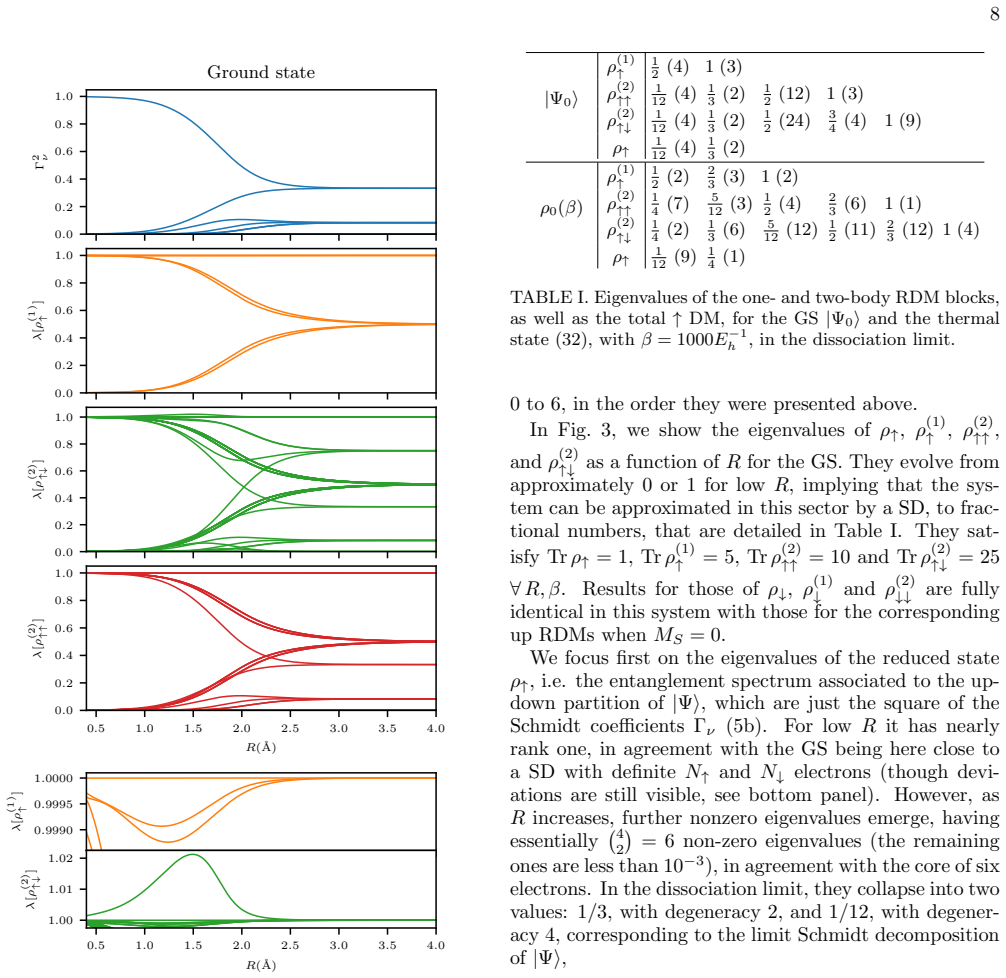
Reduced up-down mutual information Fromρ (2) ↑↓ we can recover the one-body DM blocks as ρ(1) ↑ = Tr↓ρ(2) ↑↓ /N↓,ρ (1) ↓ = Tr↑ρ(2) ↑↓ /N↑, where Trµ denotes the partial trace overµ=↑or↓modes. Then we can also examine the total (classical plus quantum) up-down cor- relations at the level of two particles through the mutual information associated withρ (2) ...
-
[5]
Total up-down Negativity We first recall that the negativity [42, 43] of a bipartite mixed stateρ AB of two distinguishable components is defined as minus the sum of the negative eigenvalues of its partial transpose [49]ρ tB AB, which are the same as those ofρ tA AB. Since Trρ tB AB = Trρ AB, the negativity can be written as NAB = 1 2[Tr|ρ tB AB| −1].(22)...
-
[6]
This yields, noting that Trρ (2)t ↓ ↑↓ = Trρ(2) ↑↓ =N ↑N↓ N (2) ↑↓ = 1 2[Tr|ρ(2)t ↓ ↑↓ | −N ↑N↓],(26) where (ρ (2)t ↓ ↑↓ )i¯j,k¯l = (ρ (2) ↑↓ )i¯l,k¯j
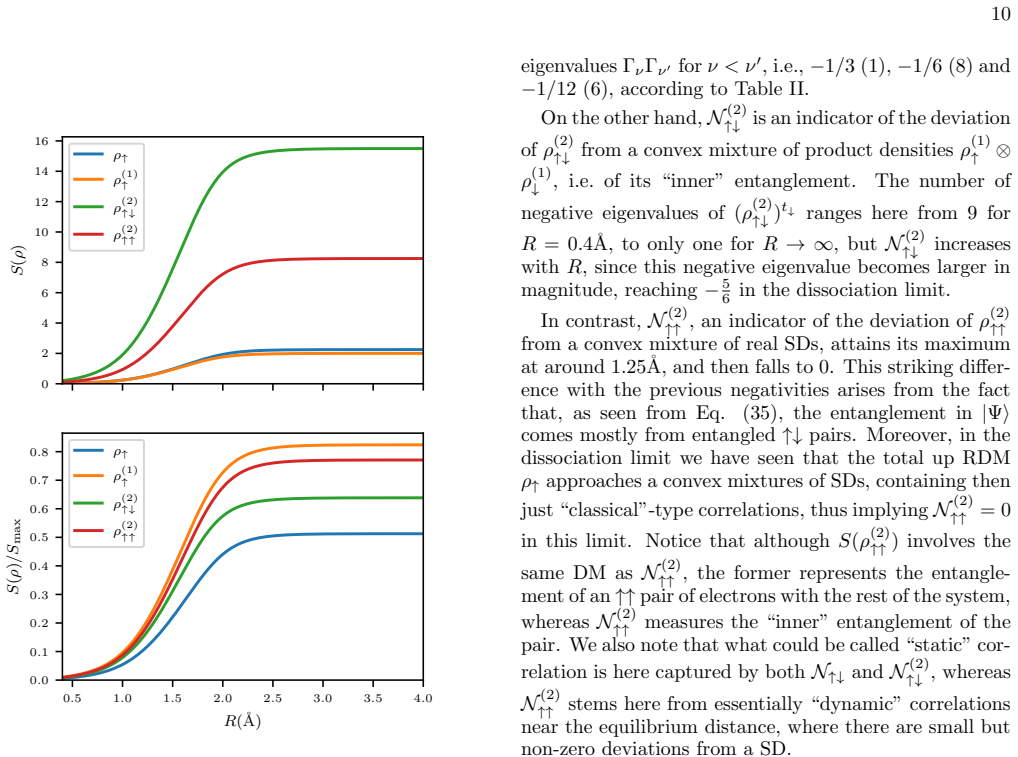
Reduced two-body up-down Negativity Similarly, in order to obtain an indicator of the “inner” entanglement of the up-down block of the two-body DM ρ(2) ↑↓ , we can define its negativity again as minus the sum of the negative eigenvalues of its partial transpose. This yields, noting that Trρ (2)t ↓ ↑↓ = Trρ(2) ↑↓ =N ↑N↓ N (2) ↑↓ = 1 2[Tr|ρ(2)t ↓ ↑↓ | −N ↑N...
-
[7]
Such real states can arise e.g
Two-body fermionic Negativity for real representations In order to obtain an analogous measure of the “inner” entanglement of a generalρ (2) or of the blocksρ (2) ↑↑ or ρ(2) ↓↓ , we now introduce a two-body negativity for real states (in some fixed sp basis), which vanishes in any convex mixture of real SDs, but can be otherwise positive, being always pos...
-
[8]
separable
Splitting the sp space into core and active parts is not strictly exact, since typically, even the highest occupation numbers are not exactly 1, but it is a good approximation for the levels with highest occupancy, and in this work almost no detail is lost with it, with one notable exception that will be discussed later. For the water molecule GS,n core =...
-
[9]
Theϕ 1s andϕ 2s orbitals are doubly occupied, while the 2porbitals are partially occupied by four electrons
GS subspace in the dissociation limit Considering first the O atom, its GS is a triplet, i.e., states 3Pfrom a sp configuration 1s 22s22p4, hence 9-fold degenerate (the spin-orbit coupling is here neglected). Theϕ 1s andϕ 2s orbitals are doubly occupied, while the 2porbitals are partially occupied by four electrons. The (N2p↑, N2p↓) occupation numbers in ...
-
[10]
complexity
Thermal state We now consider the thermal state (32). We set β= 1000E −1 h in all cases, withE h ≈27.211eVthe Hartree energy, so that only states that become degener- ate with the GS contribute toρ 0(β) near the dissociation limit. The GS energy in this limit is−74.737E h and the gap between the lowest 12 states and the next band is 0.095Eh (atR= 4 ˚A the...
-
[11]
In addition,ρ sep in (40) is clearly a convex mixture of SDs with definite number of up and down electrons, Eq
Entanglement and correlation measures In the dissociation limit, all eigenstates|K⟩in (41) are “product” states regarding the O (core + 2p) and H atoms. In addition,ρ sep in (40) is clearly a convex mixture of SDs with definite number of up and down electrons, Eq. (43a), implying that all negativitiesN ↑↓, N (2) ↑↓ andN ↑↑ also vanish when evaluated atρ s...
-
[12]
In the following discussion we seti, j∈ {2,3,6}, and k∈ {4,5}and omit the three obvious upper eigenvalues 1/2, 2/3 and 1 arising from one or two core electrons in the pair.ρ (2) ↑↑ has three additional eigenvalues 5/12, whose eigenvectors areC † ij |0⟩, and seven eigenvalues 1/4, whose eigenvectors areC † 45 |0⟩, andC † ik |0⟩. It is clear from them thatρ...
-
[13]
internal
We also mention that any non-uniform mixture of these three Bell pairs inρ 0 2p leads instead toN (2) ↑↓ >0. Finally, the up-down mutual informationsI ↑↓ andI (2) ↑↓ inρ 0(β) are depicted in the bottom panel of Fig. 6. In contrast with the GS case, they now exhibit a maximum value atR≈2.2 ˚A, the point where the excited states begin to contribute toρ 0(β)...
-
[14]
On the interaction of electrons in metals,
E. Wigner, “On the interaction of electrons in metals,” Phys. Rev.46, 1002 (1934)
1934
-
[15]
Quantum theory of many-particle sys- tems. III. Extension of the Hartree-Fock scheme to in- clude degenerate systems and correlation effects,
P.O. L¨ owdin, “Quantum theory of many-particle sys- tems. III. Extension of the Hartree-Fock scheme to in- clude degenerate systems and correlation effects,” Phys. Rev.97, 1509 (1955)
1955
-
[16]
M. A. Nielsen and I. L. Chuang,Quantum Computation and Quantum Information, 2nd ed. (Cambridge Univer- sity Press, 2010)
2010
-
[17]
Quantum entanglement,
R. Horodecki, P. Horodecki, M. Horodecki, and K. Horodecki, “Quantum entanglement,” Rev. Mod. Phys.81, 865 (2009)
2009
-
[18]
En- tanglement in many-body systems,
L. Amico, R. Fazio, A. Osterloh, and V. Vedral, “En- tanglement in many-body systems,” Rev. Mod. Phys.80, 517 (2008)
2008
-
[19]
What can quantum in- formation theory offer to quantum chemistry?
D. Aliverti-Piuri, K. Chatterjee, L. Ding, K. Liao, J. Liebert, and C. Schilling, “What can quantum in- formation theory offer to quantum chemistry?” Faraday Discuss.254, 76 (2024)
2024
-
[20]
Entanglement in indistinguishable particle sys- tems,
F. Benatti, R. Floreanini, F. Franchini, and U. Mar- zolino, “Entanglement in indistinguishable particle sys- tems,” Phys. Rep.878, 1 (2020)
2020
-
[21]
Quantum correlations in two-fermion systems,
J. Schliemann, J. I. Cirac, M. Ku´ s, M. Lewenstein, and D. Loss, “Quantum correlations in two-fermion systems,” 16 Phys. Rev. A64, 022303 (2001)
2001
-
[22]
Quantum correlations in systems of indistinguishable particles,
K. Eckert, J. Schliemann, D. Bruß, and M. Lewenstein, “Quantum correlations in systems of indistinguishable particles,” Ann. Phys.299, 88 (2002)
2002
-
[23]
Quantum entanglement in fermionic lat- tices,
Paolo Zanardi, “Quantum entanglement in fermionic lat- tices,” Phys. Rev. A65, 042101 (2002)
2002
-
[24]
Fermionic-mode entanglement in quantum infor- mation,
Nicolai Friis, Antony R Lee, and David Edward Br- uschi, “Fermionic-mode entanglement in quantum infor- mation,” Phys. Rev. A87, 022338 (2013)
2013
-
[25]
Mode entanglement of gaussian fermionic states,
C. Spee, K. Schwaiger, G. Giedke, and B. Kraus, “Mode entanglement of gaussian fermionic states,” Phys. Rev. A97, 042325 (2018)
2018
-
[26]
Entanglement in fermion systems,
N. Gigena and R. Rossignoli, “Entanglement in fermion systems,” Phys. Rev. A92, 042326 (2015)
2015
-
[27]
One-body entanglement as a quantum resource in fermionic sys- tems,
N. Gigena, M. Di Tullio, and R. Rossignoli, “One-body entanglement as a quantum resource in fermionic sys- tems,” Phys. Rev. A102, 042410 (2020)
2020
-
[28]
Many- body entanglement in fermion systems,
N. Gigena, M. Di Tullio, and R. Rossignoli, “Many- body entanglement in fermion systems,” Phys. Rev. A 103, 052424 (2021)
2021
-
[29]
Quantumness of correlations in indistinguish- able particles,
Fernando Iemini, Tiago Debarba, and Reinaldo O Vianna, “Quantumness of correlations in indistinguish- able particles,” Phys. Rev. A89, 032324 (2014)
2014
-
[30]
Multipartite concurrence for identical- fermion systems,
A.P. Majtey, P.A. Bouvrie, A. Vald´ es-Hern´ andez, and A.R. Plastino, “Multipartite concurrence for identical- fermion systems,” Phys. Rev. A93, 032335 (2016)
2016
-
[31]
Bipartite entanglement in fermion systems,
N. Gigena and R. Rossignoli, “Bipartite entanglement in fermion systems,” Phys. Rev. A95, 062320 (2017)
2017
-
[32]
Completely positive maps for reduced states of indistinguishable particles,
L. da Silva Souza, T. Debarba, D. L. Braga-Ferreira, F. Iemini, and R. O. Vianna, “Completely positive maps for reduced states of indistinguishable particles,” Phys. Rev. A98, 052135 (2018)
2018
-
[33]
Fermionic entanglement in superconducting systems,
M. Di Tullio, N. Gigena, and R. Rossignoli, “Fermionic entanglement in superconducting systems,” Phys. Rev. A97, 062109 (2018)
2018
-
[34]
Fermionic entanglement in the Lipkin model,
M. Di Tullio, R. Rossignoli, M. Cerezo, and N. Gigena, “Fermionic entanglement in the Lipkin model,” Phys. Rev. A100, 062104 (2019)
2019
-
[35]
Bipartite representations and many- body entanglement of pure states ofNindistinguishable particles,
J. A. Cianciulli, R. Rossignoli, M. Di Tullio, N. Gigena, and F. Petrovich, “Bipartite representations and many- body entanglement of pure states ofNindistinguishable particles,” Phys. Rev. A110, 032414 (2024)
2024
-
[36]
Quantum entanglement and elec- tron correlation in molecular systems,
H. Wang and S. Kais, “Quantum entanglement and elec- tron correlation in molecular systems,” Isr. J. Chem.47, 59 (2007)
2007
-
[37]
High-order entropy measures and spin-free quantum entanglement for molec- ular problems,
A. V. Luzanov and O. V. Prezhdo, “High-order entropy measures and spin-free quantum entanglement for molec- ular problems,” Mol. Phys.105, 2879 (2007)
2007
-
[38]
New in- dices for describing the multi-configurational nature of the coupled cluster wave function,
V.V. Ivanov, D.I. Lyakh, and L. Adamowicz, “New in- dices for describing the multi-configurational nature of the coupled cluster wave function,” Mol. Phys.103, 2131 (2005)
2005
-
[39]
Performance of Shannon-entropy com- pactedN-electron wave functions for configuration in- teraction methods,
D. R. Alcoba, A. Torre, L. Lain, G. E. Massaccesi, O. B. O˜ na, P. W. Ayers, M. Van Raemdonck, P. Bultinck, and D. Van Neck, “Performance of Shannon-entropy com- pactedN-electron wave functions for configuration in- teraction methods,” Theor. Chem. Acc.135, 153 (2016)
2016
-
[40]
The cumulant two- particle reduced density matrix as a measure of elec- tron correlation and entanglement,
T. Juh´ asz and D.A. Mazziotti, “The cumulant two- particle reduced density matrix as a measure of elec- tron correlation and entanglement,” J. Chem. Phys.125, 174105 (2006)
2006
-
[41]
On the measure of electron correlation and entangle- ment in quantum chemistry based on the cumulant of the second-order reduced density matrix,
D. R. Alcoba, R. C. Bochicchio, L. Lain, and A. Torre, “On the measure of electron correlation and entangle- ment in quantum chemistry based on the cumulant of the second-order reduced density matrix,” J. Chem. Phys. 133, 144104 (2010)
2010
-
[42]
Chal- lenges for variational reduced-density-matrix theory with three-particleN-representability conditions,
R. R. Li, M. D. Liebenthal, and A. E. DePrince, “Chal- lenges for variational reduced-density-matrix theory with three-particleN-representability conditions,” J. Chem. Phys.155, 174110 (2021)
2021
-
[43]
Towards a formal definition of static and dy- namic electronic correlations,
C. L. Benavides-Riveros, N. N. Lathiotakis, and M. A. L. Marques, “Towards a formal definition of static and dy- namic electronic correlations,” Phys. Chem. Chem. Phys. 19, 12655 (2017)
2017
-
[44]
Measuring electron correlation: The impact of symmetry and orbital transformations,
R. Izs´ ak, A. V. Ivanov, N. S. Blunt, N. Holzmann, and F. Neese, “Measuring electron correlation: The impact of symmetry and orbital transformations,” J. Chem. Theory Comput.19, 2703 (2023)
2023
-
[45]
Dynamic and nondynamic electron correlation energy decomposi- tion based on the node of the Hartree–Fock Slater deter- minant,
M. ˇSulka, K. ˇSulkov´ a, P. Jureˇ cka, M. Dubeck´ y, “Dynamic and nondynamic electron correlation energy decomposi- tion based on the node of the Hartree–Fock Slater deter- minant,” J. Chem. Theory Comput.19, 8147 (2023)
2023
-
[46]
On the notion of strong corre- lation in electronic structure theory,
B. Ganoe and J. Shee, “On the notion of strong corre- lation in electronic structure theory,” Faraday Discuss. 254, 53 (2024)
2024
-
[47]
Entanglement measures for single- and multireference correlation effects,
K. Boguslawski, P. Tecmer, ¨O. Legeza, and M. Reiher, “Entanglement measures for single- and multireference correlation effects,” J. Phys. Chem. Lett.3, 3129 (2012)
2012
-
[48]
Orbital entanglement in bond-formation pro- cesses,
K. Boguslawski, P. Tecmer, G. Barcza, ¨O. Legeza, and M. Reiher, “Orbital entanglement in bond-formation pro- cesses,” J. Chem. Theory Comput.9, 2959 (2013)
2013
-
[49]
Orbital entanglement in quantum chemistry,
K. Boguslawski and P. Tecmer, “Orbital entanglement in quantum chemistry,” Int. J. Q. Chem.115, 1289 (2014)
2014
-
[50]
Concept of orbital entan- glement and correlation in quantum chemistry,
L. Ding, S. Mardazad, S. Das, S. Szalay, U. Schollwo¨ ck, Z. Zimbor´ as, and C. Schilling, “Concept of orbital entan- glement and correlation in quantum chemistry,” J. Chem. Theory Comput.17, 79 (2021)
2021
-
[51]
Quantum correlations in molecules: from quantum re- sourcing to chemical bonding,
L. Ding, S. Knecht, Z. Zimbor´ as, and C. Schilling, “Quantum correlations in molecules: from quantum re- sourcing to chemical bonding,” Quantum Sci. Technol.8, 015015 (2022)
2022
-
[52]
Physical entanglement between localized orbitals,
L. Ding, G. D¨ unnweber, and C. Schilling, “Physical entanglement between localized orbitals,” Quantum Sci. Technol.9, 015005 (2023)
2023
-
[53]
Quantum information-assisted complete active space optimization (QICAS),
L. Ding, S. Knecht, and C. Schilling, “Quantum information-assisted complete active space optimization (QICAS),” J. Phys. Chem. Lett.14, 11022 (2023)
2023
-
[54]
Natural orbitals and sparsity of quantum mutual information,
L. Ratini, C. Capecci, and L. Guidoni, “Natural orbitals and sparsity of quantum mutual information,” J. Chem. Theory Comput.20, 3535 (2024)
2024
-
[55]
Computable measure of entanglement,
G. Vidal and R. F. Werner, “Computable measure of entanglement,” Phys. Rev. A65, 032314 (2002)
2002
-
[56]
Logarithmic negativity: A full entangle- ment monotone that is not convex,
M. B. Plenio, “Logarithmic negativity: A full entangle- ment monotone that is not convex,” Phys. Rev. Lett.95, 090503 (2005)
2005
-
[57]
Correlation paradox of the dissociation limit: A quantum information perspective,
L. Ding and C. Schilling, “Correlation paradox of the dissociation limit: A quantum information perspective,” J. Chem. Theory Comput.16, 4159 (2020)
2020
-
[58]
The electronic structure of the hydrogen molecule: A tutorial exercise in classical and quantum computation,
V. Graves, C. S¨ underhauf, N.S. Blunt, R. Izs´ ak, and M. Sz˝ ori, “The electronic structure of the hydrogen molecule: A tutorial exercise in classical and quantum computation,” ACS Phys. Chem Au5, 435 (2025)
2025
-
[59]
Separable states are more disordered globally than locally,
M. A. Nielsen and J. Kempe, “Separable states are more disordered globally than locally,” Phys. Rev. Lett.86, 5184 (2001)
2001
-
[60]
Generalized entropic cri- terion for separability,
R. Rossignoli and N. Canosa, “Generalized entropic cri- terion for separability,” Phys. Rev. A66, 423061 (2002). 17
2002
-
[61]
Entropy inequalities,
E.H. Lieb H. Araki, “Entropy inequalities,” Commun. Math. Phys.18, 160 (1970)
1970
-
[62]
Separability criterion for density matrices,
A. Peres, “Separability criterion for density matrices,” Phys. Rev. Lett.77, 1413 (1996)
1996
-
[63]
Multireference configuration interaction treatment of potential energy surfaces: symmetric dissociation of H 2O in a double-zeta basis,
F. B. Brown, I. Shavitt, and R. Shepard, “Multireference configuration interaction treatment of potential energy surfaces: symmetric dissociation of H 2O in a double-zeta basis,” Chem. Phys. Lett.105, 363 (1984)
1984
-
[64]
Full configuration–interaction and state of the art correlation calculations on water in a valence double- zeta basis with polarization functions,
J. Olsen, P. Jørgensen, H. Koch, A. Balkova, and R. J. Bartlett, “Full configuration–interaction and state of the art correlation calculations on water in a valence double- zeta basis with polarization functions,” J. Chem. Phys. 104, 8007 (1996)
1996
-
[65]
Reduced multireference couple clus- ter method. II. Application to potential energy surfaces of HF, F 2, and H 2O,
X. Li and J. Paldus, “Reduced multireference couple clus- ter method. II. Application to potential energy surfaces of HF, F 2, and H 2O,” J. Chem. Phys.108, 637 (1998)
1998
-
[66]
A multireference configuration interaction method based on the separated electron pair wave functions,
J. Ma, S. Li, and W. Li, “A multireference configuration interaction method based on the separated electron pair wave functions,” J. Comp. Chem.27, 39 (2005)
2005
-
[67]
Generalized unitary coupled cluster wave functions for quantum computation,
J. Lee, W. J. Huggins, M. Head-Gordon, and K. B. Wha- ley, “Generalized unitary coupled cluster wave functions for quantum computation,” J. Chem. Theory Comput. 15, 311 (2018)
2018
-
[68]
Openfermion: The electronic structure package for quantum computers,
J. R. McClean, K. J. Sung, I. D. Kivlichan, Y. Cao, C. Dai, E. Schuyler Fried, C. Gidney, B. Gimby, P. Gokhale, T. H¨ aner,et al., “OpenFermion: The electronic structure package for quantum computers,” (2019), arXiv:1710.07629 [quant-ph]
-
[69]
Libcint: An efficient general integral library for gaussian basis functions,
Q. Sun, “Libcint: An efficient general integral library for gaussian basis functions,” J. Comput. Chem.36, 1664 (2015)
2015
-
[70]
PySCF: the Python-based simulations of chemistry framework,
Q. Sun, T. C. Berkelbach, N. S. Blunt, G. H. Booth, S. Guo, Z. Li, J. Liu, J. D. McClain, E. R. Sayfutyarova, S. Sharma, S. Wouters, and G. K.-L. Chan, “PySCF: the Python-based simulations of chemistry framework,” WIREs Comput. Mol. Sci.8, e1340 (2017)
2017
-
[71]
Recent developments in the PySCF program package,
Q. Sun, X. Zhang, S. Banerjee, P. Bao, M. Barbry, N. S. Blunt, N. A. Bogdanov, G. H. Booth, J. Chen, Z.-H. Cui,et al., “Recent developments in the PySCF program package,” J. Chem. Phys.153, 024109 (2020)
2020
-
[72]
All entanglement measures were computed using our own programs [61, 62], which rely on numpy and scipy for the linear-algebraic operations, and are made available online
-
[73]
Shavitt and R.J
I. Shavitt and R.J. Bartlett,Many-body methods in chem- istry and physics: MBPT and coupled-cluster theory (Cambridge University press, 2009)
2009
-
[74]
fermionic-mbody,
J. A. Cianciulli, “fermionic-mbody,”https://github. com/aguschanchu/fermionic-mbody(2026)
2026
-
[75]
q-chemistry,
J. Garcia, R. Rossignoli, and J. A. Cianci- ulli, “q-chemistry,”https://github.com/aguschanchu/ q-chemistry(2026)
2026
discussion (0)
Sign in with ORCID, Apple, or X to comment. Anyone can read and Pith papers without signing in.