Recognition: 2 theorem links
· Lean TheoremSymmetry-guided and AI-accelerated design of intercalated transition metal dichalcogenides for antiferromagnetic spintronics
Pith reviewed 2026-05-10 18:27 UTC · model grok-4.3
The pith
Symmetry-guided AI framework identifies 55 antiferromagnetic candidates in intercalated transition metal dichalcogenides
A machine-rendered reading of the paper's core claim, the machinery that carries it, and where it could break.
Core claim
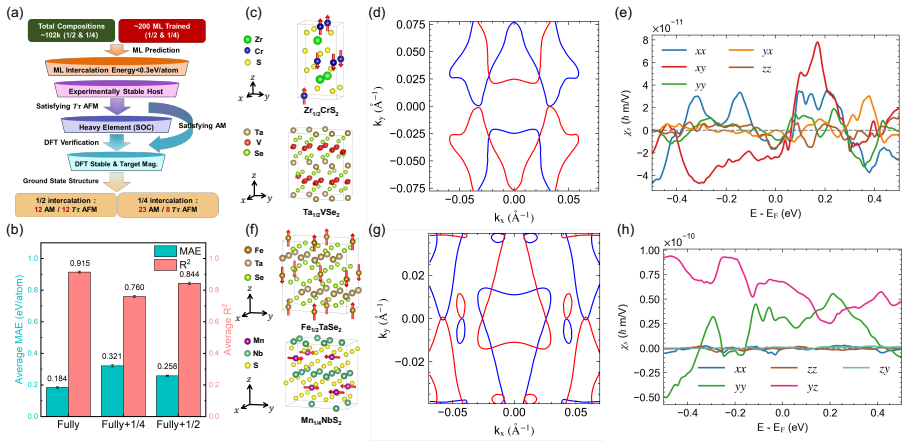
Based on fully intercalated transition metal dichalcogenides and using only 200 relaxed partially intercalated structures for transfer learning, our model effectively explores more than 100,000 partially intercalated configurations and identifies 35 altermagnetic and 20 Tτ-antiferromagnetic ground-state candidates. Tuning spin-group symmetry through intercalant arrangement or magnetic ordering realizes a series of d-wave altermagnets in these hexagonal systems with high spin-charge conversion efficiency. Furthermore, we reveal plentiful Tτ-antiferromagnets enabling efficient Néel spin-orbit torque switching, driven by giant T-odd spin Edelstein susceptibilities.
What carries the argument
Graph neural network with transfer learning that generalizes to predict ground-state magnetic orderings, symmetries, and spintronic properties across more than 100,000 unexplored configurations.
If this is right
- iTMDs establish as a versatile platform for spintronics.
- A series of d-wave altermagnets with high spin-charge conversion efficiency can be realized.
- Plentiful Tτ-antiferromagnets enable efficient Néel spin-orbit torque switching driven by giant T-odd spin Edelstein susceptibilities.
Where Pith is reading between the lines
- This framework could be extended to accelerate discovery in other classes of materials with large configurational spaces.
- Experimental synthesis and testing of the identified candidates would validate the predictions and the generalization ability of the model.
- Similar approaches might help in designing materials with targeted symmetries for various quantum technologies.
Load-bearing premise
The graph neural network with transfer learning from only 200 structures generalizes accurately to predict properties for over 100,000 configurations without substantial errors.
What would settle it
Full first-principles calculations on a representative sample of the predicted candidates to verify if the magnetic orderings and symmetries match the AI model's outputs.
Figures


read the original abstract
The advancement of antiferromagnetic spintronics depends on quantum materials with target symmetry-dictated functionalities, however, their systematic discovery is hindered by the immense configurational complexity of the available material space. Here, we introduce a symmetry-guided, AI-accelerated framework incorporating graph neural networks with high generalization ability to overcome this bottleneck. Based on fully intercalated transition metal dichalcogenides (iTMDs) and using only 200 relaxed partially intercalated structures for transfer learning, our model effectively explores more than 100,000 partially intercalated configurations and identifies 35 altermagnetic and 20 $T\tau$-antiferromagnetic ground-state candidates. Interestingly, we show that tuning spin-group symmetry through intercalant arrangement or magnetic ordering realizes a series of d-wave altermagnets in these hexagonal systems with high spin-charge conversion efficiency. Furthermore, we reveal plentiful $T\tau$-antiferromagnets enabling efficient N\'eel spin-orbit torque switching, driven by giant $T$-odd spin Edelstein susceptibilities. These results establish iTMDs as a versatile platform for spintronics and provide a general strategy for the accelerated design of symmetry-enforced quantum materials.
Editorial analysis
A structured set of objections, weighed in public.
Referee Report
Summary. The manuscript introduces a symmetry-guided, AI-accelerated framework that employs graph neural networks with transfer learning from 200 relaxed partially intercalated transition metal dichalcogenide (iTMD) structures to screen more than 100,000 configurations. It identifies 35 altermagnetic and 20 Tτ-antiferromagnetic ground-state candidates, showing that intercalant arrangement or magnetic ordering can tune spin-group symmetry to realize d-wave altermagnets with high spin-charge conversion efficiency and Tτ-antiferromagnets with giant T-odd spin Edelstein susceptibilities suitable for efficient Néel spin-orbit torque switching.
Significance. If the GNN predictions and symmetry assignments are reliable, the work offers a scalable strategy for navigating vast configurational spaces in quantum materials discovery, directly yielding concrete candidate lists for antiferromagnetic spintronics. The explicit linkage of spin-group symmetry tuning to measurable efficiencies (spin-charge conversion, Edelstein susceptibilities) provides falsifiable predictions and a template for symmetry-enforced design that could be adopted beyond iTMDs.
major comments (2)
- [Results] Results section (paragraph on screening outcomes): The central claim that the model identifies 35 altermagnetic and 20 Tτ-antiferromagnetic ground-state candidates from >100k configurations rests on GNN predictions, yet no hold-out test errors, uncertainty quantification, or DFT validation on any statistically meaningful subset of the screened or selected candidates is reported. This directly undermines in the candidate counts and the subsequent property assessments (e.g., spin Edelstein susceptibilities).
- [Methods] Methods section (GNN and transfer-learning description): The transfer-learning procedure from only 200 relaxed structures to 100k unexplored configurations lacks explicit details on the magnetic ground-state determination protocol (energy minimization versus symmetry enforcement), data exclusion criteria, and cross-validation metrics. Without these, the generalization assumption required for the functional-candidate identification cannot be evaluated.
minor comments (2)
- [Abstract] Abstract: The phrase 'high generalization ability' is stated without accompanying quantitative metrics (e.g., MAE or R² on a test set); this should be replaced by concrete performance numbers or removed.
- [Abstract] Notation: The symbol Tτ for the antiferromagnetic class is introduced without an explicit definition or reference to its spin-group representation; a brief parenthetical or footnote would improve clarity for readers outside the immediate subfield.
Simulated Author's Rebuttal
We thank the referee for the constructive comments and for recognizing the potential of our symmetry-guided AI framework for antiferromagnetic spintronics discovery. We address the major comments point by point below and will incorporate revisions to improve transparency and validation.
read point-by-point responses
-
Referee: [Results] Results section (paragraph on screening outcomes): The central claim that the model identifies 35 altermagnetic and 20 Tτ-antiferromagnetic ground-state candidates from >100k configurations rests on GNN predictions, yet no hold-out test errors, uncertainty quantification, or DFT validation on any statistically meaningful subset of the screened or selected candidates is reported. This directly undermines in the candidate counts and the subsequent property assessments (e.g., spin Edelstein susceptibilities).
Authors: We agree that quantitative validation metrics are necessary to support confidence in the large-scale screening results. The GNN was trained via transfer learning on the 200 DFT-relaxed structures, with internal performance assessed during training, but explicit hold-out test errors, uncertainty estimates for the extrapolated 100k+ configurations, and post-screening DFT validation on candidates were not reported in the submitted manuscript. In the revised version, we will add these details: model test-set errors and uncertainty quantification (via ensemble variance or similar) in the Methods/Results, plus DFT validation on a representative subset of at least 20-30 predicted candidates to confirm magnetic ground states, altermagnetism/Tτ ordering, and key properties such as spin Edelstein susceptibilities. These additions will be placed in the main text or a new SI section, directly bolstering the reported candidate counts. revision: yes
-
Referee: [Methods] Methods section (GNN and transfer-learning description): The transfer-learning procedure from only 200 relaxed structures to 100k unexplored configurations lacks explicit details on the magnetic ground-state determination protocol (energy minimization versus symmetry enforcement), data exclusion criteria, and cross-validation metrics. Without these, the generalization assumption required for the functional-candidate identification cannot be evaluated.
Authors: We thank the referee for highlighting the need for greater methodological detail. Magnetic ground states in the 200-structure training set were obtained via full spin-polarized DFT energy minimization over multiple initial spin configurations (collinear FM/AFM and non-collinear), not by symmetry enforcement. Data exclusion removed structures exhibiting DFT non-convergence or unphysical intercalant placements (e.g., interatomic distances below a defined cutoff), with the exact numbers and criteria to be quantified. Cross-validation used 5-fold stratified CV on the training data. We will expand the Methods section to explicitly describe the ground-state protocol, exclusion criteria with counts, and CV metrics (including MAE/R² for energies and moments). This will enable readers to evaluate the generalization to the screened space. revision: yes
Circularity Check
No significant circularity in derivation chain
full rationale
The paper trains a graph neural network via transfer learning on 200 external DFT-relaxed structures and applies it to predict properties across >100k new configurations. This is a standard supervised ML workflow whose outputs are not equivalent to the training inputs by construction, nor do any quoted steps reduce via self-definition, fitted-parameter renaming, or self-citation chains. The central claims rest on generalization from independent DFT data rather than tautological re-labeling of inputs, satisfying the criteria for a self-contained, non-circular derivation.
Axiom & Free-Parameter Ledger
free parameters (1)
- Training set size (200 structures)
axioms (1)
- domain assumption Spin-group symmetry through intercalant arrangement or magnetic ordering dictates altermagnetic and Tτ-antiferromagnetic functionalities
Lean theorems connected to this paper
-
IndisputableMonolith/Foundation/AlexanderDuality.leanalexander_duality_circle_linking unclear?
unclearRelation between the paper passage and the cited Recognition theorem.
tuning spin-group symmetry through intercalant arrangement or magnetic ordering realizes a series of d-wave altermagnets
What do these tags mean?
- matches
- The paper's claim is directly supported by a theorem in the formal canon.
- supports
- The theorem supports part of the paper's argument, but the paper may add assumptions or extra steps.
- extends
- The paper goes beyond the formal theorem; the theorem is a base layer rather than the whole result.
- uses
- The paper appears to rely on the theorem as machinery.
- contradicts
- The paper's claim conflicts with a theorem or certificate in the canon.
- unclear
- Pith found a possible connection, but the passage is too broad, indirect, or ambiguous to say the theorem truly supports the claim.
Reference graph
Works this paper leans on
-
[1]
T. Jungwirth, X. Marti, P. Wadley, J. Wunderlich, Antiferromagnetic Spintronics. Nat. Nanotechnol.11(3), 231–241 (2016), doi:10.1038/nnano.2016.18
-
[2]
Baltz,et al., Antiferromagnetic Spintronics.Rev
V. Baltz,et al., Antiferromagnetic Spintronics.Rev. Mod. Phys.90(1), 015005 (2018), doi:10.1103/RevModPhys.90.015005
-
[3]
J. Han, R. Cheng, L. Liu, H. Ohno, S. Fukami, Coherent Antiferromagnetic Spin- tronics.Nat. Mater.22(6), 684–695 (2023), doi:10.1038/s41563-023-01492-6
-
[5]
J. ˇZelezn´ y,et al., Spin-Orbit Torques in Locally and Globally Noncentrosymmetric Crystals: Antiferromagnets and Ferromagnets.Phys. Rev. B95(1), 014403 (2017), doi:10.1103/PhysRevB.95.014403
-
[6]
Manchon,et al., Current-Induced Spin-Orbit Torques in Ferromagnetic and Antiferromagnetic Systems.Rev
A. Manchon,et al., Current-Induced Spin-Orbit Torques in Ferromagnetic and Antiferromagnetic Systems.Rev. Mod. Phys.91(3), 035004 (2019), doi:10.1103/ RevModPhys.91.035004
2019
-
[7]
L. ˇSmejkal, J. Sinova, T. Jungwirth, Beyond Conventional Ferromagnetism and Anti- ferromagnetism: A Phase with Nonrelativistic Spin and Crystal Rotation Symmetry. Phys. Rev. X12(3), 031042 (2022), doi:10.1103/PhysRevX.12.031042
-
[8]
L. ˇSmejkal, J. Sinova, T. Jungwirth, Emerging Research Landscape of Altermag- netism.Phys. Rev. X12(4), 040501 (2022), doi:10.1103/PhysRevX.12.040501. 15
-
[9]
L.-D. Yuan, Z. Wang, J.-W. Luo, E. I. Rashba, A. Zunger, Giant Momentum- Dependent Spin Splitting in Centrosymmetric Low-ZAntiferromagnets.Phys. Rev. B102(1), 014422 (2020), doi:10.1103/PhysRevB.102.014422
-
[10]
C. Wu, K. Sun, E. Fradkin, S.-C. Zhang, Fermi Liquid Instabilities in the Spin Channel.Phys. Rev. B75(11), 115103 (2007), doi:10.1103/PhysRevB.75.115103
-
[11]
H.-Y. Ma,et al., Multifunctional Antiferromagnetic Materials with Giant Piezomag- netism and Noncollinear Spin Current.Nat. Commun.12(1), 2846 (2021), doi: 10.1038/s41467-021-23127-7
-
[12]
D.-F. Shao, S.-H. Zhang, M. Li, C.-B. Eom, E. Y. Tsymbal, Spin-Neutral Currents for Spintronics.Nat. Commun.12(1), 7061 (2021), doi:10.1038/s41467-021-26915-3
-
[13]
Bai,et al., Altermagnetism: Exploring New Frontiers in Magnetism and Spintron- ics.Adv
L. Bai,et al., Altermagnetism: Exploring New Frontiers in Magnetism and Spintron- ics.Adv. Funct. Mater.p. 2409327 (2024), doi:10.1002/adfm.202409327
-
[14]
J. Krempask´ y,et al., Altermagnetic Lifting of Kramers Spin Degeneracy.Nature 626(7999), 517–522 (2024), doi:10.1038/s41586-023-06907-7
-
[15]
R. Xu, Y. Gao, J. Liu, Chemical Design of Monolayer Altermagnets.Natl. Sci. Rev. 13(2), nwaf528 (2026), doi:10.1093/nsr/nwaf528
-
[16]
Gao,et al., AI-accelerated Discovery of Altermagnetic Materials.Natl
Z.-F. Gao,et al., AI-accelerated Discovery of Altermagnetic Materials.Natl. Sci. Rev.12(4), nwaf066 (2025), doi:10.1093/nsr/nwaf066
-
[17]
Y. Che, H. Lv, X. Wu, J. Yang, Engineering Altermagnetic States in Two- Dimensional Square Tessellations.Phys. Rev. Lett.135(3), 036701 (2025), doi: 10.1103/v38b-5by1
-
[18]
Y. Liu,et al., Robust Altermagnetism and Compensated Ferrimagnetism in MnPX 3 -Based ( X = S or Se) Heterostructures.Phys. Rev. Mater.9(10), 104406 (2025), doi:10.1103/6wmg-hxdq. 16
-
[19]
Guo,et al., Tunable Altermagnetism via Interchain Engineering in Parallel- Assembled Atomic Chains.Phys
D. Guo,et al., Tunable Altermagnetism via Interchain Engineering in Parallel- Assembled Atomic Chains.Phys. Rev. B112(4), L041404 (2025), doi:10.1103/ zhds-vnyt
2025
-
[20]
Final result of the ma- jorana demonstrator’s search for neutrinoless double-β decay in 76Ge (2023)
R. He,et al., Nonrelativistic Spin-Momentum Coupling in Antiferromagnetic Twisted Bilayers.Phys. Rev. Lett.130(4), 046401 (2023), doi:10.1103/PhysRevLett.130. 046401
-
[21]
Y. Liu, J. Yu, C.-C. Liu, Twisted Magnetic Van Der Waals Bilayers: An Ideal Platform for Altermagnetism.Phys. Rev. Lett.133(20), 206702 (2024), doi: 10.1103/PhysRevLett.133.206702
-
[22]
S. Zeng, Y.-J. Zhao, Description of Two-Dimensional Altermagnetism: Catego- rization Using Spin Group Theory.Phys. Rev. B110(5), 054406 (2024), doi: 10.1103/PhysRevB.110.054406
-
[23]
Pan,et al., General Stacking Theory for Altermagnetism in Bilayer Systems.Phys
B. Pan,et al., General Stacking Theory for Altermagnetism in Bilayer Systems.Phys. Rev. Lett.133(16), 166701 (2024), doi:10.1103/PhysRevLett.133.166701
-
[24]
S. G. Jeong,et al., Altermagnetic Polar Metallic Phase in Ultrathin Epitaxially Strained RuO 2 Films.Proc. Natl. Acad. Sci. U.S.A123(10), e2526641123 (2026), doi:10.1073/pnas.2526641123
-
[25]
Bai,et al., Efficient Spin-to-Charge Conversion via Altermagnetic Spin Splitting Effect in Antiferromagnet RuO 2.Phys
H. Bai,et al., Efficient Spin-to-Charge Conversion via Altermagnetic Spin Splitting Effect in Antiferromagnet RuO 2.Phys. Rev. Lett.130, 216701 (2023), doi:10.1103/ PhysRevLett.130.216701
2023
-
[26]
R. Gonz´ alez-Hern´ andez,et al., Efficient Electrical Spin Splitter Based on Nonrel- ativistic Collinear Antiferromagnetism.Phys. Rev. Lett.126(12), 127701 (2021), doi:10.1103/PhysRevLett.126.127701
-
[27]
J. Lai,et al., D -Wave Flat Fermi Surface in Altermagnets Enables Maximum Charge- to-Spin Conversion.Phys. Rev. Lett.135(25), 256702 (2025), doi:10.1103/bf1n-sxdl. 17
-
[28]
L. ˇSmejkal, R. Gonz´ alez-Hern´ andez, T. Jungwirth, J. Sinova, Crystal Time-Reversal Symmetry Breaking and Spontaneous Hall Effect in Collinear Antiferromagnets.Sci. Adv.(2020), doi:10.1126/sciadv.aaz8809
-
[29]
H. Pan,et al., Experimental Evidence of N´ eel-Order-Driven Magneto-optical Kerr Effect in an Altermagnetic Insulator.Phys. Rev. Lett.136(3), 036701 (2026), doi: 10.1103/q8ym-l2zt
-
[30]
Liu, J.-T
M. Liu, J.-T. Sun, S. Meng, Uncompensated Linear Dichroism of Magneto-Optical Kerr Effect in a 2D Altermagnet.Adv. Funct. Mater.p. e21111 (2025), doi:10.1002/ adfm.202521111
2025
-
[31]
Y. Li, Y. Liu, C.-C. Liu, Unconventional Magneto-Optical Effects in Altermagnets (2025), doi:10.48550/arXiv.2512.03435
-
[32]
Huang,et al., Spin Inversion Enforced by Crystal Symmetry in Ferroelastic Al- termagnets.Phys
Y. Huang,et al., Spin Inversion Enforced by Crystal Symmetry in Ferroelastic Al- termagnets.Phys. Rev. Lett.135(26), 266701 (2025), doi:10.1103/jql2-b4c4
-
[33]
N. Ding, H. Ye, S.-S. Wang, S. Dong, Ferroelastically Tunable Altermagnets.Phys. Rev. B112(22), L220410 (2025), doi:10.1103/m33v-xwn3
-
[34]
Duan,et al., Antiferroelectric Altermagnets: Antiferroelectricity Alters Magnets
X. Duan,et al., Antiferroelectric Altermagnets: Antiferroelectricity Alters Magnets. Phys. Rev. Lett.134(10) (2025), doi:10.1103/physrevlett.134.106801
-
[35]
Gu,et al., Ferroelectric Switchable Altermagnetism.Phys
M. Gu,et al., Ferroelectric Switchable Altermagnetism.Phys. Rev. Lett.134(10), 106802 (2025), doi:10.1103/PhysRevLett.134.106802
-
[36]
W. Sun, W. Wang, C. Yang, S. Huang, Z. Cheng, A Unified Symmetry Framework for Spin–Ferroelectric Coupling in Altermagnetic Multiferroics.Nat. Commun.(2026), doi:10.1038/s41467-026-69635-2
-
[37]
Y.-Q. Li,et al., Ferrovalley Physics in Stacked Bilayer Altermagnetic Systems.Nano Letters25(15), 6032–6039 (2025), doi:10.1021/acs.nanolett.4c06037
-
[38]
Chen,et al., Enumeration and Representation Theory of Spin Space Groups
X. Chen,et al., Enumeration and Representation Theory of Spin Space Groups. Phys. Rev. X14(3), 031038 (2024), doi:10.1103/PhysRevX.14.031038. 18
-
[39]
Z. Xiao, J. Zhao, Y. Li, R. Shindou, Z.-D. Song, Spin Space Groups: Full Classifica- tion and Applications.Phys. Rev. X14(3), 031037 (2024), doi:10.1103/PhysRevX. 14.031037
-
[40]
Jiang,et al., Enumeration of Spin-Space Groups: Toward a Complete Description of Symmetries of Magnetic Orders.Phys
Y. Jiang,et al., Enumeration of Spin-Space Groups: Toward a Complete Description of Symmetries of Magnetic Orders.Phys. Rev. X14(3), 031039 (2024), doi:10.1103/ PhysRevX.14.031039
2024
-
[41]
B. Li, L. Zheng, Y. Gong, P. Kang, Intercalation-Driven Tunability in Two- Dimensional Layered Materials: Synthesis, Properties, and Applications.Mater. To- day81, 118–136 (2024), doi:10.1016/j.mattod.2024.10.002
-
[42]
X. Zhao,et al., Engineering Covalently Bonded 2D Layered Materials by Self- Intercalation.Nature581(7807), 171–177 (2020), doi:10.1038/s41586-020-2241-9
-
[43]
Zhou,et al., A cation-exchange approach to tunable magnetic intercalation super- lattices.Naturepp
J. Zhou,et al., A cation-exchange approach to tunable magnetic intercalation super- lattices.Naturepp. 1–8 (2025)
2025
-
[44]
H. Takagi,et al., Spontaneous Topological Hall Effect Induced by Non-Coplanar Antiferromagnetic Order in Intercalated van Der Waals Materials.Nat. Phys.19(7), 961–968 (2023), doi:10.1038/s41567-023-02017-3
-
[45]
S. Manzeli, D. Ovchinnikov, D. Pasquier, O. V. Yazyev, A. Kis, 2D Transition Metal Dichalcogenides.Nat. Rev. Mater.2(8), 17033 (2017), doi:10.1038/natrevmats.2017. 33
-
[46]
M. Chhowalla,et al., The Chemistry of Two-Dimensional Layered Transition Metal Dichalcogenide Nanosheets.Nat. Chem.5(4), 263–275 (2013), doi:10.1038/nchem. 1589
-
[47]
M. Sprague,et al., Observation of Altermagnetic Spin Splitting in an Intercalated Transition Metal Dichalcogenide (2025), doi:10.48550/arXiv.2508.12985
-
[48]
N. Dale,et al., Non-Relativistic Spin Splitting above and below the Fermi Level in a g-Wave Altermagnet (2024), doi:10.48550/arXiv.2411.18761. 19
-
[49]
J. N. Graham,et al., Local probe evidence supporting altermagnetism in Co 1/4NbSe2 (2025), doi:10.48550/arXiv.2503.09193
-
[50]
A. P. Sakhya,et al., Electronic Structure of a Layered Altermagnetic Compound CoNb4Se8 (2025), doi:10.48550/arXiv.2503.16670
-
[51]
R. B. Regmi,et al., Altermagnetism in the Layered Intercalated Transition Metal Dichalcogenide CoNb 4Se8.Nat. Commun.16(1), 4399 (2025), doi:10.1038/ s41467-025-58642-4
2025
-
[52]
H. C. Mandujano,et al., Evolution of Altermagnetism to Spin Density Waves in Co x NbSe2.J. Am. Chem. Soc.147(49), 44926–44940 (2025), doi:10.1021/jacs.5c13085
-
[53]
N. L. Nair,et al., Electrical Switching in a Magnetically Intercalated Transition Metal Dichalcogenide.Nat. Mater.19(2), 153–157 (2020), doi:10.1038/s41563-019-0518-x
-
[54]
Liang,et al., Multi-Task Mixture Density Graph Neural Networks for Predicting Catalyst Performance.Adv
C. Liang,et al., Multi-Task Mixture Density Graph Neural Networks for Predicting Catalyst Performance.Adv. Funct. Mater.34(45), 2404392 (2024)
2024
-
[55]
M. Q. Dong, Z.-X. Guo, X.-G. Gong, Field-Free Perpendicular Magnetization Switch- ing by Altermagnet with Collinear Spin Current (2025), doi:10.48550/arXiv.2506. 10336
-
[56]
J. Tang, R. Cheng, Lossless Spin-Orbit Torque in Antiferromagnetic Topological Insulator MnBi2Te4.Phys. Rev. Lett.132, 136701 (2024), doi:10.1103/PhysRevLett. 132.136701
-
[57]
H. J. Zhao, L. Tao, Y. Fu, L. Bellaiche, Y. Ma, General Theory for Longitudinal Nonreciprocal Charge Transport.Phys. Rev. Lett.133(9), 096802 (2024), doi:10. 1103/PhysRevLett.133.096802
2024
-
[58]
D. Kaplan, T. Holder, B. Yan, Unification of Nonlinear Anomalous Hall Effect and Nonreciprocal Magnetoresistance in Metals by the Quantum Geometry.Phys. Rev. Lett.132(2), 026301 (2024), doi:10.1103/PhysRevLett.132.026301. 20
-
[59]
R. Gonz´ alez-Hern´ andez, P. Ritzinger, K. V´ yborn´ y, J.ˇZelezn´ y, A. Manchon, Non- Relativistic Torque and Edelstein Effect in Non-Collinear Magnets.Nat. Commun. 15(1), 7663 (2024), doi:10.1038/s41467-024-51565-6
-
[60]
G. Kresse, J. Furthm¨ uller, Efficient Iterative Schemes for Ab Initio Total-Energy Calculations Using a Plane-Wave Basis Set.Phys. Rev. B54(16), 11169–11186 (1996), doi:10.1103/PhysRevB.54.11169
-
[61]
G. Kresse, D. Joubert, From Ultrasoft Pseudopotentials to the Projector Augmented- Wave Method.Phys. Rev. B59(3), 1758–1775 (1999), doi:10.1103/PhysRevB.59. 1758
-
[62]
J. P. Perdew, K. Burke, M. Ernzerhof, Generalized Gradient Approximation Made Simple.Phys. Rev. Lett.77(18), 3865–3868 (1996), doi:10.1103/PhysRevLett.77. 3865
-
[63]
S. L. Dudarev, G. A. Botton, S. Y. Savrasov, C. J. Humphreys, A. P. Sutton, Electron-energy-loss spectra and the structural stability of nickel oxide: An LSDA+U study.Phys. Rev. B57, 1505–1509 (1998), doi:10.1103/PhysRevB.57.1505
-
[64]
H. J. Monkhorst, J. D. Pack, Special points for Brillouin-zone integrations.Phys. Rev. B13(12), 5188 (1976)
1976
-
[65]
H. T. Stokes, D. M. Hatch, FINDSYM: program for identifying the space-group symmetry of a crystal.J. Appl. Crystallogr.38(1), 237–238 (2005)
2005
-
[66]
A. Smolyanyuk, L. ˇSmejkal, I. I. Mazin, A tool to check whether a symmetry- compensated collinear magnetic material is antiferro- or altermagnetic.SciPost Phys. Codebasesp. 30 (2024), doi:10.21468/SciPostPhysCodeb.30
-
[67]
Pizzi,et al., Wannier90 as a community code: new features and applications.J
G. Pizzi,et al., Wannier90 as a community code: new features and applications.J. Phys.: Condens. Matter32(16), 165902 (2020). 21
2020
-
[68]
Pizzi, D
G. Pizzi, D. Volja, B. Kozinsky, M. Fornari, N. Marzari, BoltzWann: A code for the evaluation of thermoelectric and electronic transport properties with a maximally- localized Wannier functions basis.Comput. Phys. Commun.185(1), 422–429 (2014)
2014
-
[69]
ˇZelezn´ y, Wannier-linear-response code, Wannier-linear-response, doi:https:// bitbucket.org/zeleznyj/wannier-linear-response/src
J. ˇZelezn´ y, Wannier-linear-response code, Wannier-linear-response, doi:https:// bitbucket.org/zeleznyj/wannier-linear-response/src
-
[70]
F. Freimuth, S. Bl¨ ugel, Y. Mokrousov, Spin-Orbit Torques in Co/Pt(111) and Mn/W(001) Magnetic Bilayers from First Principles.Phys. Rev. B90(17), 174423 (2014), doi:10.1103/PhysRevB.90.174423
-
[71]
Li,et al., Intraband and Interband Spin-Orbit Torques in Noncentrosymmet- ric Ferromagnets.Phys
H. Li,et al., Intraband and Interband Spin-Orbit Torques in Noncentrosymmet- ric Ferromagnets.Phys. Rev. B91(13), 134402 (2015), doi:10.1103/PhysRevB.91. 134402. Acknowledgments Funding:This work was supported by the National Natural Science Foundation of China (Project No. 12474236), and the Shenzhen Science and Technology Program (ZDSYS20230626091100001...
discussion (0)
Sign in with ORCID, Apple, or X to comment. Anyone can read and Pith papers without signing in.