Recognition: no theorem link
A Search for Wide-orbit Planets Around M-dwarfs using Deep MIRI 15-micron Images
Pith reviewed 2026-05-10 17:33 UTC · model grok-4.3
The pith
Archival MIRI time-series data provides sensitive probes for wide-orbit gas giant planets around M-dwarfs.
A machine-rendered reading of the paper's core claim, the machinery that carries it, and where it could break.
Core claim
The central discovery is that processing archival MIRI 15-micron time-series data from four programs on ten M-dwarf systems yields median 5-sigma contrasts ranging from 8.9 x 10^{-4} to 6.2 x 10^{-3} at 1 arcsecond and 1.2 to 9.1 x 10^{-4} at separations greater than or equal to 3 arcseconds. Under the assumption of solar metallicity and clear atmospheres, this corresponds to sensitivity for Jupiter-sized planets at effective temperatures of approximately 170 K beyond 35 AU for systems located at 12.5 parsecs. The paper also catalogs nearby sources and evaluates their potential as background contaminants for future observations.
What carries the argument
Reference differential imaging for precise subtraction of the stellar PSF in MIRI 15-micron time-series observations.
If this is right
- Achieves contrast limits sufficient to detect Jupiter-sized planets at ~170 K effective temperature beyond 35 AU in systems at 12.5 pc.
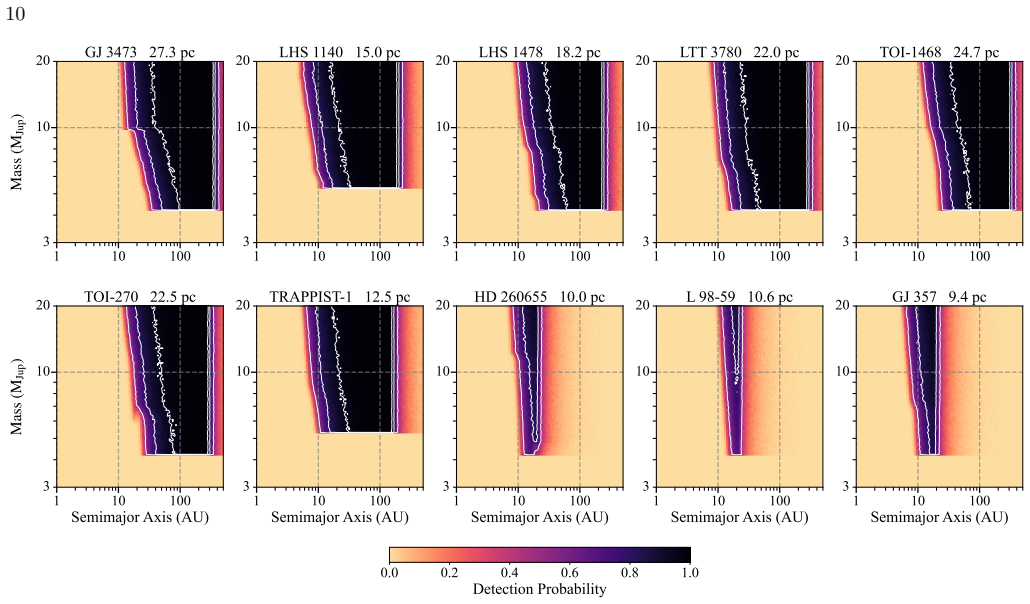
- Provides planet detection probability as a function of mass and semimajor axis for each of the ten systems.
- Catalogs nearby sources and assesses their impact assuming they are background objects.
- Establishes that archival MIRI time-series imaging data can serve as a powerful tool for investigating the population of wide-orbit gas giants around M-dwarfs.
Where Pith is reading between the lines
- Extending this analysis to a larger number of archival MIRI datasets could yield statistical constraints on the occurrence rate of wide-orbit planets around M-dwarfs.
- Cross-matching with data from other instruments or wavelengths could help confirm or rule out candidate companions identified in these images.
- This approach might be combined with radial velocity or astrometric data to better characterize any detected planets.
- Similar techniques could be applied to other stellar types to compare wide-orbit planet populations across different host star masses.
Load-bearing premise
The mapping of contrast limits to planet effective temperature and mass assumes solar metallicity and clear atmospheres without clouds or other opacity sources.
What would settle it
A direct detection of a wide-orbit planet in one of these systems at a separation and contrast consistent with the reported limits, or a null result in a much larger sample that contradicts the expected sensitivity.
Figures




read the original abstract
Wide-orbit ($>$10 AU) gas giant planets shape the architecture of planetary systems, yet their occurrence rate remains poorly constrained. JWST has obtained the deepest mid-infrared images of nearby stars to date through substantial MIRI time-series observations of transiting planets, providing sensitive probes for wide-orbit companions. Here we leverage 15 micron observations from four programs targeting ten M-dwarf systems to search for such planets. By applying reference differential imaging for precise PSF subtraction, we achieve a median 5$\sigma$ contrast of $8.9 \times 10^{-4} - 6.2 \times 10^{-3}$ (median sensitivity in apparent magnitude of 15.8-16.8 mag) at a separation of 1" and $1.2 -9.1 \times 10^{-4}$ (17.5-19.0 mag) at separations $\gtrsim$3". The sensitivity is converted to planet detection probability for each system as a function of planet mass versus semimajor axis. Assuming solar metallicity and a clear atmosphere, we are sensitive to Jupiter-sized planets with an effective temperature of ${\sim}170$ K at separations beyond 35 AU in systems at 12.5 pc. Additionally, we catalog the nearby sources and estimate their possible impact on future observations assuming they are background sources. Our results demonstrate that archival MIRI time-series imaging data is a powerful window into the population of wide-orbit gas giants around M-dwarfs.
Editorial analysis
A structured set of objections, weighed in public.
Referee Report
Summary. The paper reports a search for wide-orbit (>10 AU) gas giant planets around ten M-dwarf systems using archival JWST MIRI 15-micron time-series imaging from four programs. The authors apply reference differential imaging (RDI) for PSF subtraction to achieve median 5σ contrasts of 8.9×10^{-4} to 6.2×10^{-3} (15.8-16.8 mag) at 1 arcsec and 1.2-9.1×10^{-4} (17.5-19.0 mag) at ≳3 arcsec. These limits are converted to planet effective temperature and mass sensitivities (e.g., ~170 K Jupiter-sized planets beyond 35 AU at 12.5 pc) under solar-metallicity clear-atmosphere assumptions, with a catalog of nearby sources; the central conclusion is that such archival MIRI data provides a powerful window into wide-orbit gas giants around M-dwarfs.
Significance. If the reported contrasts and sensitivity maps hold, the work demonstrates the viability of repurposing existing JWST MIRI time-series observations for high-contrast imaging of wide-orbit companions, offering a low-cost path to constrain occurrence rates without new telescope time. The direct observational contrasts and standard post-processing approach provide concrete, falsifiable sensitivity benchmarks that can be tested against future detections or deeper surveys.
minor comments (3)
- [Abstract] Abstract and §3 (or equivalent data reduction section): the median contrast ranges are presented without explicit per-system values or a table; adding a supplementary table of individual 5σ limits at 1″ and 3″ would improve traceability of the quoted medians.
- [Results] The conversion from contrast to Teff/mass (mentioned in abstract and results) relies on solar metallicity and clear atmospheres; while not central to the viability claim, a brief sensitivity test to cloudy or sub-solar models would clarify the robustness of the ~170 K limit.
- [Discussion] The catalog of nearby sources and their potential impact is noted but lacks quantitative details on proper-motion checks or contamination probabilities; a short paragraph or figure panel would strengthen the claim that they do not affect the planet search.
Simulated Author's Rebuttal
We thank the referee for their positive summary and significance assessment of our manuscript on repurposing archival JWST MIRI 15-micron time-series imaging for high-contrast searches around M-dwarfs. The recommendation for minor revision is noted. No specific major comments were provided in the report, so we have no individual points to address point-by-point. We will incorporate any minor editorial or clarification changes as needed in the revised version.
Circularity Check
No significant circularity; results are direct observational measurements
full rationale
The paper's derivation chain consists of standard data reduction (reference differential imaging for PSF subtraction on archival MIRI 15-micron time-series data) followed by direct measurement of 5σ contrast limits at various separations, conversion of those contrasts to planet effective temperature and mass limits via explicit external assumptions (solar metallicity, clear atmosphere), and cataloging of nearby sources. No equations or steps reduce by construction to fitted inputs, self-definitions, or load-bearing self-citations; the central demonstration that the data source yields useful sensitivity is an empirical outcome of the processing pipeline applied to the observations, with all modeling assumptions stated and not derived from the results themselves. This is self-contained against external benchmarks such as standard contrast curves and atmospheric models.
Axiom & Free-Parameter Ledger
axioms (1)
- domain assumption Planet atmosphere models assume solar metallicity and clear (cloud-free) conditions to map contrast to effective temperature and mass.
Reference graph
Works this paper leans on
-
[1]
Adams Redai, J. I., Follette, K. B., Wang, J., et al. 2023, AJ, 165, 57, doi: 10.3847/1538-3881/aca60d
-
[2]
H., Espinoza, N., Diamond-Lowe, H., et al
Allen, N. H., Espinoza, N., Diamond-Lowe, H., et al. 2025, AJ, 170, 240, doi: 10.3847/1538-3881/adfc51
-
[3]
Amara, A., & Quanz, S. P. 2012, MNRAS, 427, 948, doi: 10.1111/j.1365-2966.2012.21918.x Astropy Collaboration, Robitaille, T. P., Tollerud, E. J., et al. 2013, A&A, 558, A33, doi: 10.1051/0004-6361/201322068 Astropy Collaboration, Price-Whelan, A. M., Lim, P. L., et al. 2022, ApJ, 935, 167, doi: 10.3847/1538-4357/ac7c74
-
[4]
August, P. C., Buchhave, L. A., Diamond-Lowe, H., et al. 2025, A&A, 695, A171, doi: 10.1051/0004-6361/202452611 Bardalez Gagliuffi, D. C., Balmer, W. O., Pueyo, L., et al. 2025, ApJL, 988, L18, doi: 10.3847/2041-8213/ade30f
-
[5]
2025, ApJL, 989, L22, doi: 10.3847/2041-8213/adf53f
Beichman, C., Sanghi, A., Mawet, D., et al. 2025, ApJL, 989, L22, doi: 10.3847/2041-8213/adf53f
-
[6]
2024, Astronomy & Astrophysics, 686, A33, doi: 10.1051/0004-6361/202348771
Boccaletti, A., Lagage, P.-O., & Baudoz, P. 2024, Astronomy & Astrophysics, 686, A33, doi: 10.1051/0004-6361/202348771
-
[7]
Bogat, E., Schlieder, J. E., Lawson, K. D., et al. 2025, https://arxiv.org/abs/2504.11659
-
[8]
2012, A&A, 537, A67, doi: 10.1051/0004-6361/201116852
Bonavita, M., Chauvin, G., Desidera, S., et al. 2012, A&A, 537, A67, doi: 10.1051/0004-6361/201116852
-
[9]
Bowens-Rubin, R., Mang, J., & Limbach, M. A. 2025, The Astrophysical Journal, 986, L26, doi: 10.3847/2041-8213/ada6b9
-
[10]
Bowler, B. P. 2016, PASP, 128, 102001, doi: 10.1088/1538-3873/128/968/102001
-
[12]
2025,, 2.1.0 Zenodo, doi: 10.5281/zenodo.14606896
Bradley, L., Sip˝ ocz, B., Robitaille, T., et al. 2025,, 2.1.0 Zenodo, doi: 10.5281/zenodo.14606896
-
[13]
Bryan, M. L., & Lee, E. J. 2024, ApJL, 968, L25, doi: 10.3847/2041-8213/ad4993
-
[14]
Bryan, M. L., & Lee, E. J. 2025, ApJL, 982, L7, doi: 10.3847/2041-8213/adb0bd
-
[15]
Y., de Wit, J., Broˇ z, M., et al
Burdanov, A. Y., de Wit, J., Broˇ z, M., et al. 2024, Nature, 638, 74, doi: 10.1038/s41586-024-08480-z
-
[16]
Burgasser, A. J., & Mamajek, E. E. 2017, ApJ, 845, 110, doi: 10.3847/1538-4357/aa7fea
-
[17]
Bushouse, H., Eisenhamer, J., Dencheva, N., et al. 2025,, 1.17.1 Zenodo, doi: 10.5281/zenodo.14597407
-
[18]
2023, A&A, 674, A110, doi: 10.1051/0004-6361/202346063
Carmona, A., Delfosse, X., Bellotti, S., et al. 2023, A&A, 674, A110, doi: 10.1051/0004-6361/202346063
-
[19]
2022, A&A, 666, A155, doi: 10.1051/0004-6361/202244056
Chaturvedi, P., Bluhm, P., Nagel, E., et al. 2022, A&A, 666, A155, doi: 10.1051/0004-6361/202244056
-
[20]
Cloutier, R., Eastman, J. D., Rodriguez, J. E., et al. 2020, AJ, 160, 3, doi: 10.3847/1538-3881/ab91c2
-
[21]
Dittmann, J. A., Irwin, J. M., Charbonneau, D., et al. 2017, Nature, 544, 333, doi: 10.1038/nature22055
-
[22]
2025, Nature Astronomy, 9, 358, doi: 10.1038/s41550-024-02428-z
Ducrot, E., Lagage, P.-O., Min, M., et al. 2025, Nature Astronomy, 9, 358, doi: 10.1038/s41550-024-02428-z
-
[23]
Engle, S. G., & Guinan, E. F. 2023, ApJL, 954, L50, doi: 10.3847/2041-8213/acf472 16
-
[24]
Fortune, M., Gibson, N. P., Diamond-Lowe, H., et al. 2025, A&A, 701, A25, doi: 10.1051/0004-6361/202554198
-
[25]
Franson, K., Bowler, B. P., & Zhou, Y. 2024, The Astrophysical Journal, 974, L11, doi: 10.3847/2041-8213/ad73da Gaia Collaboration, Prusti, T., de Bruijne, J. H. J., et al. 2016, A&A, 595, A1, doi: 10.1051/0004-6361/201629272 Gaia Collaboration, Vallenari, A., Brown, A. G. A., et al. 2023, A&A, 674, A1, doi: 10.1051/0004-6361/202243940
-
[26]
Gillon, M., Triaud, A. H. M. J., Demory, B.-O., et al. 2017, Nature, 542, 456, doi: 10.1038/nature21360
-
[27]
Gillon, M., Ducrot, E., Bell, T. J., et al. 2025, arXiv e-prints, arXiv:2509.02128, doi: 10.48550/arXiv.2509.02128
-
[28]
Greene, T. P., Bell, T. J., Ducrot, E., et al. 2023, Nature, 618, 39, doi: 10.1038/s41586-023-05951-7
-
[29]
Gupta, P., Atreya, S. K., Steffes, P. G., et al. 2022, in EGU General Assembly Conference Abstracts, EGU General Assembly Conference Abstracts, EGU22–966, doi: 10.5194/egusphere-egu22-966
-
[30]
Harris, C. R., Millman, K. J., van der Walt, S. J., et al. 2020, Nature, 585, 357, doi: 10.1038/s41586-020-2649-2
-
[31]
He, M. Y., & Weiss, L. M. 2023, AJ, 166, 36, doi: 10.3847/1538-3881/acdd56
-
[32]
Hunter, J. D. 2007, Computing in Science & Engineering, 9, 90, doi: 10.1109/MCSE.2007.55
-
[33]
Kammerer, J., Lawson, K., Perrin, M. D., et al. 2024, AJ, 168, 51, doi: 10.3847/1538-3881/ad4ffe
-
[34]
2020, A&A, 642, A236, doi: 10.1051/0004-6361/202038967
Kemmer, J., Stock, S., Kossakowski, D., et al. 2020, A&A, 642, A236, doi: 10.1051/0004-6361/202038967
-
[35]
Kostov, V. B., Schlieder, J. E., Barclay, T., et al. 2019, AJ, 158, 32, doi: 10.3847/1538-3881/ab2459
-
[36]
2025, Nature, doi: 10.1038/s41586-025-09150-4
Lagrange, A.-M., et al. 2025, Nature, doi: 10.1038/s41586-025-09150-4
-
[37]
Astronomy & Astrophysics623, A85 (2019)
Linder, E. F., Mordasini, C., Molli` ere, P., et al. 2019, A&A, 623, A85, doi: 10.1051/0004-6361/201833873
-
[38]
Luque, R., Fulton, B. J., Kunimoto, M., et al. 2022, A&A, 664, A199, doi: 10.1051/0004-6361/202243834
-
[39]
, year = 2024, month = sep, volume =
Matthews, E. C., Carter, A. L., Pathak, P., et al. 2024, Nature, 633, 789, doi: 10.1038/s41586-024-07837-8
-
[40]
Matthews, E. C., Mang, J., Carter, A. L., et al. 2026, arXiv e-prints, arXiv:2603.08780. https://arxiv.org/abs/2603.08780 Meier Vald´ es, E. A., Demory, B.-O., Diamond-Lowe, H., et al. 2025, A&A, 698, A68, doi: 10.1051/0004-6361/202453449
-
[41]
2025,, 1.3.4 Zenodo, doi: 10.5281/zenodo.16175987
Newville, M., Otten, R., Nelson, A., et al. 2025,, 1.3.4 Zenodo, doi: 10.5281/zenodo.16175987
-
[42]
Pass, E. K., Winters, J. G., Charbonneau, D., et al. 2023, AJ, 166, 11, doi: 10.3847/1538-3881/acd349
-
[43]
Penny, M. T., Scott Gaudi, B., Kerins, E., et al. 2019, The Astrophysical Journal Supplement Series, 241, 3, doi: 10.3847/1538-4365/aafb69
-
[44]
Phillips, M. W., Tremblin, P., Baraffe, I., et al. 2020, A&A, 637, A38, doi: 10.1051/0004-6361/201937381
-
[45]
2024, AJ, 167, 257, doi: 10.3847/1538-3881/ad374c
Poulsen, S., Debes, J., Cracraft, M., et al. 2024, AJ, 167, 257, doi: 10.3847/1538-3881/ad374c
-
[46]
Powell, D., Feinstein, A. D., Lee, E. K. H., et al. 2024, Nature, 626, 979, doi: 10.1038/s41586-024-07040-9
-
[47]
The Astronomical Journal , author =
Price-Whelan, A. M., Sip˝ ocz, B. M., G¨ unther, H. M., et al. 2018, AJ, 156, 123, doi: 10.3847/1538-3881/aabc4f
-
[48]
2016, ApJ, 824, 117, doi: 10.3847/0004-637X/824/2/117
Pueyo, L. 2016, ApJ, 824, 117, doi: 10.3847/0004-637X/824/2/117
-
[49]
2024, arXiv preprint arXiv:2404.02932
Redfield, S., Batalha, N., Benneke, B., et al. 2024, doi: 10.48550/arXiv.2404.02932
-
[50]
2025, ApJL, 989, L23, doi: 10.3847/2041-8213/adf53e
Sanghi, A., Beichman, C., Mawet, D., et al. 2025, ApJL, 989, L23, doi: 10.3847/2041-8213/adf53e
-
[51]
2012, ApJL, 755, L28, doi: 10.1088/2041-8205/755/2/L28
Soummer, R., Pueyo, L., & Larkin, J. 2012, ApJL, 755, L28, doi: 10.1088/2041-8205/755/2/L28
-
[52]
Stolker, T., Quanz, S. P., Todorov, K. O., et al. 2020, A&A, 635, A182, doi: 10.1051/0004-6361/201937159
-
[53]
Valentine, D., Wakeford, H. R., Challener, R. C., et al. 2024, AJ, 168, 123, doi: 10.3847/1538-3881/ad5c61
-
[54]
Virtanen, P., Gommers, R., Oliphant, T. E., et al. 2020, Nature Methods, 17, 261, doi: 10.1038/s41592-019-0686-2
-
[55]
J., Ruffio, J.-B., De Rosa, R
Wang, J. J., Ruffio, J.-B., De Rosa, R. J., et al. 2015,, Astrophysics Source Code Library, record ascl:1506.001 http://ascl.net/1506.001
2015
-
[56]
2023, Nature, 620, 746, doi: 10.1038/s41586-023-06232-z
Zieba, S., Kreidberg, L., Ducrot, E., et al. 2023, Nature, 620, 746, doi: 10.1038/s41586-023-06232-z 17 APPENDIX A.DETECTED BACKGROUND SOURCES We list the detected background sources in Table 3. 18 T able 3. Background Sources Astrometry And Photometry Properties Source ∆RA ∆Dec Separation Mag S/N FWHM Major FWHM Minor Mass(1 Gyr) Mass(5 Gyr) Mass(10 Gyr)...
discussion (0)
Sign in with ORCID, Apple, or X to comment. Anyone can read and Pith papers without signing in.