Recognition: unknown
Meteor clusters: tracing meteoroid fragmentation in near-Earth space
Pith reviewed 2026-05-10 17:28 UTC · model grok-4.3
The pith
All documented meteor clusters formed close to Earth, with older ones dispersing beyond local detection.
A machine-rendered reading of the paper's core claim, the machinery that carries it, and where it could break.
Core claim
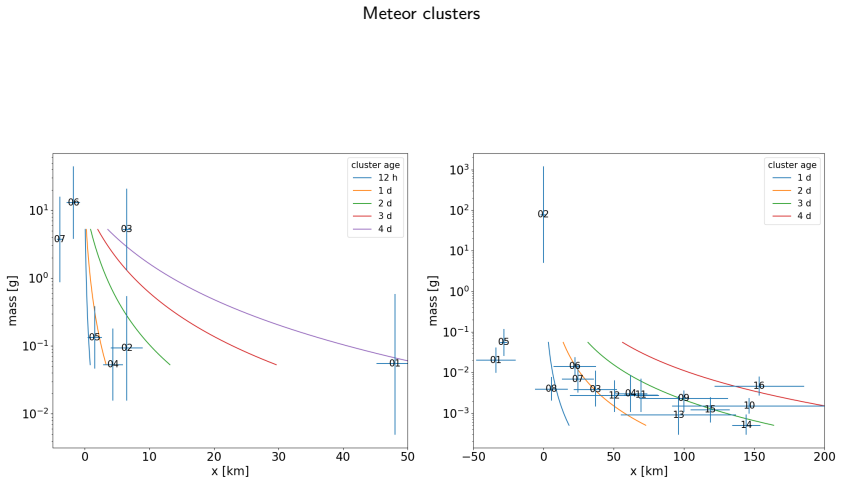
All meteor clusters observed to date formed in close proximity to Earth. Cluster volume increases with age, so older clusters created by fragmentation far from Earth disperse too widely to be recorded by local experiments, while global networks remain capable of detecting them.
What carries the argument
Meteor clusters as groups of meteors close in space and time, with fragment mass-sorting along the antisolar direction and presence of a dominant body used to estimate age and identify thermal-stress breakup.
If this is right
- Local meteor networks capture only the youngest clusters formed near Earth.
- Cluster volume grows with time, eventually exceeding the field of view of single-site detectors.
- Global meteor networks should be able to register older, more dispersed clusters that local instruments miss.
- Thermal stress is the probable cause when a dominant body and mass-ordered fragments are present.
Where Pith is reading between the lines
- Meteoroid breakup rates may be higher in the near-Earth environment than at greater distances.
- Long-term global monitoring could reveal whether distant fragmentation mechanisms differ from those seen locally.
- Cluster age estimates could be cross-checked against orbital models to test how quickly fragments separate.
Load-bearing premise
That the presence of a dominant mass body plus antisolar mass-sorting reliably marks recent thermal-stress breakup near Earth, while other mechanisms can be assessed or excluded from the same observations.
What would settle it
Detection of a meteor cluster whose fragments are dispersed without mass-sorting along the antisolar direction and whose calculated age exceeds a few days, or a clear cluster recorded by a global network but invisible to local stations.
Figures




read the original abstract
Meteor clusters are typically defined as groups of meteors that appear close together in both space and time. To date, only a handful of such events have been recorded instrumentally and analysed in detail. In many documented cases, thermal stress has been identified as the most likely cause of meteoroid fragmentation near Earth. This paper documents two further cases and provides a summary of all currently known clusters. The two clusters that were recorded over Hawaii Island in 2023 and 2024 represent two distinct scenarios. The 2024 meteor cluster was characterised by a dominant mass body and, with the fragments arranged along the antisolar direction according to their mass. Such cases enable us to reliably determine the age of the cluster and identify the most likely formation scenario. This cluster was around three days old, and the thermal stress was the most likely mechanism of its formation. The 2023 cluster was not such a case. It does not contain a mass dominant body, nor are its fragments arranged by their mass. Therefore, it was only possible to estimate its age to be no more than four days. Furthermore, other potential formation mechanisms besides thermal stress cannot be ruled out. This fact was observed in all analysed clusters. All clusters known up to date were formed in close proximity to Earth. The volume of a cluster increases with its age. This means that older clusters, formed by the fragmentation far away from Earth may remain undetected, as their fragments are also dispersed too widely to be observed by local experiment. However, global networks can detect such dispersed clusters.
Editorial analysis
A structured set of objections, weighed in public.
Referee Report
Summary. The manuscript reports two new instrumentally observed meteor clusters over Hawaii (2023 and 2024), analyzes their spatial and mass distributions, summarizes all previously documented clusters, and concludes that every known cluster formed in close proximity to Earth. The 2024 event, with a dominant mass body and fragments aligned antisolar and sorted by mass, is assigned an age of ~3 days and attributed to thermal stress; the 2023 event lacks these features, yielding only an upper age bound of 4 days with other mechanisms possible. The paper further states that cluster volume grows with age, implying a detection bias against older, more dispersed clusters formed at larger heliocentric distances.
Significance. If the age assignments and mechanism identifications are robust, the work adds two well-documented events to a very small sample of instrumentally recorded meteor clusters and highlights a plausible selection effect that could explain why distant fragmentations remain undetected by local networks. This has implications for meteoroid evolution models and the design of global detection systems. The observational contribution is clear, but the interpretive conclusions rest on steps that currently lack quantitative dynamical support.
major comments (3)
- [2024 meteor cluster] In the 2024 cluster analysis: the assertion that the observed antisolar, mass-sorted arrangement 'enables us to reliably determine the age' (~3 days) and identifies thermal stress is presented without any dynamical model, radiation-pressure or drag force equations, numerical integration method, or uncertainty budget to convert geometry into a fragmentation epoch. This step is load-bearing for the near-Earth formation claim.
- [Formation mechanisms] In the formation-mechanism discussion: alternative processes (outgassing, electrostatic disruption, or earlier breakup with differential acceleration) are acknowledged but not quantitatively modeled or excluded for either event, despite the 2023/2024 observations being used to argue that thermal stress is the most likely mechanism in the 2024 case.
- [Summary of known clusters] In the summary of all known clusters: the statements that 'all clusters known up to date were formed in close proximity to Earth' and that 'the volume of a cluster increases with its age' rest on the age estimates (≤4 days for 2023) without reported trajectory calculations, dispersion modeling, error bars, or orbital-convergence tests.
minor comments (2)
- [Abstract] The abstract omits any mention of the methods used for trajectory reconstruction, error estimation, or the precise criteria applied to distinguish thermal stress from other fragmentation processes.
- [Discussion] Cluster volume is invoked as increasing with age, but the definition and measurement of volume (or any related dispersion metric) are not explicitly stated or referenced to a table or equation.
Simulated Author's Rebuttal
We thank the referee for the constructive and detailed comments. These have identified key areas where additional quantitative support will strengthen the manuscript's interpretive claims. We address each major comment below and will incorporate revisions to provide the requested dynamical details, modeling, and uncertainty estimates.
read point-by-point responses
-
Referee: In the 2024 cluster analysis: the assertion that the observed antisolar, mass-sorted arrangement 'enables us to reliably determine the age' (~3 days) and identifies thermal stress is presented without any dynamical model, radiation-pressure or drag force equations, numerical integration method, or uncertainty budget to convert geometry into a fragmentation epoch. This step is load-bearing for the near-Earth formation claim.
Authors: We agree that the age determination requires explicit dynamical justification to be fully convincing. The estimate is based on the observed antisolar alignment and mass-dependent separations, which arise from differential solar radiation pressure (parameterized by the area-to-mass ratio β) acting on fragments released from a parent body. Using standard meteoroid densities and β values from the literature, the time since fragmentation is obtained by integrating the differential accelerations over the observed geometry. We will add a dedicated subsection with the governing equations for radiation pressure and Poynting-Robertson drag, an analytical estimate yielding ~3 days, and an uncertainty budget derived from positional and mass measurement errors. This will also clarify why the specific geometry favors thermal stress over other processes. revision: yes
-
Referee: In the formation-mechanism discussion: alternative processes (outgassing, electrostatic disruption, or earlier breakup with differential acceleration) are acknowledged but not quantitatively modeled or excluded for either event, despite the 2023/2024 observations being used to argue that thermal stress is the most likely mechanism in the 2024 case.
Authors: We acknowledge that order-of-magnitude comparisons would make the mechanism assignment more rigorous. The 2024 cluster's antisolar, mass-sorted linear arrangement with a dominant parent body is inconsistent with isotropic outgassing or random electrostatic breakup; earlier breakup at larger heliocentric distance would produce larger dispersions than observed. We will expand the discussion to include brief quantitative estimates of expected fragment distributions under each alternative mechanism and demonstrate why they fail to reproduce the 2024 geometry. For the 2023 event we already state that alternatives cannot be excluded and will retain that assessment. revision: partial
-
Referee: In the summary of all known clusters: the statements that 'all clusters known up to date were formed in close proximity to Earth' and that 'the volume of a cluster increases with its age' rest on the age estimates (≤4 days for 2023) without reported trajectory calculations, dispersion modeling, error bars, or orbital-convergence tests.
Authors: The proximity conclusion follows from the short ages inferred for every documented cluster: observed separations are consistent only with fragmentation times of a few days at typical meteoroid speeds. The volume-age relation is an empirical trend across the compiled sample. We agree that explicit modeling and uncertainties are needed. We will add a summary table listing for each cluster the age estimate, the dispersion-based method used, associated error bars, and a note that full orbital convergence is precluded by the limited astrometric precision but is unnecessary for the local-formation inference. This will also reinforce the detection-bias argument for older, more dispersed clusters. revision: yes
Circularity Check
No significant circularity; claims rest on direct observational comparison
full rationale
The paper's key assertions—that all documented clusters formed near Earth and that cluster volume grows with age—are presented as inferences from the spatial-mass ordering in the 2023/2024 Hawaii events compared against prior recorded clusters. No equations, fitted parameters, or self-citations are shown to define the age estimates (∼3 days, ≤4 days) or the formation mechanism in a self-referential loop. The derivation chain uses independent observational inputs (fragment positions, masses, antisolar alignment) without reducing any prediction back to those inputs by construction or via load-bearing self-citation. This is the normal case of an observation-driven study whose central content remains external to its own definitions.
Axiom & Free-Parameter Ledger
axioms (2)
- domain assumption Fragment arrangement by mass along the antisolar direction and presence of a dominant body indicate thermal stress as the fragmentation mechanism and allow reliable age estimation.
- domain assumption Cluster volume increases with age due to differential velocities of fragments.
Reference graph
Works this paper leans on
-
[1]
Astronomy & Astrophysics 696, A69
Towards a definition of a meteor cluster: Detection of meteor clusters from meteor orbit databases. Astronomy & Astrophysics 696, A69. doi: 10.1051/0004-6361/202452445. Beech, M., Comte, M.,
-
[2]
American Journal of Astronomy and Astrophysics 6,
The Chant Meteor Procession of 1913 – Towards a Descriptive Model. American Journal of Astronomy and Astrophysics 6,
1913
-
[3]
Borovička, J., Spurný, P., Shrbený, L., 2022a
doi: 10.11648/j.ajaa.20180602.11. Borovička, J., Spurný, P., Shrbený, L., 2022a. Data on 824 fireballs observed by the digital cameras of the European Fireball Network in 2017-2018. II. Analysis of orbital and physical properties of centimeter-sized meteoroids. Astronomy & Astrophysics 667, A158. doi:10.1051/0004-6361/ 202244197. Borovička, J., Spurný, P.,...
-
[4]
Astronomy & Astrophysics 666, A144
Ejection velocities, age, and formation process of SPE meteoroid cluster. Astronomy & Astrophysics 666, A144. doi: 10.1051/0004-6361/202243055. Čapek, D., Petřík, M., Pachman, J., Watson, E., Haloda, J., Macke, R., Henych, T., Koten, P., Schimmerohn, M., Stravová, Z., Zikmund, T., Kaiser, J.,
-
[5]
3D shape models for describing monolithic asteroids and meteoroids. Astronomy & Astrophysics 696, A40. doi: 10.1051/0004-6361/ 202452886. Ceplecha, Z.,
-
[6]
Fragmentation of a meteor in near-earth space. Nature 290, 384–386. doi: 10.1038/290384a0. Henych, T., Borovička, J., Vojáček, V ., Spurný, P.,
-
[7]
Astronomy & Astrophysics 683, A229
Mechanical strength distribution in Geminid meteoroids derived via fireball modeling. Astronomy & Astrophysics 683, A229. doi: 10.1051/0004-6361/202348797. Jenniskens, P., Nénon, Q., Gural, P.S., Albers, J., Haberman, B., Johnson, B., Morales, R., Grigsby, B.J., Samuels, D., Johannink, C.,
-
[8]
CAMS newly detected meteor showers and the sporadic background. Icarus 266, 384–409. doi: 10.1016/j.icarus.2015.11.009. Kinoshita, M., Maruyama, T., Sagayama, T.,
-
[9]
Geophysical Research Letters 26, 41–44. doi: 10.1029/1998GL900241. Koten, P., Shrbený, L., Spurný, P., Borovička, J., Štork, R., Henych, T., Vojáček, V ., Mánek, J.,
-
[10]
Astronomy & Astrophysics 675, A70
𝜏 Herculid meteor shower in the night of 30/31 May 2022 and the meteoroid properties. Astronomy & Astrophysics 675, A70. doi: 10.1051/0004-6361/202346537. Koten, P., Čapek, D., Gährken, B., Vaubaillon, J., 2025a. A single-station 2002 Leonid meteor cluster. WGN, Journal of the International Meteor Organization (submitted) . Koten, P., Čapek, D., Merizio, ...
-
[11]
doi: 10.1051/0004-6361/202348618
Astronomy & Astrophysics 683, A5. doi: 10.1051/0004-6361/202348618. Koten, P., Čapek, D., Spurný, P., Vaubaillon, J., Popek, M., Shrbený, L.,
-
[12]
Astronomy & Astrophysics 600, A74
September epsilon Perseid cluster as a result of orbital fragmentation. Astronomy & Astrophysics 600, A74. doi: 10.1051/0004-6361/201630246. Koten, P., Čapek, D., Spurný, P., Štork, R., Vojáček, V ., Bednář, J.,
-
[13]
Astronomy & Astrophysics 656, A98
Search for pairs and groups in the 2006 Geminid meteor shower. Astronomy & Astrophysics 656, A98. doi: 10.1051/0004-6361/202141809. Koten, P., Čapek, D., Tóth, J., Shrbený, L., Borovička, J., Vaubaillon, J., Zander, F., Buttsworth, D., Loehle, S., 2025b. A very young 𝜏-Herculid meteor cluster observed during a 2022 shower outburst. Astronomy & Astrophysic...
-
[14]
Monthly Notices of the Royal Astronomical Society 513, 3982–3992
Hydrogen emission from meteors and meteorites: mapping traces of H 2O molecules and organic compounds in small Solar system bodies. Monthly Notices of the Royal Astronomical Society 513, 3982–3992. doi: 10.1093/mnras/stac927. P. Koten et al.: Preprint submitted to Elsevier Page 9 of 10 Meteor clusters Piers, P.A., Hawkes, R.L.,
-
[15]
Seasonal Changes in Sporadic Meteor Rates. Icarus 135, 496–500. doi: 10.1006/icar.1998.5965. Tanaka, I., Hasegawa, H., Uda, T., Sato, M., Watanabe, J.i., Higashiyama, M.,
-
[16]
Publications of the Astronomical Society of Japan doi: 10.1093/pasj/psaf126
Detection of the 2021 Arid meteor shower on Maunakea, Hawai’i. Publications of the Astronomical Society of Japan doi: 10.1093/pasj/psaf126. Tóth, J., Kornoš, L., Ďuriš, F., Matlovič, P., , Zigo, P., Kalmančok, D., Paulech, T., Šimon, J., Baláž, M., Vörös, T., Paprskárová, M., Pazderová, V ., Solčáni, J., Schichman, M., Varga, P.,
-
[17]
Astronomy & Astrophysics 670, A86
A 2022 𝜏-Herculid meteor cluster from an airborne experiment: automated detection, characterization, and consequences for meteoroids. Astronomy & Astrophysics 670, A86. doi: 10.1051/0004-6361/202244993. Vida, D., Campbell-Brown, M., Brown, P.G., Egal, A., Mazur, M.J.,
-
[18]
Astronomy & Astrophysics 635, A153
A new method for measuring the meteor mass index: application to the 2018 Draconid meteor shower outburst. Astronomy & Astrophysics 635, A153. doi: 10.1051/0004-6361/201937296. Watanabe, J.i., Hasegawa, H., Tanaka, I., Sato, M.,
-
[19]
On the meteor clusters detected over Hawai’i in 2023 and
2023
-
[20]
Watanabe, J.I., Sekiguchi, T., Shikura, M., Naito, S., Abe, S.,
Publications of the Astronomical Society of Japan doi: 10.1093/pasj/psaf101. Watanabe, J.I., Sekiguchi, T., Shikura, M., Naito, S., Abe, S.,
-
[21]
Publications of the Astronomical Society of Japan 54, L23–L26
Wide-Field TV Observation of the Leonid Meteor Storm in 2001: Main Peak over Japan. Publications of the Astronomical Society of Japan 54, L23–L26. doi: 10.1093/pasj/54.2.L23. Watanabe, J.I., Tabe, I., Hasegawa, H., Hashimoto, T., Fuse, T., Yoshikawa, M., Abe, S., Suzuki, B.,
-
[22]
Publications of the Astronomical Society of Japan 55, L23–L26
Meteoroide Clusters in Leonids: Evidence of Fragmentation in Space. Publications of the Astronomical Society of Japan 55, L23–L26. doi: 10.1093/pasj/55.3.L23. P. Koten et al.: Preprint submitted to Elsevier Page 10 of 10 Meteor clusters Figure 1: A composite image of seven meteors of the 2023 cluster (left panel) was created by the stacking of the video f...
discussion (0)
Sign in with ORCID, Apple, or X to comment. Anyone can read and Pith papers without signing in.