Recognition: no theorem link
First Lunar Farside SETI Observations for Periodic Signals with the Low-frequency Radio Spectrometer of Chang'E-4 Mission
Pith reviewed 2026-05-11 01:41 UTC · model grok-4.3
The pith
First lunar farside radio observations find no credible periodic artificial signals after systematic cleaning.
A machine-rendered reading of the paper's core claim, the machinery that carries it, and where it could break.
Core claim
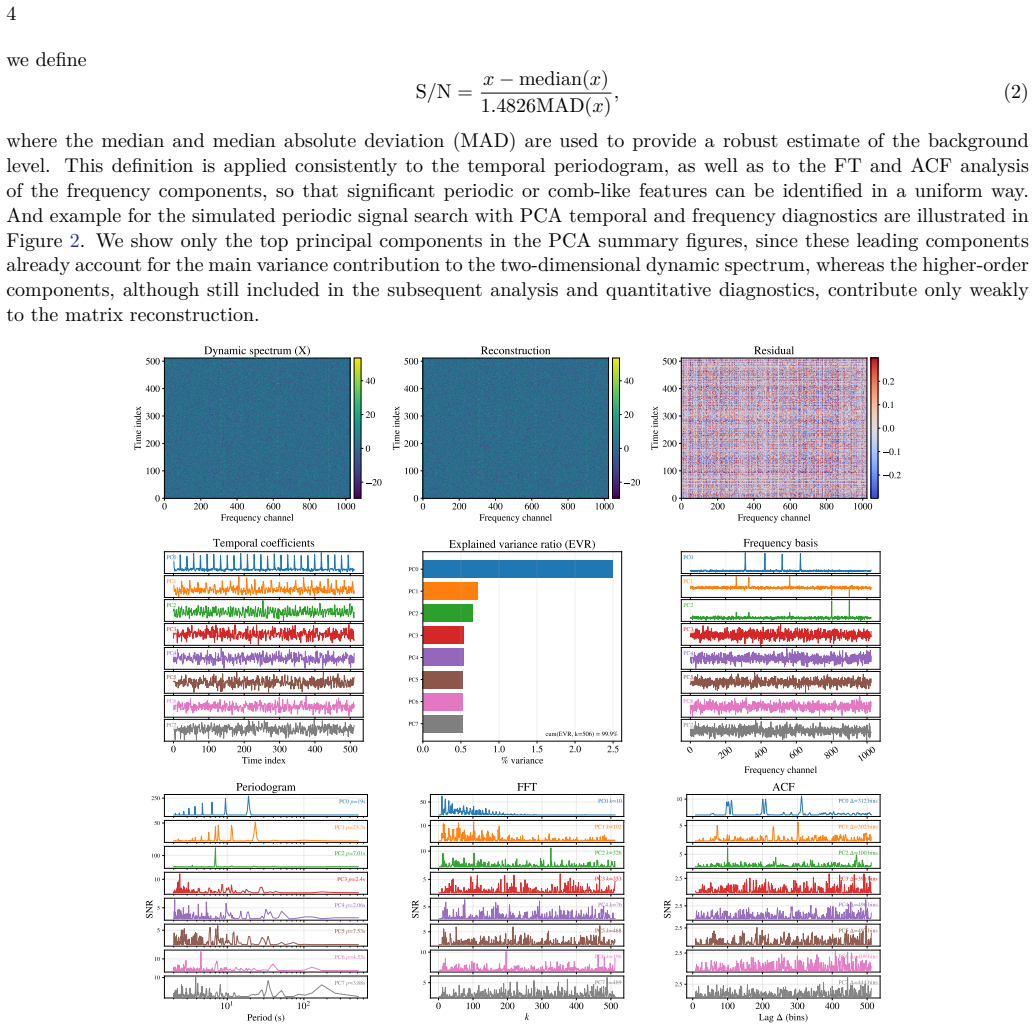
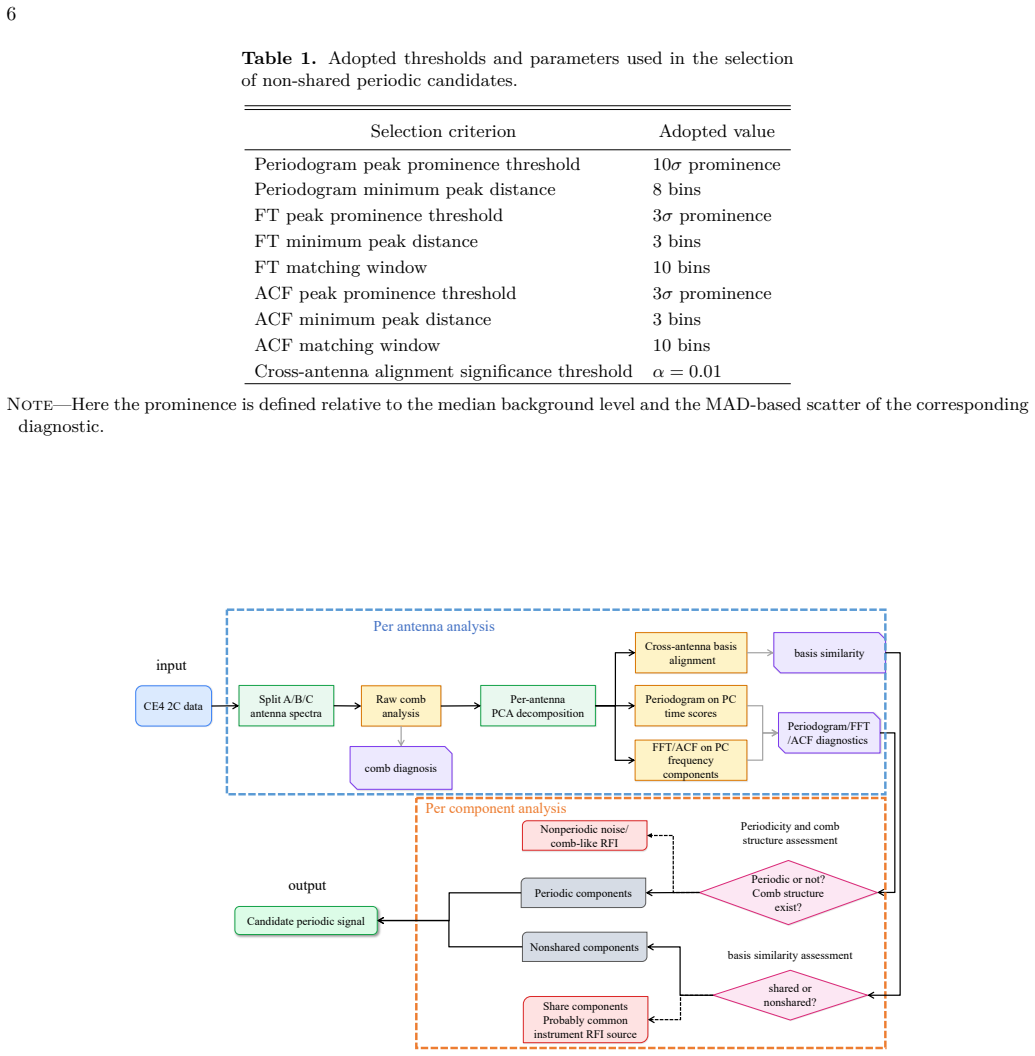
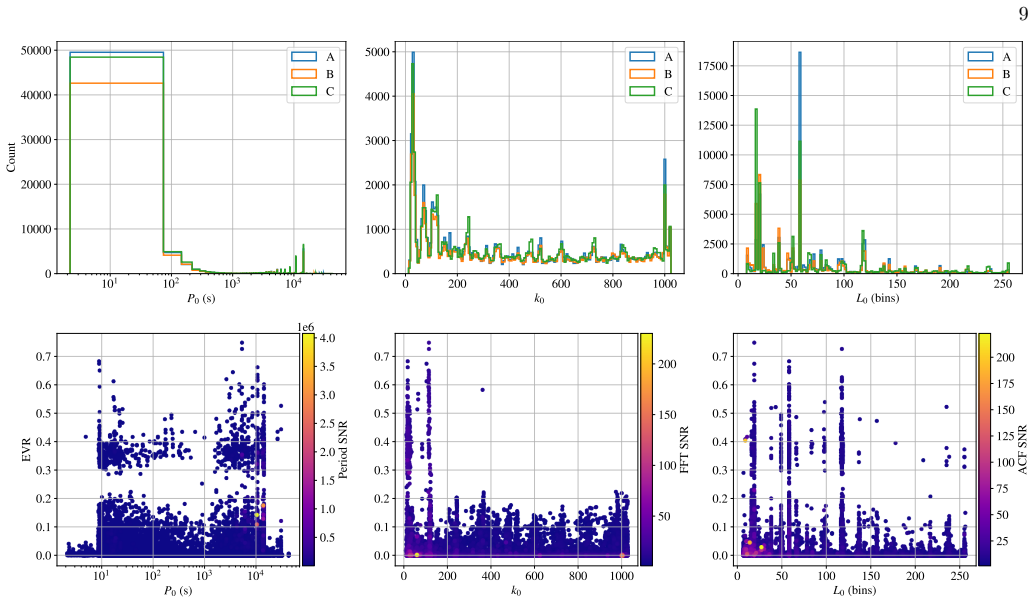
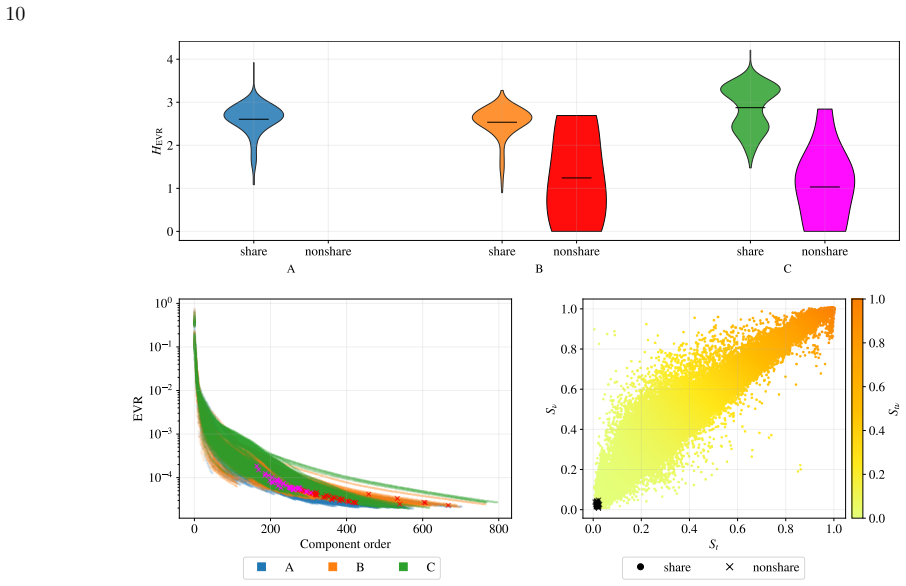
We analyze the CE4 dynamic spectra with a component-level framework that combines principal component analysis (PCA), cross-antenna basis alignment, as well as temporal periodicity and frequency comb structure diagnostics. No final periodic candidate signal is found after the selection procedure, and we therefore find no evidence in the present CE4 sample for a credible periodic artificial signal. This study serves as a pathfinder and provides a practical framework for lunar radio SETI analysis.
What carries the argument
Component-level framework combining principal component analysis (PCA), cross-antenna basis alignment, temporal periodicity checks, and frequency-comb diagnostics to isolate candidate repeating signals.
If this is right
- The lunar farside provides a radio-quiet site that can support expanded searches for technosignatures once additional missions add radio receivers.
- The described cleaning and diagnostic steps can be applied directly to new dynamic spectra from future lunar landers or orbiters.
- Absence of detections in the current sample sets an upper limit on the prevalence or strength of periodic low-frequency emissions from nearby sources.
- Repeated observations over longer baselines would increase the chance of catching intermittent or weak periodic signals.
Where Pith is reading between the lines
- Similar component-analysis methods could be tested on archival Earth-based low-frequency data to quantify how much terrestrial interference they remove compared with the lunar-farside case.
- The framework's emphasis on frequency-comb structure might be extended to search for other non-periodic artificial patterns such as narrowband drifting signals.
- Coordinated observations between lunar assets and ground-based arrays could cross-validate any future candidate by checking whether it appears only from the farside vantage.
Load-bearing premise
Any genuine periodic artificial signal in the raw data would remain detectable after PCA cleaning, antenna alignment, and periodicity diagnostics and would not be discarded as terrestrial interference or noise.
What would settle it
A controlled injection of a known periodic artificial waveform into the CE4 spectra that is recovered by the full pipeline but then rejected by the final selection criteria, or an independent higher-sensitivity observation that detects a periodic signal the current analysis missed.
Figures


read the original abstract
Chang'E-4 (CE4), the first mission to soft-land on the lunar farside, provides a unique opportunity for astronomical observations from an environment shielded from terrestrial radio interference, and thus serves as pathfinder for lunar farside radio search for extraterrestrial intelligence (SETI) studies. We present a search for periodic technosignatures using low-frequency radio observations from the CE-4 mission, the first radio SETI study based on data from on the observation in lunar farside. We analyze the CE4 dynamic spectra with a component-level framework that combines principal component analysis (PCA), cross-antenna basis alignment, as well as temporal periodicity and frequency comb structure diagnostics. No final periodic candidate signal is found after the selection procedure, and we therefore find no evidence in the present CE4 sample for a credible periodic artificial signal. This study serves as a pathfinder and provides a practical framework for lunar radio SETI analysis. As more future lunar missions begin to incorporate radio instrumentation, lunar farside may become a promising site for expanding radio SETI research.
Editorial analysis
A structured set of objections, weighed in public.
Referee Report
Summary. The paper reports the first lunar farside radio SETI search for periodic technosignatures using low-frequency dynamic spectra from the Chang'E-4 Low-frequency Radio Spectrometer. It applies a multi-stage pipeline consisting of principal component analysis for component removal, cross-antenna basis alignment, and diagnostics for temporal periodicity and frequency-comb structure. After the full selection procedure, no credible periodic artificial signals are identified, yielding a null result and the conclusion of no evidence for such signals in the present CE4 sample. The work is positioned as a pathfinder providing a practical analysis framework for future lunar radio SETI.
Significance. If the null result is robust, the study is significant as the first radio SETI observation conducted from the lunar farside, exploiting its radio-quiet environment shielded from terrestrial interference. It establishes a concrete analysis framework (PCA cleaning plus periodicity and comb diagnostics) that can be applied to data from upcoming lunar missions, thereby opening a new observational domain for periodic technosignature searches.
major comments (2)
- [Analysis pipeline and selection procedure] The central claim of 'no evidence for a credible periodic artificial signal' after the selection procedure depends on the pipeline preserving genuine periodic technosignatures. No synthetic signal injection-recovery tests are reported to quantify recovery fractions, false-negative rates, or completeness as a function of period, SNR, frequency, or signal morphology. Without these, it is impossible to determine whether the null result reflects absence of signals or over-cleaning by the PCA, alignment, and diagnostic steps.
- [Temporal periodicity and frequency comb diagnostics] The periodicity and frequency-comb detection thresholds are treated as free parameters in the pipeline. No justification, sensitivity analysis, or optimization procedure is provided for their specific values, nor is it shown how variations in these thresholds affect the final candidate list or the null conclusion.
minor comments (2)
- [Abstract] The abstract and methods description would benefit from explicit statements of the observed frequency band, total integration time, and number of dynamic spectra analyzed to allow readers to assess the search volume.
- [Selection procedure] Clarify the precise quantitative criteria (e.g., SNR thresholds, periodicity significance levels) used in the 'final selection procedure' so that the pipeline is fully reproducible.
Simulated Author's Rebuttal
We thank the referee for their constructive comments and for recognizing the significance of this work as the first lunar farside radio SETI search. We address each major comment point by point below. Revisions have been made to the manuscript to incorporate additional validation where feasible.
read point-by-point responses
-
Referee: [Analysis pipeline and selection procedure] The central claim of 'no evidence for a credible periodic artificial signal' after the selection procedure depends on the pipeline preserving genuine periodic technosignatures. No synthetic signal injection-recovery tests are reported to quantify recovery fractions, false-negative rates, or completeness as a function of period, SNR, frequency, or signal morphology. Without these, it is impossible to determine whether the null result reflects absence of signals or over-cleaning by the PCA, alignment, and diagnostic steps.
Authors: We agree that the absence of injection-recovery tests limits the ability to fully quantify the pipeline's completeness and false-negative rate. The original manuscript presented this as an initial pathfinder analysis focused on real data processing. In the revised manuscript we have added a dedicated subsection describing synthetic signal injection tests. Periodic signals with a range of periods, SNRs, and morphologies were injected into representative dynamic spectra; the full pipeline was then applied and recovery statistics reported. These tests indicate high recovery for signals above moderate SNR levels, supporting that the null result is not solely due to over-cleaning, while also noting reduced sensitivity for very weak or short-duration signals. revision: yes
-
Referee: [Temporal periodicity and frequency comb diagnostics] The periodicity and frequency-comb detection thresholds are treated as free parameters in the pipeline. No justification, sensitivity analysis, or optimization procedure is provided for their specific values, nor is it shown how variations in these thresholds affect the final candidate list or the null conclusion.
Authors: The thresholds were selected empirically to suppress obvious noise features while retaining potential candidates, but we acknowledge the lack of explicit justification or sensitivity testing in the original text. The revised manuscript now includes a sensitivity analysis subsection that varies each threshold over a plausible range and shows the resulting change in candidate numbers. The null conclusion remains stable across these variations; we also document the rationale for the adopted values based on the observed distributions of the diagnostic statistics in the cleaned data. revision: yes
Circularity Check
Observational null result with no self-referential reductions
full rationale
The paper applies a multi-stage data pipeline (PCA component removal, cross-antenna alignment, temporal/frequency-comb diagnostics, and selection criteria) to CE-4 lunar farside spectra and reports that no signals survive to become candidates. This null outcome is an empirical result of processing the input observations; none of the steps or the final claim reduces by construction to a fitted parameter, self-definition, or load-bearing self-citation. No equations equate a derived quantity to its own inputs, and the analysis remains independent of the target conclusion.
Axiom & Free-Parameter Ledger
free parameters (1)
- Periodicity and frequency-comb detection thresholds
Reference graph
Works this paper leans on
-
[1]
Chen, X., Yan, J., Deng, L., et al. 2021, Philosophical Transactions of the Royal Society of London Series A, 379, 20190566, doi: 10.1098/rsta.2019.0566
-
[2]
, year = 1959, month = sep, volume =
Cocconi, G., & Morrison, P. 1959, Nature, 184, 844, doi: 10.1038/184844a0 12
-
[3]
DeBoer, D. R., Warnick, K. F., Tremblay, C. D., et al. 2025, in 2025 United States National Committee of URSI National Radio Science Meeting (USNC-URSI NRSM), 46, doi: 10.23919/USNC-URSINRSM66067.2025.10907042
work page doi:10.23919/usnc-ursinrsm66067.2025.10907042 2025
-
[4]
The Astrophysical Journal , author =
Enriquez, J. E., Siemion, A., Foster, G., et al. 2017, ApJ, 849, 104, doi: 10.3847/1538-4357/aa8d1b
-
[5]
Gopalswamy, N., & Boardsen, S. 2025, Clps TO2-IM Rolses Bundle„ NASA Planetary Data System, urn:nasa:pds:clps_to2_im_rolses::0.1 doi: 10.17189/A755-HM31
-
[6]
Harp, G. R., Ackermann, R. F., Astorga, A., et al. 2018, ApJ, 869, 66, doi: 10.3847/1538-4357/aaeb98
-
[7]
Harris, C. R., Millman, K. J., van der Walt, S. J., et al. 2020, Nature, 585, 357, doi: 10.1038/s41586-020-2649-2
-
[8]
Hunter, J. D. 2007, Computing in Science and Engineering, 9, 90, doi: 10.1109/MCSE.2007.55
-
[9]
2026, AJ, 171, 78, doi: 10.3847/1538-3881/ae28cc
Li, J.-K., Tao, Z.-Z., Wang, P., & Zhang, T.-J. 2026, AJ, 171, 78, doi: 10.3847/1538-3881/ae28cc
-
[10]
2023, Radio Science, 58, e2022RS007595, doi: 10.1029/2022RS007595
Liu, C.-d., Su, Y., & Zhou, J.-f. 2023, Radio Science, 58, e2022RS007595, doi: 10.1029/2022RS007595
-
[11]
The Astronomical Journal , author =
Margot, J.-L., Pinchuk, P., Geil, R., et al. 2021, AJ, 161, 55, doi: 10.3847/1538-3881/abcc77
-
[12]
McKinney, W. 2010, SciPy 2010, doi: 10.25080/Majora-92bf1922-00a
-
[13]
Michaud, E. J., Siemion, A. P. V., Drew, J., & Worden, S. P. 2020, arXiv e-prints, arXiv:2009.12689, doi: 10.48550/arXiv.2009.12689
-
[14]
Mimoun, D., Wieczorek, M. A., Alkalai, L., et al. 2012, Experimental Astronomy, 33, 529, doi: 10.1007/s10686-011-9252-3 pandas development team, T. 2022, pandas-dev/pandas: Pandas, v1.5.2 Zenodo, doi: 10.5281/zenodo.7344967
-
[15]
Scikit-learn: Machine Learning in Python
Pedregosa, F., Varoquaux, G., Gramfort, A., et al. 2011, Journal of Machine Learning Research, 12, 2825, doi: 10.48550/arXiv.1201.0490
-
[16]
The Astronomical Journal , author =
Price, D. C., Enriquez, J. E., Brzycki, B., et al. 2020, AJ, 159, 86, doi: 10.3847/1538-3881/ab65f1
-
[17]
Sheikh, S. Z., Siemion, A., Enriquez, J. E., et al. 2020, AJ, 160, 29, doi: 10.3847/1538-3881/ab9361
-
[18]
Siemion, A. P. V., Demorest, P., Korpela, E., et al. 2013, ApJ, 767, 94, doi: 10.1088/0004-637X/767/1/94
-
[19]
Suresh, A., Gajjar, V., Nagarajan, P., et al. 2023, AJ, 165, 255, doi: 10.3847/1538-3881/acccf0
-
[20]
2022, AJ, 164, 160, doi: 10.3847/1538-3881/ac8bd5
Tao, Z.-Z., Zhao, H.-C., Zhang, T.-J., et al. 2022, AJ, 164, 160, doi: 10.3847/1538-3881/ac8bd5
-
[21]
Tarter, J. 2001, ARA&A, 39, 511, doi: 10.1146/annurev.astro.39.1.511
-
[22]
2021, AJ, 161, 286, doi: 10.3847/1538-3881/abf649
Traas, R., Croft, S., Gajjar, V., et al. 2021, AJ, 161, 286, doi: 10.3847/1538-3881/abf649
-
[23]
Virtanen, P., Gommers, R., Oliphant, T. E., et al. 2020, Nature Methods, 17, 261, doi: 10.1038/s41592-019-0686-2
-
[24]
2019, Nature Geoscience, 12, 222, doi: 10.1038/s41561-019-0341-7
Wu, W., Li, C., Zuo, W., et al. 2019, Nature Geoscience, 12, 222, doi: 10.1038/s41561-019-0341-7
-
[25]
2023, Space Policy, 65, 101537, doi: https://doi.org/10.1016/j.spacepol.2022.101537
Wu, X. 2023, Space Policy, 65, 101537, doi: https://doi.org/10.1016/j.spacepol.2022.101537
-
[26]
2021, Research in Astronomy and Astrophysics, 21, 116, doi: 10.1088/1674-4527/21/5/116
Zhu, X.-Y., Su, Y., Ji, Y.-C., et al. 2021, Research in Astronomy and Astrophysics, 21, 116, doi: 10.1088/1674-4527/21/5/116
discussion (0)
Sign in with ORCID, Apple, or X to comment. Anyone can read and Pith papers without signing in.