Recognition: 2 theorem links
· Lean TheoremScalable continuous gravitational wave detection in PTA data with non-parametric red noise suppression and optimal pulsar selection
Pith reviewed 2026-05-10 18:02 UTC · model grok-4.3
The pith
A frequentist method with adaptive spline noise suppression and optimal pulsar selection detects continuous gravitational waves in PTA data at accuracy matching Bayesian methods but in hours instead of days.
A machine-rendered reading of the paper's core claim, the machinery that carries it, and where it could break.
Core claim
The paper establishes that for a continuous gravitational wave signal with signal-to-noise ratio approximately 10 in simulated NANOGrav 15-year data, the frequentist method using adaptive spline red noise suppression and optimal pulsar selection achieves relative errors of 1.0% in characteristic strain and 0.072% in frequency, compared to 1.7% and 0.16% for Bayesian analysis, while completing in less than 5 hours versus 1-2 days.
What carries the argument
Adaptive spline fitting algorithm that non-parametrically suppresses red noise without per-pulsar parametric models, combined with an optimization scheme that selects the best pulsar subsets for the search.
Load-bearing premise
The adaptive spline fitting fully removes red noise without biasing or attenuating the gravitational wave signal, and the simulated dataset accurately represents the noise properties and correlations present in real pulsar timing observations.
What would settle it
Running the method on the actual NANOGrav 15-year dataset or similar real PTA data and finding that recovered parameters for injected signals exceed the reported 1.0% strain or 0.072% frequency errors, or that signals recovered by Bayesian methods are missed, would falsify the performance equivalence claim.
Figures




read the original abstract
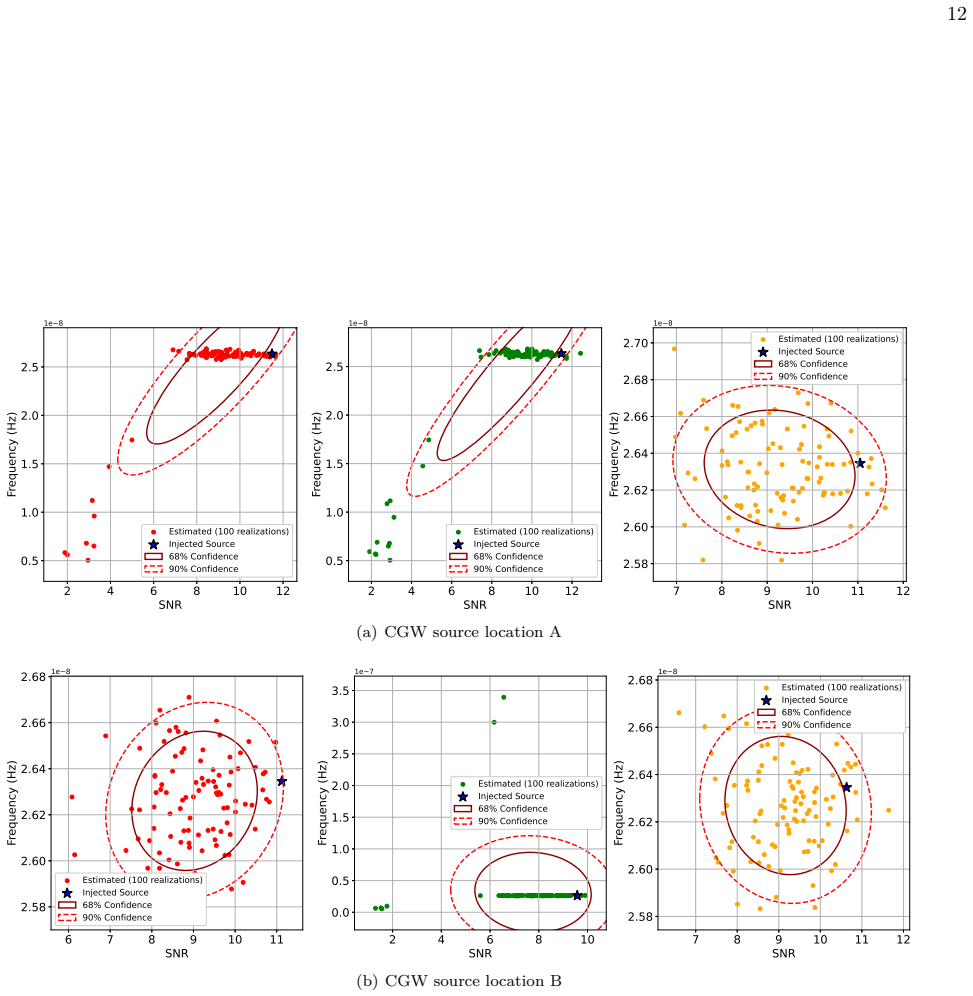
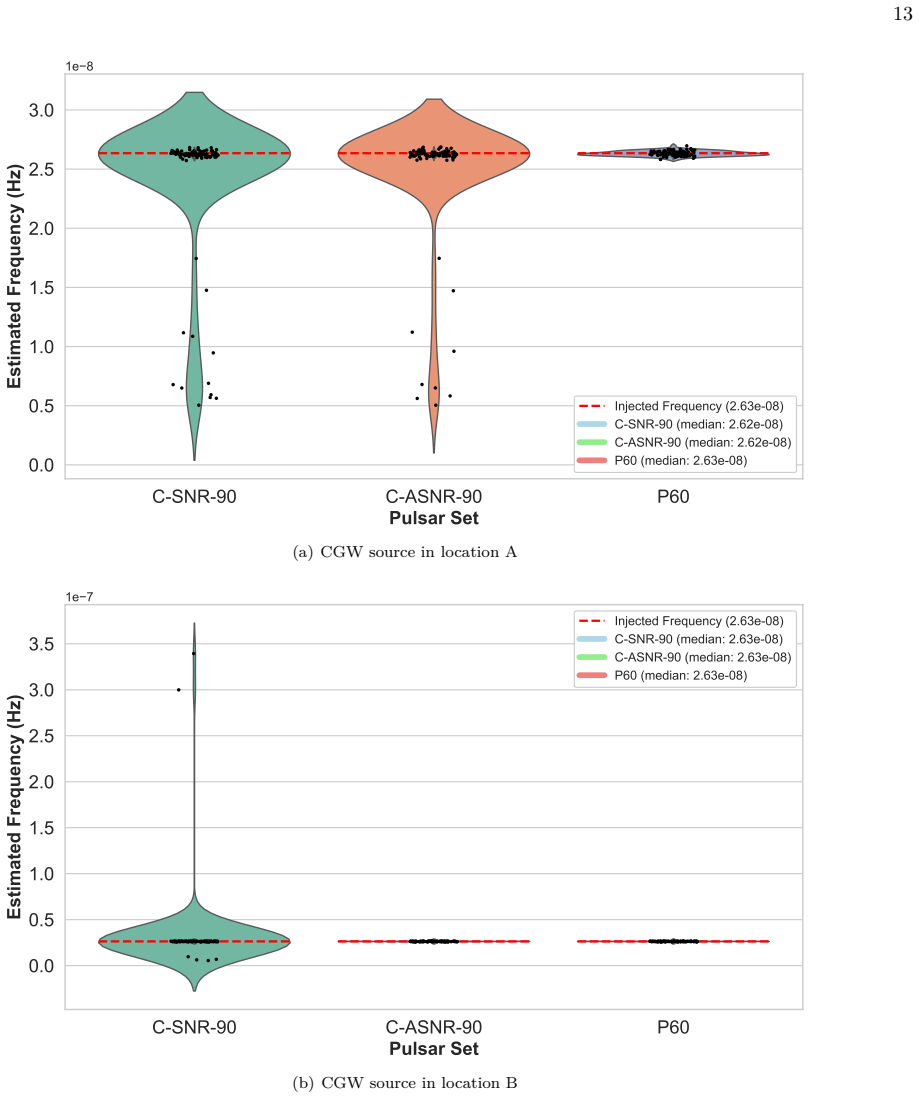
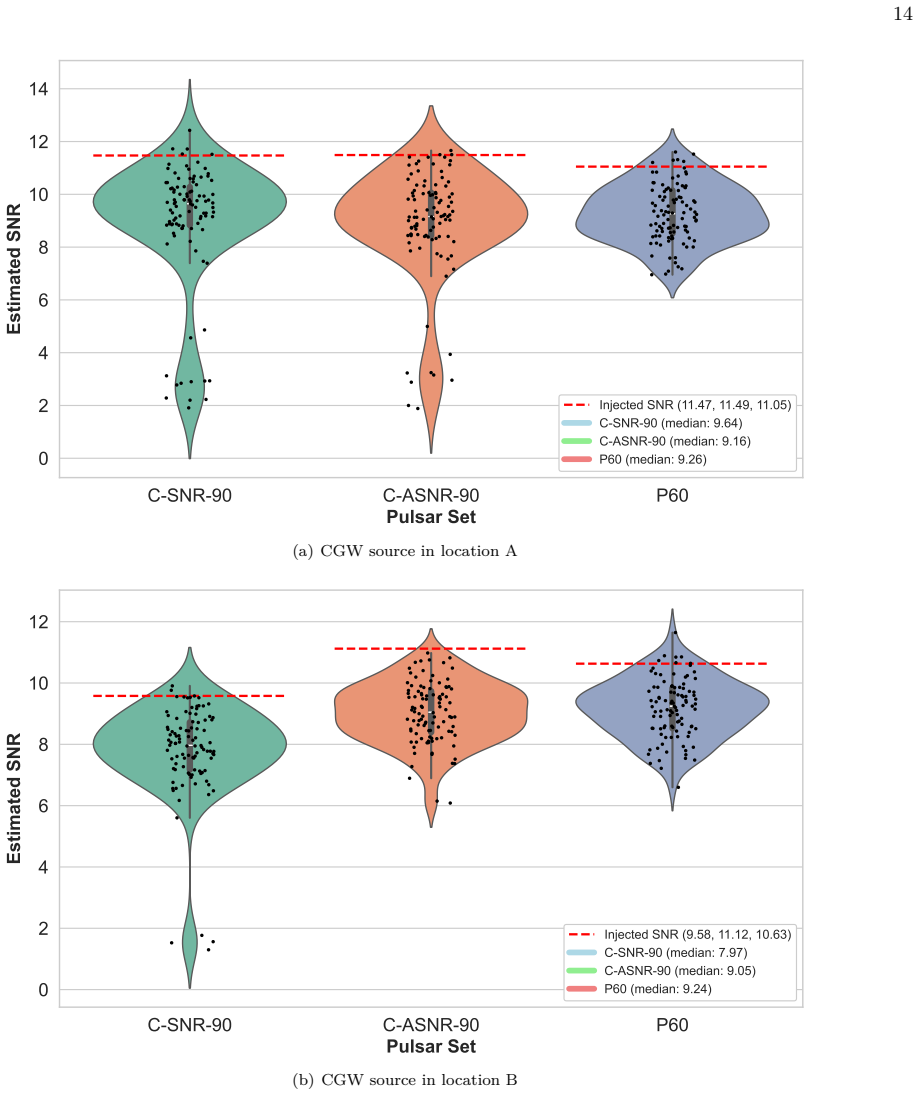
Bayesian methods for the detection of continuous gravitational waves (CGWs) in Pulsar Timing Array (PTA) data incur substantial computational costs that grow rapidly due to the number of noise and signal parameters characterizing the fitted model being proportional to the size of the PTA. This computational burden limits the scalability of these methods for large-scale PTAs comprising hundreds of pulsars anticipated from next-generation radio astronomy facilities. In this work, we introduce a computationally efficient frequentist method designed to circumvent this challenge. This is achieved by combining an adaptive spline fitting algorithm that non-parametrically suppresses red noise, thereby eliminating the need for complex noise modeling inherent to Bayesian methods, with a novel scheme for optimizing the subsets of pulsars included in the search. We quantify the performance of our method on a simulated dataset based on the NANOGrav 15-year data release and find that it achieves a performance comparable to that of Bayesian analysis: for a CGW signal with a signal-to-noise ratio of $\approx 10$, our method yields a relative characteristic strain error of 1.0\% and a frequency error of 0.072\% from the injected values by using the optimal pulsar selections, while the same errors are 1.7\% and 0.16\%, respectively, for the standard Bayesian analysis. At the same time, our analysis completes in less than 5 hours, in contrast to the 1-2 days required by Bayesian methods. This allows us to perform a rigorous study of our method using multiple data realizations and signal parameters, establishing it as an efficient and scalable tool for CGW searches with large-scale PTAs.
Editorial analysis
A structured set of objections, weighed in public.
Referee Report
Summary. The paper introduces a frequentist method for continuous gravitational wave (CGW) detection in pulsar timing array (PTA) data that combines adaptive spline fitting for non-parametric red noise suppression with an optimization scheme for selecting pulsar subsets. On a simulated dataset based on the NANOGrav 15-year release, it reports that for an injected CGW with SNR ≈10 the method recovers characteristic strain to 1.0% relative error and frequency to 0.072% relative error using optimal pulsar selections, outperforming a standard Bayesian pipeline (1.7% and 0.16% errors) while running in <5 hours versus 1-2 days. The approach is positioned as scalable for future large PTAs.
Significance. If the central no-bias claim holds, the method would provide a computationally scalable alternative to Bayesian CGW searches, enabling analyses of PTAs with hundreds of pulsars expected from next-generation facilities. The use of multiple data realizations and direct comparison against an independent Bayesian pipeline on injected signals are positive features that strengthen the performance assessment.
major comments (2)
- [adaptive spline fitting algorithm] Adaptive spline fitting section: the claim that the non-parametric red-noise suppression leaves the deterministic CGW Earth-term sinusoid and pulsar terms untouched requires explicit validation. Because splines are flexible enough to approximate low-frequency monochromatic signals, a test (e.g., power-spectrum comparison of residuals from signal-only versus noise-only injections, or recovery statistics when the spline is applied to pure-signal data) is needed to rule out partial absorption that would systematically bias the reported 1.0% strain and 0.072% frequency errors.
- [results on simulated NANOGrav data] Performance evaluation (results section): while multiple realizations are mentioned, the manuscript should report the full distribution (mean, standard deviation, or quantiles) of recovered parameters across realizations rather than single-point errors. This is required to substantiate that the quoted improvements over Bayesian analysis are robust rather than realization-dependent.
minor comments (2)
- [pulsar selection scheme] The description of the pulsar-selection optimization algorithm would benefit from a concise pseudocode or flowchart to clarify the search procedure and any hyperparameters.
- Notation for the spline knot placement and adaptation criterion is introduced without a dedicated table or appendix; a compact summary would improve readability for readers outside the immediate PTA community.
Simulated Author's Rebuttal
We thank the referee for their constructive and detailed review. The comments highlight important points regarding validation of our method and the presentation of results. We address each major comment below and will revise the manuscript accordingly to strengthen the paper.
read point-by-point responses
-
Referee: [adaptive spline fitting algorithm] Adaptive spline fitting section: the claim that the non-parametric red-noise suppression leaves the deterministic CGW Earth-term sinusoid and pulsar terms untouched requires explicit validation. Because splines are flexible enough to approximate low-frequency monochromatic signals, a test (e.g., power-spectrum comparison of residuals from signal-only versus noise-only injections, or recovery statistics when the spline is applied to pure-signal data) is needed to rule out partial absorption that would systematically bias the reported 1.0% strain and 0.072% frequency errors.
Authors: We agree that explicit validation is required to confirm that the adaptive spline fitting does not absorb components of the deterministic CGW signal. While the algorithm is intended to model only the stochastic red noise, we acknowledge that this needs direct demonstration to support the accuracy claims. In the revised manuscript, we will add a new subsection (or appendix) that applies the spline fitting to pure CGW signal injections (no red noise) and reports the recovered parameters, along with power-spectrum comparisons of the residuals before and after fitting to show preservation of the monochromatic signature. revision: yes
-
Referee: [results on simulated NANOGrav data] Performance evaluation (results section): while multiple realizations are mentioned, the manuscript should report the full distribution (mean, standard deviation, or quantiles) of recovered parameters across realizations rather than single-point errors. This is required to substantiate that the quoted improvements over Bayesian analysis are robust rather than realization-dependent.
Authors: We thank the referee for this observation. The manuscript references the use of multiple realizations to enable a rigorous study, but we agree that reporting only representative single-point errors is insufficient to demonstrate robustness. In the revised version, we will expand the results section to include the mean, standard deviation, and selected quantiles (e.g., 16th/84th percentiles) of the recovered characteristic strain and frequency errors across all realizations. These will be presented in tables or supplementary figures, allowing direct comparison of variability between our method and the Bayesian pipeline. revision: yes
Circularity Check
No significant circularity detected
full rationale
The paper introduces a frequentist method using adaptive spline fitting for non-parametric red noise suppression combined with optimal pulsar selection. Performance claims rest on recovery of known injected CGW signals in NANOGrav-based simulations, with direct numerical comparison to an independent standard Bayesian pipeline. No equations or steps in the abstract or described method reduce by construction to fitted inputs, self-definitions, or load-bearing self-citations; the reported errors (1.0% strain, 0.072% frequency) are empirical recovery metrics on external injections rather than tautological outputs. The derivation chain is self-contained against the simulation benchmark.
Axiom & Free-Parameter Ledger
axioms (2)
- domain assumption Adaptive spline fitting can suppress red noise in PTA residuals without parametric assumptions or significant signal attenuation
- domain assumption Optimal pulsar subset selection improves detection sensitivity without introducing selection bias
Lean theorems connected to this paper
-
IndisputableMonolith/Foundation/RealityFromDistinction.leanreality_from_one_distinction unclear?
unclearRelation between the paper passage and the cited Recognition theorem.
SHAPES algorithm ... adaptive spline fitting ... PSO ... AIC ... MaxAvPhase ... MMLRT statistic ... pulsar selection schemes (C-SNR-90, C-ASNR-90, P-60)
-
IndisputableMonolith/Cost/FunctionalEquation.leanwashburn_uniqueness_aczel unclear?
unclearRelation between the paper passage and the cited Recognition theorem.
non-parametrically suppresses red noise ... no complex noise modeling
What do these tags mean?
- matches
- The paper's claim is directly supported by a theorem in the formal canon.
- supports
- The theorem supports part of the paper's argument, but the paper may add assumptions or extra steps.
- extends
- The paper goes beyond the formal theorem; the theorem is a base layer rather than the whole result.
- uses
- The paper appears to rely on the theorem as machinery.
- contradicts
- The paper's claim conflicts with a theorem or certificate in the canon.
- unclear
- Pith found a possible connection, but the passage is too broad, indirect, or ambiguous to say the theorem truly supports the claim.
Reference graph
Works this paper leans on
-
[1]
Cumulative SNR-X (C-SNR-X) scheme: For a specific CGW source, the SNR contribution for each pulsar is calculated using Eq. 6. We then sort these contributions in descending order and select the pulsars whose cumulative contribution reaches X% of the total SNR. Setting X to 90, we get the C-SNR-90 scheme, as illustrated in Fig. 2(a)
-
[2]
For each pulsar, the SNR is averaged across this set of signal frequencies
Cumulative A verage SNR-X (C-ASNR-X) scheme: For a given source sky location, 100 val- ues of the signal frequency are randomly selected from a uniform grid of values in the range 20 nHz to 30 nHz. For each pulsar, the SNR is averaged across this set of signal frequencies. We then sort these average contributions in descending order and select those pulsa...
-
[3]
Com- mon
Persistence (P-Y) scheme: Similar to the C- ASNR-X scheme, we compute the SNR values for each pulsar at 100 uniformly spaced signal frequen- cies. Then, for each frequency value, we sort the pulsars in descending order of SNRs and note the pulsars that contribute X% of the total SNR. The subset of pulsars selected in this manner changes with the signal fr...
2057
-
[4]
We ran the MCMC for 107 steps with a thinning factor of 10, and using OpenMP with 8 threads
Detailed Bayesian running setup We used the default PTMCMCSampler parameters for all pulsar sets, including the full PTA: SCAMweight = 30 , AMweight = 20 , DEweight = 50 , and Tmax = 1. We ran the MCMC for 107 steps with a thinning factor of 10, and using OpenMP with 8 threads. Additionally, we enabled the pulsar term in the ENTERPRISE model, but it did n...
-
[5]
F ull PT A analysis results When the full PTA (all 68 pulsars) is used in the anal- ysis, both the SM and Bayesian methods exhibit sig- nificantly degraded performance compared to the opti- mized pulsar subsets discussed in Sec. IV A. Table V summarizes the parameter estimation errors for the full PTA configuration. The SM method yields relative er- rors ...
1903
-
[6]
M. V. Sazhin, Opportunities for detecting ultralong grav- itational waves, Soviet Astronomy 22, 36 (1978)
1978
- [7]
-
[8]
M. A. McLaughlin, The North American Nanohertz Ob- servatory for Gravitational Waves, Class. Quantum Grav. 30, 224008 (2013)
2013
-
[9]
R. N. Manchester, G. Hobbs, M. Bailes, et al., The Parkes Pulsar Timing Array Project, Publ. Astron. Soc. Aust. 30, e017 (2013)
2013
-
[10]
Kramer and D
M. Kramer and D. J. Champion, The European Pulsar Timing Array and the Large European Array for Pulsars, Class. Quantum Grav. 30, 224009 (2013)
2013
-
[11]
Babak, A
S. Babak, A. Petiteau, A. Sesana, et al., European Pulsar Timing Array limits on continuous gravitational waves from individual supermassive black hole binaries, Mon. Not. R. Astron. Soc. 455, 1665 (2016)
2016
- [12]
-
[13]
A. Paul, A. Susobhanan, A. Gopakumar, et al. , The In- dian Pulsar Timing Array (InPTA), in 2019 URSI Asia- Pacific Radio Science Conference (AP-RASC) (2019) pp. 1–1
2019
-
[14]
K. J. Lee, Prospects of Gravitational Wave Detection Us- ing Pulsar Timing Array for Chinese Future Telescopes, in Frontiers in Radio Astronomy and F AST Early Sci- ences Symposium 2015 , Vol. 502 (2016) p. 19
2015
-
[15]
Hobbs, A
G. Hobbs, A. Archibald, Z. Arzoumanian, et al. , The International Pulsar Timing Array project: Using pulsars as a gravitational wave detector, Class. Quantum Grav. 27, 084013 (2010)
2010
-
[16]
Burke-Spolaor, S
S. Burke-Spolaor, S. R. Taylor, M. Charisi, et al., The as- trophysics of nanohertz gravitational waves, Astron As- trophys Rev 27, 5 (2019)
2019
-
[17]
Agazie, A
G. Agazie, A. Anumarlapudi, A. M. Archibald, et al. , The NANOGrav 15 yr Data Set: Evidence for a Gravitational-wave Background, Astrophys. J. Lett. 951, L8 (2023)
2023
-
[18]
Antoniadis, P
J. Antoniadis, P. Arumugam, S. Arumugam, et al. , The second data release from the European Pulsar Timing Array - III. Search for gravitational wave signals, Astron. Astrophys. 678, A50 (2023)
2023
-
[19]
D. J. Reardon, A. Zic, R. M. Shannon, et al. , Search for an Isotropic Gravitational-wave Background with the Parkes Pulsar Timing Array, Astrophys. J. Lett. 951, L6 (2023)
2023
-
[20]
M. T. Miles, R. M. Shannon, D. J. Reardon, et al. , The MeerKAT Pulsar Timing Array: The 4.5-yr data release and the noise and stochastic signals of the millisecond pulsar population, Mon Not R Astron Soc 536, 1467 (2024)
2024
-
[21]
H. Xu, S. Chen, Y. Guo, et al. , Searching for the Nano- Hertz Stochastic Gravitational Wave Background with the Chinese Pulsar Timing Array Data Release I, Res. Astron. Astrophys. 23, 075024 (2023)
2023
-
[22]
G. Agazie, J. Antoniadis, A. Anumarlapudi, et al. , Com- paring recent PTA results on the nanohertz stochastic gravitational wave background (2023), 2309.00693
-
[23]
Agazie, A
G. Agazie, A. Anumarlapudi, A. M. Archibald, et al. , The NANOGrav 15 yr Data Set: Bayesian Limits on Gravitational Waves from Individual Supermassive Black Hole Binaries, Astrophys. J. Lett. 951, L50 (2023)
2023
-
[24]
Antoniadiset al., The second data release from the European Pulsar Timing Array
J. Antoniadis, P. Arumugam, S. Arumugam, et al. , The second data release from the European Pulsar Timing Array V. Search for continuous gravitational wave sig- nals, Astron. Astrophys. 690, A118 (2024), 2306.16226
-
[25]
Falxa, S
M. Falxa, S. Babak, P. T. Baker, others, and IPTA Col- laboration, Searching for continuous Gravitational Waves in the second data release of the International Pulsar Timing Array, Mon. Not. R. Astron. Soc. 521, 5077 (2023)
2023
-
[26]
J. A. Ellis, A Bayesian analysis pipeline for continuous GW sources in the PTA band, Class. Quantum Grav. 30, 224004 (2013)
2013
- [27]
-
[28]
Bécsy and N
B. Bécsy and N. J. Cornish, Joint search for isolated sources and an unresolved confusion background in pul- sar timing array data, Class. Quantum Grav. 37, 135011 (2020)
2020
-
[29]
J. A. Ellis, M. Vallisneri, S. R. Taylor, et al. , ENTER- PRISE: Enhanced Numerical Toolbox Enabling a Robust PulsaR Inference SuitE, Zenodo (2020)
2020
-
[30]
J. Luo, S. Ransom, P. Demorest, et al. , PINT: A Modern Software Package for Pulsar Timing, Astrophys. J. 911, 45 (2021)
2021
-
[31]
Bécsy, N
B. Bécsy, N. J. Cornish, and M. C. Digman, Fast Bayesian analysis of individual binaries in pulsar timing array data, Phys. Rev. D 105, 122003 (2022)
2022
-
[32]
Bécsy, Efficient Bayesian inference and model selection for continuous gravitational waves in pulsar timing array data, Class
B. Bécsy, Efficient Bayesian inference and model selection for continuous gravitational waves in pulsar timing array data, Class. Quantum Grav. 41, 225017 (2024)
2024
-
[33]
M. Vallisneri, M. Crisostomi, A. D. Johnson, and P. M. Meyers, Rapid parameter estimation for pulsar-timing- array datasets with variational inference and normalizing flows (2024), arXiv:2405.08857 [gr-qc]
-
[34]
Wang and S
Y. Wang and S. D. Mohanty, Pulsar Timing Array Based Search for Supermassive Black Hole Binaries in the Square Kilometer Array Era, Phys. Rev. Lett. 118, 151104 (2017)
2017
-
[35]
R.-d. Nan, D. Li, C.-j. Jin, et al., The five-hundred-meter aperture spherical radio telescope (F AST) project, Int. J. Mod. Phys. D 10.1142/S0218271811019335 (2012)
-
[36]
Dewdney, P
P. Dewdney, P. Hall, R. Schilizzi, et al., The Square Kilo- metre Array, Proc. IEEE 97, 1482 (2009)
2009
-
[37]
Janssen, G
G. Janssen, G. Hobbs, M. McLaughlin, et al. , Gravita- tional Wave Astronomy with the SKA, in Proceedings of Advancing Astrophysics with the Square Kilometre Ar- ray — PoS(AASKA14) (Sissa Medialab, Giardini Naxos, Italy, 2015) p. 037
2015
-
[38]
S. D. Mohanty and E. Fahnestock, Adaptive spline fitting with particle swarm optimization, Comput. Stat. 36, 155 (2021)
2021
-
[39]
Y.-Q. Qian, Y. Wang, and S. D. Mohanty, Red Noise Suppression in Pulsar Timing Array Data Using Adap- tive Splines, Universe 11, 268 (2025)
2025
-
[40]
Y. Wang, S. D. Mohanty, and F. A. Jenet, A Coherent Method for the Detection and Parameter Estimation of 23 Continuous Gravitational Wave Signals Using a Pulsar Timing Array, Astrophys. J. 795, 96 (2014)
2014
-
[41]
Y. Wang, S. D. Mohanty, and F. A. Jenet, Coherent Net- work Analysis for Continuous Gravitational Wave Signals in a Pulsar Timing Array: Pulsar Phases as Extrinsic Pa- rameters, Astrophys. J. 815, 125 (2015)
2015
-
[42]
Y.-Q. Qian, S. D. Mohanty, and Y. Wang, Iterative time- domain method for resolving multiple gravitational wave sources in pulsar timing array data, Phys. Rev. D 106, 023016 (2022)
2022
-
[43]
Speri, N
L. Speri, N. K. Porayko, M. Falxa, et al. , Quality over quantity: Optimizing pulsar timing array analysis for stochastic and continuous gravitational wave signals, Mon. Not. R. Astron. Soc. 518, 1802 (2023)
2023
-
[44]
A. Sesana and A. Vecchio, Measuring the parameters of massive black hole binary systems with Pulsar Timing Array observations of gravitational waves, Phys. Rev. D 81, 104008 (2010), 1003.0677
-
[45]
Babak and A
S. Babak and A. Sesana, Resolving multiple supermassive black hole binaries with pulsar timing arrays, Phys. Rev. D 85, 044034 (2012)
2012
-
[46]
Agazie, A
G. Agazie, A. Anumarlapudi, A. M. Archibald, et al., The NANOGrav 15 yr Data Set: Detector Characterization and Noise Budget, Astrophys. J. Lett. 951, L10 (2023)
2023
-
[47]
Agazie, M
G. Agazie, M. F. Alam, A. Anumarlapudi, et al. , The NANOGrav 15 yr Data Set: Observations and Timing of 68 Millisecond Pulsars, Astrophys. J. Lett. 951, L9 (2023)
2023
-
[48]
M. F. Alam, Z. Arzoumanian, P. T. Baker, et al. , The NANOGrav 12.5 yr Data Set: Observations and Nar- rowband Timing of 47 Millisecond Pulsars, Astrophys. J. Suppl. Ser. 252, 4 (2020)
2020
-
[49]
S. D. Mohanty, SHAPES: Swarm Heuristics based Adaptive and Penalized Estimation of Splines, https: //github.com/mohanty-sd/SHAPES (2024), [Computer software]
2024
-
[50]
S. D. Mohanty and M. A. T. Chowdhury, Glitch subtrac- tion from gravitational wave data using adaptive spline fitting, Class. Quantum Grav. 40, 125001 (2023)
2023
-
[51]
De Boor, A Practical Guide to Splines , Applied Math- ematical Sciences (Springer New York, 1978)
C. De Boor, A Practical Guide to Splines , Applied Math- ematical Sciences (Springer New York, 1978)
1978
-
[52]
Kennedy and R
J. Kennedy and R. Eberhart, Particle swarm optimiza- tion, in Proceedings of ICNN’95 - International Confer- ence on Neural Networks , Vol. 4 (1995) pp. 1942–1948 vol.4
1995
-
[53]
S. D. Mohanty, Particle Swarm Optimization, in Swarm Intelligence Methods for Statistical Regression (Chapman and Hall/CRC, 2018)
2018
-
[54]
Akaike, Information theory and an extension of the maximum likelihood principle, in Selected Papers of Hi- rotugu Akaike , edited by E
H. Akaike, Information theory and an extension of the maximum likelihood principle, in Selected Papers of Hi- rotugu Akaike , edited by E. Parzen, K. Tanabe, and G. Kitagawa (Springer New York, New York, NY, 1998) pp. 199–213
1998
-
[55]
Ellis and R
J. Ellis and R. van Haasteren, jellis18/ptmcmcsampler: Official release (2017)
2017
-
[56]
Rosenblatt, Remarks on Some Nonparametric Esti- mates of a Density Function, Ann
M. Rosenblatt, Remarks on Some Nonparametric Esti- mates of a Density Function, Ann. Math. Stat. 27, 832 (1956)
1956
-
[57]
Parzen, On Estimation of a Probability Density Func- tion and Mode, Ann
E. Parzen, On Estimation of a Probability Density Func- tion and Mode, Ann. Math. Stat. 33, 1065 (1962)
1962
-
[58]
X.-J. Zhu, L. Wen, J. Xiong, Y. Xu, Y. Wang, S. D. Mo- hanty, G. Hobbs, and R. N. Manchester, Detection and localization of continuous gravitational waves with pulsar timing arrays: The role of pulsar terms, Monthly Notices of the Royal Astronomical Society 461, 1317 (2016)
2016
-
[59]
K. Grunthal, N. Porayko, D. J. Champion, and M. Kramer, The role of distant pulsars in the de- tectability of continuous gravitational waves (2025), arXiv:2512.04589 [astro-ph]
-
[60]
The NANOGrav 15 yr Data Set: Targeted Searches for Supermassive Black Hole Binaries
N. Agarwal, G. Agazie, A. Anumarlapudi, et al. , The NANOGrav 15 yr Data Set: Targeted Searches for Su- permassive Black Hole Binaries (2025), 2508.16534
work page internal anchor Pith review Pith/arXiv arXiv 2025
-
[61]
L.-W. Tian, Y.-C. Bi, Y.-M. Wu, et al. , Targeted search for an individual SMBHB in NANOGrav 15-year and EPTA DR2 data sets (2025), 2508.14742
-
[62]
Y. Qian, Y. Wang, S. Mohanty, and S. Chen, Scalable continuous gravitational wave detection in pta data with non-parametric red noise suppression and optimal pulsar selection, 10.5281/zenodo.18092637 (2025)
discussion (0)
Sign in with ORCID, Apple, or X to comment. Anyone can read and Pith papers without signing in.