Differentiable hybrid force fields support scalable autonomous electrolyte discovery
Pith reviewed 2026-05-10 17:20 UTC · model grok-4.3
The pith
Differentiable hybrid force fields combine physical models with neural corrections to enable fast, accurate, and calibratable simulations for autonomous electrolyte discovery.
A machine-rendered reading of the paper's core claim, the machinery that carries it, and where it could break.
Core claim
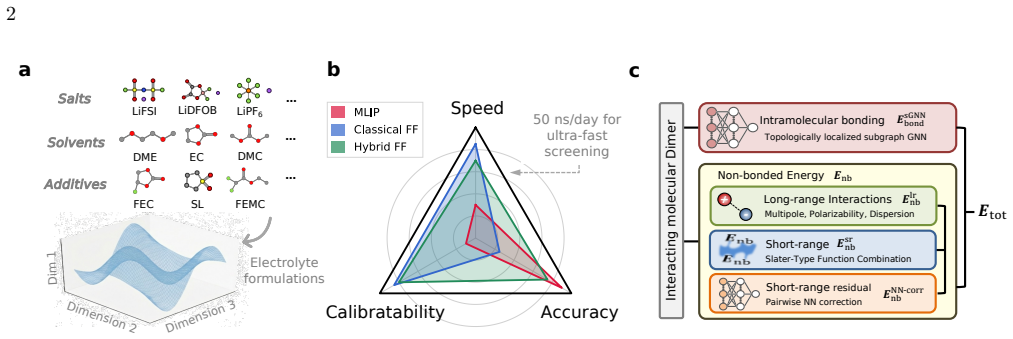
Differentiable hybrid force fields resolve the trilemma of being fast enough for high-throughput screening, accurate enough for quantitative property prediction, and calibratable enough for online refinement by fusing physically motivated functional forms with neural-network short-range corrections. Grounded in Energy Decomposition Analysis, models such as PhyNEO-Electrolyte and ByteFF-Pol achieve zero-shot generalization to bulk phases with throughputs of tens of ns/day for 10,000-atom systems. Their physical skeletons provide a well-conditioned parameter space for differentiable molecular dynamics, enabling a dual-calibration paradigm that integrates physics-grounded simulation with calibr
What carries the argument
Differentiable hybrid force fields that integrate Energy Decomposition Analysis-grounded physical skeletons with neural short-range corrections to support differentiable molecular dynamics and dual calibration.
If this is right
- High-throughput screening of electrolytes becomes possible at throughputs of tens of ns/day for 10,000-atom systems.
- Quantitative property predictions are achieved without heavy reliance on error cancellation.
- Dual calibration from ab initio data and macroscopic experiments supports online refinement.
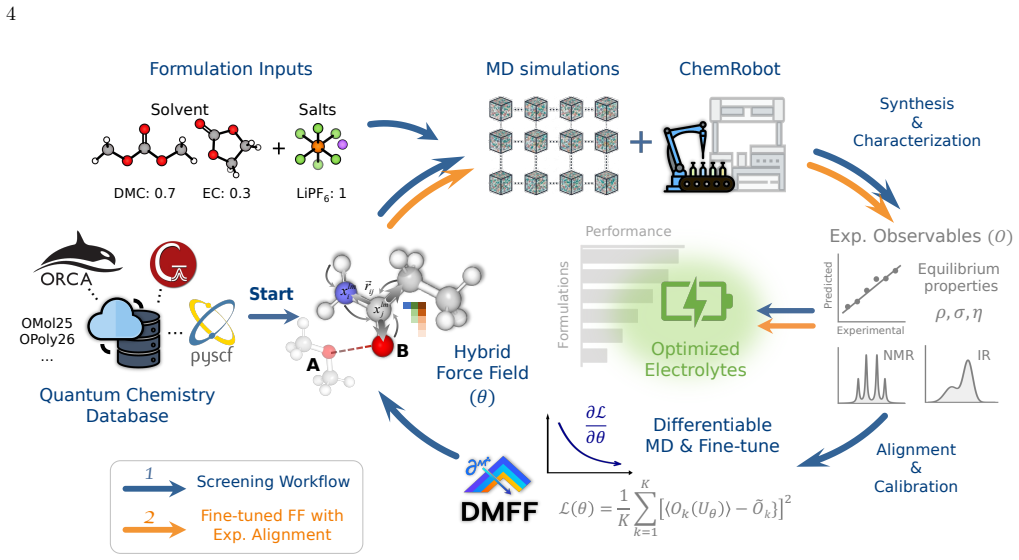
- The architecture enables closed-loop autonomous discovery by integrating simulation with experimental feedback.
Where Pith is reading between the lines
- The hybrid approach could extend to simulation challenges in other materials domains facing similar speed-accuracy-calibration conflicts.
- Limits of zero-shot generalization might be probed by testing on electrolyte compositions far from the training distribution.
- Combining these models with robotic experimental loops could shorten discovery cycles beyond the paper's outlined digital-twin concept.
Load-bearing premise
The physical skeletons of these hybrid models provide a well-conditioned parameter space for differentiable molecular dynamics and the models achieve reliable zero-shot generalization to bulk phases without post-hoc adjustments.
What would settle it
A simulation run where gradient-based calibration on the hybrid model produces unstable trajectories or where fine-tuned predictions deviate from measured bulk electrolyte properties such as conductivity would show the central claim does not hold.
Figures
read the original abstract
Autonomous electrolyte discovery demands a computational engine that satisfies a critical trilemma: it must be fast enough for high-throughput screening, accurate enough for quantitative property prediction, and calibratable enough for online refinement. Classical empirical force fields (FFs) are fast but rely on error cancellation, while standard machine learning interatomic potentials (MLIPs) are computationally expensive. In this Perspective, we highlight that differentiable hybrid FFs resolve this trilemma by fusing physically motivated functional forms with neural-network short-range corrections. Grounded in Energy Decomposition Analysis (EDA), state-of-the-art models such as PhyNEO-Electrolyte and ByteFF-Pol achieve zero-shot generalization to bulk phases, delivering throughputs on the order of tens of ns/day (up to $\sim$50 ns/day, depending on model complexity) for 10,000-atom systems. Crucially, their physical skeletons provide a well-conditioned parameter space for differentiable molecular dynamics (dMD). This enables a dual-calibration paradigm: bottom-up \textit{ab initio} parameterization combined with top-down fine-tuning from macroscopic experimental observables. We propose that this architecture meets the requirements of a ``ChemRobot-ready'' digital twin by integrating physics-grounded simulation with experimentally calibratable refinement, thereby enabling closed-loop autonomous electrolyte discovery.
Editorial analysis
A structured set of objections, weighed in public.
Referee Report
Summary. This Perspective argues that differentiable hybrid force fields resolve the trilemma of speed, accuracy, and calibratability for autonomous electrolyte discovery. By fusing EDA-grounded physical functional forms with neural short-range corrections, models such as PhyNEO-Electrolyte and ByteFF-Pol are claimed to deliver zero-shot bulk-phase generalization at throughputs of tens of ns/day (up to ~50 ns/day) on 10k-atom systems while supporting differentiable MD for dual bottom-up/top-down calibration, thereby enabling closed-loop 'ChemRobot-ready' workflows.
Significance. If the performance and conditioning claims hold, the work could meaningfully advance scalable computational electrolyte design by bridging classical FFs and MLIPs. The emphasis on physics-grounded skeletons that remain perturbative and well-conditioned for dMD calibration is a potentially useful framing for the community, though the Perspective introduces no new benchmarks or derivations.
major comments (2)
- [Abstract] Abstract: the central trilemma-resolution claim rests on zero-shot bulk-phase accuracy and ~50 ns/day throughput for 10k-atom electrolyte systems, yet the manuscript supplies no new error metrics (e.g., on densities, ionic conductivities, or solvation free energies), error bars, or direct comparisons to baselines. As a Perspective, this leaves the quantitative support entirely dependent on external citations whose applicability to autonomous workflows is not re-examined here.
- [Abstract] Abstract: the assertion that 'physical skeletons provide a well-conditioned parameter space for differentiable molecular dynamics' is load-bearing for the proposed dual-calibration paradigm, but the text contains no quantitative evidence such as Hessian eigenvalues, conditioning numbers, or calibration stability examples for the hybrid parameters.
minor comments (1)
- The phrase 'ChemRobot-ready digital twin' is introduced without a precise definition or operational criteria that would allow readers to evaluate the claim.
Simulated Author's Rebuttal
We thank the referee for their constructive comments on our Perspective. As this is a forward-looking discussion rather than a research article presenting new data, we synthesize concepts and results from the cited literature. We address each major comment below and indicate where revisions will clarify the manuscript's reliance on external citations.
read point-by-point responses
-
Referee: [Abstract] Abstract: the central trilemma-resolution claim rests on zero-shot bulk-phase accuracy and ~50 ns/day throughput for 10k-atom electrolyte systems, yet the manuscript supplies no new error metrics (e.g., on densities, ionic conductivities, or solvation free energies), error bars, or direct comparisons to baselines. As a Perspective, this leaves the quantitative support entirely dependent on external citations whose applicability to autonomous workflows is not re-examined here.
Authors: We agree that the Perspective introduces no new benchmarks or error metrics, as its purpose is to highlight the conceptual resolution of the speed-accuracy-calibratability trilemma through differentiable hybrid force fields. The cited throughput (up to ~50 ns/day on 10k-atom systems) and zero-shot bulk-phase generalization claims are drawn directly from the original PhyNEO-Electrolyte and ByteFF-Pol publications. In revision, we will expand the abstract and relevant sections to explicitly reference the specific metrics, error bars, and baseline comparisons reported in those works, while adding a brief discussion of their applicability to closed-loop autonomous workflows. This strengthens the manuscript without requiring new computations outside the Perspective scope. revision: partial
-
Referee: [Abstract] Abstract: the assertion that 'physical skeletons provide a well-conditioned parameter space for differentiable molecular dynamics' is load-bearing for the proposed dual-calibration paradigm, but the text contains no quantitative evidence such as Hessian eigenvalues, conditioning numbers, or calibration stability examples for the hybrid parameters.
Authors: The claim follows from the EDA-grounded design, in which physical functional forms capture long-range interactions and neural corrections are restricted to short-range perturbations, preserving parameter conditioning by construction. While the Perspective text does not contain new quantitative diagnostics such as Hessian eigenvalues or conditioning numbers, these properties are demonstrated in the supporting literature for the models discussed. We will revise the manuscript to include targeted citations to the relevant conditioning and stability results from the original papers, along with a concise explanatory clause in the abstract or main text to better support the dual bottom-up/top-down calibration paradigm. revision: partial
Circularity Check
No significant circularity; perspective argument is self-contained via external citations
full rationale
The manuscript is a perspective that argues differentiable hybrid FFs (via cited models PhyNEO-Electrolyte and ByteFF-Pol) resolve the speed-accuracy-calibratability trilemma for electrolyte discovery. The provided text contains no equations, no fitted parameters, no predictions derived from inputs, and no self-definitional loops or ansatzes. Claims about zero-shot generalization and well-conditioned dMD parameter spaces are attributed to prior published models rather than derived or renamed within this paper. Per the hard rules, self-citation is normal and does not constitute circularity unless a load-bearing step explicitly reduces to an unverified self-citation by construction; no such reduction is exhibited here. The derivation chain is therefore independent of the present manuscript's inputs.
Axiom & Free-Parameter Ledger
axioms (1)
- domain assumption Energy Decomposition Analysis (EDA) provides a valid grounding for separating physical long-range terms from short-range corrections in hybrid force fields.
Lean theorems connected to this paper
-
IndisputableMonolith/Cost/FunctionalEquation.leanwashburn_uniqueness_aczel unclear?
unclearRelation between the paper passage and the cited Recognition theorem.
differentiable hybrid FFs resolve this trilemma by fusing physically motivated functional forms with neural-network short-range corrections. Grounded in Energy Decomposition Analysis (EDA), state-of-the-art models such as PhyNEO-Electrolyte and ByteFF-Pol
-
IndisputableMonolith/Foundation/AlphaCoordinateFixation.leanalpha_pin_under_high_calibration unclear?
unclearRelation between the paper passage and the cited Recognition theorem.
physical skeletons provide a well-conditioned parameter space for differentiable molecular dynamics (dMD)
What do these tags mean?
- matches
- The paper's claim is directly supported by a theorem in the formal canon.
- supports
- The theorem supports part of the paper's argument, but the paper may add assumptions or extra steps.
- extends
- The paper goes beyond the formal theorem; the theorem is a base layer rather than the whole result.
- uses
- The paper appears to rely on the theorem as machinery.
- contradicts
- The paper's claim conflicts with a theorem or certificate in the canon.
- unclear
- Pith found a possible connection, but the passage is too broad, indirect, or ambiguous to say the theorem truly supports the claim.
discussion (0)
Sign in with ORCID, Apple, or X to comment. Anyone can read and Pith papers without signing in.