Recognition: unknown
Memory effect on the heavy quark dynamics in hot QCD matter
Pith reviewed 2026-05-10 17:36 UTC · model grok-4.3
The pith
Time-correlated thermal noise with memory substantially alters heavy quark dynamics in the quark-gluon plasma.
A machine-rendered reading of the paper's core claim, the machinery that carries it, and where it could break.
Core claim
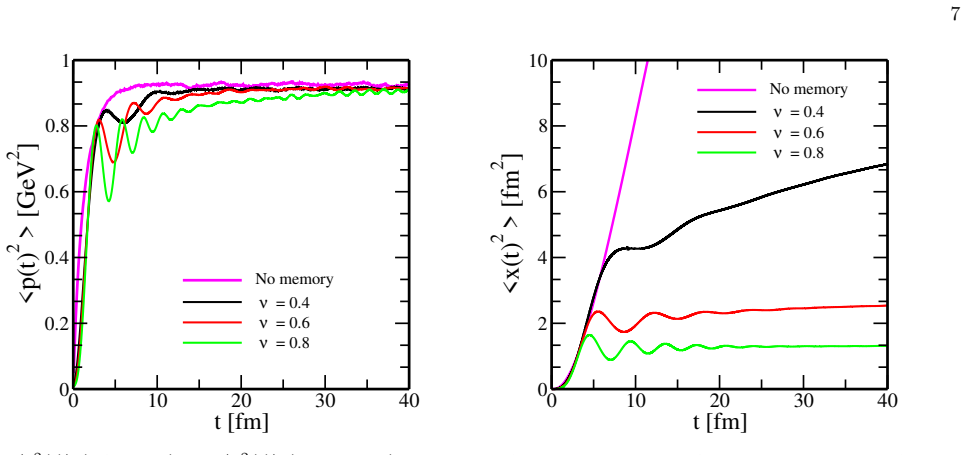
Incorporating memory through time-correlated thermal noise with power-law decay in the generalized Langevin equation produces clear deviations from the memoryless case: the momentum correlation function decays more slowly, the average squared momentum and displacement evolve differently, the kinetic energy acquires a distinct time dependence, and the normalized central moments of the heavy-quark transverse-momentum distribution depart from Gaussian values. These modifications are controlled by the fractional order parameter that tunes the strength of the memory.
What carries the argument
A generalized Langevin equation whose driving noise is generated by the Caputo fractional derivative of order nu, yielding power-law time correlations whose strength is set by nu.
If this is right
- The average squared momentum of heavy quarks grows more slowly at intermediate times than in the standard Brownian model.
- The mean squared displacement acquires a sub-diffusive or super-diffusive regime depending on the memory parameter.
- Higher central moments of the transverse-momentum distribution become non-Gaussian, altering the shape of spectra measured in experiments.
- The memory-induced changes remain visible even after the heavy quark has traversed several femtometers of plasma.
Where Pith is reading between the lines
- If the memory description holds, transport coefficients extracted from heavy-quark data under the assumption of white noise would need systematic correction.
- The same fractional-noise framework could be applied to other probes such as jets or light quarks to test whether non-Markovian effects appear more broadly in the plasma.
- Re-analysis of existing LHC or RHIC heavy-flavor data with varying memory strength might reveal preferred values of the fractional order that improve agreement with measured flow and suppression patterns.
Load-bearing premise
The thermal fluctuations experienced by heavy quarks inside the quark-gluon plasma can be faithfully represented by power-law correlated noise coming from a Caputo fractional derivative whose order is a free parameter.
What would settle it
A lattice calculation or direct experimental extraction of the heavy-quark momentum autocorrelation function that shows purely exponential decay with no power-law tail at late times would falsify the claim that memory effects substantially change the dynamics.
Figures




read the original abstract
We study the heavy quark dynamics in the presence of memory within the framework of a generalized Langevin equation. Time correlated thermal noise with power-law decay is generated by a fractional differential equation, formulated using the Caputo fractional derivative with order parameter $\nu$. The effect of memory is calculated through the momentum correlation, the time evolution of the average squared momentum, the average squared displacement, and the average kinetic energy. The effect of memory is further studied for the higher normalised central moments of the heavy quark transverse-momentum distribution. The results indicate that time correlated thermal noise substantially influences heavy quark dynamics in the quark gluon plasma.
Editorial analysis
A structured set of objections, weighed in public.
Referee Report
Summary. The paper studies heavy quark dynamics in hot QCD matter via a generalized Langevin equation that incorporates memory through time-correlated thermal noise with power-law decay, generated using a Caputo fractional derivative of order ν. It computes the impact on momentum correlations, time evolution of <p²(t)>, mean squared displacement, average kinetic energy, and higher normalized central moments of the transverse momentum distribution, concluding that such correlated noise substantially influences the dynamics relative to the standard white-noise case.
Significance. If ν could be fixed by an independent QCD calculation (e.g., matching the noise autocorrelation to the gluon correlator), the approach would usefully explore non-Markovian transport effects relevant to heavy-flavor observables in heavy-ion collisions. The inclusion of higher moments is a constructive step toward connecting to experimental p_T distributions. As formulated, however, the work mainly demonstrates sensitivity to an unconstrained parameter rather than a QCD-derived physical effect.
major comments (2)
- [Model formulation (Caputo derivative definition)] The order parameter ν is introduced as a free parameter that 'represents memory strength' (abstract and model section) without an independent derivation from QCD, such as matching to the frequency-dependent heavy-quark self-energy or lattice gluon-field correlators. Consequently, all reported differences in <p²(t)>, displacement, and moments are functions of this choice and do not constitute an emergent prediction of memory effects inside hot QCD matter.
- [Results and conclusions] The central claim that 'time correlated thermal noise substantially influences heavy quark dynamics' (abstract) rests on qualitative statements; the manuscript supplies no quantitative results, error estimates, or direct comparison to lattice QCD heavy-quark diffusion coefficients or experimental heavy-flavor data, preventing assessment of whether the changes survive for any physically motivated range of ν.
minor comments (1)
- [Method section] Notation for the generalized Langevin equation and the precise implementation of the Caputo fractional derivative (including boundary conditions and numerical scheme) should be stated explicitly with equation numbers for reproducibility.
Simulated Author's Rebuttal
We thank the referee for the constructive comments on our manuscript. We address each major point below and have made revisions to clarify the phenomenological nature of the model while strengthening the quantitative presentation of results.
read point-by-point responses
-
Referee: [Model formulation (Caputo derivative definition)] The order parameter ν is introduced as a free parameter that 'represents memory strength' (abstract and model section) without an independent derivation from QCD, such as matching to the frequency-dependent heavy-quark self-energy or lattice gluon-field correlators. Consequently, all reported differences in <p²(t)>, displacement, and moments are functions of this choice and do not constitute an emergent prediction of memory effects inside hot QCD matter.
Authors: We agree that ν is introduced as a phenomenological parameter to control the strength of memory in the time-correlated noise. The manuscript's goal is to explore the consequences of such non-Markovian dynamics within the generalized Langevin framework for heavy quarks in hot QCD matter, rather than to derive ν ab initio. In the revised version we have added a dedicated paragraph in the model section outlining how ν could be constrained in future work by matching the noise autocorrelation function to lattice QCD gluon correlators or the frequency-dependent heavy-quark self-energy. The present study therefore demonstrates the sensitivity of observables to memory effects once such a parameter is allowed, which we view as a necessary first step before a fully QCD-derived implementation. revision: partial
-
Referee: [Results and conclusions] The central claim that 'time correlated thermal noise substantially influences heavy quark dynamics' (abstract) rests on qualitative statements; the manuscript supplies no quantitative results, error estimates, or direct comparison to lattice QCD heavy-quark diffusion coefficients or experimental heavy-flavor data, preventing assessment of whether the changes survive for any physically motivated range of ν.
Authors: We have expanded the results section with explicit quantitative comparisons: relative deviations (in percent) of <p²(t)>, mean-squared displacement, average kinetic energy, and the normalized central moments are now tabulated for representative values of ν (0.3, 0.5, 0.7, 0.9) against the white-noise limit ν = 1. We also identify the interval 0.4 ≲ ν ≲ 0.8 where memory-induced changes exceed 20 % at late times, providing a concrete range for physically motivated discussion. While a direct matching to lattice heavy-quark diffusion coefficients or experimental p_T spectra lies outside the scope of this exploratory work, we relate the ν = 1 limit to the standard Langevin parameters used in heavy-ion phenomenology. Error estimates tied to lattice inputs are acknowledged as a future requirement once ν is fixed by an independent QCD calculation. revision: yes
- Providing a first-principles QCD derivation or numerical value for the memory parameter ν from lattice gluon correlators or the heavy-quark self-energy is beyond the scope of the present manuscript.
Circularity Check
No significant circularity in the derivation chain
full rationale
The paper explicitly frames its work as a phenomenological model study: it adopts a generalized Langevin equation, introduces time-correlated noise via the Caputo fractional derivative of free order ν (chosen to represent memory strength), solves the resulting stochastic equations, and reports the resulting changes in observables relative to the white-noise limit. No step claims a first-principles QCD derivation whose output is then shown to equal the input by construction; the reported influence is simply the direct numerical consequence of the chosen model equations. Because the framework is declared upfront and the calculations are standard solutions within that framework, the derivation chain is self-contained and contains no load-bearing self-definition, fitted-parameter renaming, or self-citation reduction.
Axiom & Free-Parameter Ledger
free parameters (1)
- nu
axioms (1)
- domain assumption The generalized Langevin equation with time-correlated noise generated by a Caputo fractional derivative accurately represents heavy-quark Brownian motion inside the quark-gluon plasma.
Reference graph
Works this paper leans on
-
[1]
In this case, the drag coefficient in Eq
Purely diffusive motion For illustrative purposes, the one-dimensional (1-D) pure-diffusion condition is taken, although the actual nu- merical calculations are performed in three dimensions of the HQs momentum evolution. In this case, the drag coefficient in Eq. (22) is set to zero, and the initial condi- tion is taken asp(0) = 0, so that the Langevin eq...
-
[2]
J. Adams et al. (STAR), Phys. Rev. Lett.97, 162301 (2006), arXiv:nucl-ex/0604018
-
[3]
J. Adams et al. (STAR), Nucl. Phys. A757, 102 (2005), arXiv:nucl-ex/0501009
-
[4]
K. Adcox et al. (PHENIX), Nucl. Phys. A757, 184 (2005), arXiv:nucl-ex/0410003
-
[5]
K. Aamodt et al. (ALICE), Phys. Rev. Lett.105, 252301 (2010), arXiv:1011.3916 [nucl-ex]
-
[6]
I. Arsene et al. (BRAHMS), Phys. Rev. C72, 014908 (2005), arXiv:nucl-ex/0503010
-
[7]
H. van Hees and R. Rapp, Phys. Rev. C71, 034907 (2005), arXiv:nucl-th/0412015
-
[8]
Heavy Quarks in the Quark-Gluon Plasma
R. Rapp and H. van Hees (2010) pp. 111–206, arXiv:0903.1096 [hep-ph]
work page Pith review arXiv 2010
- [9]
- [10]
-
[11]
Scardina, S
F. Scardina, S. K. Das, V. Minissale, S. Plumari, and V. Greco, Physical Review C96, 044905 (2017). 11
2017
- [12]
- [13]
-
[14]
A. Andronic et al., Eur. Phys. J. C76, 107 (2016), arXiv:1506.03981 [nucl-ex]
-
[15]
Dong and V
X. Dong and V. Greco, Prog. Part. Nucl. Phys.104, 97 (2019)
2019
-
[16]
Heavy-flavor production and medium properties in high-energy nuclear collisions - What next?,
G. Aarts et al., Eur. Phys. J. A53, 93 (2017), arXiv:1612.08032 [nucl-th]
-
[17]
S. Plumari, V. Minissale, S. K. Das, G. Coci, and V. Greco, Eur. Phys. J. C78, 348 (2018), arXiv:1712.00730 [hep-ph]
- [18]
-
[19]
J. Prakash, M. Kurian, S. K. Das, and V. Chandra, Phys. Rev. D103, 094009 (2021), arXiv:2102.07082 [hep-ph]
-
[20]
J. Prakash, V. Chandra, and S. K. Das, Phys. Rev. D 108, 096016 (2023), arXiv:2306.07966 [hep-ph]
- [21]
- [22]
-
[23]
Zaccone, Nuclear Physics B1000, 116483 (2024)
A. Zaccone, Nuclear Physics B1000, 116483 (2024)
2024
- [24]
- [25]
-
[26]
S. Mazumder, T. Bhattacharyya, J.-e. Alam, and S. K. Das, Phys. Rev. C84, 044901 (2011), arXiv:1106.2615 [nucl-th]
-
[27]
M. Y. Jamal, S. K. Das, and M. Ruggieri, Phys. Rev. D103, 054030 (2021)
2021
- [28]
- [29]
- [30]
-
[31]
S. Plumari, G. Coci, V. Minissale, S. K. Das, Y. Sun, and V. Greco, Phys. Lett. B805, 135460 (2020), arXiv:1912.09350 [hep-ph]
-
[32]
Prakash and M
J. Prakash and M. Y. Jamal, Journal of Physics G: Nu- clear and Particle Physics51, 025101 (2023)
2023
- [33]
- [34]
- [35]
-
[36]
Sumit, J. Parkash, S. K. Das, and N. Haque, (2025), arXiv:2506.01922 [hep-ph]
-
[37]
Altenkort, O
L. Altenkort, O. Kaczmarek, R. Larsen, S. Mukherjee, P. Petreczky, H.-T. Shu, and S. Stendebach (HotQCD Collaboration), Phys. Rev. Lett.130, 231902 (2023)
2023
- [38]
-
[39]
V. Chandra and S. K. Das, Eur. Phys. J. ST233, 429 (2024), arXiv:2402.18870 [hep-ph]
-
[40]
M. Debnath, R. Ghosh, M. Y. Jamal, M. Kurian, and J. Prakash, Phys. Rev. D109, L011503 (2024), arXiv:2311.16005 [hep-ph]
- [41]
- [42]
- [43]
- [44]
- [45]
- [46]
-
[47]
V. Minissale, S. Plumari, Y. Sun, and V. Greco, Eur. Phys. J. C84, 228 (2024), arXiv:2305.03687 [hep-ph]
- [48]
-
[49]
Mazumder, T
S. Mazumder, T. Bhattacharyya, J.-e. Alam, and S. K. Das, Phys. Rev. C84, 044901 (2011)
2011
-
[50]
T. Bhattacharyya, E. Megias, and A. Deppman, Phys. Lett. B856, 138907 (2024), arXiv:2405.15679 [hep-ph]
-
[51]
Young, B
C. Young, B. Schenke, S. Jeon, and C. Gale, Phys. Rev. C86, 034905 (2012)
2012
-
[52]
T. Lang, H. van Hees, G. Inghirami, J. Steinheimer, and M. Bleicher, Phys. Rev. C93, 014901 (2016)
2016
-
[53]
Cao and S
S. Cao and S. A. Bass, Phys. Rev. C84, 064902 (2011)
2011
-
[54]
Nonperturbative Heavy-Quark Diffusion in the Quark-Gluon Plasma
H. van Hees, M. Mannarelli, V. Greco, and R. Rapp, Phys. Rev. Lett.100, 192301 (2008), arXiv:0709.2884 [hep-ph]
work page Pith review arXiv 2008
-
[55]
S. Cao et al., Phys. Rev. C99, 054907 (2019), arXiv:1809.07894 [nucl-th]
-
[56]
A. Beraudo et al., Nucl. Phys. A979, 21 (2018), arXiv:1803.03824 [nucl-th]
-
[57]
Open Heavy Flavor in QCD Matter and in Nuclear Collisions
F. Prino and R. Rapp, J. Phys. G43, 093002 (2016), arXiv:1603.00529 [nucl-ex]
work page Pith review arXiv 2016
- [58]
-
[59]
Y. Xu et al., Phys. Rev. C99, 014902 (2019), arXiv:1809.10734 [nucl-th]
- [60]
- [62]
-
[63]
Schenke and C
B. Schenke and C. Greiner, Phys. Rev. Lett.98, 022301 (2007)
2007
-
[64]
J. I. Kapusta, B. M¨ uller, and M. Stephanov, Phys. Rev. C85, 054906 (2012)
2012
-
[65]
M. Ruggieri, M. Frasca, and S. K. Das, Chin. Phys. C 43, 094105 (2019), arXiv:1903.11302 [nucl-th]
-
[66]
B. Sch¨ uller, A. Meistrenko, H. Van Hees, Z. Xu, and C. Greiner, Annals Phys.412, 168045 (2020), arXiv:1905.09652 [cond-mat.stat-mech]
-
[67]
W. Chen, C. Greiner, and Z. Xu, Phys. Rev. E107, 064131 (2023)
2023
-
[68]
Greiner, K
C. Greiner, K. Wagner, and P.-G. Reinhard, Phys. Rev. C49, 1693 (1994). 12
1994
-
[69]
A. E. Gegechkori, Y. A. Anischenko, P. N. Nadtochy, and G. D. Adeev, Phys. Atom. Nucl.71, 2007 (2008)
2007
- [70]
- [71]
- [72]
-
[73]
J. Hammelmann, J. M. Torres-Rincon, J.-B. Rose, M. Greif, and H. Elfner, Phys. Rev. D99, 076015 (2019), arXiv:1810.12527 [hep-ph]
-
[74]
M. Ruggieri, Pooja, J. Prakash, and S. K. Das, Phys. Rev. D106, 034032 (2022), arXiv:2203.06712 [hep-ph]
- [75]
-
[76]
P. Guo, C. Zeng, C. Li, and Y. Chen, Fractional Cal- culus and Applied Analysis16, 123 (2013)
2013
-
[77]
Li and F
C. Li and F. Zeng, Numerical Functional Analysis and Optimization34, 149 (2013)
2013
-
[78]
K. S. Miller and B. Ross, John Wiley & Sons, Inc., New York , xvi+366 (1993)
1993
-
[79]
Caputo and F
M. Caputo and F. Mainardi, Rivista del Nuovo Cimento 1, 161 (1971)
1971
-
[80]
Carpinteri and F
A. Carpinteri and F. Mainardi, Fractals and Fractional Calculus in Continuum Mechanics378(2014)
2014
-
[81]
Ciesielski and J
M. Ciesielski and J. Leszczyski, The European Physical Journal B36, 33 (2003)
2003
discussion (0)
Sign in with ORCID, Apple, or X to comment. Anyone can read and Pith papers without signing in.