In-flight calibration of ESA Hera's HyperScout-H imager
Pith reviewed 2026-05-10 16:46 UTC · model grok-4.3
The pith
HyperScout-H shows stable bias, negligible dark current, and linear response after launch with updated radiometric constants from stars and Mars.
A machine-rendered reading of the paper's core claim, the machinery that carries it, and where it could break.
Core claim
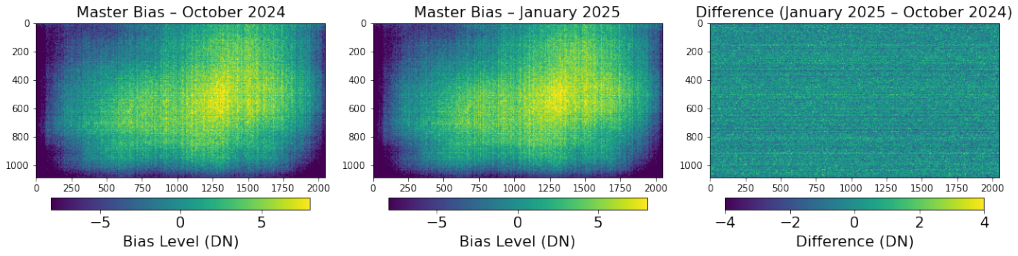
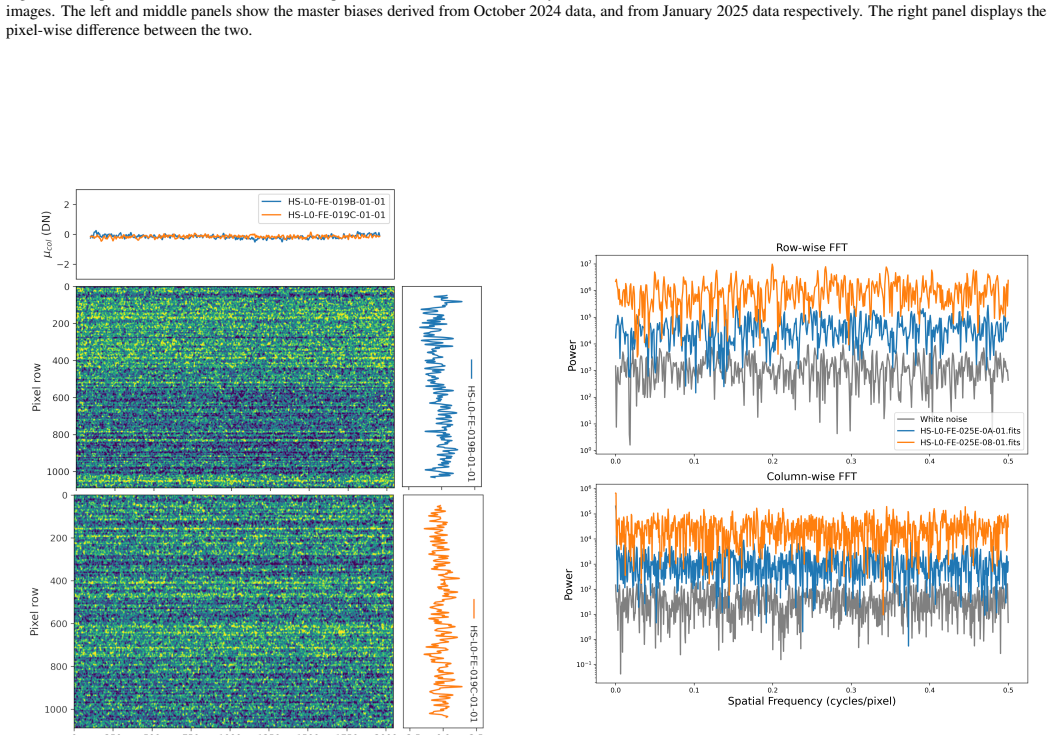
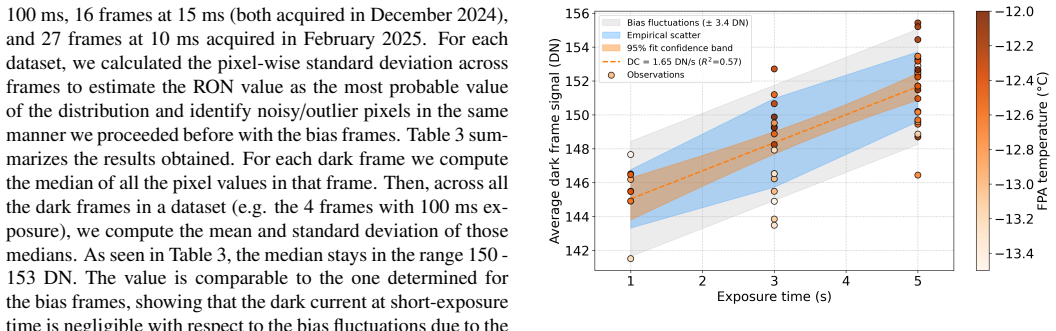
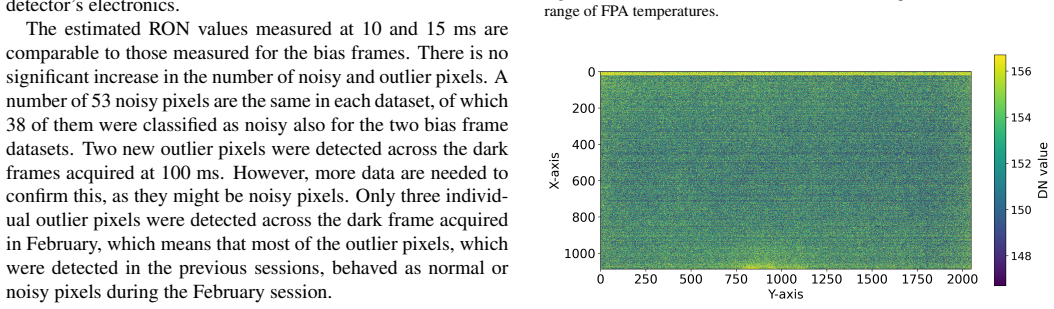
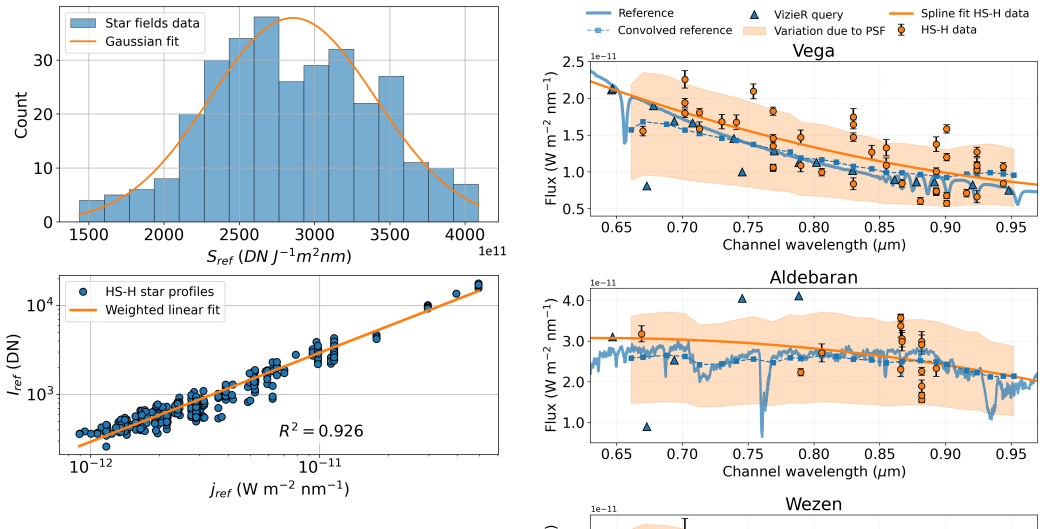
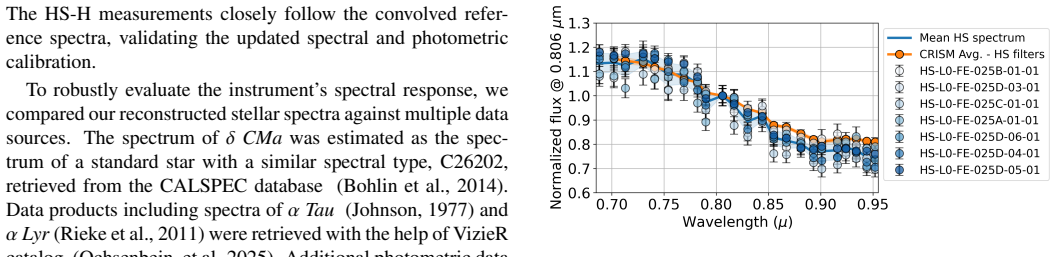
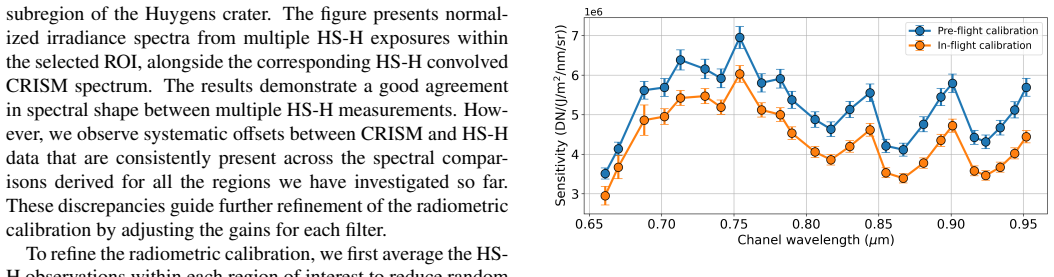
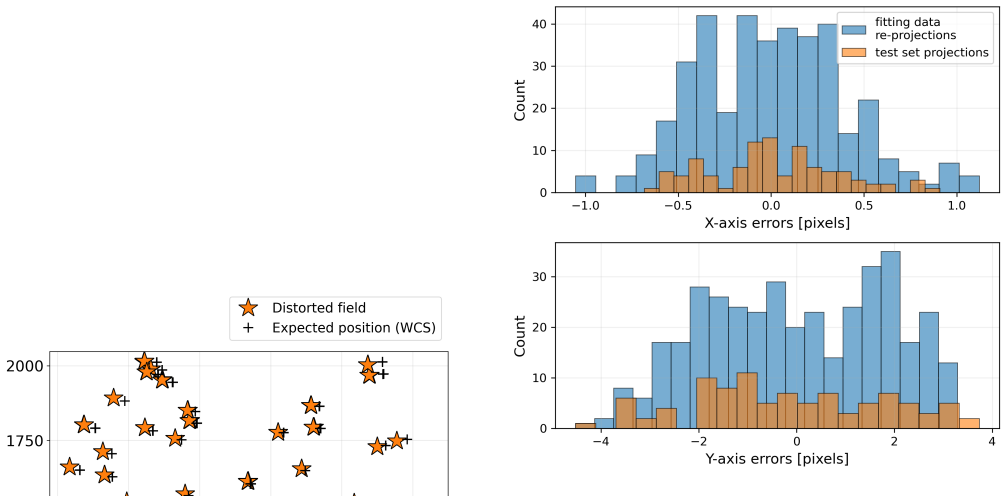
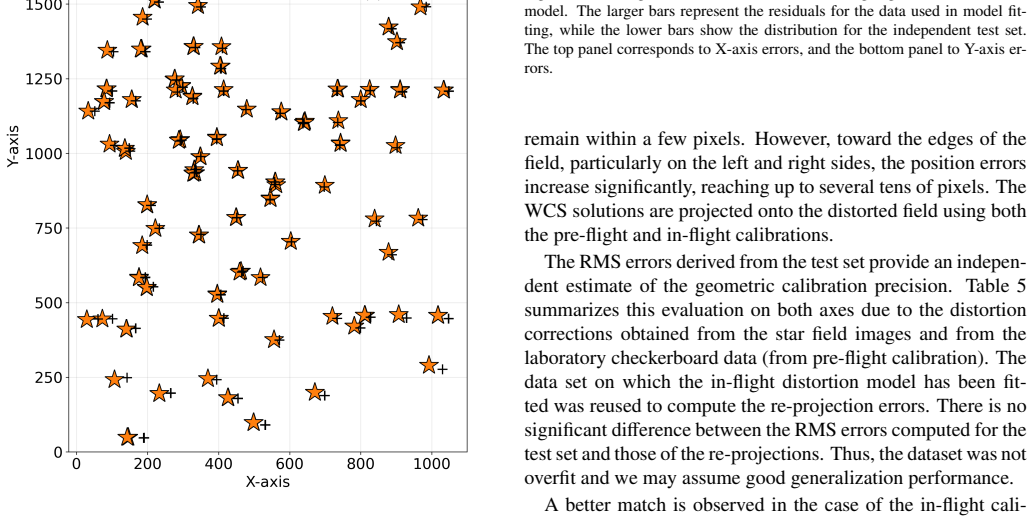
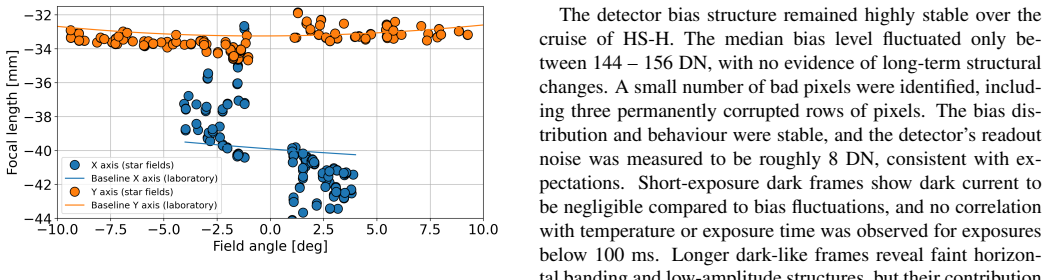
The bias pattern remains stable, dark current is negligible for short exposures, the detector response is highly linear, field-of-view alignment and geometric distortion are quantified, the point spread function is evaluated from stars, and stellar plus Mars swing-by data supply updated radiometric calibration constants that indicate slight in-flight modification of the detector's spectral response.
What carries the argument
In-flight calibration sequence of bias and dark exposures, stellar field observations, and five full-FOV Mars images used to monitor stability and derive updated radiometric constants.
If this is right
- Updated constants support accurate radiometric and spectral measurements of Didymos and Dimorphos composition.
- Quantified geometric distortion and alignment enable precise mapping and shape reconstruction of the asteroids.
- Evaluated point spread function confirms the instrument meets resolution needs for surface feature analysis.
- Stable bias and low dark current support reliable data collection over the full mission duration.
Where Pith is reading between the lines
- Periodic recalibration using planetary flybys may become standard for other hyperspectral instruments on long cruises.
- The small spectral-response shift observed here could be checked against radiation-dose models to predict behavior on future missions.
- Cross-validation with Mars data offers a template for using known targets to anchor calibration when ground truth is limited.
Load-bearing premise
The limited set of stellar fields and five Mars images supplies enough representative data to validate performance for the Didymos encounter.
What would settle it
Didymos encounter spectra that match pre-flight calibration predictions better than the updated constants, or show inconsistencies with independent measurements of the same targets, would show the in-flight updates are inaccurate.
Figures

read the original abstract
ESA's Hera space mission is on its way to the mission target, the binary asteroid (65803) Didymos. HyperScout-H, one of the instruments onboard Hera, is a hyperspectral imager operating in the visible and near-infrared regions between 0.65 and 0.95 microns. HyperScout-H will enable a detailed assessment of the composition of both objects, Didymos and its satellite Dimorphos, the characterization of space weathering effects, and the possible presence of exogenous material on their surfaces. To monitor instrument functionality, calibration exposures are acquired regularly. This article describes the in-flight calibrations carried out for HyperScout-H during the commissioning and cruise phases. Bias and dark exposures, as well as stellar field observations, were acquired several times after launch. We update the calibration data and monitor instrument performance in the space environment. In five images, the surface of Mars fills the entire field of view, enabling cross-validation of HyperScout-H results with those reported by other Mars missions. The calibration data indicate that the bias pattern is stable, the dark current remains negligible for short exposures, and the detector response is highly linear. We quantify the field-of-view alignment and geometric distortion, and evaluate the point spread function based on the stellar field observations. Stellar observations and Mars swing-by data provide updated radiometric calibration constants, suggesting that in-flight conditions have slightly modified the detector's spectral response. In-flight calibrations are essential to ensure data quality and reliability. The results obtained for HyperScout-H demonstrate that the instrument can achieve its scientific goals in observations of the Didymos-Dimorphos system.
Editorial analysis
A structured set of objections, weighed in public.
Referee Report
Summary. The manuscript describes the in-flight calibration of ESA Hera's HyperScout-H hyperspectral imager (0.65-0.95 μm) using bias/dark exposures, stellar field observations acquired multiple times post-launch, and five full-FOV Mars swing-by images. It reports a stable bias pattern, negligible dark current for short exposures, high detector linearity, quantified FOV alignment and geometric distortion, PSF evaluation from stars, and updated radiometric calibration constants from stellar and Mars data, concluding that in-flight conditions caused only slight modification to the spectral response and that the instrument is ready to meet its scientific goals for the Didymos-Dimorphos encounter.
Significance. If the calibration results hold, the work supplies essential post-launch validation for a key instrument on an active ESA planetary mission, directly supporting reliable hyperspectral data for asteroid composition, space weathering, and exogenous material studies. The multi-epoch stellar monitoring combined with external Mars cross-validation is a concrete strength that enhances credibility over purely ground-based pre-flight constants.
major comments (3)
- [Radiometric calibration results] Radiometric calibration section (near end of results): the updated constants are stated to indicate only 'slight' in-flight modification to spectral response, yet no uncertainties, error bars, or propagation details are provided for these constants, nor is the number of stellar fields or exact processing steps for the five Mars images specified; this directly weakens the quantitative support for the central claim of instrument readiness.
- [Mars cross-validation] Mars swing-by cross-validation (results and discussion): the paper uses Mars full-FOV images as an anchor to update constants for Didymos observations, but does not test or propagate the substantial differences in albedo, phase function, and atmospheric scattering; no sensitivity run replacing the Mars spectrum with a Didymos-like reflectance model is shown to confirm that the derived constants remain stable, making the applicability to the target environment a load-bearing assumption that requires explicit validation.
- [Geometric performance and PSF] Geometric and PSF evaluation (methods/results): the FOV alignment, distortion, and point-spread function are quantified from stellar fields, but the manuscript provides no details on the number of stars used, selection criteria, or how short-exposure linearity was verified across the detector; these omissions affect the robustness of the performance claims for the Didymos encounter environment.
minor comments (3)
- [Abstract] Abstract: the phrase 'consistent findings from multiple exposures' would be clearer if the exact number of bias/dark/stellar sets and their acquisition dates were stated.
- [Figures and tables] Figure captions and tables: several figures showing bias patterns or Mars spectra lack explicit mention of any applied corrections, scaling, or error representation.
- [Calibration constants] Notation: the definition of the updated radiometric constants could be given explicitly (e.g., as a table or equation) rather than described only in text.
Simulated Author's Rebuttal
We thank the referee for their constructive and detailed review of our manuscript on the in-flight calibration of HyperScout-H. We address each major comment below and indicate the revisions we will make to improve the quantitative rigor and clarity of the results.
read point-by-point responses
-
Referee: [Radiometric calibration results] Radiometric calibration section (near end of results): the updated constants are stated to indicate only 'slight' in-flight modification to spectral response, yet no uncertainties, error bars, or propagation details are provided for these constants, nor is the number of stellar fields or exact processing steps for the five Mars images specified; this directly weakens the quantitative support for the central claim of instrument readiness.
Authors: We agree that the absence of uncertainties and processing details limits the strength of the claim. In the revised manuscript we will add propagated uncertainties and error bars on the updated radiometric constants, explicitly state the number of stellar fields employed, and provide a concise step-by-step description of the Mars-image processing pipeline (including bias subtraction, flat-fielding, and integration-time normalization). These additions will furnish the quantitative support requested. revision: yes
-
Referee: [Mars cross-validation] Mars swing-by cross-validation (results and discussion): the paper uses Mars full-FOV images as an anchor to update constants for Didymos observations, but does not test or propagate the substantial differences in albedo, phase function, and atmospheric scattering; no sensitivity run replacing the Mars spectrum with a Didymos-like reflectance model is shown to confirm that the derived constants remain stable, making the applicability to the target environment a load-bearing assumption that requires explicit validation.
Authors: The radiometric constants are derived from the instrument's measured response to a known solar-illuminated target; target-specific properties are removed by forward modeling. Nevertheless, to directly address the concern we will insert a short sensitivity section that substitutes an S-type asteroid reflectance spectrum (scaled to Didymos geometry) for the Mars spectrum and shows that the resulting calibration factors change by less than the existing uncertainty. This explicit test will confirm stability for the Didymos environment. revision: yes
-
Referee: [Geometric performance and PSF] Geometric and PSF evaluation (methods/results): the FOV alignment, distortion, and point-spread function are quantified from stellar fields, but the manuscript provides no details on the number of stars used, selection criteria, or how short-exposure linearity was verified across the detector; these omissions affect the robustness of the performance claims for the Didymos encounter environment.
Authors: We will expand the methods and results sections to report the number of stars retained per field, the magnitude and isolation criteria applied for selection, and the procedure used to verify short-exposure linearity (comparison of stellar fluxes across exposure times, confirming <1 % deviation across the detector). These details will substantiate the geometric and PSF performance statements. revision: yes
Circularity Check
No circularity: empirical calibration from direct observations
full rationale
The paper reports in-flight measurements of bias stability, dark current, linearity, geometric distortion, PSF, and radiometric constants derived from acquired bias/dark exposures, stellar fields, and five Mars full-FOV images. No load-bearing step reduces by construction to a fitted input renamed as prediction, self-citation chain, or ansatz smuggled from prior author work; all quantities are computed from the new data sets themselves with external Mars cross-validation. The derivation chain is therefore self-contained against the observational inputs and does not invoke uniqueness theorems or self-referential definitions.
Axiom & Free-Parameter Ledger
free parameters (1)
- updated radiometric calibration constants
axioms (2)
- domain assumption Detector response remains linear across the observed signal range
- domain assumption Mars surface data from other missions provide valid independent reference for cross-validation
Reference graph
Works this paper leans on
-
[1]
doi:10.3847/PSJ/ac7f34. Johnson, H.L., 1977. An atlas of stellar spectra. I. Revista Mexicana de Astronomia y Astrofisica 2, 71–170. Kuramoto, K., Kawakatsu, Y ., Fujimoto, M., Araya, A., Barucci, M.A., Genda, H., Hirata, N., Ikeda, H., Imamura, T., Helbert, J., Kameda, S., Kobayashi, M., Kusano, H., Lawrence, D.J., Matsumoto, K., Michel, P., Miyamoto, H....
-
[2]
URL:https://agupubs.onlinelibrary. wiley.com/doi/abs/10.1002/2017JE005318, doi:https://doi.org/10.1002/2017JE005318, arXiv:https://agupubs.onlinelibrary.wiley.com/doi/pdf/10.1002/2017JE005318. Michel, P., Küppers, M., Bagatin, A.C., Carry, B., Charnoz, S., de Leon, J., Fitzsimmons, A., Gordo, P., Green, S.F., Hérique, A., Juzi, M., Karatekin, Ö., Kohout, ...
-
[3]
Journal of Atmospheric and Oceanic Technology 13, 321–
Preflight and in-flight calibration plan for aster. Journal of Atmospheric and Oceanic Technology 13, 321–
-
[4]
doi:10.1175/1520-0426(1996)013<0321:PAIFCP> 2.0.CO;2. Perryman, M.A.C., Lindegren, L., Kovalevsky, J., Hoeg, E., Bastian, U., Bernacca, P.L., Crézé, M., Donati, F., Grenon, M., Grewing, M., van Leeuwen, F., van der Marel, H., Mignard, F., Murray, C.A., Le Poole, R.S., Schrijver, H., Turon, C., Arenou, F., Froeschlé, M., Petersen, C.S., 1997. The HIPPARCOS...
-
[5]
Popescu, M.M., de León, J., Prodan, G.P., et al., 2025
doi:10.5194/epsc-dps2025-1250. Popescu, M.M., de León, J., Prodan, G.P., et al., 2025. Hyperscout-h: The hyperspectral imager for the esa hera mission. Space Science Reviews 221, 112. doi:10.1007/ s11214-025-01237-8. Pravec, P., Meyer, A.J., Scheirich, P., Scheeres, D.J., Ben- son, C.J., Agrusa, H.F., 2024. Rotational lightcurves of Dimorphos and constrai...
-
[6]
doi:10.3847/PSJ/ad04d8,arXiv:2310.11168. Russell, C.T., Capaccioni, F., Coradini, A., et al., 2007. Dawn mission to vesta and ceres. Earth, Moon, and Planets 101, 65–91. doi:10.1007/s11038-007-9151-9. Saito, J., Miyamoto, H., Nakamura, R., Ishiguro, M., Michikami, T., Nakamura, A.M., Demura, H., Sasaki, S., 27 Hirata, N., Honda, C., Yamamoto, A., Yokota, ...
-
[7]
Vibration i solation methods in spacecraft: A review of current techniq ues,
The impact of bias row noise to photometric accuracy: Case study based on a scientific cmos detector. Research in Astronomy and Astrophysics 24. URL:https://api. semanticscholar.org/CorpusID:266435571. Shi, H., Abubakar, M., Bai, X., Luo, Z., 2024. Vibra- tion isolation methods in spacecraft: A review of current techniques. Advances in Space Research 73, ...
discussion (0)
Sign in with ORCID, Apple, or X to comment. Anyone can read and Pith papers without signing in.