Recognition: unknown
The neutron skin effect in Pb+Pb collisions at 2.76A TeV at the LHC
Pith reviewed 2026-05-10 17:11 UTC · model grok-4.3
The pith
Neutron skin in lead nuclei increases the initial spatial anisotropy in peripheral Pb+Pb collisions at the LHC, enhancing elliptic flow especially for photons.
A machine-rendered reading of the paper's core claim, the machinery that carries it, and where it could break.
Core claim
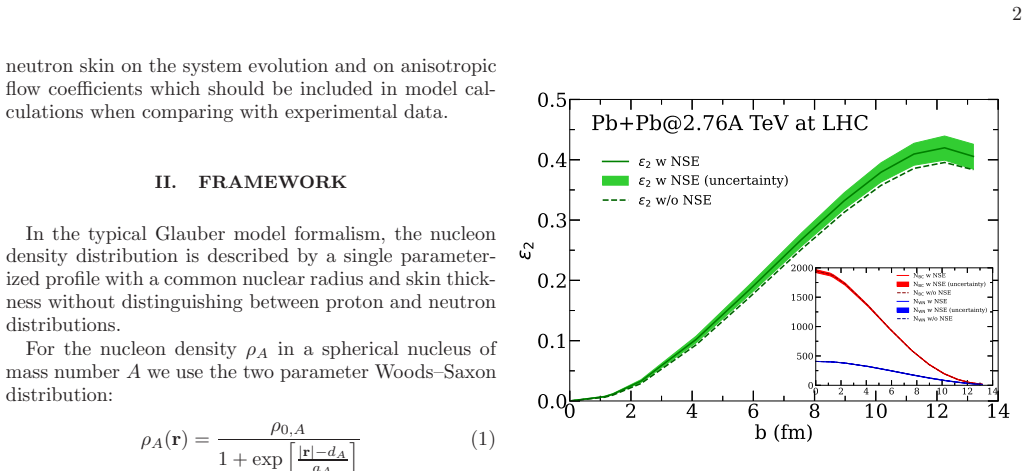
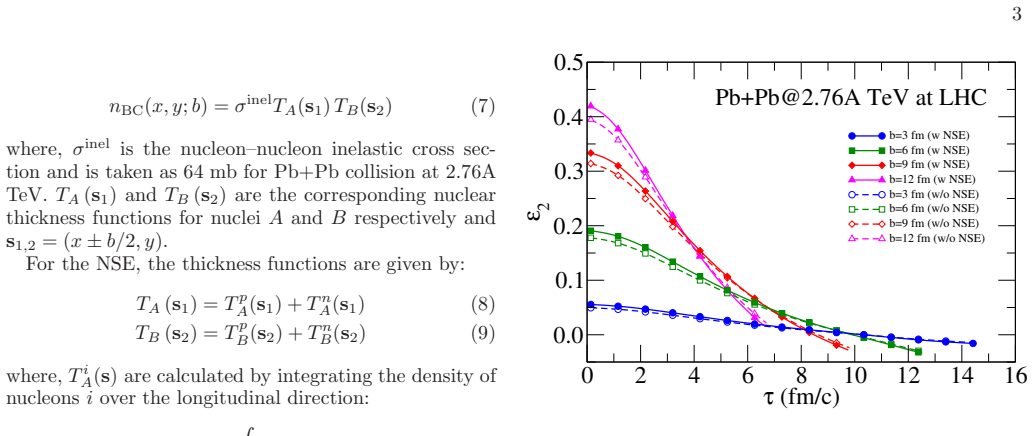
The initial spatial anisotropy of the fireball is affected by the neutron skin thickness significantly especially for the peripheral collisions. This leads to a substantial enhancement of the elliptic flow of hadrons with an even stronger effect observed for photons. In addition, the effect is found to be more pronounced for lower beam energy collisions of lead nuclei.
What carries the argument
Neutron skin thickness incorporated into the initial nuclear density distributions of lead nuclei, which modifies the spatial anisotropy of the fireball overlap region and propagates through the space-time evolution to final observables.
Load-bearing premise
The neutron skin thickness is correctly incorporated into the initial nuclear density distributions used for the collision simulations, and the subsequent evolution model accurately propagates this effect to final observables without being dominated by other model uncertainties.
What would settle it
If elliptic flow measurements for hadrons and photons in peripheral Pb+Pb collisions at 2.76 TeV show no difference between simulations with and without neutron skin, the claimed significant enhancement from the skin would be ruled out.
Figures



read the original abstract
Collisions of lead nuclei at relativistic energies provide valuable insight into the properties of the quark gluon plasma formed in such collisions where the initial geometry and density profile play a crucial role in governing the subsequent evolution of the produced hot and dense fireball. The neutron skin thickness resulting from the difference between the neutron and proton density distributions in neutron rich lead nuclei plays an important role in nuclear structure studies. In this work we investigate the impact of neutron skin on the space time evolution of the fireball formed in Pb+Pb collisions at 2.76A TeV at the LHC and analyze how the presence of neutron skin affect bulk observables sensitive to the initial nuclear structure. The time evolution of initial profile along with the average $p_T$, particle spectra and anisotropic flow parameters are estimated to investigate the effect of neutron skin on these observables. The initial spatial anisotropy of the fireball is found to be affected by the neutron skin thickness significantly especially for the peripheral collisions. This leads to a substantial enhancement of the elliptic flow of hadrons with an even stronger effect observed for photons. In addition, the effect is found to be more pronounced for lower beam energy collisions of lead nuclei.
Editorial analysis
A structured set of objections, weighed in public.
Referee Report
Summary. The manuscript investigates the role of neutron skin thickness in lead nuclei on the initial conditions and space-time evolution of the fireball in Pb+Pb collisions at 2.76A TeV. It reports that the neutron skin modifies the initial spatial anisotropy significantly, particularly in peripheral collisions, resulting in a substantial enhancement of elliptic flow for hadrons and an even stronger effect for photons, with the impact being more pronounced at lower beam energies.
Significance. If the central claim holds after robustness checks, the work would usefully connect nuclear structure (neutron skin) to heavy-ion observables, especially via direct photons which probe early dynamics. The reported peripheral sensitivity could motivate new experimental searches, but the absence of quantitative benchmarks, error estimates, and model-variation studies in the current presentation limits its immediate impact.
major comments (2)
- [Abstract] Abstract: the central claim of a 'substantial enhancement' of elliptic flow (stronger for photons) due to neutron skin is stated without any numerical values, ratios, figures, or baseline comparisons, preventing assessment of whether the effect survives hydrodynamic evolution or is comparable to known uncertainties in peripheral collisions.
- [Results and discussion] The manuscript provides no evidence that hydrodynamic parameters (shear viscosity, equation of state, particlization temperature, or initial-state fluctuations) were systematically varied while holding neutron-skin thickness fixed. Given that v2 in peripheral systems is highly sensitive to these choices, the reported enhancement cannot yet be attributed robustly to the neutron skin rather than default model settings.
minor comments (1)
- [Abstract] The abstract mentions 'average p_T, particle spectra and anisotropic flow parameters' but does not specify the hydrodynamic code, initial-condition generator, or neutron-skin parametrization employed; these details are required for reproducibility.
Simulated Author's Rebuttal
We appreciate the referee's insightful comments on our manuscript. The suggestions regarding the abstract and the need for robustness checks against hydrodynamic parameter variations are well taken. We will revise the manuscript to incorporate quantitative details in the abstract and provide additional discussion on the sensitivity to model parameters to strengthen our conclusions.
read point-by-point responses
-
Referee: [Abstract] Abstract: the central claim of a 'substantial enhancement' of elliptic flow (stronger for photons) due to neutron skin is stated without any numerical values, ratios, figures, or baseline comparisons, preventing assessment of whether the effect survives hydrodynamic evolution or is comparable to known uncertainties in peripheral collisions.
Authors: We agree with the referee that the abstract should provide more concrete information to allow readers to assess the magnitude of the effect. In the revised manuscript, we will update the abstract to include specific numerical values and ratios for the enhancement in elliptic flow of hadrons and photons, particularly in peripheral collisions, and reference the corresponding figures and baseline comparisons from our results. revision: yes
-
Referee: [Results and discussion] The manuscript provides no evidence that hydrodynamic parameters (shear viscosity, equation of state, particlization temperature, or initial-state fluctuations) were systematically varied while holding neutron-skin thickness fixed. Given that v2 in peripheral systems is highly sensitive to these choices, the reported enhancement cannot yet be attributed robustly to the neutron skin rather than default model settings.
Authors: The referee correctly points out that we have not systematically varied the hydrodynamic parameters in the current study. Our calculations were performed with a fixed set of standard parameters to isolate the impact of the neutron skin on the initial conditions. We recognize that this limits the robustness claim. In the revised version, we will include a new subsection discussing the potential effects of varying shear viscosity, equation of state, and other parameters, and present arguments based on the initial geometry change that the enhancement should be largely independent of these choices. However, a full parameter scan is beyond the scope of the current work. revision: partial
Circularity Check
No circularity: standard forward simulation from input nuclear densities to computed observables
full rationale
The paper modifies the initial nuclear density profiles of Pb nuclei to include a neutron skin thickness (an external nuclear-structure input), then evolves the system via a hydrodynamic or transport model to obtain space-time profiles, spectra, and anisotropic flow coefficients. All reported effects on elliptic flow and photon v2 are direct numerical outputs of this forward chain; no target observable is used to fit a parameter that is later renamed as a prediction, and no load-bearing step reduces by definition or self-citation to the final result. The derivation remains self-contained against external benchmarks.
Axiom & Free-Parameter Ledger
free parameters (1)
- neutron skin thickness parameter
axioms (1)
- domain assumption Relativistic hydrodynamic evolution of the QGP fireball
Reference graph
Works this paper leans on
-
[1]
Trzcinska, J
A. Trzcinska, J. Jastrzebski, P. Lubinski, F. J. Hartman n, R. Schmidt, T. von Egidy, and B. Klos, Phys. Rev. Lett. 87, 082501 (2001)
2001
-
[2]
Tarbert et al ., [Crystal Ball at MAMI and A2 Col- laboration], Phys
C.M. Tarbert et al ., [Crystal Ball at MAMI and A2 Col- laboration], Phys. Rev. Lett. 112, 242502 (2014)
2014
-
[3]
Giacalone, G
G. Giacalone, G. Nijs, and W. van der Schee, Phys. Rev. Lett. 131, 202302 (2023)
2023
-
[4]
B. A. Brown, Phys. Rev. Lett. 85, 5296 (2000)
2000
-
[5]
Bartel, P
J. Bartel, P. Quentin, M. Brack, C. Guet, and H. B. Hakansson, Nucl. Phys. A 386 , 79 (1982)
1982
-
[6]
R. J. Furnstahl, Nucl. Phys. A 706 , 85 (2002)
2002
-
[7]
Roca-Maza, M
X. Roca-Maza, M. Centelles, X. Vinas, and M. Warda, Phys. Rev. Lett. 106, 252501 (2011)
2011
-
[8]
G. Nijs, W. van der Schee, SciPost Phys. 15, 041 (2023)
2023
-
[9]
L.-M. Liu, J. Xu, G.-X. Peng, Phys. Lett. B 838, 137701 (2023)
2023
-
[10]
Abrahamyan et al
S. Abrahamyan et al. , [PREX Collaboration], Phys. Rev. Lett. 108, 112502 (2012)
2012
-
[11]
S. De, J. Phys. G 44, no.4, 045104 (2017) doi:10.1088/1361-6471/aa5689 [arXiv:1609.09608 [nucl- th]]
-
[12]
Ding, D.-Q
M.-Q. Ding, D.-Q. Fang, Y.-G. Ma, Nucl. Sci. Tech. 35, no.12, 211 (2024)
2024
-
[13]
Paukkunen, Phys
H. Paukkunen, Phys. Lett. B 745, 73–78 (2015)
2015
-
[14]
Helenius, H
I. Helenius, H. Paukkunen, K. J. Eskola, Eur. Phys. J. C 77, 148 (2017)
2017
-
[15]
Li et al ., Phys
H. Li et al ., Phys. Rev. Lett. 125, 222301 (2020)
2020
-
[16]
van der Schee, Yen-Jie Lee, Govert Nijs, Yi Chen, Phys
W. van der Schee, Yen-Jie Lee, Govert Nijs, Yi Chen, Phys. Lett. B 856, 138953 (2024)
2024
- [17]
-
[18]
Hammelmann, A
J. Hammelmann, A. Soto-Ontoso, M. Alvioli, H. Elfner, and M. Strikman, Phys. Rev. C 101, 061901(R) (2020)
2020
-
[19]
Q. Liu, S. Zhao, H.-J. Xu, H. Song, Phys. Rev. C 109, 034912 (2024)
2024
-
[20]
J. W. Harris and B Muller, Ann. Rev. Nucl. Part. Sci., 46, 71 (1996)
1996
-
[21]
Shuryak, Rev
E. Shuryak, Rev. Mod. Phys., 89, 035001 (2017)
2017
-
[22]
K. Yagi, T. Hatsuda, and Y. Miake, Camb. Monogr. Part. Phys. Nucl. Phys. Cosmol., 23, 1 (2005)
2005
-
[23]
U. W. Heinz, J. Phys. Conf. Ser., 455, 012044 (2013)
2013
-
[24]
Adler et
C. Adler et. al., [STAR Collaboration], Phys. Rev. Lett. 87, 182301 (2001)
2001
-
[25]
S. S. Adler et. al., [PHENIX Collaboration], Phys. Rev. Lett. 91, 182301 (2003)
2003
- [26]
-
[27]
M. L. Miller et al. , Ann. Rev. Nucl. Part. Sci. 57, 205 (2007)
2007
-
[28]
Schenke, S
B. Schenke, S. Jeon, and C. Gale, Phys. Rev. C 82, 014903 (2010)
2010
-
[29]
D. K. Srivastava, J. Phys. G 35, 104026 (2008)
2008
-
[30]
Vujanovic, J
G. Vujanovic, J. F. Paquet, G. S. Denicol, M. Luzum, B. Schenke, S. Jeon and C. Gale, Nucl. Phys. A 932, 230-234 (2014)
2014
-
[31]
David, Rept
G. David, Rept. Prog. Phys. 83, 046301 (2020)
2020
-
[32]
Chatterjee, H
R. Chatterjee, H. Holopainen, T. Renk and K. J. Eskola, Phys. Rev. C 85, 064910 (2012)
2012
-
[33]
Huovinen and P
P. Huovinen and P. Petreczky, Nucl. Phys. A837 26 (2010)
2010
-
[34]
P. Dasgupta, S. De, R. Chatterjee and D. K. Sri- vastava, Phys. Rev. C 98, no.2, 024911 (2018) doi:10.1103/PhysRevC.98.024911 [arXiv:1804.02828 [nucl-th]]
-
[35]
Cooper and G
F. Cooper and G. Frye, Phys. Rev. D 10, 186 (1974)
1974
-
[36]
P. B. Arnold, G. D. Moore and L. G. Yaffe, JHEP 12, 009 (2001)
2001
-
[37]
Ghiglieri, J
J. Ghiglieri, J. Hong, A. Kurkela, E. Lu, G. D. Moore and D. Teaney, JHEP 05, 010 (2013)
2013
-
[38]
Turbide, R
S. Turbide, R. Rapp and C. Gale, Phys. Rev. C 69, 014903 (2004)
2004
-
[39]
Abelev et al ., Phys
B. Abelev et al ., Phys. Rev. C 88 044910 (2013)
2013
-
[40]
Chatterjee, E
R. Chatterjee, E. S. Frodermann, U. W. Heinz and D. K. Srivastava, Phys. Rev. Lett. 96, 202302 (2006)
2006
-
[41]
C. Gale, Y. Hidaka, S. Jeon, S. Lin, J. F. Paquet, R. D. Pisarski, D. Satow, V. V. Skokov and G. Vujanovic, Phys. Rev. Lett. 114, 072301 (2015)
2015
-
[42]
Chatterjee, H
R. Chatterjee, H. Holopainen, I. Helenius, T. Renk and K. J. Eskola, Phys. Rev. C 88, 034901 (2013)
2013
-
[43]
Chatterjee and P
R. Chatterjee and P. Dasgupta Phys. Rev. C 104, 064907 (2021)
2021
-
[44]
Chatterjee and P
R. Chatterjee and P. Dasgupta, MDPI Physics 6, 674 (2014)
2014
discussion (0)
Sign in with ORCID, Apple, or X to comment. Anyone can read and Pith papers without signing in.