Recognition: 2 theorem links
· Lean TheoremDetecting Chiral Gravitational Wave Background with a Dipole Pulsar Timing Array
Pith reviewed 2026-05-10 17:19 UTC · model grok-4.3
The pith
A dipole pulsar timing array detects chiral gravitational wave backgrounds by isolating parity violation through overlap reduction functions.
A machine-rendered reading of the paper's core claim, the machinery that carries it, and where it could break.
Core claim
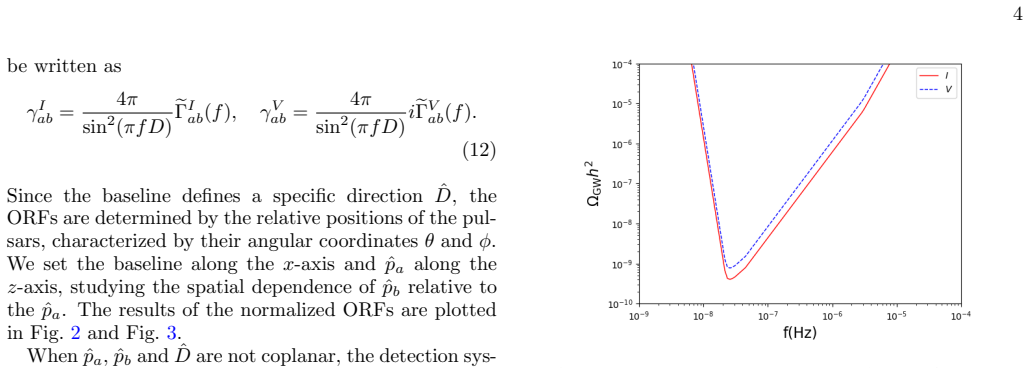
By deriving the overlap reduction functions from the cross-correlation of timing signals in a dipole pulsar timing array, the system is shown to be sensitive to chiral gravitational wave backgrounds in the nanohertz regime, and numerical sensitivity curves confirm an extension of the detectable frequency range for gravitational wave backgrounds from nanohertz to microhertz.
What carries the argument
The dipole pulsar timing array configuration, using overlap reduction functions derived from cross-correlations of pulsar timing signals to isolate chiral components of the gravitational wave background.
If this is right
- The dPTA enables detection of chiral GWBs at nanohertz frequencies inaccessible to conventional PTAs.
- It broadens the GWB detection frequency range to include microhertz scales.
- This configuration allows probing of parity-violating physics in the gravitational wave background through modified cross-correlation signals.
- The method provides sensitivity curves that quantify the improved reach compared to standard arrays.
Where Pith is reading between the lines
- Reprocessing existing PTA datasets by selecting pulsar pairs with dipole-like separations could yield initial constraints on chiral signals without new observations.
- The geometric approach might extend to other array symmetries for isolating different polarization states beyond chirality.
- Successful detection would provide a ground-based complement to future space-based detectors operating at overlapping or higher frequencies.
Load-bearing premise
A practical dipole configuration of real pulsars can be achieved such that the overlap reduction functions isolate the chiral signal without being dominated by noise, systematics, or unaccounted correlations.
What would settle it
Numerical computation of the overlap reduction functions for a dipole geometry that shows no difference in response to chiral versus non-chiral waves, or pulsar timing data from dipole-like pairs whose measured correlations match only the standard PTA prediction without an extra chiral contribution.
Figures




read the original abstract
The pulsar timing array (PTA) is a powerful technique for detecting nanohertz gravitational wave backgrounds (GWBs). However, conventional PTAs lack sensitivity to parity violation in the GWB. In this work, we propose a dipole pulsar timing array system (dPTA). By deriving the overlap reduction functions (ORFs) from the cross-correlation of timing signals, we find that this system exhibits sensitivity to chiral GWBs in the nanohertz regime. Furthermore, through numerical calculations of its sensitivity curves, we demonstrate that the dPTA extends the detectable frequency range of PTAs for GWBs from the nanohertz to the microhertz regime.
Editorial analysis
A structured set of objections, weighed in public.
Referee Report
Summary. The paper proposes a dipole pulsar timing array (dPTA) to detect chiral (parity-violating) gravitational wave backgrounds (GWBs). It derives overlap reduction functions (ORFs) from cross-correlations of timing residuals for a dipole geometry of pulsars, claims this configuration is sensitive to chiral GWBs in the nanohertz regime, and presents numerical sensitivity curves showing an extension of the detectable GWB frequency range from nanohertz to microhertz.
Significance. If the ORF derivations and sensitivity calculations are correct, the work would provide a novel theoretical route to access parity-odd GWB signals inaccessible to standard PTAs, potentially enabling tests of early-universe parity violation or chiral astrophysical sources. The claimed frequency extension could bridge PTA and higher-frequency GW detectors, but this hinges on idealized assumptions about pulsar geometry and noise.
major comments (2)
- [Derivation of ORFs (likely §3)] The central claim that the dPTA exhibits sensitivity to chiral GWBs rests on the derived ORFs isolating the parity-odd component. However, the manuscript provides no explicit expressions, assumptions (e.g., plane-wave approximation, Earth-term only or full), or validation against known PTA ORFs (such as Hellings-Downs), making independent verification of the chiral sensitivity impossible. This is load-bearing for the abstract's first result.
- [Sensitivity curves (likely §4)] The numerical sensitivity curves claim extension to the microhertz regime, but the calculation appears to omit realistic noise sources (timing errors, common-mode red noise, or unmodeled spatial correlations) and assumes an idealized dipole geometry. Given the uneven sky distribution of real millisecond pulsars, this undermines the practical extension claim without an error budget or Monte Carlo validation.
minor comments (2)
- [Abstract] The abstract states results without referencing any equations or figures; the manuscript should include at least one key ORF expression and a sensitivity plot in the abstract or introduction for clarity.
- [Introduction or §2] Notation for the dipole geometry (e.g., definition of the two-pulsar axis and polarization basis) should be introduced with a diagram to aid reproducibility.
Simulated Author's Rebuttal
We thank the referee for their thorough review and valuable feedback on our manuscript proposing the dipole pulsar timing array (dPTA) for detecting chiral gravitational wave backgrounds. We address each of the major comments below and have made revisions to improve the clarity and completeness of the paper.
read point-by-point responses
-
Referee: [Derivation of ORFs (likely §3)] The central claim that the dPTA exhibits sensitivity to chiral GWBs rests on the derived ORFs isolating the parity-odd component. However, the manuscript provides no explicit expressions, assumptions (e.g., plane-wave approximation, Earth-term only or full), or validation against known PTA ORFs (such as Hellings-Downs), making independent verification of the chiral sensitivity impossible. This is load-bearing for the abstract's first result.
Authors: We agree that the explicit derivation of the ORFs is crucial for verifying the chiral sensitivity. In the original manuscript, the derivations were presented in §3 but perhaps not with sufficient detail on assumptions and comparisons. In the revised version, we will expand §3 to include the full mathematical expressions for the ORFs in the dipole geometry, specify the plane-wave approximation and the treatment of Earth and pulsar terms, and provide a direct comparison to the Hellings-Downs curve for the standard PTA case. This will enable independent verification. revision: yes
-
Referee: [Sensitivity curves (likely §4)] The numerical sensitivity curves claim extension to the microhertz regime, but the calculation appears to omit realistic noise sources (timing errors, common-mode red noise, or unmodeled spatial correlations) and assumes an idealized dipole geometry. Given the uneven sky distribution of real millisecond pulsars, this undermines the practical extension claim without an error budget or Monte Carlo validation.
Authors: We acknowledge the limitations in our sensitivity analysis. The calculations in §4 are intended to illustrate the potential of the dPTA under idealized conditions to highlight the frequency extension. In the revision, we will add a dedicated subsection discussing the assumptions, including the idealized dipole geometry, and provide an estimate of the impact of realistic noise sources such as timing errors and red noise. We will also note the challenges posed by the actual distribution of pulsars and suggest that full Monte Carlo simulations with real PTA data would be a valuable extension for future work. However, we maintain that the theoretical demonstration remains valid as a proof-of-concept. revision: partial
Circularity Check
No circularity: ORF derivation and sensitivity curves are independent first-principles calculations
full rationale
The paper proposes a dipole PTA geometry and derives overlap reduction functions directly from the cross-correlation of pulsar timing residuals induced by a chiral gravitational wave background. This follows standard PTA formalism (Hellings-Downs style integrals over the sky and polarization tensors) applied to the new dipole baseline, without any parameter fitting to data or redefinition of inputs as outputs. Numerical sensitivity curves are then obtained by integrating the derived ORFs against noise models and frequency bins, which is a standard forward computation rather than a statistical prediction forced by the fit. No self-citation chain is invoked to justify uniqueness or to smuggle an ansatz; the central claims rest on explicit geometry-dependent integrals that can be reproduced from the stated assumptions alone. The reader's assessment of score 1.0 is consistent with this self-contained structure.
Axiom & Free-Parameter Ledger
axioms (1)
- standard math Standard general-relativistic treatment of pulsar timing residuals and overlap reduction functions for gravitational wave backgrounds.
invented entities (1)
-
Dipole pulsar timing array (dPTA)
no independent evidence
Lean theorems connected to this paper
-
IndisputableMonolith/Foundation/RealityFromDistinction.leanreality_from_one_distinction unclearBy deriving the overlap reduction functions (ORFs) from the cross-correlation of timing signals, we find that this system exhibits sensitivity to chiral GWBs in the nanohertz regime.
-
IndisputableMonolith/Foundation/AlexanderDuality.leanalexander_duality_circle_linking unclearthe dPTA extends the detectable frequency range of PTAs for GWBs from the nanohertz to the microhertz regime
Reference graph
Works this paper leans on
-
[1]
The NANOGrav 15-year Data Set: Evidence for a Gravitational-Wave Background
G. Agazieet al.(NANOGrav), The NANOGrav 15 yr Data Set: Evidence for a Gravitational-wave Background, Astrophys. J. Lett.951, L8 (2023), arXiv:2306.16213 [astro-ph.HE]
work page internal anchor Pith review arXiv 2023
- [2]
-
[3]
Afzalet al.(NANOGrav), Astrophys
A. Afzalet al.(NANOGrav), The NANOGrav 15 yr Data Set: Search for Signals from New Physics, Astrophys. J. Lett.951, L11 (2023), [Erratum: Astrophys.J.Lett. 971, L27 (2024), Erratum: Astrophys.J. 971, L27 (2024)], arXiv:2306.16219 [astro-ph.HE]
-
[4]
Agazieet al.(NANOGrav), Astrophys
G. Agazieet al.(NANOGrav), The NANOGrav 15 yr Data Set: Observations and Timing of 68 Mil- lisecond Pulsars, Astrophys. J. Lett.951, L9 (2023), arXiv:2306.16217 [astro-ph.HE]
-
[5]
D. J. Reardonet al., Search for an Isotropic Gravitational-wave Background with the Parkes Pul- sar Timing Array, Astrophys. J. Lett.951, L6 (2023), arXiv:2306.16215 [astro-ph.HE]
work page internal anchor Pith review arXiv 2023
-
[6]
Antoniadiset al.(EPTA), Astron
J. Antoniadiset al.(EPTA), The second data release from the European Pulsar Timing Array - I. The dataset and timing analysis, Astron. Astrophys.678, A48 (2023), arXiv:2306.16224 [astro-ph.HE]
-
[7]
Antoniadiset al.(EPTA, InPTA:), Astron
J. Antoniadiset al.(EPTA, InPTA:), The second data release from the European Pulsar Timing Array - III. Search for gravitational wave signals, Astron. Astrophys. 678, A50 (2023), arXiv:2306.16214 [astro-ph.HE]
- [8]
-
[9]
A. R. Taylor, The Square Kilometre Array, IAU Symp. 291, 337 (2013)
2013
-
[10]
H. Xuet al., Searching for the Nano-Hertz Stochastic Gravitational Wave Background with the Chinese Pulsar Timing Array Data Release I, Res. Astron. Astrophys. 23, 075024 (2023), arXiv:2306.16216 [astro-ph.HE]
work page internal anchor Pith review arXiv 2023
- [11]
- [12]
-
[13]
Allen, inLes Houches School of Physics: Astrophysical Sources of Gravitational Radiation (1996) pp
B. Allen, The Stochastic gravity wave background: Sources and detection, inLes Houches School of Physics: Astrophysical Sources of Gravitational Radiation(1996) pp. 373–417, arXiv:gr-qc/9604033
-
[14]
Cosmological Backgrounds of Gravitational Waves,
C. Caprini and D. G. Figueroa, Cosmological Back- grounds of Gravitational Waves, Class. Quant. Grav.35, 163001 (2018), arXiv:1801.04268 [astro-ph.CO]
- [15]
- [16]
- [17]
- [18]
- [19]
- [20]
- [21]
- [22]
-
[23]
T. Takahashi and J. Soda, Chiral Primordial Gravita- tional Waves from a Lifshitz Point, Phys. Rev. Lett.102, 231301 (2009), arXiv:0904.0554 [hep-th]
- [24]
-
[25]
Vachaspati, Estimate of the primordial magnetic field helicity, Phys
T. Vachaspati, Estimate of the primordial magnetic field helicity, Phys. Rev. Lett.87, 251302 (2001), arXiv:astro- ph/0101261
-
[26]
T. Kahniashvili, G. Gogoberidze, and B. Ratra, Polar- ized cosmological gravitational waves from primordial helical turbulence, Phys. Rev. Lett.95, 151301 (2005), arXiv:astro-ph/0505628
-
[27]
A. Roper Pol, S. Mandal, A. Brandenburg, T. Kahni- ashvili, and A. Kosowsky, Numerical simulations of gravi- tational waves from early-universe turbulence, Phys. Rev. D102, 083512 (2020), arXiv:1903.08585 [astro-ph.CO]
- [28]
- [29]
-
[30]
K. Ding, C. Fu, B. Xu, and Y.-L. Zhang, Chiral grav- itational wave background in millihertz from axion-like fields, SCIENTIA SINICA Physica, Mechanica, Astro- nomica54, 270408 (2024)
2024
-
[31]
B. Xu, K. Ding, H. Su, J. Chen, and Y.-L. Zhang, Chi- ral gravitational wave background from audible axion via Nieh–Yan term, Phys. Dark Univ.49, 101980 (2025), arXiv:2411.08691 [hep-ph]
work page internal anchor Pith review Pith/arXiv arXiv 2025
-
[32]
J. Garriga, M. A. Gorji, F. Hajkarim, and M. Sasaki, Oscillations and parity violation in gravitational wave background from extra tensor modes, arXiv (2025), arXiv:2508.08481 [astro-ph.CO]. 10
-
[33]
L. Valbusa Dall’Armi, A. Nishizawa, A. Ricciardone, and S. Matarrese, Circular Polarization of the Astrophysical Gravitational Wave Background, Phys. Rev. Lett.131, 041401 (2023), arXiv:2301.08205 [astro-ph.CO]
- [34]
-
[35]
K. Martinovic, C. Badger, M. Sakellariadou, and V. Mandic, Searching for parity violation with the LIGO- Virgo-KAGRA network, Phys. Rev. D104, L081101 (2021), arXiv:2103.06718 [gr-qc]
-
[36]
Y. Jiang and Q.-G. Huang, Upper limits on the polarized isotropic stochastic gravitational-wave background from advanced LIGO-Virgo’s first three observing runs, JCAP 02, 026, arXiv:2210.09952 [astro-ph.CO]
-
[37]
H. Omiya and N. Seto, Measuring the maximally al- lowed polarization states of the isotropic stochastic grav- itational wave background with the ground-based detec- tors, Phys. Rev. D107, 124027 (2023), arXiv:2301.01489 [astro-ph.CO]
-
[38]
Barausseet al., Prospects for Fundamental Physics with LISA, Gen
E. Barausseet al., Prospects for Fundamental Physics with LISA, Gen. Rel. Grav.52, 81 (2020), arXiv:2001.09793 [gr-qc]
- [39]
-
[40]
W.-H. Ruan, Z.-K. Guo, R.-G. Cai, and Y.-Z. Zhang, Taiji program: Gravitational-wave sources, Int. J. Mod. Phys. A35, 2050075 (2020), arXiv:1807.09495 [gr-qc]
-
[41]
TianQin: a space-borne gravitational wave detector
J. Luoet al.(TianQin), TianQin: a space-borne gravi- tational wave detector, Class. Quant. Grav.33, 035010 (2016), arXiv:1512.02076 [astro-ph.IM]
work page Pith review arXiv 2016
-
[42]
Fundamental Physics and Cosmology with TianQin,
J. Luoet al., Fundamental Physics and Cosmology with TianQin, arXiv (2025), arXiv:2502.20138 [gr-qc]
-
[43]
N. Seto, Quest for circular polarization of gravitational wave background and orbits of laser interferometers in space, Phys. Rev. D75, 061302 (2007), arXiv:astro- ph/0609633
-
[44]
N. Seto, Measuring Parity Asymmetry of Gravitational Wave Backgrounds with a Heliocentric Detector Network in the mHz Band, Phys. Rev. Lett.125, 251101 (2020), arXiv:2009.02928 [gr-qc]
- [45]
-
[46]
G. Wang, W.-T. Ni, W.-B. Han, P. Xu, and Z. Luo, Alter- native LISA-TAIJI networks, Phys. Rev. D104, 024012 (2021), arXiv:2105.00746 [gr-qc]
-
[47]
G.-C. Liu and K.-W. Ng, Overlap reduction functions for a polarized stochastic gravitational-wave background in the Einstein Telescope-Cosmic Explorer and the LISA-Taiji networks, Phys. Rev. D107, 104040 (2023), arXiv:2210.16143 [gr-qc]
- [48]
- [49]
- [50]
- [51]
-
[52]
Probing circular polarization in stochastic gravitational wave background with pulsar timing arrays,
R. Kato and J. Soda, Probing circular polarization in stochastic gravitational wave background with pul- sar timing arrays, Phys. Rev. D93, 062003 (2016), arXiv:1512.09139 [gr-qc]
-
[53]
E. Belgacem and M. Kamionkowski, Chirality of the gravitational-wave background and pulsar-timing arrays, Phys. Rev. D102, 023004 (2020), arXiv:2004.05480 [astro-ph.CO]
-
[54]
G. Sato-Polito and M. Kamionkowski, Pulsar-timing measurement of the circular polarization of the stochas- tic gravitational-wave background, Phys. Rev. D106, 023004 (2022), arXiv:2111.05867 [astro-ph.CO]
-
[55]
Q. Liang, M.-X. Lin, M. Trodden, and S. S. C. Wong, Probing parity violation in the stochastic gravitational wave background with astrometry, Phys. Rev. D109, 083028 (2024), arXiv:2309.16666 [astro-ph.CO]
-
[56]
First astrometric constraints on parity-violation in the gravitational wave background
S. Jaraba, S. Kuroyanagi, Q. Liang, M.-X. Lin, and M. Trodden, First astrometric constraints on parity- violation in the gravitational wave background, arXiv (2025), arXiv:2505.18085 [astro-ph.CO]
work page internal anchor Pith review Pith/arXiv arXiv 2025
-
[57]
M. C ¸ alı¸ skan, Y. Chen, L. Dai, N. Anil Kumar, I. Stomberg, and X. Xue, Dissecting the stochastic grav- itational wave background with astrometry, JCAP05, 030, arXiv:2312.03069 [gr-qc]
-
[58]
Husa, Michele Maggiore: Gravitational waves
S. Husa, Michele Maggiore: Gravitational waves. Volume 1: Theory and experiments, Gen. Rel. Grav.41, 1667 (2009)
2009
- [59]
-
[60]
N. Seto, Prospects for direct detection of circular po- larization of gravitational-wave background, Phys. Rev. Lett.97, 151101 (2006), arXiv:astro-ph/0609504
-
[61]
Sensitivity curves for searches for gravitational-wave backgrounds,
E. Thrane and J. D. Romano, Sensitivity curves for searches for gravitational-wave backgrounds, Phys. Rev. D88, 124032 (2013), arXiv:1310.5300 [astro-ph.IM]
-
[62]
Hobbs, A
G. Hobbs, A. Archibald, Z. Arzoumanian, D. Backer, M. Bailes, N. Bhat, M. Burgay, S. Burke-Spolaor, D. Champion, I. Cognard,et al., The international pul- sar timing array project: using pulsars as a gravita- tional wave detector, Classical and Quantum Gravity27, 084013 (2010)
2010
-
[63]
Antoniadiset al.(EPTA, InPTA), The second data release from the European Pulsar Timing Array - II
J. Antoniadiset al.(EPTA, InPTA), The second data release from the European Pulsar Timing Array - II. Customised pulsar noise models for spatially correlated gravitational waves, Astron. Astrophys.678, A49 (2023), arXiv:2306.16225 [astro-ph.HE]
-
[64]
International Pulsar Timing Array, Interna- tional Pulsar Timing Array (IPTA), Available at: https://ipta4gw.org/, accessed: 26 August 2025
2025
- [65]
-
[66]
K. Kuroda, W.-T. Ni, and W.-P. Pan, Gravitational waves: Classification, Methods of detection, Sensitivities, and Sources, Int. J. Mod. Phys. D24, 1530031 (2015), 11 arXiv:1511.00231 [gr-qc]
-
[67]
J. Antoniadiset al., The International Pulsar Timing Ar- ray second data release: Search for an isotropic gravita- tional wave background, Mon. Not. Roy. Astron. Soc. 510, 4873 (2022), arXiv:2201.03980 [astro-ph.HE]
-
[68]
Reconstructing the spectral shape of a stochastic gravitational wave background with LISA,
C. Caprini, D. G. Figueroa, R. Flauger, G. Nardini, M. Peloso, M. Pieroni, A. Ricciardone, and G. Tasinato, Reconstructing the spectral shape of a stochastic grav- itational wave background with LISA, JCAP11, 017, arXiv:1906.09244 [astro-ph.CO]
- [69]
-
[70]
L. G. Book and E. E. Flanagan, Astrometric Effects of a Stochastic Gravitational Wave Background, Phys. Rev. D83, 024024 (2011), arXiv:1009.4192 [astro-ph.CO]
work page Pith review arXiv 2011
-
[71]
W. Qin, K. K. Boddy, M. Kamionkowski, and L. Dai, Pulsar-timing arrays, astrometry, and gravitational waves, Phys. Rev. D99, 063002 (2019), arXiv:1810.02369 [astro-ph.CO]
work page Pith review arXiv 2019
- [72]
-
[73]
L. M. B. Alves, A. G. Sullivan, I. Bartos, D. Veske, S. Will, Z. M´ arka, and S. M´ arka, Artificial Precision Timing Array: bridging the decihertz gravitational- wave sensitivity gap with clock satellites, arXiv (2024), arXiv:2401.13668 [astro-ph.IM]
work page internal anchor Pith review Pith/arXiv arXiv 2024
-
[74]
H. Jiang, B. Xu, and Y.-L. Zhang, Artificial Precision Po- larization Array: Sensitivity for the axion-like dark mat- ter with clock satellites, arXiv (2025), arXiv:2511.04400 [astro-ph.CO]
work page internal anchor Pith review Pith/arXiv arXiv 2025
-
[75]
B. Allen and J. D. Romano, Detecting a stochastic background of gravitational radiation: Signal process- ing strategies and sensitivities, Phys. Rev. D59, 102001 (1999), arXiv:gr-qc/9710117
discussion (0)
Sign in with ORCID, Apple, or X to comment. Anyone can read and Pith papers without signing in.